
Chemical Bonding - JEE Main Previous Year Questions with Solutions

eSaral Academic and Editorial Team
Summary
Chemical Bonding JEE Main previous year questions cover topics including VSEPR theory, molecular orbital (MO) theory, hybridisation, bond order, dipole moment, and covalent character. From AIEEE 2009 to recent JEE Main sessions, this chapter contributes 1–2 questions per paper. Mastering these questions can secure quick, reliable marks in JEE Main Chemistry.

Home > JEE Main Previous Year Questions > Chemical Bonding JEE Main Questions

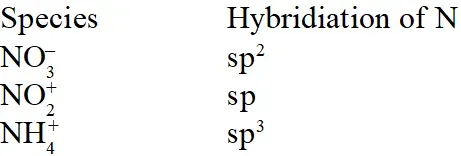
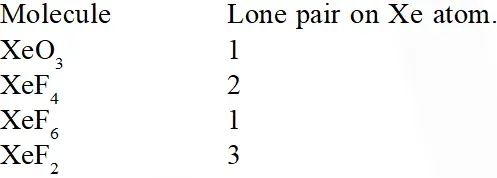
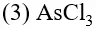
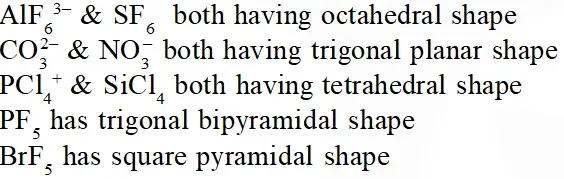
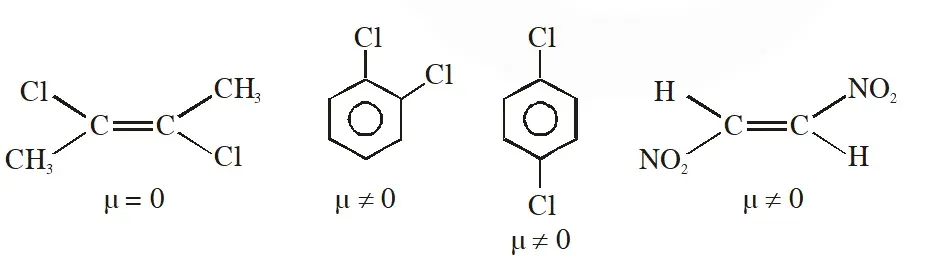
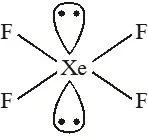
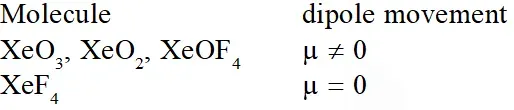
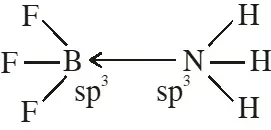
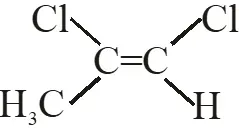
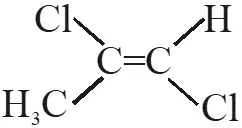
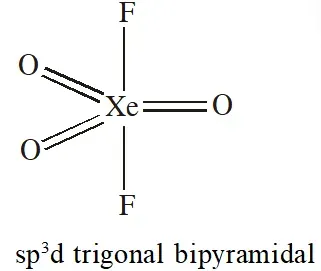
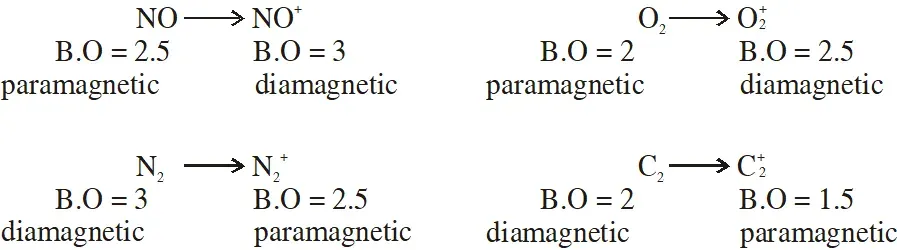
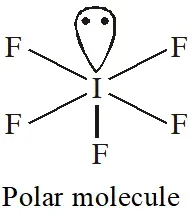
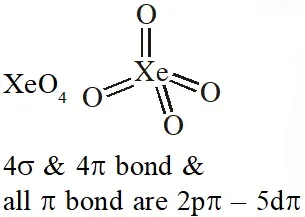
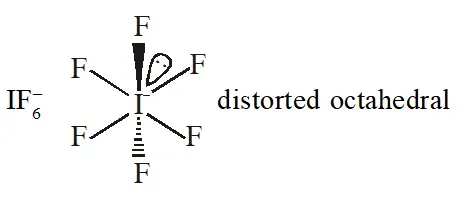
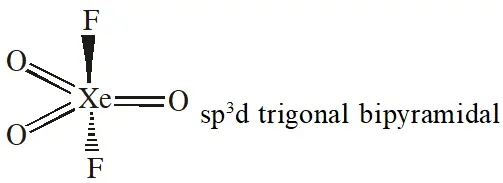
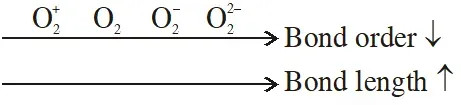
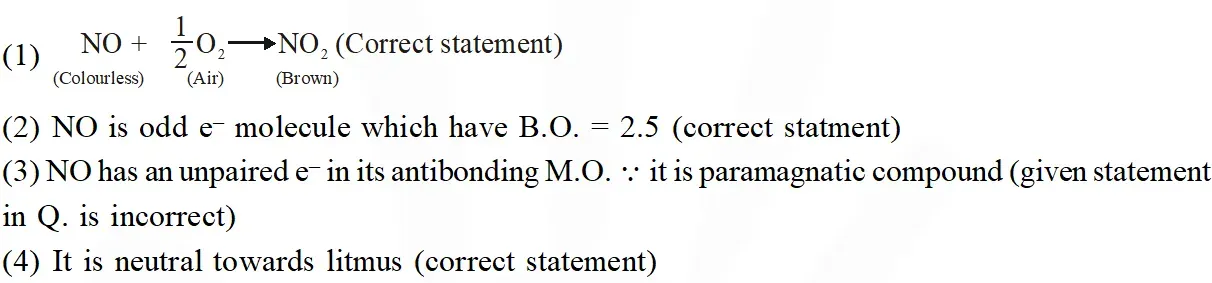
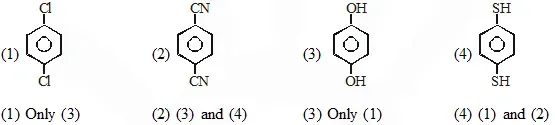
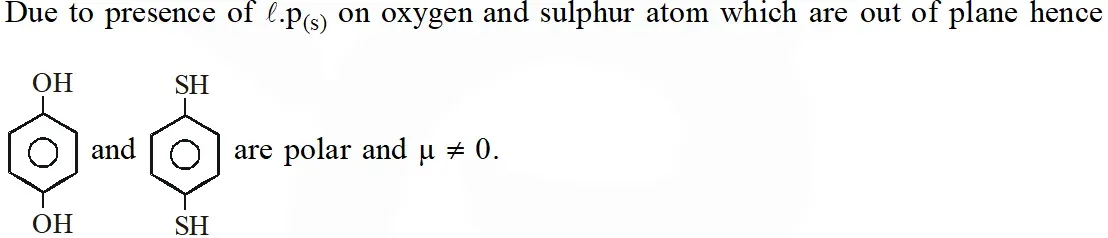
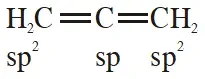
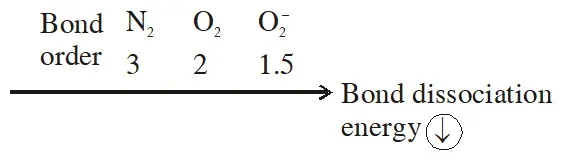
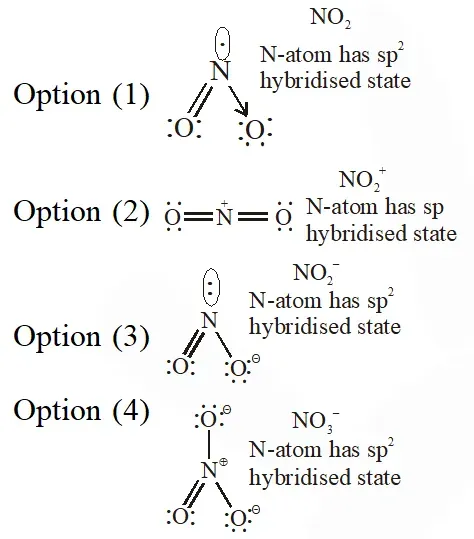
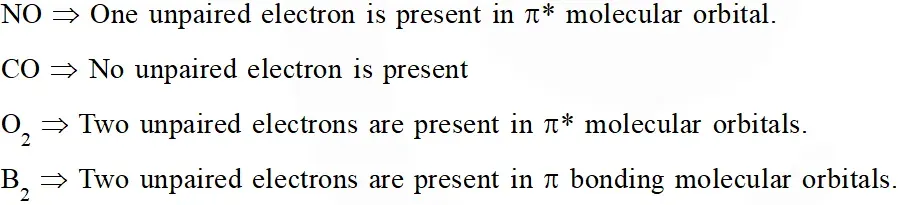
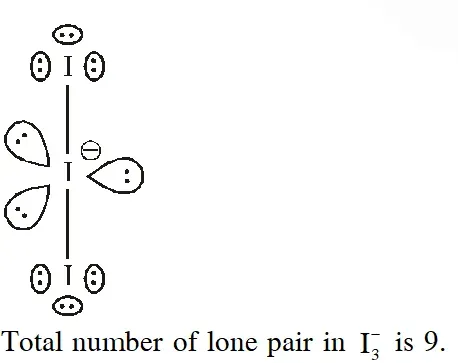
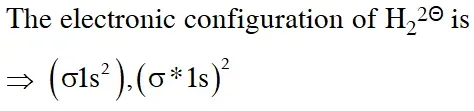
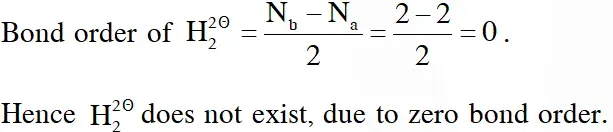
JEE Main Previous Year Papers Questions of Chemistry With Solutions are available at eSaral. Simulator Previous Years AIEEE/JEE Mains Questions [esquestion] The bond dissociation energy of B–F in $\mathrm{BF}_{3}$ is 646 kJ $\mathrm{mol}^{-1}$whereas that of C–F in $\mathrm{CF}_{4}$ is 515 kJ mol–1. The correct reason for higher B–F bond dissociation energy as compared to that of C–F is :- (1) Significant $\mathrm{p} \pi-\mathrm{p} \pi$ interaction between B and F in $\mathrm{BF}_{3}$whereas there is not possibility of such interaction between C and F in $\mathrm{CF}_{4}$. (2) Lower degree of p – p interaction between B and F in $\mathrm{BF}_{3}$ than that between C and F in $\mathrm{CF}_{4}$ (3)Smaller size of B-atom as compared to that of C-atom (4) Stronger bond between B and F in $\mathrm{BF}_{3}$ as compared to that between C and F in $\mathrm{CF}_{4}$ #tag# [AIEEE-2009] #sol# (1) Due to back bonding in BF3 molecule all B–F bond having partial double bond character. [/esquestion] [esquestion] Using MO theory predict which of the following species has the shortest bond length ? (1) $\mathrm{o}_{2}^{-}$ (2) $\mathrm{O}_{2}^{2-}$ (3) $\mathrm{O}_{2}^{2+}$ (4) $\mathrm{O}_{2}^{+}$ #tag# [AIEEE-2009] #sol# (3) [/esquestion] [esquestion] The hybridisation of orbitals of N atom in $\mathrm{NO}_{3}^{-}, \mathrm{NO}_{2}^{+}$ and $\mathrm{NH}_{4}^{+}$ are respectively:- #tag# [AIEEE-2011] #sol# (4) [/esquestion] [esquestion] The structure of $\mathrm{IF}_{7}$ is :- (1) octahedral (2) pentagonal bipyramid (3) square pyramid (4) trigonal bipyramid #tag# [AIEEE-2011] #sol# (2) [/esquestion] [esquestion] Among the following the maximum covalent character is shown by the compound :- (1) $\mathrm{AlCl}_{3}$ (2) $\mathrm{MgCl}_{2}$ (3) FeCl $_{2}$ (4) $\mathrm{SnCl}_{2}$ #tag# [AIEEE-2011] #sol# (1) $\mathrm{Al}^{+3}$ having highest polarizing power than other : having greater covalent character [/esquestion] [esquestion] Which of the following has maximum number of lone pairs associated with Xe (1) $\mathrm{XeO}_{3}$ (2) $\mathrm{XeF}_{4}$ (3) XeF $_{6}$ (4) $\mathrm{XeF}_{2}$ #tag# [AIEEE-2011] #sol# (4) [/esquestion] [esquestion] The number of types of bonds between two carbon atoms in calcium carbide is :- (1) One sigma, two pi (2) One sigma, one pi (3) Two sigma, one pi (4) Two sigma, two pi #tag# [AIEEE-2011] #sol# (1) $\mathrm{Ca}^{+2}(\mathrm{C} \equiv \mathrm{C})^{2-}$ [/esquestion] [esquestion] The molecule having smallest bond angle is :- (1) $\mathrm{PCl}_{3}$ (2) $\mathrm{NCl}_{3}$ (4) $\mathrm{SbCl}_{3}$ #tag# [AIEEE-2012] #sol# (4) Bond angle order $\mathrm{NCl}_{3}>\mathrm{PCl}_{3}>\mathrm{AsCl}_{3}>\mathrm{SbCl}_{3}$ [/esquestion] [esquestion] In which of the following pairs the two species are not isostructural ? (1) $\mathrm{AIF}_{6}^{3-}$ and $\mathrm{SF}_{6}$ (3) $\mathrm{CO}_{3}^{2-}$ and $\mathrm{NO}_{3}^{-}$ (3) $\mathrm{PCl}_{4}^{+}$ and $\mathrm{SiCl}_{4}$ (4) $\mathrm{PF}_{5}$ and $\mathrm{BrF}_{5}$ #tag# [AIEEE-2012] #sol# (4) [/esquestion] [esquestion] The number of S–S bonds in $\mathrm{SO}_{3}, \mathrm{S}_{2} \mathrm{O}_{3}^{2-}, \mathrm{S}_{2} \mathrm{O}_{6}^{2-}$ and $\mathrm{S}_{2} \mathrm{O}_{8}^{2-}$ respectively are :- (1) 1, 0, 1, 0 (2) 0, 1, 1, 0 (3) 1, 0, 0, 1 (4) 0, 1, 0, 1 #tag# [JEE-MAINS(Online) 2012] #sol# (2) [/esquestion] [esquestion] Dipole moment is shown by :- (1) trans-2, 3-dichloro- 2-butene (2) 1, 2-dichlorobenzene (3) 1, 4-dichlorobenzene (4) trans-1, 2-dinitroethene #tag# [JEE-MAINS(Online) 2012] #sol# (2) [/esquestion] [esquestion] Among the following species which two have trigonal bipyramidal shape ? #tag# [JEE-MAINS(Online) 2012] #sol# (Bonus) [/esquestion] [esquestion] Among the following, the species having the smallest bond is :- (1) NO (2) $\mathrm{NO}^{+}$ (3) $\mathrm{O}_{2}$ (4) $\mathrm{NO}^{-}$ #tag# [JEE-MAINS(Online) 2012] #sol# (2) [/esquestion] [esquestion] Based on lattice energy and other considerations, which one of the following alkali metal chloride is expected to have the highest melting point ? (1) RbCl (2) LiCl (3) KCl (4) NaCl #tag# [JEE-MAINS(Online) 2012] #sol# (4) Highest melting is of NaCl [/esquestion] [esquestion] Which of the following has the square planar structure :- (1) $\mathrm{NH}_{4}^{+}$ (2) $\mathrm{CCl}_{4}$ (3) $\mathrm{XeF}_{4}$ (4) $\mathrm{BF}_{4}^{-}$ #tag# [JEE-MAINS(Online) 2012] #sol# (3) Hybridisation $\mathrm{Sp}^{3} \mathrm{d}^{2}$ Shape – square planar [/esquestion] [esquestion] The compound of Xenon with zero dipole moment is :- (1) $\mathrm{XeO}_{3}$ (2) $\mathrm{XeO}_{2}$ (3) $\mathrm{XeF}_{4}$ (4) $\mathrm{XeOF}_{4}$ #tag# [JEE-MAINS(Online) 2012] #sol# (3) [/esquestion] [esquestion] Among the following the molecule with the lowest dipole moment is :- (1) $\mathrm{CHCl}_{3}$ (2) $\mathrm{CH}_{2} \mathrm{Cl}_{2}$ (3) $\mathrm{CCl}_{4}$ (4) $\mathrm{CH}_{3} \mathrm{Cl}$ #tag# [JEE-MAINS(Online) 2012] #sol# (3) $\mathrm{CCl}_{4}<\mathrm{CHCl}_{3}<\mathrm{CH}_{2} \mathrm{Cl}_{2}<\mathrm{CH}_{3} \mathrm{Cl}(\text { Dipolar moment })$ [/esquestion] [esquestion] The formation of molecular complex $\mathrm{BF}_{3}-\mathrm{NH}_{3}$ results in a change in hybridisation of boron (1) from $\operatorname{sp}^{3}$ to $\mathrm{sp}^{3} \mathrm{d}$ (2) from $\operatorname{sp}^{2}$ to $\mathrm{dsp}^{2}$ (3) from $\operatorname{sp}^{3}$ to $\mathrm{sp}^{2}$ (4) from $\operatorname{sp}^{2}$ to $\mathrm{sp}^{3}$ #tag# [JEE-MAINS(Online) 2012] #sol# (4) [/esquestion] [esquestion] Among the following chloro-compound having the lowest dipole moment is :- (1) $\mathrm{CH}_{2} \mathrm{Cl}_{2}$ (2) $\mathrm{CH}_{3} \mathrm{Cl}$ (3) (4) #tag# #sol# (1) $\mathrm{CH}_{2} \mathrm{Cl}_{2}$ has lowest dipole moment [/esquestion] [esquestion] Which one of the following molecules is expected to exhibit diamagnetic behaviour ? (1) $\mathrm{C}_{2}$ (2) $\mathrm{N}_{2}$ (3) $\mathrm{O}_{2}$ (4) $\mathrm{S}_{2}$ #tag# [AIEEE-2013] #sol# (2) $\mathrm{N}_{2}$ is diamagnetic [/esquestion] [esquestion] Which of the following is the wrong statement? (1) ONCl and $\mathrm{ONO}^{-}$ are not isoelectronic (2) $\mathrm{O}_{3}$ molecule is bent (3) Ozone is violet-black in solid state (4) Ozone is diamagnetic gas #tag# [JEE-maIN 2013] #sol# (1) Number of electron in ONCl an $\mathrm{ONO}^{-}$ is 32 & 24 respectively. [/esquestion] [esquestion] In which of the following pairs of molecules/ions, both the species are not likely to exist ? (1) $\mathrm{H}_{2}^{+}, \mathrm{He}_{2}^{2-}$ (2) $\mathrm{H}_{2}^{-}, \mathrm{He}_{2}^{2-}$ (3) $\mathrm{H}_{2}^{2+}, \mathrm{He}_{2}$ (4) $\mathrm{H}_{2}^{-}, \mathrm{H} \mathrm{e}_{2}^{2+}$ #tag# [JEE-main 2013] #sol# (3) Bond order of $\mathrm{H}_{2}^{2+} \& \mathrm{He}_{2}$ is zero i.e. these molecule do not exist. [/esquestion] [esquestion] Stability of the species $\mathrm{Li}_{2}, \quad \mathrm{Li}_{2}^{-}$ and $\mathrm{Li}_{2}^{+}$ increases in the order of :- (1) $\mathrm{Li}_{2}<\mathrm{Li}_{2}^{+}<\mathrm{Li}_{2}^{-}$ (2) $\mathrm{Li}_{2}^{-}<\mathrm{Li}_{2}^{+}<\mathrm{Li}_{2}$ (3) $\mathrm{Li}_{2}<\mathrm{Li}_{2}<\mathrm{Li}_{2}^{+}$ (4) $\mathrm{Li}_{2}^{-}<\mathrm{Li}_{2}<\mathrm{Li}_{2}^{+}$ #tag# [JEE-main 2013] #sol# (2) [/esquestion] [esquestion] Trigonal bipyramidal geometry is shown by: (1) $\mathrm{XeO}_{3} \mathrm{F}_{2}$ (2) $\mathrm{XeOF}_{2}$ (3) $\left[\mathrm{XeF}_{8}\right]^{2-}$ #tag# [JEE-MAINS(Online) 2013] #sol# (1) [/esquestion] [esquestion] In which of the following ionization processes the bond energy has increased and also the magnetic behaviour has changed from paramagnetic to diamagnetic ? (1) $\mathrm{NO} \rightarrow \mathrm{NO}^{+}$ (2) $\mathrm{O}_{2} \rightarrow \mathrm{O}_{2}^{+}$ (3) $\mathrm{N}_{2} \rightarrow \mathrm{N}_{2}^{+}$ ( 4) $\mathrm{C}_{2} \rightarrow \mathrm{C}_{2}^{+}$ #tag# [JEE-MAINS(Online) 2013] #sol# (1) [/esquestion] [esquestion] Which one of the following molecules is polar? (1) $\mathrm{CF}_{4}$ (2) $\mathrm{SbF}_{5}$ (3) $\mathrm{IF}_{5}$ (4) $\mathrm{XeF}_{4}$ #tag# [JEE-MAINS(Online) 2013] #sol# (3) [/esquestion] [esquestion] Oxidation state of sulphur in anions $\mathrm{SO}_{3,}^{2-} \mathrm{S}_{2} \mathrm{O}_{4}^{2-}$ and $\mathrm{S}_{2} \mathrm{O}_{6}^{2-}$ increases in the orders : (1) $\mathrm{S}_{2} \mathrm{O}_{6}^{2-}<\mathrm{S}_{2} \mathrm{O}_{4}^{2-}<\mathrm{SO}_{3}^{2-}$ (2) $\mathrm{SO}_{3}^{2-}<\mathrm{S}_{2} \mathrm{O}_{4}^{2-}<\mathrm{S}_{2} \mathrm{O}_{6}^{2-}$ (3) $\mathrm{S}_{2} \mathrm{O}_{4}^{2-}<\mathrm{SO}_{3}^{2-}<\mathrm{S}_{2} \mathrm{O}_{6}^{2-}$ (4) $\mathrm{S}_{2} \mathrm{O}_{4}^{2-}<\mathrm{S}_{2} \mathrm{O}_{6}^{2-}<\mathrm{SO}_{3}^{2-}$ #tag# [JEE-MAINS(Online) 2013] #sol# (3) [/esquestion] [esquestion] Bond order normally gives idea of stability of a molecular species. All the molecules viz. $\mathrm{H}_{2}, \mathrm{Li}_{2}$ and $\mathrm{B}_{2}$ have the same bond order yet they are not equally stable. Their stability order is: (1) $\mathrm{Li}_{2}>\mathrm{H}_{2}>\mathrm{B}_{2}$ (2) $\mathrm{H}_{2}>\mathrm{B}_{2}>\mathrm{Li}_{2}$ (3) $\mathrm{B}_{2}>\mathrm{H}_{2}>\mathrm{Li}_{2}$ (4) $\mathrm{Li}_{2}>\mathrm{B}_{2}>\mathrm{H}_{2}$ #tag# [JEE-MAINS(Online) 2013] #sol# (2) [/esquestion] [esquestion] The solubility order for alkali metal fluoride in water is : (1) $\mathrm{LiF}<\mathrm{NaF}<\mathrm{KF}<\mathrm{RbF}$ (2) $\mathrm{LiF}>\mathrm{NaF}>\mathrm{KF}>\mathrm{RbF}$ (3) $\mathrm{RbF}<\mathrm{KF}<\mathrm{NaF}<\mathrm{LiF}$ (4) $\mathrm{LiF}<\mathrm{RbF}<\mathrm{KF}<\mathrm{NaF}$ #tag# [JEE-MAINS(Online) 2013] #sol# (1) Solubility order LiF < NaF < KF < RbF [/esquestion] [esquestion] $\mathrm{XeO}_{4}$ molecule is tetrahedral having : (1) Two p $\pi$ -d $\pi$ bonds (2) Four p $\pi$ - d $\pi$ bonds (3) One $\mathrm{p} \pi-\mathrm{d} \pi$ bond (4) Three p $\pi$ -d $\pi$ bonds #tag# [JEE-MAINS(Online) 2013] #sol# (2) [/esquestion] [esquestion] Bond distance in HF is 9.17 × $10^{-11}$ m. Dipole moment of HF is 6.104 × 10⁻³⁰ Cm. The percent ionic character in HF will be : (electron charge = 1.60 × $10^{-19}$ C) (1) 61.0% (2) 38.0% (3) 35.5% (4) 41.5% #tag# [JEE-MAINS(Online) 2013] #sol# (4) [/esquestion] [esquestion] The shape of $\mathrm{IF}_{6}^{-}$ is : (1) Trigonally distorted octahedron (2) Pyramidal (3) Octahedral (4) Square antiprism #tag# [JEE-MAINS(Online) 2013] #sol# (1) [/esquestion] [esquestion] Which has trigonal bipyramidal shape ? (1) $\mathrm{XeOF}_{4}$ (2) $\mathrm{XeO}_{3}$ (3) $\mathrm{XeO}_{3} \mathrm{F}_{2}$ (4) $\mathrm{XeOF}_{2}$ #tag# [JEE-MAINS(Online) 2013] #sol# (3) [/esquestion] [esquestion] The catenation tendency of C, Si and Ge is in the order Ge < Si < C. The bond energies (in kJ $\mathrm{mol}^{-1}$) of C — C, Si —Si and Ge—Ge bonds are respectively : (1) 348, 260, 297 (2) 348, 297, 260 (3) 297, 348, 260 (4) 260, 297, 348 #tag# [JEE-MAINS(Online) 2013] #sol# (2) Catenation/Bond energy order C – C > Si – Si > Ge – Ge [/esquestion] [esquestion] In which of the following sets, all the given species are isostructural ? (1) $\mathrm{BF}_{3}, \mathrm{NF}_{3}, \mathrm{PF}_{3}, \mathrm{AlF}_{3}$ (2) $\mathrm{PCl}_{3}, \mathrm{AlCl}_{3}, \mathrm{BCl}_{3}, \mathrm{SbCl}_{3}$ (3) $\mathrm{BF}_{4}^{-}, \mathrm{CCl}_{4}, \mathrm{NH}_{4}^{+}, \mathrm{PCl}_{4}^{+}$ (4) $\mathrm{CO}_{2}, \mathrm{NO}_{2}, \mathrm{ClO}_{2}, \mathrm{SiO}_{2}$ #tag# [JEE-MAINS(Online) 2013] #sol# (3) $\mathrm{BF}_{4}^{-}, \mathrm{CC}_{4}, \mathrm{NH}_{4}^{+}, \mathrm{PCl}_{4}^{+}$ are terahedral [/esquestion] [esquestion] The internuclear distances in O —O bonds for O, $\mathrm{O}_{2}, \mathrm{O}^{-}$2 and O respectively are : (1) 1.49 Å, 1.21 Å, 1.12 Å, 1.30 Å (2) 1.30 Å, 1.49 Å, 1.12 Å, 1.21 (3) 1.12 Å, 1.21 Å, 1.30 Å, 1.49 Å (4) 1.21 Å, 1.12 Å, 1.49 Å, 1.30 Å #tag# [JEE-MAINS(Online) 2013] #sol# (3) [/esquestion] [esquestion] Which one of the following properties is not shown by NO ? (1) It combines with oxygen to form nitrogen dioxide (2) It's bond order is 2.5 (3) It is diamagnetic in gaseous state (4) It is a neutral oxide #tag# [JEE-main 2014] #sol# (3) [/esquestion] [esquestion] For which of the following molecule significant $\mu \neq 0$ #tag# [JEE-main 2014] #sol# (2) [/esquestion] [esquestion] The number and type of bonds in $\mathrm{C}_{2}^{2-} \mathrm{ion}$ in $\mathrm{CaC}_{2}$ are: (1) Two $\sigma$ bonds and one $\pi-$ bond (2) Two $\sigma$ bonds and two $\pi-$ bonds (3) One $\sigma$ bond and two $\pi-$ bonds (4) One $\sigma$ bond and one $\pi-$ bond #tag# [JEE-MAINS(Online) 2014] #sol# (3) [/esquestion] [esquestion] For the compounds $\mathrm{CH}_{3} \mathrm{Cl}, \mathrm{CH}_{3} \mathrm{Br}, \mathrm{CH}_{3} \mathrm{I}$ and $\mathrm{CH}_{3} \mathrm{F}$ (1) $\mathrm{CH}_{3} \mathrm{F}<\mathrm{CH}_{3} \mathrm{Br}<\mathrm{CH}_{3} \mathrm{Cl}<\mathrm{CH}_{3} \mathrm{I}$ (2) $\mathrm{CH}_{3} \mathrm{F}<\mathrm{CH}_{3} \mathrm{Cl}<\mathrm{CH}_{3} \mathrm{Br}<\mathrm{CH}_{3} \mathrm{I}$ (3) $\mathrm{CH}_{3} \mathrm{Cl}<\mathrm{CH}_{3} \mathrm{Br}<\mathrm{CH}_{3} \mathrm{F}<\mathrm{CH}_{3} \mathrm{I}$, the correct order of increasing C-halogen bond length is : (4) $\mathrm{CH}_{3} \mathrm{F}<\mathrm{CH}_{3} \mathrm{I}<\mathrm{CH}_{3} \mathrm{Br}<\mathrm{CH}_{3} \mathrm{Cl}$ #tag# [JEE-MAINS(Online) 2014] #sol# (2) [/esquestion] [esquestion] Which of the following has unpaired electron(s) ? (1) $\mathrm{O}_{2}^{-}$ (2) $\mathrm{N}_{2}^{2+}$ (3) $\mathrm{O}_{2}^{2-}$ (4) $\mathrm{N}_{2}$ #tag# [JEE-MAINS(Online) 2014] #sol# (1) $\mathrm{O}_{2}^{-}$ ha one unpaired electron [/esquestion] [esquestion] In allene $\left(\mathrm{C}_{3} \mathrm{H}_{4}\right)$, the type(s) of hybridization of the carbon atoms is (are): (1) only sp $^{2}$ (2) $\mathrm{sp}^{2}$ and $\mathrm{sp}$ (3) sp and sp $^{3}$ (4) $\mathrm{sp}^{2}$ and $\mathrm{sp}^{3}$ #tag# [JEE-MAINS(Online) 2014] #sol# (2) [/esquestion] [esquestion] Shapes of certain interhalogen compounds are stated below. Which one of them is not correctly stated? (1) IF $_{7}:$ Pentagonal bipyramid (2) BrF $_{5}:$ Trigonal bipyramid (4) $\mathrm{BrF}_{3}:$ Planar T-shaped #tag# [JEE-MAINS(Online) 2014] #sol# (2) $\mathrm{BrF}_{5}$ have square pyramidal shape. [/esquestion] [esquestion] The correct order of bond dissociation energy among $\mathrm{N}_{2}, \mathrm{O}_{2}, \mathrm{o}_{2}^{-}$ is shown in which of the following arrangements? (1) $\mathrm{N}_{2}>\mathrm{O}_{2}>\mathrm{O}_{2}^{-}$ (2) $\mathrm{O}_{2}>\mathrm{O}_{2}^{-}>\mathrm{N}_{2}$ (3) $\mathrm{N}_{2}>\mathrm{O}_{2}^{-}>\mathrm{O}_{2}$ (4) $\mathrm{O}_{2}^{-}>\mathrm{O}_{2}>\mathrm{N}_{2}$ #tag# [JEE-MAINS(Online) 2014] #sol# (1) [/esquestion] [esquestion] Which of the following molecules has two sigma$(\sigma)$ and two $\operatorname{pi}(\pi)$ bonds :- (1) HCN (2) $\mathrm{C}_{2} \mathrm{H}_{2} \mathrm{Cl}_{2}$ (3) $\mathrm{N}_{2} \mathrm{F}_{2}$ (4) $\mathrm{C}_{2} \mathrm{H}_{4}$ #tag# [JEE-MAINS(Online) 2014] #sol# (1) [/esquestion] [esquestion] Which one of the following molecules is paramagnetic? (1) NO ( 2) $\mathrm{O}_{3}$ (3) $\mathrm{N}_{2}$ (4) CO #tag# [JEE-MAINS(Online) 2014] #sol# (1) NO has unpaired e $^{-} \therefore$ paramagnetic is nature [/esquestion] [esquestion] Amongst LiCl, RbCl, $\mathrm{BeCl}_{2}$ and $\mathrm{MgCl}_{2}$ the compounds with the greatest and the least ionic character, respectively are : (1) $\mathrm{RbCl}$ and $\mathrm{MgCl}_{2}$ (2) LiCl and RbCl (3) $\mathrm{MgCl}_{2}$ and $\mathrm{BeCl}_{2}$ (4) $\mathrm{RbCl}$ and $\mathrm{BeCl}_{2}$ #tag# [JEE-MAINS(Online) 2014] #sol# (4) RbCl has highest ionic & and $\mathrm{BeCl}_{2}$ is most covalent [/esquestion] [esquestion] The species in which the N atom is in a state of sp hybridization is :- (1) $\mathrm{NO}_{2}$ (2) $\mathrm{NO}_{2}^{+}$ (3) $\mathrm{NO}_{2}^{-}$ (4) $\mathrm{NO}_{3}^{-}$ #tag# [JEE-MAINS 2016] #sol# (2) [/esquestion] [esquestion] Which of the following species is not paramagnetic :- (1)NO (2) CO (3) $\mathrm{O}_{2}$ (4) $\mathrm{B}_{2}$ #tag# [JEE-MAINS 2017] #sol# (2) [/esquestion] [esquestion] Total number of lone pair of electrons in $\mathrm{I}_{3}^{-} \mathrm{ion}$ is (1) 6 (2) 9 (3) 12 (4) 3 #tag# [JEE-MAINS 2018] #sol# (2) [/esquestion] [esquestion] According to molecular orbital theory, which of the following will not be a viable molecule ? (1) $\mathrm{He}_{2}^{+}$ (2) $\mathrm{H}_{2}^{-}$ (3) $\mathrm{H}_{2}^{2-}$ (4) $\mathrm{He}_{2}^{2+}$ #tag# [JEE-MAINS 2018] #sol# (3) [/esquestion] [esquestion] Which of the following compounds contain(s) no covalent bond(s) ? $\mathrm{KCl}, \mathrm{PH}_{3}, \mathrm{O}_{2}, \mathrm{B}_{2} \mathrm{H}_{6}, \mathrm{H}_{2} \mathrm{SO}_{4}$ $(1) \mathrm{KCl}, \mathrm{H}_{2} \mathrm{SO}_{4}$ (2) KC1 (3) $\mathrm{KCl}, \mathrm{B}_{2} \mathrm{H}_{6}$ (4) $\mathrm{KCl}, \mathrm{B}_{2} \mathrm{H}_{6}, \mathrm{PH}_{3}$ #tag# [JEE-MAINS 2018] #sol# (2) [/esquestion]















Chemical Bonding JEE Main Previous Year Questions can be supplemented with other Chemistry topics through the JEE Mains PYQs chapter wise collection.
Solved a few Chemical Bonding Jee Main Previous Year Questions problems here? The complete JEE Mains paper has full, year-wise papers so you can see how Chemical Bonding Jee Main Previous Year Questions questions actually show up in the real exam.
Frequently Asked Questions
What is back bonding and which molecules show it?
Back bonding occurs when an atom with an empty orbital accepts electron density from a neighbouring atom's filled orbital through π overlap. BF₃ is the classic JEE example: the empty 2p orbital on B accepts lone pair density from F, creating partial double bond character in all three B–F bonds. This raises bond dissociation energy above what a pure single bond would predict.
Is NCERT enough for Chemical Bonding in JEE Main?
NCERT Class 11 Chapter 4 (Chemical Bonding and Molecular Structure) covers approximately 70% of what JEE Main tests. The remaining 30% — especially advanced MO theory questions, back bonding, and Xenon compound geometries — requires additional practice through previous year questions and eSaral's topic-wise question banks built by IIT Bombay faculty
How do you determine if a molecule is polar or non-polar?
A molecule is non-polar when all bond dipoles cancel due to symmetry (e.g., CCl₄, XeF₄, SF₆). It is polar when bond dipoles do not cancel — either due to asymmetric substitution or the presence of lone pairs that distort geometry (e.g., IF₅, CHCl₃, H₂O). Always draw the 3D shape before judging polarity.
What is the difference between bond order and bond length?
Bond order and bond length are inversely related — as bond order increases, bond length decreases and bond energy increases. For example, N₂ (bond order 3) has a shorter, stronger bond than N₂⁻ (bond order 2.5). Use this relationship directly to answer "shortest bond" or "most stable species" questions.
Which topics in Chemical Bonding are most important for JEE Main?
The highest-priority topics are: VSEPR theory and molecular shapes, Molecular Orbital (MO) theory with bond order calculations, hybridisation, dipole moment and polarity, and Fajans' Rules for covalent character. Together, these five areas cover approximately 80% of all Chemical Bonding questions in JEE Main history.
How many questions come from Chemical Bonding in JEE Main?
Chemical Bonding typically contributes 1–2 questions per JEE Main session. Based on NTA's official papers from 2013 to 2024, this chapter has appeared in every paper without exception. With two sessions per year (January and April), you can expect 2–4 Chemical Bonding questions annually across both attempts
Team eSaral
eSaral Academic and Editorial Team
Team eSaral is the collective author profile for educational content created by eSaral’s teachers and academic contributors. The team draws on expertise from IIT graduates, doctors, experienced educators and subject specialists to develop resources for JEE, NEET and school students. Our articles aim to explain concepts clearly and help students study with confidence.
Related Posts

BITSAT 2027: Registration Date, Exam Date, Syllabus, Eligibility, Pattern & Fees
BITSAT 2027 exam dates, registration timeline, eligibility criteria, exam pattern, marking scheme, syllabus and fees in one page.

BITSAT Previous Year Question Paper PDF (2017-2026)
Download BITSAT previous year question papers PDF from 2017 to 2026,session-wise. Memory-based papers,exam pattern, paper analysis and how to practise

CBSE Class 10 Date Sheet 2027: Expected Exam Dates, Release Date, Admit Card & Result Timeline
CBSE Class 10 date sheet 2027 is awaited. See the expected exam dates, release window, how to download the PDF, admit card and result timelines.

NCERT Physics Class 10 Book PDF in Hindi 2026-27 – भौतिक विज्ञान के 4 अध्याय (Free Download)
NCERT Physics Class 10 book PDF in Hindi 2026-27: download all 4 chapters (अध्याय 9–12) free, with topics and important formulas.

NCERT Biology Class 9 Book Anveshan PDF in Hindi - जीव विज्ञान कक्षा 9 पुस्तक अन्वेषण PDF
Download NCERT Biology Class 9 book PDF in Hindi chapterwise for 2026-27: Cell, Tissues, Reproduction and Diversity. Free PDFs.

Essay On Artificial Intelligence in English (100,150, 200, 250, 300, 500 Words)
This is in contrast to the natural intelligence of humans. With Artificial Intelligence, machines can perform

Essay on 78th India Independence Day in English for Student (100, 150, 200, 250, 300, 500 Words)
Read the best essays on India's Independence Day in English. Short & long essays (100, 150, 200, 250, 300, 500 words) perfect for school exams
NCERT Class 11 English Snapshots book - Free PDF download- Esaral
Download NCERT Class 11 English Snapshots book PDF for free. Get all 8 chapters, chapter-wise. Start your prep today!
NCERT Class 10 biology book pdf - Free PDF Download - eSaral
NCERT Class 10 Biology book PDF 2026-27: all 5 chapters (Life Processes to Our Environment) in English & Hindi, with CBSE syllabus, marks & practical

Essay on Global Warming in English (100,150, 200, 250, 300, 500 Words)
Global warming means the Earth is getting hotter. This happens because of things like pollution from cars and factories.