
Circle Class 11 Notes | Formulae | Equations of Circle - IIT JEE

eSaral Academic and Editorial Team
Summary
Circle Class 11 Notes cover the definition and the standard equation of a circle, the general equation with its centre and radius, the diameter form, the position of a point and of a line with respect to a circle, tangents and normals, the chord of contact, the radical axis, families of circles and common tangents.
In NCERT Class 11 Mathematics, the circle is the first conic in the chapter Conic Sections, which is Chapter 10 of the current book (Chapter 11 in older books). The textbook gives the standard equation of a circle. JEE problems also use the general equation, tangents, the chord of contact and the radical axis, so these Circle Class 11 Notes cover those topics too. They assume that you know the straight line, so revise it with eSaral’s Straight Lines Class 11 notes first.
Circle Class 11 Notes: Chapter Overview and Syllabus
Topic | CBSE Class 11 | JEE Main |
|---|---|---|
Standard equation of a circle | Yes | Yes |
General equation, centre and radius | Used in problems | Yes |
Diameter form | Used in problems | Yes |
Line and circle, condition for tangency, equation of a tangent | Used in problems | Yes |
Chord of contact, pair of tangents, radical axis, family of circles, common tangents | Not in the board syllabus | Common in problems, and more in JEE Advanced |
Check the latest syllabi of CBSE and NTA for the exact lists.
Tip from the eSaral Maths team: For almost every circle problem, the first step is to find the centre and the radius. Then draw a rough figure, and use the distance from the centre to the line or the point, because it solves most tangent and chord questions.
India's Best Exam Preparation for Class 11th - Download Now
Circle Class 11 Notes
India's Best Exam Preparation for Class 11th - Download Now
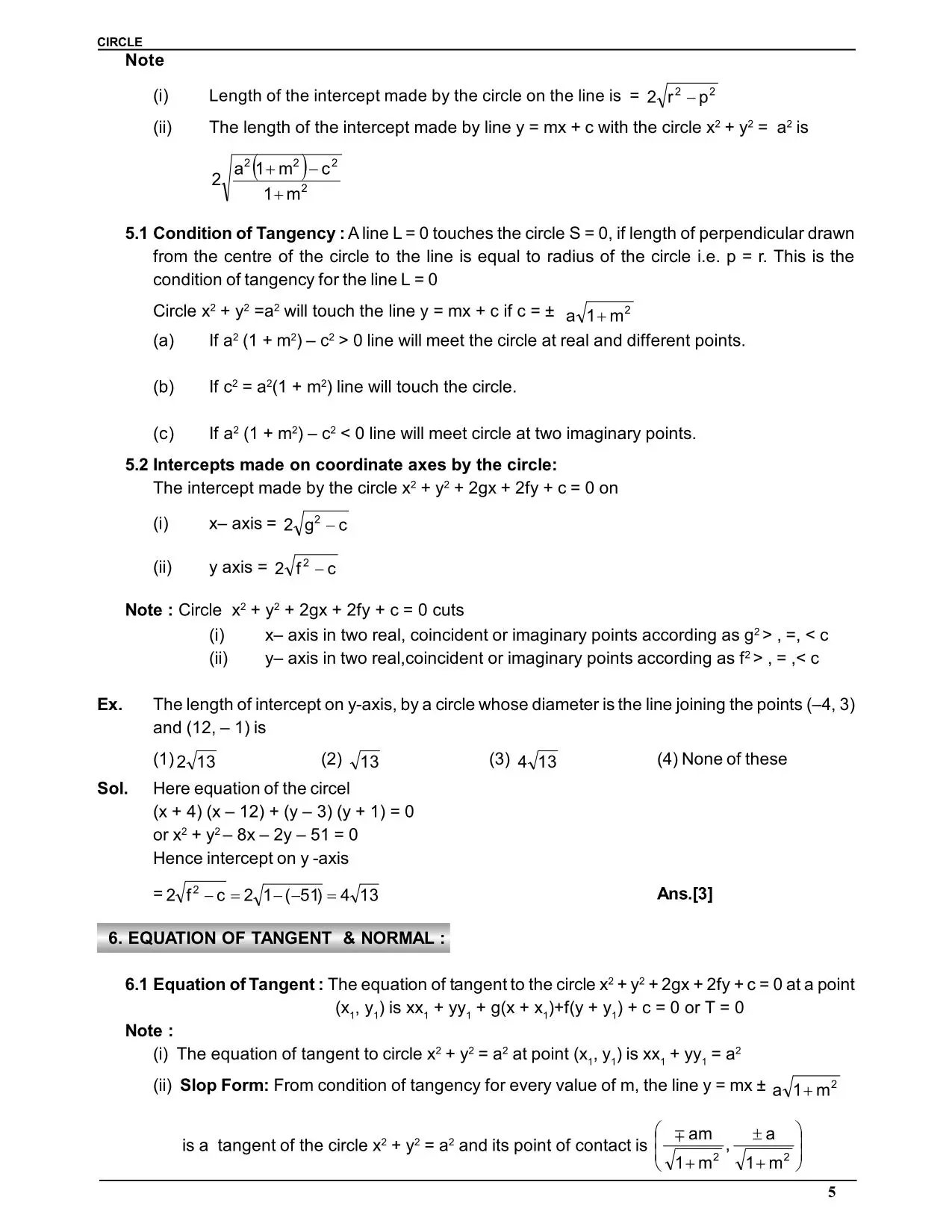
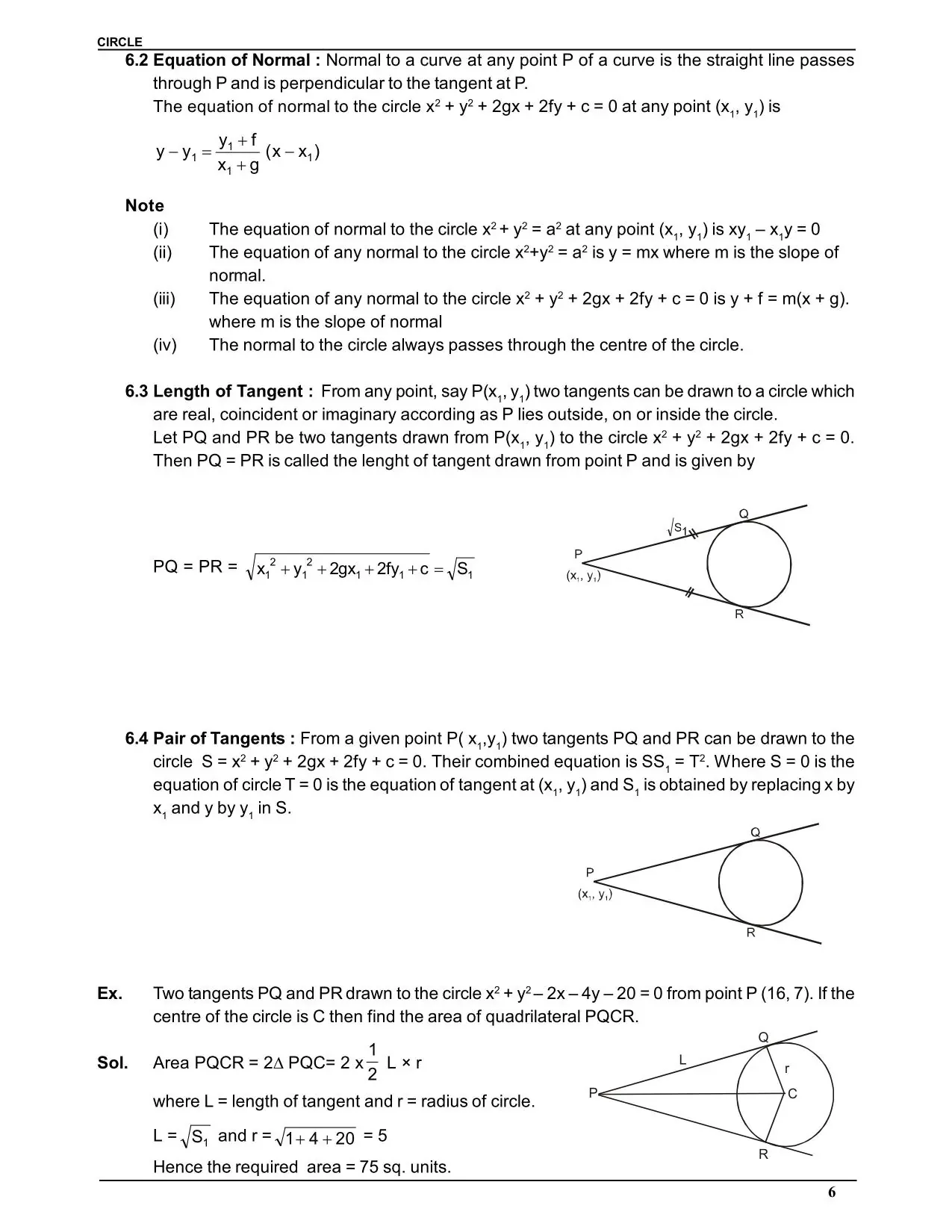
India's Best Exam Preparation for Class 11th - Download Now
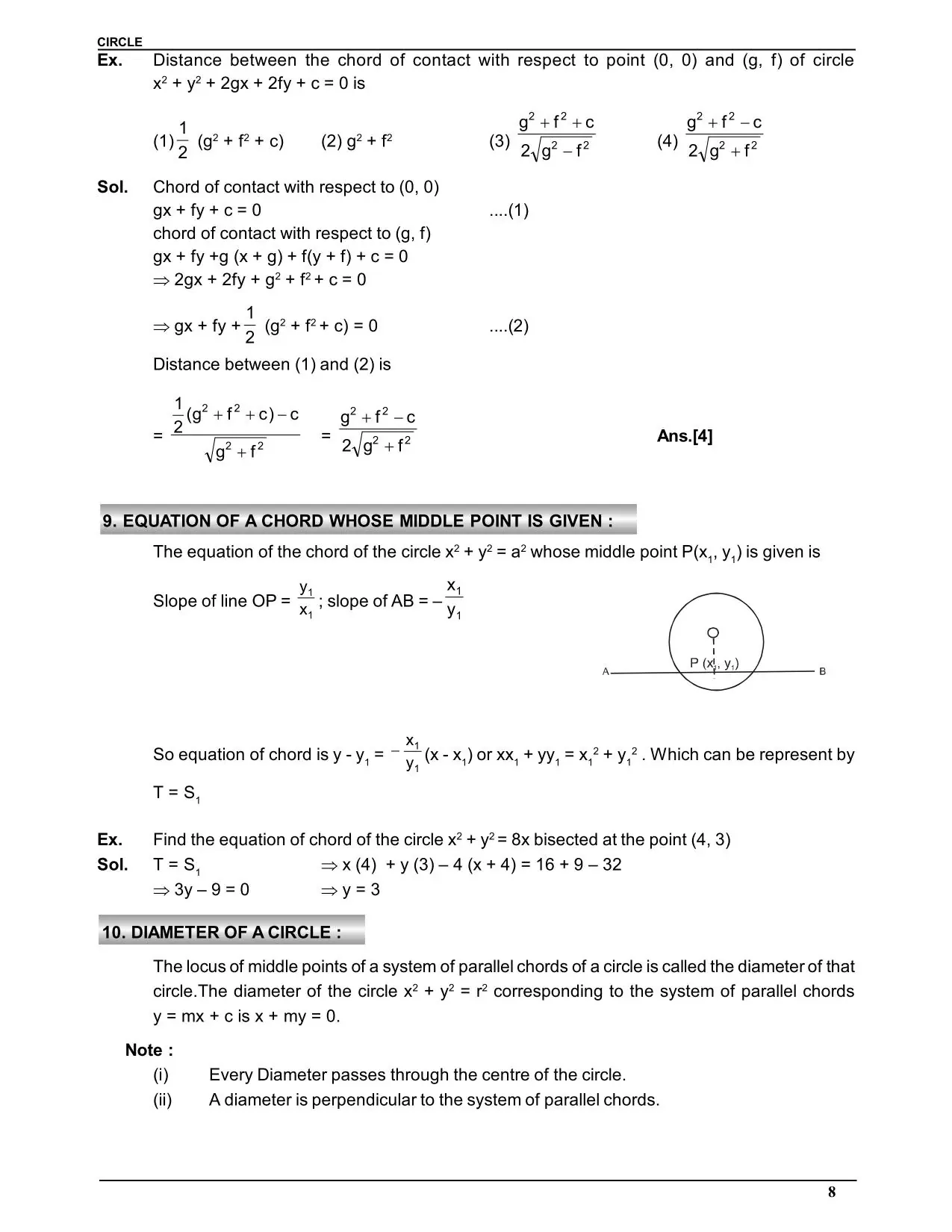
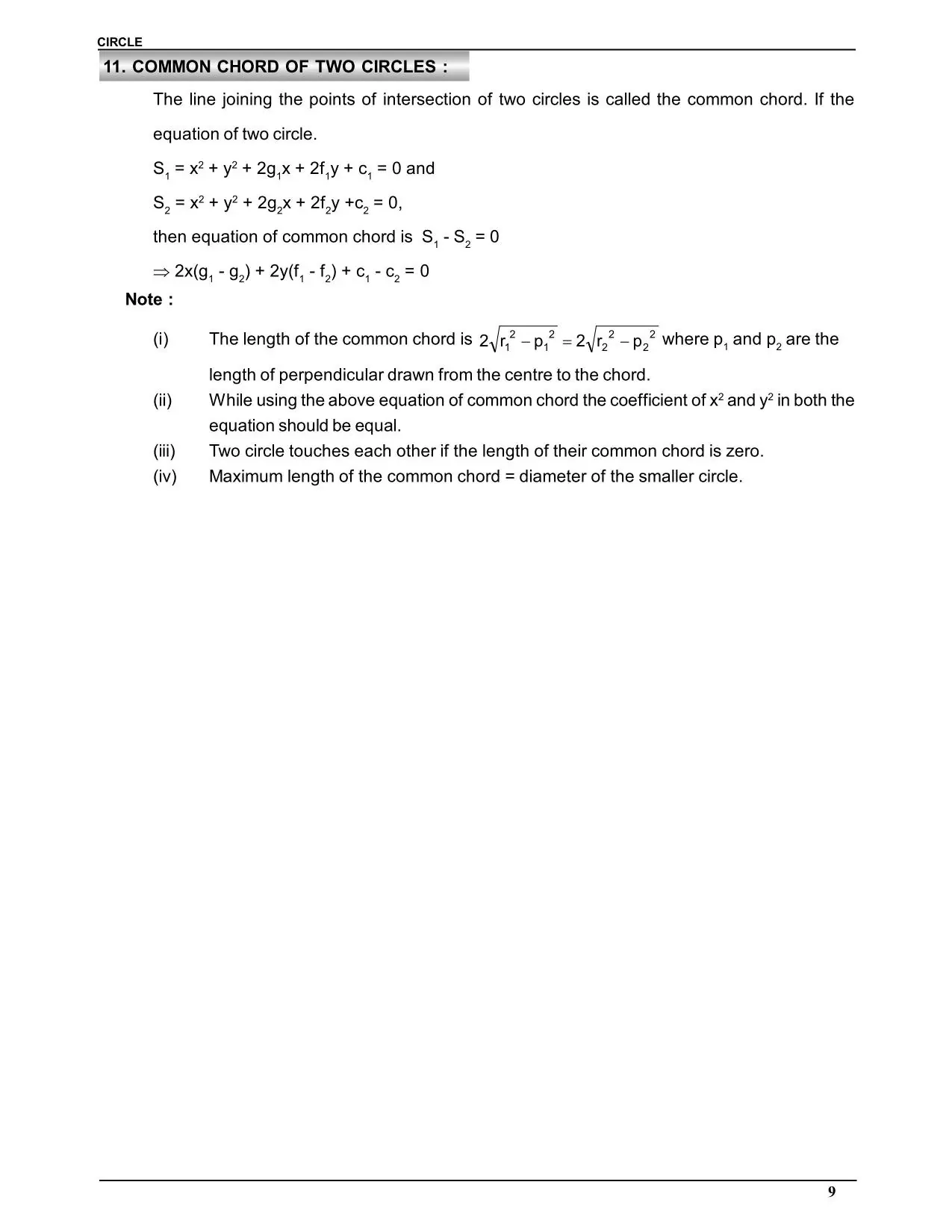
India's Best Exam Preparation for Class 11th - Download Now
eSaral helps the students by providing them an easy way to understand concepts and attractive study material for IIT JEE, which includes the video lectures & Study Material designed by expert IITian Faculties of KOTA. eSaral provides a series of detailed chapter-wise notes for all the Subjects of class 11th and 12th.
India's Best Exam Preparation for Class 11th - Download Now
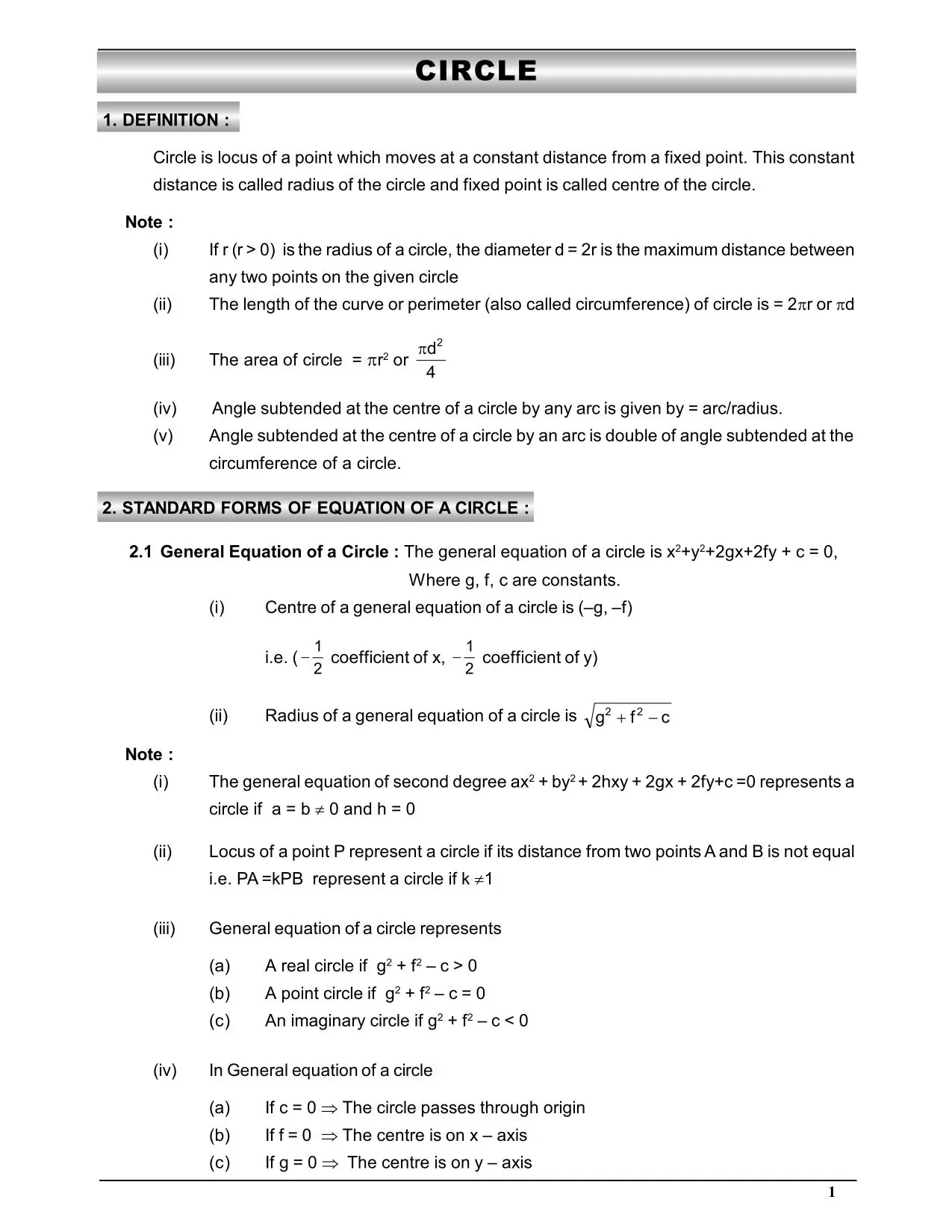
Standard Equation of a Circle in Circle Class 11 Notes
A circle is the locus of all points in a plane that are at a fixed distance $r$ (the radius) from a fixed point $(h, k)$ (the centre):
$$(x - h)^{2} + (y - k)^{2} = r^{2}$$
If the centre is the origin, the equation is $x^{2} + y^{2} = r^{2}$. The parametric form of a point on the circle is:
$$x = h + r\cos\theta, \qquad y = k + r\sin\theta$$
General Equation of a Circle in Circle Class 11 Notes
$$x^{2} + y^{2} + 2gx + 2fy + c = 0$$
Quantity | Value |
|---|---|
Centre | $(-g,\ -f)$ |
Radius | $r = \sqrt{g^{2} + f^{2} - c}$ |
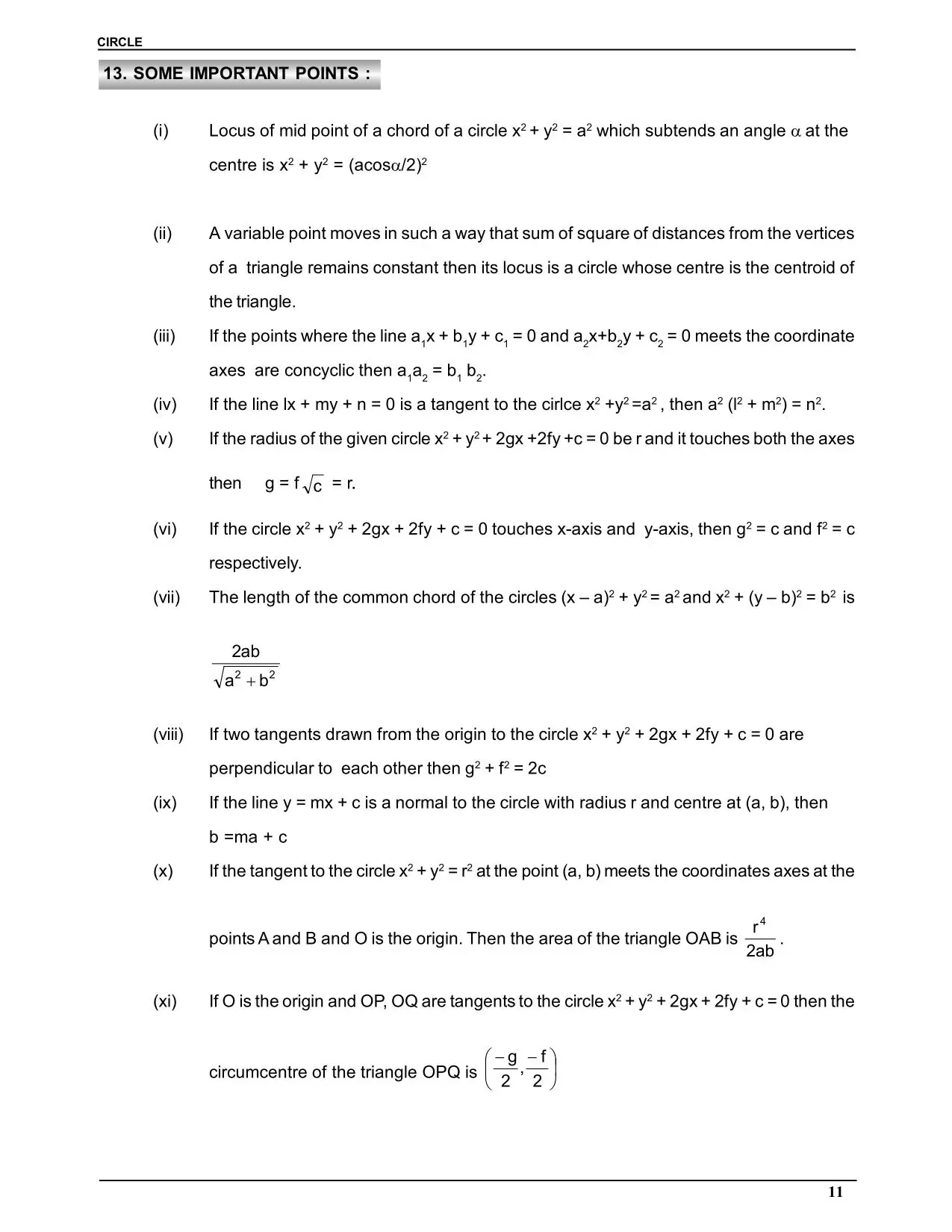
If $g^{2} + f^{2} - c > 0$, the circle is real. If it is $0$, the circle is a point. If it is negative, the circle is imaginary. A general second-degree equation $ax^{2} + 2hxy + by^{2} + 2gx + 2fy + c = 0$ represents a circle only if $a = b \neq 0$ and $h = 0$.
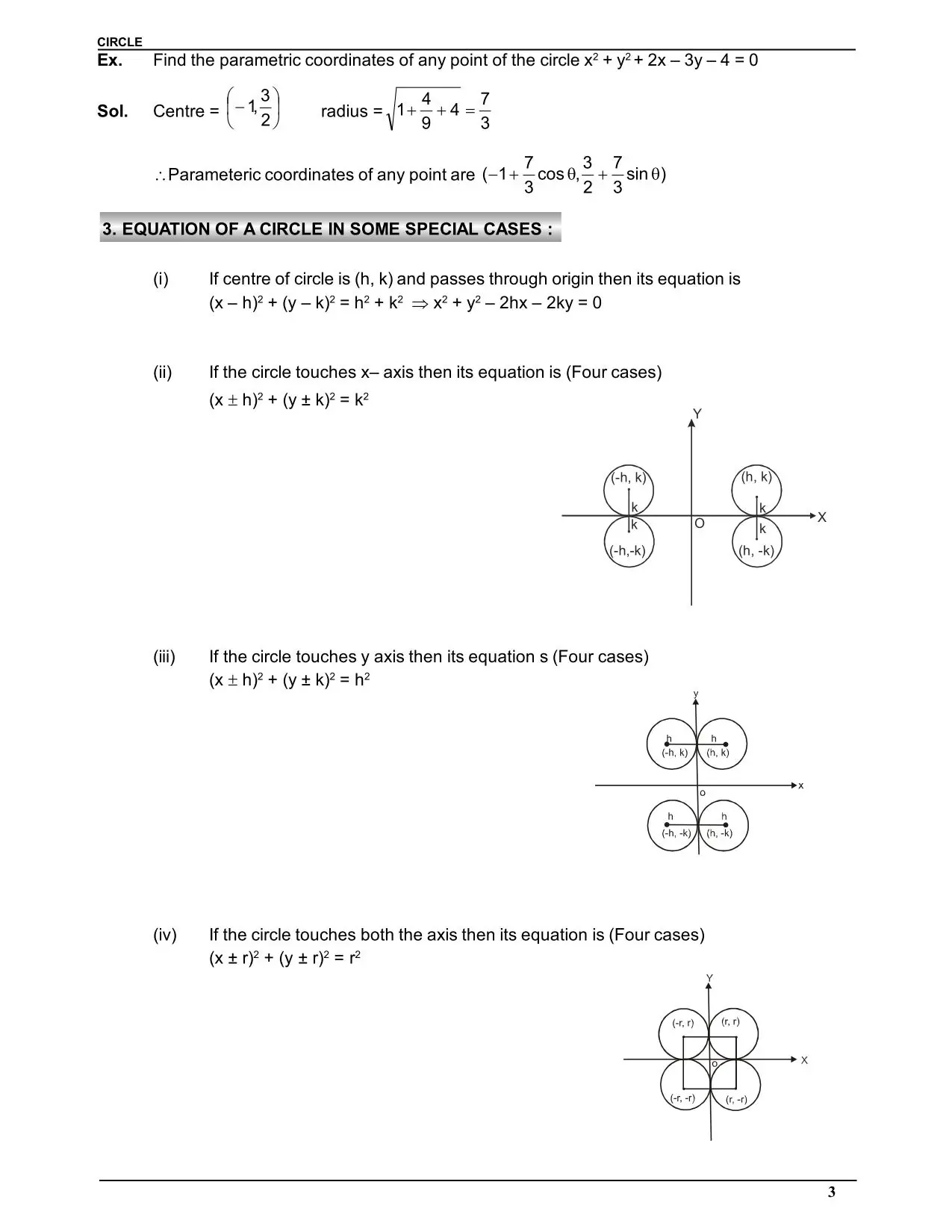
Special Cases
Condition | Equation or result |
|---|---|
Passes through the origin | $c = 0$ |
Touches the $x$-axis | $\lvert k\rvert = r$, which means $c = g^{2}$ |
Touches the $y$-axis | $\lvert h\rvert = r$, which means $c = f^{2}$ |
Touches both axes (radius $a$, in the first quadrant) | $(x - a)^{2} + (y - a)^{2} = a^{2}$ |
Length of the intercept on the $x$-axis | $2\sqrt{g^{2} - c}$ |
Length of the intercept on the $y$-axis | $2\sqrt{f^{2} - c}$ |
Diameter Form and Circle Through Three Points in Circle Class 11 Notes
If $(x_1, y_1)$ and $(x_2, y_2)$ are the ends of a diameter, the equation of the circle is:
$$(x - x_1)(x - x_2) + (y - y_1)(y - y_2) = 0$$
This comes from the angle in a semicircle being $90^\circ$. The circle through three non-collinear points $(x_i, y_i)$ is:
$$\begin{vmatrix} x^{2} + y^{2} & x & y & 1 \\ x_1^{2} + y_1^{2} & x_1 & y_1 & 1 \\ x_2^{2} + y_2^{2} & x_2 & y_2 & 1 \\ x_3^{2} + y_3^{2} & x_3 & y_3 & 1 \end{vmatrix} = 0$$
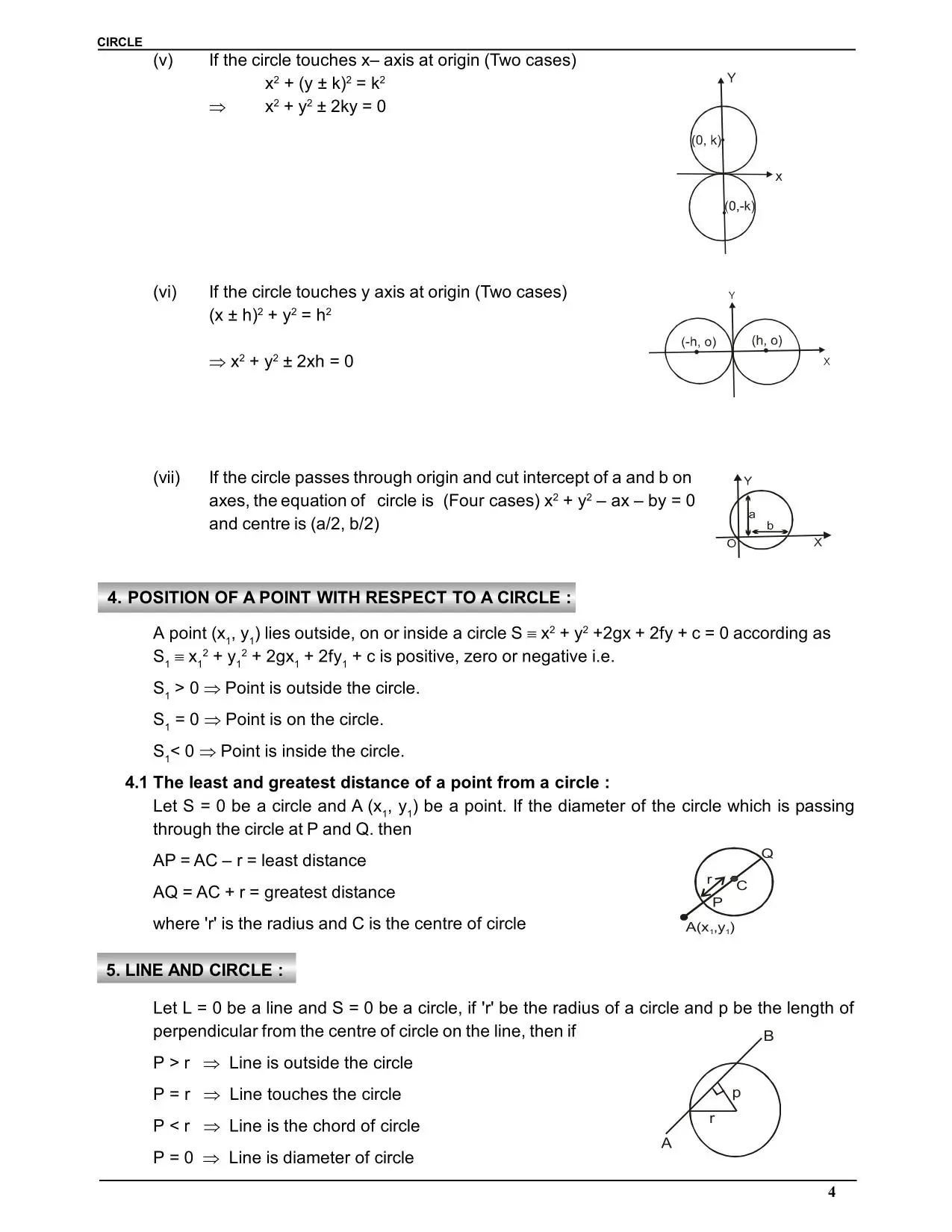
Position of a Point and a Line with Respect to a Circle in Circle Class 11 Notes
For the circle $S: x^{2} + y^{2} + 2gx + 2fy + c = 0$ and a point $P(x_1, y_1)$, let $S_1 = x_1^{2} + y_1^{2} + 2gx_1 + 2fy_1 + c$.
Value of $S_1$ | Position of $P$ |
|---|---|
$S_1 > 0$ | Outside the circle |
$S_1 = 0$ | On the circle |
$S_1 < 0$ | Inside the circle |
The length of the tangent from an outside point $P$ is $\sqrt{S_1}$.
For a line at a distance $d$ from the centre of a circle of radius $r$:
Condition | Position of the line |
|---|---|
$d < r$ | A secant, which cuts the circle at two points |
$d = r$ | A tangent |
$d > r$ | Does not meet the circle |
The length of the chord cut by a secant is $2\sqrt{r^{2} - d^{2}}$.
Tangent and Normal in Circle Class 11 Notes
Case | Equation of the tangent |
|---|---|
Circle $x^{2} + y^{2} = r^{2}$ at $(x_1, y_1)$ | $xx_1 + yy_1 = r^{2}$ |
Circle $S = 0$ at $(x_1, y_1)$ (the $T = 0$ form) | $xx_1 + yy_1 + g(x + x_1) + f(y + y_1) + c = 0$ |
Circle $x^{2} + y^{2} = r^{2}$ with the slope $m$ | $y = mx \pm r\sqrt{1 + m^{2}}$ |
Circle $(x - h)^{2} + (y - k)^{2} = r^{2}$ with the slope $m$ | $y - k = m(x - h) \pm r\sqrt{1 + m^{2}}$ |
Circle $x^{2} + y^{2} = r^{2}$, parametric point | $x\cos\theta + y\sin\theta = r$ |
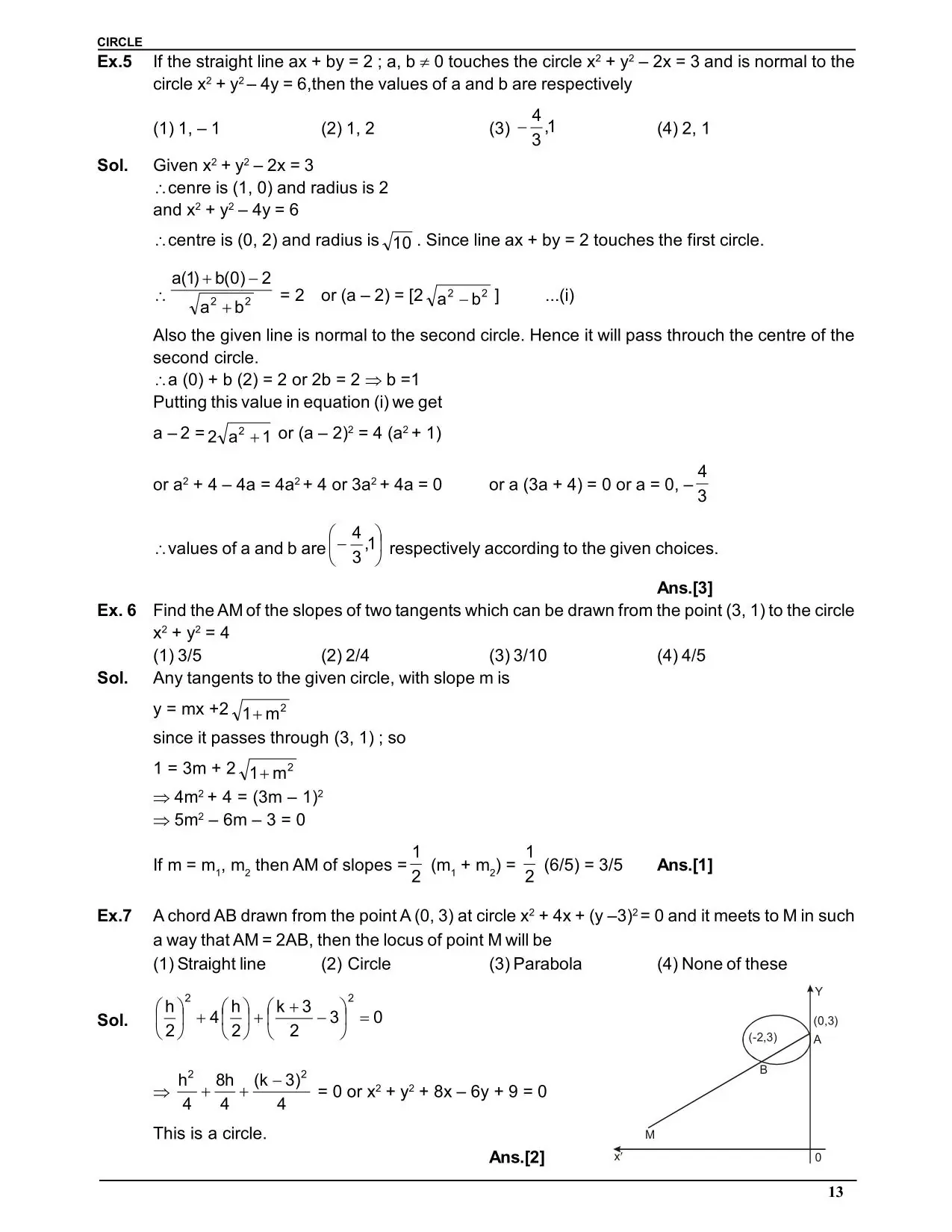
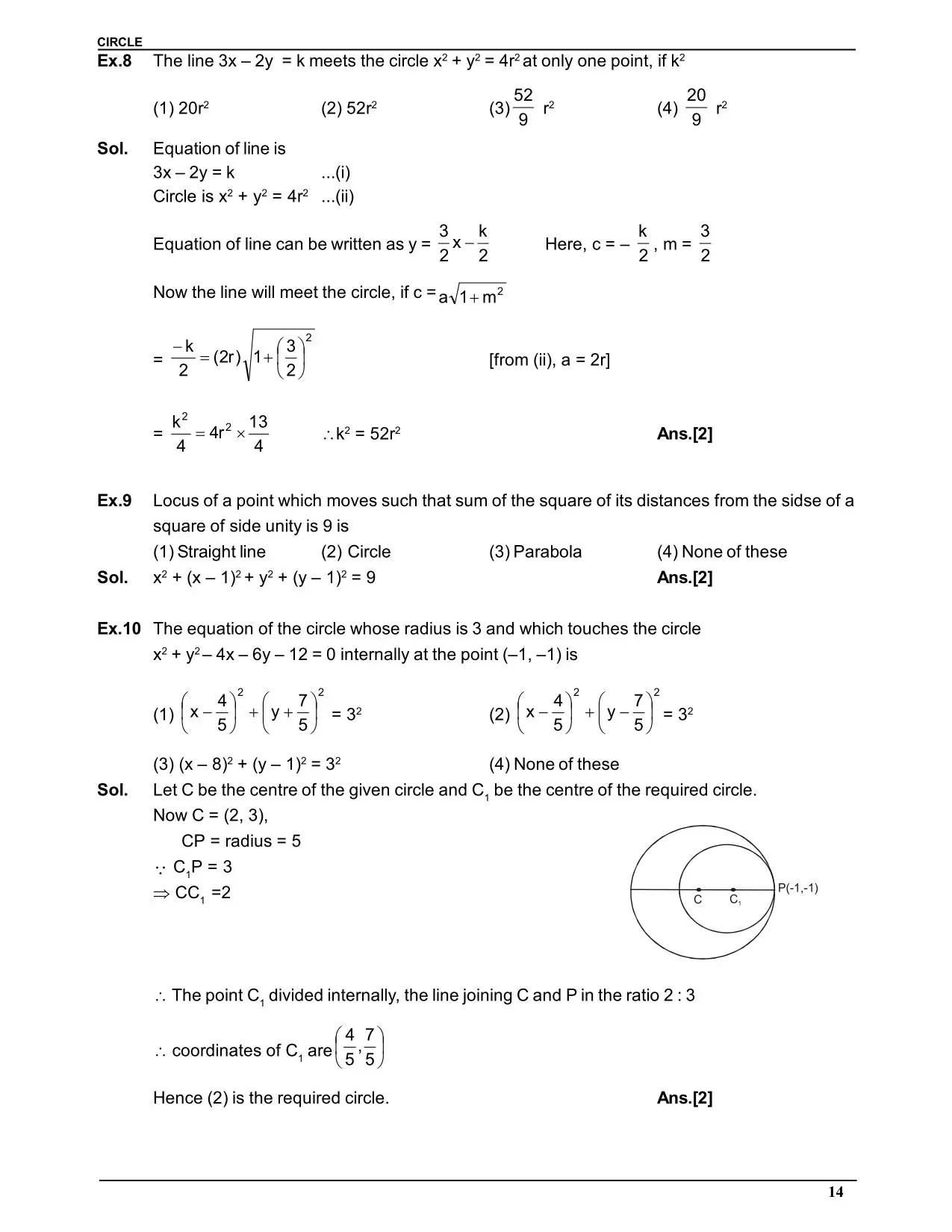
Condition for the line $y = mx + c$ to touch $x^{2} + y^{2} = r^{2}$: the distance from the origin to the line is $\dfrac{\lvert c\rvert}{\sqrt{1 + m^{2}}}$, and it must equal $r$, so:
$$c^{2} = r^{2}(1 + m^{2})$$
The normal at a point on a circle passes through the centre. For $x^{2} + y^{2} = r^{2}$, the normal at $(x_1, y_1)$ is $xy_1 - yx_1 = 0$.
Chord of Contact, Pair of Tangents and Director Circle in Circle Class 11 Notes
For a point $P(x_1, y_1)$ outside the circle $S = 0$:
Concept | Equation |
|---|---|
Chord of contact (the chord joining the points of contact of the tangents from $P$) | $T = 0$ |
Chord with $(x_1, y_1)$ as its midpoint | $T = S_1$ |
Pair of tangents from $P$ | $S\,S_1 = T^{2}$ |
Director circle of $x^{2} + y^{2} = r^{2}$ (the locus of the points from which perpendicular tangents are drawn) | $x^{2} + y^{2} = 2r^{2}$ |
Here, $T = xx_1 + yy_1 + g(x + x_1) + f(y + y_1) + c$.
Radical Axis, Family of Circles and Common Tangents in Circle Class 11 Notes
For two circles $S_1 = 0$ and $S_2 = 0$:
- The radical axis is the locus of the points that have equal tangent lengths to both circles. Its equation is $S_1 - S_2 = 0$. It is a straight line, and it is perpendicular to the line joining the two centres. If the circles intersect, it is their common chord.
- The three radical axes of three circles meet at one point, the radical centre.
- Family of circles: $S_1 + \lambda S_2 = 0$ (the circles through the intersection of two circles), and $S + \lambda L = 0$ (the circles through the intersection of a circle and a line).
- Orthogonal circles satisfy $2g_1g_2 + 2f_1f_2 = c_1 + c_2$.
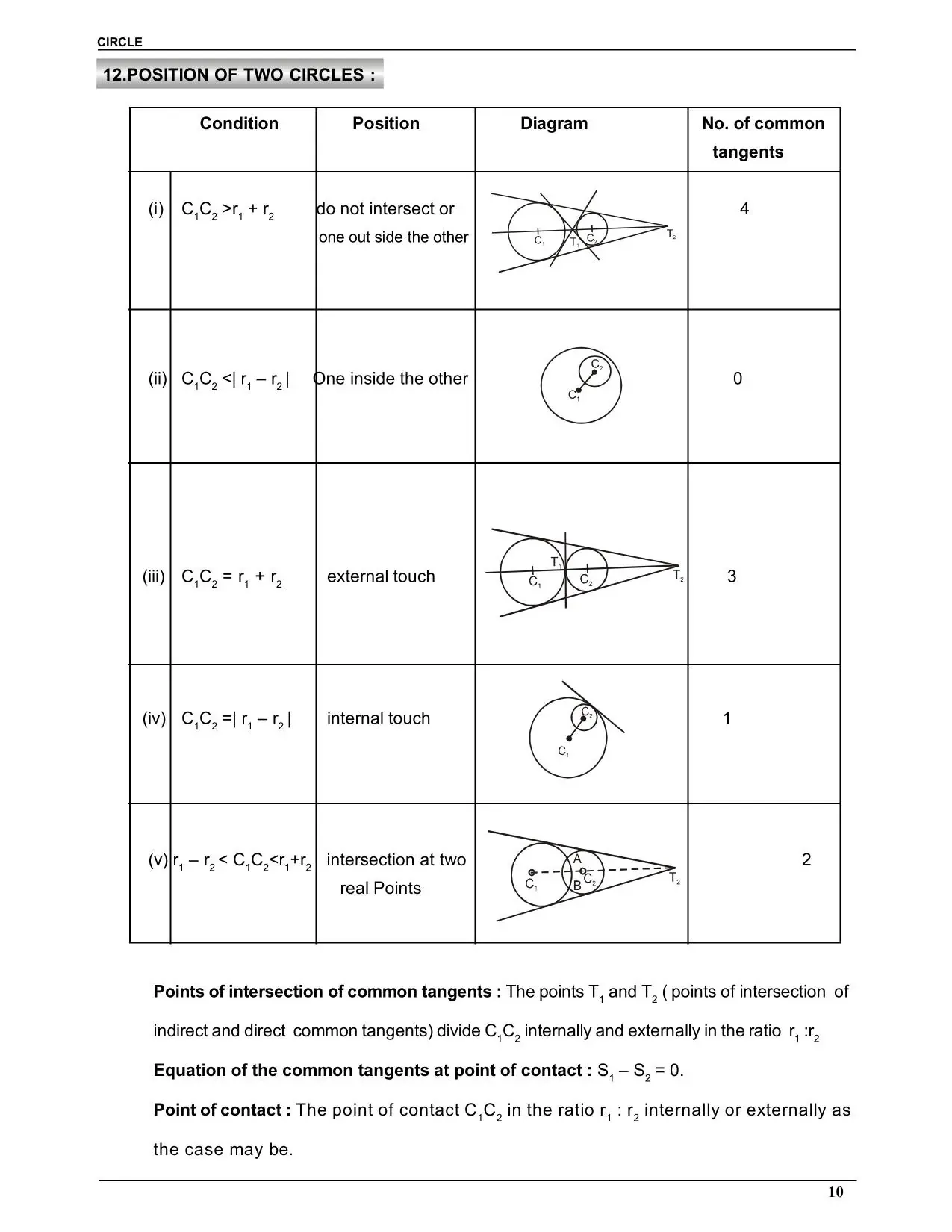
Number of common tangents for circles with centres at a distance $d$ and radii $r_1$ and $r_2$:
Condition | Position | Common tangents |
|---|---|---|
$d > r_1 + r_2$ | Separate | 4 |
$d = r_1 + r_2$ | Touch externally | 3 |
$\lvert r_1 - r_2\rvert < d < r_1 + r_2$ | Intersect | 2 |
$d = \lvert r_1 - r_2\rvert$ | Touch internally | 1 |
$d < \lvert r_1 - r_2\rvert$ | One inside the other | 0 |
Key Formulas in Circle Class 11 Notes
Concept | Formula |
|---|---|
Standard equation | $(x - h)^2 + (y - k)^2 = r^2$ |
General equation | $x^2 + y^2 + 2gx + 2fy + c = 0$ |
Centre and radius | $(-g, -f)$ and $\sqrt{g^2 + f^2 - c}$ |
Diameter form | $(x - x_1)(x - x_2) + (y - y_1)(y - y_2) = 0$ |
Length of the tangent | $\sqrt{S_1}$ |
Tangency condition | $c^2 = r^2(1 + m^2)$ |
Tangent at a point | $T = 0$ |
Chord with a given midpoint | $T = S_1$ |
Pair of tangents | $SS_1 = T^2$ |
Radical axis | $S_1 - S_2 = 0$ |
Solved Examples from Circle Class 11 Notes
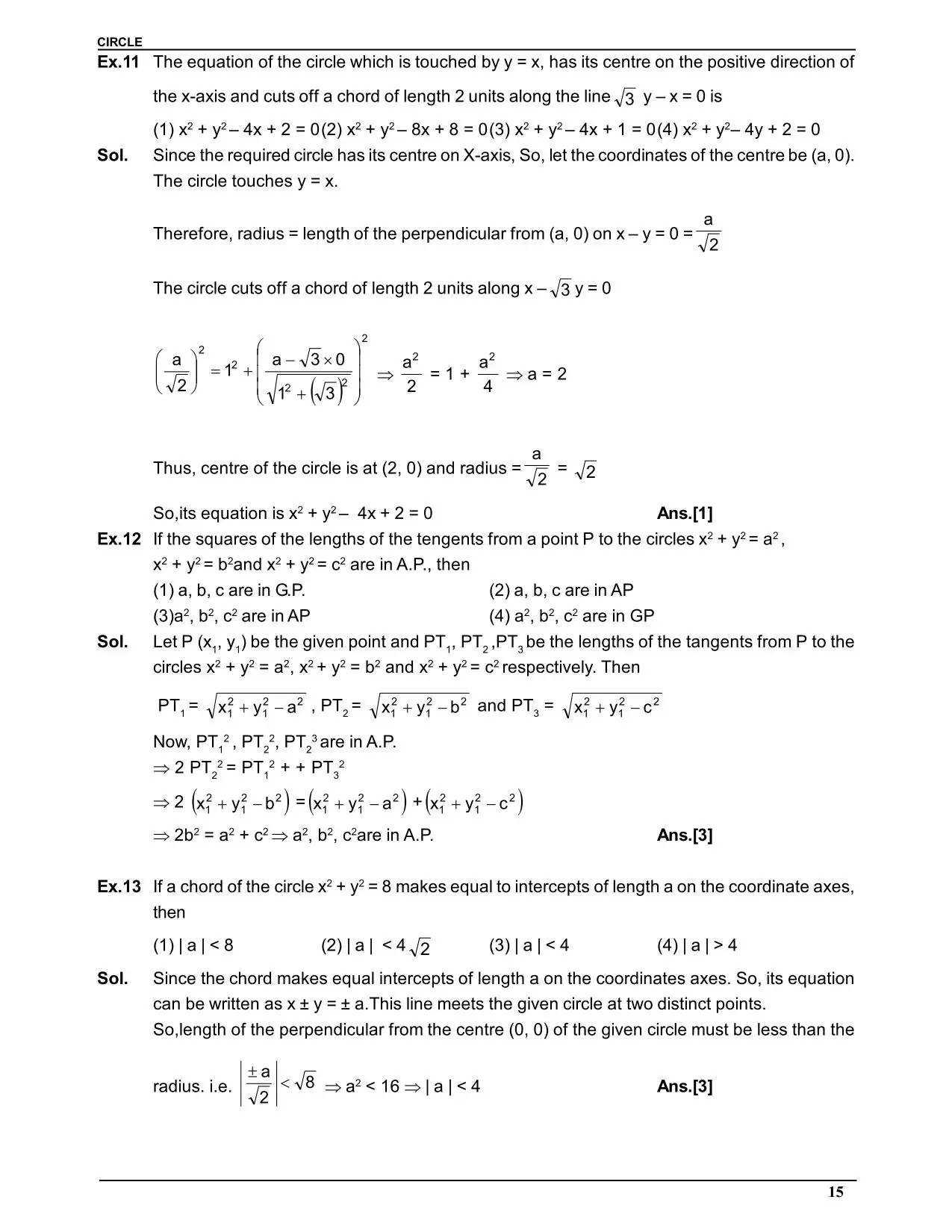
Example 1 (centre and radius): Find the centre and the radius of $x^{2} + y^{2} - 6x + 4y - 12 = 0$.
$g = -3$, $f = 2$ and $c = -12$. The centre is $(3, -2)$, and $r = \sqrt{9 + 4 + 12} = 5$.
Example 2 (diameter form): Find the circle that has the points $(1, 2)$ and $(3, -4)$ as the ends of a diameter.
$(x - 1)(x - 3) + (y - 2)(y + 4) = 0$, which gives $x^{2} + y^{2} - 4x + 2y - 5 = 0$.
Example 3 (tangency condition): For which values of $c$ is the line $y = 2x + c$ a tangent to $x^{2} + y^{2} = 5$?
$c^{2} = r^{2}(1 + m^{2}) = 5(1 + 4) = 25$, so $c = \pm 5$.
Example 4 (tangent at a point): Find the tangent to $x^{2} + y^{2} = 25$ at $(3, 4)$.
$xx_1 + yy_1 = 25$ gives $3x + 4y = 25$.
Example 5 (length of a tangent): Find the length of the tangent from $(5, 0)$ to $x^{2} + y^{2} = 9$.
$S_1 = 25 + 0 - 9 = 16$, so the length is $\sqrt{16} = 4$.
Example 6 (radical axis): Find the radical axis of $x^{2} + y^{2} - 4 = 0$ and $x^{2} + y^{2} - 2x - 4y + 4 = 0$.
$S_1 - S_2 = (-4) - (-2x - 4y + 4) = 2x + 4y - 8 = 0$, so the radical axis is $x + 2y = 4$.
Example 7 (chord of contact): Tangents are drawn from $(4, 0)$ to $x^{2} + y^{2} = 4$. Find the chord of contact and its length.
$T = 0$ gives $4x = 4$, so $x = 1$. The points of contact have $y^{2} = 4 - 1 = 3$, so the chord has the length $2\sqrt{3}$.
Example 8 (common tangents): How many common tangents do $x^{2} + y^{2} = 1$ and $(x - 3)^{2} + y^{2} = 4$ have?
The centres are at the distance $d = 3$, and $r_1 + r_2 = 1 + 2 = 3$. The circles touch externally, so there are 3 common tangents.
Example 9 (intercepts): For $x^{2} + y^{2} - 4x - 6y + 4 = 0$, find the intercepts on the axes.
$g = -2$, $f = -3$ and $c = 4$. The intercept on the $x$-axis is $2\sqrt{g^{2} - c} = 2\sqrt{4 - 4} = 0$, so the circle touches the $x$-axis. The intercept on the $y$-axis is $2\sqrt{9 - 4} = 2\sqrt{5}$.
Common Mistakes in Circle Class 11 Notes Problems
Mistake | Correct approach |
|---|---|
Writing the centre as $(g, f)$ | The centre is $(-g, -f)$ |
Writing the tangency condition as $c = r/\sqrt{1 + m^{2}}$ | It is $\dfrac{\lvert c\rvert}{\sqrt{1 + m^{2}}} = r$, so $c^{2} = r^{2}(1 + m^{2})$ |
Forgetting to check that $g^{2} + f^{2} - c > 0$ | If it is zero or negative, the equation is a point or an imaginary circle |
Using $x^{2} + y^{2} + 2gx + 2fy + c = 0$ when the coefficients of $x^2$ and $y^2$ are not 1 | Divide the equation first, so that the coefficients are 1 |
Using the tangent $T = 0$ for a point that is not on the circle | For an outside point, $T = 0$ is the chord of contact |
Taking the radical axis of two concentric circles | There is none (the equation $S_1 - S_2 = 0$ gives no line) |
Counting 2 common tangents for circles that touch externally | They have 3 common tangents, and internally touching circles have 1 |
How to Study Circle Class 11 Notes
- Read the NCERT chapter on conic sections first, and download the textbook from eSaral’s NCERT books for Class 11 page.
- Revise the line first, with eSaral’s Straight Lines Class 11 notes, because the distance of a point from a line is used again and again. The trigonometry formulas for Class 11 page helps with the parametric form.
- Practise in this order: centre and radius, diameter form, tangents, chord of contact, radical axis and then families of circles.
- Revise all the chapters with eSaral’s Class 11 Maths notes, and test yourself with eSaral’s JEE Main chapter-wise PYQs.
Frequently Asked Questions
What is the condition for a line to be tangent to a circle?
A line is a tangent to a circle if the perpendicular distance from the centre to the line equals the radius. For the line $y = mx + c$ and the circle $x^{2} + y^{2} = r^{2}$, the distance from the origin is $\dfrac{\lvert c\rvert}{\sqrt{1 + m^{2}}}$, so the condition is $c^{2} = r^{2}(1 + m^{2})$. eSaral’s Circle Class 11 Notes use this condition in Example 3.
How do I find the centre and radius from the general equation of a circle?
For $x^{2} + y^{2} + 2gx + 2fy + c = 0$, the centre is $(-g, -f)$ and the radius is $\sqrt{g^{2} + f^{2} - c}$. Always check that $g^{2} + f^{2} - c > 0$. If it is zero, the circle is a point, and if it is negative, the circle is imaginary. You can also complete the square in $x$ and $y$.
What is the standard equation of a circle in Class 11?
The standard equation of a circle with centre $(h, k)$ and radius $r$ is $(x - h)^{2} + (y - k)^{2} = r^{2}$. If the centre is the origin, it becomes $x^{2} + y^{2} = r^{2}$. In Circle Class 11 Notes, this is the form that all the other forms come from.
What is the diameter form of a circle and when should I use it?
The diameter form is $(x - x_1)(x - x_2) + (y - y_1)(y - y_2) = 0$. Use it when the two ends of a diameter are given. It follows from the fact that an angle in a semicircle is a right angle, and it avoids finding the centre and the radius separately.
What is the radical axis of two circles?
The radical axis of $S_1 = 0$ and $S_2 = 0$ is the locus of the points that have equal tangent lengths to both circles. Its equation is $S_1 - S_2 = 0$, which is a straight line perpendicular to the line joining the centres. For intersecting circles, it is the common chord.
How many common tangents can two circles have?
Four if the circles are separate ($d > r_1 + r_2$), three if they touch externally, two if they intersect, one if they touch internally and none if one lies inside the other. This is a standard question in Circle Class 11 Notes for JEE.
How many questions come from circles in JEE Main?
Circles are part of the coordinate geometry syllabus of JEE Main, usually together with straight lines and conics. The number of questions changes every year, so check previous years’ papers. Tangents, the chord of contact and the radical axis are the typical topics.
Which chapter number is the circle in Class 11 Maths?
In the current NCERT Class 11 Mathematics book, the circle is part of Chapter 10, Conic Sections (Chapter 11 in older books). These Circle Class 11 Notes follow that chapter, and they add the JEE topics.
Where can I find more Class 11 Maths notes on eSaral?
eSaral has chapter-wise Class 11 Maths notes, notes on Straight Lines, a trigonometry formula sheet and JEE Main chapter-wise PYQs, all linked with these Circle Class 11 Notes on this page.
Team eSaral
eSaral Academic and Editorial Team
Team eSaral is the collective author profile for educational content created by eSaral’s teachers and academic contributors. The team draws on expertise from IIT graduates, doctors, experienced educators and subject specialists to develop resources for JEE, NEET and school students. Our articles aim to explain concepts clearly and help students study with confidence.
Related Posts

NCERT Physics Class 10 Book PDF in Hindi 2026-27 – भौतिक विज्ञान के 4 अध्याय (Free Download)
NCERT Physics Class 10 book PDF in Hindi 2026-27: download all 4 chapters (अध्याय 9–12) free, with topics and important formulas.

NCERT Biology Class 9 Book Anveshan PDF in Hindi - जीव विज्ञान कक्षा 9 पुस्तक अन्वेषण PDF
Download NCERT Biology Class 9 book PDF in Hindi chapterwise for 2026-27: Cell, Tissues, Reproduction and Diversity. Free PDFs.

Essay On Artificial Intelligence in English (100,150, 200, 250, 300, 500 Words)
This is in contrast to the natural intelligence of humans. With Artificial Intelligence, machines can perform

Essay on 78th India Independence Day in English for Student (100, 150, 200, 250, 300, 500 Words)
Read the best essays on India's Independence Day in English. Short & long essays (100, 150, 200, 250, 300, 500 words) perfect for school exams
NCERT Class 11 English Snapshots book - Free PDF download- Esaral
Download NCERT Class 11 English Snapshots book PDF for free. Get all 8 chapters, chapter-wise. Start your prep today!
NCERT Class 10 biology book pdf - Free PDF Download - eSaral
NCERT Class 10 Biology book PDF 2026-27: all 5 chapters (Life Processes to Our Environment) in English & Hindi, with CBSE syllabus, marks & practical

Essay on Global Warming in English (100,150, 200, 250, 300, 500 Words)
Global warming means the Earth is getting hotter. This happens because of things like pollution from cars and factories.

NCERT Class 12 English Book 2026-27: Flamingo, Vistas and Kaleidoscope PDF, Chapters and Syllabus
NCERT Class 12 English book 2026-27: Flamingo & Vistas (English Core) and Kaleidoscope (Elective) PDFs chapter-wise, with syllabus and sample papers.
NCERT Class 11 Physics Book —Part1 & Part 2 download in Hindi - NCERT भौतिकी कक्षा 11 पुस्तक
Download Class 11 Physics NCERT book PDF in Hindi – all 15 chapters, chapterwise links, JEE & NEET tips. Free PDF, no signup needed.

NCERT Class 10 Hindi Book PDF 2026-27 – क्षितिज, कृतिका, स्पर्श, संचयन (Chapterwise Free Download)
Download NCERT Class 10 Hindi Book PDF 2026-27 free, chapterwise: Kshitij, Kritika, Sparsh, Sanchayan. Includes CBSE syllabus & deleted chapters.