
Hydrocarbons Class 11 Notes for IIT JEE and NEET: Alkanes, Alkenes, Alkynes, Benzene, Mechanisms and Name Reactions

eSaral Academic and Editorial Team
Summary
Hydrocarbons Class 11 Notes cover the classification, nomenclature and isomerism of hydrocarbons, and the preparation, properties and reactions of alkanes, alkenes, alkynes and aromatic hydrocarbons. They explain the free radical mechanism of halogenation, electrophilic addition (Markovnikov’s rule and the peroxide effect), ozonolysis, the acidity of terminal alkynes, aromaticity and electrophilic aromatic substitution.
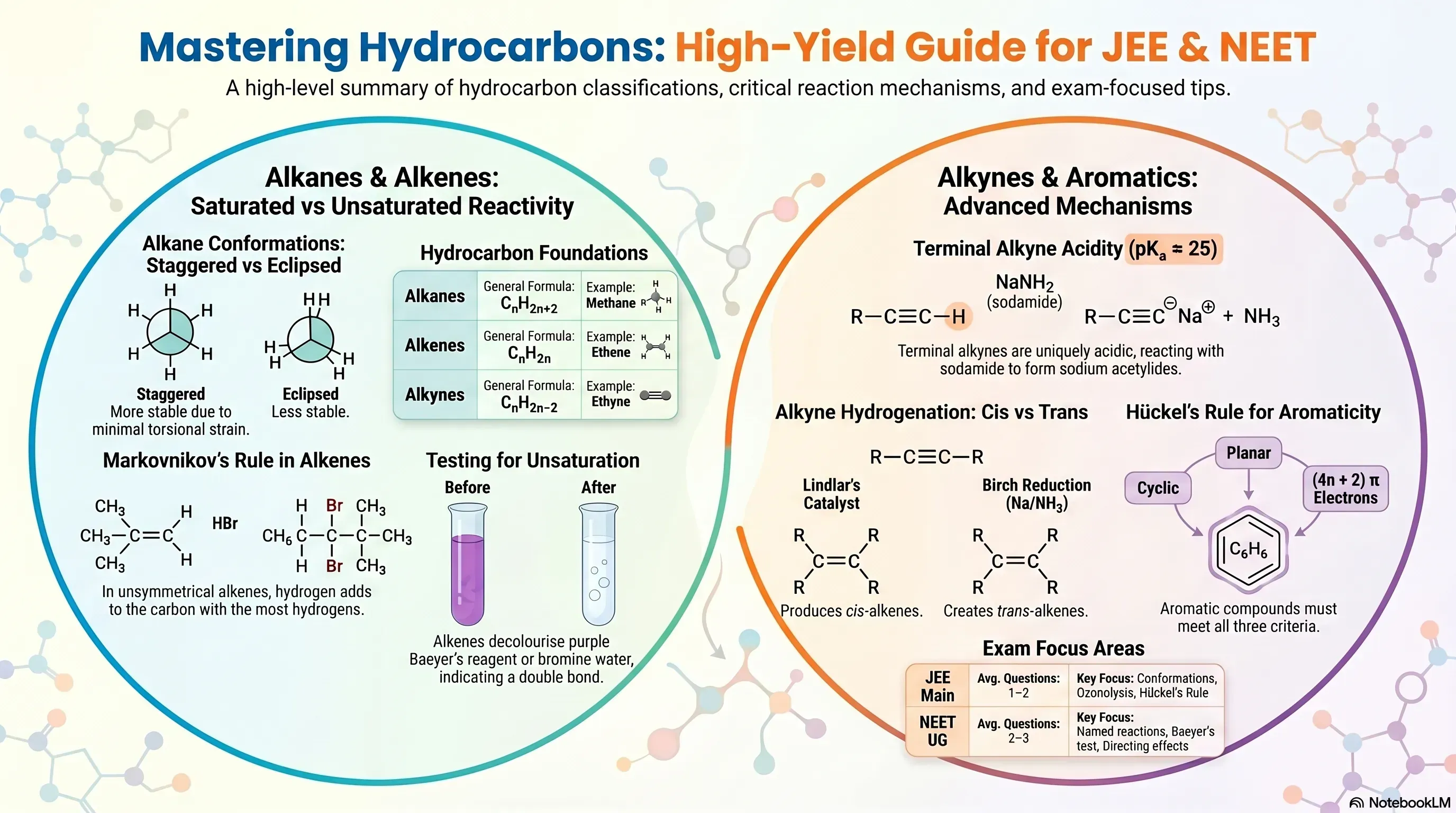
Hydrocarbons is Chapter 9 of the current NCERT Class 11 Chemistry book (Chapter 13 in older books). It follows Organic Chemistry: Some Basic Principles and Techniques, whose ideas (electronic effects, carbocation stability and isomerism) are used in every reaction of this chapter. The chapter is part of the organic chemistry syllabus of JEE Main, JEE Advanced and NEET, and its reaction types come back in the Class 12 chapters on haloalkanes, alcohols and carbonyl compounds. Read eSaral’s Organic Chemistry: Some Basic Principles and Techniques notes first if the electronic effects are not clear.
Hydrocarbons Class 11 Notes for IIT JEE and NEET
India's Best Exam Preparation for Class 11th - Download Now
Also read, Class 11 Chemistry Chapter 2 Notes
India's Best Exam Preparation for Class 11th - Download Now
India's Best Exam Preparation for Class 11th - Download Now
India's Best Exam Preparation for Class 11th - Download Now
India's Best Exam Preparation for Class 11th - Download Now
Hydrocarbons Class 11 Notes: Classification and General Formulas
Hydrocarbons are compounds of carbon and hydrogen only.
Class | Bond | General formula | Hybridisation and bond length | Example |
|---|---|---|---|---|
Alkanes | Only C–C single bonds | $\mathrm{C_nH_{2n+2}}$ | $sp^3$, C–C about 154 pm | Methane, ethane |
Alkenes | One C=C bond | $\mathrm{C_nH_{2n}}$ | $sp^2$, C=C about 134 pm | Ethene, propene |
Alkynes | One C≡C bond | $\mathrm{C_nH_{2n-2}}$ | $sp$, C≡C about 120 pm | Ethyne, propyne |
Aromatic (arenes) | A planar ring with delocalised $\pi$ electrons | Benzene is $\mathrm{C_6H_6}$ | $sp^2$, all C–C in benzene about 139 pm | Benzene, toluene |
Nomenclature and Isomerism in Hydrocarbons Class 11 Notes
IUPAC naming: choose the longest chain that contains the multiple bond, number it from the end that gives the lowest locant to the double or triple bond (then to the substituents), and write the substituents in alphabetical order. Use -ane, -ene and -yne as the suffixes.
Type of isomerism | Hydrocarbon example |
|---|---|
Chain | $\mathrm{C_4H_{10}}$: butane and 2-methylpropane |
Position | But-1-ene and but-2-ene |
Functional | $\mathrm{C_4H_6}$: but-1-yne and buta-1,3-diene. Also alkenes and cycloalkanes ($\mathrm{C_4H_8}$) |
Geometrical (cis–trans) | But-2-ene. Each doubly bonded carbon must carry two different groups |
Number of chain isomers of alkanes: $\mathrm{C_4H_{10}}$ has 2, $\mathrm{C_5H_{12}}$ has 3, $\mathrm{C_6H_{14}}$ has 5 and $\mathrm{C_7H_{16}}$ has 9.
Alkanes in Hydrocarbons Class 11 Notes
Preparation of Alkanes in Hydrocarbons Class 11 Notes
Method | Reaction |
|---|---|
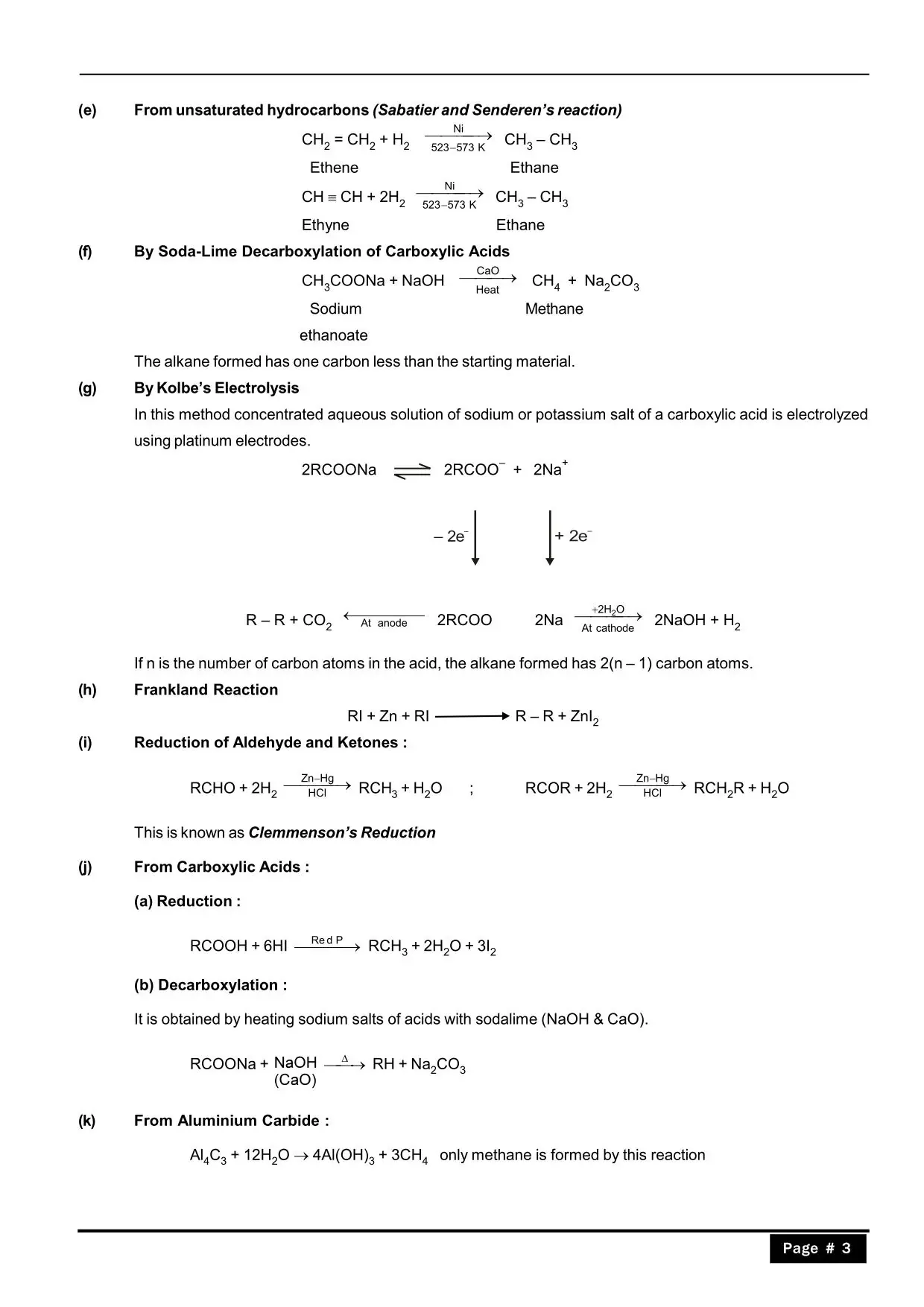
Hydrogenation of alkenes or alkynes (Ni, Pd or Pt) | $\mathrm{CH_2{=}CH_2 + H_2 \rightarrow CH_3CH_3}$ |
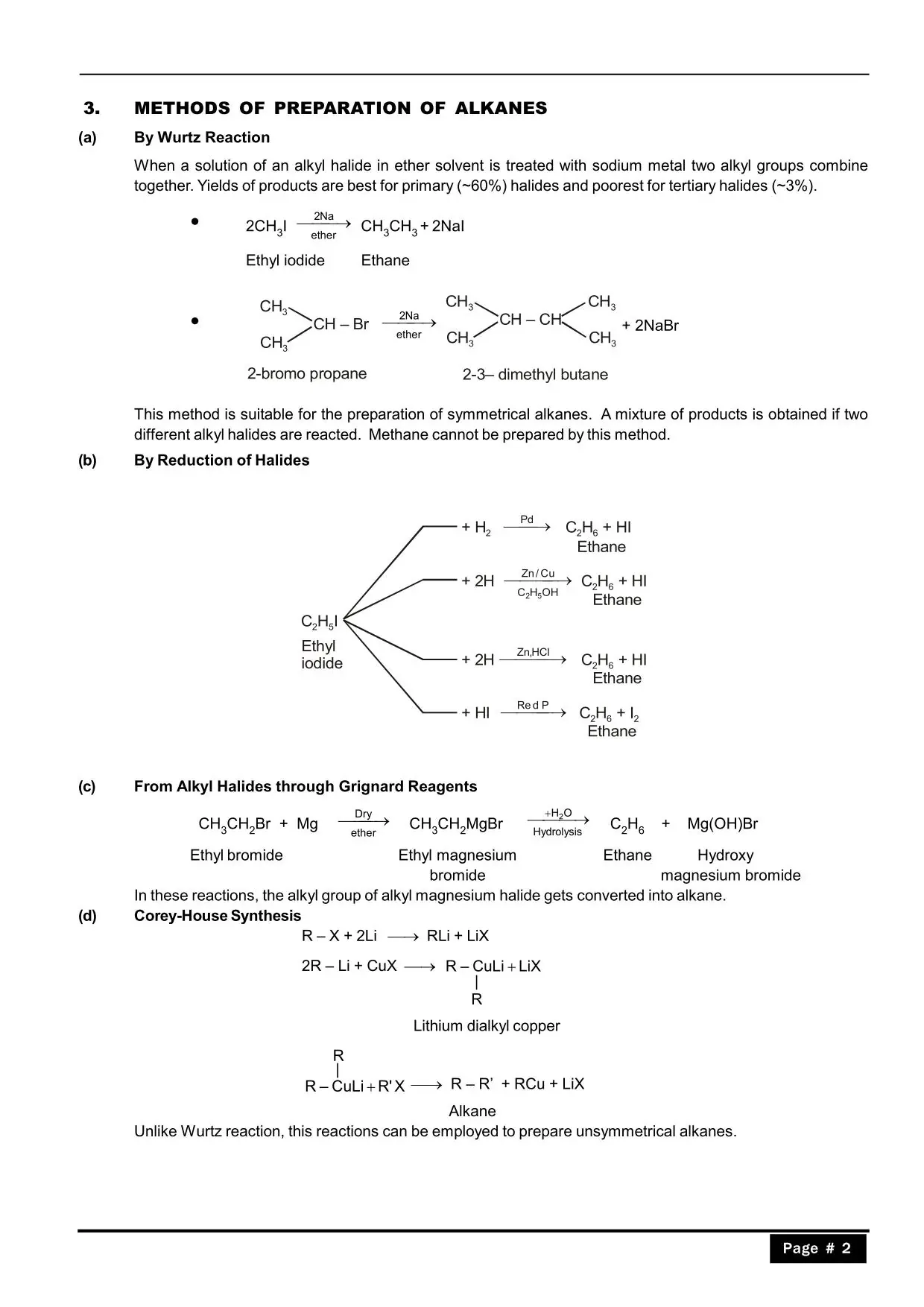
Wurtz reaction (Na in dry ether) | $\mathrm{2CH_3Br + 2Na \rightarrow CH_3CH_3 + 2NaBr}$ |
Kolbe’s electrolysis of sodium salts of acids | $\mathrm{2CH_3COONa + 2H_2O \rightarrow CH_3CH_3 + 2CO_2 + H_2 + 2NaOH}$ |
Decarboxylation (soda lime, heat) | $\mathrm{CH_3COONa + NaOH \xrightarrow{CaO,\ \Delta} CH_4 + Na_2CO_3}$ |
Conformations of ethane
Rotation about the C–C single bond gives different arrangements (conformations). The staggered form (dihedral angle $60^\circ$) is the most stable, and the eclipsed form (dihedral angle $0^\circ$) is the least stable. The difference is about $12.5\ \mathrm{kJ\,mol^{-1}}$, because of torsional strain. Newman and sawhorse projections are used to draw them.
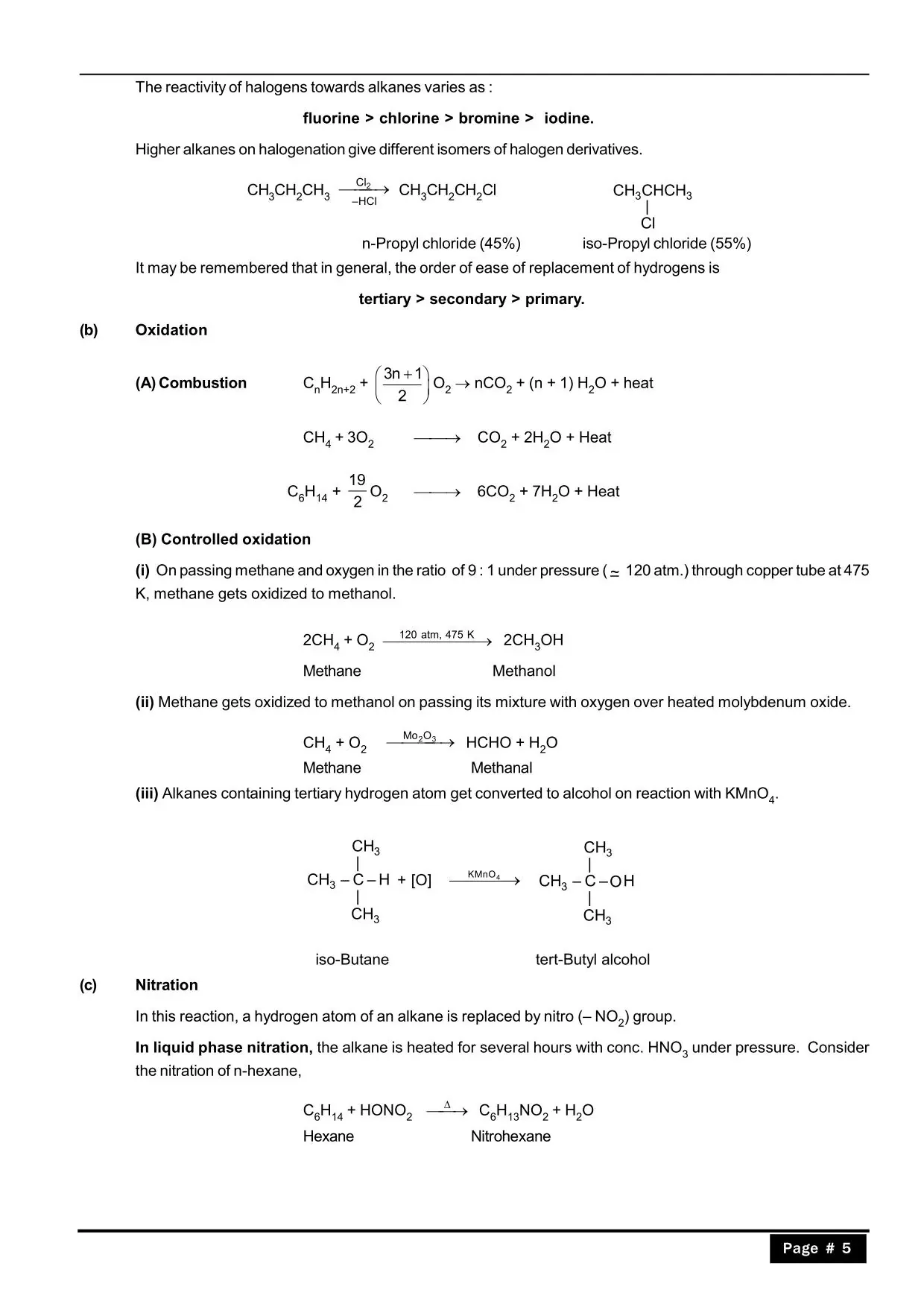
Free Radical Halogenation in Hydrocarbons Class 11 Notes
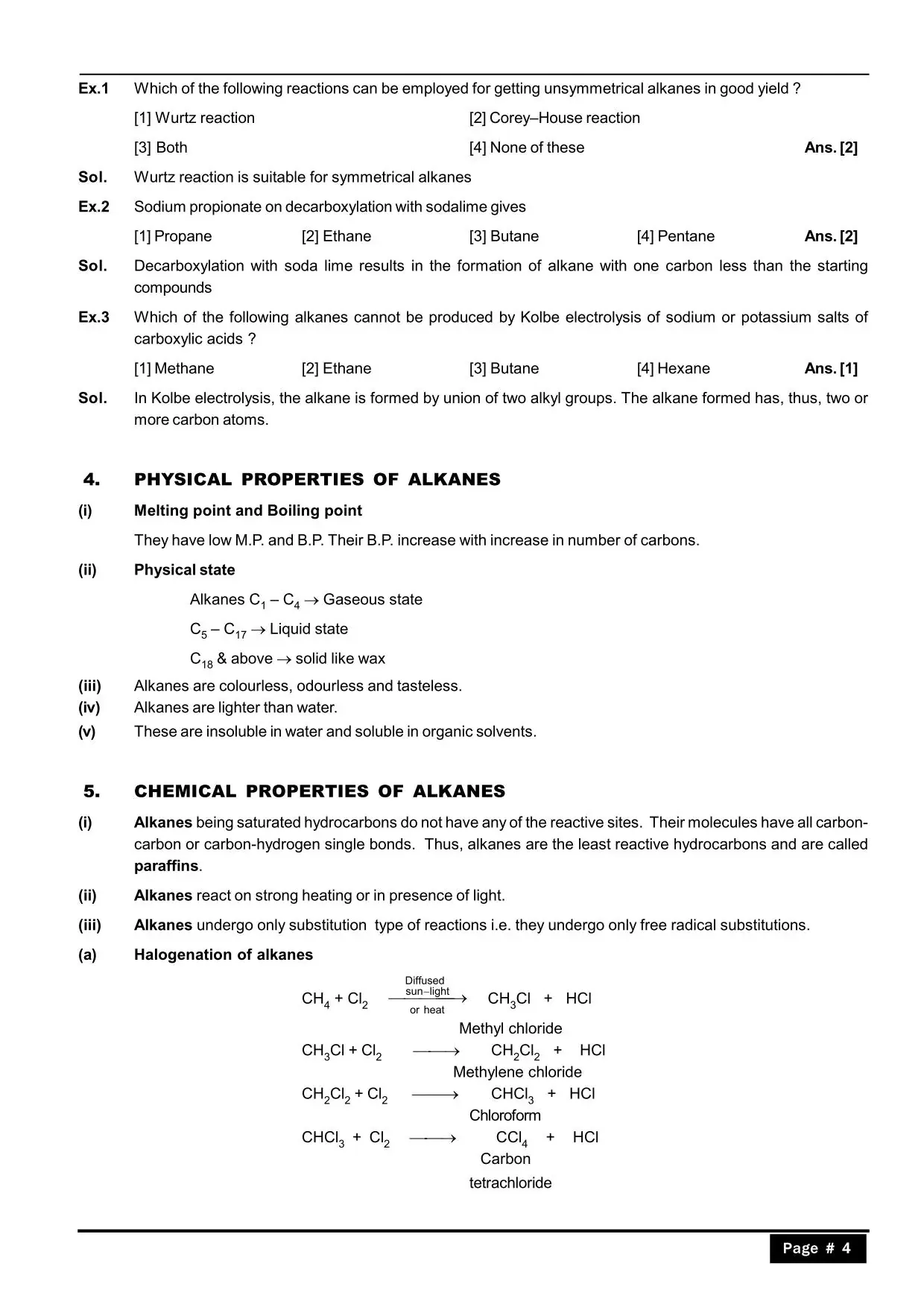
$$\mathrm{CH_4 + Cl_2 \xrightarrow{h\nu\ \text{or heat}} CH_3Cl + HCl}$$
Step | Reaction |
|---|---|
Initiation | $\mathrm{Cl{-}Cl \xrightarrow{h\nu} 2Cl\cdot}$ |
Propagation | $\mathrm{Cl\cdot + CH_4 \rightarrow CH_3\cdot + HCl}$ and $\mathrm{CH_3\cdot + Cl_2 \rightarrow CH_3Cl + Cl\cdot}$ |
Termination | $\mathrm{Cl\cdot + Cl\cdot \rightarrow Cl_2}$, $\ \mathrm{CH_3\cdot + CH_3\cdot \rightarrow C_2H_6}$, $\ \mathrm{CH_3\cdot + Cl\cdot \rightarrow CH_3Cl}$ |
- Reactivity of the halogen: $\mathrm{F_2 > Cl_2 > Br_2 > I_2}$ (iodination is not feasible).
- Selectivity of the hydrogen: $3^\circ\,\mathrm{H} > 2^\circ\,\mathrm{H} > 1^\circ\,\mathrm{H}$, because the $3^\circ$ radical is the most stable. For chlorination, the relative rates per hydrogen are about $1^\circ : 2^\circ : 3^\circ = 1 : 3.8 : 5$, and bromination is much more selective (about $1 : 82 : 1600$).
Other reactions
- Combustion: $\mathrm{C_nH_{2n+2} + \tfrac{3n+1}{2}O_2 \rightarrow nCO_2 + (n+1)H_2O}$ (heat is released).
- Pyrolysis (cracking): a higher alkane breaks into smaller alkanes and alkenes at a high temperature.
- Physical properties: $\mathrm{C_1}$ to $\mathrm{C_4}$ are gases, $\mathrm{C_5}$ to $\mathrm{C_{17}}$ are liquids, and the higher ones are solids. The boiling point rises with the chain length, and branching lowers it.
Alkenes in Hydrocarbons Class 11 Notes
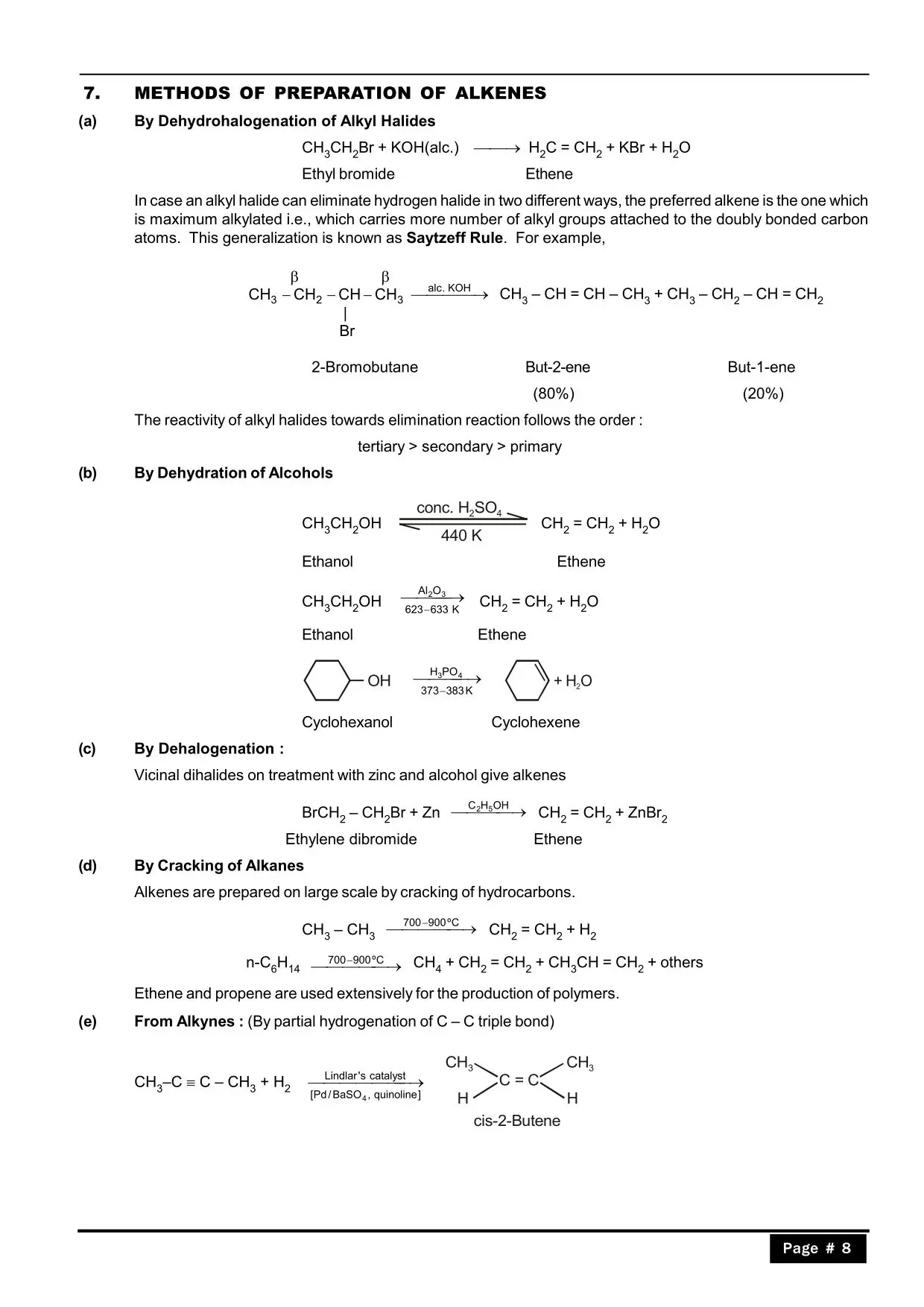
Preparation of alkenes
- Dehydrohalogenation of alkyl halides with alcoholic KOH. When there is a choice, the more substituted alkene is the major product (Saytzeff’s rule).
- Dehydration of alcohols with conc. $\mathrm{H_2SO_4}$ (heat), or with $\mathrm{Al_2O_3}$.
- Partial reduction of alkynes (see below).
Geometrical isomerism
Rotation about the C=C bond is restricted, so alkenes such as but-2-ene exist as cis and trans isomers. The trans isomer is usually more stable and has a lower heat of hydrogenation. The more substituted an alkene is, the more stable it is (hyperconjugation).
Electrophilic Addition Reactions of Alkenes in Hydrocarbons Class 11 Notes
Reaction | Reagent | Product with propene |
|---|---|---|
Hydrogenation | $\mathrm{H_2}$, Ni (or Pd, Pt) | Propane |
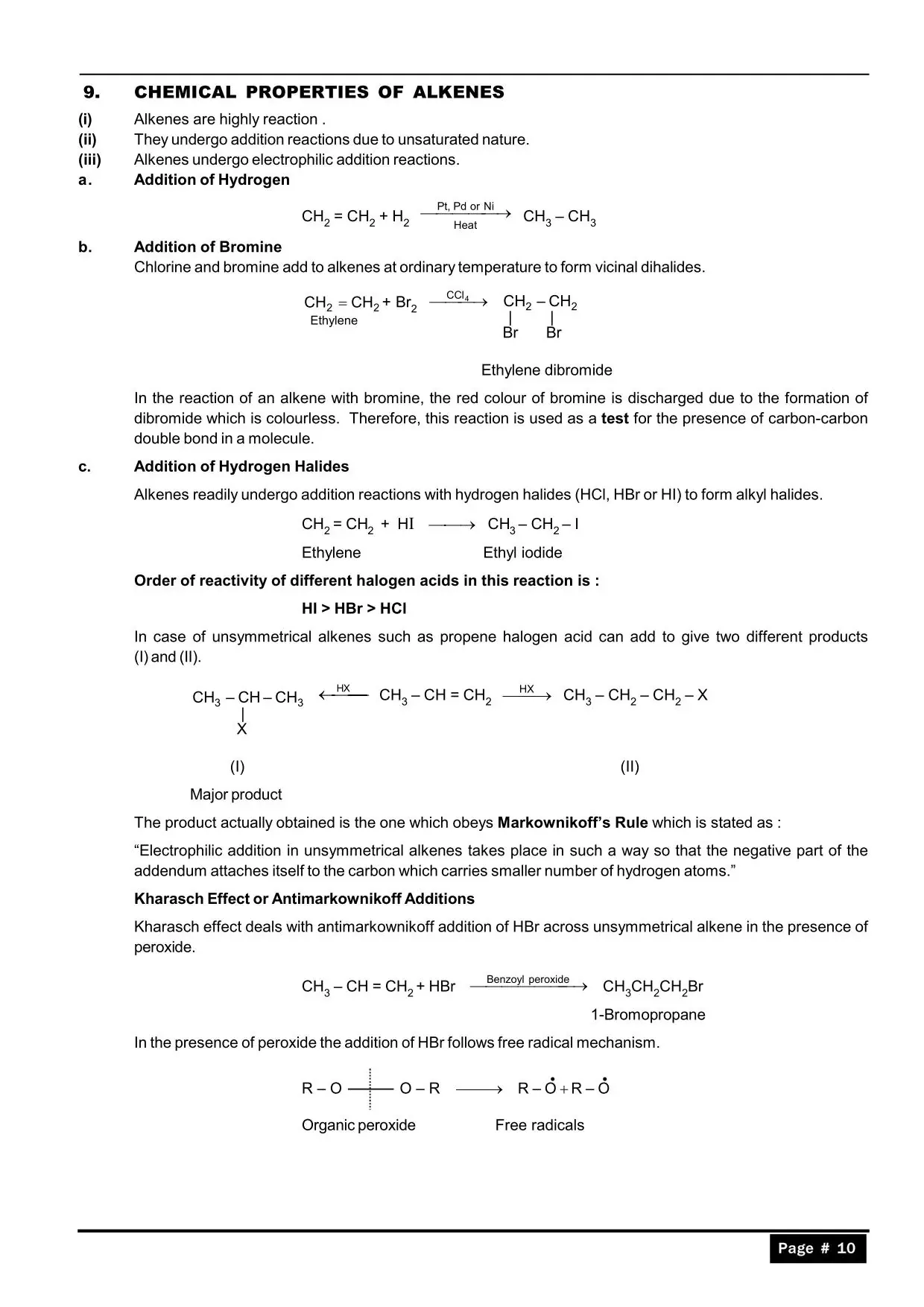
Halogenation (anti addition) | $\mathrm{Br_2}$ in $\mathrm{CCl_4}$ | 1,2-Dibromopropane. The red-brown colour disappears |
Addition of HX (Markovnikov) | HBr | 2-Bromopropane |
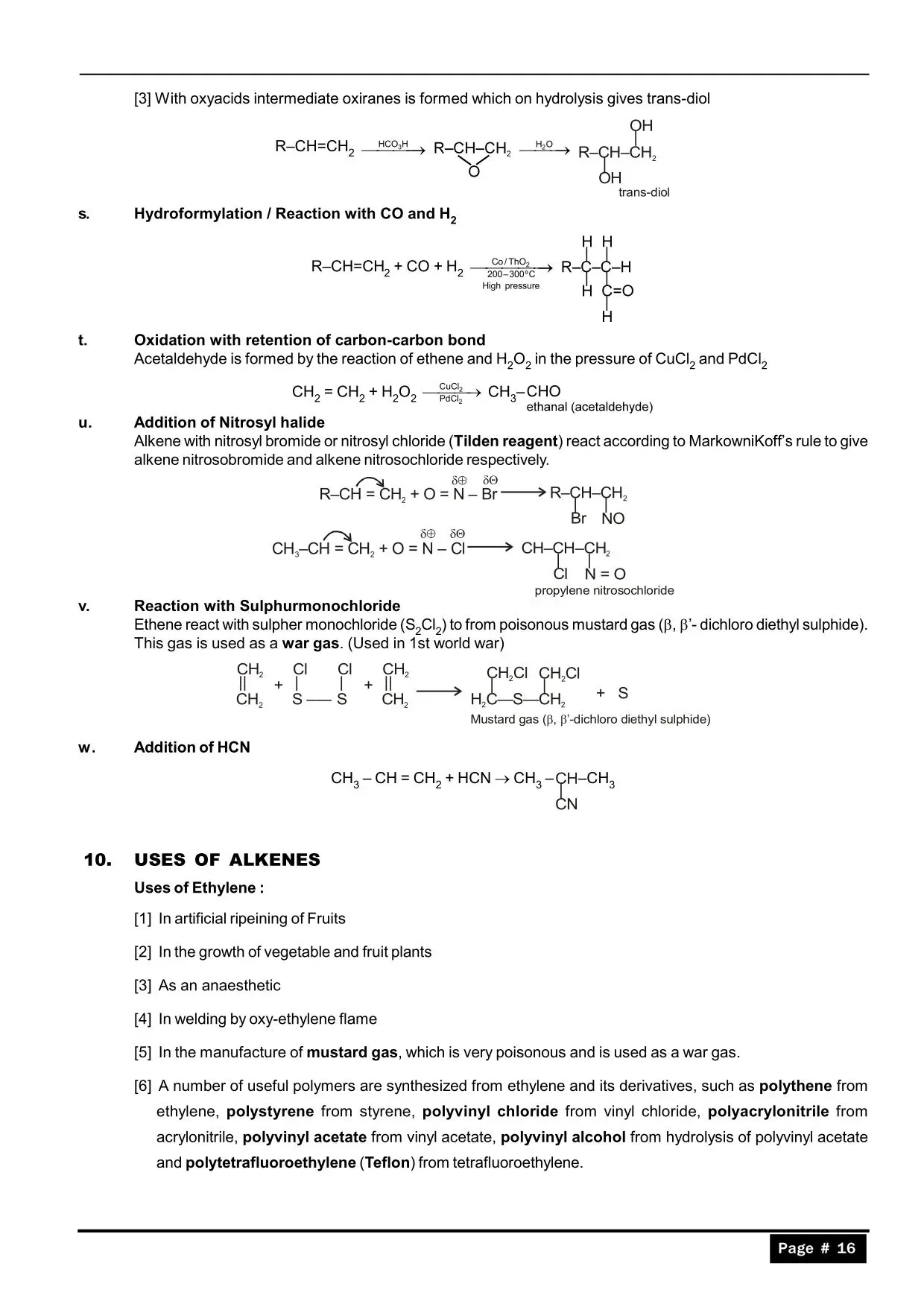
Addition of HBr with peroxide (anti-Markovnikov) | HBr, $\mathrm{R{-}O{-}O{-}R}$ | 1-Bromopropane |
Hydration (acid catalysed, Markovnikov) | Dilute $\mathrm{H_2SO_4}$ | Propan-2-ol |
Hydroboration–oxidation (anti-Markovnikov, JEE Advanced) | $\mathrm{B_2H_6}$, then $\mathrm{H_2O_2/OH^-}$ | Propan-1-ol |
Markovnikov’s rule: in the addition of HX to an unsymmetrical alkene, the hydrogen goes to the carbon that already has more hydrogens. The mechanism explains why: the $\mathrm{H^+}$ adds first, and it forms the more stable carbocation, and then $\mathrm{X^-}$ attacks it.
$$\mathrm{CH_3CH{=}CH_2 + H^+ \rightarrow CH_3\overset{+}{C}HCH_3 \xrightarrow{Br^-} CH_3CHBrCH_3}$$
A carbocation can rearrange (a hydride or methyl shift) to a more stable one before it is attacked, which changes the product.
Peroxide effect (Kharasch effect): in the presence of peroxides, HBr adds by a free radical chain mechanism, and the bromine radical adds to the less substituted carbon, which gives the more stable radical. It works only for HBr, and not for HCl or HI.
Ozonolysis and oxidation
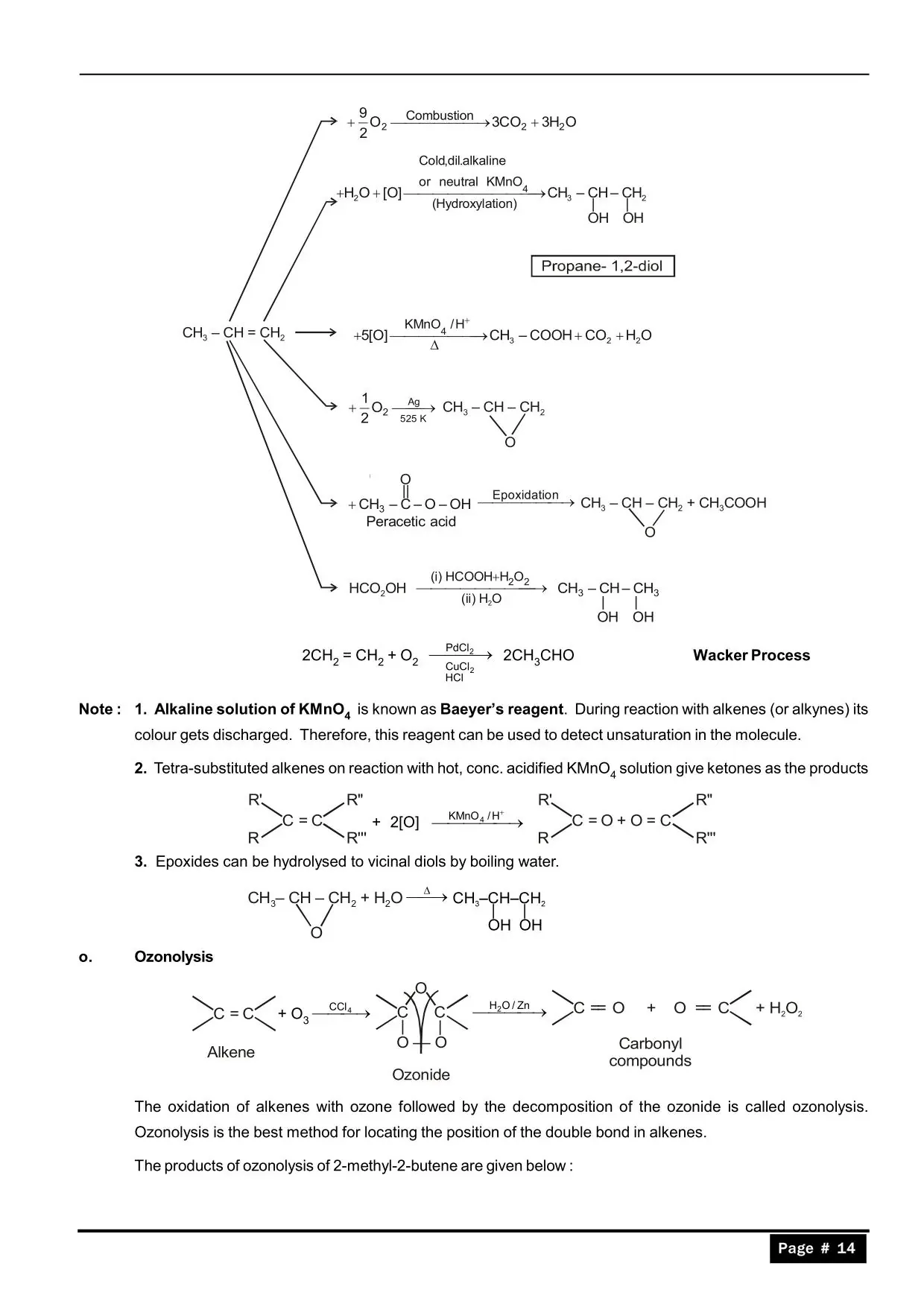
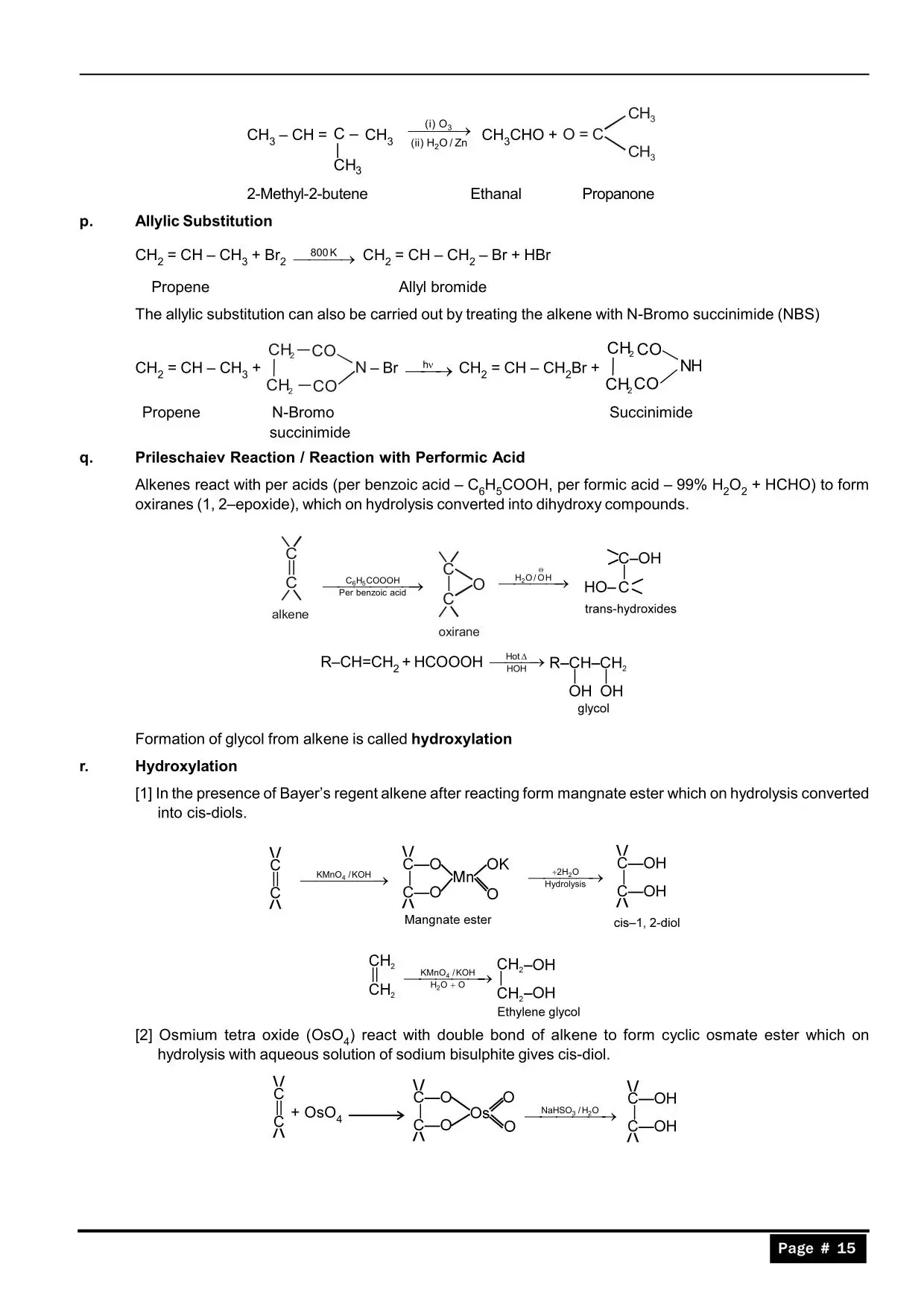
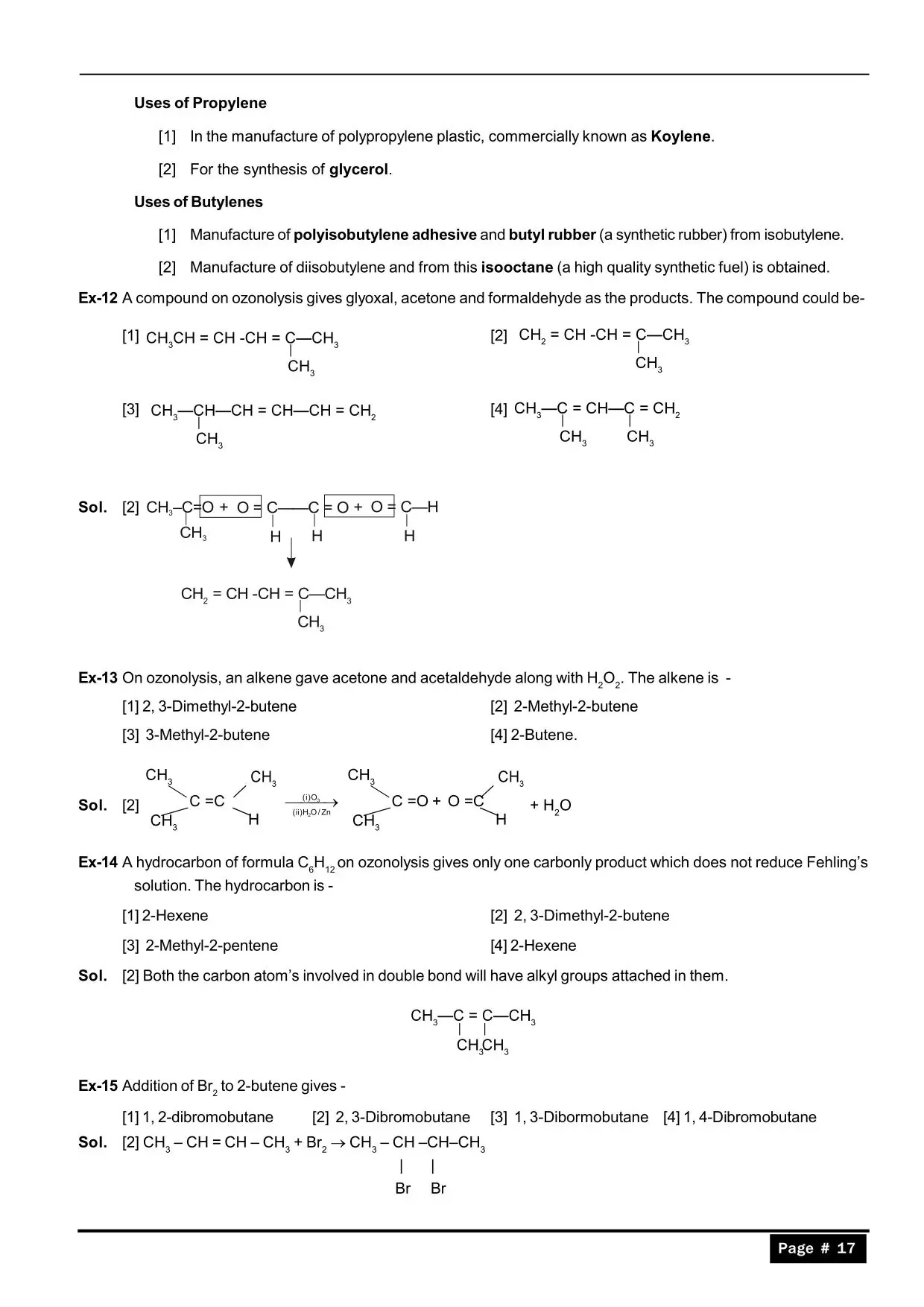
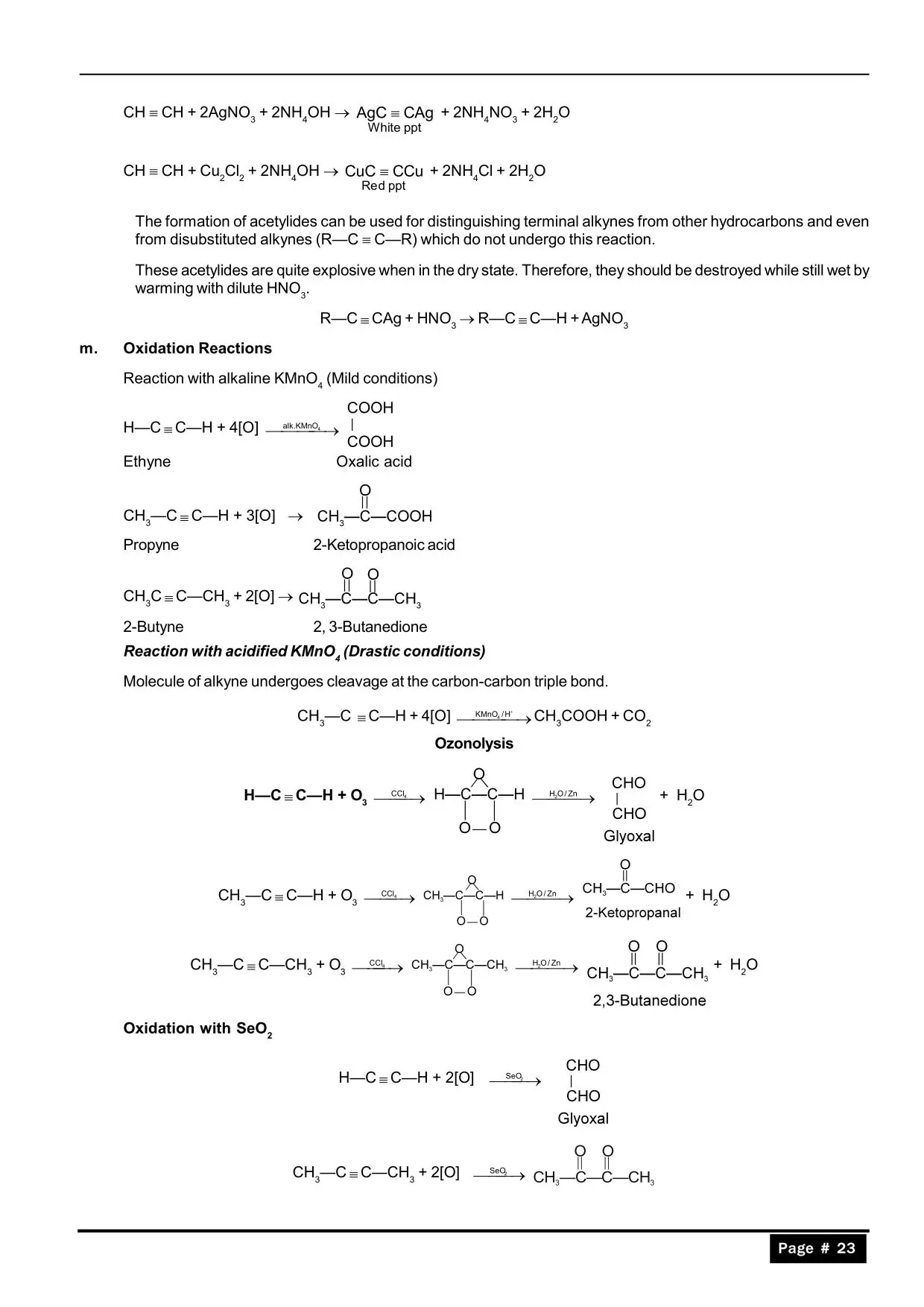
$$\text{Alkene} \xrightarrow{O_3} \text{ozonide} \xrightarrow{Zn/H_2O} \text{aldehydes and/or ketones}$$
Ozonolysis locates the double bond: each $\mathrm{C{=}}$ carbon becomes a $\mathrm{C{=}O}$ carbon.
Oxidising agent | Result |
|---|---|
Cold, dilute, alkaline $\mathrm{KMnO_4}$ (Baeyer’s reagent) | A cis diol. The purple colour disappears (a test for unsaturation) |
Hot, acidic $\mathrm{KMnO_4}$ | The double bond is cleaved. $\mathrm{=CH_2}$ gives $\mathrm{CO_2}$, $\mathrm{=CHR}$ gives $\mathrm{RCOOH}$, and $\mathrm{=CR_2}$ gives a ketone |
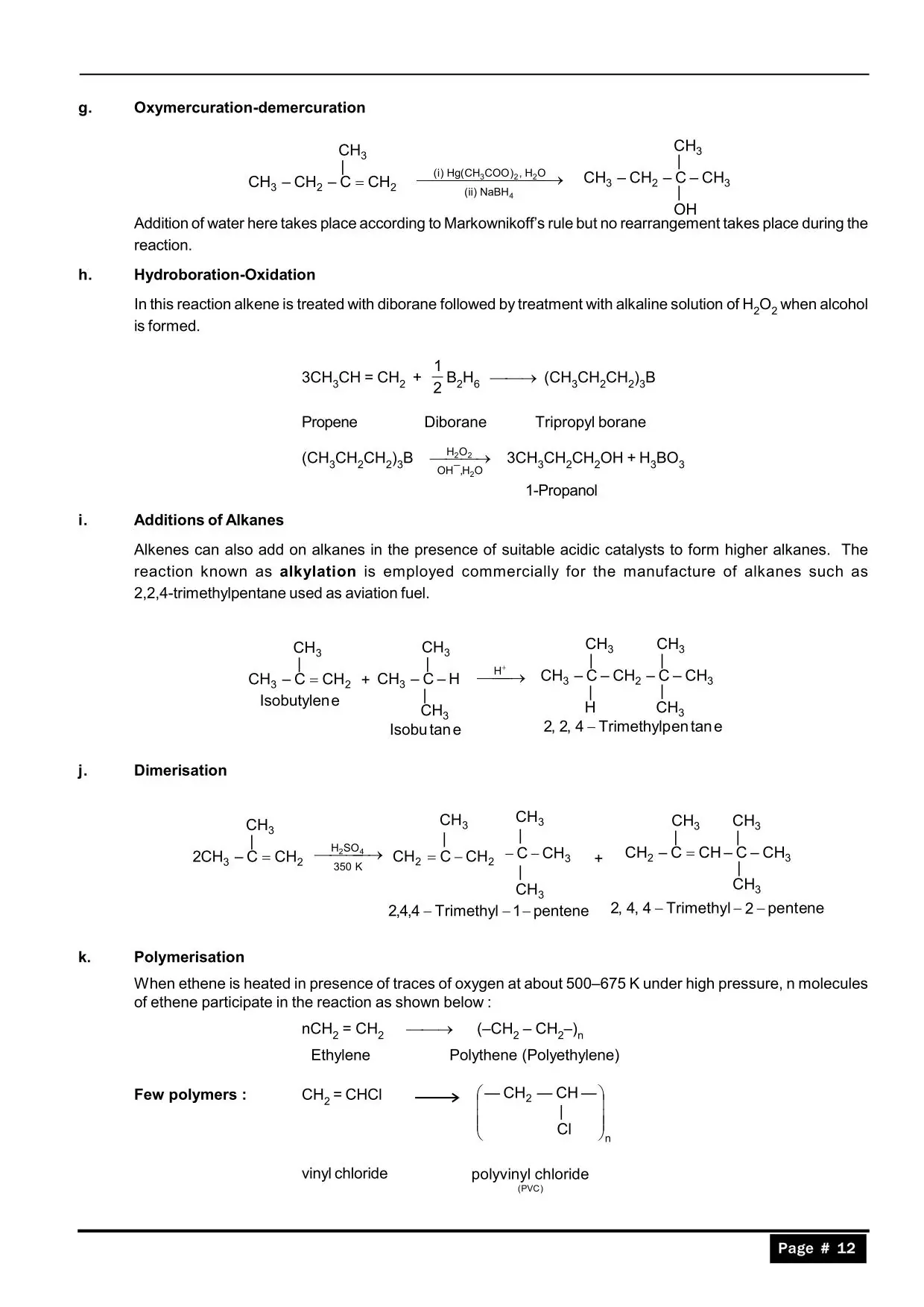
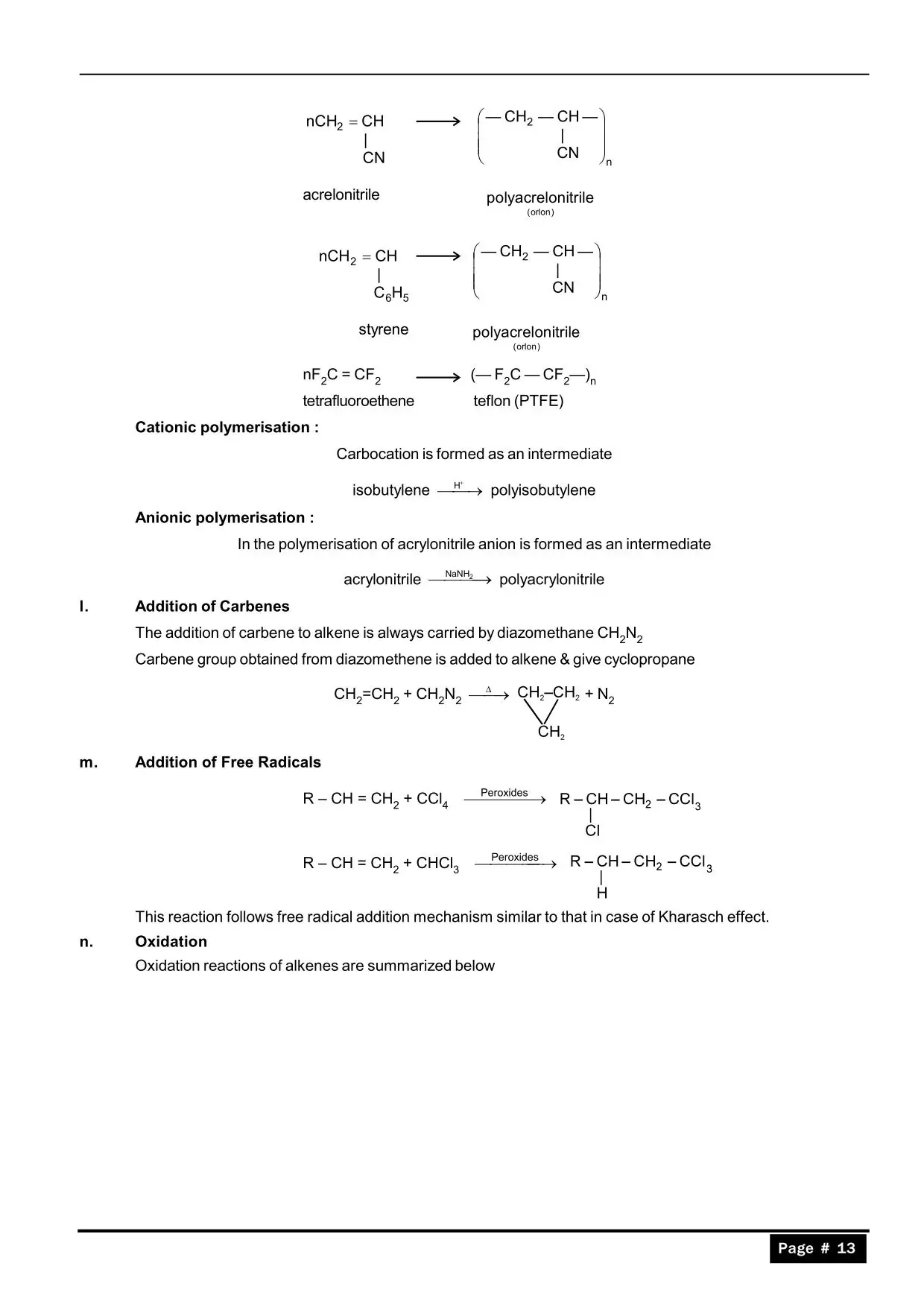
Polymerisation: $\mathrm{nCH_2{=}CH_2 \rightarrow -(CH_2{-}CH_2)_n-}$ (polythene).
Alkynes in Hydrocarbons Class 11 Notes
Preparation of alkynes
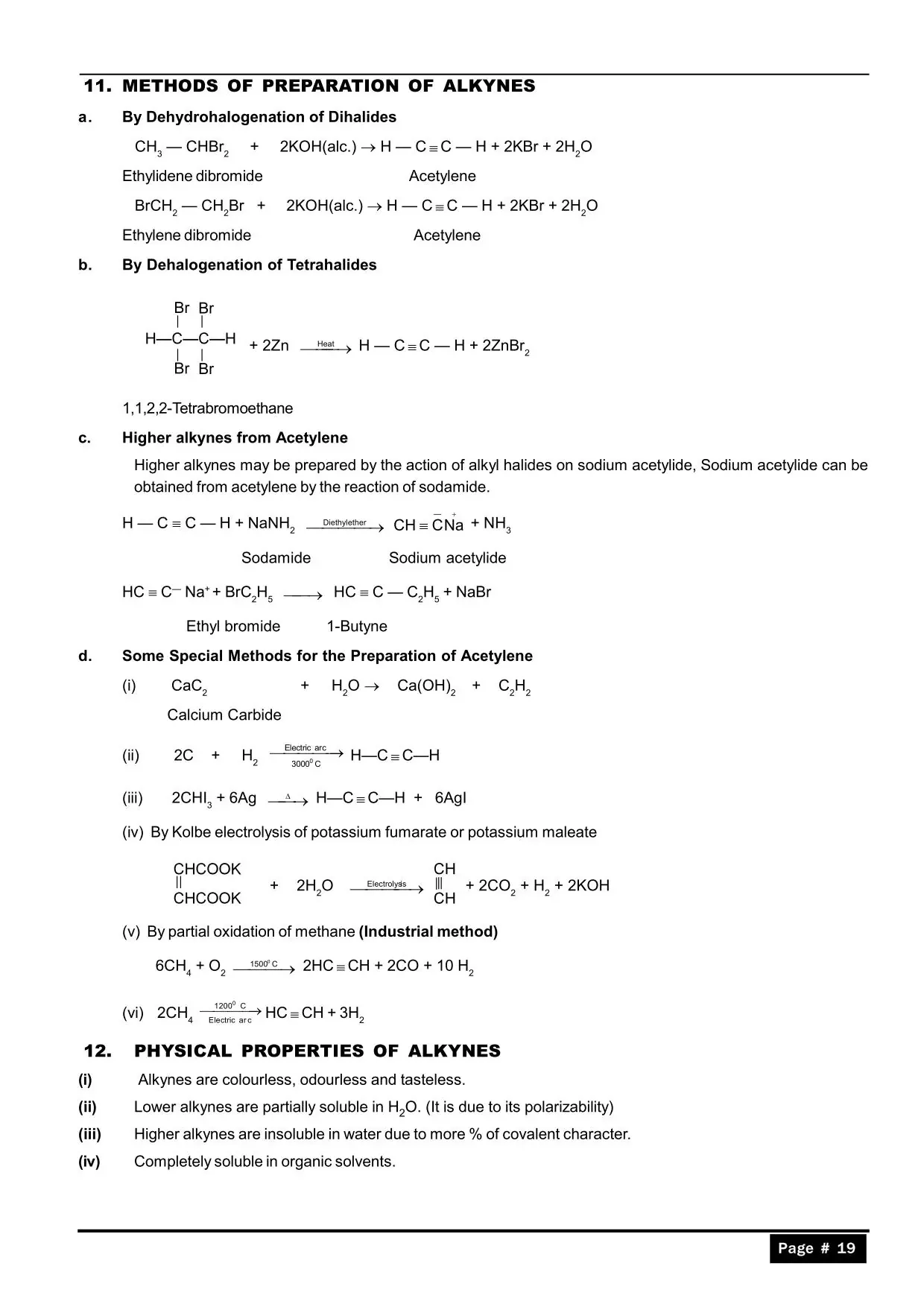
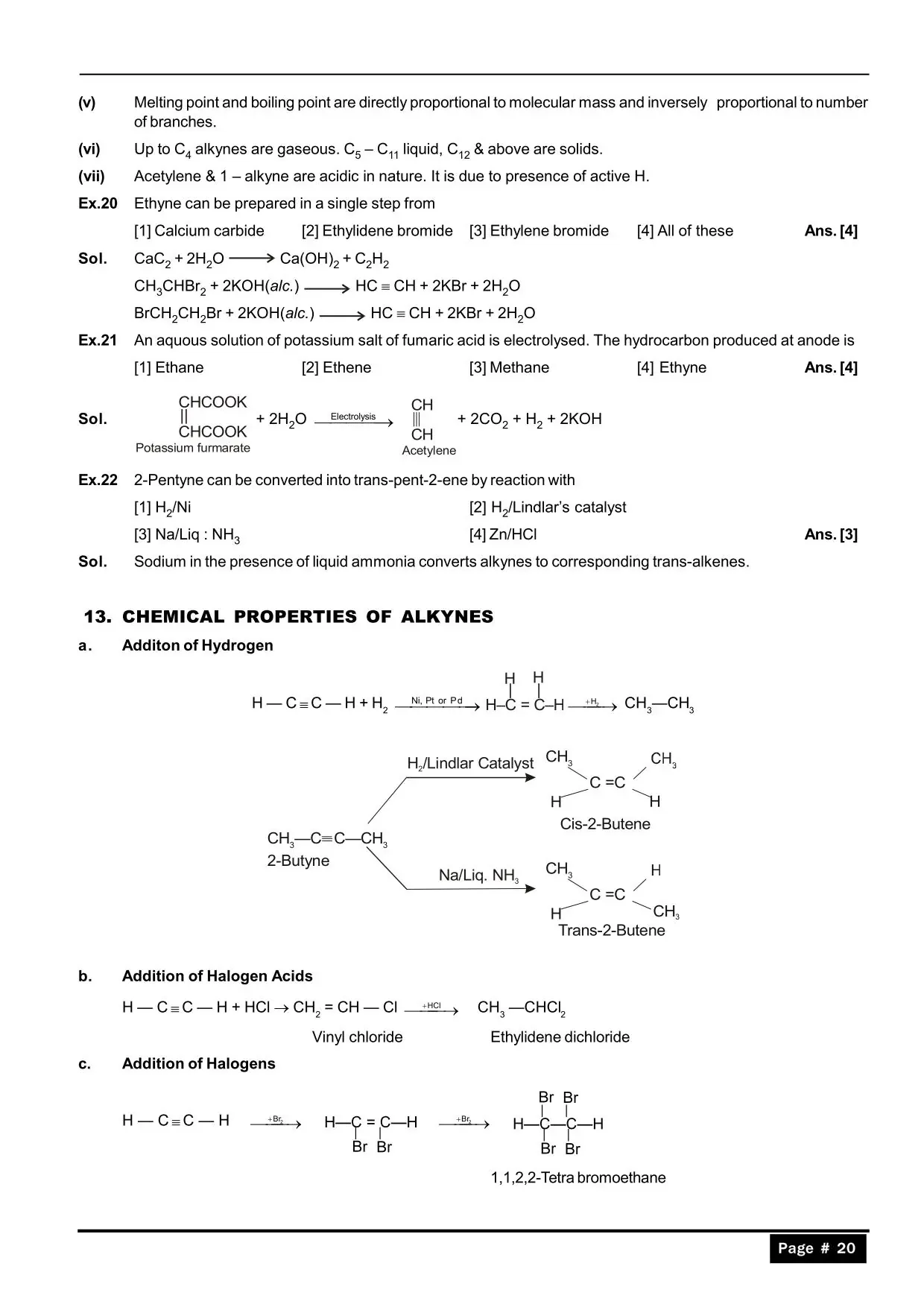
- From calcium carbide: $\mathrm{CaC_2 + 2H_2O \rightarrow HC{\equiv}CH + Ca(OH)_2}$.
- Dehydrohalogenation of vicinal dihalides with alcoholic KOH (and then $\mathrm{NaNH_2}$).
Acidity of Terminal Alkynes in Hydrocarbons Class 11 Notes
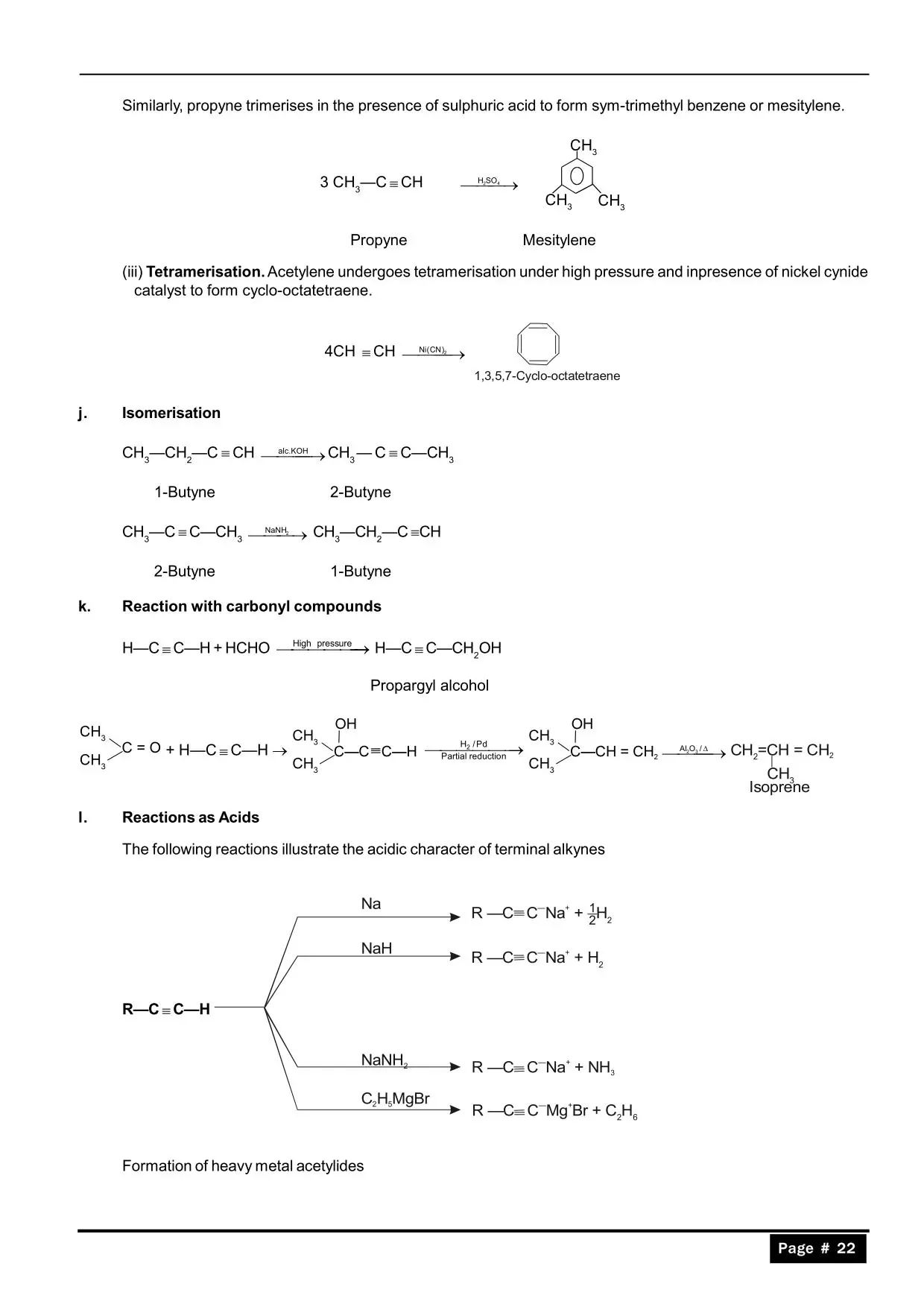
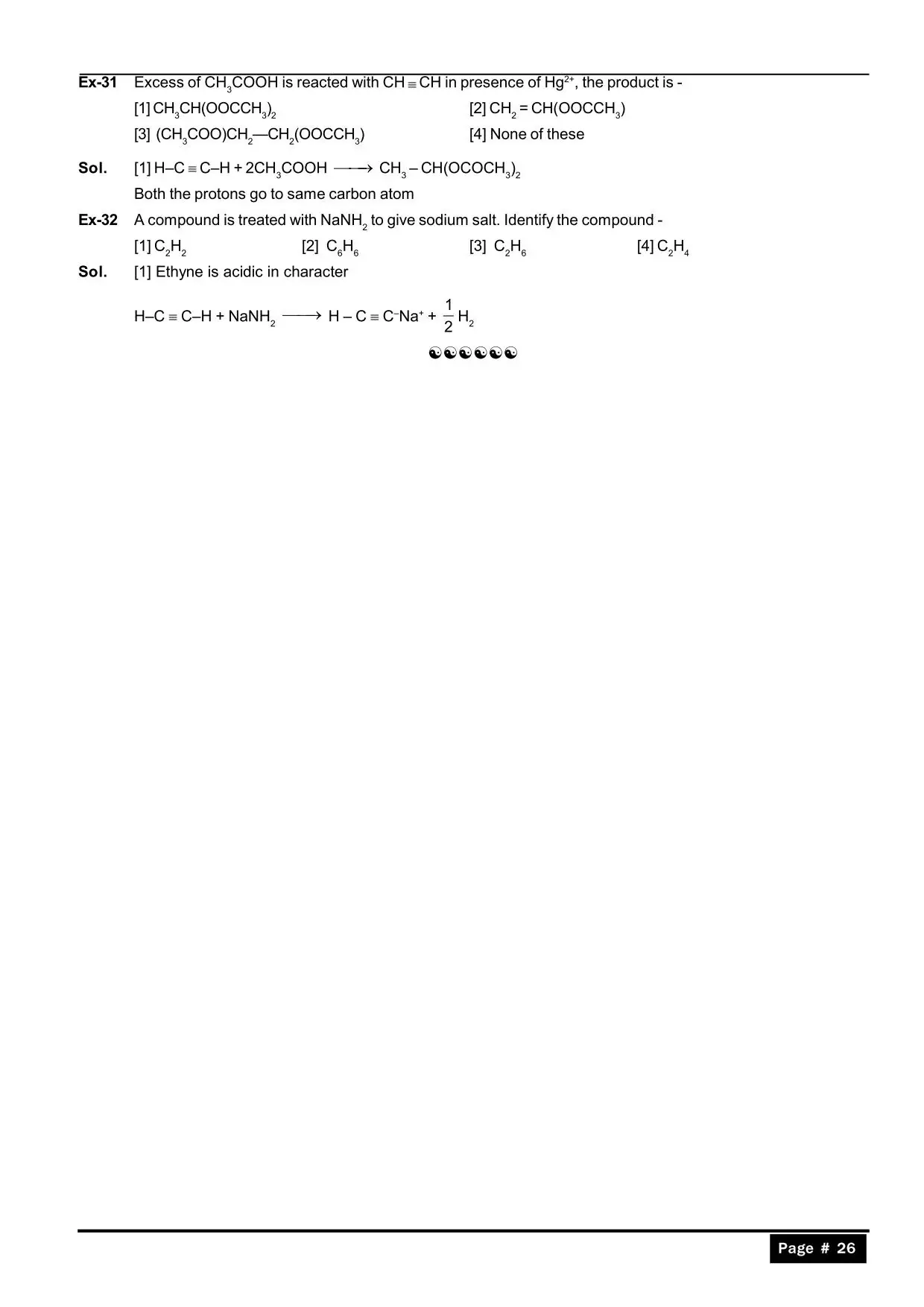
A hydrogen on an $sp$ carbon is acidic, because the $sp$ carbon is the most electronegative. The order of acidity is $\mathrm{HC{\equiv}CH > H_2C{=}CH_2 > H_3C{-}CH_3}$ ($\mathrm{p}K_a$ about 25, 44 and 50). Terminal alkynes react with a strong base and with some metal salts:
$$\mathrm{RC{\equiv}CH + NaNH_2 \rightarrow RC{\equiv}C^-Na^+ + NH_3}$$ $$\mathrm{RC{\equiv}CH + [Ag(NH_3)_2]^+ \rightarrow RC{\equiv}CAg\downarrow\ (\text{white})}$$ $$\mathrm{RC{\equiv}CH + [Cu(NH_3)_2]^+ \rightarrow RC{\equiv}CCu\downarrow\ (\text{red})}$$
Alkynes with the triple bond inside the chain (non-terminal) do not give these precipitates. The sodium alkynide can react with an alkyl halide to lengthen the carbon chain.
Addition reactions of alkynes
Reaction | Reagent | Result |
|---|---|---|
Complete hydrogenation | $\mathrm{H_2}$, Ni | Alkane |
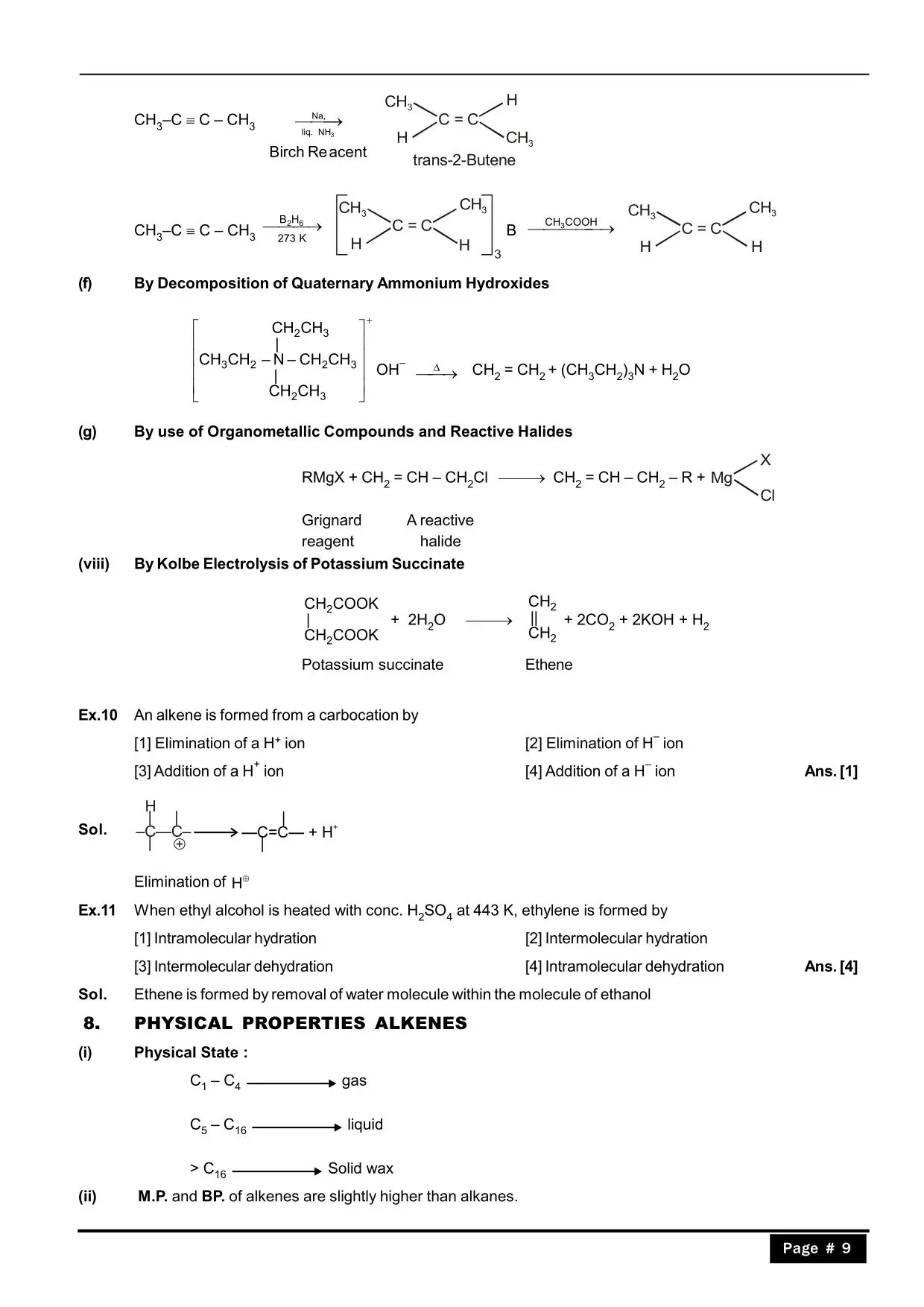
Partial hydrogenation, syn addition | $\mathrm{H_2}$, Lindlar’s catalyst (Pd poisoned with lead acetate and quinoline) | cis-Alkene |
Reduction, anti addition | Na in liquid $\mathrm{NH_3}$ (dissolving-metal reduction) | trans-Alkene |
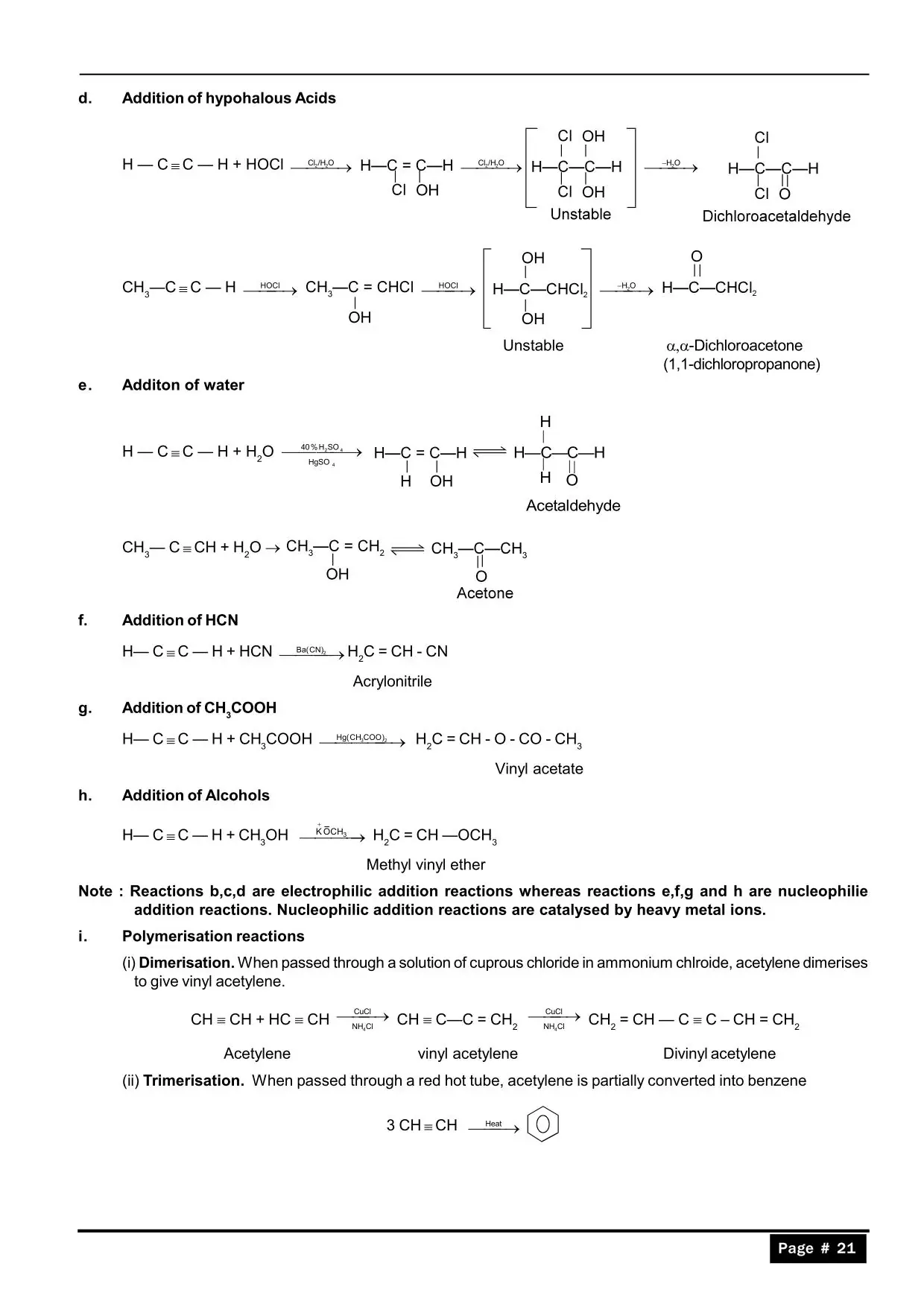
Halogenation | $\mathrm{Br_2}$ (1 or 2 moles) | Dibromoalkene, then tetrabromoalkane |
Addition of HX (2 moles, Markovnikov) | HBr | Gem-dibromide ($\mathrm{CH_3CBr_2R}$) |
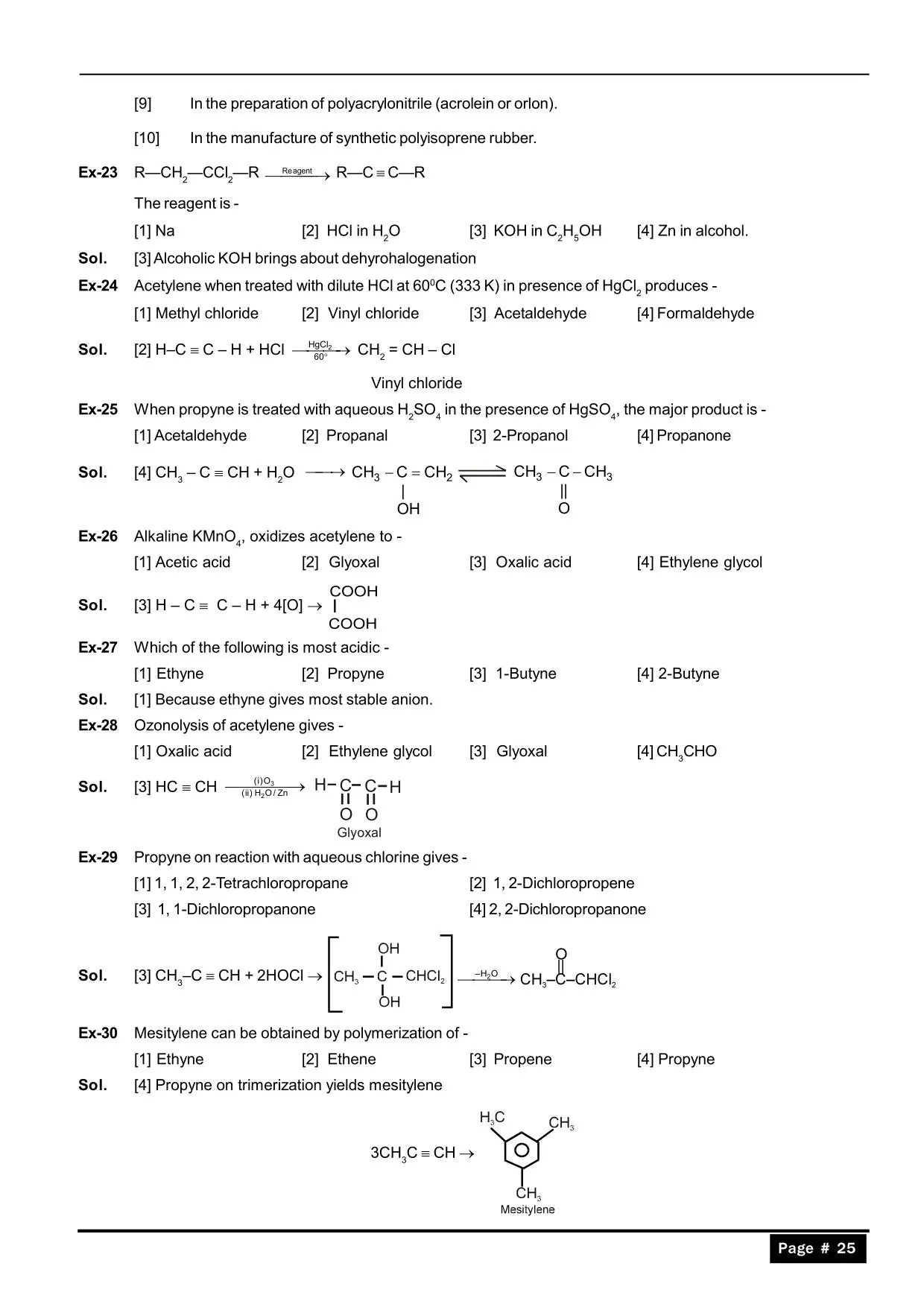
Hydration | Dilute $\mathrm{H_2SO_4}$, $\mathrm{HgSO_4}$ | An enol, which changes into a ketone (ethyne gives ethanal, and propyne gives propanone) |
Polymerisation | Ethyne through a red-hot iron tube (873 K) | Benzene |
Note: “Birch reduction” is the name of a different reaction, the reduction of benzene to 1,4-cyclohexadiene with Na in liquid $\mathrm{NH_3}$ and an alcohol. The reduction of an alkyne to a trans-alkene is called a dissolving-metal reduction.
Aromatic Hydrocarbons in Hydrocarbons Class 11 Notes
Structure of benzene and aromaticity
Benzene is a planar hexagon in which all the C–C bonds have the same length (about 139 pm). It is a resonance hybrid of the two Kekulé structures, and its resonance energy is about $150\ \mathrm{kJ\,mol^{-1}}$. A compound is aromatic if it is cyclic, planar, has a continuous cloud of $\pi$ electrons, and has $(4n + 2)$ $\pi$ electrons ($n = 0, 1, 2, \ldots$).
Species | $\pi$ electrons | Result |
|---|---|---|
Benzene, naphthalene | 6, 10 | Aromatic |
Cyclopentadienyl anion | 6 | Aromatic |
Cyclopropenyl cation | 2 | Aromatic |
Tropylium cation | 6 | Aromatic |
Cyclobutadiene | 4 | Antiaromatic |
Cyclooctatetraene | 8 | Non-planar, so not aromatic |
Electrophilic Aromatic Substitution (EAS) in Hydrocarbons Class 11 Notes
Mechanism: an electrophile $\mathrm{E^+}$ attacks the ring to give a resonance-stabilised carbocation (the arenium ion, or sigma complex). Then a proton is lost, and the aromatic ring is restored.
Reaction | Reagent | Electrophile | Product |
|---|---|---|---|
Nitration | Conc. $\mathrm{HNO_3}$ + conc. $\mathrm{H_2SO_4}$ | $\mathrm{NO_2^+}$ | Nitrobenzene |
Halogenation | $\mathrm{Cl_2}$ or $\mathrm{Br_2}$ with $\mathrm{FeCl_3}$ or $\mathrm{FeBr_3}$ | $\mathrm{Cl^+}$ or $\mathrm{Br^+}$ (polarised) | Chlorobenzene or bromobenzene |
Sulphonation | Fuming $\mathrm{H_2SO_4}$ (oleum) | $\mathrm{SO_3}$ | Benzenesulphonic acid (reversible) |
Friedel–Crafts alkylation | $\mathrm{RCl}$, anhydrous $\mathrm{AlCl_3}$ | $\mathrm{R^+}$ | Alkylbenzene |
Friedel–Crafts acylation | $\mathrm{RCOCl}$, anhydrous $\mathrm{AlCl_3}$ | $\mathrm{RC{\equiv}O^+}$ | Acylbenzene (a ketone) |
$$\mathrm{HNO_3 + 2H_2SO_4 \rightarrow NO_2^+ + H_3O^+ + 2HSO_4^-}$$
- Friedel–Crafts alkylation can give a rearranged product (carbocation shift) and more than one alkyl group. Acylation does not rearrange, and it stops after one acyl group.
- Both Friedel–Crafts reactions fail on strongly deactivated rings (for example nitrobenzene), and on rings with $\mathrm{-NH_2}$ (the amine binds to $\mathrm{AlCl_3}$).
Directing Effects of Substituents in Hydrocarbons Class 11 Notes
Group | Effect on the ring | Directs to |
|---|---|---|
$\mathrm{-OH}$, $\mathrm{-OR}$, $\mathrm{-NH_2}$, alkyl | Activating | ortho and para |
$\mathrm{-F}$, $\mathrm{-Cl}$, $\mathrm{-Br}$, $\mathrm{-I}$ | Deactivating | ortho and para |
$\mathrm{-NO_2}$, $\mathrm{-CN}$, $\mathrm{-CHO}$, $\mathrm{-COR}$, $\mathrm{-COOH}$, $\mathrm{-SO_3H}$ | Deactivating | meta |
Order of reactivity in nitration: toluene > benzene > chlorobenzene > nitrobenzene.
Other reactions of benzene and toluene
- Addition (hard): hydrogenation with Ni at 453–473 K gives cyclohexane, and chlorination in sunlight gives hexachlorocyclohexane (BHC). Birch reduction (Na, liquid $\mathrm{NH_3}$, alcohol) gives 1,4-cyclohexadiene.
- Toluene: $\mathrm{Cl_2/FeCl_3}$ gives ring substitution (ortho and para), and $\mathrm{Cl_2}$ with light gives side-chain substitution (benzyl chloride). Hot $\mathrm{KMnO_4}$ oxidises the side chain to benzoic acid.
- Combustion: benzene burns with a sooty flame because of its high carbon content. Polynuclear aromatic hydrocarbons can be carcinogenic.
Important Trends in Hydrocarbons Class 11 Notes
Topic | Trend |
|---|---|
Stability of carbocations and free radicals | $3^\circ > 2^\circ > 1^\circ > \mathrm{CH_3}$. Allylic and benzylic species are more stable |
Boiling points of alkanes | Increase with the molar mass, and decrease with branching |
Alkene stability | More substituted > less substituted. trans > cis |
Acidity of C–H | $sp > sp^2 > sp^3$ |
Reactivity of benzene derivatives (EAS) | Activating groups increase the rate, and deactivating groups decrease it |
Bond lengths | C–C 154 pm > C=C 134 pm > C≡C 120 pm |
Summary of Reactions in Hydrocarbons Class 11 Notes
Hydrocarbon | Reaction | Reagent | Product |
|---|---|---|---|
Alkane | Free radical halogenation | $\mathrm{X_2}$, light | Haloalkane |
Alkene | Markovnikov addition | HX | More substituted halide |
Alkene | Peroxide effect | HBr, peroxide | Less substituted bromide |
Alkene | Ozonolysis | $\mathrm{O_3}$, then $\mathrm{Zn/H_2O}$ | Aldehydes and ketones |
Alkene | Baeyer’s test | Cold, dilute $\mathrm{KMnO_4}$ | Diol |
Alkyne | Partial hydrogenation | $\mathrm{H_2}$, Lindlar | cis-Alkene |
Alkyne | Dissolving-metal reduction | Na, liquid $\mathrm{NH_3}$ | trans-Alkene |
Alkyne | Acidic character | $\mathrm{NaNH_2}$ | Sodium alkynide |
Alkyne | Test for a terminal alkyne | $\mathrm{AgNO_3/NH_3}$ | White precipitate |
Alkyne | Hydration | $\mathrm{H_2SO_4}$, $\mathrm{HgSO_4}$ | Ketone (ethanal from ethyne) |
Benzene | Nitration | $\mathrm{HNO_3 + H_2SO_4}$ | Nitrobenzene |
Benzene | Friedel–Crafts | $\mathrm{RCl}$ or $\mathrm{RCOCl}$, $\mathrm{AlCl_3}$ | Alkyl or acylbenzene |
IIT JEE and NEET Tips for Hydrocarbons Class 11 Notes
- Count the products of halogenation: group the hydrogens that are equivalent, and write one product for each group. Add the stereoisomers if a product has a chiral centre.
- Check for a carbocation shift whenever an alkene (or an alcohol) reacts through a carbocation.
- Identify the reagent first: Lindlar (cis), Na and liquid $\mathrm{NH_3}$ (trans), peroxide (anti-Markovnikov), cold $\mathrm{KMnO_4}$ (diol), hot $\mathrm{KMnO_4}$ (cleavage).
- For ozonolysis problems, join the carbonyl carbons with a double bond to get back the alkene.
- In EAS problems, find the directing group first. Remember that halogens are deactivating and ortho, para directing.
- Test questions: $\mathrm{Br_2/CCl_4}$ and Baeyer’s reagent show unsaturation, and $\mathrm{AgNO_3/NH_3}$ shows a terminal alkyne.
Solved Examples from Hydrocarbons Class 11 Notes
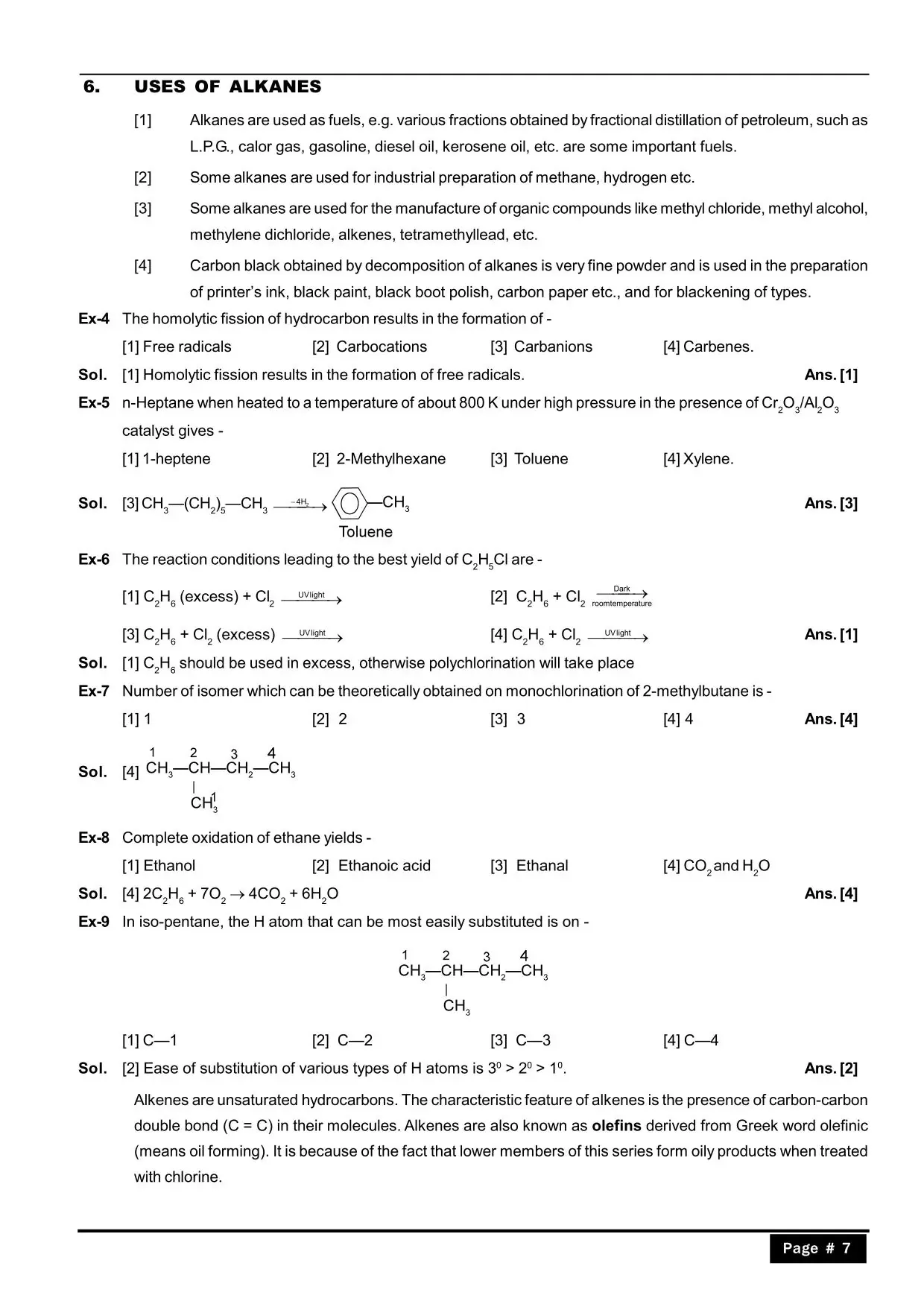
Example 1 (number of products): How many monochloro products (structural, and with stereoisomers) does 2-methylbutane give? Estimate the percentage of each with the rates $1^\circ : 2^\circ : 3^\circ = 1 : 3.8 : 5$.
There are four types of hydrogen: (a) 6 H on the two $\mathrm{CH_3}$ groups at C-2 (gives 1-chloro-2-methylbutane, chiral), (b) 1 H on C-2 ($3^\circ$, gives 2-chloro-2-methylbutane), (c) 2 H on C-3 ($2^\circ$, gives 2-chloro-3-methylbutane, chiral), and (d) 3 H on C-4 (gives 1-chloro-3-methylbutane). So there are 4 structural isomers, and 6 with stereoisomers (two chiral products, with two enantiomers each). The relative yields are $6\times1 = 6$, $1\times5 = 5$, $2\times3.8 = 7.6$ and $3\times1 = 3$, which are about 28%, 23%, 35% and 14%.
Example 2 (Markovnikov and the peroxide effect): Give the product of propene with HBr, with and without a peroxide.
Without a peroxide, the product is 2-bromopropane ($\mathrm{CH_3CHBrCH_3}$). With a peroxide, it is 1-bromopropane ($\mathrm{CH_3CH_2CH_2Br}$).
Example 3 (carbocation rearrangement): Predict the major product of 3-methylbut-1-ene with HBr.
$\mathrm{H^+}$ adds to $\mathrm{CH_2{=}}$ to give the $2^\circ$ carbocation $\mathrm{(CH_3)_2CH\overset{+}{C}HCH_3}$. A hydride shift gives the $3^\circ$ carbocation $\mathrm{(CH_3)_2\overset{+}{C}CH_2CH_3}$. So the major product is 2-bromo-2-methylbutane.
Example 4 (ozonolysis): An alkene gives $\mathrm{CH_3CHO}$ and $\mathrm{CH_3COCH_3}$ on ozonolysis with $\mathrm{Zn/H_2O}$. Find the alkene.
Join the two carbonyl carbons with a double bond: $\mathrm{CH_3CH{=}C(CH_3)_2}$, which is 2-methylbut-2-ene.
Example 5 (oxidation): Give the products of the hot, acidic $\mathrm{KMnO_4}$ oxidation of 2-methylbut-2-ene.
The $\mathrm{=C(CH_3)_2}$ end gives propanone ($\mathrm{CH_3COCH_3}$), and the $\mathrm{=CHCH_3}$ end gives ethanoic acid ($\mathrm{CH_3COOH}$).
Example 6 (stereochemistry): What do you get from but-2-yne with (a) $\mathrm{H_2}$/Lindlar and (b) Na in liquid $\mathrm{NH_3}$?
(a) cis-but-2-ene (syn addition). (b) trans-but-2-ene (anti addition).
Example 7 (hydration of an alkyne): Give the product of the hydration of propyne with $\mathrm{H_2SO_4/HgSO_4}$.
The enol $\mathrm{CH_3C(OH){=}CH_2}$ is formed first, and it changes into propanone, $\mathrm{CH_3COCH_3}$.
Example 8 (a chemical test): How can you distinguish but-1-yne from but-2-yne?
Add $\mathrm{AgNO_3/NH_3}$. But-1-yne (terminal) gives a white precipitate of the silver alkynide. But-2-yne gives no precipitate.
Example 9 (directing effects): Give the major products of (a) the nitration of toluene, and (b) the bromination of nitrobenzene with $\mathrm{Br_2/FeBr_3}$.
(a) $\mathrm{-CH_3}$ is an ortho, para director, so the products are o-nitrotoluene and p-nitrotoluene. (b) $\mathrm{-NO_2}$ is a meta director, so the product is m-bromonitrobenzene.
Example 10 (aromaticity): Classify the cyclopentadienyl anion, the cyclopropenyl cation and cyclobutadiene.
The cyclopentadienyl anion has 6 $\pi$ electrons ($4n+2$, $n=1$), so it is aromatic. The cyclopropenyl cation has 2 $\pi$ electrons ($n=0$), so it is aromatic. Cyclobutadiene has 4 $\pi$ electrons ($4n$), so it is antiaromatic.
Example 11 (isomers): How many isomers does $\mathrm{C_5H_{12}}$ have, and how many alkenes (with stereoisomers) does $\mathrm{C_4H_8}$ have?
$\mathrm{C_5H_{12}}$: pentane, 2-methylbutane and 2,2-dimethylpropane, so 3. $\mathrm{C_4H_8}$ alkenes: but-1-ene, cis-but-2-ene, trans-but-2-ene and 2-methylpropene, so 4.
Example 12 (acidity and chain extension): Arrange ethane, ethene and ethyne in the order of acidity, and show how propyne can be converted into but-2-yne.
Acidity: ethyne > ethene > ethane ($sp > sp^2 > sp^3$). $\mathrm{CH_3C{\equiv}CH + NaNH_2 \rightarrow CH_3C{\equiv}C^-Na^+}$, and then $\mathrm{CH_3C{\equiv}C^-Na^+ + CH_3Br \rightarrow CH_3C{\equiv}CCH_3 + NaBr}$.
Common Mistakes in Hydrocarbons Class 11 Notes Problems
Mistake | Correct approach |
|---|---|
Calling the reduction of an alkyne with Na and liquid $\mathrm{NH_3}$ a “Birch reduction” | It is a dissolving-metal reduction. Birch reduction is for benzene rings |
Writing Lindlar’s catalyst as $\mathrm{Pd/BaSO_4}$ and quinoline | Lindlar’s catalyst is Pd poisoned with lead acetate and quinoline. Pd on $\mathrm{BaSO_4}$ is used in the Rosenmund reduction |
Using the peroxide effect for HCl or HI | It works only for HBr |
Forgetting a carbocation shift | Check whether a more stable carbocation can form |
Saying that halogens are meta directors | They are deactivating, but they direct ortho and para |
Using Friedel–Crafts on nitrobenzene or aniline | It fails on strongly deactivated rings and on $\mathrm{-NH_2}$ |
Giving the same number of products for chlorination and bromination | The ratio of the products differs, because bromination is more selective |
Saying that alkynes give the silver test even when they are non-terminal | Only terminal alkynes ($\mathrm{RC{\equiv}CH}$) do |
How to Study Hydrocarbons Class 11 Notes
- Read the NCERT chapter first, and download the textbook from eSaral’s NCERT books for Class 11 page. Revise the electronic effects in the GOC notes.
- Learn the mechanisms (free radical halogenation, electrophilic addition and EAS) before the reactions, and write each reaction with its reagent and product.
- Practise one problem each on counting products, Markovnikov and peroxide addition, ozonolysis, alkyne reductions, directing effects and aromaticity.
- Revise with eSaral’s Organic Chemistry Revision Series (videos and mind maps), and see the next topic in eSaral’s Halogen Derivatives notes.
- Test yourself with eSaral’s JEE Main chapter-wise PYQs and NEET chapter-wise PYQs.
Frequently Asked Questions
What are the most important topics in Hydrocarbons Class 11 for NEET?
The most important topics are Markovnikov’s rule and the peroxide effect, ozonolysis and the oxidation of alkenes, the acidity of terminal alkynes with the silver and copper tests, the cis and trans reductions of alkynes, aromaticity, and electrophilic aromatic substitution with directing effects. The number of questions changes every year, so check previous years’ papers. eSaral’s Hydrocarbons Class 11 Notes cover each of these with reactions and solved examples.
What is Markovnikov's rule and how is it tested in JEE Main?
In the addition of HX to an unsymmetrical alkene, the hydrogen adds to the carbon that has more hydrogens, so the halogen goes to the more substituted carbon. The reason is that the more stable carbocation forms. JEE Main asks for the major product of HBr with an alkene, including carbocation rearrangements, and contrasts it with the peroxide effect. In Hydrocarbons Class 11 Notes, the rule is explained with the mechanism.
What is the difference between Lindlar’s catalyst and sodium in liquid ammonia in alkyne reduction?
Lindlar’s catalyst (palladium poisoned with lead acetate and quinoline) with $\mathrm{H_2}$ gives a cis-alkene by syn addition. Sodium in liquid ammonia gives a trans-alkene by anti addition. The second reaction is called a dissolving-metal reduction, and it is not the Birch reduction, which is the reduction of benzene to 1,4-cyclohexadiene.
How do you test for an alkene, an alkyne and a terminal alkyne?
In Hydrocarbons Class 11 Notes, bromine in $\mathrm{CCl_4}$ (the red-brown colour disappears) and cold dilute $\mathrm{KMnO_4}$ (the purple colour disappears) show unsaturation in both alkenes and alkynes. To show a terminal alkyne, add $\mathrm{AgNO_3/NH_3}$ (a white precipitate) or $\mathrm{Cu_2Cl_2/NH_3}$ (a red precipitate).
What is the peroxide effect?
In Hydrocarbons Class 11 Notes, the peroxide effect means that HBr adds to an alkene by a free radical chain mechanism in the presence of peroxides, and the bromine goes to the less substituted carbon (anti-Markovnikov). It does not work with HCl or HI.
What is aromaticity, and what is Hückel’s rule?
A compound is aromatic if it is cyclic, planar, has a continuous cloud of $\pi$ electrons and has $(4n+2)$ $\pi$ electrons. Benzene has 6, so it is aromatic. Cyclobutadiene has 4 $\pi$ electrons, so it is antiaromatic. These Hydrocarbons Class 11 Notes have a table of examples.
Why does Friedel–Crafts alkylation give rearranged products, and how can it be avoided?
In Hydrocarbons Class 11 Notes, the alkylating agent forms a carbocation, which can shift to a more stable one before it attacks the ring. To avoid this, first do an acylation (which does not rearrange), and then reduce the ketone to an alkyl group (Clemmensen or Wolff–Kishner reduction).
How do you count the monohalogenated products of an alkane?
In Hydrocarbons Class 11 Notes, group the hydrogens that are equivalent, and write one product for each group. If a product has a chiral centre, add its stereoisomers. For the relative amounts, multiply the number of hydrogens by the reactivity of each type ($1^\circ : 2^\circ : 3^\circ = 1 : 3.8 : 5$ for chlorination).
Which chapter number is Hydrocarbons in Class 11 Chemistry?
In the current NCERT Class 11 Chemistry book, Hydrocarbons is Chapter 9 (Chapter 13 in older books), and it follows Organic Chemistry: Some Basic Principles and Techniques. These Hydrocarbons Class 11 Notes follow the NCERT chapter and add the IIT JEE and NEET topics.
Where can I find more Class 11 Chemistry notes on eSaral?
eSaral has chapter-wise Class 11 Chemistry notes, an Organic Chemistry Revision Series with videos and mind maps, NCERT books, JEE Main and NEET chapter-wise PYQs, and these Hydrocarbons Class 11 Notes, all linked on this page.
Team eSaral
eSaral Academic and Editorial Team
Team eSaral is the collective author profile for educational content created by eSaral’s teachers and academic contributors. The team draws on expertise from IIT graduates, doctors, experienced educators and subject specialists to develop resources for JEE, NEET and school students. Our articles aim to explain concepts clearly and help students study with confidence.
Related Posts

BITSAT 2027: Registration Date, Exam Date, Syllabus, Eligibility, Pattern & Fees
BITSAT 2027 exam dates, registration timeline, eligibility criteria, exam pattern, marking scheme, syllabus and fees in one page.

BITSAT Previous Year Question Paper PDF (2017-2026)
Download BITSAT previous year question papers PDF from 2017 to 2026,session-wise. Memory-based papers,exam pattern, paper analysis and how to practise

CBSE Class 10 Date Sheet 2027: Expected Exam Dates, Release Date, Admit Card & Result Timeline
CBSE Class 10 date sheet 2027 is awaited. See the expected exam dates, release window, how to download the PDF, admit card and result timelines.

NCERT Physics Class 10 Book PDF in Hindi 2026-27 – भौतिक विज्ञान के 4 अध्याय (Free Download)
NCERT Physics Class 10 book PDF in Hindi 2026-27: download all 4 chapters (अध्याय 9–12) free, with topics and important formulas.

NCERT Biology Class 9 Book Anveshan PDF in Hindi - जीव विज्ञान कक्षा 9 पुस्तक अन्वेषण PDF
Download NCERT Biology Class 9 book PDF in Hindi chapterwise for 2026-27: Cell, Tissues, Reproduction and Diversity. Free PDFs.

Essay On Artificial Intelligence in English (100,150, 200, 250, 300, 500 Words)
This is in contrast to the natural intelligence of humans. With Artificial Intelligence, machines can perform

Essay on 78th India Independence Day in English for Student (100, 150, 200, 250, 300, 500 Words)
Read the best essays on India's Independence Day in English. Short & long essays (100, 150, 200, 250, 300, 500 words) perfect for school exams
NCERT Class 11 English Snapshots book - Free PDF download- Esaral
Download NCERT Class 11 English Snapshots book PDF for free. Get all 8 chapters, chapter-wise. Start your prep today!
NCERT Class 10 biology book pdf - Free PDF Download - eSaral
NCERT Class 10 Biology book PDF 2026-27: all 5 chapters (Life Processes to Our Environment) in English & Hindi, with CBSE syllabus, marks & practical

Essay on Global Warming in English (100,150, 200, 250, 300, 500 Words)
Global warming means the Earth is getting hotter. This happens because of things like pollution from cars and factories.