
JEE 2028 Preparation for Class 11: The Complete 2-Year Roadmap by IIT Faculty

eSaral › JEE › JEE Main ›JEE 2028 Preparation for Class 11

🚀 Checkout eSaral Courses
Why Starting JEE 2028 Preparation in Class 11 Changes Everything
Most students underestimate what two full years can do for their JEE rank.
When you start JEE preparation in Class 11, you get time for something most students never experience: multiple complete revisions of the entire syllabus. Students who begin in Class 12 or as droppers are always catching up. Students who begin in Class 11 are always building ahead.
Consider the data from JEE Advanced 2025: the general category cut-off was 92 marks, and the last-placed qualifier scored approximately 20 marks higher than their 2024 equivalent. Boards have improved. Competition has sharpened. Students are studying better content earlier. Starting late is no longer an option if a top IIT is the goal.
What Changes When You Start in Class 11?
- You cover concepts at a learning pace, not a cramming pace
- Boards and JEE preparation run in parallel without last-minute panic
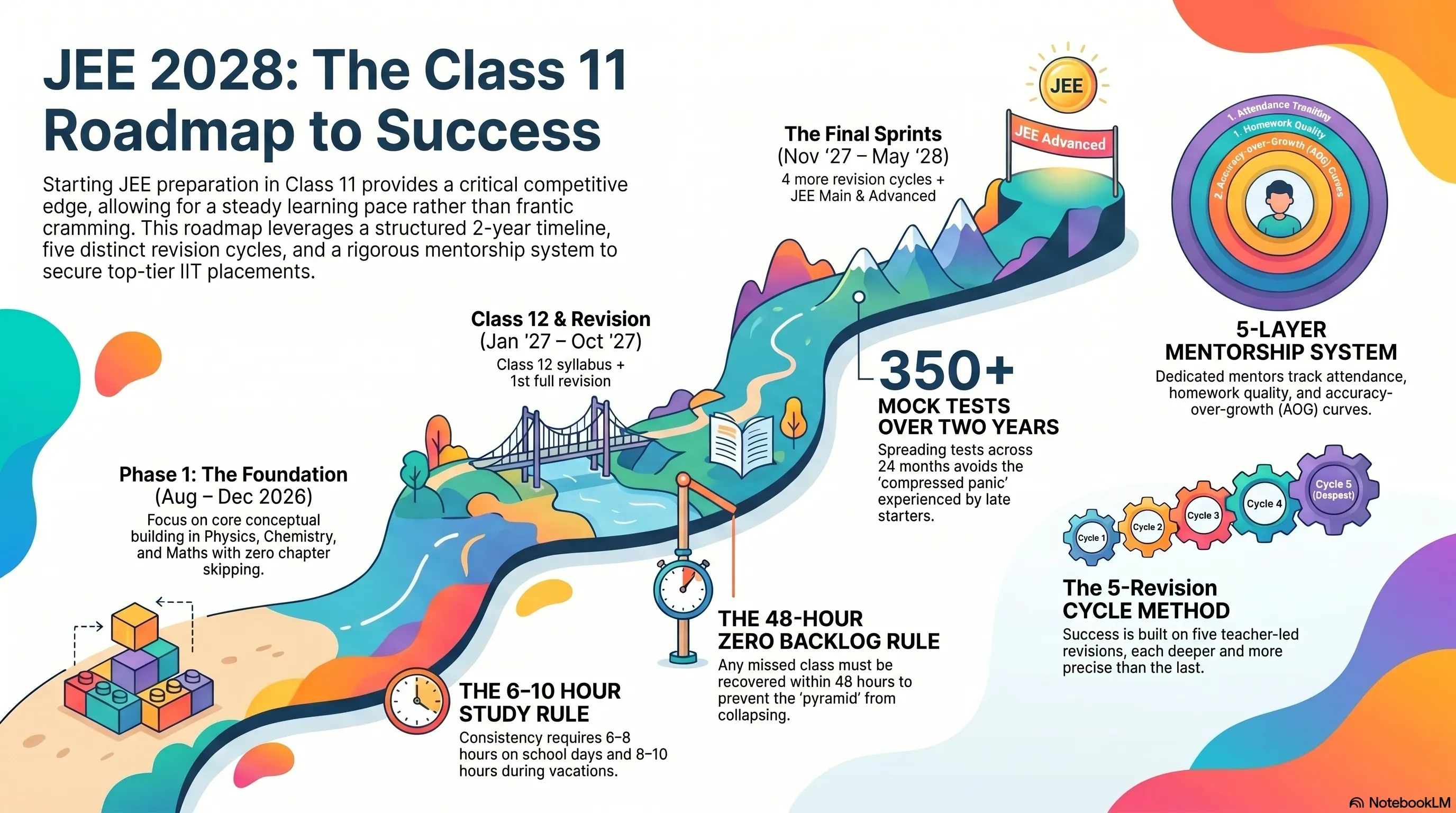
- You get 350+ mock tests spread over two years, not compressed into six months
- Five full revision cycles become achievable — each one deeper than the last
💡 Expert Tip by Saransh Gupta, IIT Bombay AIR-41: "The students who cracked the top 100 in JEE Advanced 2025 from eSaral weren't geniuses — they were students who started early, revised five times, and never skipped a test. Kushagr from Jabalpur, who got AIR 1255, studied completely online from home. Consistency beats talent every time."
The 2-Year JEE Preparation Timeline: Month-by-Month Breakdown
Here is the exact timeline followed by eSaral's 2025 top rankers — students who achieved ranks of 79, 112, 175, 236, and 260 in JEE Advanced.
Phase | Period | Focus |
|---|---|---|
Phase 1 — Class 11 Foundation | Aug 2026 – Dec 2026 | Complete Class 11 JEE syllabus (Physics, Chemistry, Maths) |
Phase 2 — Class 12 Launch | Jan 2027 – Oct 2027 | Class 12 syllabus + simultaneous Class 11 Revision 1 |
Phase 3 — Revision 2 | Nov 2027 – Dec 2027 | Second full revision of entire syllabus |
Phase 4 — JEE Main Sprint | Dec 2027 – Jan 2028 | Revision 3 + JEE Main Session 1 preparation |
Phase 5 — Boards + Revision 4 | Feb 2028 – Mar 2028 | Board exams + Revision 4 |
Phase 6 — JEE Advanced Final | Apr 2028 – May 2028 | Revision 5 — JEE Advanced precision preparation |
How to Execute Phase 1 (Class 11 Foundation)
The first five months are the most important. This is where your conceptual foundation is built. Focus areas:
- Physics: Mechanics (Kinematics, Laws of Motion, Work-Energy, Rotational Motion)
- Chemistry: Mole Concept, Atomic Structure, Chemical Bonding, Thermodynamics
- Maths: Sets & Relations, Trigonometry, Straight Lines, Quadratic Equations, Permutations
Do not skip chapters. Every JEE Advanced question is multi-concept — a weak chapter in Class 11 will cost you marks two years from now.
How Many Hours Should You Study for JEE Daily?
JEE 2028 preparation from Class 11 requires 6–8 hours of focused study per day during school days, and 8–10 hours during vacations and revision phases. Quality matters far more than raw hours.
The Daily Schedule That Works
Time Block | Activity |
|---|---|
6:00 AM – 7:30 AM | Self-study: review previous day's class notes |
School hours | School + board syllabus |
5:00 PM – 8:00 PM | Live online coaching class (3 hours) |
8:30 PM – 10:30 PM | Homework, DPP problems, doubt clearing |
10:30 PM – 11:00 PM | Review what you solved; mark weak areas |
How Much Backlog Is Acceptable?
Zero backlog is the goal — but this needs to be managed realistically. If you miss a class or fall behind on a chapter, recover it within 48 hours. Backlog that accumulates beyond one week compounds quickly. During eSaral's top students' preparation, mentors tracked attendance and called students who missed classes to ensure same-week recovery.
The 5-Revision Cycle Method: How Top Rankers Actually Study
What Is the 5-Revision Cycle?
Most coaching institutes tell you to "revise before the exam." eSaral's top rankers revise five times, each with a teacher, not alone. Here is what each cycle does:
- Revision 1 (During Class 12, alongside new chapters): First re-visit of Class 11 topics
- Revision 2 (Nov–Dec 2027): Full syllabus sweep; identify weak chapters
- Revision 3 (Dec 2027 – Jan 2028): JEE Main-focused; speed and accuracy training
- Revision 4 (Feb–Mar 2028): Boards coverage + integrated JEE revision
- Revision 5 (Apr–May 2028): JEE Advanced precision — the hardest problems, timed
Why Revising With a Teacher Changes Everything
Kushagr, who prepared entirely online from Jabalpur, used a specific strategy: he watched the pre-recorded visualisation lectures before each live class. By the time the live session started, his teacher's explanation served as his first revision. So by the end of Phase 1, he had already revised every chapter twice.
His result: AIR 1255 in JEE Advanced 2025.
How to Study a Chapter for Maximum Retention
- Watch the visualisation/concept lecture first (no note-taking, just understanding)
- Attend the live class — take structured notes here
- Solve CPP (Core Practice Problems) the same evening
- Attempt the chapter test within 48 hours
- Review test analysis: mark every error by category (silly mistake / conceptual gap / time issue)
What Study Material Do You Actually Need for JEE 2028?
Students often buy 10 books and finish none. The answer to "what material should I study" is simpler than you think.
Material | Purpose | Priority |
|---|---|---|
eSaral Modules | Primary theory + solved examples | Must-do |
NCERT (all three subjects) | Foundation + board integration | Must-do |
CPPs (Core Practice Problems) | Daily problem solving | Must-do |
Shaktimann Quiz | Speed + accuracy drills | High |
Super Quiz | Multi-concept application | High |
Special Sub-26 | Chapter-end challenge problems | Medium-High |
Rank Boosters | Top-level JEE Advanced questions | Phase 5 only |
Previous Year Papers (JEE Advanced question papers) | Pattern recognition + real exam feel | Must-do (Phase 4 onward) |
What You Should NOT Do
- Do not purchase multiple coaching modules from different institutes
- Do not attempt Rank Boosters before completing CPPs
- Do not skip NCERT in Chemistry — most organic and inorganic questions in JEE Main are NCERT-based
- Do not solve problems without writing solutions on paper (mental solving does not build exam muscle memory)
How Does Mentorship Help You Get a Top 100 JEE Advanced Rank?
This is the single biggest differentiator between students who crack top-100 ranks and those who don't.
The 5-Layer Mentorship System
At eSaral, every student is assigned two dedicated mentors — separate from their subject teachers. These mentors track:
- Attendance: Miss a class, get a call the same day
- Notes and homework: Checked regularly for quality and completeness
- Test analysis: Every test report reviewed — per-question, per-subject, per-student
- AOG Analysis (Accuracy-Over-Growth): Tracks Physics, Chemistry, and Maths performance curves over time
- Backlog recovery: Dedicated sessions are scheduled when a student falls behind
How Mentorship Works in Practice
Parents get the mentor's phone number directly. Students can call their mentor any time. Weekly scheduled check-ins happen regardless. This is not a chatbot or a ticket system — it is a real person who knows your weak chapters, your distraction patterns, and your exam-day readiness.
In 2026, eSaral achieved India's highest JEE Advanced selection ratio for the fifth consecutive year — with 1,600+ students qualifying from a limited-enrollment batch. That ratio is the direct result of one thing: a system that tracks every student, every week, without exception.
For students who want Kota-level faculty without relocating, eSaral's online batch delivers live, two-way interactive classes where your video is on, your copy can be checked, and you can speak directly to your teacher. It is the closest thing to an offline classroom that online coaching has produced.
If you are a Class 10 student moving to Class 11 and targeting JEE 2028, explore the eSaral JEE 2028 BrahMos course — both online and offline options are available, with limited seats.
🚀 Checkout eSaral Courses
Frequently Asked Questions
How should a Class 11 student start JEE 2028 preparation from scratch?
Start JEE 2028 preparation in Class 11 by enrolling in a structured 2-year course as soon as Class 10 boards end — ideally July or August 2026. Begin with Class 11 Physics (Mechanics), Chemistry (Mole Concept), and Maths (Trigonometry and Quadratic Equations). Maintain zero backlog from day one and attempt chapter tests within 48 hours of completing each topic.
Can I crack the JEE Advanced top 100 with online coaching?
Yes. Multiple eSaral students achieved top-100 JEE Advanced ranks through fully online preparation. AIR 79, 112, and 175 were achieved by students who attended live interactive online classes. The key is two-way interaction — not pre-recorded videos alone — combined with regular tests, mentorship, and five full revision cycles.
How many hours should a Class 11 student study for JEE daily?
A Class 11 student targeting JEE 2028 should study 6–8 hours per day on school days, divided between attending live coaching classes (3 hours), self-study (2–3 hours), and problem-solving practice (1–2 hours). During vacations and revision phases, increase to 8–10 focused hours per day. Quality of practice matters more than raw hours.
Which is better for JEE 2028 — online coaching or offline Kota coaching?
Both can deliver top results when the teaching quality, mentorship, and test infrastructure are strong. Online coaching works well for disciplined students who benefit from home comfort and saving travel time. Offline Kota coaching suits students who thrive in a peer-immersive environment. eSaral offers both options — a single faculty team teaches across online and Kota offline batches, ensuring identical content quality.
Is it possible to prepare for JEE and Class 11 boards simultaneously?
Yes, and it is the standard approach for 2-year JEE preparation. The JEE Main and JEE Advanced syllabi overlap significantly with Class 11 and Class 12 CBSE boards — particularly in Physics and Chemistry. eSaral's 2-year batch includes dedicated board preparation support and revision cycles that align JEE preparation with board exam timelines, so students do not need separate board coaching.