
JEE Main 2026 April 2 Shift 1 Paper Analysis: Difficulty, Weightage & Student Reactions
eSaral › JEE › JEE Main ›JEE Main 2026 April 2 Shift 1 Paper Analysis: Difficulty, Weightage & Student Reactions

🚀 Checkout eSaral Courses
The JEE Main 2026 Session 2 exam held on April 2, Shift 1 (9 AM – 12 PM) was conducted in CBT mode for B.E./B.Tech aspirants. The paper consisted of 75 questions from Physics, Chemistry, and Mathematics for a total of 300 marks with the standard +4 / −1 marking scheme.
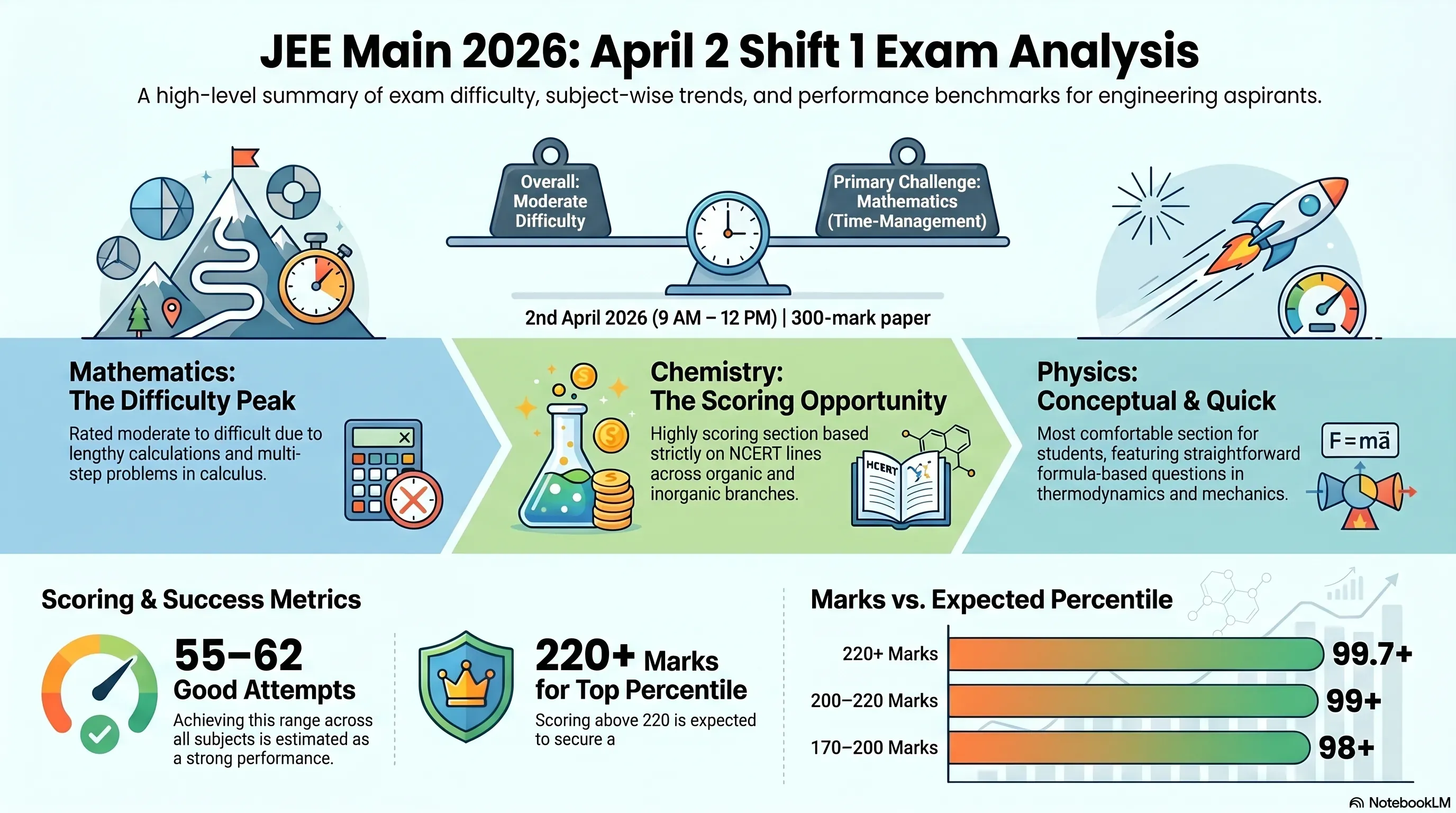
This shift was widely regarded by students and experts as moderate in overall difficulty, with Mathematics emerging as the most time-consuming section.
Students looking for complete JEE Main 2026 question papers of all shifts can access them here: before going through the detailed analysis of April 2 Shift 1.
Overall Difficulty Level
Parameter | Analysis |
|---|---|
Overall Paper Level | Moderate |
Easiest Section | Physics |
Most Difficult Section | Mathematics |
Most Scoring Section | Chemistry |
Time Pressure | High in Mathematics |
Question Nature | Conceptual + Calculation based |
Class 11 vs 12 Weightage | Slightly more from Class 12 |
Section-Wise Difficulty Analysis
Subject | Difficulty Level | Nature of Questions | Student Experience |
|---|---|---|---|
Physics | Easy to Moderate | Formula & concept based | Quick to attempt, less lengthy |
Chemistry | Easy to Moderate | NCERT based, factual + numerical | Scoring for prepared students |
Mathematics | Moderate to Difficult | Lengthy calculations, multi-step | Very time consuming |
Mathematics Detailed Analysis
Mathematics was the toughest section in this shift due to lengthy calculations and time-intensive problems.
Major Chapters Asked | Question Trend |
|---|---|
Integral Calculus | Lengthy definite integrals |
Conic Sections | Standard but calculative |
Algebra | Mixed concept questions |
Coordinate Geometry | Formula application |
Probability & Statistics | Direct concept based |
Vectors & 3D | Easy but time taking |
Key Observation: Students who managed time well in Maths gained an advantage.
Physics Detailed Analysis
Physics was the most comfortable section for students with strong conceptual clarity.
Major Chapters Asked | Question Trend |
|---|---|
Thermodynamics | Direct formula based |
Electromagnetism | Conceptual numericals |
Optics | Ray optics focus |
Mechanics | Mixed easy questions |
Modern Physics | Direct theory based |
Key Observation: Most questions were straightforward and less time consuming.
Chemistry Detailed Analysis
Chemistry was considered highly scoring, especially for students who thoroughly prepared from NCERT.
Branch | Important Topics | Question Trend |
|---|---|---|
Inorganic | Coordination Compounds, Periodic Table | Direct NCERT lines |
Organic | Amines, GOC | Reaction based |
Physical | Chemical Kinetics, Ionic Equilibrium | Numerical based |
Key Observation: Balanced distribution from Organic, Inorganic, and Physical Chemistry.
Difficulty Order (As per Students)
Mathematics > Chemistry > Physics
Chapter-Wise Weightage Snapshot
Subject | High Weightage Chapters |
|---|---|
Mathematics | Calculus, Conics, Algebra, Vectors |
Physics | Thermodynamics, EM Waves, Optics, Mechanics |
Chemistry | Coordination Compounds, Amines, Kinetics, Ionic Equilibrium |
Student Reactions
- “Physics was easier than expected.”
- “Chemistry was straight from NCERT.”
- “Mathematics took too much time.”
- “Paper was balanced but time management was crucial.”
- “Accuracy mattered more than speed.”
Good Attempts Estimate
Subject | Good Attempts |
|---|---|
Physics | 20–22 questions |
Chemistry | 20–23 questions |
Mathematics | 14–17 questions |
Overall Good Attempts | 55–62 questions |
Expected Marks vs Percentile (Estimated)
Marks Range | Expected Percentile |
|---|---|
220+ | 99.7+ |
200–220 | 99+ |
170–200 | 98+ |
150–170 | 97+ |
130–150 | 95+ |
Final Verdict
- The paper was moderate and balanced
- Mathematics required serious time management
- Chemistry was most scoring
- Physics was quick to solve
- Students with strong basics and accuracy performed best in this shift
Frequently Asked Questions
What was the overall difficulty level of JEE Main 2026 April 2 Shift 1?
The paper was moderate overall. It had a balanced mix of conceptual and calculation-based questions, with no section being exceptionally easy or shockingly difficult. Most students with consistent preparation found it manageable if they handled time well.
Which section was the toughest in JEE Main 2026 April 2 Shift 1?
Mathematics was the toughest section in this shift. The difficulty came less from conceptual complexity and more from lengthy multi-step calculations, particularly in Integral Calculus and Conic Sections. Many students ran short on time despite knowing the correct approaches.
Which section was easiest and most scoring in this shift?
Physics was the easiest to attempt due to direct formula-based questions. Chemistry was the most scoring because questions were closely aligned with NCERT textbook content, especially in Inorganic Chemistry. Prepared students could score 80+ marks in Chemistry alone.
How many questions should be attempted for a good score in this shift?
Attempting 55–62 questions with high accuracy (85–90%) is considered a strong performance. Given the −1 negative marking, blind guessing in Mathematics is not advisable. Quality of attempts matters more than raw quantity in this paper.
Was the paper more from Class 11 or Class 12 syllabus?
The paper had slightly more weightage from Class 12 topics across all three subjects. However, Class 11 chapters like Mechanics, Organic Chemistry basics, and Coordinate Geometry were also present. Ignoring either year's syllabus would have been costly.