
JEE Main 2026 Chemistry Syllabus - PDF Download

eSaral Academic and Editorial Team
Summary
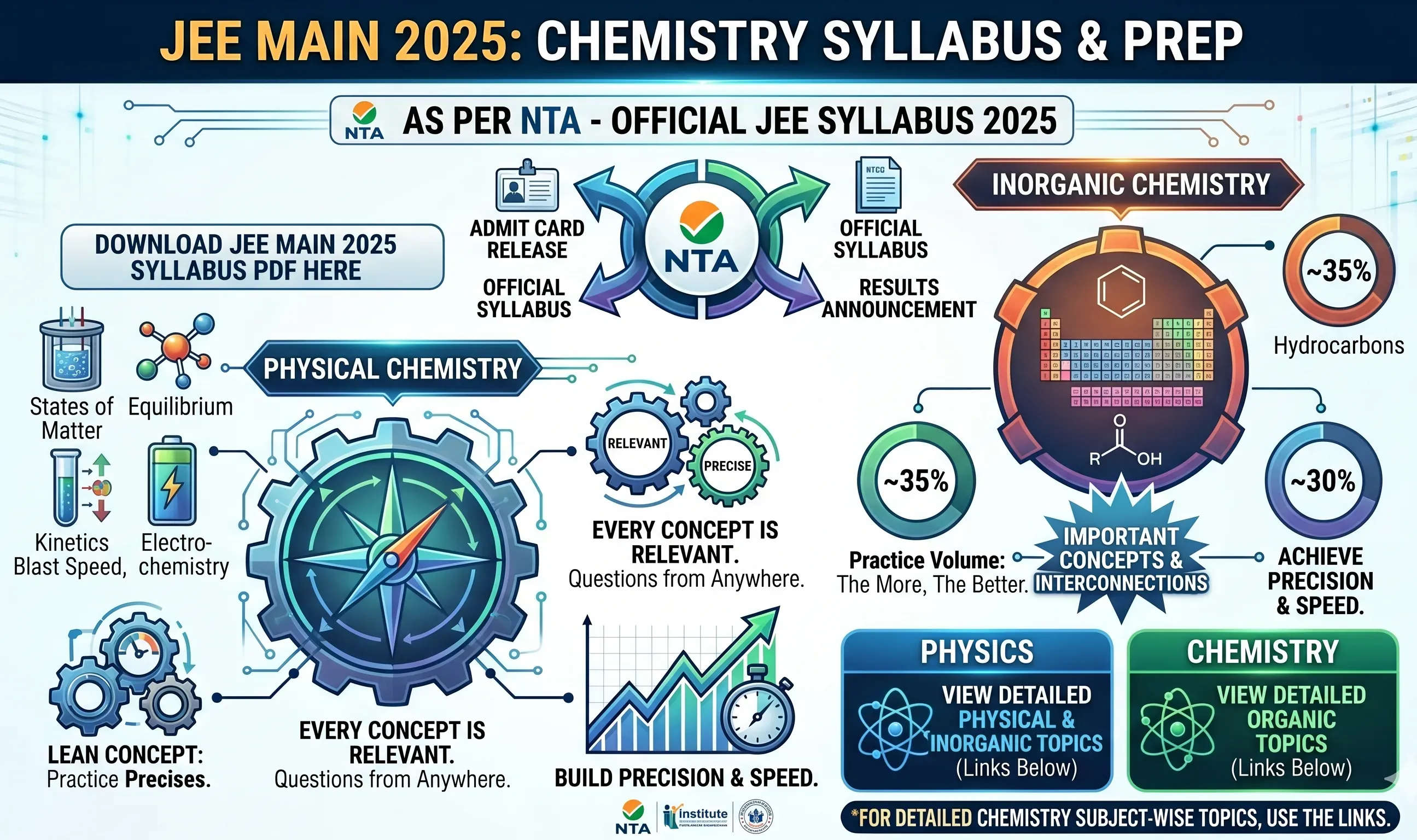
JEE Main 2026 Chemistry Syllabus: NTA (National Testing Agency) will release the JEE Main 2026 Chemistry syllabus online. Candidates have to visit their official website for the Chemistry syllabus of JEE Main 2025. Moreover, you can check the JEE Main syllabus 2025 on our page. The syllabus of JEE Main 2026 comprises important topics that are essential for exam preparation. You can also check the JEE Main Chemistry syllabus 2025 weightage chapter-wise to understand which chapters carry higher question weightage.
eSaral › JEE › JEE Main ›JEE Main 2026 Chemistry Syllabus

JEE Main 2026 Chemistry Syllabus
Mentioned below is the syllabus of the JEE inorganic chemistry syllabus 2026, and the organic and physical chemistry syllabus.
The detailed list of all the concepts covered in the JEE Main Chemistry Syllabus for Physical Chemistry is mentioned below.
JEE Main Physical Chemistry Syllabus 2026 (Section A)
|
S.No. |
Units |
Chemistry Topics |
|
Unit 1 |
Some Basic Concepts of Chemistry |
|
|
Unit 2 |
States of Matter |
|
|
Unit 3 |
Atomic Structure |
|
|
Unit 4 |
Chemical Bonding and Molecular Structure |
|
|
Unit 5 |
Chemical Thermodynamics |
|
|
Unit 6 |
Solutions |
|
|
Unit 7 |
Equilibrium |
|
|
Unit 8 |
Redox Reactions and Electrochemistry |
|
|
Unit 9 |
Chemical Kinetics |
|
|
Unit 10 |
Surface Chemistry |
|
The detailed list of all the concepts covered in the JEE Chemistry syllabus for Inorganic Chemistry is mentioned below.
Inorganic Chemistry Chapters for JEE Mains 2026 (Section B)
|
S.No. |
Units |
Chemistry Topics |
|
Unit 11 |
Classification of Elements and Periodicity in Properties |
|
|
Unit 12 |
General Principles and Process of Isolation of Metals |
|
Unit 13 |
Hydrogen |
|
|
Unit 14 |
S Block Elements (Alkali and Alkaline Earth Metals) |
|
|
Unit 15 |
P Block Elements |
|
|
Unit 16 |
D and F Block Elements |
|
|
Unit 17 |
Coordination Compounds |
|
|
Unit 18 |
Environmental Chemistry |
|
The detailed list of all the concepts covered in the JEE Main Chemistry Syllabus for Organic Chemistry is mentioned below.
Organic Chemistry Syllabus (Section C)
|
S.No. |
Units |
Chemistry Topics |
|
Unit 19 |
Purification and Characterisation of Organic Compounds |
|
|
Unit 20 |
Some Basic Principles of Organic Chemistry |
|
|
Unit 21 |
Hydrocarbons |
|
|
Unit 22 |
Organic Compounds Containing Halogens |
|
|
Unit 23 |
Organic Compounds Containing Oxygen |
|
|
Unit 24 |
Organic Compounds Containing Nitrogen |
|
|
Unit 25 |
Polymers |
|
|
Unit 26 |
Biomolecules |
|
|
Unit 27 |
Chemistry in Everyday Life |
|
|
Unit 28 |
Principles Related to Practical Chemistry |
|
JEE Main 2023 Syllabus with Weightage for Chemistry (Topic-wise)
You can get the JEE Mains 2023 syllabus with its weightage for Chemistry in a chapter-wise manner.
Important Topics | Number of Questions | Marks |
Transition Elements and Coordination Chemistry | 3 | 12 |
Periodic Table and Representative Elements | 3 | 12 |
Thermodynamics and Gaseous State | 2 | 8 |
Atomic Structure | 2 | 8 |
Chemical Bonding | 2 | 8 |
Ionic and Chemical Equilibrium | 2 | 8 |
Nuclear Chemistry and the Environment | 2 | 8 |
Solid state and surface chemistry | 2 | 8 |
Redox reaction | 1 | 4 |
Mole concept | 1 | 4 |
Chemical Kinetics | 1 | 4 |
Electrochemistry | 1 | 4 |
General organic chemistry | 1 | 4 |
Solution and colligative properties | 1 | 4 |
Hydrocarbon | 1 | 4 |
Stereochemistry | 1 | 4 |
Alkyl Halides | 1 | 4 |
Aromatic Compounds | 1 | 4 |
Carboxylic acid and their derivatives | 1 | 4 |
Carbohydrates, amino acids,d and Polymers | 1 | 4 |
Why Covering the Complete JEE Main Chemistry Syllabus is Beneficial
Solving the complete JEE Main syllabus of chemistry can offer many advantages to candidates preparing for the exam. Chemistry is one of the three subjects tested in JEE Main, and a thorough knowledge of the subject is crucial for a good score. Here are some benefits of solving the complete JEE Main syllabus of chemistry:
- Comprehensive Coverage: By solving the entire JEE Main syllabus for chemistry, students ensure that they have covered all the essential topics and concepts that may be tested in the exam. This comprehensive coverage increases your chances of encountering familiar questions during the actual test.
- Strong Conceptual Understanding: This subject involves various theories, principles, and reactions. Solving a wide range of problems will help you to develop a strong conceptual understanding of the subject. This understanding is vital for solving complex and application-based problems in the exam.
- Improved Problem-Solving Skills: Regular practice with different chemistry problems helps in honing problem-solving skills. You can learn to apply different concepts to solve problems, which is very crucial for performing well in JEE Main.
- Time Management: JEE Main is a time-bound exam, which is 3 hours long; efficient time management is essential. Solving the whole syllabus under timed conditions improves time management skills, enabling students to allocate appropriate time to each section during the exam.
- Identification of Weak Areas: By covering the entire syllabus, you can identify your weak areas or topics. Recognising these areas allows you to focus on improvement and seek additional help in case you need it.
- Confidence Boost: Completing the JEE Main syllabus in chemistry induces confidence in candidates. It assures them that they have sufficiently prepared for the subject and are ready to face the exam with self-assurance.
- Synergy with Other Subjects: Chemistry often overlaps with physics and mathematics in some topics. Solving the complete chemistry syllabus can help in reinforcing concepts shared with other subjects, contributing to a more holistic preparation.
- Better Adaptation to Different Question Types: The JEE Main chemistry section may consist of multiple-choice questions(MCQs), numerical problems and reasoning-based questions. Solving the whole syllabus exposes students to different question types, making them more adaptable during the actual exam.
- Revision and Retention: Regular practice strengthens knowledge and enhances retention. By solving the complete syllabus, you can engage in ample revision, which aids in recalling important concepts during the exam.
- Performance Improvement: Solving the complete chemistry syllabus with dedication and focus often leads to improved performance. As a student, you can become more familiar with a wide range of questions, and you may be better prepared to tackle the challenges of the actual JEE Main chemistry section.
Remember that while solving the complete JEE Main chemistry syllabus is beneficial, it is equally important to strike a balance between chemistry, physics, and mathematics preparation. Additionally, practising previous years' question papers and taking mock tests can further strengthen your readiness for the JEE Main exam.
Best Books for JEE Main Chemistry
Most of the candidates feel that chemistry is the easiest section of the JEE Main exam because of fewer formulae and calculations involved in it. However, it is a subject that mostly revolves around concepts and theories. To complete the JEE Main chemistry syllabus, consider the NCERT as the main book and plan your study accordingly. However, you can also prefer some of the Chemistry books for JEE Main that are referred to by the toppers for boosting the preparation. The list of the best chemistry books for JEE Main which you can use. Mentioned below is the best books table for you.
Best Books for JEE Main Chemistry
S.No | Name of the book and author | The book will be best for JEE Main Chemistry |
1 | NCERT Textbooks (for Class XI and XII) | Many questions are being asked directly from the NCERT textbook |
2 | Modern Approach to Chemical Calculations by R.C. Mukherjee | For practice in solving Physical Chemistry Numericals |
3 | Organic Chemistry by O P Tandon | Good explanation of topics |
4 | Concept of Physical Chemistry by P Bahadur | Good explanation and a set of quality problems |
5 | Concise Inorganic Chemistry by J D Lee | Good reference book on Inorganic Chemistry |
6 | Physical Chemistry by P.W. Atkins | Refer to this book once you are done with the above books or want to practise more |
7 | Organic Chemistry by Morrison & Boyd | Refer to this book once you are done with the above books, or want to practise more. |
Practice these high-priority chapters using chapter-wise JEE Main previous year question papers with solutions available on eSaral.
JEE Main PYQs & Notes
Chapter-wise questions with solutions. Free to access.
Frequently Asked Questions
Is the JEE Main Chemistry syllabus based on NCERT?
Yes, the JEE Main Chemistry syllabus is completely based on NCERT Class 11 and 12. Most questions, especially in Inorganic and Organic Chemistry, are directly or indirectly derived from NCERT textbooks.
Which topics have the highest weightage in JEE Main Chemistry?
High-weightage topics include Coordination Compounds, Transition Elements, Thermodynamics, Chemical Bonding, Equilibrium, and Hydrocarbons. These chapters frequently contribute multiple questions to the exam.
Is JEE Main Chemistry easy compared to Physics and Maths?
Chemistry is generally considered easier and more scoring than Physics and Mathematics. However, it requires strong conceptual clarity, especially in Organic Chemistry, and memorisation in Inorganic Chemistry.
How many questions are asked from Chemistry in JEE Main?
Typically, 25 questions are asked from Chemistry in JEE Main, carrying a total of 100 marks, including both MCQs and numerical-based questions.
Does JEE Main Chemistry include numerical questions?
Yes, Chemistry includes numerical value-based questions, especially from Physical Chemistry topics like mole concept, thermodynamics, and electrochemistry.
Team eSaral
eSaral Academic and Editorial Team
Team eSaral is the collective author profile for educational content created by eSaral’s teachers and academic contributors. The team draws on expertise from IIT graduates, doctors, experienced educators and subject specialists to develop resources for JEE, NEET and school students. Our articles aim to explain concepts clearly and help students study with confidence.
Related Posts

BITSAT 2027: Registration Date, Exam Date, Syllabus, Eligibility, Pattern & Fees
BITSAT 2027 exam dates, registration timeline, eligibility criteria, exam pattern, marking scheme, syllabus and fees in one page.

BITSAT Previous Year Question Paper PDF (2017-2026)
Download BITSAT previous year question papers PDF from 2017 to 2026,session-wise. Memory-based papers,exam pattern, paper analysis and how to practise

CBSE Class 10 Date Sheet 2027: Expected Exam Dates, Release Date, Admit Card & Result Timeline
CBSE Class 10 date sheet 2027 is awaited. See the expected exam dates, release window, how to download the PDF, admit card and result timelines.

NCERT Physics Class 10 Book PDF in Hindi 2026-27 – भौतिक विज्ञान के 4 अध्याय (Free Download)
NCERT Physics Class 10 book PDF in Hindi 2026-27: download all 4 chapters (अध्याय 9–12) free, with topics and important formulas.

NCERT Biology Class 9 Book Anveshan PDF in Hindi - जीव विज्ञान कक्षा 9 पुस्तक अन्वेषण PDF
Download NCERT Biology Class 9 book PDF in Hindi chapterwise for 2026-27: Cell, Tissues, Reproduction and Diversity. Free PDFs.

Essay On Artificial Intelligence in English (100,150, 200, 250, 300, 500 Words)
This is in contrast to the natural intelligence of humans. With Artificial Intelligence, machines can perform

Essay on 78th India Independence Day in English for Student (100, 150, 200, 250, 300, 500 Words)
Read the best essays on India's Independence Day in English. Short & long essays (100, 150, 200, 250, 300, 500 words) perfect for school exams
NCERT Class 11 English Snapshots book - Free PDF download- Esaral
Download NCERT Class 11 English Snapshots book PDF for free. Get all 8 chapters, chapter-wise. Start your prep today!
NCERT Class 10 biology book pdf - Free PDF Download - eSaral
NCERT Class 10 Biology book PDF 2026-27: all 5 chapters (Life Processes to Our Environment) in English & Hindi, with CBSE syllabus, marks & practical

Essay on Global Warming in English (100,150, 200, 250, 300, 500 Words)
Global warming means the Earth is getting hotter. This happens because of things like pollution from cars and factories.