
Magnetic Dipole Moment Formula – Definition & Solved Examples
eSaral › Class 12 Physics › Magnetic Dipole Moment Formula – Definition & Solved Examples

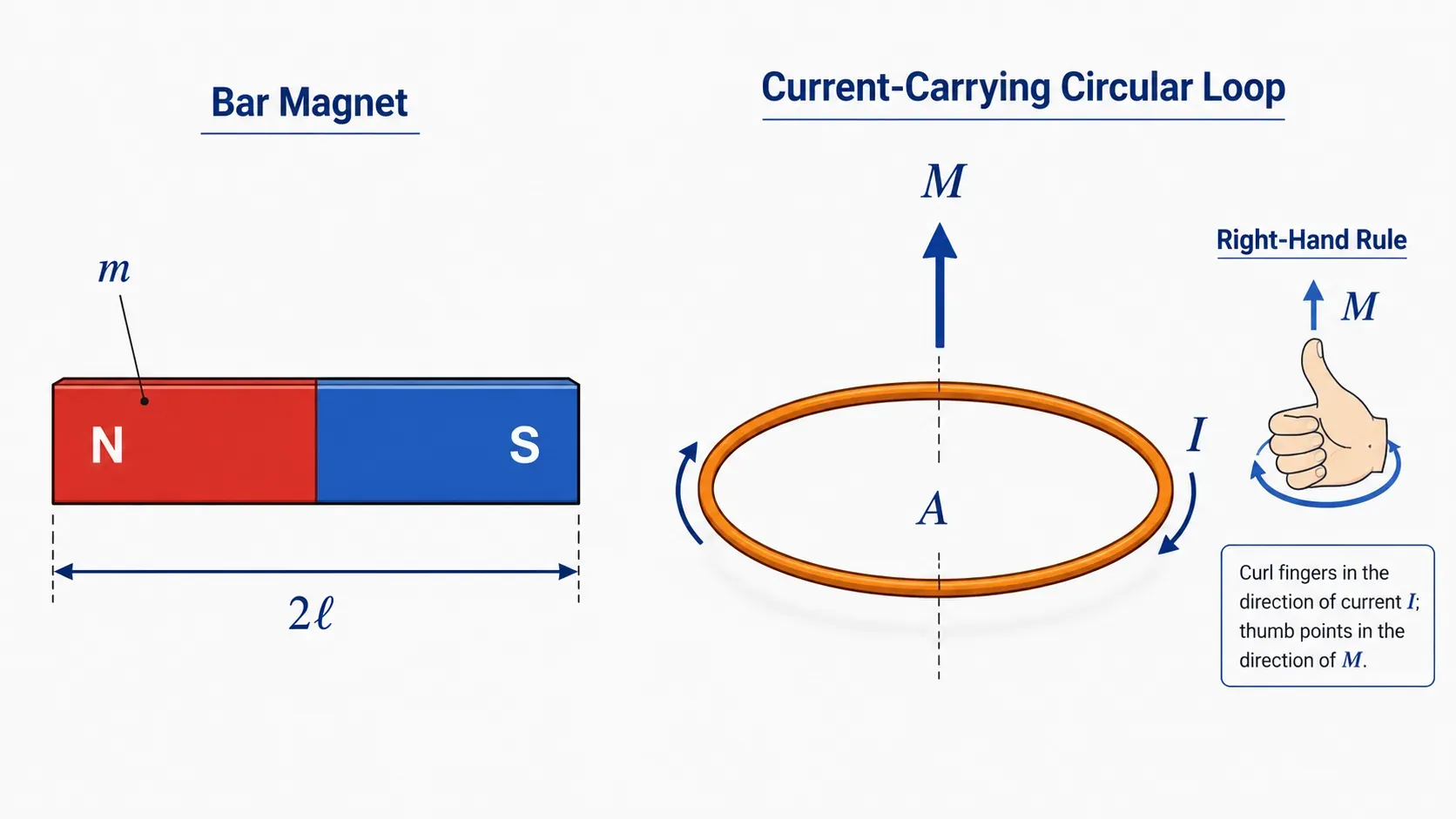
Magnetic dipole moment formula: For a bar magnet, M = m(2ℓ), where m is the pole strength and 2ℓ is the magnetic length. For a current-carrying loop, M = NIA, where N is the number of turns, I is the current, and A is the area of the loop. Magnetic dipole moment is a vector quantity, measured in A·m², directed from the south pole to the north pole (or given by the right-hand rule for a current loop).
A magnetic moment is a quantity that represents the magnetic strength and orientation of a magnet or any other object that produces a magnetic field. More precisely, a magnetic moment refers to a magnetic dipole moment, the component of the magnetic moment that can be represented by a magnetic dipole. Know the magnetic dipole moment definition, formulae, and solved examples here.
What Is a Magnetic Dipole?
An arrangement of two magnetic poles of equal and opposite strengths separated by a finite distance is called a magnetic dipole.
- Two poles of a magnetic dipole or a magnet are of equal strength and opposite nature.
- The line joining the poles of the magnet is called the magnetic axis.
- The distance between the two poles of a bar magnet is called the magnetic length of the magnet. It is denoted by 2ℓ.
- The distance between the ends of the magnet is called the geometrical length of the magnet.
- The ratio of magnetic length and geometrical length is 5/6 or 0.83.
- A small bar magnet is treated like a magnetic dipole.
What Is the Formula for Magnetic Dipole Moment of a Bar Magnet?
The product of the strength of either pole and the magnetic length of the magnet is called a magnetic dipole moment.
M = m(2ℓ)
Important points to remember:
- It is a vector quantity whose direction is from the south pole to the north pole of a magnet.
- The unit of magnetic dipole moment is ampere metre² (A·m²) and Joule/Tesla (J/T). The dimensions are [M⁰L²T⁰A¹].
- If a magnet is cut into two equal parts along the length, then the pole strength is reduced to half, and the length remains unchanged. New magnetic dipole moment M' = m'(2ℓ) = (m/2) × 2ℓ = M/2. The new magnetic dipole moment of each part becomes half of the original value.
- If a magnet is cut into two equal parts transverse to the length, then pole strength remains unchanged, and length is reduced to half. New magnetic dipole moment M' = m(2ℓ/2) = M/2. The new magnetic dipole moment of each part becomes half of the original value.
- In magnetism, the existence of a magnetic monopole is not possible.
- The magnetic dipole moment of a magnet is equal to the product of pole strength and distance between poles: M = md.
- As the magnetic moment is a vector, in the case of two magnets having magnetic moments M₁ and M₂ with angle θ between them, the resulting magnetic moment: M = [M₁² + M₂² + 2M₁M₂cos θ]^(1/2), with tan φ = [M₂ sin θ / (M₁ + M₂ cos θ)].
What Is the Formula for Magnetic Dipole Moment of a Current Loop?
Besides the bar-magnet formula M = m(2ℓ), CBSE and JEE syllabi also define magnetic dipole moment for a current-carrying loop, since a current loop behaves exactly like a magnetic dipole:
M = NIA
where N is the number of turns, I is the current flowing through the loop, and A is the area enclosed by the loop. In vector form, M = NIA n̂, where n̂ is the unit vector normal to the plane of the loop, determined using the right-hand rule. This is the formula of magnetic moment most frequently tested in Moving Charges and Magnetism numerical problems, since real magnetic dipoles in JEE/NEET questions are usually current loops or solenoids rather than bar magnets.
How Do the Two Magnetic Dipole Moment Formulas (Bar Magnet vs Current Loop) Compare?
Feature | Bar Magnet Formula | Current Loop Formula |
|---|---|---|
Formula | M = m(2ℓ) | M = NIA |
Variables | m = pole strength, 2ℓ = magnetic length | N = turns, I = current, A = loop area |
Direction | South pole to north pole | Given by right-hand rule, normal to loop plane |
Applies to | Bar magnets, compass needles | Solenoids, current-carrying coils, atomic current loops |
SI Unit | A·m² | A·m² |
This bar-magnet vs current-loop distinction is a common conceptual trap in JEE Advanced Chapterwise PYQ, especially in assertion-reason questions.
What Is the Formula for Torque on a Magnetic Dipole in a Magnetic Field?
When a magnetic dipole of moment M is placed in a uniform magnetic field B, it experiences a torque that tries to align it with the field:
τ = M × B, with magnitude τ = MB sin θ
where θ is the angle between the magnetic dipole moment vector and the magnetic field. Torque is maximum when θ = 90° (τ = MB) and zero when the dipole is aligned parallel or antiparallel to the field (θ = 0° or 180°). This formula connects directly to the magnetic dipole moment formula and is a near-guaranteed numerical question type in JEE Main. Practice how torque-based dipole questions appear in JEE Main Chapterwise PYQ.
What Is the Potential Energy of a Magnetic Dipole in a Magnetic Field?
The potential energy of a magnetic dipole placed in a magnetic field is given by:
U = −M·B = −MB cos θ
- Minimum (most stable) potential energy occurs at θ = 0° (dipole aligned parallel to B), where U = −MB.
- Maximum (least stable) potential energy occurs at θ = 180° (dipole antiparallel to B), where U = +MB.
- At θ = 90°, U = 0, which is taken as the reference position in most derivations.
What Is the Magnetic Dipole Moment of a Revolving Electron?
A classic application of the current-loop magnetic moment formula is an electron revolving around the nucleus in an atom, which behaves as a tiny current loop:
M = (e/2m) × L
where e is the electron's charge, m is its mass, and L is its orbital angular momentum. This relation, and its smallest value known as the Bohr magneton (μ_B ≈ 9.27 × 10⁻²⁴ A·m²), is frequently asked in NEET and JEE Main as a direct application of the magnetic dipole moment formula beyond bar magnets. Test this exact application with NEET Chapterwise PYQ.
Solved Examples on the Magnetic Dipole Moment Formula
Ex. The force between two magnetic poles in air is 9.604 mN. If one pole is 10 times stronger than the other, calculate the pole strength of each if the distance between the two poles is 0.1 m.
Sol. Force between poles F = (μ₀/4π)(m₁m₂/r²) 9.604 × 10⁻³ = (10⁻⁷ × m × 10m) / (0.1 × 0.1) m² = 96.04 N²T⁻² m = 9.8 N/T So strength of the other pole is 9.8 × 10 = 98 N/T
Ex. A steel wire of length L has a magnetic moment M. It is then bent into a semicircular arc. What is the new magnetic moment?
Sol. If m is the pole strength, then M = m·L, or m = M/L. If it is bent into a semicircular arc, then L = πr, or r = L/π. So the new magnetic moment M' = m × 2r = (M/L) × 2 × (L/π) = 2M/π
Ex. Two identical bar magnets, each of length L and pole strength m, are placed at right angles to each other with the north pole of one touching the south pole of the other. Evaluate the magnetic moment of the system.
Sol. M₁ = M₂ = mL. Since the magnets are at right angles, the resultant magnetic moment M = √(M₁² + M₂²) = √2 mL
Ex. A circular coil of 50 turns and radius 2 cm carries a current of 3 A. Find its magnetic dipole moment.
Sol. Using M = NIA, where A = πr² = π(0.02)² = 1.257 × 10⁻³ m² M = 50 × 3 × 1.257 × 10⁻³ = 0.1885 A·m²
Ex. A magnetic dipole of moment 2 A·m² is placed in a uniform magnetic field of 0.5 T at an angle of 30° to the field. Find the torque acting on it.
Sol. τ = MB sin θ = 2 × 0.5 × sin 30° = 2 × 0.5 × 0.5 = 0.5 N·m
Ex. Find the work done in rotating a magnetic dipole of moment 4 A·m² from its stable equilibrium position (θ = 0°) to θ = 90° in a magnetic field of 0.2 T.
Sol. W = U(90°) − U(0°) = (−MB cos 90°) − (−MB cos 0°) = 0 − (−4 × 0.2) = 0.8 J
Ex. An electron in a hydrogen atom has an orbital angular momentum of 1.05 × 10⁻³⁴ kg·m²/s. Find its magnetic dipole moment. (e = 1.6 × 10⁻¹⁹ C, mₑ = 9.1 × 10⁻³¹ kg)
Sol. M = (e/2mₑ) × L = (1.6 × 10⁻¹⁹ / (2 × 9.1 × 10⁻³¹)) × 1.05 × 10⁻³⁴ = 9.23 × 10⁻²⁴ A·m² (approximately one Bohr magneton)
Which Other eSaral Physics Resources Should Class 12 Students Check Next?
- NCERT Solutions for Class 12 Physics — Moving Charges and Magnetism
- CBSE Class 12 Physics Revision Notes with Weightage (check if this exact slug exists on your site — verify before publishing)
- Practice magnetism-based JEE Main questions: JEE Main Chapterwise PYQ with Solutions →
- Test your speed with topic-wise mock sections: JEE Test Series →
Want to master magnetism topics like torque, potential energy, and dipole moment with solved JEE and NEET problems? eSaral's Class 12 Physics course covers Moving Charges and Magnetism in depth with concept videos by IIT Bombay faculty and chapter-wise practice tests. Explore Class 12 Physics Courses on eSaral →
Frequently Asked Questions
What is the SI unit of magnetic dipole moment?
The SI unit of magnetic dipole moment is ampere metre squared (A·m²), also expressed as joule per tesla (J/T).
What is the formula of magnetic moment for a current loop?
The formula of magnetic moment for a current loop is M = NIA, with direction given by the right-hand rule, perpendicular to the plane of the loop. This is the version most commonly used in JEE and NEET numerical problems involving solenoids and coils.
What is the formula for magnetic dipole moment?
The magnetic dipole moment formula for a bar magnet is M = m(2ℓ), where m is pole strength and 2ℓ is magnetic length. For a current-carrying loop, the formula is M = NIA, where N is turns, I is current, and A is the loop's area.
What is the potential energy formula for a magnetic dipole in a magnetic field?
The potential energy of a magnetic dipole in a magnetic field is U = −MB cos θ. It is minimum (most stable) when the dipole is aligned parallel to the field and maximum when antiparallel to it.
What is the torque on a magnetic dipole placed in a magnetic field?
The torque on a magnetic dipole in a uniform magnetic field is τ = MB sin θ, where M is the magnetic dipole moment, B is the magnetic field strength, and θ is the angle between them. Torque is maximum when the dipole is perpendicular to the field.
What is the dimensional formula of magnetic dipole moment?
The dimensional formula of magnetic dipole moment is [M⁰L²T⁰A¹], derived from either M = m(2ℓ) or M = NIA.
What is the magnetic dipole moment of a revolving electron?
The magnetic dipole moment of an electron revolving around the nucleus is given by M = (e/2m) × L, where L is its orbital angular momentum. Its smallest possible value is called the Bohr magneton, approximately 9.27 × 10⁻²⁴ A·m².
What happens to the magnetic dipole moment when a bar magnet is cut into two equal pieces?
If a bar magnet is cut along its length or transverse to its length into two equal pieces, the magnetic dipole moment of each new piece becomes half the original value, though the reason differs — pole strength halves in one case, magnetic length halves in the other.
Is magnetic dipole moment a scalar or vector quantity?
Magnetic dipole moment is a vector quantity. For a bar magnet, its direction is from the south pole to the north pole; for a current loop, its direction is given by the right-hand rule, normal to the plane of the loop.
How is the magnetic dipole moment formula related to torque and potential energy?
Once the magnetic dipole moment M of a system is known using M = m(2ℓ) or M = NIA, it directly determines both the torque (τ = MB sin θ) and potential energy (U = −MB cos θ) of that dipole in an external magnetic field, making the magnetic moment formula the starting point for most magnetism numerical problems.