
Metallurgy Notes for Class 12, IIT JEE and NEET

eSaral Academic and Editorial Team
Summary
Metallurgy Notes for Class 12 cover the terms mineral, ore, gangue, flux and slag, the main ores of common metals, the steps of extraction (concentration, conversion to oxide, reduction and refining), the thermodynamic principles and the Ellingham diagram, and the extraction of aluminium, copper, iron and zinc.
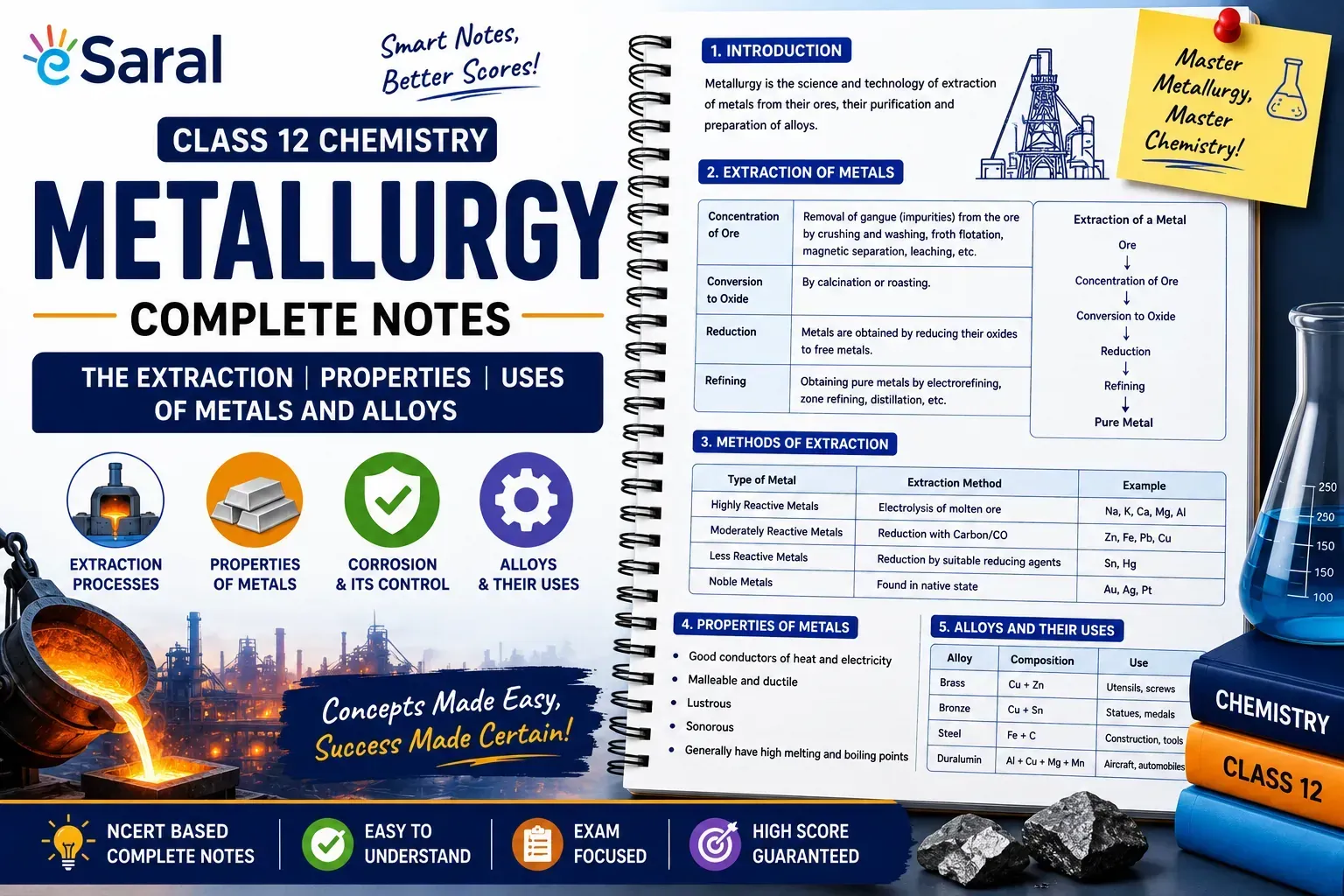
The topic is called General Principles and Processes of Isolation of Elements, or metallurgy. It is a part of the inorganic chemistry syllabus of JEE Main and JEE Advanced, and it connects thermodynamics (Gibbs energy) and electrochemistry (electrolysis) with the chemistry of the metals. Check the latest syllabus of your board and of NEET for the exact topic list. These Metallurgy Notes for Class 12 explain the whole process in the order in which a metal is obtained from its ore. For the other chapters, see eSaral’s Class 12 Chemistry notes.

Metallurgy Notes for Class 12 for IIT JEE and NEET
India's Best Exam Preparation for Class 12th - Download Now
India's Best Exam Preparation for Class 12th - Download Now
India's Best Exam Preparation for Class 12th - Download Now
India's Best Exam Preparation for Class 12th - Download Now
India's Best Exam Preparation for Class 12th - Download Now
Basic Terms in Metallurgy Notes for Class 12
Term | Meaning |
|---|---|
Mineral | A naturally occurring compound of a metal that is found in the Earth’s crust |
Ore | A mineral from which the metal can be extracted conveniently and profitably |
Gangue (matrix) | The earthy impurities (sand, rock) that are present in the ore |
Flux | A substance that combines with the gangue (or an impurity) to form a fusible slag |
Slag | The fusible product of the flux and the impurity, for example $\mathrm{CaSiO_3}$ |
Metallurgy | The whole process of obtaining a pure metal from its ore |
All ores are minerals, but not all minerals are ores. For example, both clay and bauxite contain aluminium, but only bauxite is an ore of aluminium.
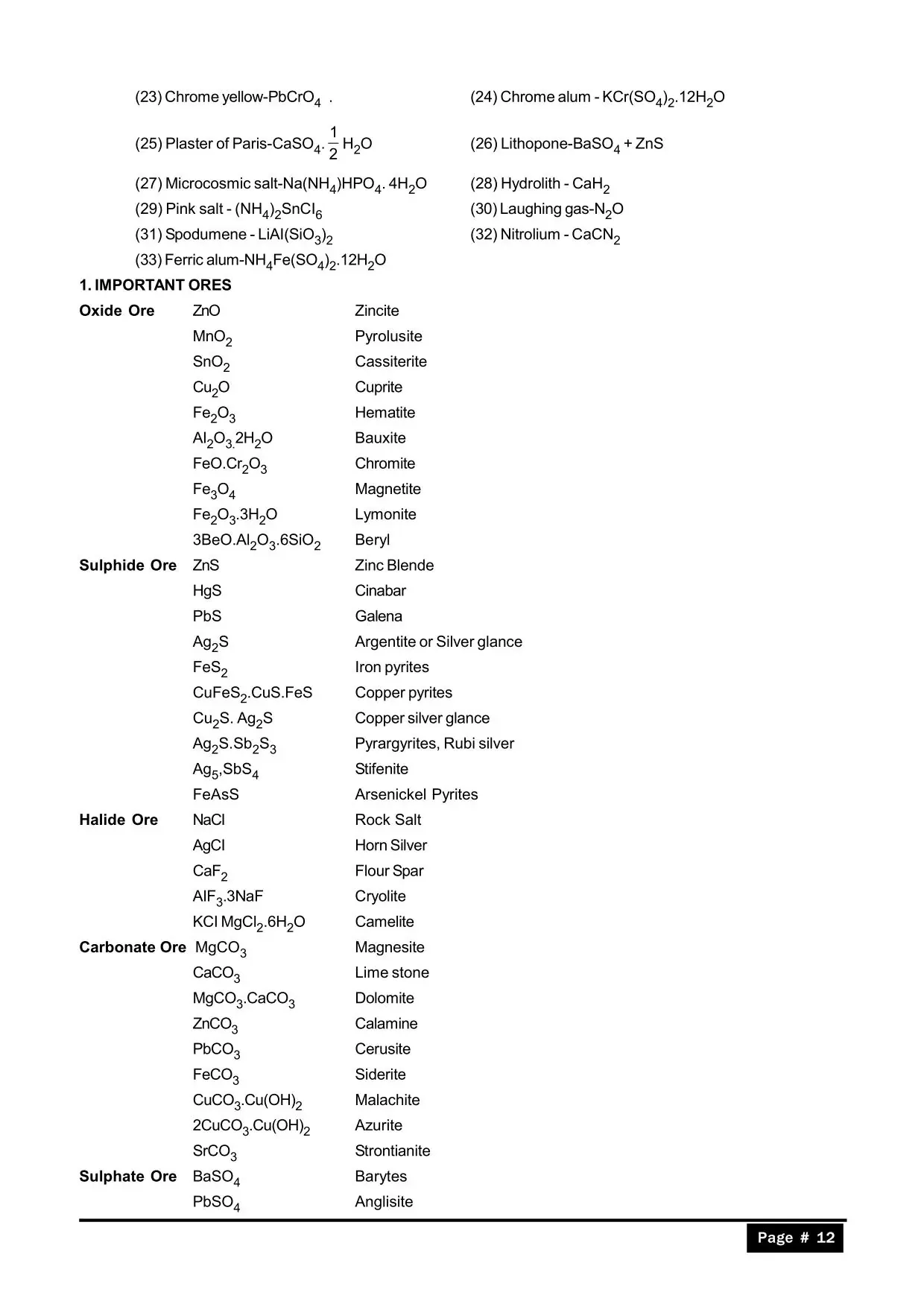
Important Ores of Metals in Metallurgy Notes for Class 12
Metal | Ore | Formula |
|---|---|---|
Aluminium | Bauxite, corundum, cryolite | $\mathrm{Al_2O_3\cdot xH_2O}$, $\mathrm{Al_2O_3}$, $\mathrm{Na_3AlF_6}$ |
Iron | Haematite, magnetite, siderite, iron pyrites | $\mathrm{Fe_2O_3}$, $\mathrm{Fe_3O_4}$, $\mathrm{FeCO_3}$, $\mathrm{FeS_2}$ |
Copper | Copper pyrites, malachite, cuprite, copper glance | $\mathrm{CuFeS_2}$, $\mathrm{CuCO_3\cdot Cu(OH)_2}$, $\mathrm{Cu_2O}$, $\mathrm{Cu_2S}$ |
Zinc | Zinc blende, calamine, zincite | $\mathrm{ZnS}$, $\mathrm{ZnCO_3}$, $\mathrm{ZnO}$ |
Lead | Galena | $\mathrm{PbS}$ |
Tin | Cassiterite | $\mathrm{SnO_2}$ |
Silver | Argentite (silver glance), horn silver | $\mathrm{Ag_2S}$, $\mathrm{AgCl}$ |
Magnesium | Magnesite, carnallite | $\mathrm{MgCO_3}$, $\mathrm{KCl\cdot MgCl_2\cdot 6H_2O}$ |
Concentration of the Ore in Metallurgy Notes for Class 12
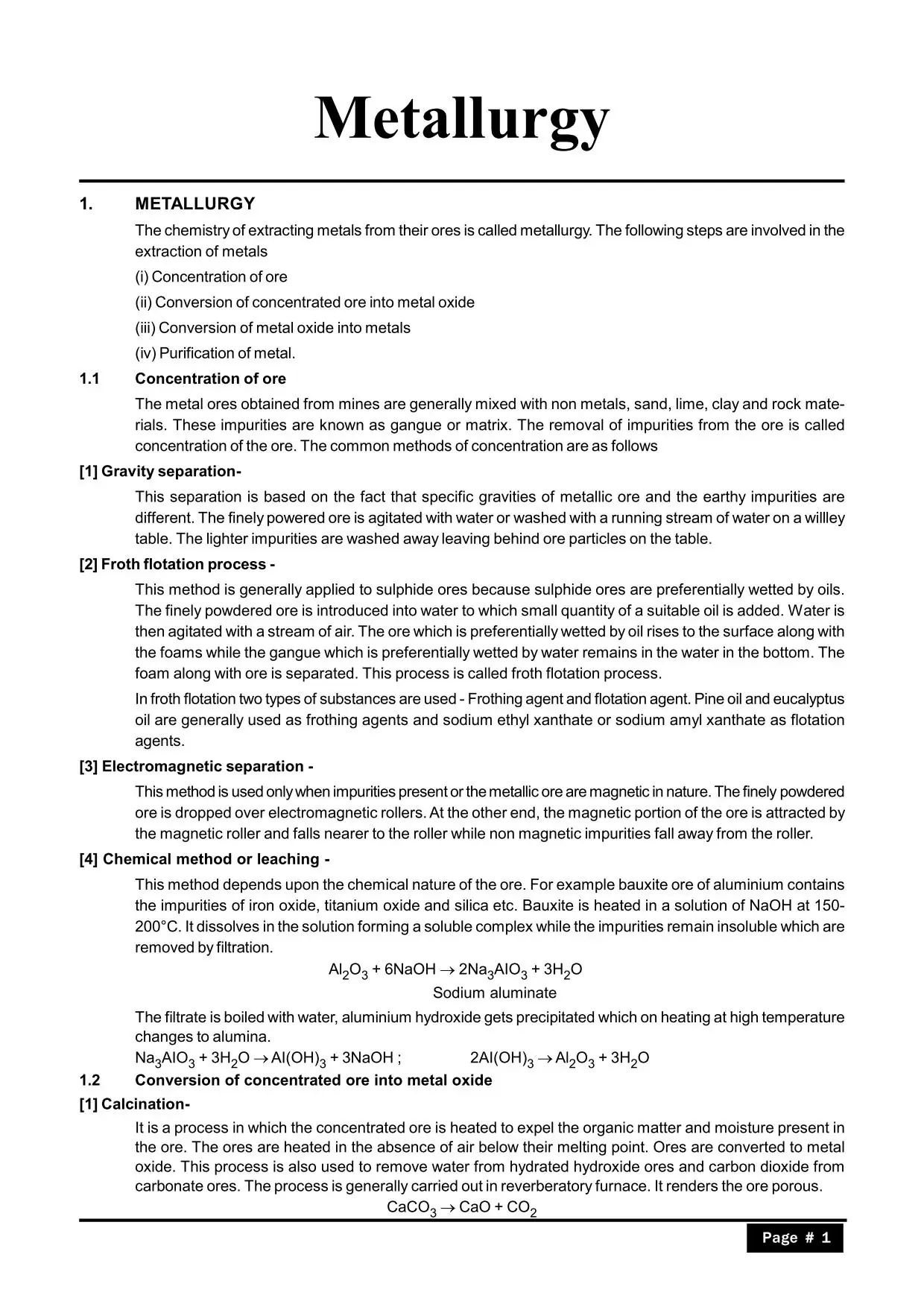
Concentration (benefaction) removes the gangue. The method depends on the ore.
Method | Principle | Used for |
|---|---|---|
Hydraulic washing (gravity separation) | The ore particles are heavier than the gangue, so a stream of water washes the gangue away | Oxide ores such as haematite and cassiterite |
Magnetic separation | The ore (or the gangue) is magnetic | Magnetic ores such as magnetite, and tin ore with magnetic impurities |
Froth flotation | The sulphide ore is wetted by oil and floats in the froth, and the gangue is wetted by water and sinks. Pine oil is the collector, and xanthates are also used. | Sulphide ores such as $\mathrm{ZnS}$, $\mathrm{PbS}$ and $\mathrm{Cu_2S}$ |
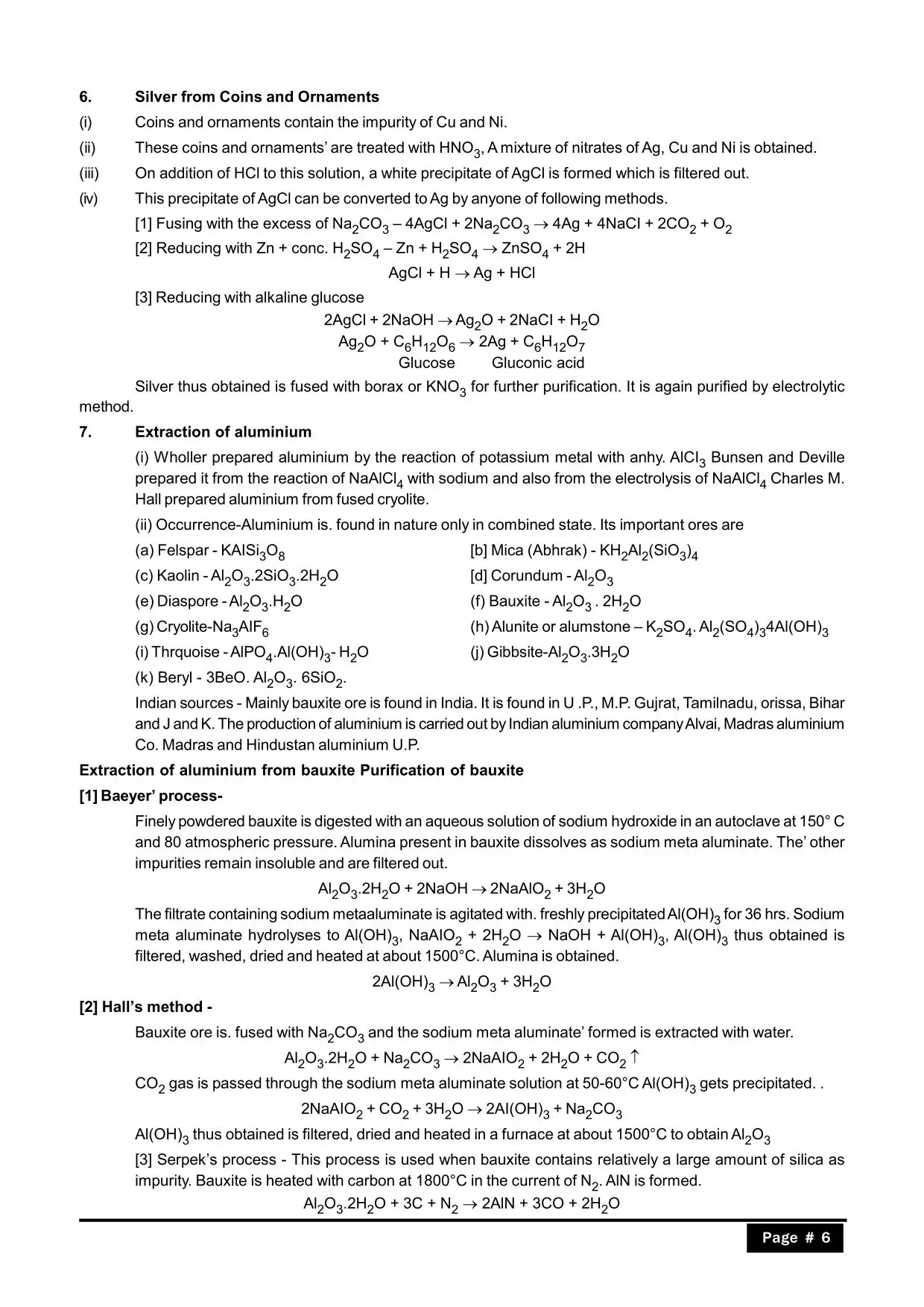
Leaching (chemical method) | The ore is dissolved in a suitable reagent, and the impurities stay behind | Bauxite, gold and silver |
- Froth flotation with a depressant: to separate $\mathrm{ZnS}$ from $\mathrm{PbS}$, NaCN is added as a depressant. It stops $\mathrm{ZnS}$ from forming a froth with the collector, so $\mathrm{PbS}$ floats.
- Leaching of bauxite (Baeyer’s process): the ore is treated with concentrated NaOH, and then the solution is neutralised with $\mathrm{CO_2}$:
$$\mathrm{Al_2O_3 + 2NaOH + 3H_2O \rightarrow 2Na[Al(OH)_4]}$$ $$\mathrm{2Na[Al(OH)_4] + CO_2 \rightarrow Al_2O_3\cdot xH_2O\downarrow + 2NaHCO_3}$$
The hydrated alumina is filtered and heated to give pure $\mathrm{Al_2O_3}$.
- Cyanide process for silver and gold:
$$\mathrm{4Ag + 8CN^- + 2H_2O + O_2 \rightarrow 4[Ag(CN)_2]^- + 4OH^-}$$ $$\mathrm{2[Ag(CN)_2]^- + Zn \rightarrow [Zn(CN)_4]^{2-} + 2Ag}$$
Calcination and Roasting in Metallurgy Notes for Class 12
Process | Condition | Examples |
|---|---|---|
Calcination | The ore is heated strongly in the absence (or limited supply) of air. It removes water and $\mathrm{CO_2}$. | $\mathrm{ZnCO_3 \rightarrow ZnO + CO_2}$, $\ \mathrm{CaCO_3 \rightarrow CaO + CO_2}$, $\ \mathrm{Fe_2O_3\cdot xH_2O \rightarrow Fe_2O_3 + xH_2O}$ |
Roasting | The ore is heated in a regular supply of air below its melting point. It converts a sulphide to an oxide, and removes $\mathrm{S}$, $\mathrm{As}$ and $\mathrm{Sb}$ as volatile oxides. | $\mathrm{2ZnS + 3O_2 \rightarrow 2ZnO + 2SO_2}$, $\ \mathrm{2PbS + 3O_2 \rightarrow 2PbO + 2SO_2}$ |
Reduction of the Oxide to the Metal in Metallurgy Notes for Class 12
Method | Reaction | Used for |
|---|---|---|
Smelting with carbon (coke) or CO | $\mathrm{ZnO + C \rightarrow Zn + CO}$, $\ \mathrm{Fe_2O_3 + 3CO \rightarrow 2Fe + 3CO_2}$ | Zn, Fe, Sn, Pb |
Aluminothermy (thermite process) | $\mathrm{Cr_2O_3 + 2Al \rightarrow Al_2O_3 + 2Cr}$ | Cr, Mn and others that need a strong reducing agent |
Self-reduction (auto-reduction) | $\mathrm{2Cu_2O + Cu_2S \rightarrow 6Cu + SO_2}$ | Cu, Pb |
Electrolytic reduction | Molten salt or oxide is electrolysed, and the metal is formed at the cathode | Al, Na, Mg and other highly reactive metals |
Hydrometallurgy (displacement) | $\mathrm{Cu^{2+} + Zn \rightarrow Zn^{2+} + Cu}$ | Cu, Ag, Au from solutions |
Flux and slag: if the ore has an acidic impurity such as $\mathrm{SiO_2}$, a basic flux such as $\mathrm{CaO}$ is added: $\mathrm{CaO + SiO_2 \rightarrow CaSiO_3}$ (slag). If the impurity is basic (for example $\mathrm{FeO}$ or $\mathrm{CaO}$), an acidic flux such as $\mathrm{SiO_2}$ is used.
Thermodynamic Principles and the Ellingham Diagram in Metallurgy Notes for Class 12
A reduction is feasible if the Gibbs energy change is negative:
$$\Delta G^\circ = \Delta H^\circ - T\Delta S^\circ, \qquad \Delta G^\circ = -RT\ln K$$
For a reduction that has $\Delta H^\circ > 0$ and $\Delta S^\circ > 0$, $\Delta G^\circ$ becomes negative above the temperature $T = \dfrac{\Delta H^\circ}{\Delta S^\circ}$. For the thermodynamics, see eSaral’s Thermodynamics short notes.
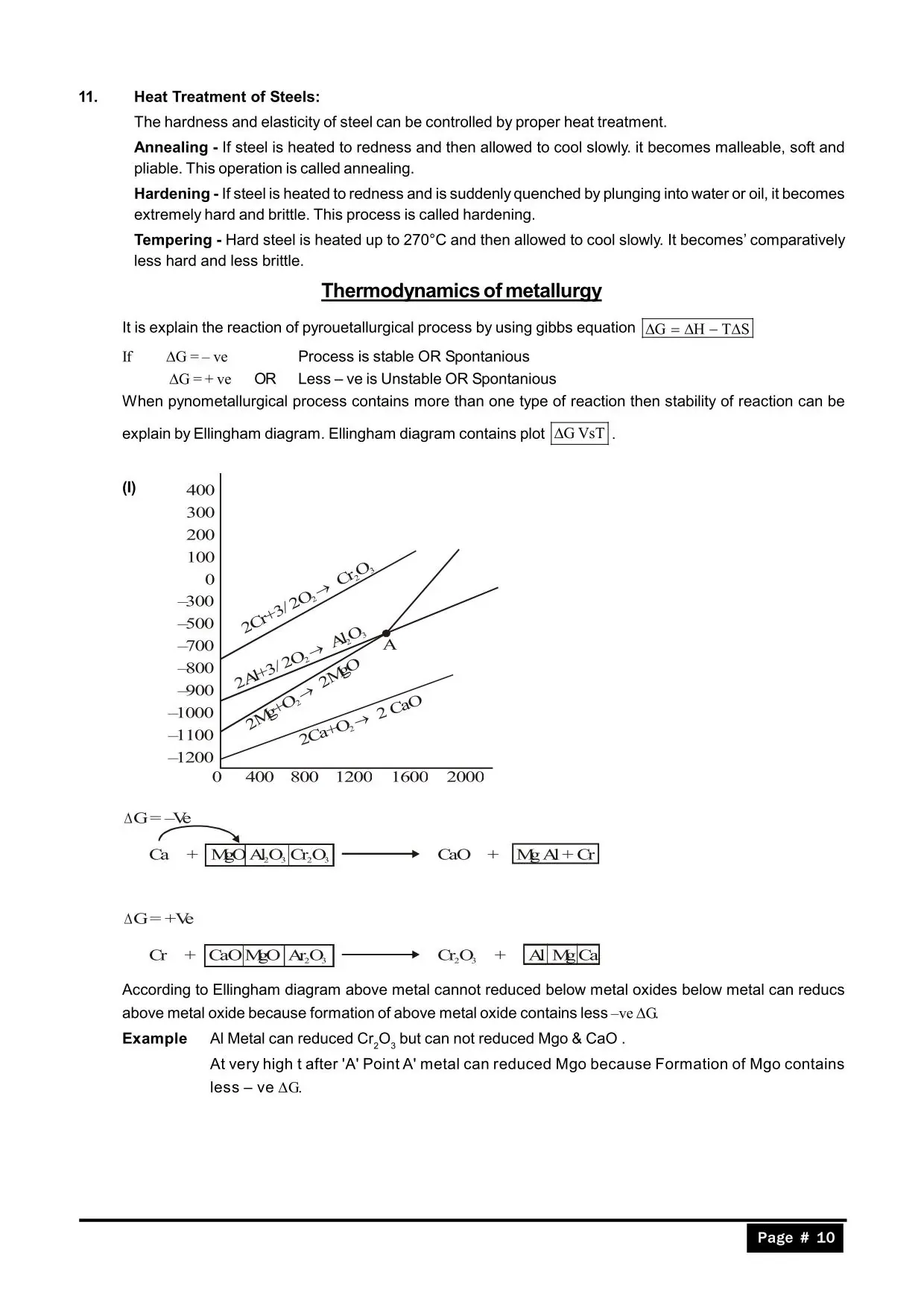
Ellingham diagram: it is a plot of $\Delta G^\circ$ against the temperature for the formation of oxides, taken per mole of $\mathrm{O_2}$.
- The slope of each line is $-\Delta S^\circ$. When a metal forms a solid oxide, a gas ($\mathrm{O_2}$) is used up, so $\Delta S^\circ$ is negative, and the line has a positive slope.
- The line for $\mathrm{2C + O_2 \rightarrow 2CO}$ has a negative slope, because the number of moles of gas increases. The line for $\mathrm{C + O_2 \rightarrow CO_2}$ is almost horizontal.
- The slope of a line increases at the melting point and the boiling point of the metal, because $\Delta S^\circ$ becomes more negative.
- Use: at a given temperature, a metal can reduce the oxide of another metal if its own oxide line lies below the line of that oxide. Carbon (as CO) can reduce an oxide above the temperature at which the $\mathrm{C \rightarrow CO}$ line goes below the line of that oxide. This is why $\mathrm{ZnO}$ needs a high temperature, and why Al can reduce $\mathrm{Cr_2O_3}$.
- Limits: the diagram tells only about the thermodynamic feasibility. It does not give the rate of the reaction, and it is for the standard states.
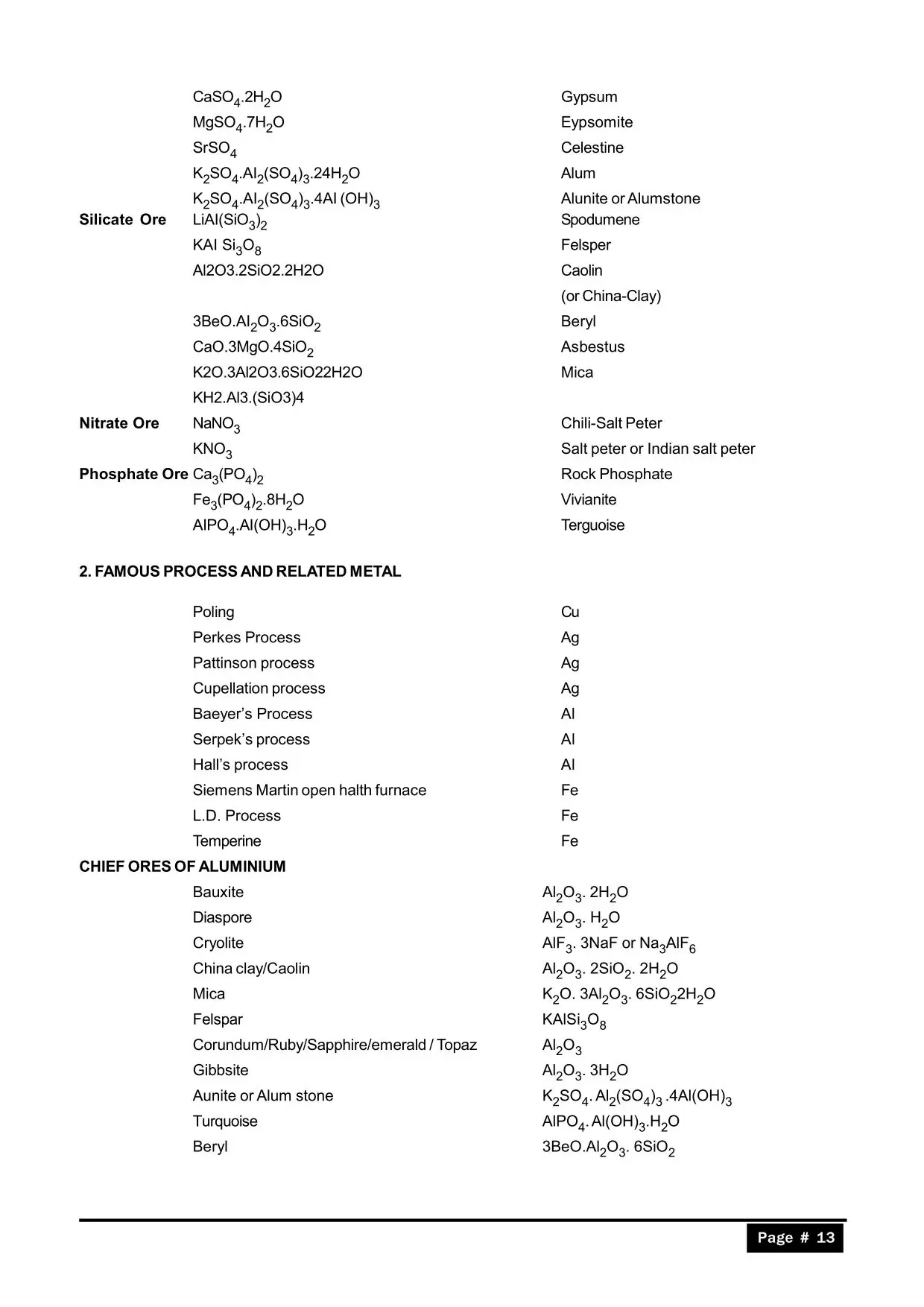
Extraction of Aluminium (Hall–Héroult Process) in Metallurgy Notes for Class 12
- Purification of bauxite by Baeyer’s process (shown above) gives pure $\mathrm{Al_2O_3}$.
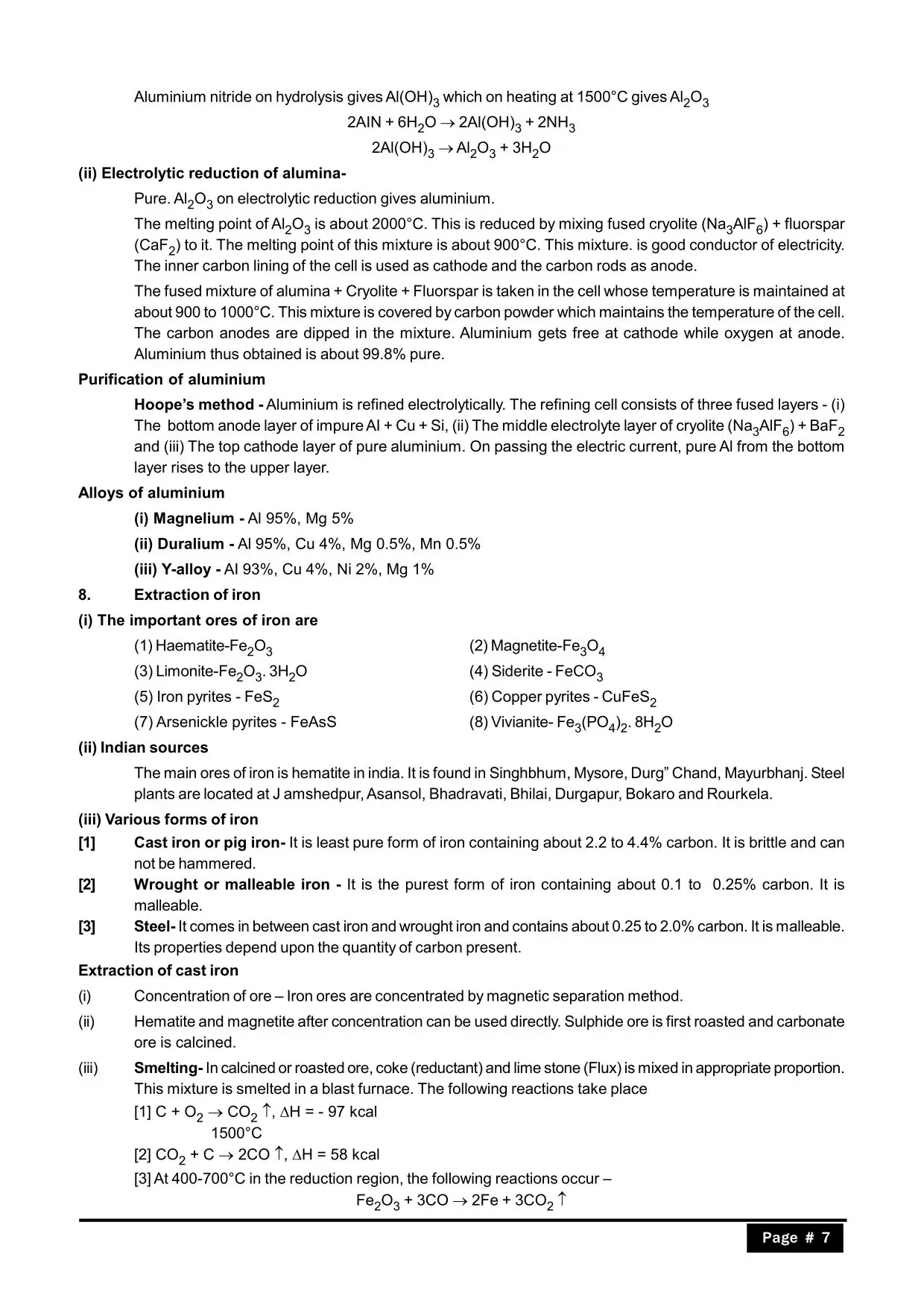
- Electrolysis: pure $\mathrm{Al_2O_3}$ is dissolved in molten cryolite ($\mathrm{Na_3AlF_6}$) with some fluorspar ($\mathrm{CaF_2}$). This lowers the melting point of the mixture from about $2000\,^\circ\mathrm{C}$ (pure $\mathrm{Al_2O_3}$) to below about $1000\,^\circ\mathrm{C}$, and it increases the electrical conductivity. The cell has a carbon lining (the cathode) and graphite anodes.
$$\text{Cathode: } \mathrm{Al^{3+} + 3e^- \rightarrow Al}$$ $$\text{Anode: } \mathrm{C + O^{2-} \rightarrow CO + 2e^-}, \qquad \mathrm{C + 2O^{2-} \rightarrow CO_2 + 4e^-}$$ $$\text{Overall: } \mathrm{2Al_2O_3 + 3C \rightarrow 4Al + 3CO_2}$$
The anodes burn away, so they are replaced from time to time. The liquid aluminium collects at the bottom of the cell.
Extraction of Copper from Copper Pyrites in Metallurgy Notes for Class 12
- Concentration of $\mathrm{CuFeS_2}$ by froth flotation.
- Roasting removes $\mathrm{S}$ and $\mathrm{As}$ as oxides, and converts part of the ore to $\mathrm{Cu_2S}$ and $\mathrm{FeS}$ (and part of $\mathrm{FeS}$ to $\mathrm{FeO}$).
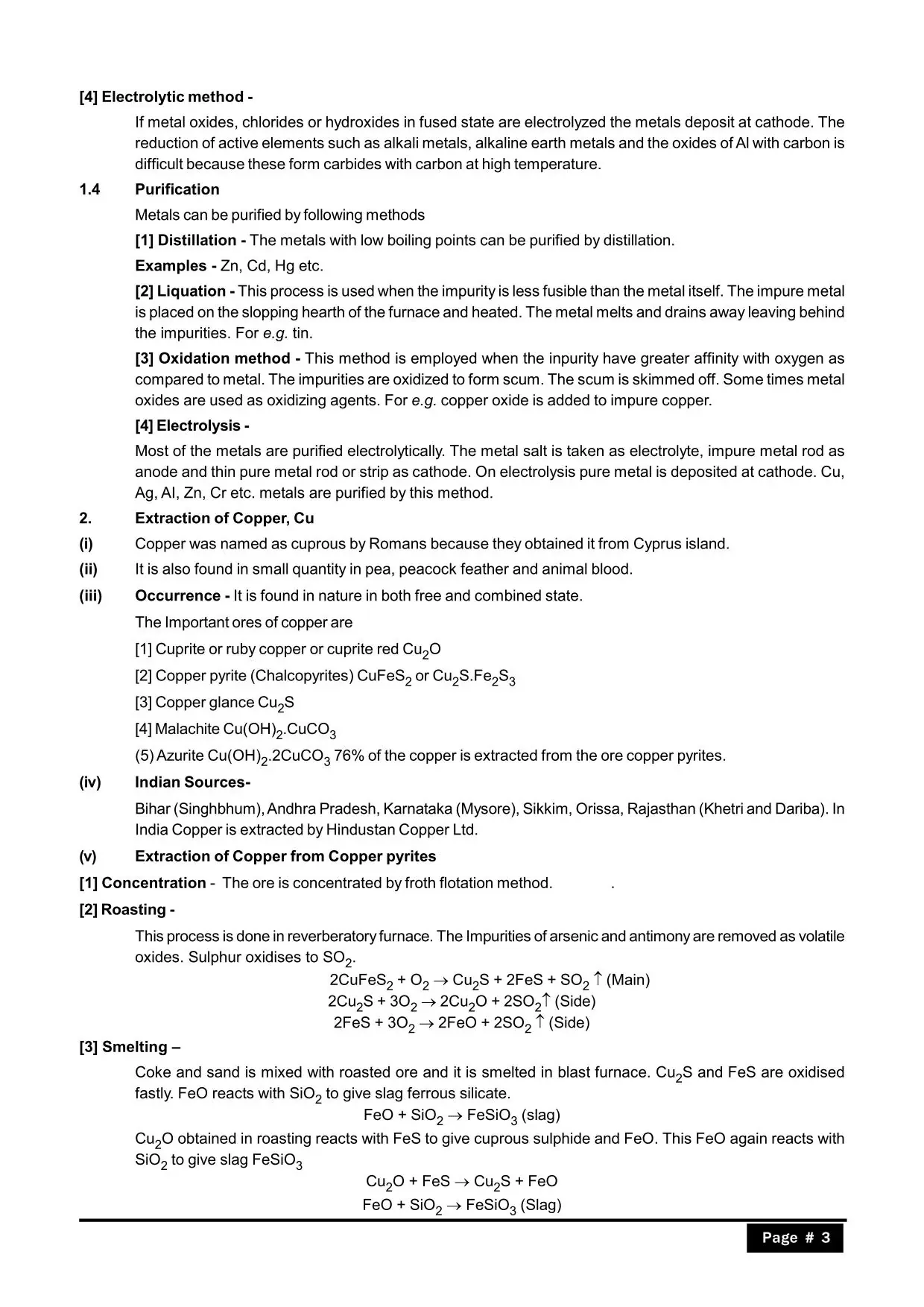
- Smelting with sand ($\mathrm{SiO_2}$) in a reverberatory furnace removes iron as slag, and gives matte ($\mathrm{Cu_2S}$ with a little $\mathrm{FeS}$): $\ \mathrm{FeO + SiO_2 \rightarrow FeSiO_3}$.
- Bessemer converter: air is blown through the molten matte with some silica.
$$\mathrm{2FeS + 3O_2 \rightarrow 2FeO + 2SO_2}, \qquad \mathrm{FeO + SiO_2 \rightarrow FeSiO_3}$$ $$\mathrm{2Cu_2S + 3O_2 \rightarrow 2Cu_2O + 2SO_2}, \qquad \mathrm{2Cu_2O + Cu_2S \rightarrow 6Cu + SO_2}$$
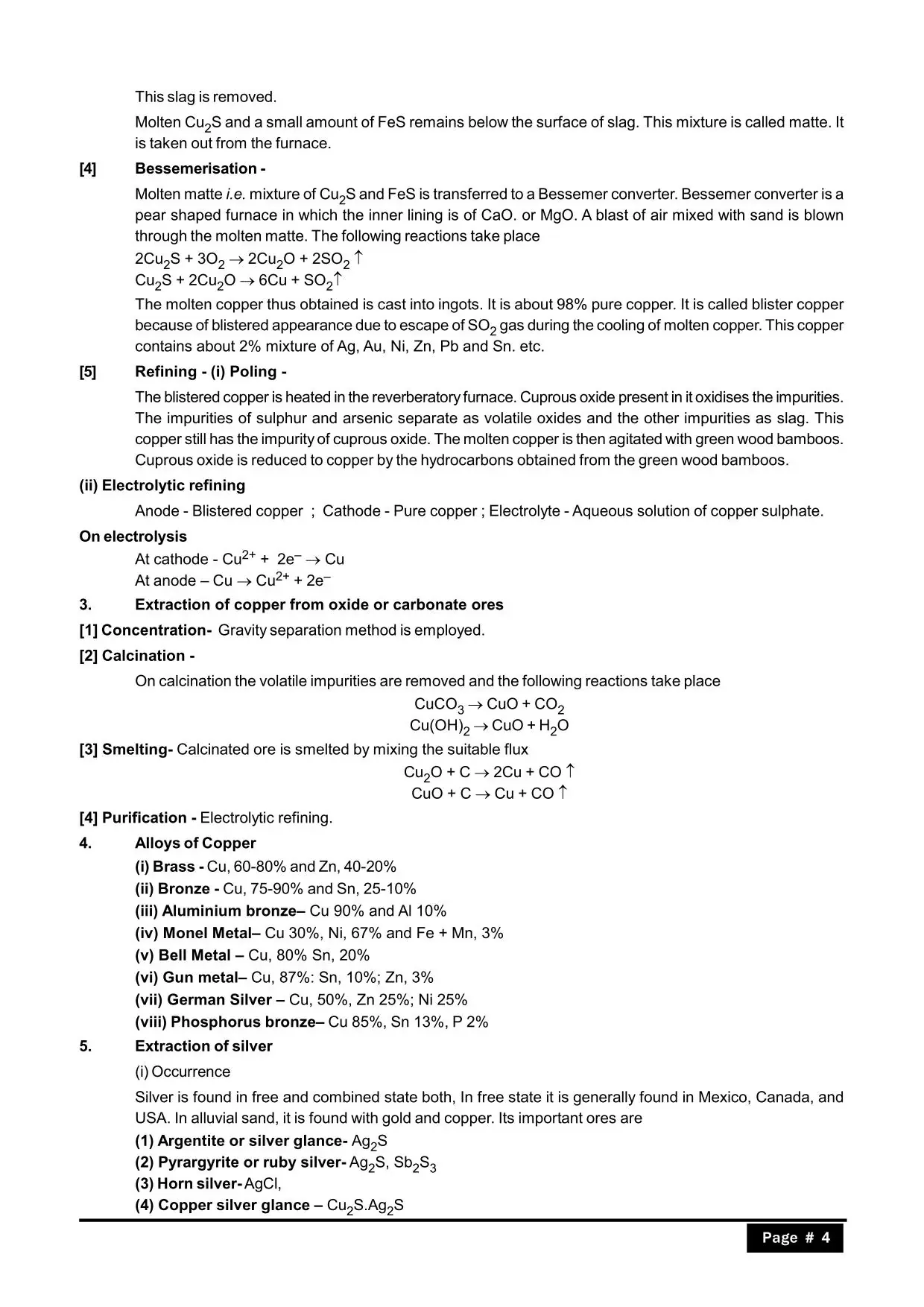
The copper is obtained as blister copper (the $\mathrm{SO_2}$ that escapes forms blisters on the surface). It is refined by electrolytic refining.
Extraction of Iron (Blast Furnace) in Metallurgy Notes for Class 12
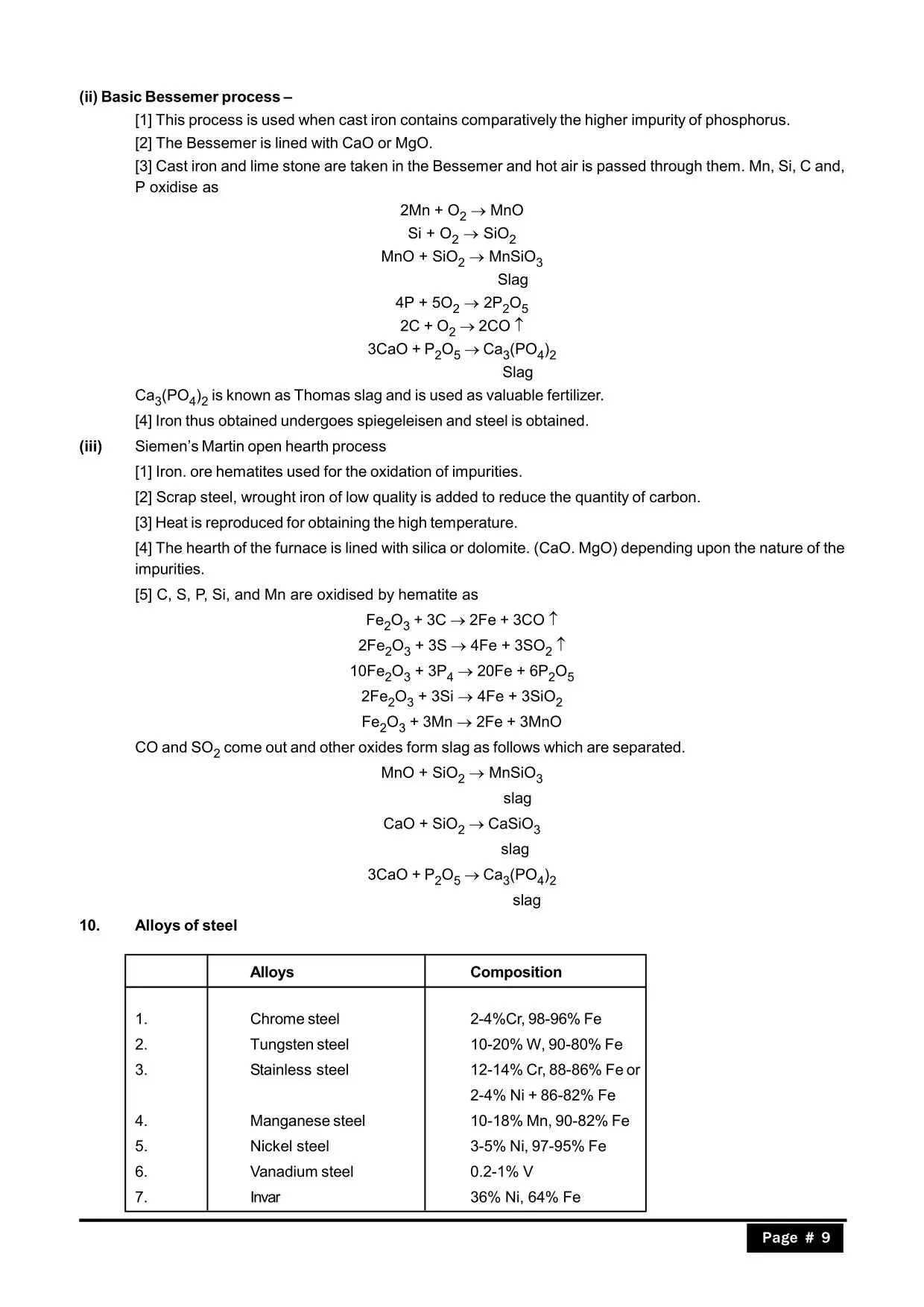
The charge of roasted ore (mostly $\mathrm{Fe_2O_3}$), coke and limestone is fed from the top, and hot air is blown from the bottom.
$$\mathrm{C + O_2 \rightarrow CO_2}, \qquad \mathrm{CO_2 + C \rightarrow 2CO}$$ $$\mathrm{Fe_2O_3 + 3CO \rightarrow 2Fe + 3CO_2}$$ $$\mathrm{CaCO_3 \rightarrow CaO + CO_2}, \qquad \mathrm{CaO + SiO_2 \rightarrow CaSiO_3\ (slag)}$$
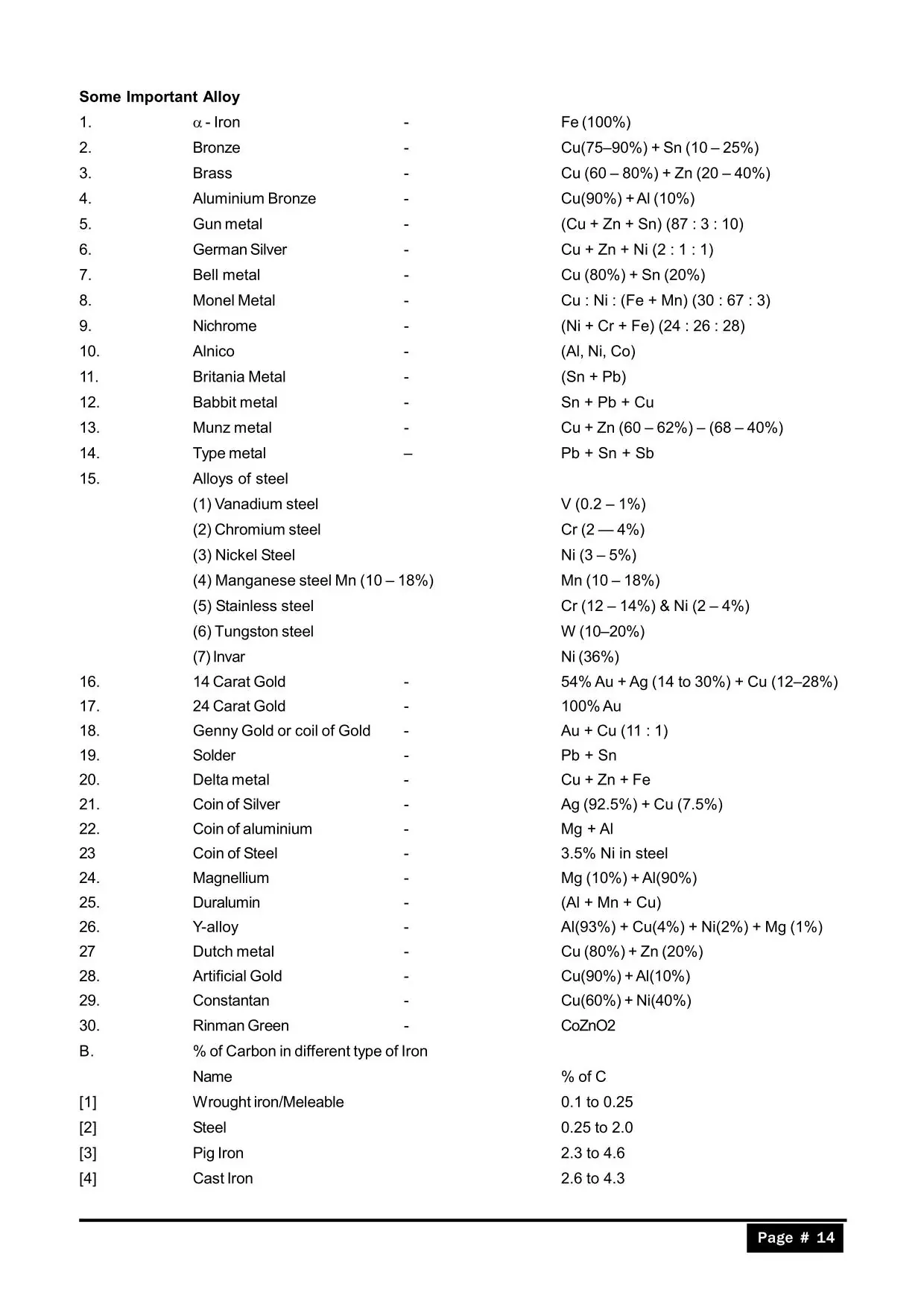
The iron that is obtained is pig iron (about 4% carbon). Cast iron has about 3% carbon, and wrought iron (the purest form) has about 0.1% to 0.25% carbon.
Extraction of Zinc in Metallurgy Notes for Class 12
$\mathrm{ZnS}$ is concentrated by froth flotation, and then roasted to $\mathrm{ZnO}$. The oxide is reduced with coke at about $1673\ \mathrm{K}$, and the zinc is obtained as vapour, which is condensed:
$$\mathrm{2ZnS + 3O_2 \rightarrow 2ZnO + 2SO_2}, \qquad \mathrm{ZnO + C \xrightarrow{1673\ K} Zn + CO}$$
Refining of Metals in Metallurgy Notes for Class 12
Method | Principle | Metals |
|---|---|---|
Distillation | The metal is volatile and the impurities are not | Zn, Hg |
Liquation | The metal has a low melting point, so it melts and flows away from the infusible impurities | Sn, Pb |
Electrolytic refining | The impure metal is the anode, and a strip of pure metal is the cathode. The pure metal deposits on the cathode, and the impurities fall as anode mud. | Cu, Zn, Ni, Ag, Au, Al |
Zone refining | A circular heater moves along a rod, and the impurities move into the molten zone, because they are more soluble in the melt | Ge, Si, Ga, B, In (for semiconductors) |
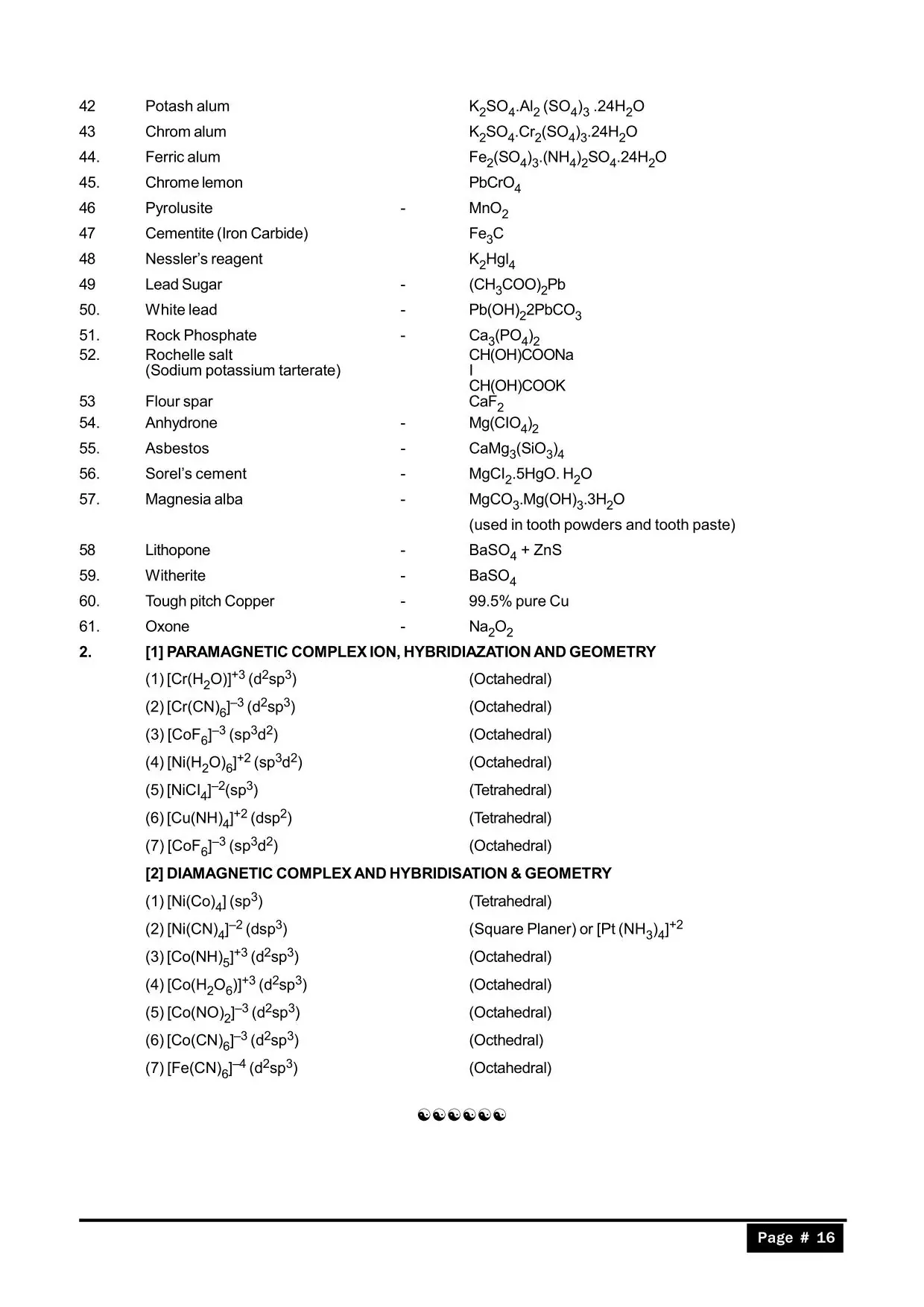
Vapour phase refining (Mond process) | The impure Ni forms the volatile $\mathrm{Ni(CO)_4}$, which decomposes to give pure Ni | Ni |
Vapour phase refining (Van Arkel method) | The metal forms a volatile iodide, which decomposes on a hot tungsten filament | Zr, Ti |
Chromatography | The components are adsorbed to different extents on a column | Elements that are available in small amounts, and that have very high purity needs |
Mond process:
$$\mathrm{Ni + 4CO \xrightarrow{330-350\ K} Ni(CO)_4}, \qquad \mathrm{Ni(CO)_4 \xrightarrow{450-470\ K} Ni + 4CO}$$
Van Arkel method for zirconium:
$$\mathrm{Zr + 2I_2 \rightarrow ZrI_4}, \qquad \mathrm{ZrI_4 \xrightarrow{\text{hot W filament}} Zr + 2I_2}$$
Electrolytic refining of copper: at the anode, $\mathrm{Cu \rightarrow Cu^{2+} + 2e^-}$, and at the cathode, $\mathrm{Cu^{2+} + 2e^- \rightarrow Cu}$. The electrolyte is acidified $\mathrm{CuSO_4}$, and the less active impurities (Ag, Au, Pt) collect as anode mud. The laws of electrolysis are in eSaral’s Electrochemistry notes.
IIT JEE Tips for Metallurgy Notes for Class 12
- Calcination vs roasting: calcination is in the absence of air (carbonates and hydrated oxides), and roasting is in the presence of air (sulphides).
- Match the method with the ore: sulphides go for froth flotation, and then roasting. Carbonates go for calcination. Oxides can be reduced directly.
- Ellingham diagram: the slope is $-\Delta S^\circ$. The oxide line that lies lower belongs to the better reducing agent.
- Flux: an acidic impurity needs a basic flux, and a basic impurity needs an acidic flux.
- Refining: link the method to the property: volatility (distillation, Mond), low melting point (liquation), the semiconductor grade (zone refining) and a very high purity (Van Arkel).
- Electrolytic questions: use $\mathrm{Q = It}$ and Faraday’s laws, with the number of electrons per atom of the metal.
Key Facts in Metallurgy Notes for Class 12
Metal | Concentration | Reduction | Refining |
|---|---|---|---|
Al | Baeyer’s leaching of bauxite | Electrolysis in molten cryolite | Electrolytic (Hoopes) |
Cu | Froth flotation | Self-reduction in a Bessemer converter | Electrolytic |
Fe | Magnetic or gravity separation, then roasting | Reduction with CO in a blast furnace | Several methods, depending on the grade |
Zn | Froth flotation, then roasting | Reduction with coke at 1673 K | Distillation or electrolytic |
Ni | – | – | Mond process |
Zr, Ti | – | – | Van Arkel method |
Solved Examples from Metallurgy Notes for Class 12
Example 1 (calcination or roasting): Which process is used for $\mathrm{ZnCO_3}$, and which for $\mathrm{ZnS}$? Write the reactions.
$\mathrm{ZnCO_3}$ is calcined: $\mathrm{ZnCO_3 \rightarrow ZnO + CO_2}$. $\mathrm{ZnS}$ is roasted: $\mathrm{2ZnS + 3O_2 \rightarrow 2ZnO + 2SO_2}$.
Example 2 (temperature for a reduction): A reduction has $\Delta H^\circ = +200\ \mathrm{kJ\,mol^{-1}}$ and $\Delta S^\circ = +200\ \mathrm{J\,K^{-1}\,mol^{-1}}$. Above what temperature is it spontaneous?
$\Delta G^\circ < 0$ when $T > \dfrac{\Delta H^\circ}{\Delta S^\circ} = \dfrac{200000}{200} = 1000\ \mathrm{K}$.
Example 3 (using data from an Ellingham diagram): Suppose that at 1500 K, $\Delta G^\circ$ for $\mathrm{2C + O_2 \rightarrow 2CO}$ is $-370\ \mathrm{kJ}$ and for $\mathrm{2Zn + O_2 \rightarrow 2ZnO}$ is $-330\ \mathrm{kJ}$ (illustrative values). Can carbon reduce ZnO at 1500 K?
For $\mathrm{2ZnO + 2C \rightarrow 2Zn + 2CO}$, $\Delta G^\circ = -370 - (-330) = -40\ \mathrm{kJ}$, which is negative, so the reduction is feasible.
Example 4 (froth flotation): How can $\mathrm{ZnS}$ and $\mathrm{PbS}$ be separated by froth flotation?
Add NaCN as a depressant. It prevents $\mathrm{ZnS}$ from forming a froth, so $\mathrm{PbS}$ floats, and $\mathrm{ZnS}$ stays in the pulp.
Example 5 (a flux): Which flux is used to remove $\mathrm{SiO_2}$, and which to remove $\mathrm{CaO}$?
For the acidic impurity $\mathrm{SiO_2}$, a basic flux $\mathrm{CaO}$ is used: $\mathrm{CaO + SiO_2 \rightarrow CaSiO_3}$. For the basic impurity $\mathrm{CaO}$, an acidic flux $\mathrm{SiO_2}$ is used.
Example 6 (aluminium by electrolysis): What mass of aluminium is obtained from a current of $10{,}000\ \mathrm{A}$ for 1 hour (100% efficiency)? ($\mathrm{Al} = 27$, $F = 96500\ \mathrm{C\,mol^{-1}}$)
$Q = 10000\times 3600 = 3.6\times10^{7}\ \mathrm{C}$. The moles of Al $= \dfrac{Q}{3F} = \dfrac{3.6\times10^{7}}{3\times 96500} \approx 124.4$ mol, so the mass is $124.4\times 27 \approx 3360\ \mathrm{g}$, which is about $3.36\ \mathrm{kg}$.
Example 7 (anode consumption): How much carbon is used at the anode for each kilogram of aluminium, if the overall reaction is $\mathrm{2Al_2O_3 + 3C \rightarrow 4Al + 3CO_2}$?
4 mol Al uses 3 mol C. So 1 mol Al ($27$ g) uses $0.75$ mol C $= 9$ g C. The mass of carbon per kg of Al is $\dfrac{9}{27} \approx 0.33\ \mathrm{kg}$.
Example 8 (iron from haematite): How much iron can be obtained from 1000 kg of pure $\mathrm{Fe_2O_3}$? ($\mathrm{Fe} = 56$, $\mathrm{O} = 16$)
$\mathrm{Fe_2O_3}$ has a molar mass of $160$, and it contains $112$ of Fe. The mass of iron is $1000\times\dfrac{112}{160} = 700\ \mathrm{kg}$.
Example 9 (the Mond process): How is nickel purified by the Mond process, and why is CO not wasted?
Impure Ni reacts with CO at $330$–$350\ \mathrm{K}$ to give volatile $\mathrm{Ni(CO)_4}$. The vapour is heated to $450$–$470\ \mathrm{K}$, and it decomposes to pure Ni and CO. The CO is released again, so it is recycled.
Example 10 (the cyanide process): Write the reactions for the extraction of native silver by the cyanide process.
$\mathrm{4Ag + 8CN^- + 2H_2O + O_2 \rightarrow 4[Ag(CN)_2]^- + 4OH^-}$, and then $\mathrm{2[Ag(CN)_2]^- + Zn \rightarrow [Zn(CN)_4]^{2-} + 2Ag}$. Zinc is a stronger reducing agent than silver, so it displaces silver from the complex.
Common Mistakes in Metallurgy Notes for Class 12 Problems
Mistake | Correct approach |
|---|---|
Saying that roasting is done in the absence of air | Roasting uses air. Calcination is in the absence (or limited supply) of air. |
Using froth flotation for oxide or carbonate ores | It is for sulphide ores |
Reading the Ellingham diagram with the wrong line | The oxide line that lies lower is the more stable oxide, and it belongs to the better reducing agent |
Forgetting that the slope is $-\Delta S^\circ$ | A negative $\Delta S^\circ$ gives a positive slope |
Writing that Al is made by reducing $\mathrm{Al_2O_3}$ with carbon | Al is obtained by electrolysis in molten cryolite |
Mixing up the flux for an acidic and a basic impurity | Acidic impurity: basic flux. Basic impurity: acidic flux. |
Using zone refining for any metal | It is for semiconductor-grade Ge, Si and Ga |
Thinking that the Ellingham diagram gives the rate | It gives only the thermodynamic feasibility |
How to Study Metallurgy Notes for Class 12
- Read the chapter in your textbook first, and then use these Metallurgy Notes for Class 12 for revision. See eSaral’s Class 12 Chemistry notes for the other chapters.
- Learn the steps in the order of extraction: concentration, calcination or roasting, reduction and refining. Then learn the Ellingham diagram.
- Learn the reactions of aluminium, copper, iron and zinc as a set, with the method and the flux.
- Practise one problem each on the Ellingham diagram, a flux, a refining method and an electrolysis numerical.
- Revise with eSaral’s JEE Main Chemistry revision notes, and test yourself with eSaral’s JEE Main chapter-wise PYQs.
Frequently Asked Questions
What is the Ellingham diagram, and why is it important for JEE?
The Ellingham diagram plots the standard Gibbs energy change $\Delta G^\circ$ for the formation of oxides against the temperature, per mole of $\mathrm{O_2}$. At a given temperature, a metal (or carbon) can reduce the oxide of another metal if its oxide line lies below the line of that oxide. It decides which reducing agent can be used, and in which temperature range. eSaral’s Metallurgy Notes for Class 12 explain how to read the slopes.
Why is cryolite added in the Hall–Héroult process?
Pure $\mathrm{Al_2O_3}$ melts at about $2000\,^\circ\mathrm{C}$, which is too high for a cell. Dissolving it in molten cryolite ($\mathrm{Na_3AlF_6}$), with a little fluorspar, lowers the melting point of the mixture to below about $1000\,^\circ\mathrm{C}$ and increases its electrical conductivity. Then the electrolysis is possible at a much lower cost of energy.
What is the difference between a mineral and an ore?
A mineral is any naturally occurring compound of a metal in the Earth’s crust. An ore is a mineral from which the metal can be extracted conveniently and profitably. All ores are minerals, but not all minerals are ores: clay and bauxite both contain aluminium, but only bauxite is an ore of aluminium. These Metallurgy Notes for Class 12 start with these terms.
What is the difference between calcination and roasting?
In calcination, the ore is heated strongly in the absence (or a limited supply) of air, to remove water and $\mathrm{CO_2}$ from hydrated oxides and carbonates. In roasting, the ore is heated in a regular supply of air, which converts a sulphide into its oxide and removes $\mathrm{S}$, $\mathrm{As}$ and $\mathrm{Sb}$ as volatile oxides. These Metallurgy Notes for Class 12 treat the two processes separately.
Which metals are refined by the Van Arkel method?
The Van Arkel method is used for the ultrapure forms of titanium and zirconium. The crude metal is heated with iodine to form a volatile iodide (for example $\mathrm{ZrI_4}$), which is decomposed on a hot tungsten filament, and the pure metal deposits on it. This method is part of the refining table in Metallurgy Notes for Class 12.
How is copper extracted from copper pyrites?
The ore is concentrated by froth flotation, roasted, smelted with silica to remove iron as slag (this gives matte), and then the matte is converted in a Bessemer converter, where the self-reduction $\mathrm{2Cu_2O + Cu_2S \rightarrow 6Cu + SO_2}$ gives blister copper. The blister copper is refined electrolytically. In Metallurgy Notes for Class 12, this is one of the four metals that are studied in full.
Is metallurgy in the JEE Main and NEET syllabus?
It is a part of the JEE Main and JEE Advanced inorganic chemistry syllabus, and Metallurgy Notes for Class 12 cover it. For NEET and your board exam, check the latest syllabus. The number of questions changes every year, so use previous years’ papers to see the trend.
Which refining method is used for semiconductors such as silicon and germanium?
Zone refining is used. A circular heater moves along a rod of the element, and the impurities are more soluble in the molten zone than in the solid, so they are carried to one end of the rod, which is then cut off. Metallurgy Notes for Class 12 list zone refining with Ge, Si and Ga.
How do you find the temperature above which a reduction becomes spontaneous?
In Metallurgy Notes for Class 12, use $\Delta G^\circ = \Delta H^\circ - T\Delta S^\circ$. If $\Delta H^\circ$ and $\Delta S^\circ$ are both positive, then $\Delta G^\circ < 0$ above $T = \Delta H^\circ/\Delta S^\circ$.
Where can I find more Class 12 Chemistry notes on eSaral?
eSaral has chapter-wise Class 12 Chemistry notes, JEE Main Chemistry revision notes, notes on Electrochemistry and Thermodynamics, JEE Main chapter-wise PYQs, and these Metallurgy Notes for Class 12, all linked on this page.
Team eSaral
eSaral Academic and Editorial Team
Team eSaral is the collective author profile for educational content created by eSaral’s teachers and academic contributors. The team draws on expertise from IIT graduates, doctors, experienced educators and subject specialists to develop resources for JEE, NEET and school students. Our articles aim to explain concepts clearly and help students study with confidence.
Related Posts

BITSAT 2027: Registration Date, Exam Date, Syllabus, Eligibility, Pattern & Fees
BITSAT 2027 exam dates, registration timeline, eligibility criteria, exam pattern, marking scheme, syllabus and fees in one page.

BITSAT Previous Year Question Paper PDF (2017-2026)
Download BITSAT previous year question papers PDF from 2017 to 2026,session-wise. Memory-based papers,exam pattern, paper analysis and how to practise

CBSE Class 10 Date Sheet 2027: Expected Exam Dates, Release Date, Admit Card & Result Timeline
CBSE Class 10 date sheet 2027 is awaited. See the expected exam dates, release window, how to download the PDF, admit card and result timelines.

NCERT Physics Class 10 Book PDF in Hindi 2026-27 – भौतिक विज्ञान के 4 अध्याय (Free Download)
NCERT Physics Class 10 book PDF in Hindi 2026-27: download all 4 chapters (अध्याय 9–12) free, with topics and important formulas.

NCERT Biology Class 9 Book Anveshan PDF in Hindi - जीव विज्ञान कक्षा 9 पुस्तक अन्वेषण PDF
Download NCERT Biology Class 9 book PDF in Hindi chapterwise for 2026-27: Cell, Tissues, Reproduction and Diversity. Free PDFs.

Essay On Artificial Intelligence in English (100,150, 200, 250, 300, 500 Words)
This is in contrast to the natural intelligence of humans. With Artificial Intelligence, machines can perform

Essay on 78th India Independence Day in English for Student (100, 150, 200, 250, 300, 500 Words)
Read the best essays on India's Independence Day in English. Short & long essays (100, 150, 200, 250, 300, 500 words) perfect for school exams
NCERT Class 11 English Snapshots book - Free PDF download- Esaral
Download NCERT Class 11 English Snapshots book PDF for free. Get all 8 chapters, chapter-wise. Start your prep today!
NCERT Class 10 biology book pdf - Free PDF Download - eSaral
NCERT Class 10 Biology book PDF 2026-27: all 5 chapters (Life Processes to Our Environment) in English & Hindi, with CBSE syllabus, marks & practical

Essay on Global Warming in English (100,150, 200, 250, 300, 500 Words)
Global warming means the Earth is getting hotter. This happens because of things like pollution from cars and factories.