
Numericals on Mole Concept Class 11 with Answers

eSaral Academic and Editorial Team
Summary
These numericals on mole concept for Class 11 Chemistry cover the calculations of Some Basic Concepts of Chemistry: moles, mass and number of particles, gas volume at STP, percentage composition, empirical and molecular formulas, limiting reagent and stoichiometry, and molarity, molality and mole fraction. Every numerical has a step-by-step answer, and the page adds the formulas, a method, common mistakes, practice questions and FAQs for boards, JEE and NEET.
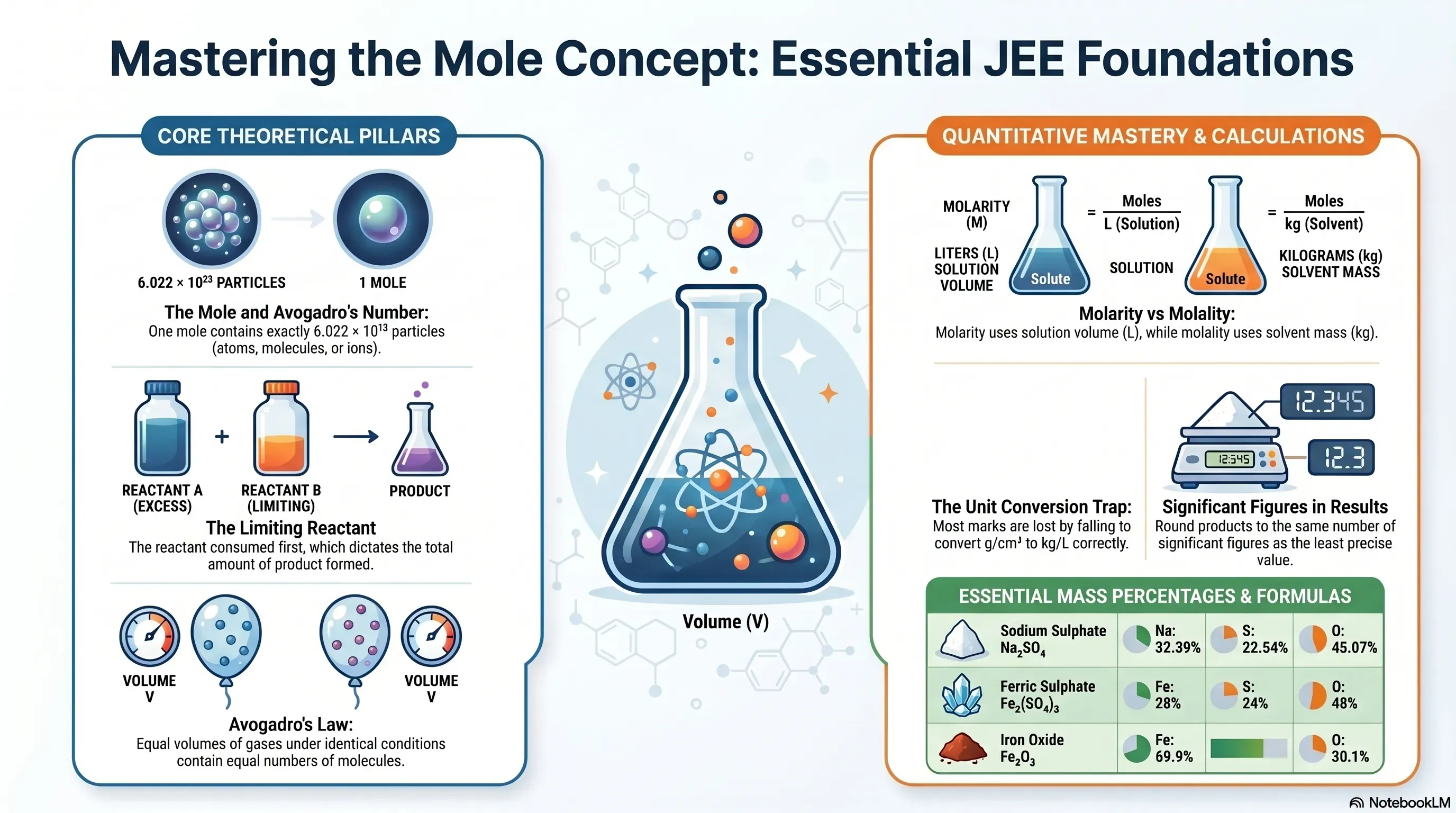
Numericals on mole concept look long, but they use the same few steps again and again, so numericals on mole concept become easy with practice. This page groups 40 solved numericals on mole concept by type, so that you can practise one type at a time. If you need the theory first, read eSaral’s Mole Concept notes for Class 11, JEE and NEET. For the NCERT questions on SI units, significant figures and the laws of chemical combination, use eSaral’s NCERT Solutions for Class 11 Chemistry Chapter 1.
Formulas Used in Numericals on Mole Concept
Quantity | Formula |
|---|---|
Number of moles | $n = \dfrac{m}{M} = \dfrac{N}{N_A} = \dfrac{V_{STP}}{22.4\ \text{L}}$, with $N_A = 6.022\times 10^{23}$ |
Percentage composition | $\%\ \text{of element} = \dfrac{\text{mass of element in 1 mol}}{\text{molar mass}} \times 100$ |
Molarity | $M = \dfrac{n}{V\ (\text{L})} = \dfrac{w}{M_B}\times\dfrac{1000}{V\ (\text{mL})}$ |
Molality | $m = \dfrac{n_{solute}}{\text{mass of solvent (kg)}}$ |
Mole fraction | $x_A = \dfrac{n_A}{n_A + n_B}$ |
Molarity from density | $M = \dfrac{10 \times d \times \%\ \text{w/w}}{M_B}$ |
Molecular formula | $n = \dfrac{\text{molar mass}}{\text{empirical formula mass}}$, molecular formula $= n \times$ empirical formula |
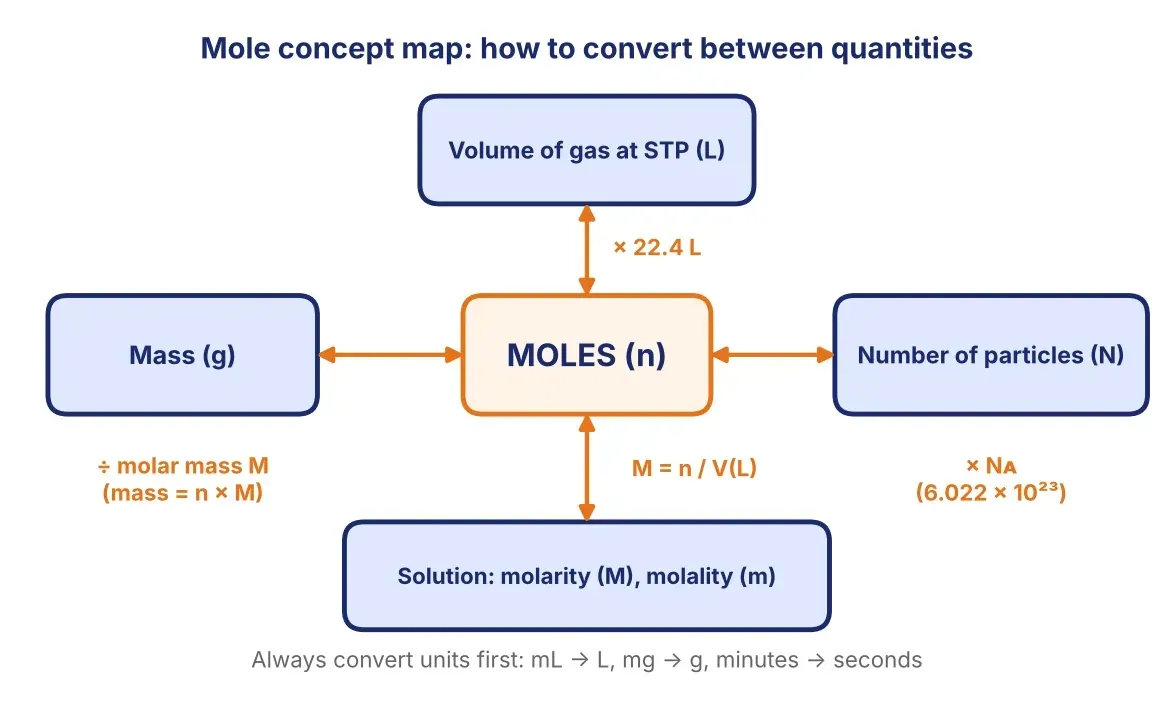
How to Solve Numericals on Mole Concept: 4 Steps
Use this method for all numericals on mole concept.
- Write the data with units, and convert the units first (mL to L, mg to g).
- Convert the given quantity to moles using the mass, the number of particles, the gas volume or the molarity.
- Use the balanced equation or the formula to find the moles of the quantity that you need.
- Convert the moles to the answer: mass, volume or number of particles, with the right unit and significant figures.
Numericals on Mole Concept: Moles, Mass and Number of Particles
These numericals on mole concept practise the three basic conversions: mass, number of particles and gas volume to moles.
Q1. Calculate the number of moles in (i) 11 g of $CO_2$, (ii) $3.01\times 10^{22}$ molecules of $CO_2$, (iii) 1.12 L of $CO_2$ at STP.
(i) $M = 44\ \text{g/mol}$, so $n = \dfrac{11}{44} = 0.25$ mol.
(ii) $n = \dfrac{3.01\times 10^{22}}{6.02\times 10^{23}} = 0.05$ mol.
(iii) $n = \dfrac{1.12}{22.4} = 0.05$ mol.
Q2. Calculate the number of atoms in (i) 52 mol of Ar, (ii) 52 u of He, (iii) 52 g of He.
(i) $52 \times 6.022\times 10^{23} = 3.13\times 10^{25}$ atoms.
(ii) One He atom has a mass of 4 u, so the number of atoms is $\dfrac{52}{4} = 13$.
(iii) $n = \dfrac{52}{4} = 13$ mol, so the number of atoms is $13 \times 6.022\times 10^{23} = 7.83\times 10^{24}$.
Q3. In three moles of ethane ($C_2H_6$), calculate (i) the moles of carbon atoms, (ii) the moles of hydrogen atoms, (iii) the number of molecules of ethane.
One mole of $C_2H_6$ has 2 mol of C atoms and 6 mol of H atoms.
(i) $3 \times 2 = 6$ mol of C. (ii) $3 \times 6 = 18$ mol of H. (iii) $3 \times 6.022\times 10^{23} = 1.81\times 10^{24}$ molecules.
Q4. Which one has the largest number of atoms: 1 g Au, 1 g Na, 1 g Li or 1 g $Cl_2$? (Au = 197, Na = 23, Li = 7, Cl = 35.5)
Atoms per gram are proportional to $\dfrac{1}{\text{atomic mass}}$, and for $Cl_2$ to $\dfrac{2}{71}$:
$$\text{Au: } 0.0051, \quad \text{Na: } 0.0435, \quad \text{Li: } 0.1429, \quad Cl_2\text{: } 0.0282 \quad (\times\, 6.022\times 10^{23})$$
Answer: 1 g of Li has the largest number of atoms.
Q5. Chlorophyll contains 2.68% of magnesium by mass. Calculate the number of Mg atoms in 5.00 g of chlorophyll. (Mg = 24)
Mass of Mg $= \dfrac{2.68}{100}\times 5.00 = 0.134$ g, so $n = \dfrac{0.134}{24}$ mol.
$$N = \frac{0.134}{24}\times 6.022\times 10^{23} = 3.36\times 10^{21}\ \text{atoms}$$
Q6. How many oxygen atoms are present in 0.5 mol of $Al_2(SO_4)_3$?
One formula unit has $3 \times 4 = 12$ oxygen atoms. So 0.5 mol has $6$ mol of O atoms.
$$N = 6 \times 6.022\times 10^{23} = 3.61\times 10^{24}\ \text{atoms}$$
Q7. Find the volume at STP of (i) 14 g of $N_2$, (ii) $6.023\times 10^{22}$ molecules of $NH_3$, (iii) 0.1 mol of $SO_2$.
(i) $n = \dfrac{14}{28} = 0.5$ mol, so $V = 0.5 \times 22.4 = 11.2$ L.
(ii) $n = \dfrac{6.023\times 10^{22}}{6.023\times 10^{23}} = 0.1$ mol, so $V = 2.24$ L.
(iii) $V = 0.1 \times 22.4 = 2.24$ L.
Numericals on Mole Concept: Average Atomic Mass
Numericals on mole concept with isotopes use the weighted average of the isotopic masses.
Q8. Calculate the average atomic mass of chlorine from the data: $^{35}Cl$ (34.9689 u, 75.77%) and $^{37}Cl$ (36.9659 u, 24.23%).
$$M_{avg} = \frac{34.9689\times 75.77 + 36.9659\times 24.23}{100} = 35.45\ \text{u}$$
Q9. Find the molar mass of naturally occurring argon from the data: $^{36}Ar$ (35.96755 u, 0.337%), $^{38}Ar$ (37.96272 u, 0.063%) and $^{40}Ar$ (39.9624 u, 99.600%).
$$M_{avg} = \frac{35.96755\times 0.337 + 37.96272\times 0.063 + 39.9624\times 99.600}{100} \approx 39.95\ \text{g/mol}$$
Numericals on Mole Concept: Percentage Composition
In these numericals on mole concept, the mass of the element in one mole is divided by the molar mass.
Q10. Calculate the mass percentage of iron, sulphur and oxygen in ferric sulphate, $Fe_2(SO_4)_3$. (Fe = 56, S = 32, O = 16)
Formula mass $= 2\times 56 + 3(32 + 64) = 400$ u.
$$\%\,Fe = \frac{112}{400}\times 100 = 28\%, \qquad \%\,S = \frac{96}{400}\times 100 = 24\%, \qquad \%\,O = \frac{192}{400}\times 100 = 48\%$$
Q11. Calculate the mass percent of each element in sodium sulphate, $Na_2SO_4$.
Molar mass $= 2\times 23 + 32 + 4\times 16 = 142$ g/mol.
$$\%\,Na = \frac{46}{142}\times 100 = 32.39\%, \quad \%\,S = \frac{32}{142}\times 100 = 22.54\%, \quad \%\,O = \frac{64}{142}\times 100 = 45.07\%$$
Q12. How much copper can be obtained from 100 g of copper sulphate, $CuSO_4$? (Cu = 63.5)
Molar mass of $CuSO_4 = 63.5 + 32 + 64 = 159.5$ g/mol, and it has 63.5 g of Cu.
$$\text{Cu} = \frac{63.5}{159.5}\times 100 = 39.81\ \text{g}$$
Numericals on Mole Concept: Empirical and Molecular Formula
The numericals on mole concept below follow one method: percentages, moles, the simplest ratio, and then the molecular formula.
Q13. An oxide of iron has 69.9% iron and 30.1% oxygen by mass, and its molar mass is 159.8 g/mol. Find its molecular formula. (Fe = 55.85, O = 16)
Element | Mass (g in 100 g) | Moles | Ratio |
|---|---|---|---|
Fe | 69.9 | $\dfrac{69.9}{55.85} = 1.25$ | 1 |
O | 30.1 | $\dfrac{30.1}{16} = 1.88$ | 1.5 |
The ratio Fe : O $= 1 : 1.5 = 2 : 3$, so the empirical formula is $Fe_2O_3$ (mass 159.7). Since $n = \dfrac{159.8}{159.7} \approx 1$, the molecular formula is also $Fe_2O_3$.
Q14. A 4.24 mg sample of butyric acid gives 8.45 mg of $CO_2$ and 3.46 mg of $H_2O$ on complete burning. Find the mass percent of each element, and the empirical and molecular formula if the molecular mass is 88 u.
$$\text{Mass of C} = \frac{12}{44}\times 8.45 = 2.30\ \text{mg}, \qquad \%\,C = \frac{2.30}{4.24}\times 100 = 54.35\%$$ $$\text{Mass of H} = \frac{2}{18}\times 3.46 = 0.384\ \text{mg}, \qquad \%\,H = \frac{0.384}{4.24}\times 100 = 9.07\%$$ $$\%\,O = 100 - 54.35 - 9.07 = 36.58\%$$
Moles (per 100 g): C $= \dfrac{54.35}{12} = 4.53$, H $= 9.07$, O $= \dfrac{36.58}{16} = 2.29$. Dividing by 2.29, the ratio is C : H : O $= 2 : 4 : 1$, so the empirical formula is $C_2H_4O$ (mass 44). Then $n = \dfrac{88}{44} = 2$, and the molecular formula is $C_4H_8O_2$.
Q15. A welding fuel has only carbon and hydrogen. Burning a sample gives 3.38 g of $CO_2$ and 0.690 g of $H_2O$. 10.0 L of the gas at STP weighs 11.6 g. Find the empirical formula, the molar mass and the molecular formula.
$$\text{Mass of C} = \frac{12\times 3.38}{44} = 0.922\ \text{g}, \qquad \text{Mass of H} = \frac{2\times 0.690}{18} = 0.077\ \text{g}$$
Moles: C $= \dfrac{0.922}{12} = 0.077$, H $= \dfrac{0.077}{1} = 0.077$, so the empirical formula is CH (mass 13).
Molar mass $= \dfrac{11.6 \times 22.4}{10.0} = 25.98$ g/mol, and $n = \dfrac{25.98}{13} \approx 2$, so the molecular formula is $C_2H_2$.
Q16. Naphthalene has 93.71% carbon and 6.29% hydrogen, and its molar mass is 128 g/mol. Find its molecular formula.
In 100 g: C $= \dfrac{93.71}{12.0} = 7.81$ mol, H $= \dfrac{6.29}{1.00} = 6.29$ mol. The ratio C : H $= 1.24 \approx \dfrac{5}{4}$, so the empirical formula is $C_5H_4$ (mass 64). Since $n = \dfrac{128}{64} = 2$, the molecular formula is $C_{10}H_8$.
Numericals on Mole Concept: Stoichiometry and Limiting Reagent
Stoichiometry numericals on mole concept always start from the balanced equation, and from the limiting reagent when both amounts are given.
Q17. How many grams of HCl react with 5.0 g of $MnO_2$? $4HCl + MnO_2 \rightarrow 2H_2O + MnCl_2 + Cl_2$ (Mn = 55)
$n(MnO_2) = \dfrac{5.0}{87} = 0.0575$ mol. The mole ratio HCl : $MnO_2$ is $4 : 1$, so $n(HCl) = 4 \times 0.0575 = 0.230$ mol.
$$\text{Mass of HCl} = 0.230 \times 36.5 = 8.39\ \text{g}$$
Q18. In the manufacture of $HNO_3$, how many moles of $NO_2$ produce 7.33 mol of $HNO_3$? $3NO_2 + H_2O \rightarrow 2HNO_3 + NO$
2 mol of $HNO_3$ need 3 mol of $NO_2$, so $n(NO_2) = \dfrac{3}{2}\times 7.33 = 10.995 \approx 11.0$ mol.
Q19. $6.023\times 10^{23}$ molecules of $N_2$ react completely with $H_2$: $N_2 + 3H_2 \rightarrow 2NH_3$. Find the number of $NH_3$ molecules formed.
1 molecule of $N_2$ gives 2 molecules of $NH_3$, so the number of molecules is $2 \times 6.023\times 10^{23} = 1.204\times 10^{24}$.
Q20. If 0.30 mol of Zn is added to hydrochloric acid with 0.52 mol of HCl, how many moles of $H_2$ form, and which is the limiting reactant? $Zn + 2HCl \rightarrow ZnCl_2 + H_2$
0.30 mol of Zn needs $2 \times 0.30 = 0.60$ mol of HCl, but only 0.52 mol is present, so HCl is the limiting reactant.
$$n(H_2) = \frac{0.52}{2} = 0.26\ \text{mol}$$
Q21. For $A + B_2 \rightarrow AB_2$, find the limiting reagent in each mixture: (i) 300 atoms of A + 200 molecules of $B_2$, (ii) 2 mol A + 3 mol $B_2$, (iii) 100 atoms of A + 100 molecules of $B_2$, (iv) 5 mol A + 2.5 mol $B_2$, (v) 2.5 mol A + 5 mol $B_2$.
The ratio is $1 : 1$.
Mixture | Limiting reagent |
|---|---|
(i) 300 A + 200 $B_2$ | $B_2$ (100 atoms of A are left) |
(ii) 2 mol A + 3 mol $B_2$ | A |
(iii) 100 A + 100 $B_2$ | None (stoichiometric mixture) |
(iv) 5 mol A + 2.5 mol $B_2$ | $B_2$ |
(v) 2.5 mol A + 5 mol $B_2$ | A |
Q22. Potassium bromide contains 32.9% potassium by mass. If 6.4 g of bromine reacts with 3.60 g of K, find the number of moles of K that combine with bromine to form KBr.
32.9 g of K combine with 67.1 g of Br, so 3.60 g of K need $\dfrac{67.1}{32.9}\times 3.60 = 7.34$ g of Br. Only 6.4 g of bromine is present, so bromine is the limiting reactant.
$$n(Br_2) = \frac{6.4}{160} = 0.04\ \text{mol}, \qquad 2K + Br_2 \rightarrow 2KBr \;\Rightarrow\; n(K) = 2\times 0.04 = 0.08\ \text{mol}$$
Q23. How many grams of $N_2$ react completely with 0.3 g of $H_2$ to form ammonia, and how much ammonia forms? $N_2 + 3H_2 \rightarrow 2NH_3$
$n(H_2) = \dfrac{0.3}{2} = 0.15$ mol. From the ratio, $n(N_2) = \dfrac{0.15}{3} = 0.05$ mol and $n(NH_3) = \dfrac{2}{3}\times 0.15 = 0.10$ mol.
$$\text{Mass of } N_2 = 0.05\times 28 = 1.4\ \text{g}, \qquad \text{Mass of } NH_3 = 0.10\times 17 = 1.7\ \text{g}$$
Q24. In $2Br^- + Cl_2 \rightarrow 2Cl^- + Br_2$, what volume of 0.050 M $Cl_2$ solution reacts completely with 50.0 mL of 0.060 M NaBr?
$n(Br^-) = 0.0500 \times 0.060 = 0.0030$ mol. The ratio $Br^- : Cl_2$ is $2 : 1$, so $n(Cl_2) = 0.0015$ mol.
$$V = \frac{0.0015}{0.050} = 0.030\ \text{L} = 30\ \text{mL}$$
Q25. 500 mL of 0.25 M $Na_2SO_4$ is added to 15.00 g of $BaCl_2$. Find the moles and the mass of $BaSO_4$ formed. (Ba = 137, S = 32, O = 16)
$n(Na_2SO_4) = 0.500\times 0.25 = 0.125$ mol, and $n(BaCl_2) = \dfrac{15.00}{208.2} = 0.072$ mol. They react $1 : 1$, so $BaCl_2$ is the limiting reagent.
$$n(BaSO_4) = 0.072\ \text{mol}, \qquad \text{mass} = 0.072\times 233.4 = 16.8\ \text{g}$$
Q26. Calculate the lime, $Ca(OH)_2$, needed to remove the hardness of 60,000 L of water that contains 16.2 g of calcium bicarbonate per 100 L. (Ca = 40, C = 12, O = 16, H = 1)
Mass of $Ca(HCO_3)_2 = \dfrac{16.2}{100}\times 60000 = 9720$ g. The molar mass is 162 g/mol, so $n = 60$ mol.
$$Ca(HCO_3)_2 + Ca(OH)_2 \rightarrow 2CaCO_3 + 2H_2O$$
The ratio is $1 : 1$, so 60 mol of $Ca(OH)_2$ is needed: $60 \times 74 = 4440$ g, that is, 4.44 kg.
Q27. 20 g of $CH_4$ burns in 64 g of $O_2$: $CH_4 + 2O_2 \rightarrow CO_2 + 2H_2O$. Find the limiting reagent, the mass of $CO_2$ formed and the mass of the reactant left.
$n(CH_4) = \dfrac{20}{16} = 1.25$ mol and $n(O_2) = \dfrac{64}{32} = 2.0$ mol. Moles divided by the coefficient: $CH_4$ gives 1.25 and $O_2$ gives $\dfrac{2.0}{2} = 1.0$, so $O_2$ is the limiting reagent.
$$n(CO_2) = 1.0\ \text{mol} = 44\ \text{g}, \qquad CH_4\ \text{left} = (1.25 - 1.0)\times 16 = 4\ \text{g}$$
Q28. 100 mL of 0.2 M $Al_2(SO_4)_3$ is mixed with 200 mL of 0.05 M $NH_4OH$. Find the mass of $Al(OH)_3$ precipitated and the molarity of each ion in the resulting solution. (Treat the reaction as complete.)
$$Al_2(SO_4)_3 + 6NH_4OH \rightarrow 2Al(OH)_3 + 3(NH_4)_2SO_4$$
$n(Al_2(SO_4)_3) = 0.100\times 0.2 = 0.020$ mol and $n(NH_4OH) = 0.200\times 0.05 = 0.010$ mol. $NH_4OH$ is the limiting reagent, so
$$n(Al(OH)_3) = \frac{2}{6}\times 0.010 = 0.00333\ \text{mol}, \qquad \text{mass} = 0.00333\times 78 = 0.26\ \text{g}$$
The total volume is 300 mL. $Al^{3+}$ left $= 0.040 - 0.00333 = 0.0367$ mol, so $[Al^{3+}] = 0.122$ M. $SO_4^{2-} = 0.060$ mol, so $[SO_4^{2-}] = 0.20$ M. $NH_4^+ = 0.010$ mol, so $[NH_4^+] = 0.033$ M. The normality is molarity $\times$ charge: $Al^{3+}$ 0.367 N, $SO_4^{2-}$ 0.40 N and $NH_4^+$ 0.033 N.
Numericals on Mole Concept: Molarity, Molality and Mole Fraction
These numericals on mole concept need careful units: litres of solution for molarity, and kilograms of solvent for molality.
Q29. What is the concentration of sugar ($C_{12}H_{22}O_{11}$) in mol/L if 20 g is dissolved in enough water to make 2 L of solution?
$M_B = 342$ g/mol, so $n = \dfrac{20}{342} = 0.0585$ mol.
$$M = \frac{0.0585}{2} = 0.0292\ \text{mol/L}$$
Q30. How many moles and how many grams of NaCl are present in 250 cm³ of 0.50 M NaCl? (Na = 23, Cl = 35.5)
$$n = M\times V = 0.50\times 0.250 = 0.125\ \text{mol}, \qquad \text{mass} = 0.125\times 58.5 = 7.31\ \text{g}$$
Q31. 18.25 g of NaOH is dissolved in water to make 200 cm³ of solution. Find the molarity.
$$M = \frac{18.25}{40}\times\frac{1000}{200} = 2.28\ \text{mol/L}$$
Q32. A sample of $NaNO_3$ weighing 0.83 g is placed in a 50 mL flask and made up to the mark. Find the molarity. (Na = 23, N = 14, O = 16)
$M_B = 85$ g/mol.
$$M = \frac{0.83}{85}\times\frac{1000}{50} = 0.195\ \text{M}$$
Q33. (i) 38 g of NaOH is dissolved to make 50.0 mL of solution. Find the molarity. (ii) How many moles of NaOH are in 27 mL of 0.15 M NaOH?
(i) $M = \dfrac{38}{40}\times\dfrac{1000}{50} = 19$ M.
(ii) $n = 0.15\times 0.027 = 4.05\times 10^{-3}$ mol.
Q34. 0.38 g of NaOH is dissolved to make 50.0 cm³ of solution. Find the molarity.
$$M = \frac{0.38}{40}\times\frac{1000}{50} = 0.19\ \text{mol/L}$$
Q35. How many mL of 0.150 M NaOH contain 0.184 g of NaOH?
$n = \dfrac{0.184}{40} = 0.0046$ mol, so $V = \dfrac{0.0046}{0.150} = 0.0307$ L $= 30.7$ mL.
Q36. Calculate the mass of sodium acetate ($CH_3COONa$, molar mass 82.0245 g/mol) needed to make 500 mL of 0.375 M solution.
$$n = 0.375\times 0.500 = 0.1875\ \text{mol}, \qquad \text{mass} = 0.1875\times 82.0245 = 15.38\ \text{g}$$
Q37. If the density of methanol is 0.793 kg/L, what volume is needed to make 2.5 L of 0.25 M solution?
$n = 0.25\times 2.5 = 0.625$ mol, so the mass is $0.625\times 32 = 20$ g. The density is 0.793 g/mL.
$$V = \frac{20}{0.793} = 25.2\ \text{mL}$$
Q38. Calculate the molality of ethanol in water when the mole fraction of ethanol is 0.040.
For 1 mol of solution: 0.040 mol of ethanol and 0.960 mol of water, which is $0.960\times 18 = 17.28$ g $= 0.01728$ kg.
$$m = \frac{0.040}{0.01728} = 2.31\ \text{mol/kg}$$
Q39. Drinking water has 15 ppm (by mass) of chloroform, $CHCl_3$. Express this as (i) percent by mass and (ii) molality.
(i) 15 ppm means 15 g in $10^6$ g, so the percent by mass is $\dfrac{15}{10^6}\times 100 = 1.5\times 10^{-3}\%$.
(ii) $n = \dfrac{15}{119.5} = 0.1255$ mol in about $10^6$ g $= 10^3$ kg of water.
$$m = \frac{0.1255}{1000} = 1.25\times 10^{-4}\ \text{mol/kg}$$
Q40. A 10% (w/w) glucose solution has a density of 1.20 g/mL. Find (i) the molality, (ii) the molarity and (iii) the mole fraction of each component.
Take 100 g of solution: 10 g of glucose ($n = \dfrac{10}{180} = 0.0556$ mol) and 90 g of water ($n = \dfrac{90}{18} = 5.0$ mol).
(i) $m = \dfrac{0.0556}{0.090} = 0.618$ mol/kg.
(ii) $V = \dfrac{100}{1.20} = 83.3$ mL, so $M = \dfrac{0.0556}{0.0833} = 0.667$ M.
(iii) $x_{glucose} = \dfrac{0.0556}{5.0556} = 0.011$ and $x_{water} = 0.989$.
Bonus: Molarity of concentrated nitric acid
Find the molarity of nitric acid that has a density of 1.41 g/mL and 69% $HNO_3$ by mass. ($M_B = 63$)
$$M = \frac{10\times 1.41\times 69}{63} \approx 15.44\ \text{M}$$
Practice Numericals on Mole Concept
Try these numericals on mole concept without looking at the answers.
- How many molecules are present in 5.5 g of $CO_2$? (C = 12, O = 16)
- Find the mass of $NH_3$ formed from 14 g of $N_2$ and excess $H_2$. $N_2 + 3H_2 \rightarrow 2NH_3$
- A compound has 40% C, 6.7% H and 53.3% O, and its molar mass is 180 g/mol. Find its molecular formula.
- Find the molarity of a solution made by dissolving 5.85 g of NaCl in 500 mL of solution. (Na = 23, Cl = 35.5)
Answers: 1. $n = \dfrac{5.5}{44} = 0.125$ mol, so $N = 0.125\times 6.022\times 10^{23} = 7.53\times 10^{22}$ molecules. 2. $n(N_2) = 0.5$ mol, so $n(NH_3) = 1.0$ mol and the mass is 17 g. 3. The ratio C : H : O $= 3.33 : 6.7 : 3.33 = 1 : 2 : 1$, so the empirical formula is $CH_2O$ (mass 30), $n = 6$, and the molecular formula is $C_6H_{12}O_6$. 4. $n = \dfrac{5.85}{58.5} = 0.1$ mol, so $M = \dfrac{0.1}{0.5} = 0.2$ M.
Common Mistakes in Numericals on Mole Concept
These mistakes cost marks in numericals on mole concept.
Mistake | Correct approach |
|---|---|
Using the volume in mL in $M = n/V$ | Convert to litres, or use $\dfrac{w}{M_B}\times\dfrac{1000}{V_{mL}}$ |
Using the volume of the solvent for molarity | Molarity uses the volume of the solution |
Using the mass of the solution for molality | Molality uses the mass of the solvent in kg |
Treating $Cl_2$, $N_2$ and $O_2$ as atoms | These are molecules: 1 mol of $Cl_2$ has 2 mol of Cl atoms and a molar mass of 71 g |
Applying 22.4 L at any temperature | 22.4 L per mole is only for STP (273 K and 1 atm) |
Finding the limiting reagent by comparing the masses | Compare moles divided by the coefficients |
Forgetting to round to the right significant figures | Give the answer with the same number of significant figures as the least precise data |
Related Topics
For more help with numericals on mole concept, use these eSaral pages.
Frequently Asked Questions
What are numericals on mole concept?
Numericals on mole concept are calculation problems based on the mole, which connect the mass, the number of particles, the volume of a gas and the concentration of a solution through the number of moles. They include conversions, percentage composition, empirical and molecular formulas, limiting reagent problems and questions on molarity and molality.
How do you solve numericals on mole concept step by step?
Write the data with units, convert the units (mL to L, mg to g), change the given quantity to moles, use the balanced equation or the formula to find the moles of the required substance, and then convert the moles to the quantity asked: mass, volume or number of particles.
What is the formula for the number of moles?
Moles $n = \dfrac{\text{mass}}{\text{molar mass}} = \dfrac{N}{6.022\times 10^{23}} = \dfrac{V_{STP}}{22.4\ \text{L}}$. For a solution, $n = M \times V$, where $M$ is the molarity and $V$ is the volume in litres.
What is the difference between molarity and molality?
Molarity is the moles of solute per litre of solution, and it changes with temperature because the volume changes. Molality is the moles of solute per kilogram of solvent, and it does not change with temperature. eSaral’s Molarity formula and Molality formula pages explain both with examples.
How do you find the limiting reagent?
Divide the moles of each reactant by its coefficient in the balanced equation. The reactant with the smaller value is the limiting reagent, because it is used up first. All the product calculations are done from the limiting reagent.
How do you find the empirical formula from percentage composition?
Take 100 g of the compound, so that the percentages become masses. Divide each mass by the atomic mass to get the moles, divide all the moles by the smallest one, and round to whole numbers. The ratio gives the empirical formula. The molecular formula is the empirical formula multiplied by $n = \dfrac{\text{molar mass}}{\text{empirical formula mass}}$.
What volume does one mole of a gas occupy at STP?
In the NCERT convention, one mole of any gas occupies 22.4 L at 273 K and 1 atm. The value is different at other temperatures and pressures, so use it only when the question says STP.
How do you calculate molarity from the percentage by mass and the density?
Molarity $= \dfrac{10 \times d \times \text{mass percent}}{\text{molar mass}}$, where $d$ is the density in g/mL. For 69% nitric acid with $d = 1.41$ g/mL, the molarity is $\dfrac{10 \times 1.41 \times 69}{63} \approx 15.44$ M.
Why do we convert mL to L in numericals on mole concept?
Molarity is defined per litre. If you use the volume in mL without converting, your answer is wrong by a factor of 1000. The shortcut $M = \dfrac{w}{M_B} \times \dfrac{1000}{V_{mL}}$ already includes the conversion.
Are numericals on mole concept important for JEE and NEET?
Yes. Mole concept is the base of stoichiometry, solutions, equilibrium and electrochemistry, so its numericals appear in JEE Main, JEE Advanced and NEET, directly or as the first step of another problem. eSaral’s mole concept notes and PYQ pages cover the exam-level questions.
Where can I find the NCERT solutions and notes for mole concept?
eSaral has the NCERT Solutions for Class 11 Chemistry Chapter 1 (Some Basic Concepts of Chemistry), which includes the NCERT numericals on SI units and significant figures, and the Mole Concept notes for Class 11, JEE and NEET. Both are linked on this page.
Team eSaral
eSaral Academic and Editorial Team
Team eSaral is the collective author profile for educational content created by eSaral’s teachers and academic contributors. The team draws on expertise from IIT graduates, doctors, experienced educators and subject specialists to develop resources for JEE, NEET and school students. Our articles aim to explain concepts clearly and help students study with confidence.
Related Posts

BITSAT 2027: Registration Date, Exam Date, Syllabus, Eligibility, Pattern & Fees
BITSAT 2027 exam dates, registration timeline, eligibility criteria, exam pattern, marking scheme, syllabus and fees in one page.

BITSAT Previous Year Question Paper PDF (2017-2026)
Download BITSAT previous year question papers PDF from 2017 to 2026,session-wise. Memory-based papers,exam pattern, paper analysis and how to practise

CBSE Class 10 Date Sheet 2027: Expected Exam Dates, Release Date, Admit Card & Result Timeline
CBSE Class 10 date sheet 2027 is awaited. See the expected exam dates, release window, how to download the PDF, admit card and result timelines.

NCERT Physics Class 10 Book PDF in Hindi 2026-27 – भौतिक विज्ञान के 4 अध्याय (Free Download)
NCERT Physics Class 10 book PDF in Hindi 2026-27: download all 4 chapters (अध्याय 9–12) free, with topics and important formulas.

NCERT Biology Class 9 Book Anveshan PDF in Hindi - जीव विज्ञान कक्षा 9 पुस्तक अन्वेषण PDF
Download NCERT Biology Class 9 book PDF in Hindi chapterwise for 2026-27: Cell, Tissues, Reproduction and Diversity. Free PDFs.

Essay On Artificial Intelligence in English (100,150, 200, 250, 300, 500 Words)
This is in contrast to the natural intelligence of humans. With Artificial Intelligence, machines can perform

Essay on 78th India Independence Day in English for Student (100, 150, 200, 250, 300, 500 Words)
Read the best essays on India's Independence Day in English. Short & long essays (100, 150, 200, 250, 300, 500 words) perfect for school exams
NCERT Class 11 English Snapshots book - Free PDF download- Esaral
Download NCERT Class 11 English Snapshots book PDF for free. Get all 8 chapters, chapter-wise. Start your prep today!
NCERT Class 10 biology book pdf - Free PDF Download - eSaral
NCERT Class 10 Biology book PDF 2026-27: all 5 chapters (Life Processes to Our Environment) in English & Hindi, with CBSE syllabus, marks & practical

Essay on Global Warming in English (100,150, 200, 250, 300, 500 Words)
Global warming means the Earth is getting hotter. This happens because of things like pollution from cars and factories.