
NCERT Exemplar Class 12 Chemistry Chapter 4 - Chemical kinetics - Free PDF Download
Home » NCERT Exemplar Class 12 Chemistry » Chemical Kinetics

What Is NCERT Exemplar Class 12 Chemistry?
NCERT Exemplar Class 12 Chemistry Chapter 4 is an official supplementary problem book published by NCERT, covering Chemical Kinetics in greater depth than the standard textbook. It is specifically designed to challenge students beyond rote learning — pushing them to apply rate laws, interpret graphs, and solve multi-step problems that routinely appear in CBSE board exams and JEE Main.
The chapter focuses on how fast chemical reactions occur and what factors control that speed. Unlike the NCERT textbook exercises, the Exemplar problems test conceptual clarity, numerical application, and data interpretation simultaneously. This makes it the single most efficient resource for scoring above 90% in the Chemistry board paper and cracking the 2–3 Chemical Kinetics questions that appear every year in JEE Main (as per NTA's official question distribution data).
Students who pair this Exemplar with NCERT Solutions for Class 12 Chemistry cover every possible question variant the CBSE examiner can set.
Download the PDF of NCERT Exemplars Class 12 Chemistry Chapter 4 “Chemical kinetics
Full Syllabus Breakdown
The NCERT Exemplar Chapter 4 PDF covers every subtopic listed in the CBSE Class 12 Chemistry syllabus for Chemical Kinetics:
Topic | CBSE Importance | JEE Relevance |
|---|---|---|
Rate of a Reaction | High | Medium |
Factors Affecting Rate | High | Medium |
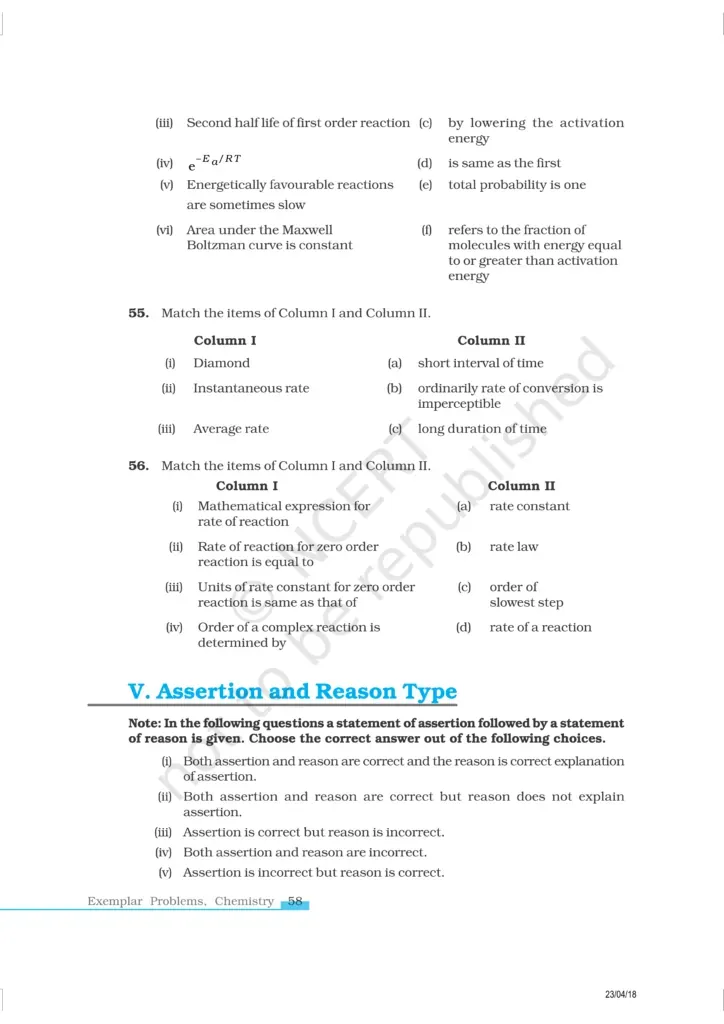
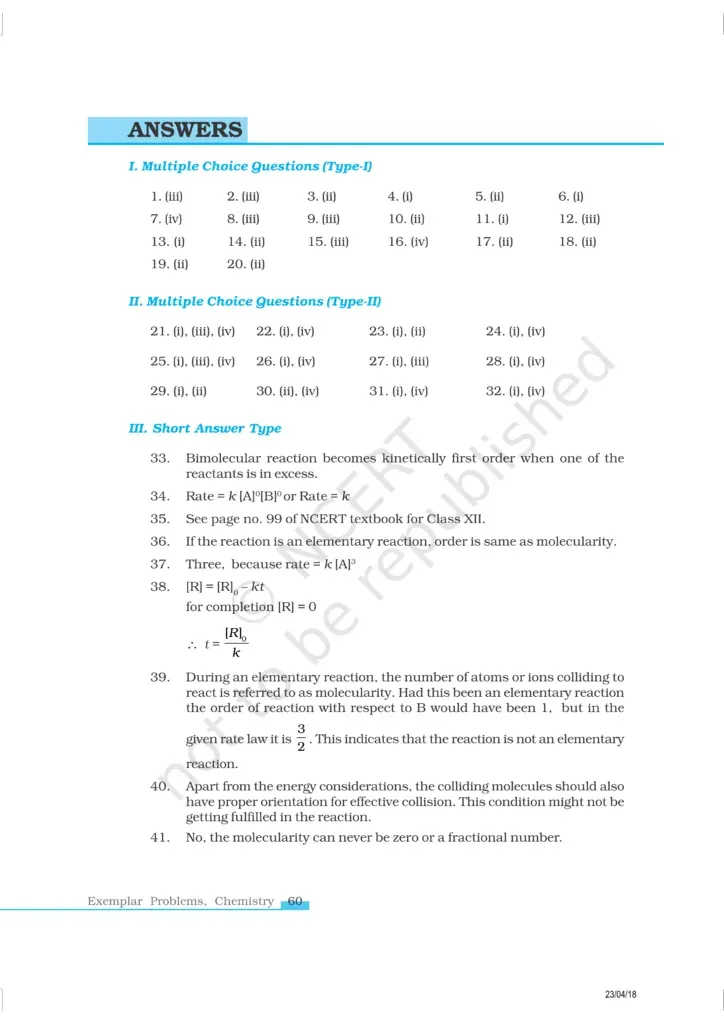
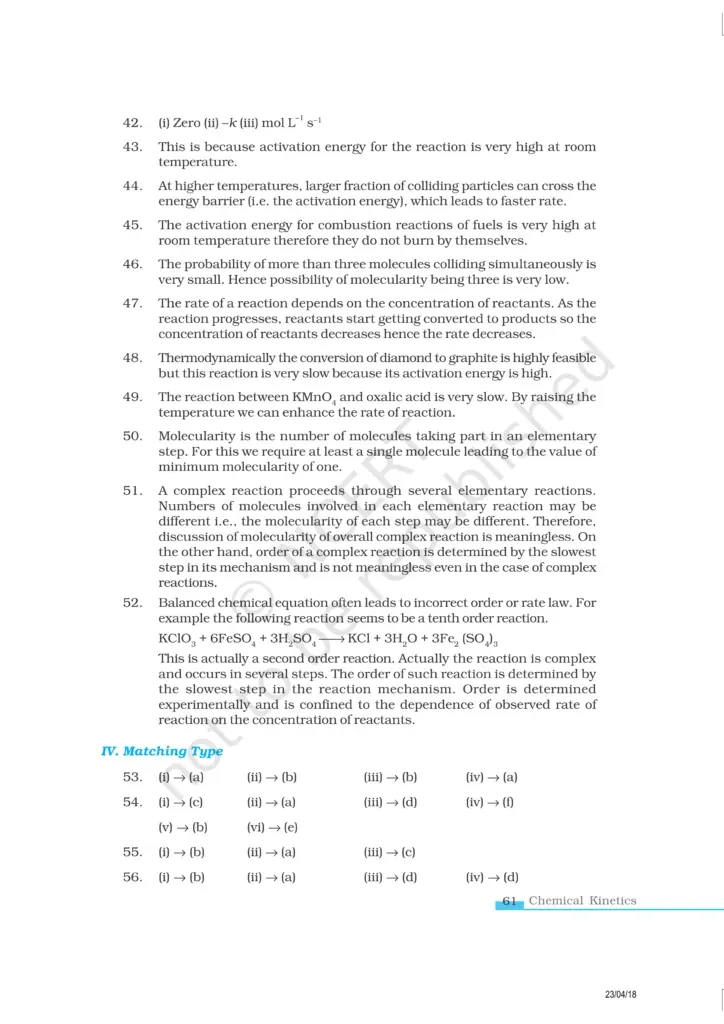
Order and Molecularity | Very High | Very High |
Integrated Rate Equations (0, 1, 2 order) | Very High | Very High |
Half-Life Calculations | Very High | High |
Pseudo First-Order Reactions | Medium | High |
Temperature Dependence – Arrhenius Equation | Very High | Very High |
Activation Energy | High | High |
Collision Theory | Medium | Low |
Effect of Catalyst | High | Medium |
Key Formulas You Must Know
- Rate law: $Rate = k[A]^m[B]^n$
- First-order integrated equation: $\ln[A] = \ln[A]_0 - kt$
- Half-life (first order): $t_{1/2} = \frac{0.693}{k}$
- Arrhenius equation: $k = Ae^{-E_a/RT}$
- $\log\left(\frac{k_2}{k_1}\right) = \frac{E_a}{2.303R}\left(\frac{T_2-T_1}{T_1T_2}\right)$
Question Types in NCERT Exemplar Chapter 4 – What to Expect
How Exemplar Questions Compare to Textbook Questions
Question Type | NCERT Textbook | NCERT Exemplar | CBSE Board Level | JEE Main Level |
|---|---|---|---|---|
MCQ (Single Correct) | Few | Many | Moderate | High |
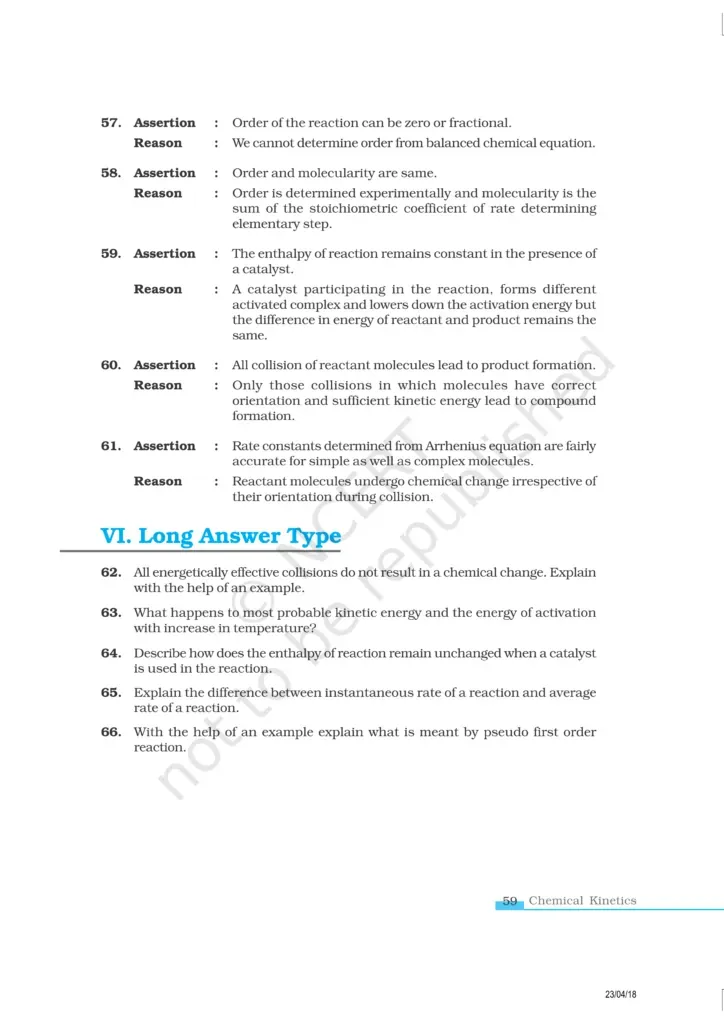
Assertion–Reason | None | Included | High | High |
Short Answer (2–3 marks) | Moderate | Many | High | Medium |
Long Answer / Case-based | Few | Included | High | Low |
Data / Graph Interpretation | Rare | Frequent | Medium | Very High |
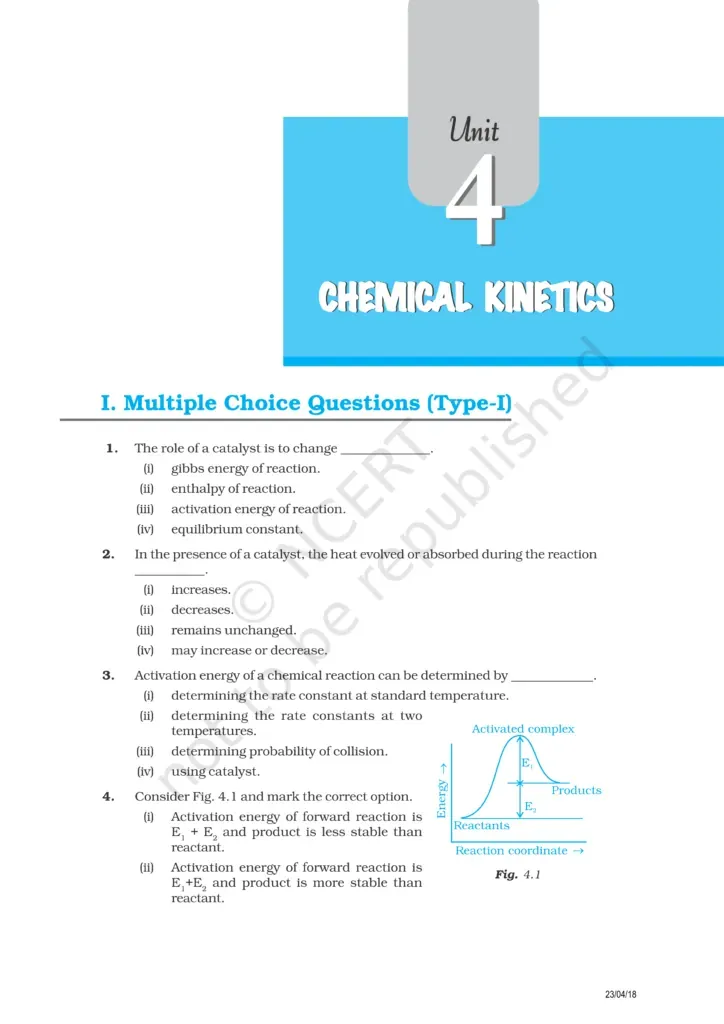
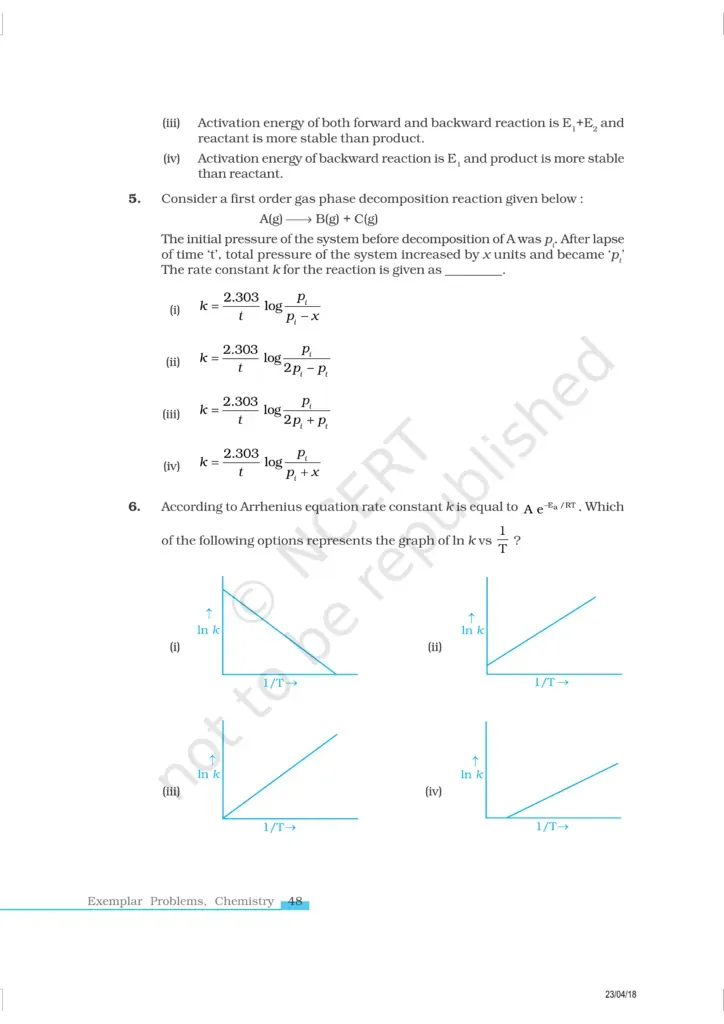
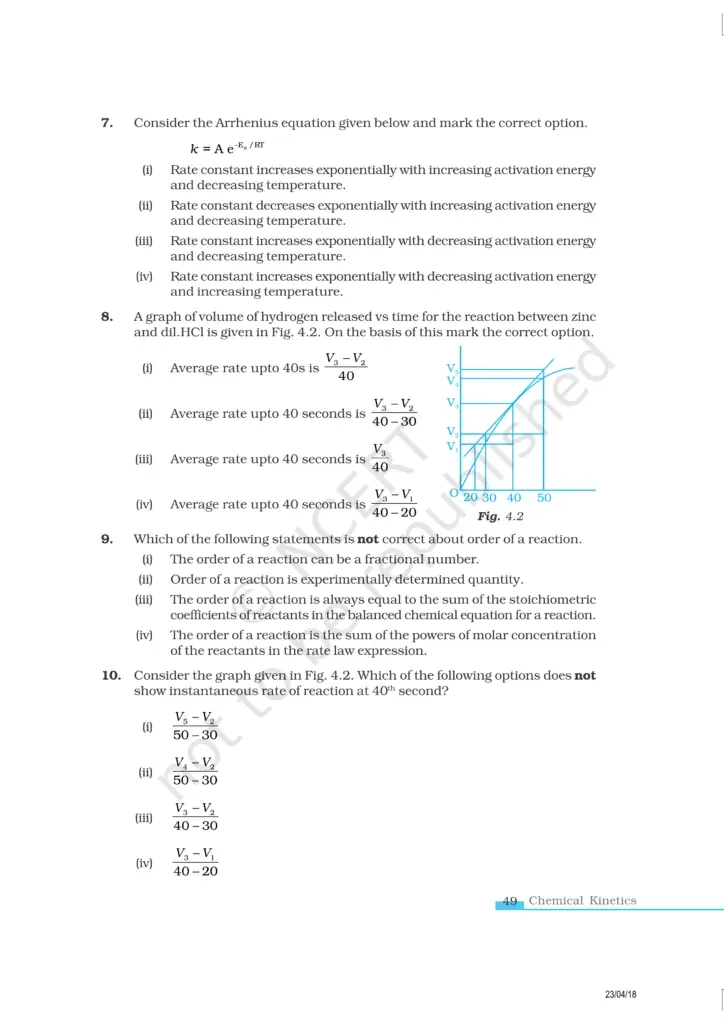
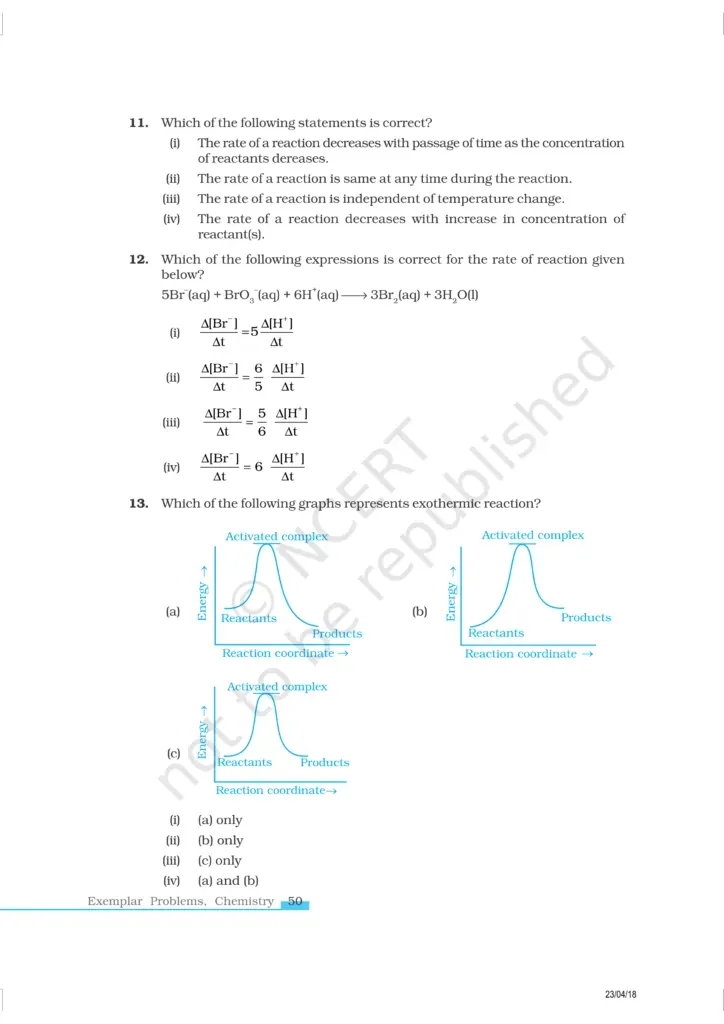
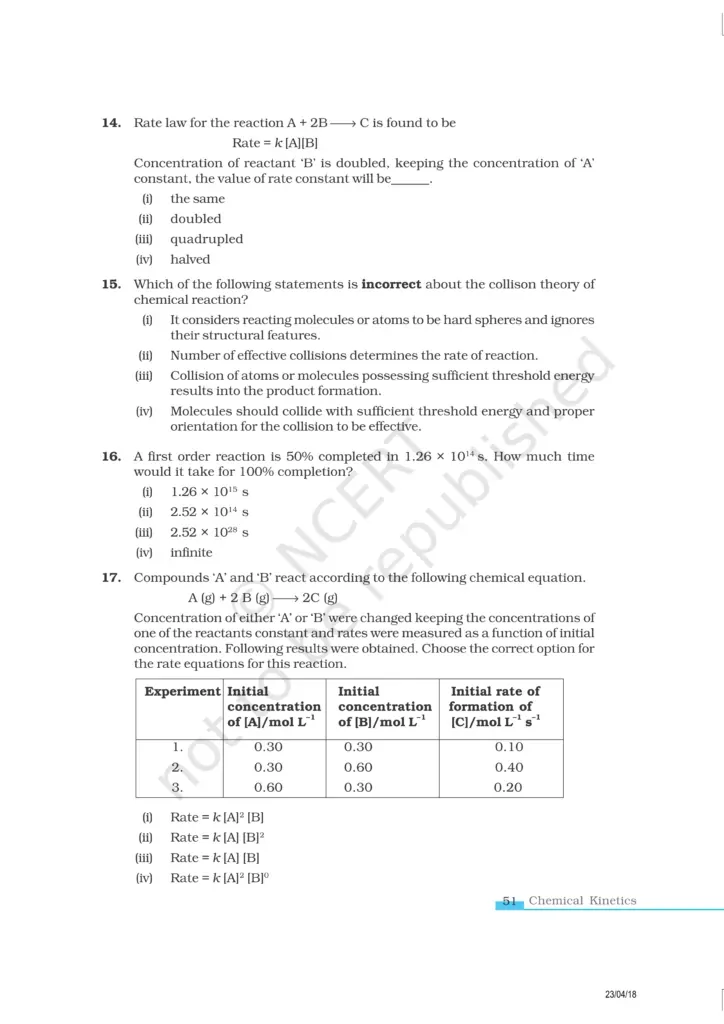
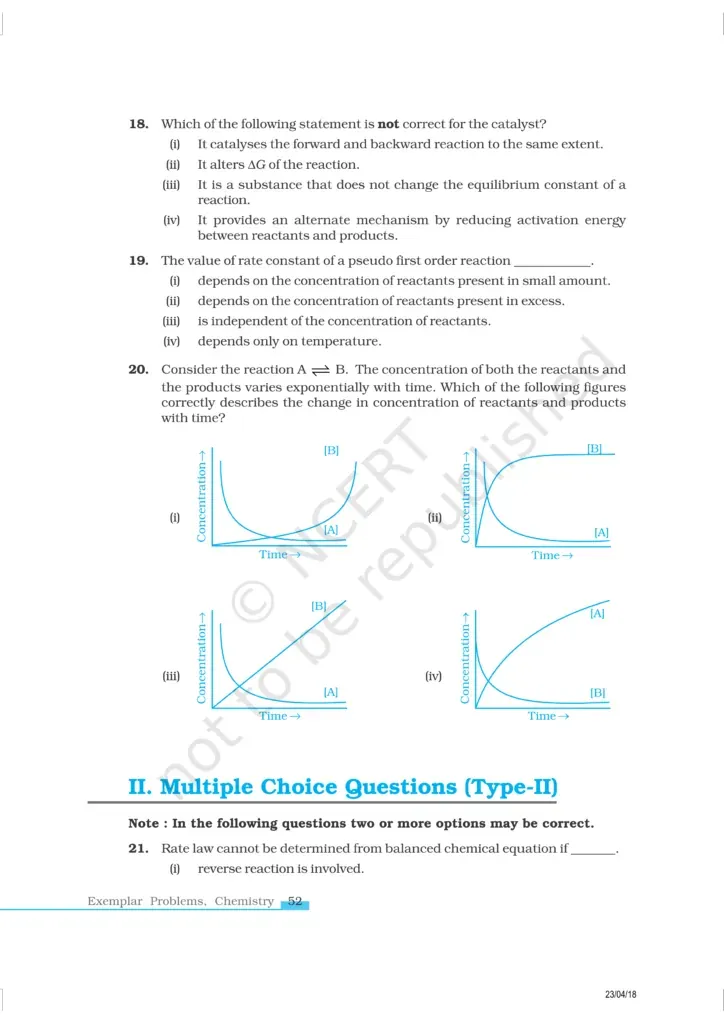
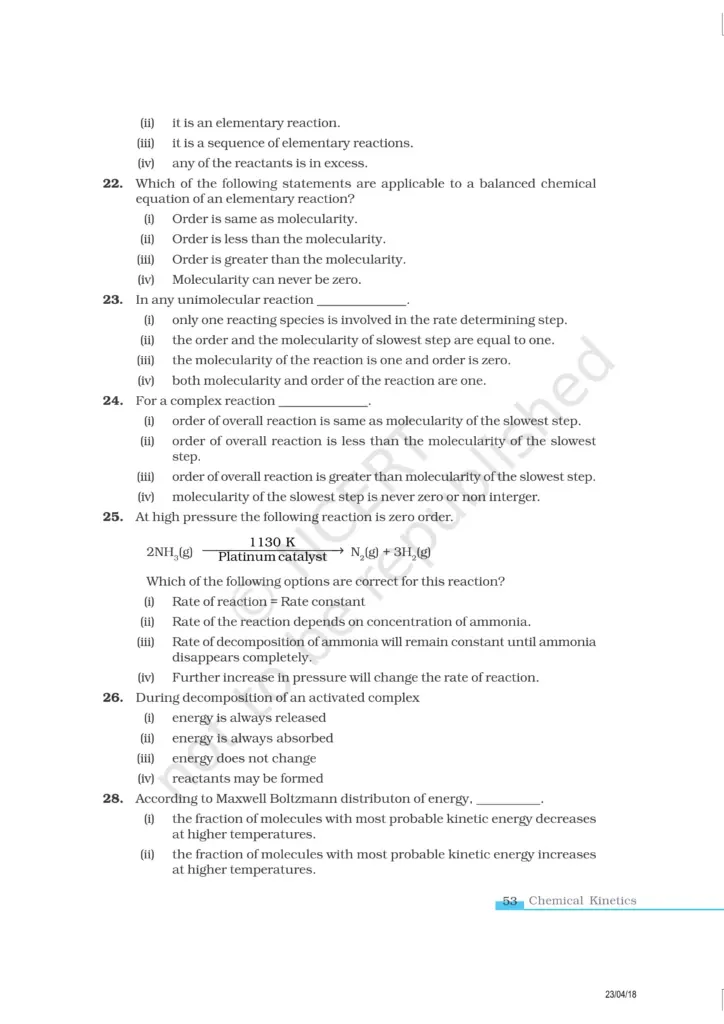
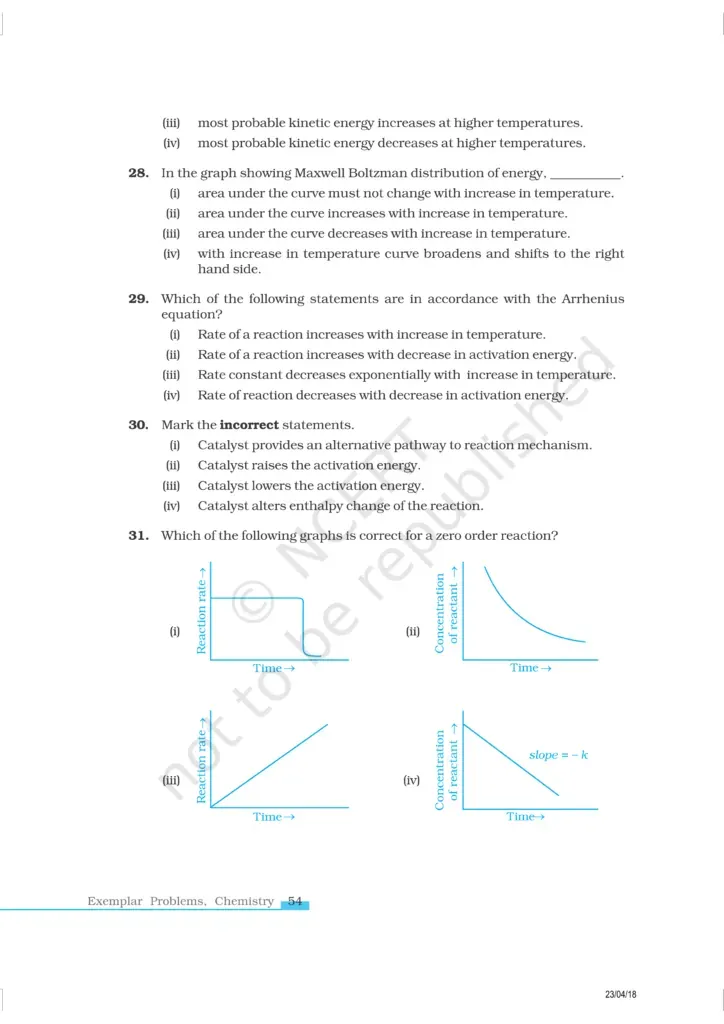
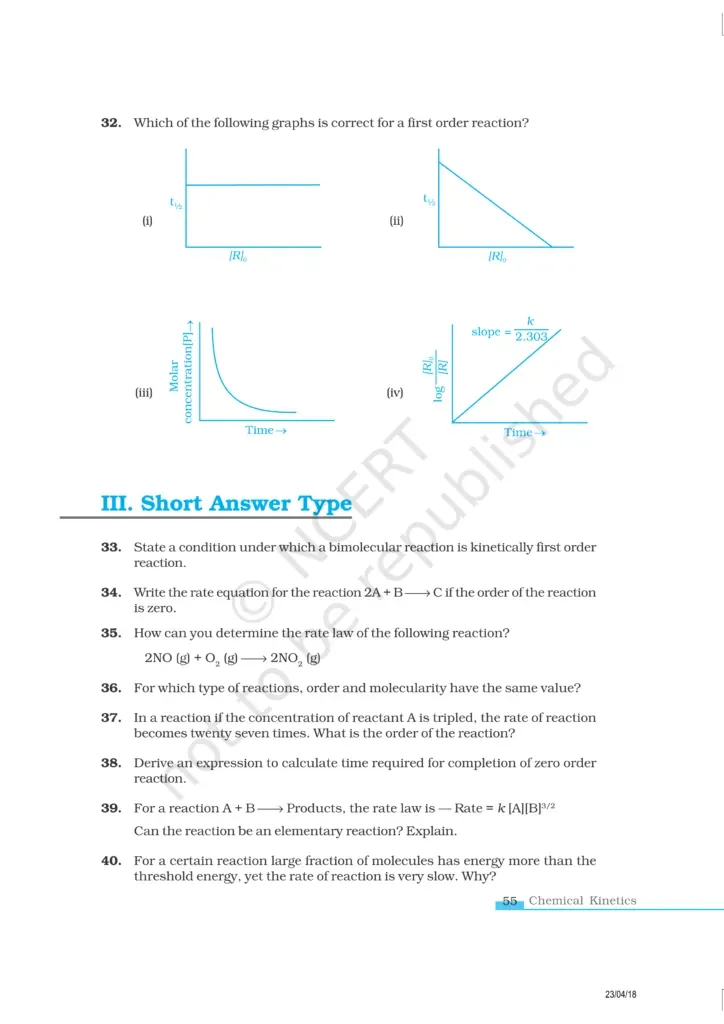
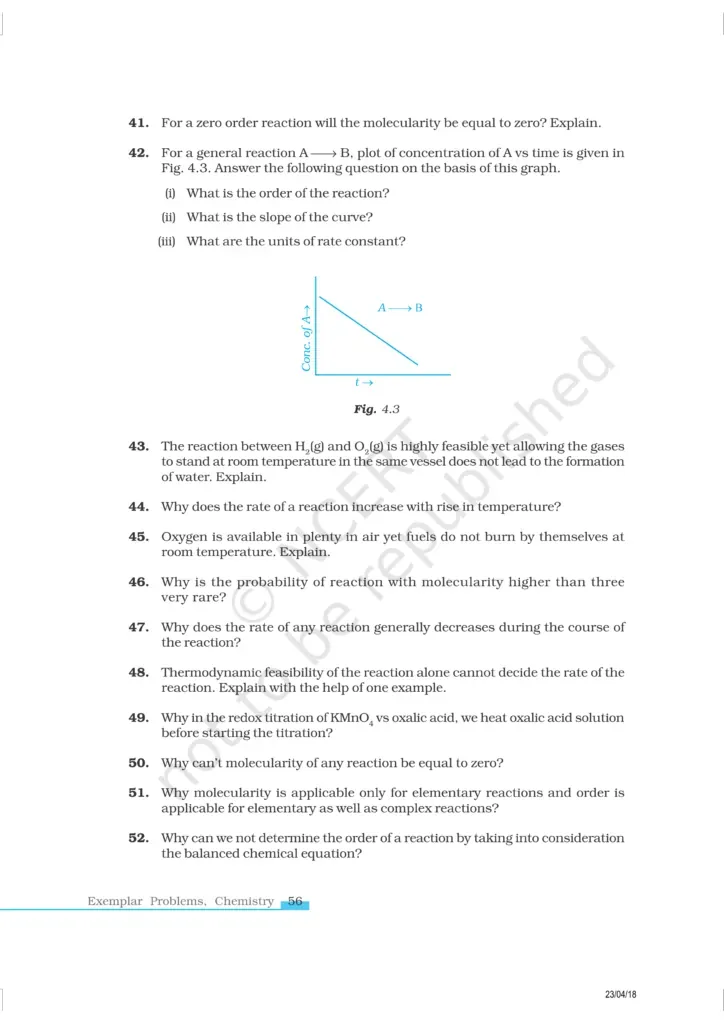
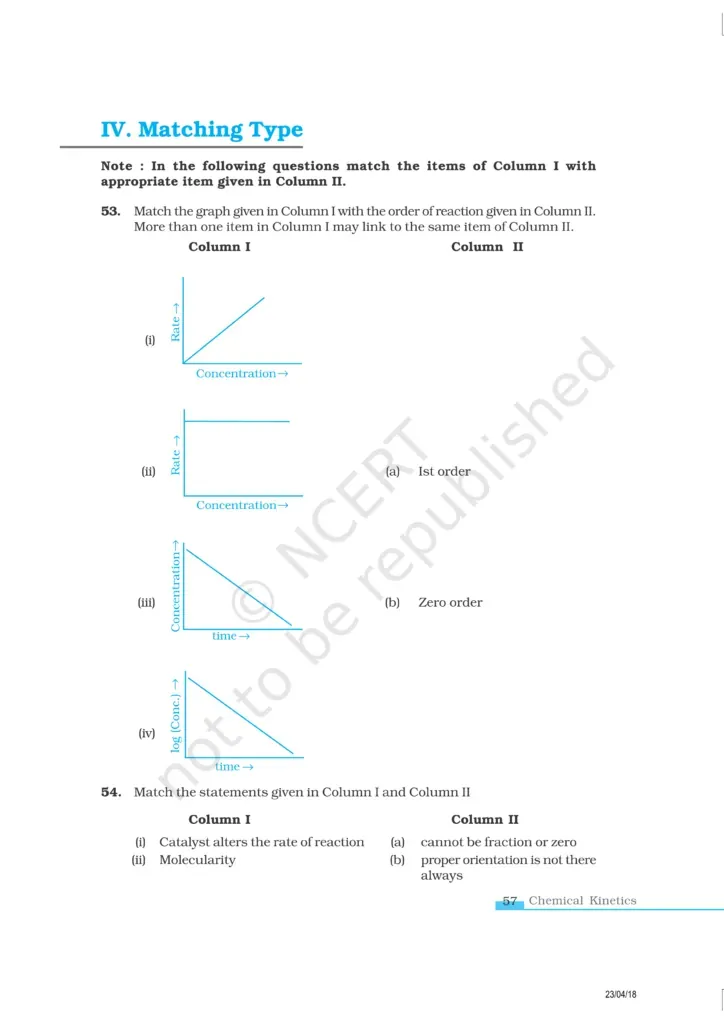
So, that’s all from this article. I hope you enjoyed this post. If you found this article helpful, then please share it with other students.
Also Read,
Download Class 12 Chemistry Revision Notes
Download NCERT Class 12 Chemistry Book
Download CBSE Class 12 Chemistry Syllabus
Download NCERT Exemplar Class 12 Chemistry all chapters
Download NCERT Exemplar Class 12 Physics all chapters
Download NCERT Exemplar Class 12 Biology all chapters
Download NCERT Exemplar Class 12 Maths all chapters
If you have any Confusion related to the NCERT Exemplar Class 12 Chemistry Chapter 4, then feel free to ask in the comments section down below.
To watch Free Learning Videos on Class 12 Chemistry by Kota’s top Faculties, install the eSaral App
Frequently Asked Questions
What is the most important topic in Chemical Kinetics for JEE Main?
The Arrhenius equation and integrated rate laws are the most frequently tested topics in JEE Main from Chemical Kinetics. According to NTA's historical question papers, at least one numerical involving the calculation of activation energy using two temperature-rate constant pairs appears in almost every JEE Main session. Master these two areas first before moving to molecularity and collision theory.
How many questions are in the NCERT Exemplar Class 12 Chemistry Chapter 4?
NCERT Exemplar Class 12 Chemistry Chapter 4 contains approximately 55–60 questions in total, spread across MCQs (single correct and multiple correct), Assertion–Reason pairs, short-answer questions, and long-answer questions. Each question type targets a specific cognitive level, ranging from recall (MCQ) to application and analysis (long-answer and data-based questions)
Is the NCERT Exemplar Class 12 Chemistry Chapter 4 enough for CBSE board exams?
NCERT Exemplar Chapter 4 is sufficient for scoring full marks in the Chemical Kinetics section of the CBSE board exam when combined with the standard NCERT textbook. The Exemplar covers all question formats — MCQ, Assertion–Reason, short answer, and long answer — that CBSE uses. Students who complete both textbook exercises and Exemplar questions rarely find any board questions outside their preparation.
Can NCERT Exemplar Chapter 4 help in NEET preparation?
NEET does not include Chemical Kinetics as a core chapter in the Biology-heavy NEET syllabus, but it does appear in NEET Chemistry. The NCERT Exemplar Chapter 4 questions — particularly those on Arrhenius equation, temperature dependence of reaction rate, and catalysis — directly match the NEET question pattern. Completing this Exemplar strengthens both CBSE board performance and NEET Chemistry scores simultaneously.
How do I calculate the half-life of a first-order reaction?
The half-life of a first-order reaction is t₁/₂ = 0.693/k, where k is the rate constant in s⁻¹. This value is constant — it does not depend on the initial concentration of the reactant. This is a defining characteristic of first-order reactions and is tested in both CBSE board numericals and JEE Main conceptual MCQs. Always state this independence explicitly in board exam answers to secure full marks.
What is the difference between order and molecularity of a reaction?
Order of reaction is determined experimentally from the rate law and can be zero, fractional, or any whole number. Molecularity is a theoretical concept based on the number of molecules colliding in a single elementary step — it is always a positive whole number and applies only to elementary reactions. CBSE board papers and NCERT Exemplar both test this distinction through Assertion–Reason and definition-based questions.
Where can I find detailed solutions for NCERT Exemplar Class 12 Chemistry Chapter 4?
Detailed, step-by-step solutions for NCERT Exemplar Class 12 Chemistry Chapter 4 are available through eSaral's app and website. eSaral's solutions are prepared by IIT Bombay faculty — including AIR-2 rank holders — who present solutions in the exact format CBSE awards full marks. Each solution includes the formula, substitution, unit tracking, and the final answer with the correct significant figures.