
Principle of parallel plate capacitors - Definition, Capacitance - eSaral

eSaral Academic and Editorial Team
Summary
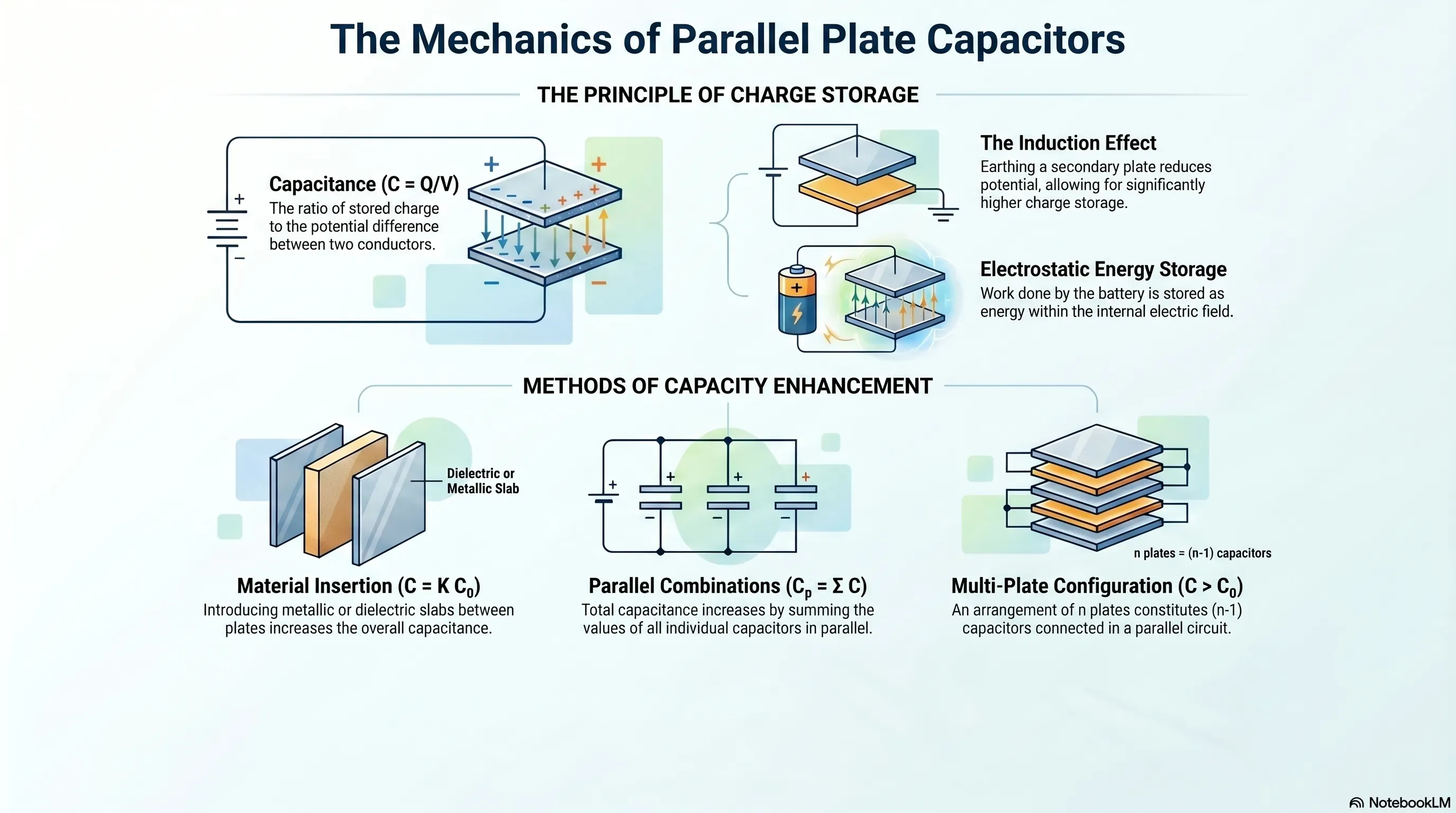
Principle of Parallel Plate Capacitors: A parallel plate capacitor stores electric charge and energy between two oppositely charged conductors separated by a dielectric, with capacitance defined as C = Q/V; its capacitance increases when conductors, dielectric slabs, or metallic slabs are introduced, while parallel combinations follow Cp = C1 + C2 + C3 and store energy U = ½CV².
eSaral › JEE › JEE Main ›Principle of parallel plate capacitors - Definition, Capacitance

🚀 Checkout eSaral Courses
Principle of Parallel plate capacitor
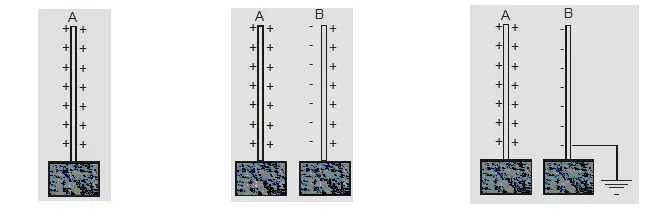
Let an insulated metal plate A be given a positive charge till its potential becomes maximum. When another insulated plate B is brought near A. Then by induction inner face of B becomes negatively charged and the outer face becomes positively charged. The negative charge tries to reduce the potential of A and the positive charge tries to increase it. When the outer surface of B is earthed positive charge flows to the earth while the negative charge stays on causing a reduction in the potential of A. Thus, a larger amount of charge can be given to A to raise it to maximum potential.
Important Points
- The capacitance of an insulated conductor is increased by bringing an uncharged earthed conductor near it.
- An arrangement of two conductors carrying equal and opposite charge separated by a dielectric medium are said to form a capacitor.
- The capacitor is an arrangement for storing a large amount of charge and hence electrical energy in a small space.
- The capacity of a capacitor is defined as the ratio of charge Q on the plates to the potential difference between the plates i.e. $C=\frac{Q}{V}$
- Capacitors are used in various electrical circuits like oscillators, in tuning circuits, filter circuits, electric fan, and motor, etc.
- The shape of conductors can be a plane, spherical or cylindrical make a parallel plate, spherical or cylindrical capacitor.
Capacitors in parallel
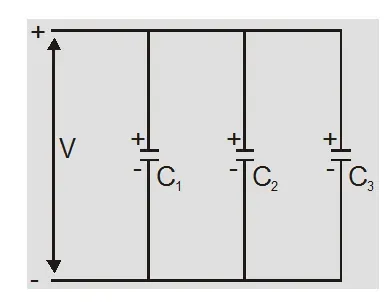
- Capacitors are said to be connected in parallel between two points if it is possible to proceed from one point to another point along different paths.
- Capacitors are said to be in parallel if the potential across each individual capacitor is the same and equal to the applied potential.
- Charge on each capacitor is different and is proportional to capacity of capacitor $Q \propto C$ so $\mathrm{Q}_{1}=\mathrm{C}_{1} \mathrm{~V}$ , $\mathrm{Q}_{2}=\mathrm{C}_{2} \mathrm{~V}$ , $Q_{3}=C_{3} V$
- The parallel combination obeys law of conservation of charge So
$\mathrm{Q}=\mathrm{Q}_{1}+\mathrm{Q}_{2}+\mathrm{Q}_{3}$
$=C_{1} V+C_{2} V+C_{3} V$
$=\left(C_{1}+C_{2}+C_{3}\right) V$equivalent capacitance $C_{p}=\frac{Q}{V}$
$=C_{1}+C_{2}+C_{3}$ - The equivalent capacitance may be defined as the capacitance of a single capacitor that would acquire the same total charge Q with the same potential difference V.
- The equivalent capacitance in parallel is equal to the sum of individual capacitances.
- The equivalent capacitance is greater than the largest of individual capacitances.
- The capacitors are connected in parallel (a) to increase the capacitance (b) when larger capacitance is required at low potential.
- If n identical capacitors are connected in parallel then equivalent parallel capacitance $C_{p}=n C$
- The total energy stored in parallel combination
$U=\frac{1}{2} C_{p} V^{2}$
$=\frac{1}{2}\left(\mathrm{C}_{1}+\mathrm{C}_{2}+\mathrm{C}_{3}+\ldots .\right) \mathrm{V}^{2}$
or$\mathrm{U}=\frac{1}{2} \mathrm{C}_{1} \mathrm{~V}^{2}+\frac{1}{2} \mathrm{C}_{2} \mathrm{~V}^{2}+\ldots \ldots=\mathrm{U}_{1}+\mathrm{U}_{2}$
$+U_{3}+\ldots \ldots$
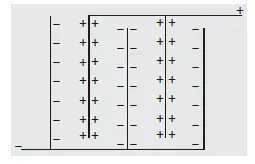
The total energy stored in parallel combination is equal to the sum of energies stored in individual capacitors. - If n plates are arranged as shown they constitute (n–1) capacitors in parallel each of capacitance $\frac{\varepsilon_{0} \mathrm{~A}}{\mathrm{~d}}$
Equivalent capacitance $C_{P}=(n-1) \frac{\varepsilon_{0} A}{d}$
Capacitance of parallel plate capacitor with conducting slab
The original uniform field $E_{0}$ exists in distance d-t so potential difference between the plates
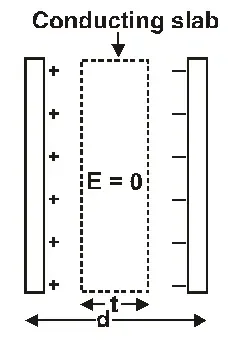
$V=E_{0}(d-t)=\frac{\sigma}{\varepsilon_{0}}(d-t)$
$=\frac{Q}{\varepsilon_{0} A}(d-t)$
Capacitance $C=\frac{Q}{V}$
$=\frac{\varepsilon_{0} A}{d(1-t / d)}=\frac{C_{0}}{1-t / d}$
$c>c_{0}$ so capacitance increases on introducing a metallic slab between the plates.
The capacitance of parallel plate capacitor with dielectric slab
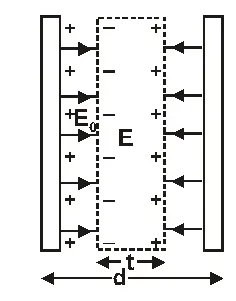
When a dielectric is introduced between plates then $\mathrm{E}_{0}$ field is present outside the dielectric and field E exists inside the dielectric. The potential difference between the plates
$V=E_{0}(d-t)+E t=E_{0}(d-t)$
$+\frac{E_{0} t}{K}=E_{0}\left[d-t\left(1-\frac{1}{K}\right)\right]$
$\mathrm{V}=\frac{\sigma}{\varepsilon_{0}}\left[\mathrm{~d}-\mathrm{t}\left(1-\frac{1}{\mathrm{~K}}\right)\right]$
$=\frac{\mathrm{Qd}}{\varepsilon_{0} \mathrm{~A}}\left[1-\frac{\mathrm{t}}{\mathrm{d}}\left(1-\frac{1}{\mathrm{~K}}\right)\right]$
Capacitance $C=\frac{Q}{V} \frac{\varepsilon_{0} A}{d\left[1-\frac{t}{d}\left(1-\frac{1}{K}\right)\right]}$
$=\frac{C_{0}}{1-\frac{t}{d}\left(1-\frac{1}{K}\right)}$
- $C>C_{0}$ so capacitance increases on introducing a dielectric slab between plates of capacitor.
- The capacitance is independent of position of dielectric slab between the plates.
- If whole space is filled with dielectric than t = d and $C=K C_{0}$
Energy stored in Capacitor
The charging of a capacitor involves transfer of electrons from one plate to another. The battery transfers a positive charge from negative to positive plate. Some work is done in transferring this charge which is stored as electrostatic energy in the field.
If dq charge is given to capacitor at potential V
then dW = V dq
or
$W=\int_{0}^{Q} \frac{q}{C} d q$
$\frac{Q^{2}}{2 C}=\frac{1}{2} C V^{2}=\frac{1}{2} Q V$
Important Points
- The energy is stored in the electric field between plates of capacitors.
- The energy stored depends on capacitance, charge, and potential difference. This does not depend on the shape of the capacitor.
- The energy is obtained at cost of the chemical energy of the battery
Frequently Asked Questions
What is the principle of a parallel plate capacitor?
A parallel plate capacitor works on the principle that an earthed conductor placed near a charged conductor reduces the potential of the charged conductor. This allows more charge to be stored for the same potential, effectively increasing capacitance. The capacitor consists of two parallel conducting plates separated by a dielectric medium carrying equal and opposite charges.
What is the formula for the capacitance of a parallel plate capacitor?
The capacitance of a parallel plate capacitor in vacuum is C = ε₀A/d, where ε₀ is the permittivity of free space (8.85 × 10⁻¹² F/m), A is the area of each plate, and d is the separation between them. With a dielectric of constant K filling the gap completely, the formula becomes C = Kε₀A/d.
How does inserting a dielectric slab increase capacitance?
When a dielectric slab is inserted, the electric field inside the dielectric reduces to E₀/K due to polarisation. This lowers the potential difference between the plates for the same charge, so more charge can be stored — meaning capacitance increases. The increase depends on both the dielectric constant K and the thickness t of the slab relative to plate separation d.
What happens to capacitance if a conducting slab is fully inserted between the plates?
If a conducting slab of thickness t = d is fully inserted (completely filling the gap), the effective separation becomes zero, making capacitance approach infinity. In practice, this means the two plates are effectively connected — a short circuit occurs. For t < d, capacitance increases to C = ε₀A/(d – t).
Why is the equivalent capacitance of capacitors in parallel greater than any individual capacitor?
In a parallel combination, all capacitors share the same voltage but their charges add up. The equivalent capacitance Cₚ = C₁ + C₂ + C₃ + … accounts for the total charge stored, which is the sum of charges on each capacitor. Since you are adding positive values, Cₚ is always larger than the largest single capacitor in the combination.
Team eSaral
eSaral Academic and Editorial Team
Team eSaral is the collective author profile for educational content created by eSaral’s teachers and academic contributors. The team draws on expertise from IIT graduates, doctors, experienced educators and subject specialists to develop resources for JEE, NEET and school students. Our articles aim to explain concepts clearly and help students study with confidence.
Related Posts
Plant Cell Diagram: Labelled Structure, Parts and Functions
Simple, labelled plant cell diagram with parts and functions. Covers plant cell structure for Class 6, 7, 8, 9, 10 and 11 students, CBSE-aligned.

Saransh Gupta Sir's Visit to IIT Patna: Hostel Life, Placements & Lessons for JEE Aspirants
Inside Saransh Gupta Sir's IIT Patna visit — hostel life, the library, placements, internships, and real advice for JEE aspirants from students living the IIT dream.
Molality Formula: Formula for Molality, Derivation & Solved Examples
Molality formula is $m = \dfrac{n}{W}$. Learn the formula of molality, its SI unit, derivation, relation with molarity, and solved examples for Class 11, JEE and NEET.

BITSAT Previous Year Question Paper PDF
Download BITSAT previous year question papers PDF. Get year-wise BITSAT PYQs, memory-based papers, exam pattern, and preparation tips to improve your BITSAT preparation.

Teachers’ Day 2026 at eSaral Gurukul: Celebrating the Bond Between Students, Teachers & Mentors
See how Teachers’ Day 2026 was celebrated at eSaral Gurukul, reflecting the bond among students, teachers, and mentors, and the role of guidance beyond academics.
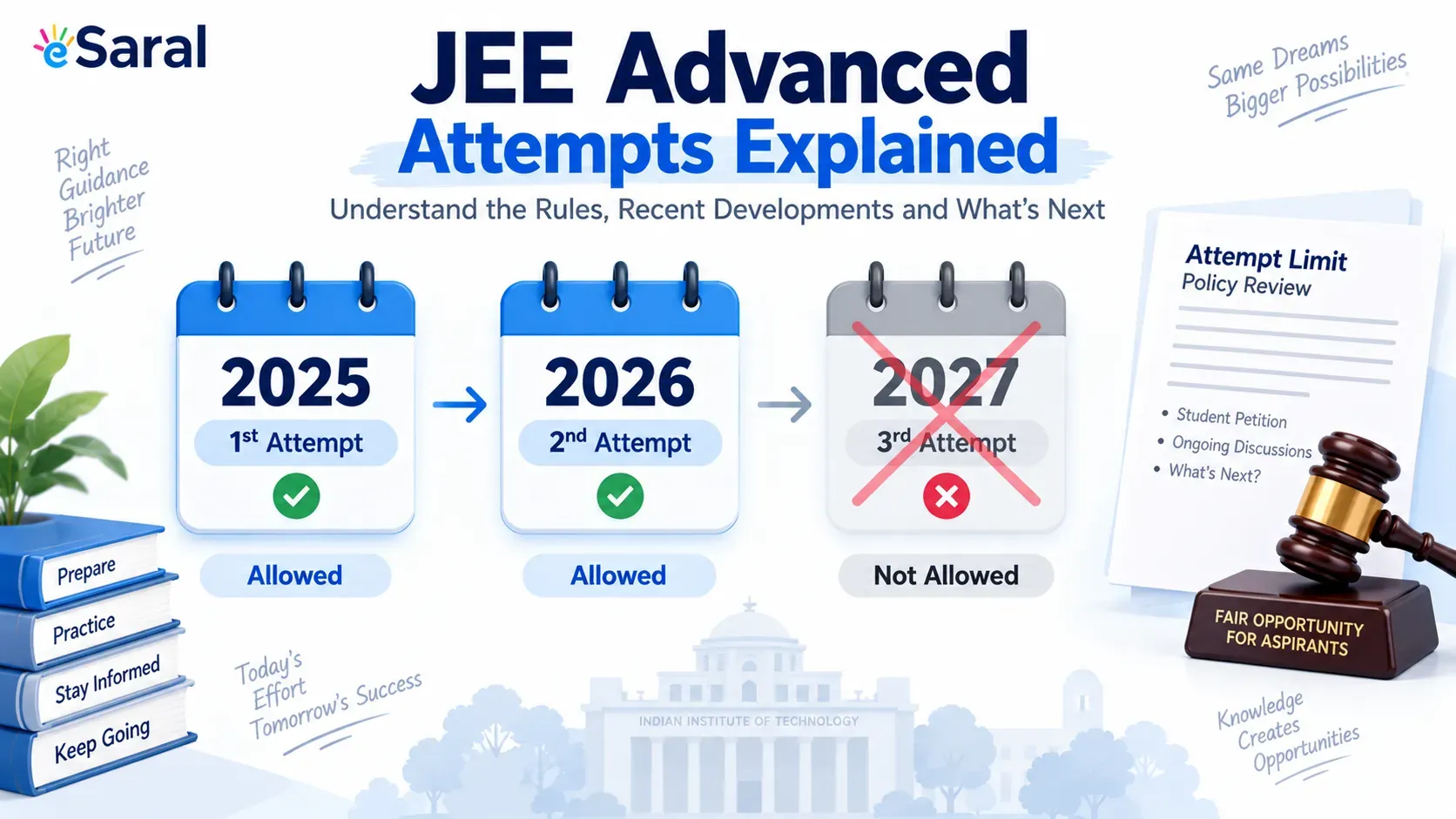
JEE Advanced Attempts: Can You Give It a Third Time? Rules Explained
JEE Advanced attempts: current rule is 2 consecutive years only: full eligibility criteria, the 2025 third-attempt controversy, and the latest 2026 petition news.

Best JEE Preparation App
Best JEE preparation app for Main & Advanced: AI mock tests, live doubt-solving, thousands of practice questions. JEE preparation app for droppers & Class 11-12.
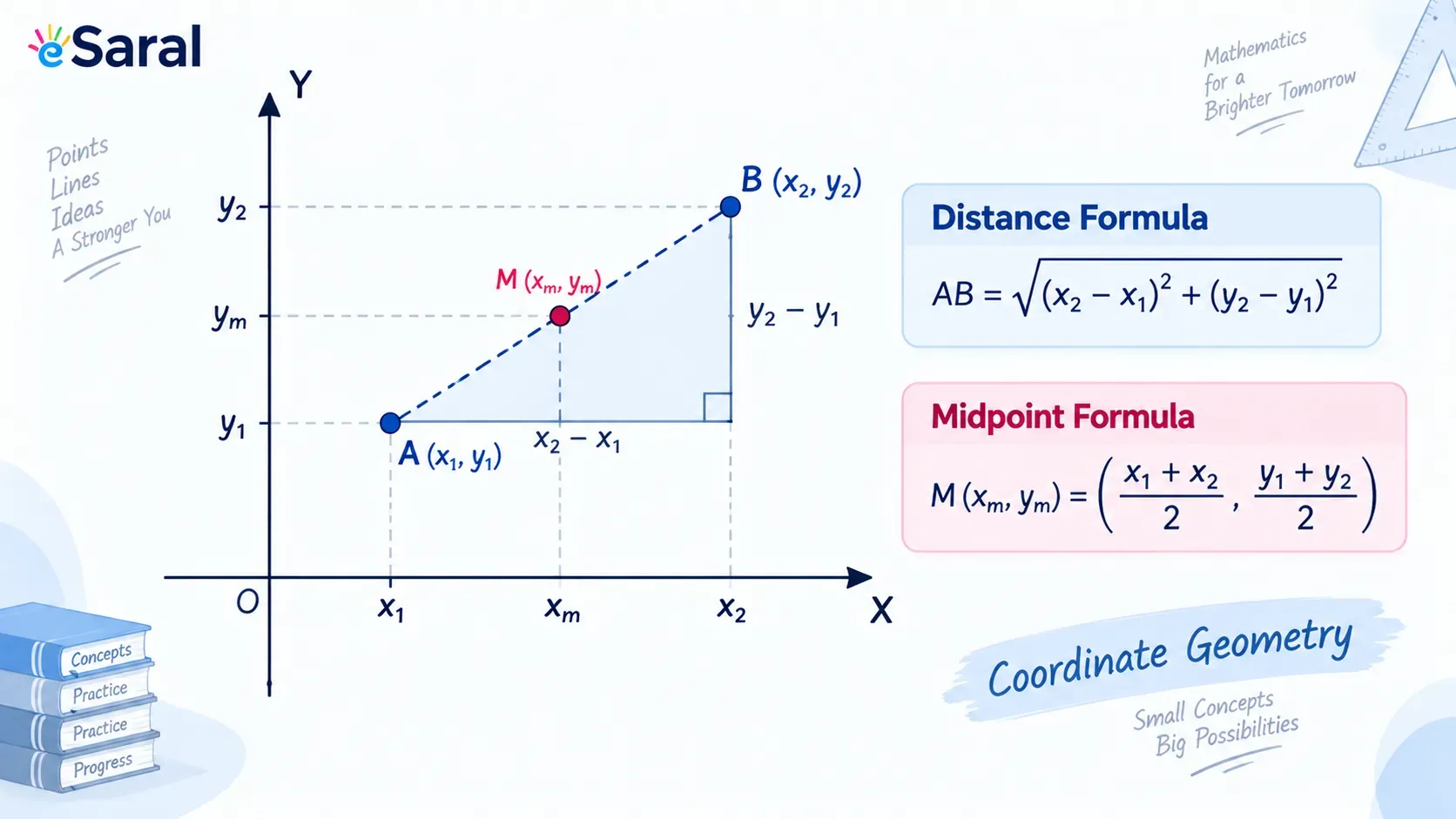
Coordinate Geometry Class 10: Formulas, Notes & Solved Examples
Coordinate geometry class 10: complete CBSE formulas — distance, section, midpoint and area of triangle — with derivation, notes and solved examples.
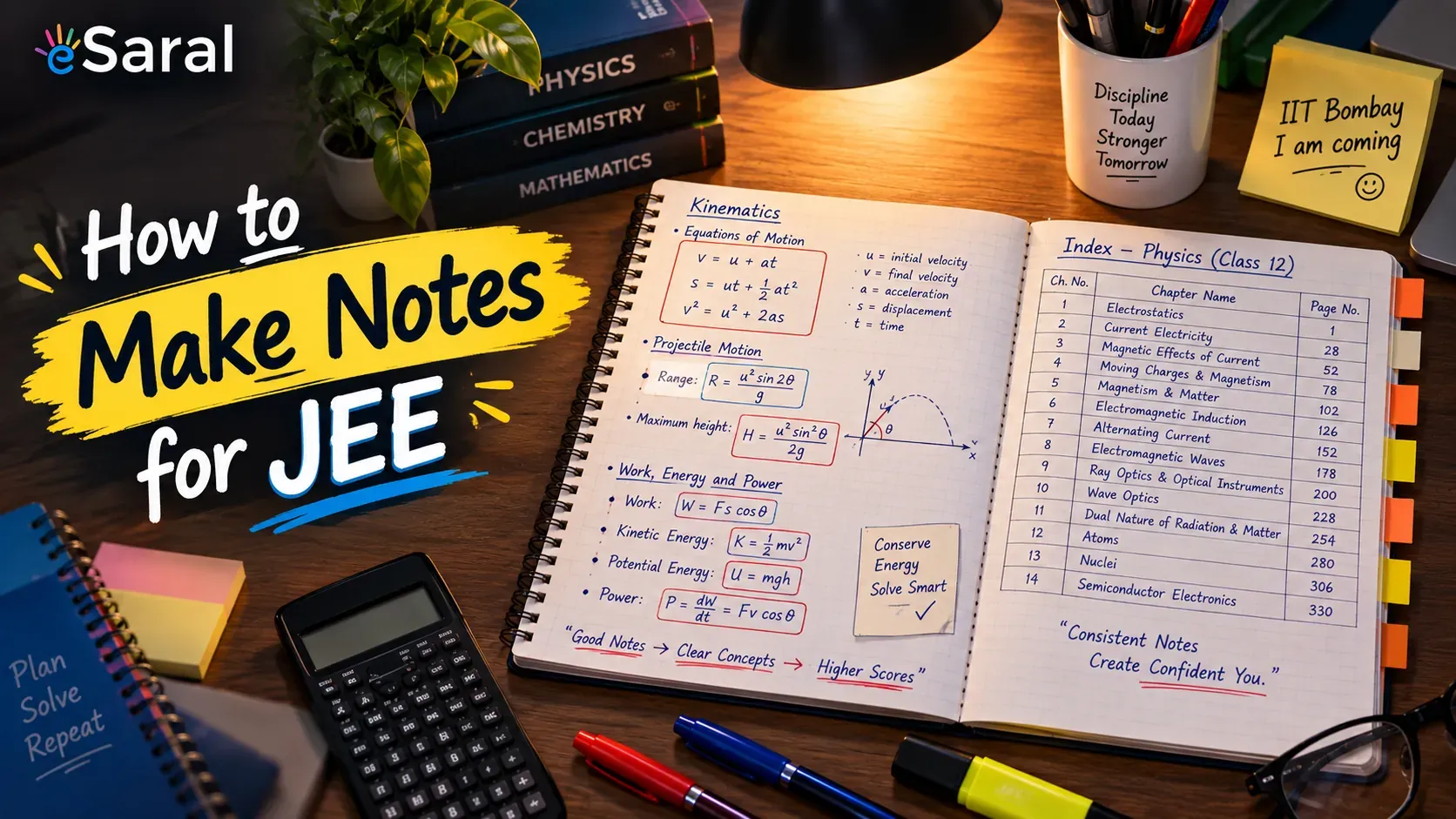
How to make Notes For JEE Smart Notes Strategy of an AIR 41
Learn how to make notes for JEE the way toppers do — indexing, shorthand, and smart short notes for JEE that cut revision time to just 5–7 days.
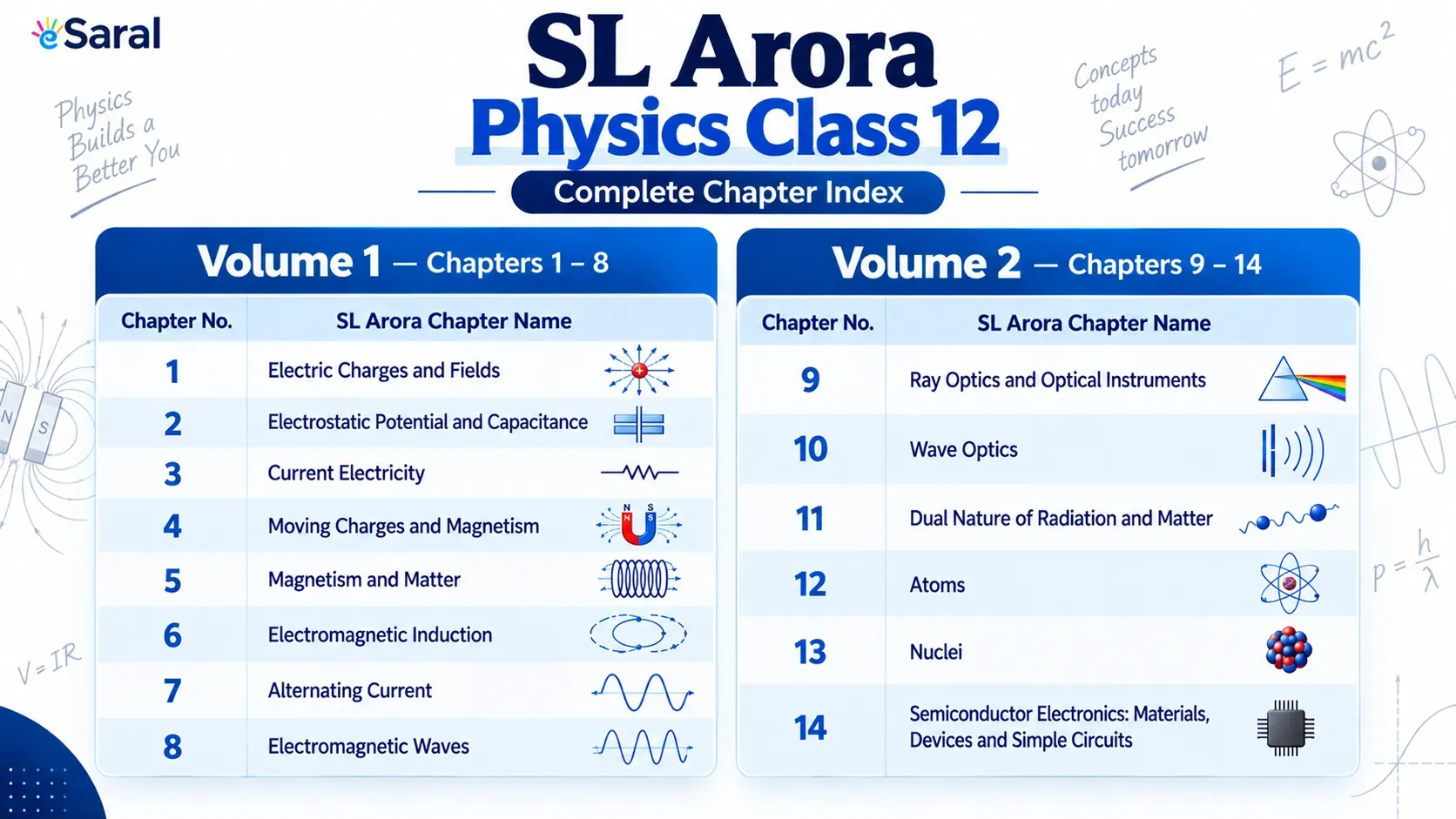
SL Arora Physics Class 12 Index – Chapter List for Volume 1 & 2
SL Arora Physics Class 12 index — complete chapter list for Volume 1 & 2, mapped to NCERT solutions for board, JEE Main, and NEET preparation.