
Solutions Chemistry Class 12 Notes for CBSE, JEE and NEET

eSaral Academic and Editorial Team
Summary
Solutions Chemistry Class 12 Notes cover types of solutions, concentration terms, Henry’s law, Raoult’s law, ideal and non-ideal solutions, the four colligative properties, osmotic pressure, abnormal molar mass and the van’t Hoff factor. This page gives corrected formulas, solved numericals and handwritten notes for CBSE boards, JEE Main and NEET.
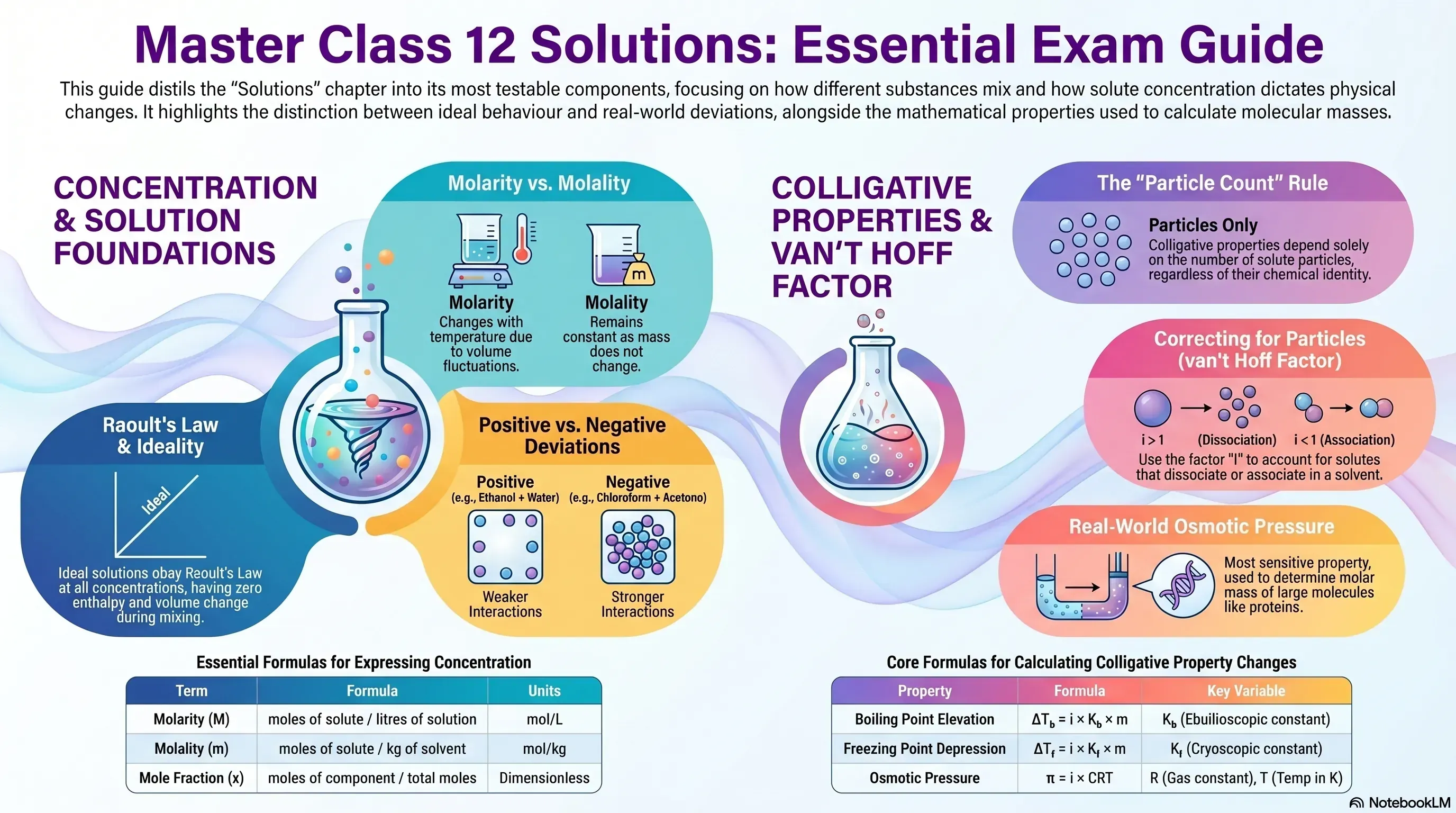
Solutions is Unit 1 of 10 in the current NCERT Class 12 Chemistry book (it was Chapter 2 in older books), and it carries 7 marks in the CBSE theory paper for 2026-27. It is a Physical Chemistry unit with both concept and numerical questions, and it uses the mole concept from Class 11. This page is about the chapter named Solutions. For the textbook exercise answers, see eSaral’s NCERT Solutions for Class 12.
Solutions Chemistry Class 12 Notes: Chapter Overview and What Each Exam Needs
The CBSE unit covers: types of solutions, expression of concentration of solutions, solubility, vapour pressure of liquid solutions, ideal and non-ideal solutions, colligative properties and determination of molar mass, and abnormal molecular masses.
Exam | Typical focus |
|---|---|
CBSE boards (7 marks in the 2026-27 scheme) | Concentration terms, Raoult’s law, ideal and non-ideal solutions, colligative properties, numericals on molar mass, van’t Hoff factor |
JEE Main | Numericals on ΔTb, ΔTf, osmotic pressure and the van’t Hoff factor, Raoult’s law with two volatile liquids |
NEET | Concentration terms, Raoult’s law, osmosis, isotonic solutions and colligative-property numericals |
The number of questions varies every year, so check previous years’ papers and the latest syllabus of your exam.
Tip from the eSaral, IIT Bombay Faculty: In numericals, write the given data with units first, convert all the masses to the units that the formula needs, and then substitute. Most mistakes come from a mixed-up unit (g and kg, or mL and L).
Types of Solutions and Concentration Terms in Solutions Chemistry Class 12 Notes
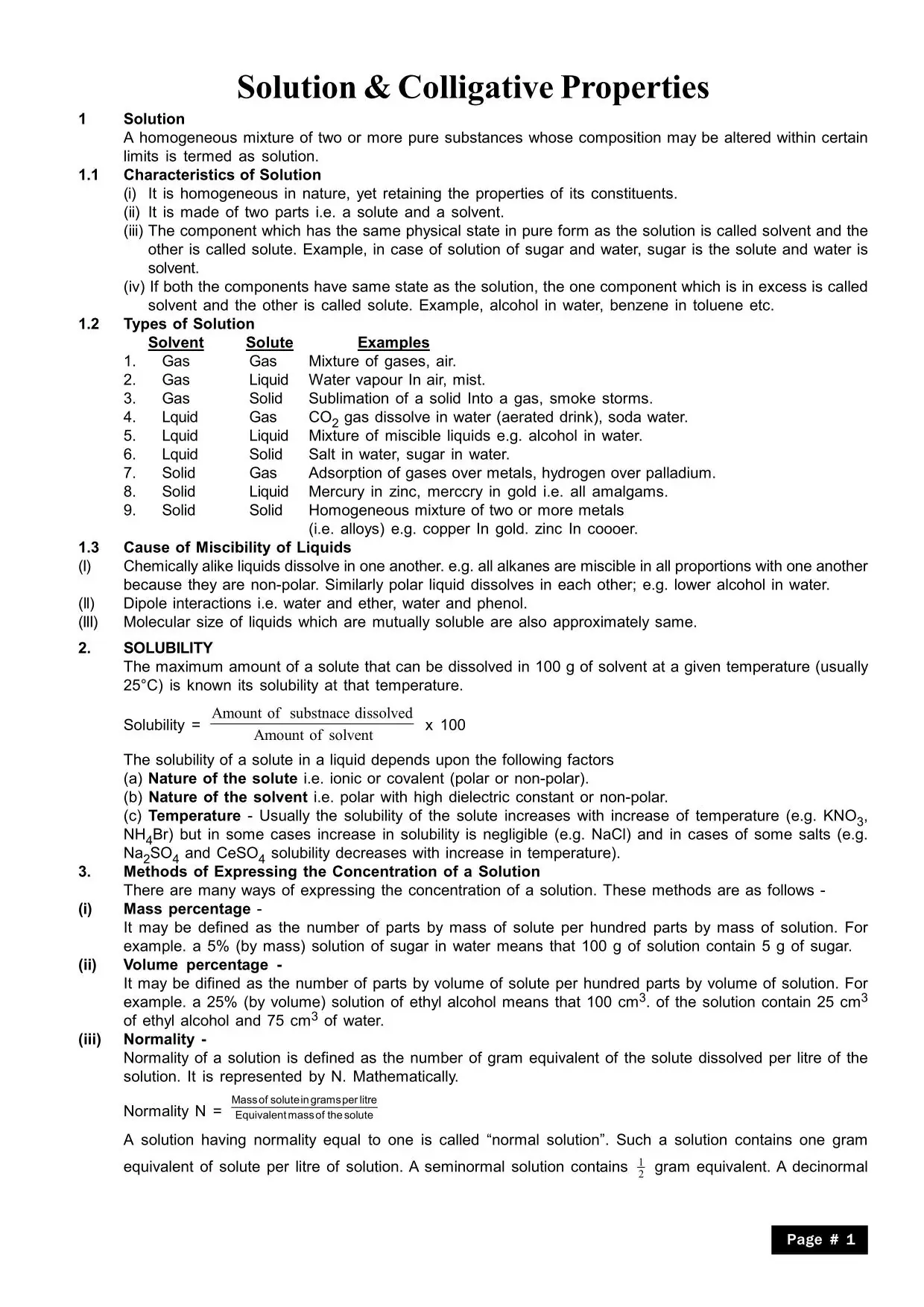
A solution is a homogeneous mixture of two or more components. The component present in the larger amount is the solvent, and the other is the solute.
Solute | Solvent | Example |
|---|---|---|
Gas | Gas | Air (O₂ in N₂) |
Gas | Liquid | Soda water (CO₂ in water) |
Gas | Solid | Hydrogen in palladium |
Liquid | Gas | Water vapour in air |
Liquid | Liquid | Ethanol in water |
Liquid | Solid | Amalgam of mercury with sodium |
Solid | Gas | Iodine vapour in air |
Solid | Liquid | Sugar in water |
Solid | Solid | Copper in gold (alloy) |
Ways of Expressing Concentration
Term | Formula | Unit |
|---|---|---|
Mass percentage (w/w) | (mass of component ÷ total mass of solution) × 100 | % |
Volume percentage (v/v) | (volume of component ÷ total volume of solution) × 100 | % |
Parts per million (ppm) | (parts of component ÷ total parts of solution) × 10⁶ | ppm |
Mole fraction (x) | moles of component ÷ total moles of all components | No unit |
Molarity (M) | moles of solute ÷ volume of solution in litres | mol/L |
Molality (m) | moles of solute ÷ mass of solvent in kg | mol/kg |
Molarity changes with temperature, because the volume changes. Molality does not change with temperature, because mass does not change. Use molality in colligative-property calculations. Normality is not part of the current NCERT chapter. For worked conversions between these terms, see eSaral’s mole concept notes for Class 11.
Solubility and Henry’s Law in Solutions Chemistry Class 12 Notes
The solubility of a gas in a liquid increases with pressure and decreases with temperature. Henry’s law says that the partial pressure of a gas in the vapour phase is proportional to its mole fraction in the solution:
p = K_H × x, where K_H is Henry’s law constant. A higher K_H means a lower solubility at the same pressure.
Vapour Pressure and Raoult’s Law in Solutions Chemistry Class 12 Notes
The vapour pressure of a liquid is the pressure of its vapour in equilibrium with the liquid at a given temperature, and it increases with temperature.
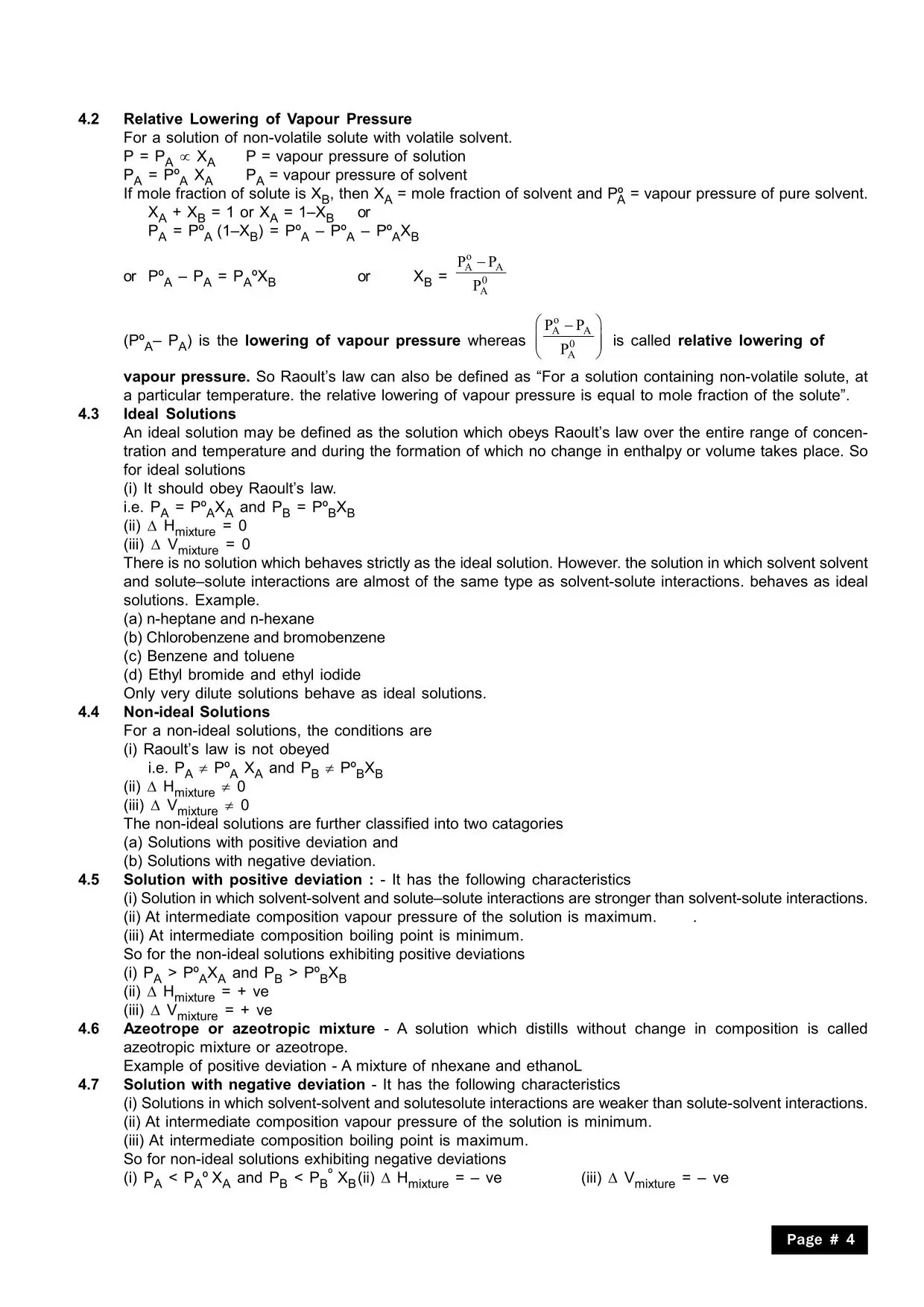
- Raoult’s law for a non-volatile solute: p₁ = x₁ p₁°, where x₁ is the mole fraction of the solvent and p₁° is the vapour pressure of the pure solvent.
- Relative lowering of vapour pressure: (p₁° − p₁)/p₁° = x₂, the mole fraction of the solute. For dilute solutions, it is approximately n₂/n₁ = w₂M₁/(M₂w₁).
- Two volatile liquids: p_total = x₁p₁° + x₂p₂°. The mole fraction of a component in the vapour is its partial pressure divided by the total pressure.
Ideal and Non-Ideal Solutions in Solutions Chemistry Class 12 Notes
Type | Behaviour | Example |
|---|---|---|
Ideal solution | Obeys Raoult’s law at all concentrations. ΔH_mix = 0 and ΔV_mix = 0 | n-Hexane and n-heptane, benzene and toluene |
Non-ideal, positive deviation | Vapour pressure is higher than the Raoult’s law value. A–B interactions are weaker than A–A and B–B. ΔH_mix > 0 | Ethanol and water |
Non-ideal, negative deviation | Vapour pressure is lower than the Raoult’s law value. A–B interactions are stronger. ΔH_mix < 0 | Chloroform and acetone |
Azeotropes are liquid mixtures that boil at a constant temperature, and their vapour has the same composition as the liquid. Positive-deviation mixtures form minimum-boiling azeotropes (ethanol and water), and negative-deviation mixtures form maximum-boiling azeotropes (nitric acid and water).
India's Best Exam Preparation for Class 12th - Download Now
Solutions | Chemistry Class 12 Notes | IIT-JEE & NEET
India's Best Exam Preparation for Class 12th - Download Now
India's Best Exam Preparation for Class 12th - Download Now
India's Best Exam Preparation for Class 12th - Download Now
Colligative Properties in Solutions Chemistry Class 12 Notes
Colligative properties depend only on the number of solute particles and not on their nature. There are four: relative lowering of vapour pressure, elevation of boiling point, depression of freezing point and osmotic pressure.
Elevation of Boiling Point in Solutions Chemistry Class 12 Notes
ΔT_b = K_b × m, and the molar mass is M₂ = (K_b × w₂ × 1000)/(ΔT_b × w₁), with w₁ and w₂ in grams. K_b depends only on the solvent: water 0.52 K kg/mol and benzene 2.53 K kg/mol.
Depression of Freezing Point in Solutions Chemistry Class 12 Notes
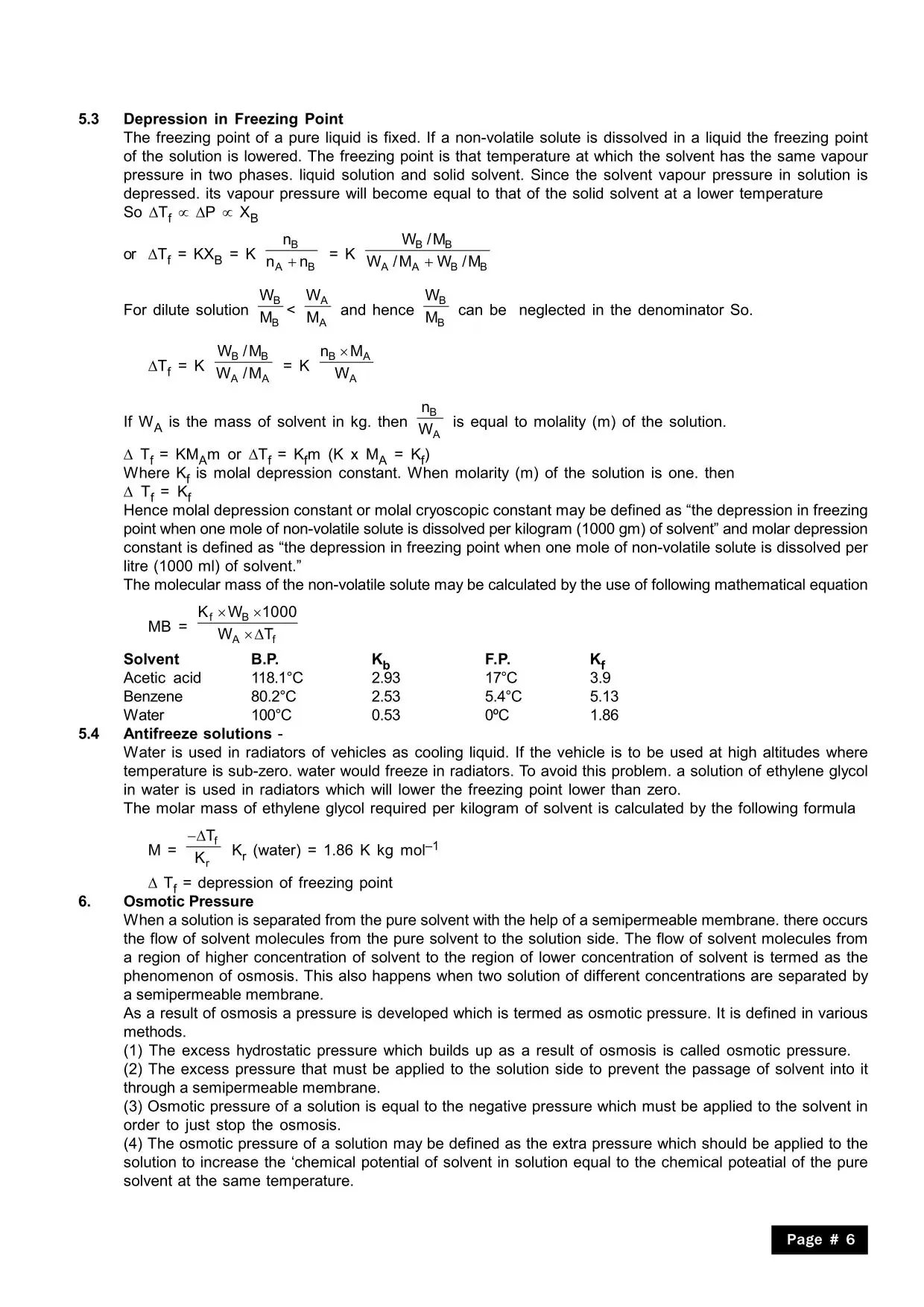
ΔT_f = K_f × m, and M₂ = (K_f × w₂ × 1000)/(ΔT_f × w₁). K_f for water is 1.86 K kg/mol and for benzene it is 5.12 K kg/mol. Antifreeze in a car radiator and salt on icy roads both lower the freezing point.
Osmotic Pressure in Solutions Chemistry Class 12 Notes
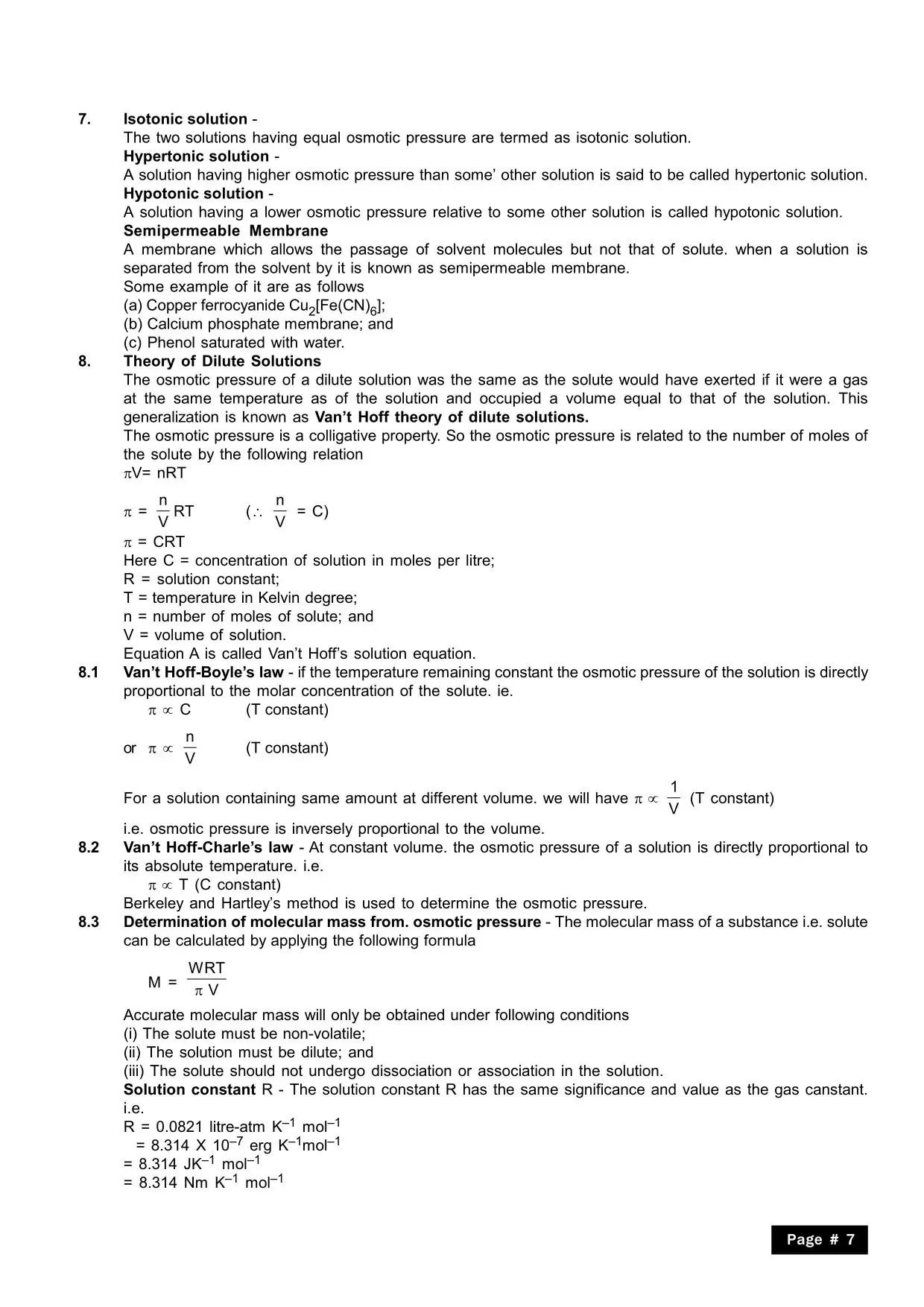
Osmosis is the flow of the solvent through a semipermeable membrane from the dilute solution to the concentrated solution. The osmotic pressure is π = CRT = (n₂/V)RT, with R = 0.0821 L atm mol⁻¹ K⁻¹. The molar mass is M₂ = w₂RT/(πV).
- Isotonic solutions have the same osmotic pressure. Hypertonic means a higher osmotic pressure than the reference, and hypotonic means a lower one.
- Osmotic pressure is used for the molar mass of large molecules such as proteins and polymers, because it can measure very dilute solutions at room temperature.
- Reverse osmosis applies a pressure greater than the osmotic pressure to the solution side, so the solvent flows out of the solution. It is used for the desalination of sea water.
Abnormal Molar Mass and van’t Hoff Factor in Solutions Chemistry Class 12 Notes
If the solute dissociates or associates in the solution, the number of particles changes, and the calculated molar mass appears abnormal. The van’t Hoff factor corrects for this:
i = observed colligative property ÷ calculated colligative property = normal molar mass ÷ observed molar mass
Case | Value of i | Example |
|---|---|---|
No dissociation or association | i = 1 | Glucose in water |
Dissociation | i > 1 | NaCl (about 2), CaCl₂ (about 3) |
Association | i < 1 | Acetic acid in benzene |
The modified formulas are ΔT_b = i K_b m, ΔT_f = i K_f m, π = i CRT and relative lowering = i x₂.
- Degree of dissociation (a solute that gives n ions): i = 1 + α(n − 1), so α = (i − 1)/(n − 1).
- Degree of association (n molecules forming one): i = 1 − α(1 − 1/n).
Key Formulas in Solutions Chemistry Class 12 Notes
Formula | Description |
|---|---|
p₁ = x₁p₁° | Raoult’s law |
p_total = x₁p₁° + x₂p₂° | Two volatile liquids |
(p₁° − p₁)/p₁° = x₂ | Relative lowering of vapour pressure |
p = K_H x | Henry’s law |
ΔT_b = i K_b m | Elevation of boiling point |
ΔT_f = i K_f m | Depression of freezing point |
π = i CRT | Osmotic pressure |
M₂ = w₂RT/(πV) | Molar mass from osmotic pressure |
i = 1 + α(n − 1) | Dissociation |
Solved Examples from Solutions Chemistry Class 12 Notes
Example 1 (concentration): 18 g of glucose (M = 180) is dissolved in 200 g of water. Find the molality and the mole fraction of glucose.
n = 18/180 = 0.1 mol. Molality = 0.1/0.2 = 0.5 m. Moles of water = 200/18 = 11.11, so x = 0.1/(0.1 + 11.11) ≈ 0.009.
Example 2 (relative lowering of vapour pressure): Find the relative lowering of vapour pressure in Example 1.
The relative lowering equals the mole fraction of the solute, so it is ≈ 0.009. If the vapour pressure of pure water is 23.8 mm Hg, the lowering is about 0.21 mm Hg.
Example 3 (boiling point): 6 g of urea (M = 60) is dissolved in 200 g of water. Find the boiling point (K_b = 0.52 K kg/mol).
m = (6/60)/0.2 = 0.5 mol/kg. ΔT_b = 0.52 × 0.5 = 0.26 K. The boiling point is about 100.26 °C.
Example 4 (freezing point with an electrolyte): Find the freezing point of a 0.1 m NaCl solution, assuming complete dissociation (K_f = 1.86 K kg/mol).
i = 2, so ΔT_f = 2 × 1.86 × 0.1 = 0.372 K. The freezing point is about −0.37 °C.
Example 5 (molar mass from osmotic pressure): 2 g of a polymer in 500 mL of solution gives an osmotic pressure of 0.0123 atm at 300 K. Find its molar mass.
M₂ = w₂RT/(πV) = (2 × 0.0821 × 300)/(0.0123 × 0.5) ≈ 8.0 × 10³ g/mol.
Example 6 (degree of dissociation): A 0.1 m solution of a weak electrolyte HA shows ΔT_f = 0.2 K (K_f = 1.86 K kg/mol). Find the degree of dissociation.
i = ΔT_f/(K_f × m) = 0.2/0.186 ≈ 1.075. α = (i − 1)/(n − 1) = 0.075/1 = 0.075, or 7.5%.
Common Mistakes in Solutions Chemistry Class 12 Notes Problems
Mistake | Correct approach |
|---|---|
Using molarity in ΔT_b and ΔT_f formulas | Use molality, because it does not depend on temperature |
Using the mass of the solution instead of the mass of the solvent | Molality uses the mass of the solvent in kg |
Forgetting i for electrolytes | Multiply the colligative property by i for NaCl, CaCl₂ and so on |
Using °C in π = CRT | T must be in kelvin |
Mixing the signs of the deviations | Positive deviation: weaker A–B interactions and ΔH_mix > 0. Negative deviation: stronger A–B interactions. |
Using g and kg together in M₂ = K_b w₂ 1000/(ΔT_b w₁) | Use w₁ and w₂ in grams, because the factor 1000 converts to kg |
How to Study Solutions Chemistry Class 12 Notes
- Read the NCERT chapter first, and learn the concentration terms. Download the book from eSaral’s NCERT books for Class 12 page.
- Practise numericals for each colligative property, first without i and then with i.
- Learn the deviations table and the azeotrope examples as short facts for the boards.
- Revise the chapter with eSaral’s Class 12 Chemistry notes, and then solve previous year questions.
Frequently Asked Questions
What are colligative properties, and why do they depend only on the number of particles?
Colligative properties are properties of a solution that depend on the number of solute particles and not on their identity. They are the relative lowering of vapour pressure, elevation of boiling point, depression of freezing point and osmotic pressure. They depend on the number of particles because each particle reduces the tendency of the solvent to escape, whatever the particle is. eSaral’s Solutions Chemistry Class 12 Notes include numericals on all four.
What is the difference between molarity and molality?
Molarity is the moles of solute per litre of solution, and it changes with temperature because the volume changes. Molality is the moles of solute per kilogram of solvent, and it does not change with temperature. In the Solutions Chemistry Class 12 Notes, use molality for colligative properties and molarity for solutions at a fixed temperature.
What is Raoult’s law, and when does a solution deviate from it?
In Solutions Chemistry Class 12 notes, Raoult’s law says that the vapour pressure of the solvent above a solution equals the mole fraction of the solvent multiplied by the vapour pressure of the pure solvent. Ideal solutions obey it at all concentrations. A solution shows positive deviation when the solute–solvent interactions are weaker than the interactions in the pure liquids (ethanol and water), and negative deviation when they are stronger (chloroform and acetone).
What is the van’t Hoff factor, and how is it used?
In Solutions Chemistry Class 12 notes, the van’t Hoff factor (i) is the ratio of the observed colligative property to the calculated one. For a dissociating solute such as NaCl, i is greater than 1, and for an associating solute such as acetic acid in benzene, i is less than 1. The colligative formulas are multiplied by i: ΔT_b = i K_b m, ΔT_f = i K_f m and π = i CRT.
How many marks does the Solutions chapter carry in CBSE Class 12 boards?
In CBSE’s 2026-27 unit-wise scheme, Unit 1, Solutions, carries 7 marks out of the 70 marks of the theory paper. The questions usually combine conceptual short answers with a numerical, but check the latest sample paper for the pattern.
What is Henry’s law?
In Solutions Chemistry Class 12 notes, Henry’s law says that the partial pressure of a gas above a solution is proportional to its mole fraction in the solution, p = K_H x. A higher value of K_H means a lower solubility of the gas at a given pressure. Solubility of a gas also decreases as the temperature increases.
Which chapter number is Solutions in Class 12 Chemistry?
In the current NCERT Class 12 Chemistry book, Solutions is Unit 1 of 10. In older books, it was Chapter 2, after The Solid State. These Solutions Chemistry Class 12 notes follow the chapter name.
What is an azeotrope?
In Solutions Chemistry Class 12 notes, an azeotrope is a liquid mixture that boils at a constant temperature without a change in composition, so it cannot be separated by simple distillation. Mixtures with positive deviation form minimum-boiling azeotropes (ethanol and water), and mixtures with negative deviation form maximum-boiling azeotropes (nitric acid and water).
Where can I find more Class 12 Chemistry notes on eSaral?
eSaral has Solutions Chemistry Class 12 Notes on this page, the NCERT book for Class 12, the Class 12 Chemistry notes hub and notes on other chapters such as Electrochemistry and Coordination Compounds.
Team eSaral
eSaral Academic and Editorial Team
Team eSaral is the collective author profile for educational content created by eSaral’s teachers and academic contributors. The team draws on expertise from IIT graduates, doctors, experienced educators and subject specialists to develop resources for JEE, NEET and school students. Our articles aim to explain concepts clearly and help students study with confidence.
Related Posts

BITSAT 2027: Registration Date, Exam Date, Syllabus, Eligibility, Pattern & Fees
BITSAT 2027 exam dates, registration timeline, eligibility criteria, exam pattern, marking scheme, syllabus and fees in one page.

BITSAT Previous Year Question Paper PDF (2017-2026)
Download BITSAT previous year question papers PDF from 2017 to 2026,session-wise. Memory-based papers,exam pattern, paper analysis and how to practise

CBSE Class 10 Date Sheet 2027: Expected Exam Dates, Release Date, Admit Card & Result Timeline
CBSE Class 10 date sheet 2027 is awaited. See the expected exam dates, release window, how to download the PDF, admit card and result timelines.

NCERT Physics Class 10 Book PDF in Hindi 2026-27 – भौतिक विज्ञान के 4 अध्याय (Free Download)
NCERT Physics Class 10 book PDF in Hindi 2026-27: download all 4 chapters (अध्याय 9–12) free, with topics and important formulas.

NCERT Biology Class 9 Book Anveshan PDF in Hindi - जीव विज्ञान कक्षा 9 पुस्तक अन्वेषण PDF
Download NCERT Biology Class 9 book PDF in Hindi chapterwise for 2026-27: Cell, Tissues, Reproduction and Diversity. Free PDFs.

Essay On Artificial Intelligence in English (100,150, 200, 250, 300, 500 Words)
This is in contrast to the natural intelligence of humans. With Artificial Intelligence, machines can perform

Essay on 78th India Independence Day in English for Student (100, 150, 200, 250, 300, 500 Words)
Read the best essays on India's Independence Day in English. Short & long essays (100, 150, 200, 250, 300, 500 words) perfect for school exams
NCERT Class 11 English Snapshots book - Free PDF download- Esaral
Download NCERT Class 11 English Snapshots book PDF for free. Get all 8 chapters, chapter-wise. Start your prep today!
NCERT Class 10 biology book pdf - Free PDF Download - eSaral
NCERT Class 10 Biology book PDF 2026-27: all 5 chapters (Life Processes to Our Environment) in English & Hindi, with CBSE syllabus, marks & practical

Essay on Global Warming in English (100,150, 200, 250, 300, 500 Words)
Global warming means the Earth is getting hotter. This happens because of things like pollution from cars and factories.