
Cells Connected in Series, Parallel & Mixed Grouping — Class 12 Physics

eSaral Academic and Editorial Team
Summary
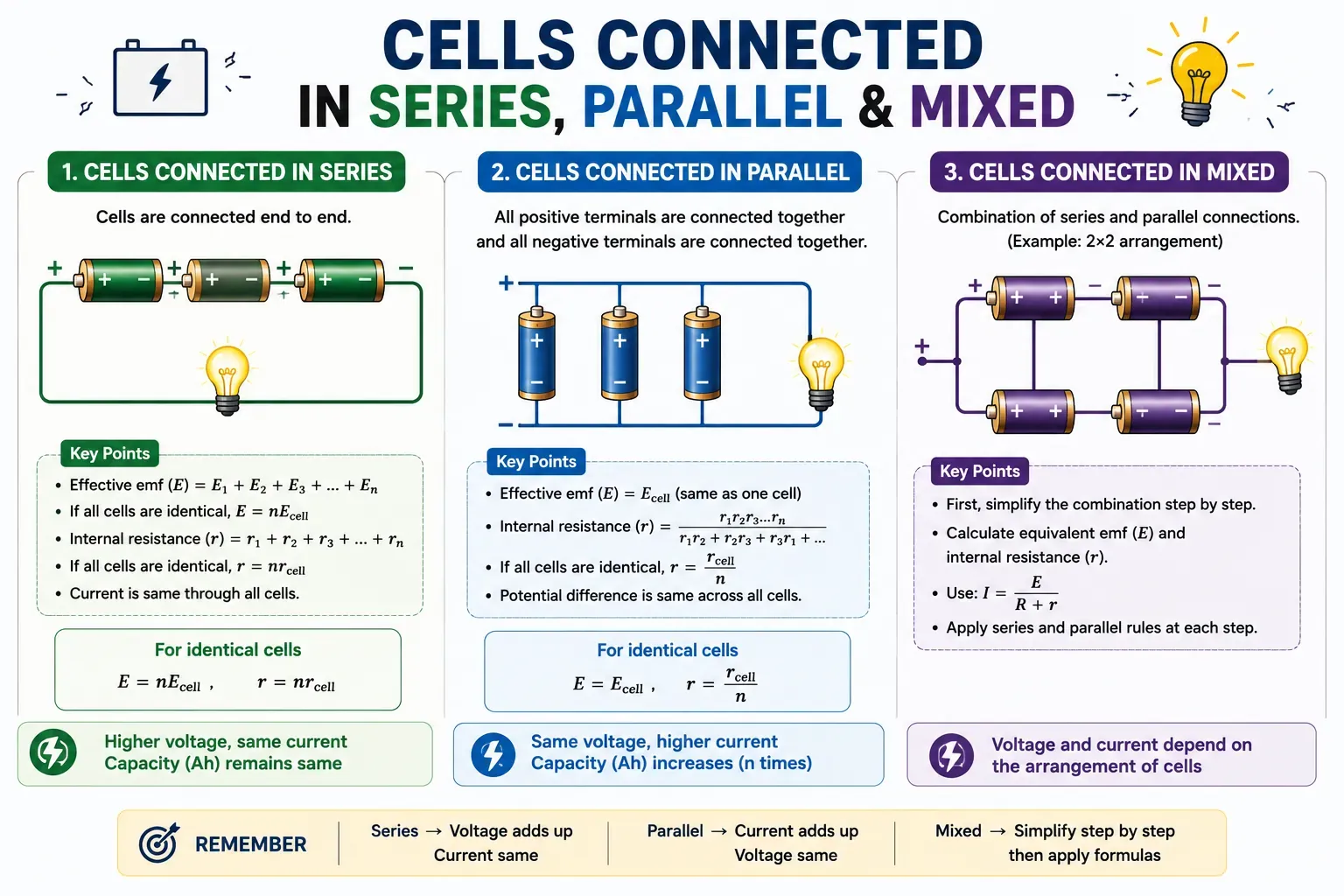
When cells are connected in series, the equivalent EMF = nE and internal resistance = nr. In parallel, equivalent EMF = E and internal resistance = r/m. In mixed grouping (n cells per row, m rows), equivalent EMF = nE and internal resistance = nr/m. Maximum current flows when external resistance equals total internal resistance.
Home > Physics Current Electricity > Cells Connected in Series, Parallel & Mixed Grouping

What Is Grouping of Cells in a Circuit?
In real circuits — whether in a torch, a car battery bank, or a lab experiment — a single cell rarely provides enough current or voltage. That is why cells are grouped together, either in series, in parallel, or in a combination of both (mixed grouping).
This topic is a high-weightage section of Class 12 Physics, Chapter 3 — Current Electricity, and appears regularly in JEE Main, JEE Advanced, and NEET question papers. According to the NTA syllabus, students must be able to derive equivalent EMF and internal resistance for all three configurations and apply them to solve circuit problems.
The core idea mirrors what you already know about resistors: just as resistors combine to give an equivalent resistance, a group of cells can be replaced by one equivalent cell. Understanding the condition for maximum current — especially in mixed grouping — is one of the most frequently tested concepts at the JEE level.
For step-by-step NCERT solutions on this chapter, refer to NCERT Solutions Class 12 Physics on eSaral.
Cells Connected in Series Combination
Series Combination Formula and Derivation
Cells are said to be connected in series when the negative terminal of one cell is connected to the positive terminal of the next. The external resistance is connected between the free terminals of the first and last cells.
Setup: n identical cells, each with EMF = E and internal resistance = r.
Equivalent single cell:
- Equivalent EMF: Eeq = nE
- Equivalent internal resistance: req = nr
Current through the circuit:
I = nE / (R + nr)
where R is the external load resistance.
Key Results for Series Combination
Condition | Result |
|---|---|
nr < R (internal resistance small) | I ≈ nE/R — current is n times that of single cell |
nr >> R (internal resistance large) | I ≈ E/r — equals short-circuit current of one cell |
p cells reversed out of n | Eeq = (n − 2p)E, req = nr |
If cells are non-identical:
Eeq = ΣEi req = Σri
I = ΣEi / (R + Σri)
When Is Series Combination Useful?
Series combination is most effective when the external resistance R is large compared to the total internal resistance nr. Under this condition, the series arrangement genuinely multiplies the available voltage and drives significantly more current than a single cell could.
In JEE problems, always check whether cells are identical before applying the series formula. If one cell is reversed, subtract its EMF contribution but add its internal resistance — a common mistake that costs marks. Students in eSaral's JEE batch who practise this distinction consistently score full marks on grouping-of-cells MCQs.
Cells Connected in Parallel Combination
Parallel Combination Formula and Derivation
Cells are said to be connected in parallel when all positive terminals are joined at one node and all negative terminals at another. The external resistor connects these two nodes.
Setup: m identical cells, each with EMF = E and internal resistance = r.
Equivalent single cell:
- Equivalent EMF: Eeq = E (same as one cell)
- Equivalent internal resistance: req = r/m
Current through the circuit:
I = E / (R + r/m)
Key Results for Parallel Combination
Condition | Result |
|---|---|
r/m < R (small equivalent internal resistance) | I ≈ E/R — same as single cell |
r/m >> R (large equivalent internal resistance) | I ≈ mE/r — m times short-circuit current of one cell |
When Is Parallel Combination Useful?
Parallel combination is best suited when the external resistance R is small. The key advantage is that it reduces the effective internal resistance to r/m, allowing more current to be delivered to a low-resistance load without excessive internal losses.
This is exactly why batteries in power banks or UPS systems are often connected in parallel — they share the current load equally, extending both capacity and lifespan.
Mixed Grouping of Cells
In mixed grouping, n cells are connected in series per row, and m such rows are connected in parallel.
Total cells = p = n × m
Equivalent single cell:
- Equivalent EMF: Eeq = nE
- Equivalent internal resistance: req = nr/m
Current through the circuit:
I = nE / (R + nr/m) = E / (R/n + r/m)
Power delivered to load:
P = E²R / (R/n + r/m)²
What Is the Condition for Maximum Current in Mixed Grouping?
Current (and power to load) is maximum when the denominator (R/n + r/m) is minimised.
R/n = r/m
R = nr/m
This means maximum current flows when external resistance equals the total internal resistance of the combination.
Imax = nE / 2R = mE / 2r
Pmax = n²E² / 4R = m²E²R / 4r²
Mixed grouping is preferred in practical and exam scenarios because maximum current and maximum power transfer occur under the same condition (R = nr/m). In pure series or pure parallel configurations, these optima are separate. Faculty at eSaral — trained at IIT Bombay — specifically flag this point as a high-probability JEE Advanced reason-based question.
Series vs Parallel vs Mixed — Quick Comparison Table
Parameter | Series (n cells) | Parallel (m cells) | Mixed (n×m cells) |
|---|---|---|---|
Equivalent EMF | nE | E | nE |
Equivalent Internal Resistance | nr | r/m | nr/m |
Current Formula | nE / (R + nr) | E / (R + r/m) | nE / (R + nr/m) |
Best For | Large R | Small R | Any R (optimisable) |
Max Current Condition | R >> nr | R << r/m | R = nr/m |
Max Current Value | nE/R (approx.) | mE/r (approx.) | nE/2R |
This table is a quick-revision tool. Before any exam, reproduce it from memory — it covers almost every MCQ variation on this topic. You can also find related practice problems in the NCERT Solutions for Class 12 Physics chapter on Current Electricity.
Solved Examples
Example 1: Finding Internal Resistance in Parallel Combination
Question: Three identical cells, each of EMF 2V, are connected in parallel and then connected to a 5 Ω resistor. If the terminal voltage across the cells is 1.5 V, find the internal resistance of each cell.
Solution
For m = 3 cells in parallel:
I = E / (R + r/3) and V = IR
Terminal voltage:
V = ER / (R + r/3)
Rearranging:
r/3 = R(E − V)/V
Substituting values:
r/3 = 5(2 − 1.5)/1.5 = 5/3
r = 5 Ω
Answer: Internal resistance of each cell = 5 Ω
Example 2: Applying Kirchhoff's Laws to a Multi-Cell Circuit
Question: Determine currents I₁, I₂, and I₃ in the circuit (as described in the original figure with EMFs of 24V and 27V, and resistances of 2Ω, 6Ω, 4Ω).
Solution
Using Kirchhoff's Voltage Law (KVL) in loop abcda:
-2I₁ + 24 - 27 - 6I₂ = 0
2I₁ + 6I₂ = -3 ...(1)
Using KVL in loop cdfec:
-27 - 6I₂ + 4I₃ = 0
-6I₂ + 4I₃ = 27 ...(2)
Using Kirchhoff's Current Law (KCL) at junction c:
I₁ = I₂ + I₃ ...(3)
Substituting equation (3) into equation (2):
4I₁ - 10I₂ = 27 ...(4)
Solving equations (1) and (4):
I₁ = 3 A, I₂ = -1.5 A, I₃ = 4.5 A
The negative value of I₂ means its actual direction is opposite to the assumed direction in the figure.
For more practice problems on Kirchhoff's Laws and Current Electricity, explore the full NCERT Solutions Class 12 library on eSaral.
Like resistors, a circuit can also have a combination of cells connected in series, parallel or even both! And again like resistors, we can calculate current and voltages that can be replaced by an equivalent cell in a circuit which we will learn here.
A circuit composed solely of components connected in series is known as a series circuit; likewise, one connected completely in parallel is known as a parallel circuit.
In a series circuit, the current that flows through each of the components is the same, and the voltage across the circuit is the sum of the individual voltage drops across each component. In a parallel circuit, the voltage across each of the components is the same, and the total current is the sum of the currents flowing through each component. [source]
Here we will see cells connected in series, parallel and mixed one by one along with examples.
Contents:
- Cells connected in Series Combination
- Cells connected in Parallel Combination
- Cells connected in Mixed Grouping
- Solved Examples
Cells connected in Series Combination
The cells are said to be connected in series if negative terminal first is connected to positive of second whose negative terminal is connected to positive of third cell. The external resistance is connected between free terminals of first and last cells.
[caption id="attachment_4615" align="aligncenter" width="255"] Cells connected in Series Combination[/caption]
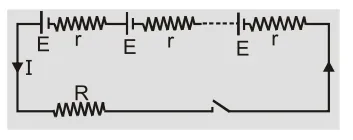
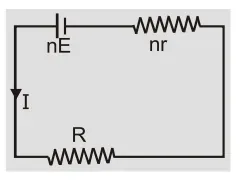
Let 'n' identical cells each of emf E and internal resistance r be connected in series. The combination can be replaced by a single cell of emf nE and internal resistance nr. The current flowing through load ${\rm{I}} = {{{\rm{nE}}} \over {{\rm{R}} + {\rm{nr}}}}$
[caption id="attachment_4616" align="aligncenter" width="205"] Equivalent circuit for series combination[/caption]
- If ${\rm{nr}} < < {\rm{R}}$ then ${\rm{I}} = {{{\rm{nE}}} \over {\rm{R}}}$ If equivalent internal resistance nr is less than external resistance R then current in circuit is equal to n times circuit current due to single cell.
- If nr >> R then I = E/r. If equivalent internal resistance nr is greater than external resistance R then current in circuit is equal to short circuited current obtained from one cell.
- Maximum current can be drawn from series combination of cells if external resistance is very large as compared to equivalent internal resistance.
- If in series combination of n cells p cells are reversed than equivalent emf${E_{{\rm{eq}}}} = ({\rm{n}} - {\rm{p}}){\rm{E}} - {\rm{pE}} = ({\rm{n}} - 2{\rm{p}}){\rm{E}}\quad $ and $\quad {{\rm{r}}_{{\rm{eq}}}} = {\rm{nr}}\quad $
So current ${\rm{I}} = {{({\rm{n}} - 2{\rm{p}}){\rm{E}}} \over {{\rm{nr}} + {\rm{R}}}}$
- If in series combination of n cells p cells are reversed than equivalent emf${E_{{\rm{eq}}}} = ({\rm{n}} - {\rm{p}}){\rm{E}} - {\rm{pE}} = ({\rm{n}} - 2{\rm{p}}){\rm{E}}\quad $ and $\quad {{\rm{r}}_{{\rm{eq}}}} = {\rm{nr}}\quad $
- If un-identical cells are connected in series then${E_{{\rm{eq}}}} = {{\rm{E}}_1} + {{\rm{E}}_2} + \ldots . = \Sigma {{\rm{E}}_{\rm{i}}}$ and ${r_{eq}} = {r_1} + {r_2} + \ldots . = \Sigma {r_i}$
So current ${\rm{I}} = {{\Sigma {{\rm{E}}_{\rm{i}}}} \over {{\rm{R}} + \Sigma {{\rm{r}}_{\rm{i}}}}}$.
- If un-identical cells are connected in series then${E_{{\rm{eq}}}} = {{\rm{E}}_1} + {{\rm{E}}_2} + \ldots . = \Sigma {{\rm{E}}_{\rm{i}}}$ and ${r_{eq}} = {r_1} + {r_2} + \ldots . = \Sigma {r_i}$
Cells connected in Parallel Combination
The cells are said to be connected in parallel if positive terminals of all the cells are connected together at one point and their negative terminals at another point. The external resistor is connected between these two points.
[caption id="attachment_4617" align="aligncenter" width="237"] Cells connected in Parallel Combination[/caption]
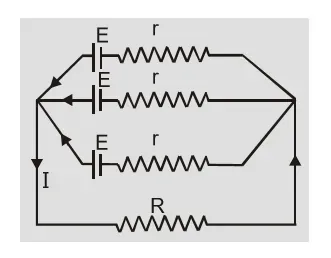
Let ‘m’ identical cells each of emf E and internal resistance r be connected in parallel. The combination can be replaced by a single cell of emf $E$ and internal resistance ${\rm{r}}/{\rm{m}}.$ The current ${\rm{I}} = {{\rm{E}} \over {{\rm{R}} + {\rm{r}}/{\rm{m}}}}$
[caption id="attachment_4618" align="aligncenter" width="218"] Equivalent circuit for parallel combination[/caption]
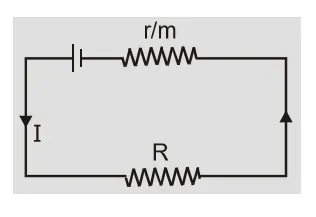
- If ${\rm{r}}/{\rm{m}} < < {\rm{R}}$ then ${\rm{I}} = {{\rm{E}} \over {\rm{R}}}$ . If equivalent internal resistance ${\rm{r}}/{\rm{m}}$ is less than external resistance ${\rm{R}}$ then current in circuit is equal to current produced by a single cell.
- If ${\rm{r}}/{\rm{m}} > > {\rm{R}}$ then ${\rm{I}} = {{{\rm{mE}}} \over {\rm{r}}}$. If equivalent internal resistance ${{\rm{r}} \over {\rm{m}}}$ is greater than external resistance then current in circuit is equal to ${\rm{m}}$ times the current produced by a short circuited cell.
- Thus maximum current can be drawn from parallel combination of cells if external resistance is small as compared to net internal resistance of cells.
Mixed Grouping
Let there be $n$ identical cells in one row and $m$ rows of cells in parallel. The combination of cells can be replaced by a single cell of emf nE and internal resistance ${{{\rm{ nr }}} \over m}$ .
The current $I = {{nE} \over {R + {{nr} \over m}}} = {E \over {{R \over n} + {r \over m}}}$ where $\quad {\rm{n}} \times {\rm{m}} = {\rm{p}} = $ total number of cells.
[caption id="attachment_4619" align="aligncenter" width="279"] Cells connected in Mixed Grouping[/caption]
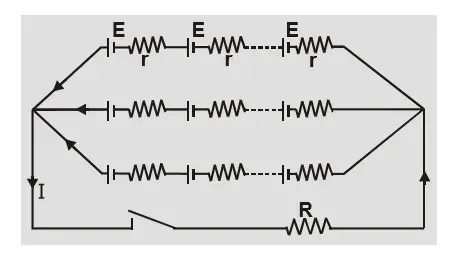
[caption id="attachment_4620" align="aligncenter" width="165"] Equivalent circuit for Mixed Grouping[/caption]
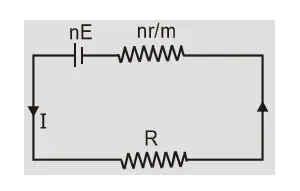
- The current in the circuit is maximum when ${{\rm{R}} \over {\rm{n}}} + {{\rm{r}} \over {\rm{m}}}$ is minimum
So$\quad {{\rm{d}} \over {{\rm{dm}}}}\left( {{{\rm{R}} \over {\rm{n}}} + {{\rm{r}} \over {\rm{m}}}} \right) = 0\quad $
or $\quad {{\rm{d}} \over {{\rm{dm}}}}\left( {{{{\rm{mR}}} \over {\rm{p}}} + {{\rm{r}} \over {\rm{m}}}} \right) = 0\quad $
or $\quad {{\rm{R}} \over {\rm{p}}} - {{\rm{r}} \over {{{\rm{m}}^2}}} = 0$
or $\quad {{\rm{R}} \over {\rm{p}}} = {{\rm{R}} \over {{\rm{mn}}}} = {{\rm{r}} \over {{{\rm{m}}^2}}}\quad $
or $\quad {{\rm{R}} \over {\rm{n}}} = {{\rm{r}} \over {\rm{m}}}$
In mixed grouping of cells current in circuit is maximum if ${{\rm{R}} \over {\rm{n}}} = {{\rm{r}} \over {\rm{m}}}\quad $ and $\quad {{\rm{I}}_{\max }} = {{{\rm{nE}}} \over {2{\rm{R}}}} = {{{\rm{mE}}} \over {2{\rm{r}}}}$
- The current in the circuit is maximum when ${{\rm{R}} \over {\rm{n}}} + {{\rm{r}} \over {\rm{m}}}$ is minimum
- In mixed grouping of cells power transferred to the load is maximum where external resistance R is equal to total internal resistance or $R = {{{\rm{ nr }}} \over m}\quad $ or $\quad {R \over n} = {r \over m}$. This shows power transfer is maximum when current is maximum.$P = {{{E^2}R} \over {{{\left( {{R \over n} + {r \over m}} \right)}^2}}}\quad $ and $\quad {P_{\max }} = {{{n^2}{E^2}} \over {4R}} = {{{m^2}{E^2}R} \over {4{r^2}}}$
- In mixed combination of cells, current in circuit and power transferred to load become maximum under same condition. This is why it is preferred over series and parallel combination of cells.
Solved Examples
[esquestion]Three identical cells each of emf 2V and unknown internal resistance are connected in parallel. This combination is connected to a 5$\Omega $ resistor. If the terminal voltage across the cells is 1.5V. What is the internal resistance of each cell?
#sol#In parallel combination of three cells ${\rm{I}} = {{\rm{E}} \over {{\rm{R}} + {\rm{r}}/3}}$
Terminal potential difference $V = IR = {{ER} \over {R + r/3}}\quad $ or $\quad {r \over 3} = {{ER - RV} \over V}$
or $\quad r = 3\left( {{{ER - RV} \over V}} \right) = 3\left( {{{2 \times 5 - 5 \times 1.5} \over {1.5}}} \right) = 5\Omega $
[/esquestion]
[esquestion]Determine currents ${{\rm{I}}_1},{{\rm{I}}_2}$ and ${{\rm{I}}_3}?$
#sol#Using II law in loop abcda $ - 2{{\rm{I}}_1} + 24 - 27 - 6{{\rm{I}}_2} = 0\quad $ or $\quad 2{{\rm{I}}_1} + 6{{\rm{I}}_2} = - 3$ $ \ldots ..(1)$
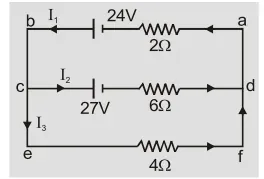
Using II law in loop cdfec we get $\quad - 27 - 6{{\rm{I}}_2} + 4{{\rm{I}}_3} = 0\quad $ or $\quad - 6{{\rm{I}}_2} + 4{{\rm{I}}_3} = 27\quad \ldots \ldots (2)$
From junction rule at c we get $\quad {{\rm{I}}_1} = {{\rm{I}}_2} + {{\rm{I}}_3}$ $ \ldots ..(3)$
From 2 and 3 we get $\quad - 6{{\rm{I}}_2} + 4\left( {{{\rm{I}}_1} - {{\rm{I}}_2}} \right) = 27\quad $ or $\quad 4{{\rm{I}}_1} - 10{{\rm{I}}_2} = 27\quad \ldots \ldots $ (4)
Solving 1 and 4 we get ${{\rm{I}}_1} = 3{\rm{A}},\quad {{\rm{I}}_2} = - 1.5{\rm{A}}\quad $ so ${{\rm{I}}_3} = {{\rm{I}}_1} - {{\rm{I}}_2} = 4.5{\rm{A}}$
Negative ${{\rm{I}}_2}$ means the direction should have been opposite to shown in figure.
[/esquestion] Also Read:
- Types and Effects of Electric Current
- Ohm’s Law and Resistance
- Combination of Resistances
- EMF and Internal Resistances of a Cell
- Cells Connected in Series, parallel and Mixed
- Kirchhoff’s Circuit Law
- Electric Currents in Conductors
- Wheatstone Bridge
- Post office Box
- Wheatstone Meter Bridge
- Moving Coil galvanometer
- Ammeter and Voltmeter
- Potentiometer Working Principle
Frequently Asked Questions
What is the condition for maximum current in mixed grouping?
Maximum current in mixed grouping occurs when the external resistance R equals the total equivalent internal resistance nr/m. Mathematically: R/n = r/m, which gives R = nr/m. Under this condition, I_max = nE/2R = mE/2r. Importantly, this is also the condition for maximum power transfer to the external load.
What is mixed grouping of cells and when is it used?
Mixed grouping arranges n cells in series per row and m such rows in parallel (total cells = n × m). It gives equivalent EMF = nE and internal resistance = nr/m. Mixed grouping is used when neither pure series nor pure parallel alone gives optimal performance. It is especially useful in JEE-level problems where you must find the arrangement that maximises current for a given total number of cells.
Why does parallel combination not increase the total EMF?
In a parallel combination, all positive terminals are at the same potential and all negative terminals are at the same potential. This means no additional potential difference is created — the EMF stays equal to that of one cell (E). However, the effective internal resistance reduces to r/m, allowing the combination to supply more current to a low-resistance external circuit.
What is the equivalent EMF when cells are connected in series?
When n identical cells, each of EMF E, are connected in series, the equivalent EMF is nE. This is because EMFs of individual cells add up directly. If p cells are reversed, the equivalent EMF reduces to (n − 2p)E. For non-identical cells, E_eq equals the algebraic sum of individual EMFs
How do you decide between series and parallel combinations of cells?
Use series combination when the external resistance is large — the high equivalent EMF (nE) drives more current through a high-resistance load. Use parallel combination when the external resistance is small — the reduced internal resistance (r/m) prevents internal losses and maximises current delivery. For intermediate or variable loads, mixed grouping is the most flexible choice
Team eSaral
eSaral Academic and Editorial Team
Team eSaral is the collective author profile for educational content created by eSaral’s teachers and academic contributors. The team draws on expertise from IIT graduates, doctors, experienced educators and subject specialists to develop resources for JEE, NEET and school students. Our articles aim to explain concepts clearly and help students study with confidence.
Related Posts

Plant Cell Diagram: Labelled Structure, Parts and Functions
Simple, labelled plant cell diagram with parts and functions. Covers plant cell structure for Class 6, 7, 8, 9, 10 and 11 students, CBSE-aligned.

Saransh Gupta Sir's Visit to IIT Patna: Hostel Life, Placements & Lessons for JEE Aspirants
Inside Saransh Gupta Sir's IIT Patna visit — hostel life, the library, placements, internships, and real advice for JEE aspirants from students living the IIT dream.
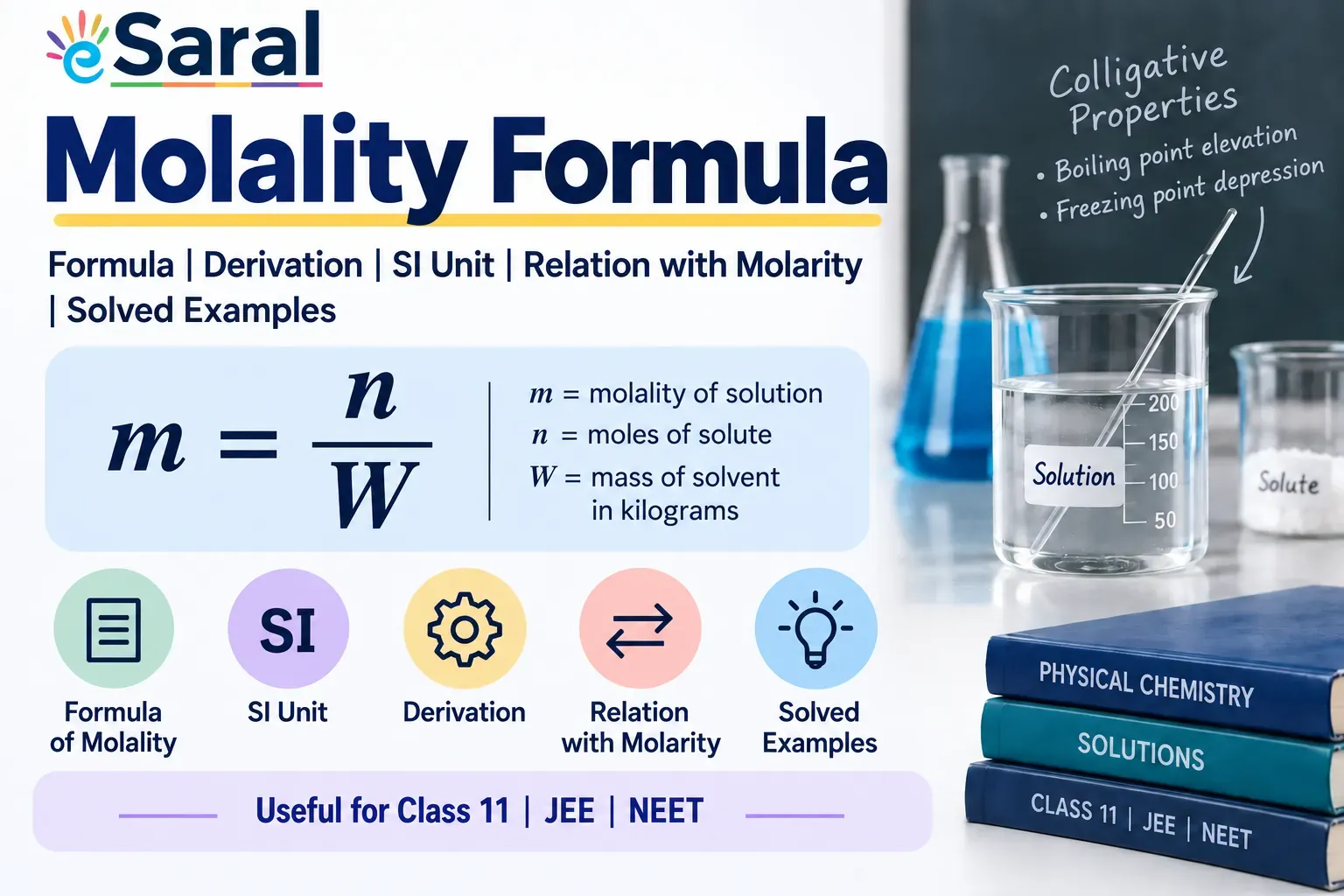
Molality Formula: Formula for Molality, Derivation & Solved Examples
Molality formula is $m = \dfrac{n}{W}$. Learn the formula of molality, its SI unit, derivation, relation with molarity, and solved examples for Class 11, JEE and NEET.

BITSAT Previous Year Question Paper PDF
Download BITSAT previous year question papers PDF. Get year-wise BITSAT PYQs, memory-based papers, exam pattern, and preparation tips to improve your BITSAT preparation.

Teachers’ Day 2026 at eSaral Gurukul: Celebrating the Bond Between Students, Teachers & Mentors
See how Teachers’ Day 2026 was celebrated at eSaral Gurukul, reflecting the bond among students, teachers, and mentors, and the role of guidance beyond academics.

JEE Advanced Attempts: Can You Give It a Third Time? Rules Explained
JEE Advanced attempts: current rule is 2 consecutive years only: full eligibility criteria, the 2025 third-attempt controversy, and the latest 2026 petition news.

Best JEE Preparation App
Best JEE preparation app for Main & Advanced: AI mock tests, live doubt-solving, thousands of practice questions. JEE preparation app for droppers & Class 11-12.
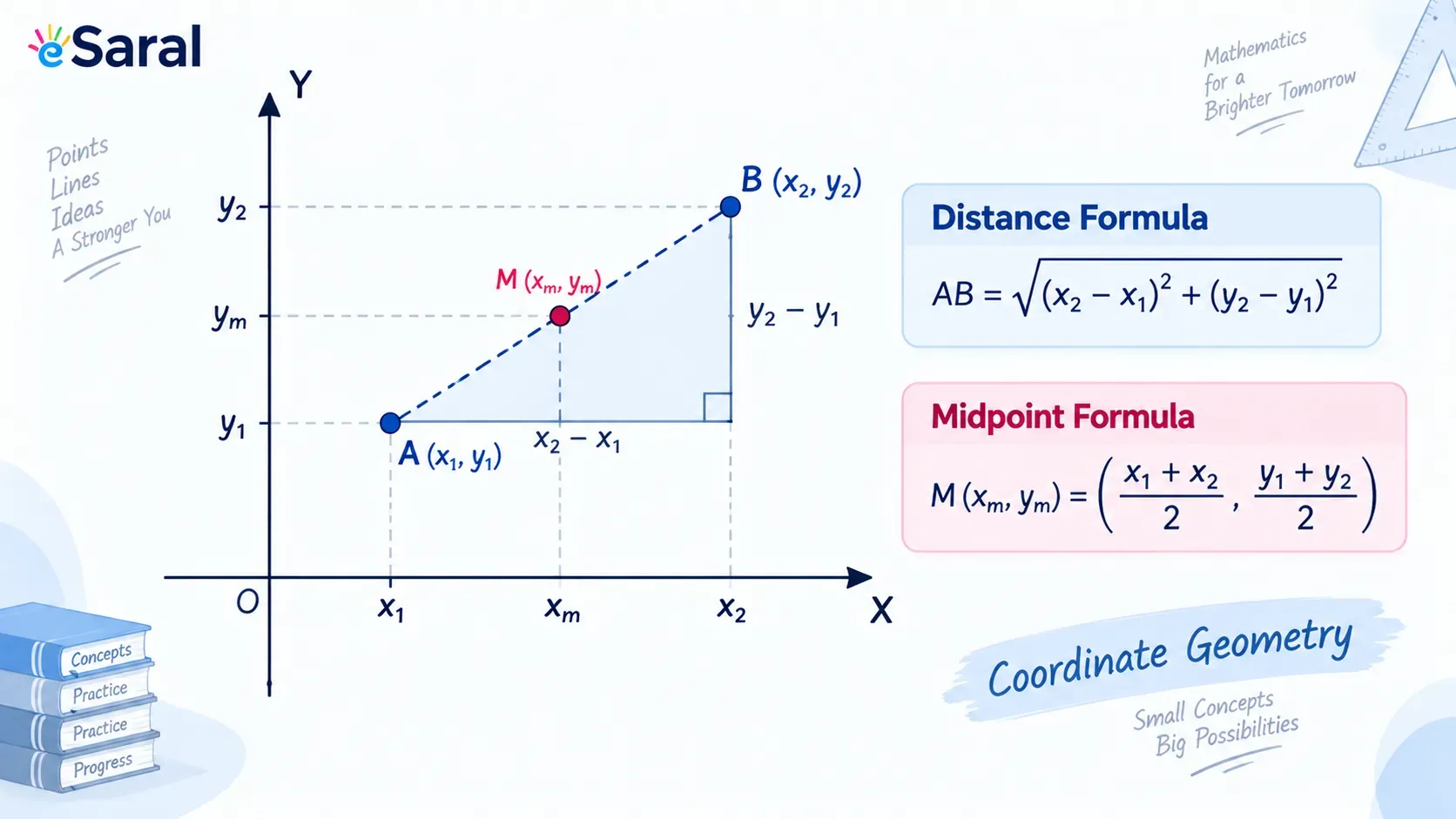
Coordinate Geometry Class 10: Formulas, Notes & Solved Examples
Coordinate geometry class 10: complete CBSE formulas — distance, section, midpoint and area of triangle — with derivation, notes and solved examples.
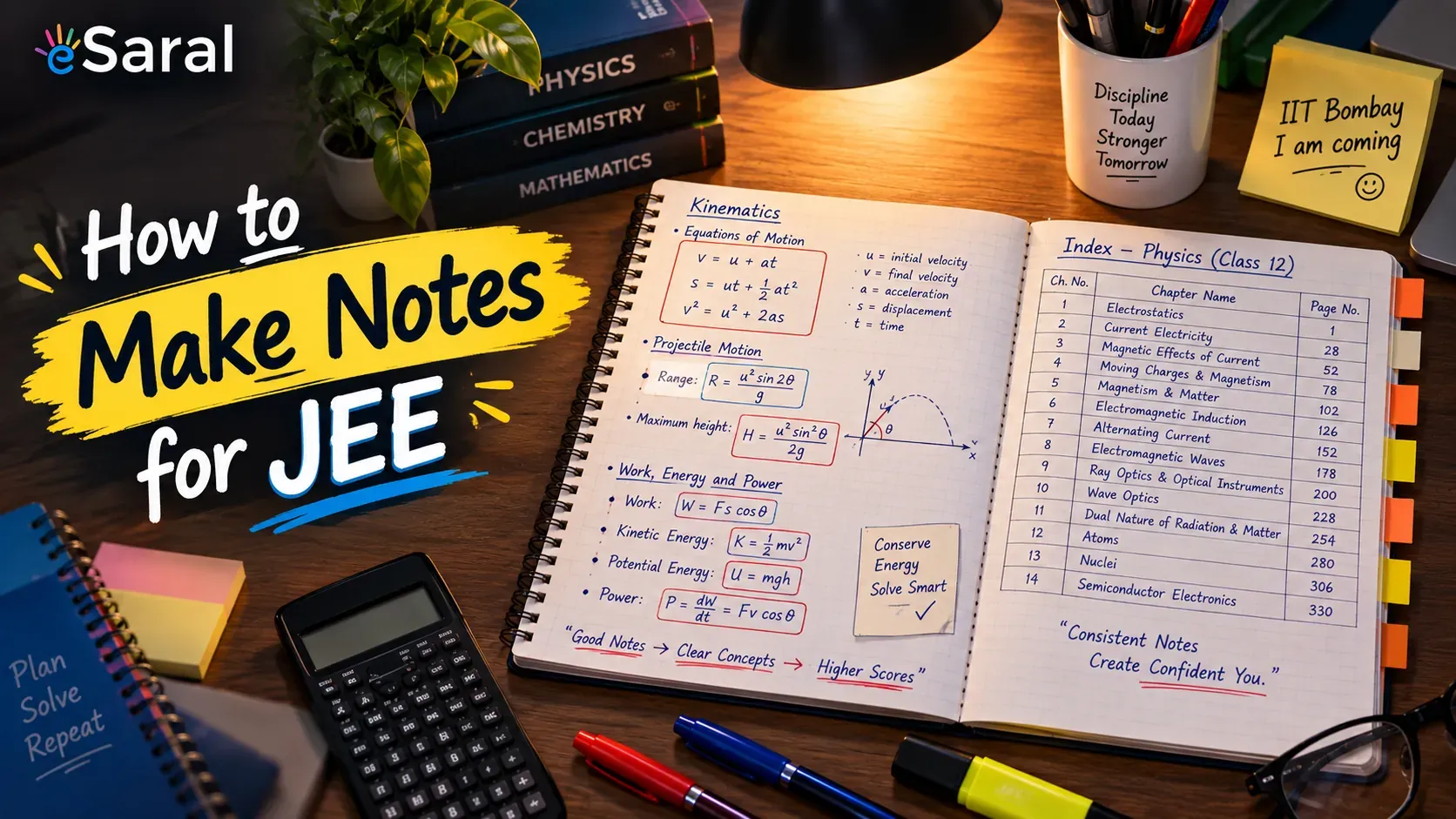
How to make Notes For JEE Smart Notes Strategy of an AIR 41
Learn how to make notes for JEE the way toppers do — indexing, shorthand, and smart short notes for JEE that cut revision time to just 5–7 days.
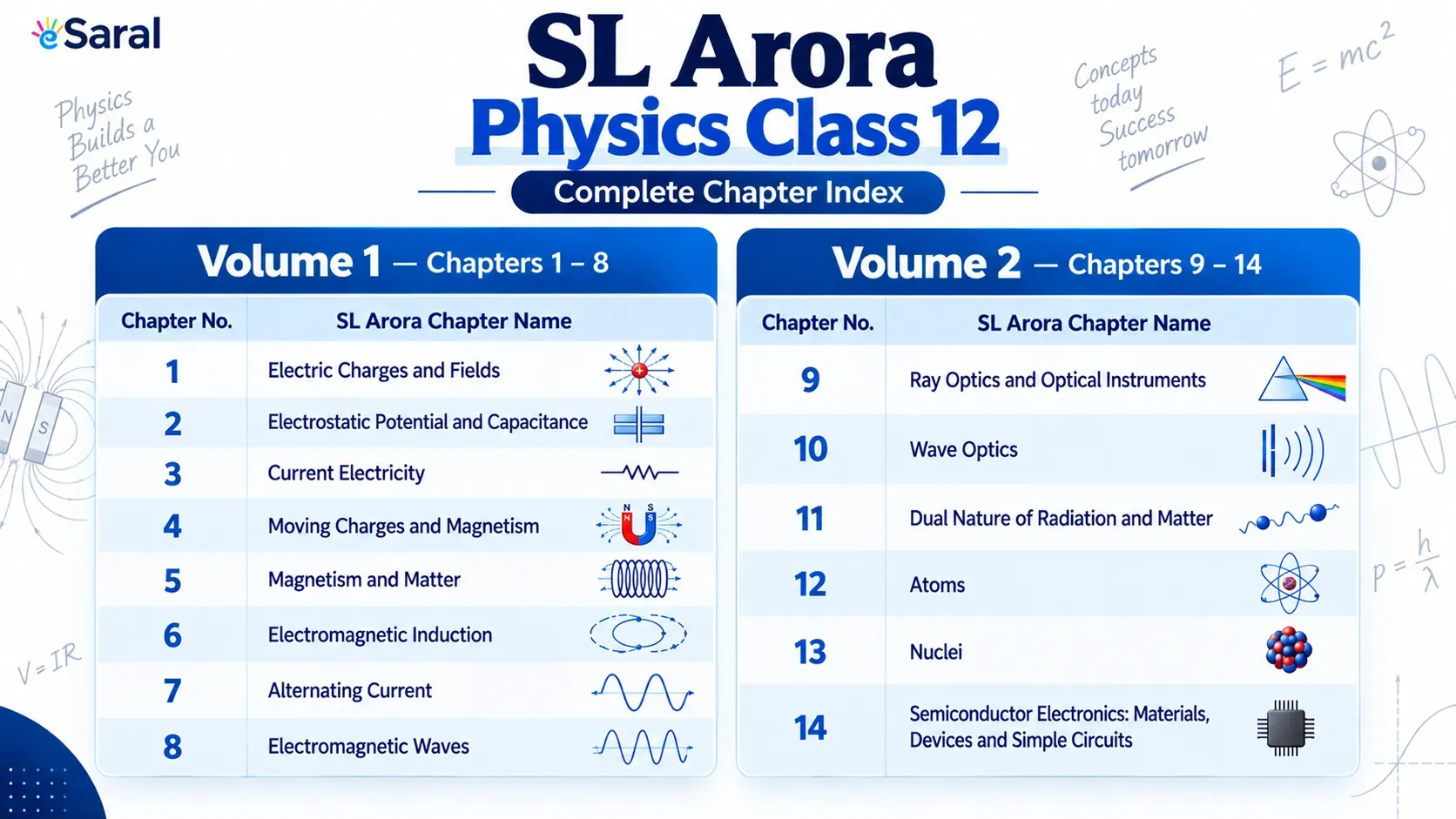
SL Arora Physics Class 12 Index – Chapter List for Volume 1 & 2
SL Arora Physics Class 12 index — complete chapter list for Volume 1 & 2, mapped to NCERT solutions for board, JEE Main, and NEET preparation.