
Coordination Compounds - JEE Advanced Previous Year Questions with Solutions

eSaral Academic and Editorial Team
Summary
Coordination Compounds questions appear in JEE Advanced almost every year, testing isomerism, magnetic moment (spin-only formula), crystal field theory, IUPAC nomenclature, and geometrical shapes of complexes. This page compiles every JEE Advanced Previous Year Question on Coordination Compounds with step-by-step solutions and concept explanations.

eSaral > JEE Advanced Chemistry PYQs > Coordination Compounds

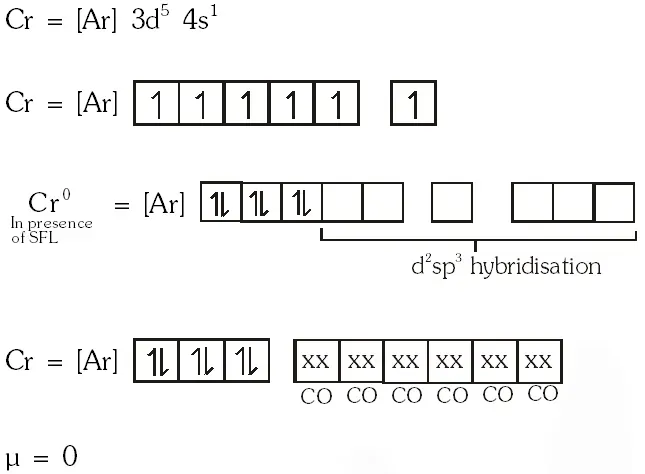
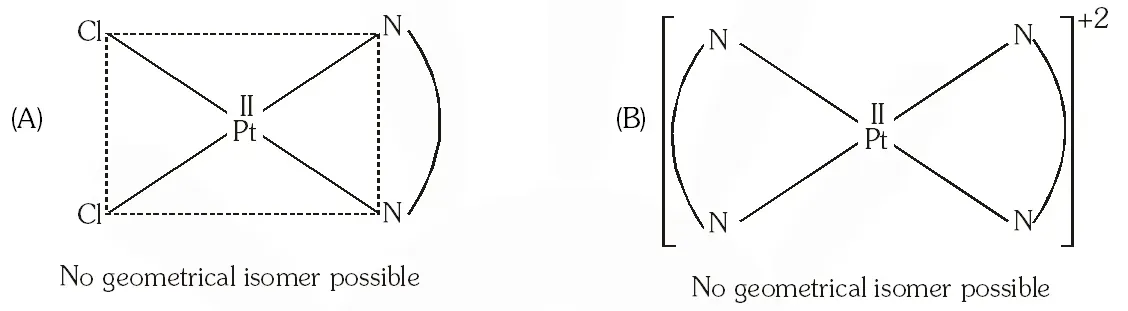
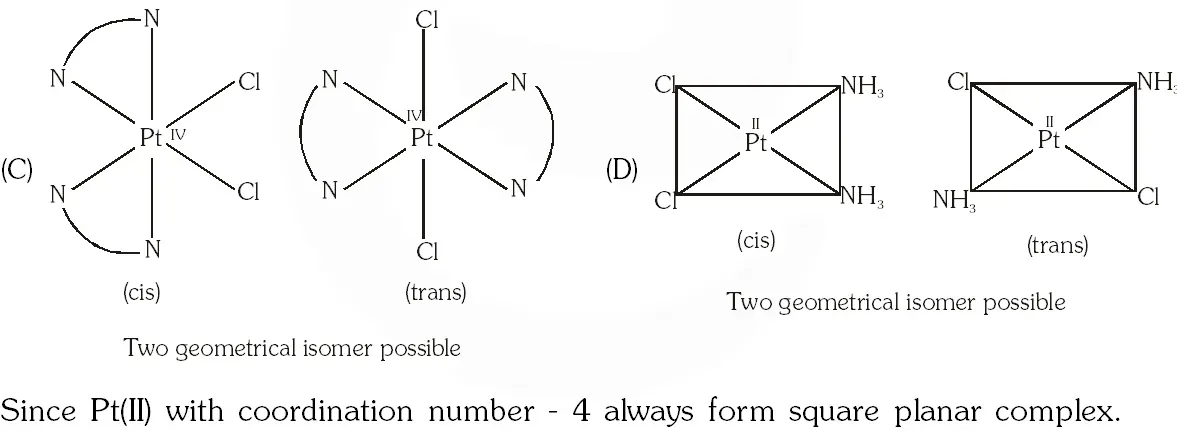
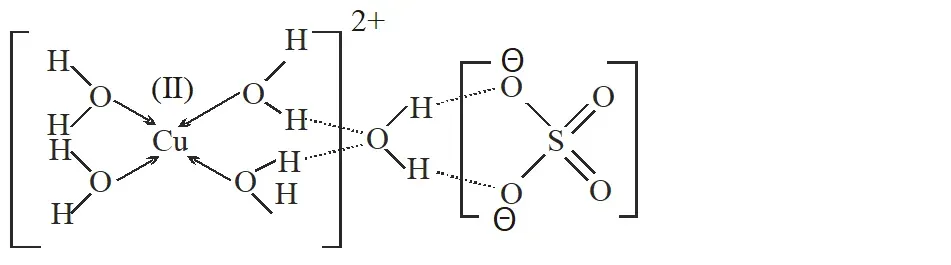
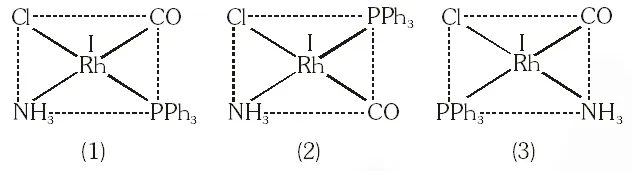
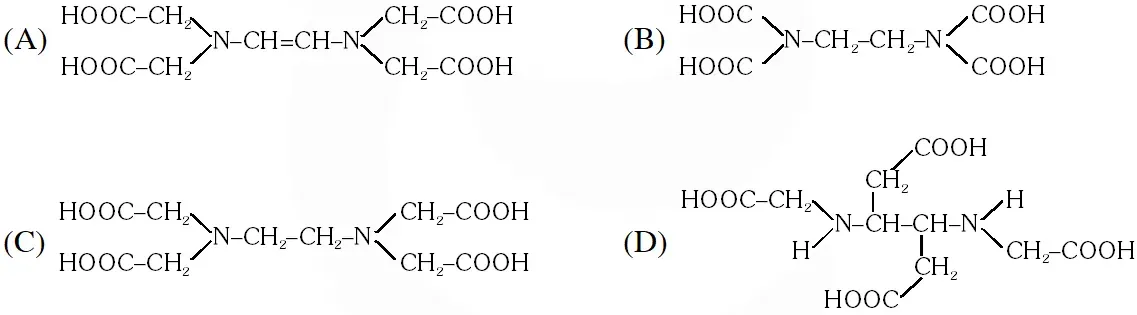
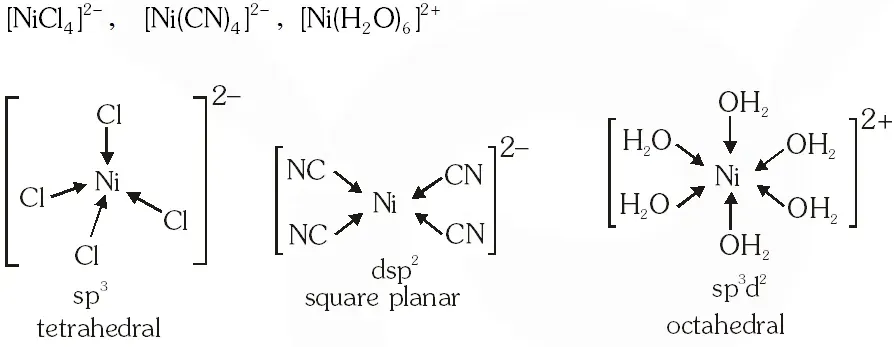
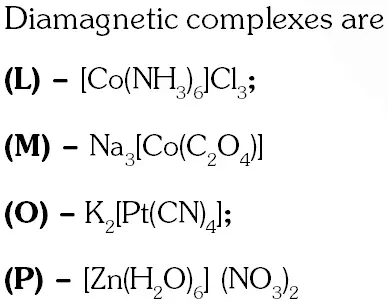
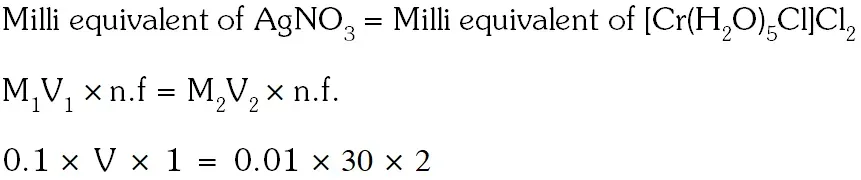
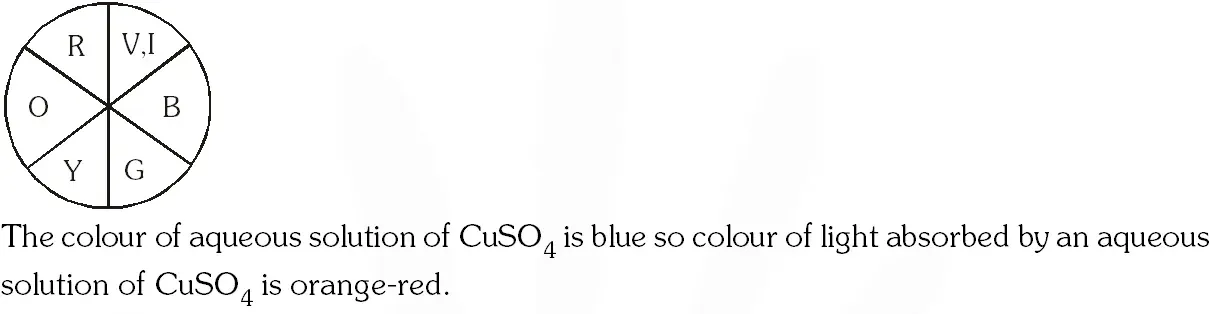
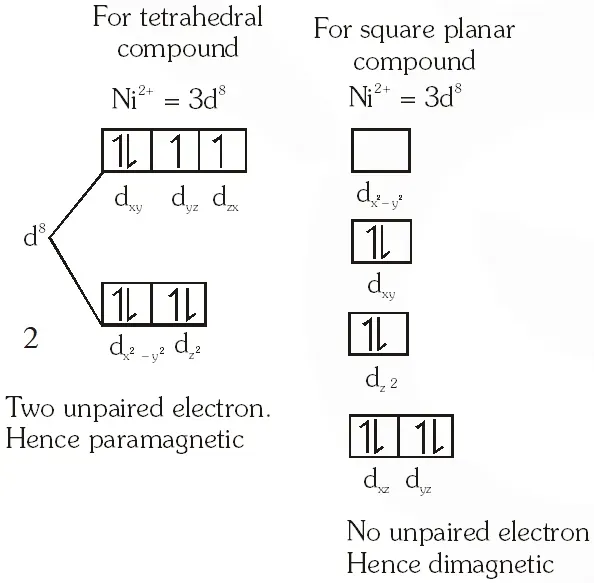
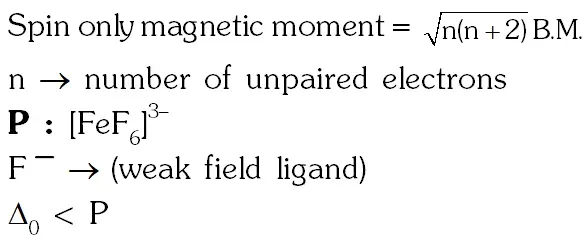
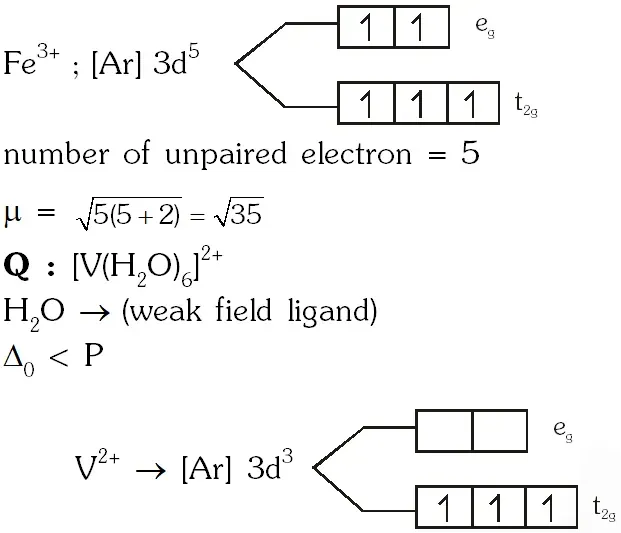
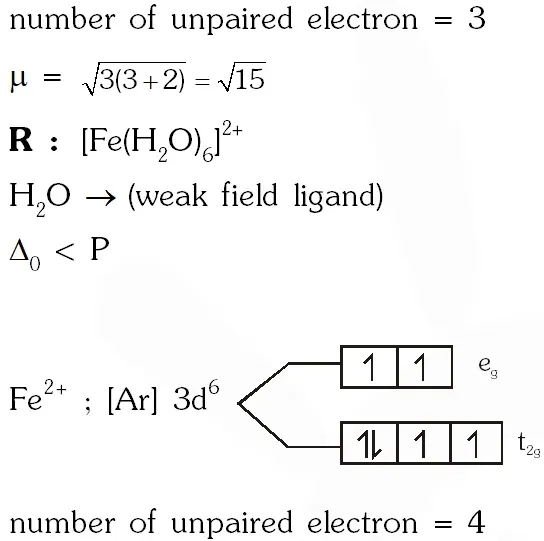
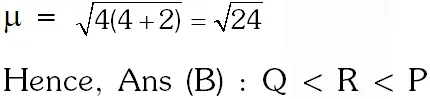
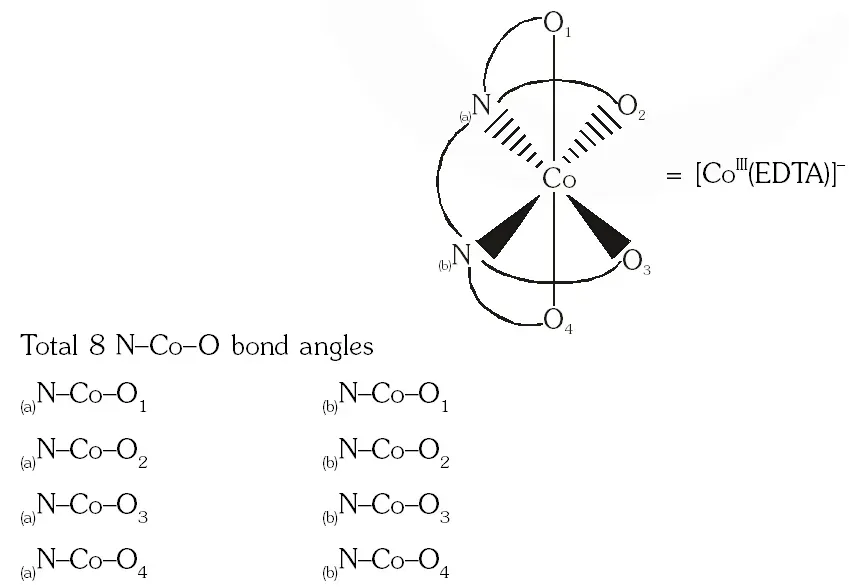
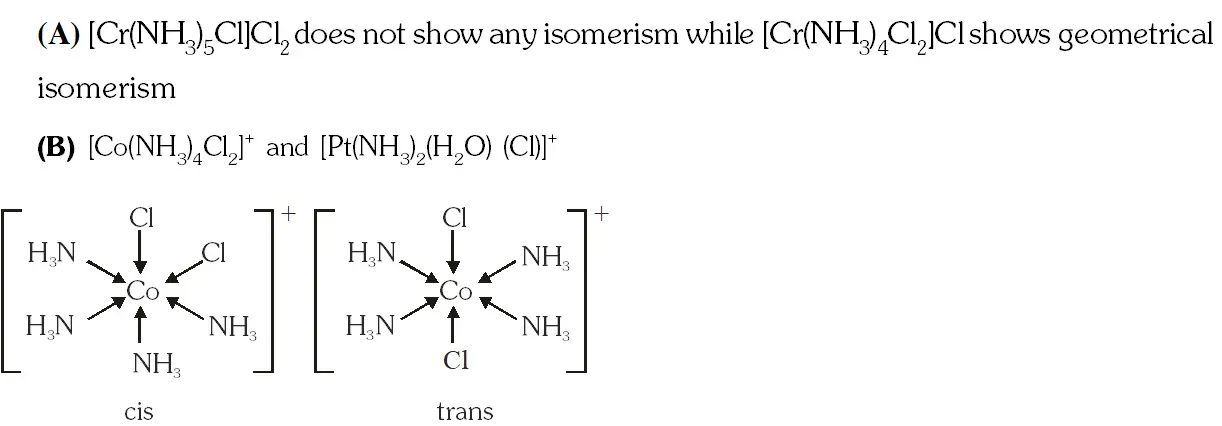
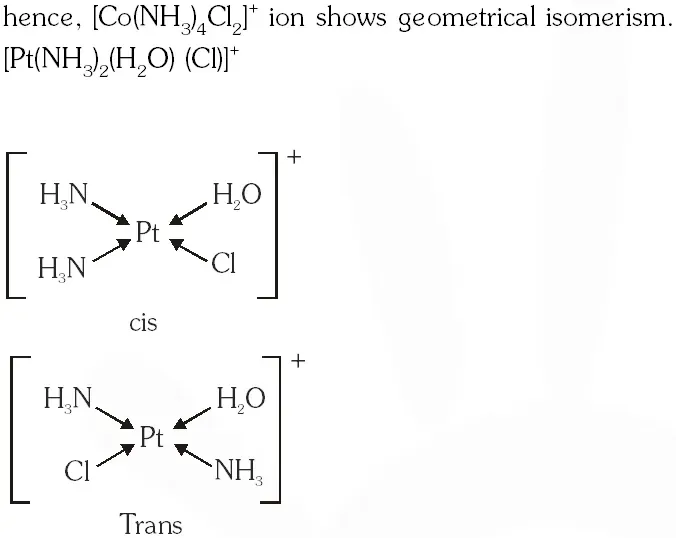
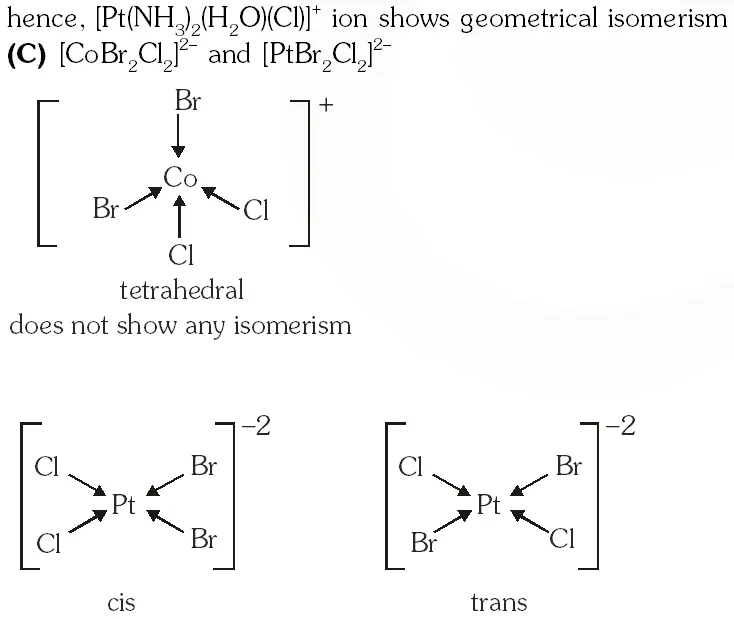
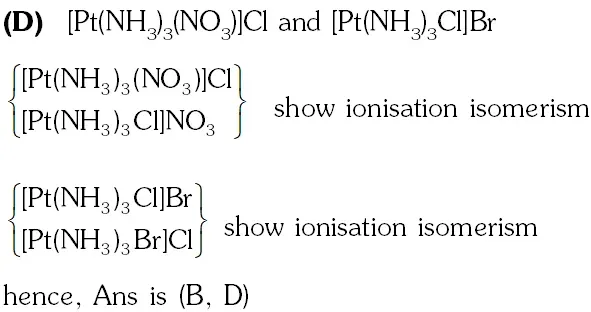
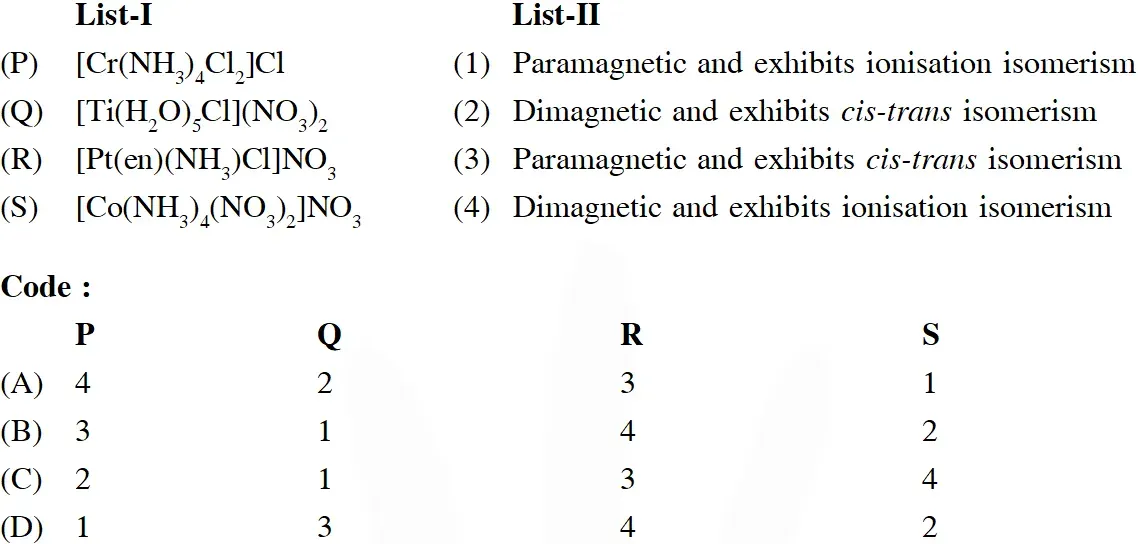
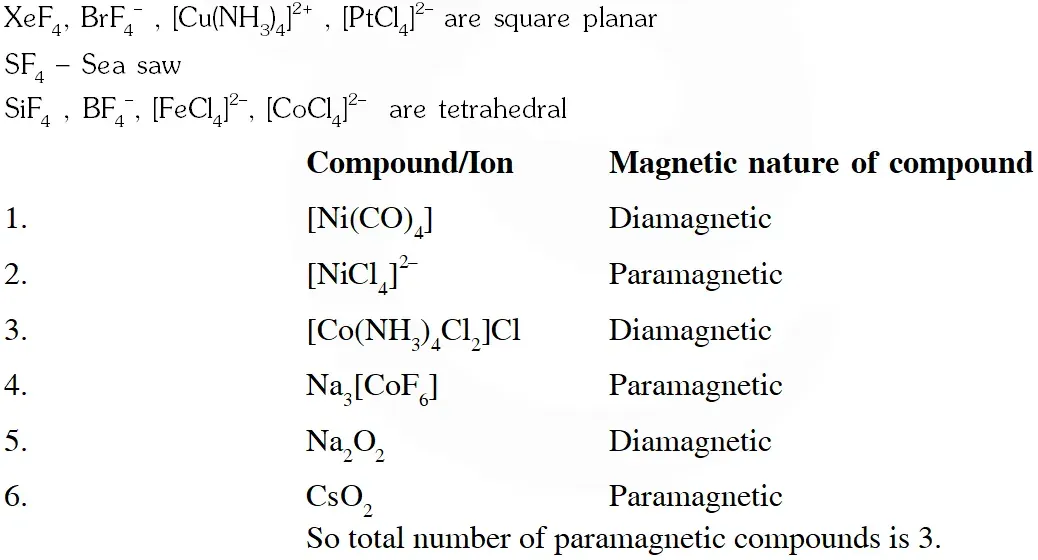
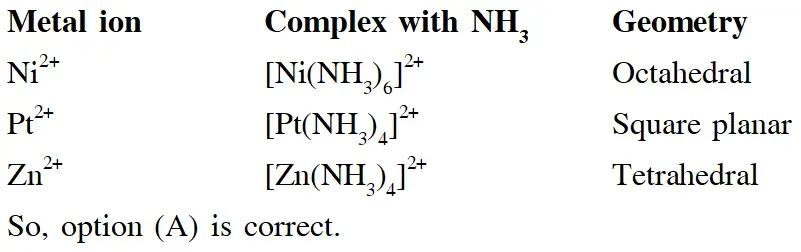
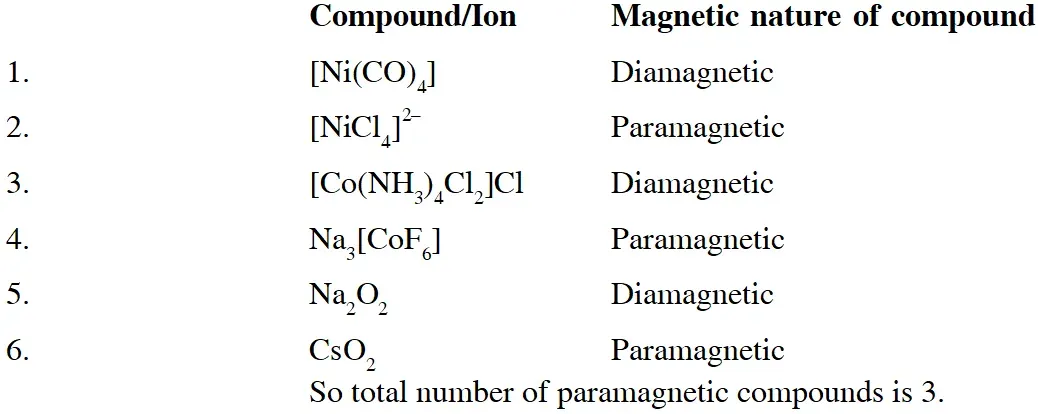
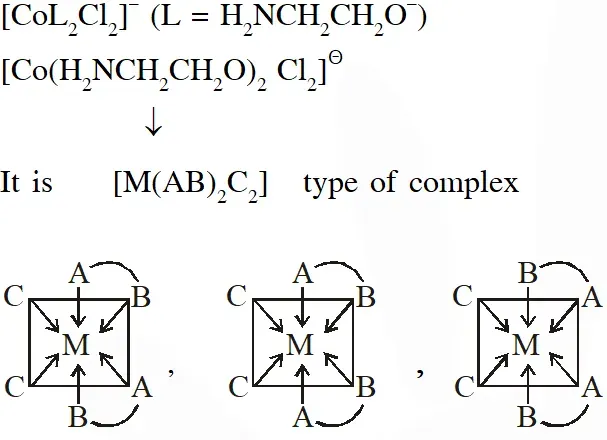
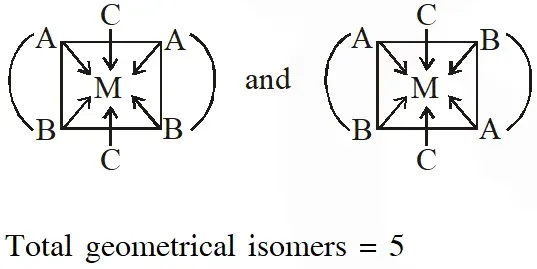
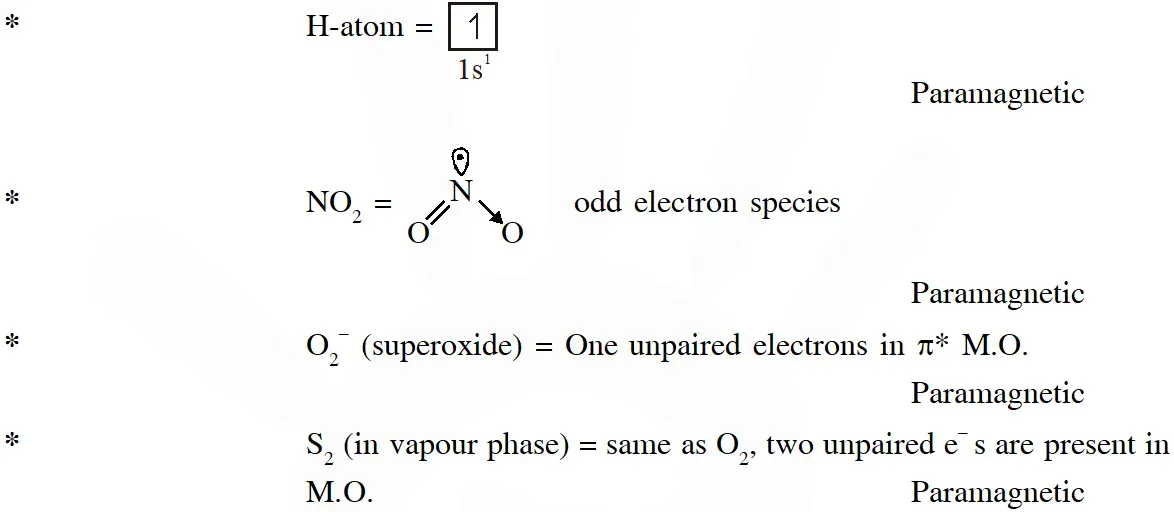
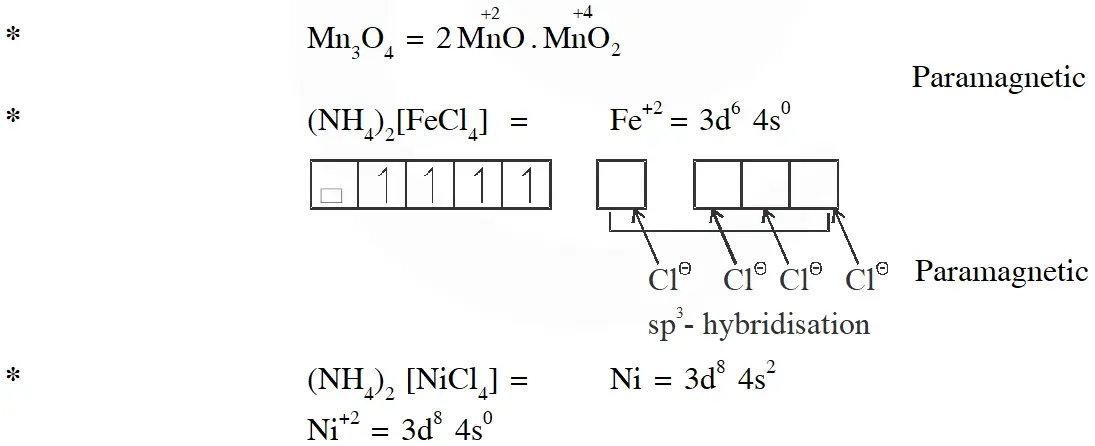
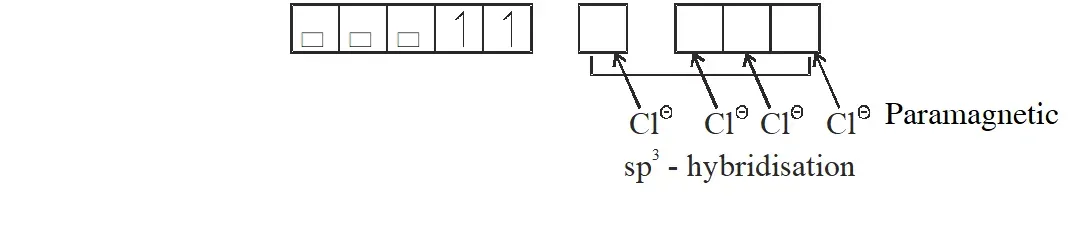
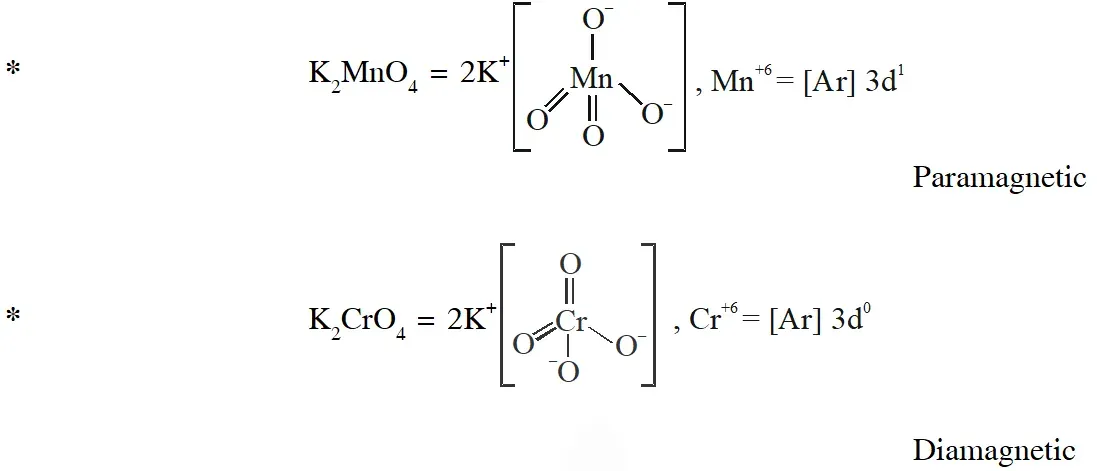
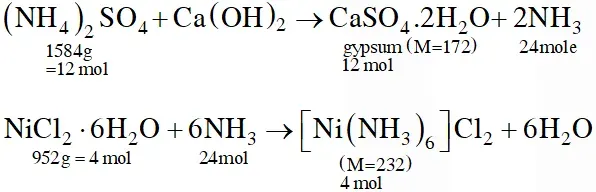
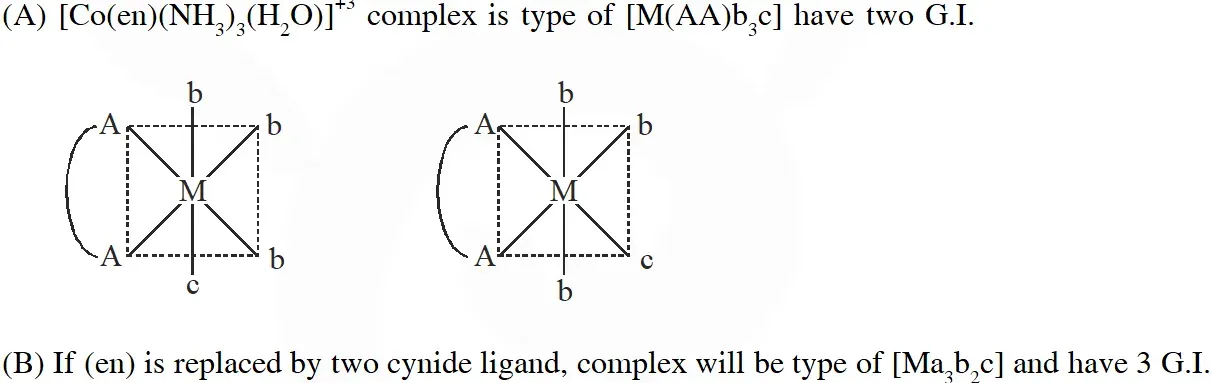
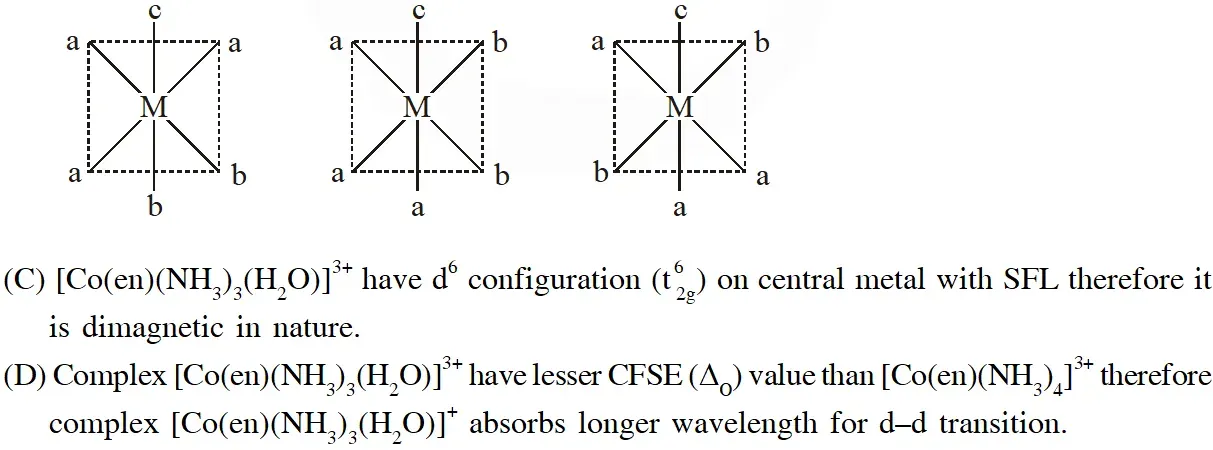
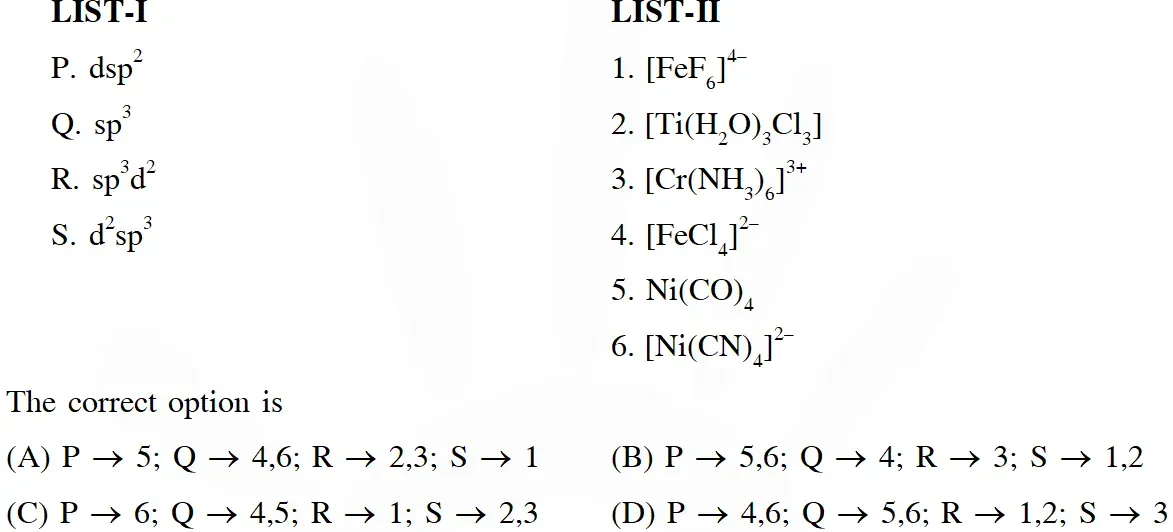
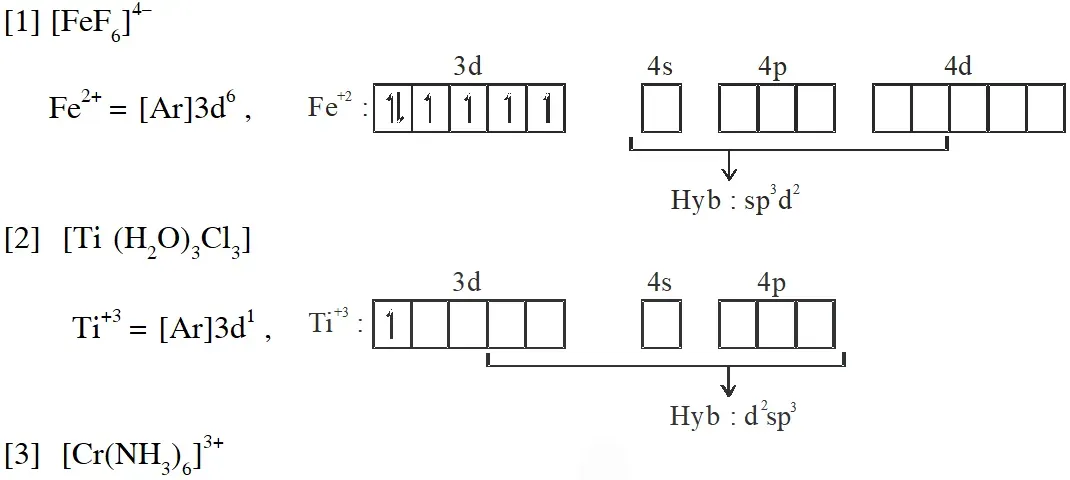
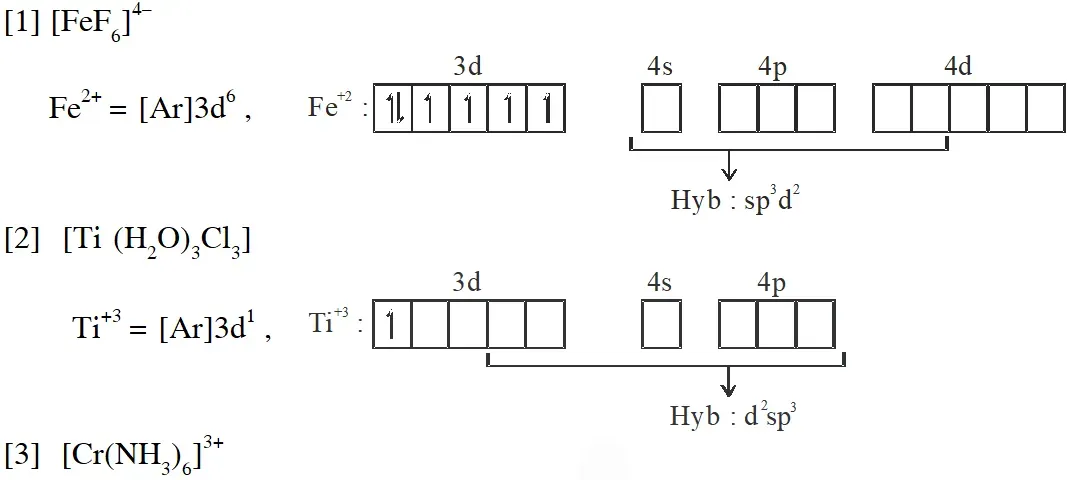
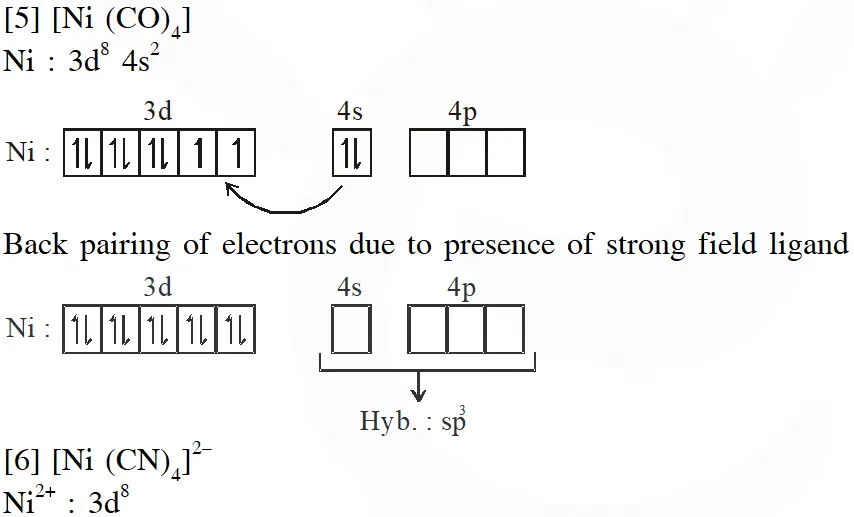
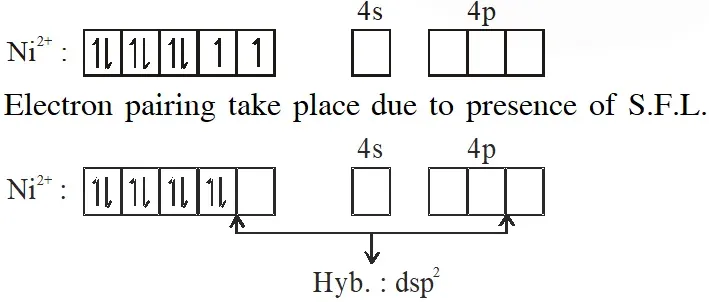
JEE Advanced Previous Year Questions of Chemistry with Solutions are available at eSaral. Practicing JEE Advanced Previous Year Papers Questions of Chemistry will help the JEE aspirants in realizing the question pattern as well as help in analyzing weak & strong areas. Simulator Previous Years JEE Advance Questions [esquestion] The spin only magnetic moment value (in Bohr magneton units) of \mathrm{Cr}(\mathrm{CO})_{6} is (A) 0 (B) 2.84 (C) 4.90 (D) 5.92 #tag# [JEE 2009] #sol# (A) [/esquestion] [esquestion] The compound(s) that exhibit(s) geometrical isomerism is (are) : (A) $\left[\mathrm{Pt}(\mathrm{en}) \mathrm{Cl}_{2}\right]$ (B) $\left[\mathrm{Pt}(\mathrm{en})_{2}\right] \mathrm{Cl}_{2}$ (C) $\left[\mathrm{Pt}(\mathrm{en})_{2} \mathrm{Cl}_{2}\right] \mathrm{Cl}_{2}$ (D) $\left[\mathrm{Pt}\left(\mathrm{NH}_{3}\right)_{2} \mathrm{Cl}_{2}\right]$ #tag# [JEE 2009] #sol# (C,D) [/esquestion] [esquestion] The number of water molecule(s) directly bonded to the metal centre in $\mathrm{CuSO}_{4}$. $5 \mathrm{H}_{2} \mathrm{O}$ is. #tag# [JEE 2009] #sol# 4 [/esquestion] [esquestion] The ionization isomer of $\left[\mathrm{Cr}\left(\mathrm{H}_{2} \mathrm{O}\right)_{4} \mathrm{Cl}\left(\mathrm{NO}_{2}\right)\right] \mathrm{Cl}$ is – (A) $\left[\mathrm{Cr}\left(\mathrm{H}_{2} \mathrm{O}\right)_{4}\left(\mathrm{O}_{2} \mathrm{N}\right)\right] \mathrm{Cl}_{2}$ (B) $\left[\mathrm{Cr}\left(\mathrm{H}_{2} \mathrm{O}\right)_{4} \mathrm{Cl}_{2}\right]\left(\mathrm{NO}_{2}\right)$ (C) $\left[\mathrm{Cr}\left(\mathrm{H}_{2} \mathrm{O}\right)_{4} \mathrm{Cl}(\mathrm{ONO})\right] \mathrm{Cl}$ (D) $\left[\mathrm{Cr}\left(\mathrm{H}_{2} \mathrm{O}\right)_{4} \mathrm{Cl}_{2}\left(\mathrm{NO}_{2}\right)\right] \cdot \mathrm{H}_{2} \mathrm{O}$ #tag# #sol# (B) Ionisation isomers differ in ions in solution thus, ionisation isomer of $\left[\mathrm{Cr}\left(\mathrm{H}_{2} \mathrm{O}\right)_{4} \mathrm{Cl}\left(\mathrm{NO}_{2}\right)\right] \mathrm{Cl}$ is $\left[\mathrm{Cr}\left(\mathrm{H}_{2} \mathrm{O}\right)_{4} \mathrm{Cl}_{2}\right]\left(\mathrm{NO}_{2}\right)$. Because $\left[\mathrm{Cr}\left(\mathrm{H}_{2} \mathrm{O}\right)_{4} \mathrm{Cl}\left(\mathrm{NO}_{2}\right)\right] \mathrm{Cl} \longrightarrow\left[\mathrm{Cr}\left(\mathrm{H}_{2} \mathrm{O}\right)_{4} \operatorname{Cl}\left(\mathrm{NO}_{2}\right)\right]^{+}+\mathrm{Cl}^{-}$ (Given compound) $\left[\mathrm{Cr}\left(\mathrm{H}_{2} \mathrm{O}\right)_{4} \mathrm{Cl}_{2}\right]\left(\mathrm{NO}_{2}\right) \longrightarrow\left[\mathrm{Cr}\left(\mathrm{H}_{2} \mathrm{O}\right)_{4} \mathrm{Cl}_{2}\right]^{+}+\mathrm{NO}_{2}^{-}$ Ionisation isomer of given compound. [/esquestion] [esquestion] Total number of geometrical isomers for the complex $\left[\mathrm{RhCl}(\mathrm{CO})\left(\mathrm{PPh}_{3}\right)\left(\mathrm{NH}_{3}\right)\right]$ is. #tag# [JEE 2010] #sol# 3 $\left[\mathrm{RhCl}(\mathrm{Co})\left(\mathrm{PPh}_{3}\right)\left(\mathrm{NH}_{3}\right)\right]$ $\mathrm{dsp}^{2},$ square planar, total 3 geometrical isomer. [/esquestion] [esquestion] The correct structure of ethylenediaminetetraacetic acid (EDTA) is – #tag# [JEE 2010] #sol# (C) The correct structure of ethylenediaminetetra acetic acid (EDTA) is [/esquestion] [esquestion] Geometrical shapes of the complexes formed by the reaction of $\mathrm{Ni}^{2+}$ with $\mathrm{Cl}^{-}, \mathrm{CN}$ and $\mathrm{H}_{2} \mathrm{O}$ respectively, are – (A) octahedral, tetrahedral and square planar (B) tetrahedral, square planar and octahedral (C) square planar, tetrahedral and octahedral (D) octahedral, square planar and octahedral #tag# [JEE 2011] #sol# (B) [/esquestion] [esquestion] Among the following complexes (K–P) $\mathrm{K}_{3}\left[\mathrm{Fe}(\mathrm{CN})_{6}\right](\mathbf{K}),\left[\mathrm{Co}\left(\mathrm{NH}_{3}\right)_{6}\right] \mathrm{Cl}_{3}(\mathrm{L}), \mathrm{Na}_{3}\left[\mathrm{Co}\left(\text { oxalate) }_{3}\right](\mathrm{M}),\left[\mathrm{Ni}\left(\mathrm{H}_{2}\mathrm{O}\right)_{6}\right] \mathrm{Cl}_{2}(\mathrm{N})\right.$$\mathrm{K}_{2}\left[\mathrm{Pt}(\mathrm{CN}) {4}\right](\mathbf{O})$ and $\left[\mathrm{Zn}\left(\mathrm{H}_{2} \mathrm{O}\right)_{6}\right]\left(\mathrm{NO}_{3}\right)_{2}(\mathbf{P})$ The diamagnetic complex are – (A) K, L, M, N (B) K, M, O, P (C) L, M, O, P (D) L, M, N, O #tag# [JEE 2011] #sol# (C) [/esquestion] [esquestion] The volume (in mL) of 0.1M AgNO3 required for complete precipitation of chloride ions present in 30 mL of 0.01M solution of $\left[\mathrm{Cr}\left(\mathrm{H}_{2} \mathrm{O}\right)_{6} \mathrm{Cl}\right] \mathrm{Cl}_{2}$, as silver chloride is close to. #tag# [JEE 2011] #sol# 6 [/esquestion] [esquestion] As per IUPAC nomenclature, the name of the complex $\left[\mathrm{Co}\left(\mathrm{H}_{2} \mathrm{O}\right)_{4}\left(\mathrm{NH}_{3}\right)_{2}\right] \mathrm{Cl}_{3}$ is : (A) Tetraaquadiaminecobalt(III) chloride (B) Tetraaquadiamminecobalt(III) chloride (C) Diaminetetraaquacobalt(III) chloride (D) Diamminetetraaquacobalt(III) chloride #tag# [JEE 2012] #sol# (D) $\left[\mathrm{C}_{\alpha}\left(\mathrm{H}_{2} \mathrm{O}\right)_{4}\left(\mathrm{NH}_{3}\right)_{2} \mathrm{Cl}_{3}\right.$ Diamminetetraaquacobalt(III) chloride $\frac{V I B G Y O R}{\lambda-v^{-} E^{-}}$ [/esquestion] [esquestion] The colour of light absorbed by an aqueous solution of $\mathrm{CuSO}_{4}$ is – (A) orange-red (B) blue-green (C) yellow (D) violet #tag# [JEE 2012] #sol# (A) [/esquestion] [esquestion] $\mathrm{NiCl}_{2}\left\{\mathrm{P}\left(\mathrm{C}_{2} \mathrm{H}_{5}\right)_{2}\left(\mathrm{C}_{6} \mathrm{H}_{5}\right)\right\}_{2}$ exhibits temperature dependent magnetic behavior (paramagnetic/diamagnetic). The coordination geometries of Ni2+ in the paramagnetic and diamagnetic states are respectively : (A) tetrahedral and tetrahedral (B) square planar and square planar (C) tetrahedral and square planar (D) square planar and tetrahedral #tag# [JEE 2012] #sol# (C) [/esquestion] [esquestion] Consider the following complex ions P, Q and R , $\mathbf{P}=\left[\mathrm{FeF}_{6}\right]^{3-}, \mathbf{Q}=\left[\mathrm{V}\left(\mathrm{H}_{2} \mathrm{O}\right)_{6}\right]^{2+}$ and $\mathbf{R}=\left[\mathrm{Fe}\left(\mathrm{H}_{2} \mathrm{O}\right)_{6}\right]^{2+}$ The correct order of the complex ions, according to their spin-only magnetic moment values (in B.M.) is – (A) R < Q < P (B ) Q < R < P (C) R < P < Q (D) Q < P < R #tag# [JEE 2013] #sol# (B) [/esquestion] [esquestion] EDTA $^{4}$ is ethylenediaminetetraacetate ion. The total number of $\mathrm{N}-\mathrm{Co}-\mathrm{O}$ bond angles in $[\mathrm{Co}(\mathrm{EDTA})]^{-1}$ complex ion is - #tag# [JEE 2013] #sol# 8 [/esquestion] [esquestion] The pair(s) of coordination complex/ion exhibiting the same kind of isomerism is(are) – (A) $\left[\mathrm{Cr}\left(\mathrm{NH}_{3}\right)_{5} \mathrm{Cl}\right] \mathrm{Cl}_{2}$ and $\left[\mathrm{Cr}\left(\mathrm{NH}_{3}\right)_{4} \mathrm{Cl}_{2}\right] \mathrm{Cl}$ (B) $\left[\mathrm{Co}\left(\mathrm{NH}_{3}\right)_{4} \mathrm{Cl}_{2}\right]^{+}$ and $\left[\mathrm{Pt}\left(\mathrm{NH}_{3}\right)_{2}\left(\mathrm{H}_{2} \mathrm{O}\right) \mathrm{Cl}\right]^{+}$ (C) $\left[\mathrm{CoBr}_{2} \mathrm{Cl}_{2}\right]^{2-}$ and $\left[\mathrm{PtBr}_{2} \mathrm{Cl}_{2}\right]^{2-}$ (D)$\left[\mathrm{Pt}\left(\mathrm{NH}_{3}\right)_{3}\left(\mathrm{NO}_{3}\right)\right] \mathrm{Cl}$ and $\left[\mathrm{Pt}\left(\mathrm{NH}_{3}\right)_{3} \mathrm{Cl}\right] \mathrm{Br}$ #tag# [JEE 2013] #sol# (B,D) [/esquestion] [esquestion] Match each coordination compound in List-I with an appropriate pair of characteristics from List-II and select the correct answer using the code given below the lists. #tag# [JEE Adv. 2014] #sol# (B) (P) $\left[\mathrm{Cr}^{\mathrm{III}}\left(\mathrm{NH}_{3}\right)_{4} \mathrm{Cl}_{2}\right] \mathrm{Cl}:$ (1) Complex given in (P) is Paramagnetic & show two geometrical (3 unpaired electrons) isomerism (cis and trans) (does not show ionization isomer) (Q) $\left[\mathrm{Ti}^{\mathrm{III}}\left(\mathrm{H}_{2} \mathrm{O}\right)_{5} \mathrm{Cl}\right]\left(\mathrm{NO}_{3}\right)_{2}$ (2) Complex given in (Q) is paramagnetic show ionization(1 unpaired electrons) isomerism (R) $\left[\mathrm{Pt}^{\mathrm{Il}}(\mathrm{en})\left(\mathrm{NH}_{3}\right) \mathrm{Cl}\right] \mathrm{NO}_{3}$ (3) Complex given in (R) is diamagnetic and show ionization(1 unpaired electrons) isomerism (S)$\left[\mathrm{Co}^{\mathrm{III}}\left(\mathrm{NH}_{3}\right)_{4}\left(\mathrm{NO}_{3}\right)_{2}\right] \mathrm{NO}_{3}$ (4) Complex given in (S) is diamagnetic does not show ionization (0 unpaired electrons) isomerism show geometrical isomerism [/esquestion] [esquestion]A list of species having the formula $\mathrm{XZ}_{4}$ is given below : $\mathrm{XeF}_{4}, \mathrm{SF}_{4}, \mathrm{SF}_{4}, \mathrm{BF}_{4}^{-}, \mathrm{BrF}_{4}^{-},\left[\mathrm{Cu}\left(\mathrm{NH}_{3}\right)_{4}\right]^{2+},\left[\mathrm{FeCl}_{4}\right]^{2-},\left[\mathrm{CoCl}_{4}\right]^{2-}$ and $\left[\mathrm{PtCl}_{4}\right]^{2-}$. Defining shape on the basis of the location of X and Z atoms, the total number of species having a square planar shape is #tag# [JEE Adv. 2014] #sol# [/esquestion] [esquestion] The geometries of the ammonia complexes of $\mathrm{Ni}^{2+}, \mathrm{Pt}^{2+}$ and $\mathrm{Zn}^{2+}$ , respectively , are : (A) octahedral, square planar and tetrahederal (B) square planar, octahederal and tetrahederal (C) tetrahederal, square planar and octahederal (D) octahederal , tetrahederal and square planar #tag# [JEE - Adv. 2016] #sol# (A) [/esquestion] [esquestion] Among $\left[\mathrm{Ni}(\mathrm{CO}), \mathrm{I},\left[\mathrm{NiCl}_{4}\right]^{2},\left[\mathrm{Co}\left(\mathrm{NH}_{3}\right), \mathrm{Cl}_{2}\right] \mathrm{Cl}, \mathrm{Na}_{3}\left[\mathrm{CoF}_{6}\right], \mathrm{NaO}_{2} \mathrm{and} \mathrm{Co}_{2}\right.$, the total number of paramagnetic compounds is – (A) 2 (B) 3 (C) 4 (D) 5 #tag# [JEE - Adv. 2016] #sol# (B) [/esquestion] [esquestion] The number of geometric isomers possible for the complex$\left[\mathrm{CoL}_{2} \mathrm{Cl}_{2}\right]^{-}\left(\mathrm{L}=\mathrm{H}_{2} \mathrm{NCH}_{2} \mathrm{CH}_{2} \mathrm{O}^{-}\right)$ is #tag# [JEE - Adv. 2016] #sol# 5 [/esquestion] [esquestion] Addition of excess aqueous ammonia to a pink coloured aqueous solution of $\mathrm{MCl}_{2} \cdot 6 \mathrm{H}_{2} \mathrm{O}$ (X) and $\mathrm{NH}_{4} \mathrm{Cl}$ gives an octahedral complex Y in the presence of air. In aqueous solution, complex Y behaves as 1 : 3 electrolyte. The reaction of X with excess HCl at room temperature results in the formation of a blue coloured complex Z. The calculated spin only magnetic moment of X and Z is 3.87 B.M., whereas it is zero for complex Y. Among the following options, which statements is(are) correct ? (A) The hybridization of the central metal ion in Y is d2sp3 (B) Z is tetrahedral complex (C) Addition of silver nitrate to Y gives only two equivalents of silver chloride (D) When X and Z are in equilibrium at 0°C, the colour of the solution is pink #tag# [JEE - Adv. 2017] #sol# (A,B,D) (A) Hybridisation of $(\mathrm{Y})$ is $\mathrm{d}^{2} \mathrm{sp}^{3}$ as $\mathrm{NH}_{3}$ is strong field ligand (B) $\left[\mathrm{CoCl}_{4}\right]^{2-}$ have $\mathrm{sp}^{3}$ hybridisation as $\mathrm{Cl}^{-}$ is weak field ligand When ice is added to the solution the equilibrium shifts right hence pink colour will remain predominant So, correct answer is (A,B& D) [/esquestion]A [esquestion] The correct statement(s) regarding the binary transition metal carbonyl compounds is (are) (Atomic numbers : Fe = 26, Ni = 28) (A) Total number of valence shell electrons at metal centre in $\mathrm{Fe}(\mathrm{CO})_{5}$ or $\mathrm{Ni}(\mathrm{CO})_{4}$ is 16 (B) These are predominantly low spin in nature (C) Metal - carbon bond strengthens when the oxidation state of the metal is lowered (D) The carbonyl C–O bond weakens when the oxidation state of the metal is increased #tag# [JEE - Adv. 2018] #sol# (B,C) (A) $\left[\mathrm{Fe}\left(\mathrm{CO}_{5}\right)\right] \&\left[\mathrm{Ni}(\mathrm{CO})_{4}\right]$ complexes have 18-electrons in their valence shell. (B) Carbonyl complexes are predominantly low spin complexes due to strong ligand field. (C) As electron density increases on metals (with lowering oxidation state on metals), the extent of synergic bonding increases. Hence M–C bond strength increases (D) While positive charge on metals increases and the extent of synergic bond decreases and hence C–O bond becomes stronger. [/esquestion] [esquestion] Among the species given below, the total number of diamagnetic species is____. H atom, $\mathrm{NO}_{2}$ monomer, $\mathrm{O}_{2}^{-}$ (superoxide), dimeric sulphur in vapour phase, $\mathrm{Mn}_{3} \mathrm{O}_{4},\left(\mathrm{NH}_{4}\right)_{2}\left[\mathrm{FeCl}_{4}\right],\left(\mathrm{NH}_{4}\right)_{2}\left[\mathrm{NiCl}_{4}\right], \mathrm{K}_{2} \mathrm{MnO}_{4}, \mathrm{K}_{2} \mathrm{CrO}_{4}$ #tag# [JEE - Adv. 2018] #sol# (1) [/esquestion] [esquestion] The ammonia prepared by treating ammonium sulphate with calcium hydroxide is completely used by $\mathrm{NiCl}_{2} \cdot 6 \mathrm{H}_{2} \mathrm{O}$ to form a stable coordination compound. Assume that both the reactions are 100% complete. If 1584 g of ammonium sulphate and 952g of NiCl2.6H2O are used in the preparation, the combined weight (in grams) of gypsum and the nickel-ammonia coordination compound thus produced is___. (Atomic weights in g $\mathrm{mol}^{-1}$: H = 1, N = 14, O = 16, S = 32, Cl = 35.5, Ca = 40, Ni = 59) (A) It has two geometrical isomers (B) It will have three geometrical isomers if bidentate 'en' is replaced by two cyanide ligands (C) It is paramagnetic (D) It absorbs light at longer wavelength as compared to $\left[\mathrm{Co}(\mathrm{en})\left(\mathrm{NH}_{3}\right)_{4}\right]^{3+}$ #tag# [JEE - Adv. 2018] #sol# 2992 Total mass = 12 × 172 + 4 × 232 = 2992 g [/esquestion] [esquestion] The correct option(s) regarding the complex $\left[\mathrm{Co}(\mathrm{en})\left(\mathrm{NH}_{3}\right)_{3}\left(\mathrm{H}_{2} \mathrm{O}\right)\right]^{3+}:-$ $\left(\mathrm{en}=\mathrm{H}_{2} \mathrm{NCH}_{2} \mathrm{CH}_{2} \mathrm{NH}_{2}\right)$ is (are) #tag# [JEE - Adv. 2018] #sol# (A,B,D) [/esquestion] [esquestion] Match each set of hybrid orbitals from LIST-I with complex (es) given in LIST-II. #tag# [JEE - Adv. 2018] #sol# (C) [/esquestion]









Use the JEE Advanced PYQ archive to understand how Coordination Compounds - JEE Advanced PYQs (Chemistry) appears in actual papers.
Frequently Asked Questions
What types of isomerism are most tested in JEE Advanced Coordination Compounds?
Geometrical isomerism and ionisation isomerism are tested most frequently. Geometrical isomerism appears in square planar and octahedral complexes; ionisation isomerism involves swapping ligands between the inner coordination sphere and outer sphere. Linkage isomerism (from ambidentate ligands like NO₂⁻) and optical isomerism also appear occasionally.
What is the spin-only magnetic moment formula used in JEE Advanced?
The spin-only magnetic moment is calculated using μ = √(n(n+2)) Bohr Magnetons, where n is the number of unpaired electrons. To apply this correctly in JEE Advanced, first determine the oxidation state of the metal, then assign d-electrons, and finally decide whether the ligand is strong-field or weak-field using the spectrochemical series.
How many questions come from Coordination Compounds in JEE Advanced?
Coordination Compounds typically contribute 1–3 questions per JEE Advanced paper, accounting for approximately 4–12 marks. It has appeared in 12 out of 15 years between 2009 and 2023, making it one of the most reliable chapters in Inorganic Chemistry for the exam.
Should I study NCERT before attempting JEE Advanced Coordination Compounds PYQs?
Yes — NCERT Class 12 Chemistry Chapter 9 is the foundation for all JEE Advanced questions in this chapter. Crystal field theory, IUPAC rules, Werner's theory, and types of isomerism are all covered in NCERT. Once you are clear on NCERT, use these PYQs to test application. Access NCERT Solutions for Class 12 Chemistry for detailed chapter-wise explanations.
What is the correct IUPAC name for \[Co(NH₃)₄(H₂O)₂\]Cl₃?
The correct IUPAC name is tetraamminediaquacobalt(III) chloride. Ligands are named alphabetically — ammine (from NH₃) comes before aqua (from H₂O). The metal's oxidation state (+3) is given in Roman numerals. The outer sphere anion (Cl⁻) is named last as chloride.
How do I determine the geometry of a coordination complex in JEE Advanced?
Geometry depends on three factors: (1) the coordination number, (2) the metal's d-electron count, and (3) ligand field strength. CN 4 gives tetrahedral (weak field) or square planar (strong field / d⁸ metals like Pt²⁺, Pd²⁺, Ni²⁺ with CN⁻). CN 6 almost always gives octahedral geometry in JEE Advanced questions.
Team eSaral
eSaral Academic and Editorial Team
Team eSaral is the collective author profile for educational content created by eSaral’s teachers and academic contributors. The team draws on expertise from IIT graduates, doctors, experienced educators and subject specialists to develop resources for JEE, NEET and school students. Our articles aim to explain concepts clearly and help students study with confidence.
Related Posts
Plant Cell Diagram: Labelled Structure, Parts and Functions
Simple, labelled plant cell diagram with parts and functions. Covers plant cell structure for Class 6, 7, 8, 9, 10 and 11 students, CBSE-aligned.

Saransh Gupta Sir's Visit to IIT Patna: Hostel Life, Placements & Lessons for JEE Aspirants
Inside Saransh Gupta Sir's IIT Patna visit — hostel life, the library, placements, internships, and real advice for JEE aspirants from students living the IIT dream.
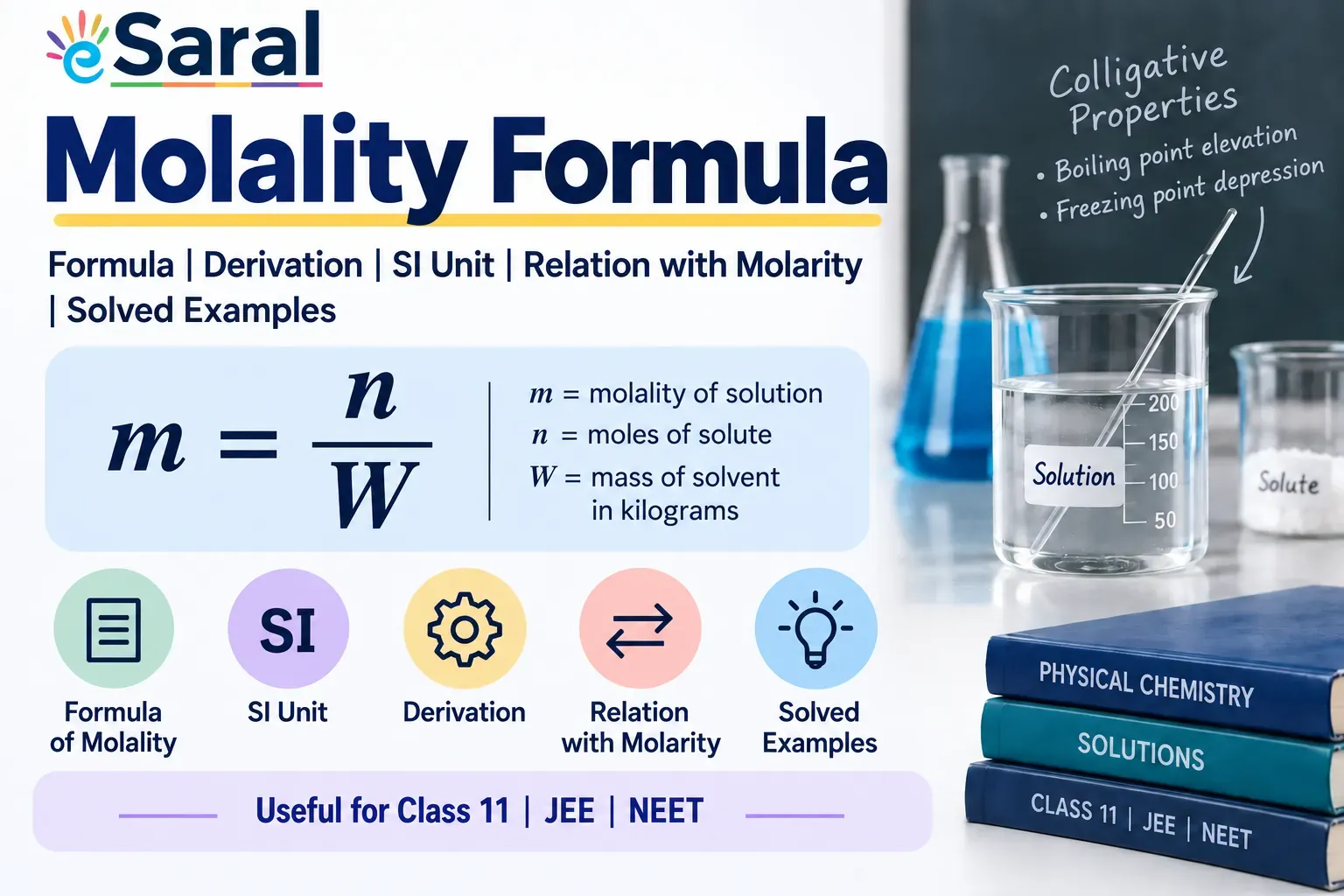
Molality Formula: Formula for Molality, Derivation & Solved Examples
Molality formula is $m = \dfrac{n}{W}$. Learn the formula of molality, its SI unit, derivation, relation with molarity, and solved examples for Class 11, JEE and NEET.

BITSAT Previous Year Question Paper PDF
Download BITSAT previous year question papers PDF. Get year-wise BITSAT PYQs, memory-based papers, exam pattern, and preparation tips to improve your BITSAT preparation.

Teachers’ Day 2026 at eSaral Gurukul: Celebrating the Bond Between Students, Teachers & Mentors
See how Teachers’ Day 2026 was celebrated at eSaral Gurukul, reflecting the bond among students, teachers, and mentors, and the role of guidance beyond academics.

JEE Advanced Attempts: Can You Give It a Third Time? Rules Explained
JEE Advanced attempts: current rule is 2 consecutive years only: full eligibility criteria, the 2025 third-attempt controversy, and the latest 2026 petition news.

Best JEE Preparation App
Best JEE preparation app for Main & Advanced: AI mock tests, live doubt-solving, thousands of practice questions. JEE preparation app for droppers & Class 11-12.
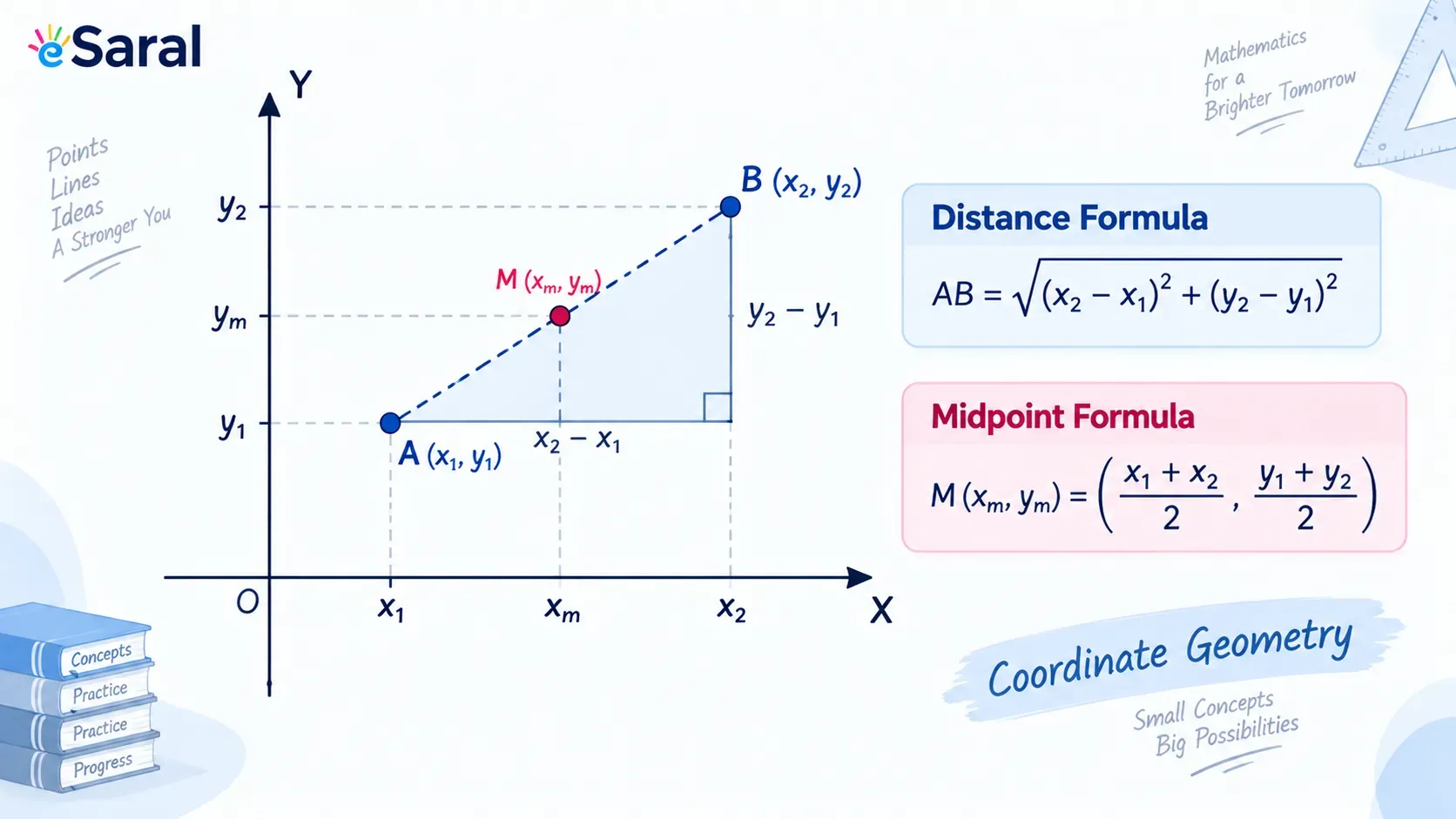
Coordinate Geometry Class 10: Formulas, Notes & Solved Examples
Coordinate geometry class 10: complete CBSE formulas — distance, section, midpoint and area of triangle — with derivation, notes and solved examples.

How to make Notes For JEE Smart Notes Strategy of an AIR 41
Learn how to make notes for JEE the way toppers do — indexing, shorthand, and smart short notes for JEE that cut revision time to just 5–7 days.
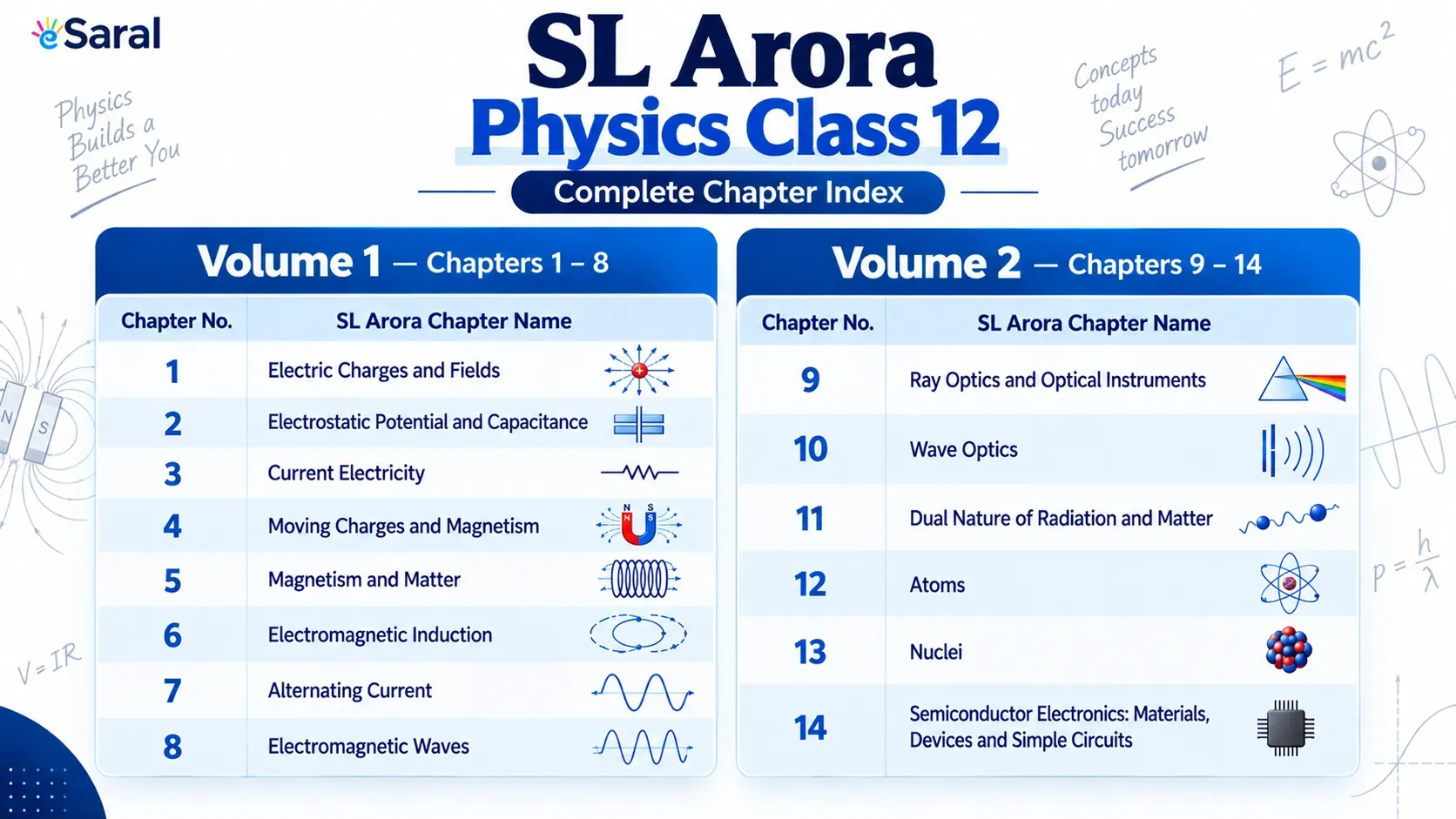
SL Arora Physics Class 12 Index – Chapter List for Volume 1 & 2
SL Arora Physics Class 12 index — complete chapter list for Volume 1 & 2, mapped to NCERT solutions for board, JEE Main, and NEET preparation.