
Determinant - JEE Main Previous Year Question with Solutions
Summary
Determinant questions appear in almost every JEE Main session. Between 2009 and 2024, NTA has asked 1–2 questions per paper from this chapter, focusing on properties of determinants, solutions of linear equation systems (unique, infinite, no solution), and non-trivial solution conditions. Mastering these question types is essential for a 80+ score in JEE Main Mathematics.

eSaral › JEE Main › Maths › Determinant Previous Year Questions with Solutions

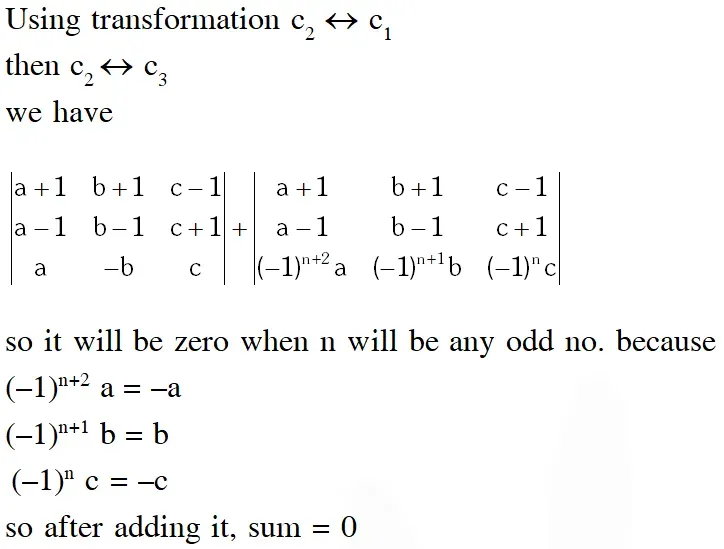
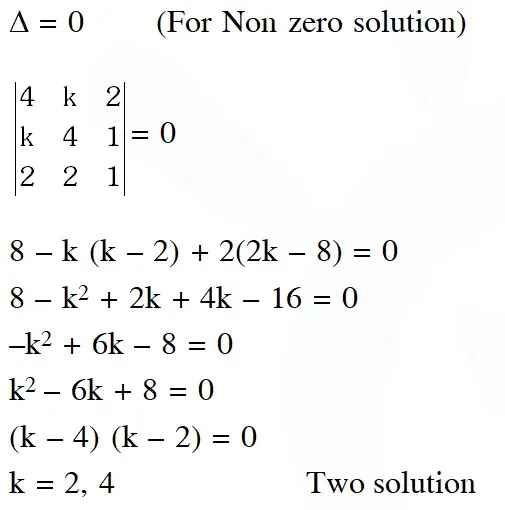
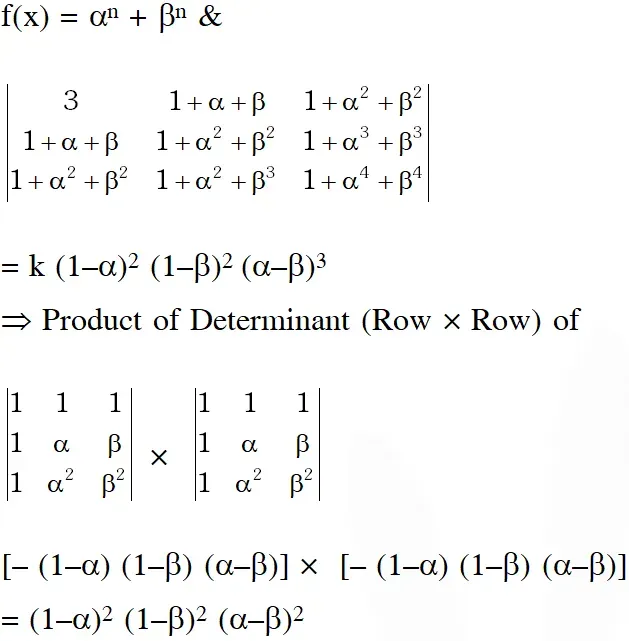
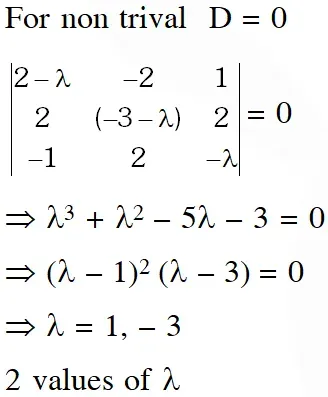
JEE Main Previous Year Question of Math with Solutions are available at eSaral. Practicing JEE Main Previous Year Papers Questions of mathematics will help the JEE aspirants in realizing the question pattern as well as help in analyzing weak & strong areas. eSaral helps the students in clearing and understanding each topic in a better way. eSaral is providing complete chapter-wise notes of Class 11th and 12th both for all subjects. Besides this, eSaral also offers NCERT Solutions, Previous year questions for JEE Main and Advance, Practice questions, Test Series for JEE Main, JEE Advanced and NEET, Important questions of Physics, Chemistry, Math, and Biology and many more. Download eSaral app for free study material and video tutorials. [esquestion] Let $a, b, c$ be such that $\mathrm{b}(\mathrm{a}+\mathrm{c}) \neq 0 . \mathrm{If}$ If $\left|\begin{array}{ccc}{a} & {a+1} & {a-1} \\ {-b} & {b+1} & {b-1} \\ {c} & {c-1} & {c+1}\end{array}\right|+\left|\begin{array}{ccc}{a+1} & {b+1} & {c-1} \\ {a-1} & {b-1} & {c+1} \\ {-1} & {a} & {(-1)^{n+1} b} & {(-1)^{n} c}\end{array}\right|=0$ then the value of n is :- (1) Any odd integer (2) Any integer (3) Zero (4) Any even integer #tag# [AIEEE - 2009] #sol# (1) [/esquestion] [esquestion] Consider the system of linear equations : $\mathrm{x}_{1}+2 \mathrm{x}_{2}+\mathrm{x}_{3}=3$ $2 \mathrm{x}_{1}+3 \mathrm{x}_{2}+\mathrm{x}_{3}=3$ $3 x_{1}+5 x_{2}+2 x_{3}=1$ The system has (1) Infinite number of solutions (2) Exactly 3 solutions (3) A unique solution (4) No solution #tag# [AIEEE - 2010] #sol# (4) Here $D=0$ $\& \quad D_{1} \neq 0$ so we can say no solution [/esquestion] [esquestion] The number of values of k for which the linear equations 4x + ky + 2z = 0 kx + 4y + z = 0 2x + 2y + z = 0 possess a non-zero solution is :- (1) 1 (2) zero (3) 3 (4) 2 #tag# [AIEEE - 2011] #sol# (4) [/esquestion] [esquestion] If the trivial solution is the only solution of the system of equations x – ky + z = 0 kx + 3y – kz = 0 3x + y – z = 0 Then the set of all values of k is: (1) {2, –3} (2) R – {2, –3} (3) R – {2} (4) R – {–3} #tag# [AIEEE - 2011] #sol# (2) Here for trival solution $D \neq 0$ So $\mathrm{D}=\left|\begin{array}{ccc}{1} & {-\mathrm{k}} & {1} \\ {\mathrm{k}} & {3} & {-\mathrm{k}} \\ {3} & {1} & {-1}\end{array}\right|=0$ $\Rightarrow \mathrm{D}=2 \mathrm{k}^{2}-12+2 \mathrm{k}=0 \Rightarrow \mathrm{k}=-3,2$ so $\mathrm{R}-\{-3,2\}$ [/esquestion] [esquestion] The number of values of k, for which the system of equations : (k + 1)x + 8y = 4k kx + (k + 3)y = 3k – 1 has no solution, is – (1) infinite (2) 1 (3) 2 (4) 3 #tag# [JEE(Main)-2013] #sol# (2) $\frac{k+1}{k}=\frac{8}{k+3}=\frac{4 k}{3 k-1}$ (1) = (2) $\Rightarrow \quad k^{2}-4 k+3=0$ k = 1, 3 for k = 1 (2) = (3) for $\mathrm{k}=3 \quad(2) \neq(3)$ k = 3 [/esquestion] [esquestion] If $\alpha, \beta \neq 0,$ and $f(\mathrm{n})=\alpha^{\mathrm{n}}+\beta^{\mathrm{n}}$ and $\left|\begin{array}{ccc}{3} & {1+f(1)} & {1+f(2)} \\ {1+f(1)} & {1+f(2)} & {1+f(3)} \\ {1+f(2)} & {1+f(3)} & {1+f(4)}\end{array}\right|=\mathrm{K}(1-\alpha)^{2}(1-\beta)^{2}(\alpha-\beta)^{2}$ then K is equal to : (1) $\alpha \beta$ (2) $\frac{1}{\alpha \beta}$ (3) 1 (4) –1 #tag# [JEE(Main)-2014] #sol# (3) $\therefore k=1$ [/esquestion] [esquestion] The set of all values of $\lambda$ for which the system of linear equations : $2 \mathrm{x}_{1}-2 \mathrm{x}_{2}+\mathrm{x}_{3}=\lambda \mathrm{x}_{1}$ $2 \mathrm{x}_{1}-3 \mathrm{x}_{2}+2 \mathrm{x}_{3}=\lambda \mathrm{x}_{2}$ $-\mathrm{x}_{1}+2 \mathrm{x}_{2}=\lambda \mathrm{x}_{3}$ has a non-trivial solution (1) contains two elements (2) contains more than two elements (3) is an empty set (4) is a singleton #tag# [JEE(Main)-2015] #sol# (1) [/esquestion] [esquestion] The system of linear equations $\mathrm{x}+\lambda \mathrm{y}-\mathrm{z}=0$ $\lambda \mathrm{x}-\mathrm{y}-\mathrm{z}=0$ $\mathrm{x}+\mathrm{y}-\lambda \mathrm{z}=0$ has a non-trivial solution for : (1) exactly three values of $\lambda$ (2) infinitely many values of $\lambda$ (3) exactly one value of $\lambda$ (4) exactly two values of $\lambda$ #tag# [JEE(Main)-2016] #sol# (1) $\left|\begin{array}{ccc}{1} & {\lambda} & {-1} \\ {\lambda} & {-1} & {-1} \\ {1} & {1} & {-\lambda}\end{array}\right|=0 \quad \Rightarrow \quad \lambda=0,1,-1$ [/esquestion] [esquestion] If S is the set of distinct values of 'b' for which the following system of linear equations x + y + z = 1 x + ay + z = 1 ax + by + z = 0 has no solution, then S is : (1) a singleton (2) an empty set (3) an infinite set (4) a finite set containing two or more elements #tag# [JEE(Main)-2017] #sol# (1) $D=\left|\begin{array}{lll}{1} & {1} & {1} \\ {1} & {a} & {1} \\ {a} & {b} & {1}\end{array}\right|=0 \Rightarrow a=1$ and at a = 1 $\mathrm{D}_{1}=\mathrm{D}_{2}=\mathrm{D}_{3}=0$ But at a = 1 and b = 1 $\left.\begin{array}{ll}{\text { First two equations are }} & {x+y+z=1} \\ {\text { and third equation is }} & {x+y+z=0}\end{array}\right] \Rightarrow$ There is nosolution. $\mathrm{b}=\{1\} \Rightarrow$ it is a singleton set [/esquestion] [esquestion] If $\left|\begin{array}{ccc}{x-4} & {2 x} & {2 x} \\ {2 x} & {x-4} & {2 x} \\ {2 x} & {2 x} & {x-4}\end{array}\right|=(A+B x)(x-A)^{2},$ then the ordered pair $(A, B)$ is equal to : (1) (–4, 3) (2) (–4, 5) (3) (4, 5) (4) (–4, –5) #tag# [JEE(Main)-2018] #sol# (2) $\left|\begin{array}{ccc}{\mathrm{x}-4} & {2 \mathrm{x}} & {2 \mathrm{x}} \\ {2 \mathrm{x}} & {\mathrm{x}-4} & {2 \mathrm{x}} \\ {2 \mathrm{x}} & {2 \mathrm{x}} & {\mathrm{x}-4}\end{array}\right|=(\mathrm{A}+\mathrm{Bx})(\mathrm{x}-\mathrm{A})^{2}$ Put $x=0 \Rightarrow\left|\begin{array}{ccc}{-4} & {0} & {0} \\ {0} & {-4} & {0} \\ {0} & {0} & {-4}\end{array}\right|=A^{3} \Rightarrow A=-4$ $\left|\begin{array}{ccc}{\mathrm{x}-4} & {2 \mathrm{x}} & {2 \mathrm{x}} \\ {2 \mathrm{x}} & {\mathrm{x}-4} & {2 \mathrm{x}} \\ {2 \mathrm{x}} & {2 \mathrm{x}} & {\mathrm{x}-4}\end{array}\right|=(\mathrm{Bx}-4)(\mathrm{x}+4)^{2}$ $\left|\begin{array}{ccc}{1-\frac{4}{\mathrm{x}}} & {2} & {2} \\ {2} & {1-\frac{4}{\mathrm{x}}} & {2} \\ {2} & {2} & {1-\frac{4}{\mathrm{x}}}\end{array}\right|=\left(\mathrm{B}-\frac{4}{\mathrm{x}}\right)\left(1+\frac{4}{\mathrm{x}}\right)^{2}$ Put $\mathrm{x} \rightarrow \infty \quad \Rightarrow \quad\left|\begin{array}{lll}{1} & {2} & {2} \\ {2} & {1} & {2} \\ {2} & {2} & {1}\end{array}\right|=\mathrm{B} \Rightarrow \mathrm{B}=5$ ordered pair (A, B) is (–4, 5) [/esquestion] [esquestion] If the system of linear equations $x+k y+3 z=0$ $3 x+k y-2 z=0$ $2 x+4 y-3 z=0$ has a non-zero solution $(\mathrm{x}, \mathrm{y}, \mathrm{z}),$ then $\frac{\mathrm{xz}}{\mathrm{y}^{2}}$ is equal to : (1) 10 (2) – 30 (3) 30 (4) –10 #tag# [JEE(Main)-2018] #sol# (1) [/esquestion] [esquestion] If the system of linear equations : $x+a y+z=3$ $\mathrm{x}+2 \mathrm{y}+2 \mathrm{z}=6$ $x+5 y+3 z=b$ has no solution, then :- (1) $a=-1, b=9$ (2) $a \neq-1, b=9$ (3) $a=1, b \neq 9$ (4) $a=-1, b \neq 9$ #tag# [JEE(Main)-2018] #sol# (4) [/esquestion] [esquestion] The number of values of k for which the system of linear equations, (k+2)x + 10y = k kx + (k+3) y = k – 1 has no solution is : (1) infinitely many (2) 1 (3) 2 (4) 3 #tag# [JEE(Main)-2018] #sol# (2) [/esquestion]
This is one chapter among many, so students can use the JEE Mains PYQ chapter wise index to continue their Maths PYQ practice.
Determinants is only one part of the exam — see exactly how it fits into a complete paper on our JEE Main previous year question paper page.
Frequently Asked Questions
Is the Determinants chapter in JEE Main syllabus 2025 the same as before?
Yes. According to the NTA official JEE Main 2025 syllabus, Determinants remains a core topic under Algebra. It covers properties of determinants, evaluation of 2×2 and 3×3 determinants, cofactors, minors, and the application to systems of linear equations. No major syllabus revision has affected this chapter
What is the most important concept in determinants for JEE Main?
The most tested concept is the condition for a system of linear equations to have no solution, a unique solution, or infinitely many solutions. This directly uses the condition D = 0 or D ≠ 0, combined with the values of D₁, D₂, and D₃. Mastering this single concept can secure 2–4 marks per paper.
How many questions from Determinants appear in JEE Main each year?
NTA typically sets 1 to 2 questions directly from determinants per JEE Main session. Since JEE Main is conducted in multiple sessions (January and April), students can expect 2 to 4 determinant-based questions across the full year. The topic is considered medium-weight in the Mathematics paper.
Can determinant questions appear in JEE Advanced too?
Yes. JEE Advanced tests determinants at a higher depth — expect questions involving abstract matrix properties, determinants of block matrices, or problems requiring multiple row/column operations in sequence. However, the JEE Main questions on this page are the correct foundation. Once these are solid, transition to JEE Advanced-level determinant problems. You can also explore the full NCERT Solutions library for chapter-wise theory support.
What is the difference between trivial and non-trivial solutions?
A trivial solution means x = y = z = 0 — the only solution. This occurs when D ≠ 0 for a homogeneous system. A non-trivial solution means at least one variable is non-zero. This requires D = 0. JEE Main asks for the values of a parameter (k or λ) that switch the system between these cases.
How do I prepare determinants from scratch for JEE Main?
Start with NCERT Class 12 Chapter 4 (Determinants), solve all examples and exercises, then move to previous year JEE Main questions sorted by sub-topic. Focus first on system-of-equations problems as they appear most frequently. Use eSaral's video lectures for visual explanation of row and column operations before attempting timed practice.
Team eSaral
Related Posts
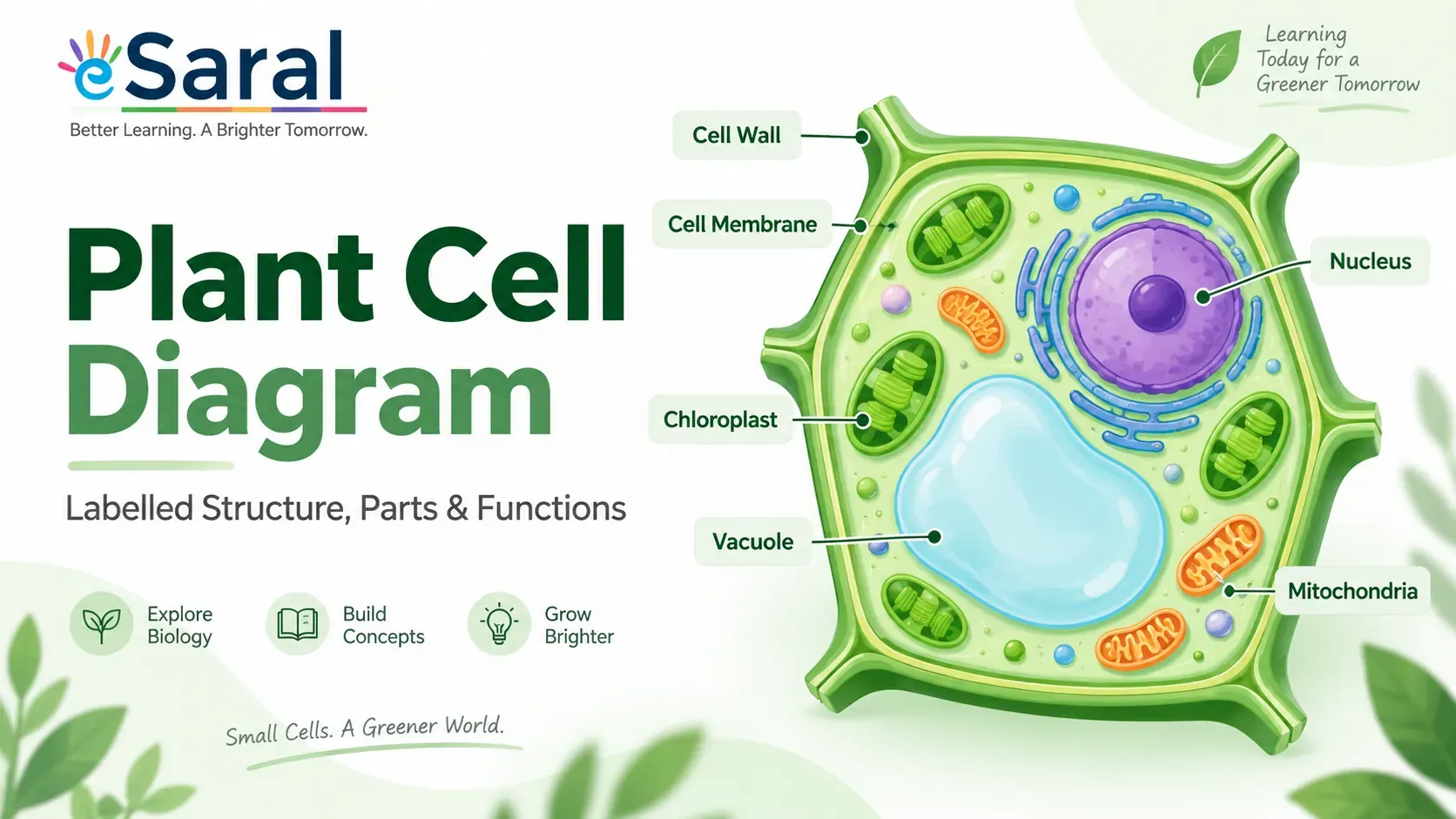
Plant Cell Diagram: Labelled Structure, Parts and Functions
Simple, labelled plant cell diagram with parts and functions. Covers plant cell structure for Class 6, 7, 8, 9, 10 and 11 students, CBSE-aligned.

Saransh Gupta Sir's Visit to IIT Patna: Hostel Life, Placements & Lessons for JEE Aspirants
Inside Saransh Gupta Sir's IIT Patna visit — hostel life, the library, placements, internships, and real advice for JEE aspirants from students living the IIT dream.
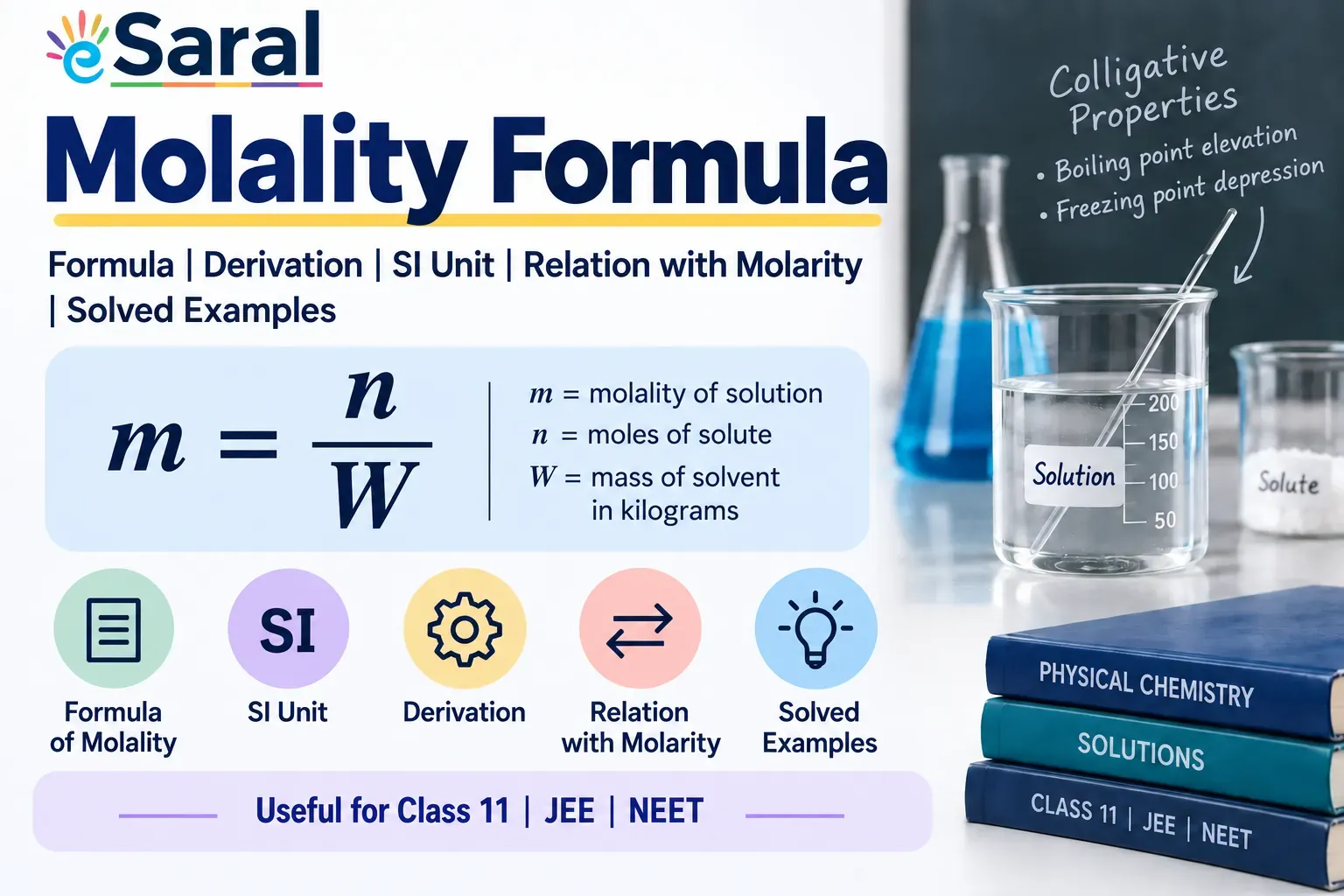
Molality Formula: Formula for Molality, Derivation & Solved Examples
Molality formula is $m = \dfrac{n}{W}$. Learn the formula of molality, its SI unit, derivation, relation with molarity, and solved examples for Class 11, JEE and NEET.
BITSAT Previous Year Question Paper PDF
Download BITSAT previous year question papers PDF. Get year-wise BITSAT PYQs, memory-based papers, exam pattern, and preparation tips to improve your BITSAT preparation.

Teachers’ Day 2026 at eSaral Gurukul: Celebrating the Bond Between Students, Teachers & Mentors
See how Teachers’ Day 2026 was celebrated at eSaral Gurukul, reflecting the bond among students, teachers, and mentors, and the role of guidance beyond academics.
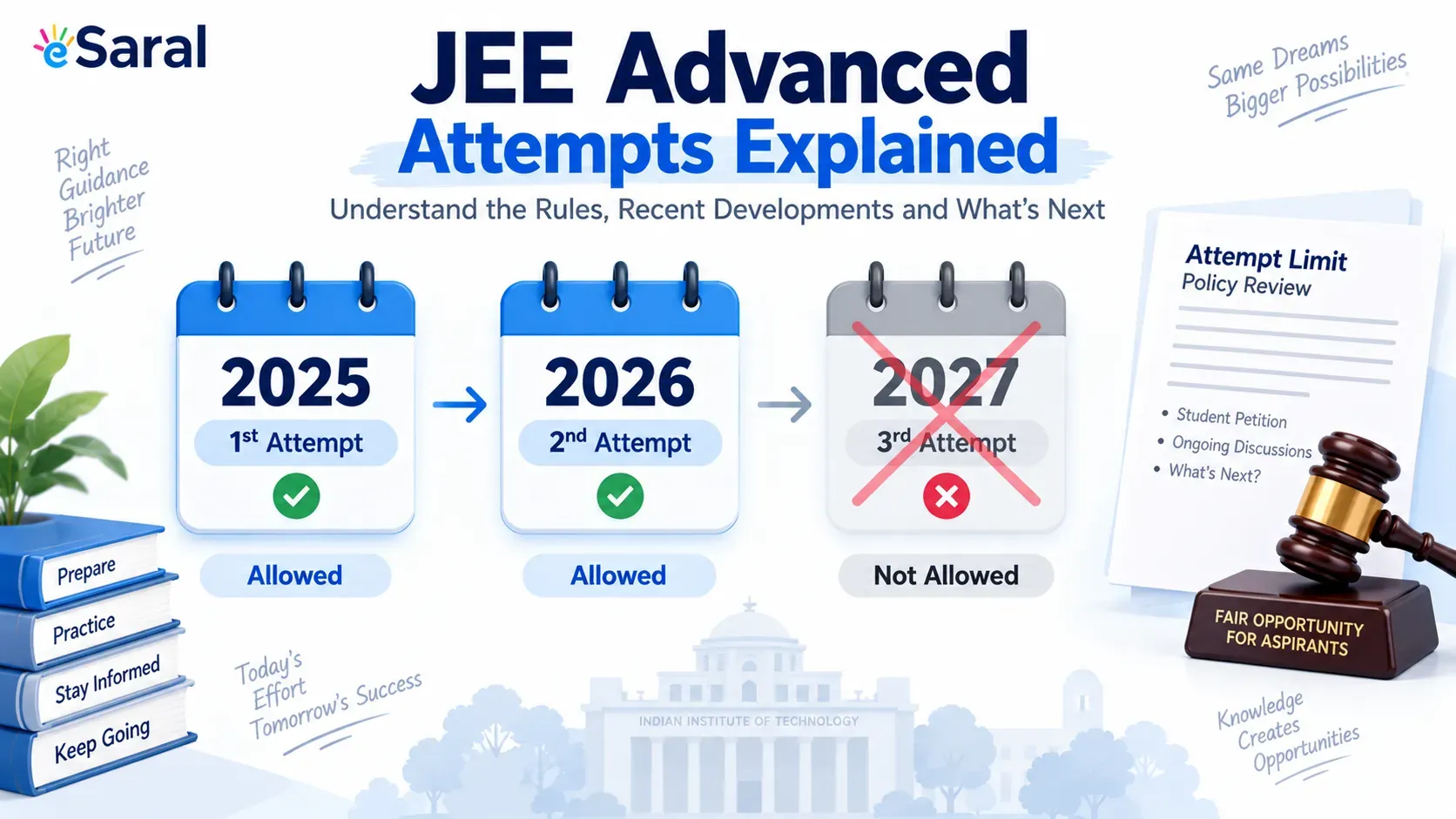
JEE Advanced Attempts: Can You Give It a Third Time? Rules Explained
JEE Advanced attempts: current rule is 2 consecutive years only: full eligibility criteria, the 2025 third-attempt controversy, and the latest 2026 petition news.

Best JEE Preparation App
Best JEE preparation app for Main & Advanced: AI mock tests, live doubt-solving, thousands of practice questions. JEE preparation app for droppers & Class 11-12.
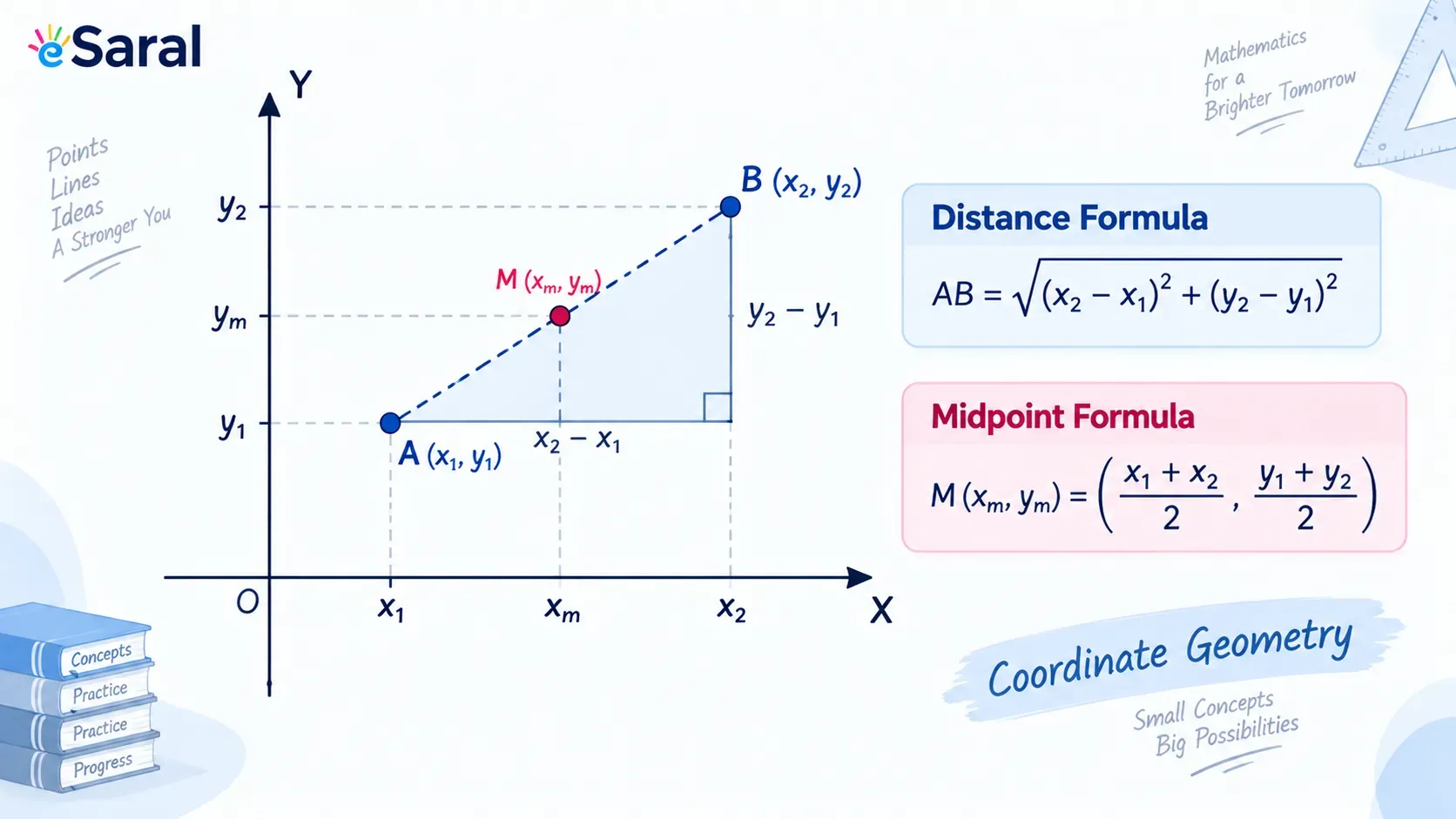
Coordinate Geometry Class 10: Formulas, Notes & Solved Examples
Coordinate geometry class 10: complete CBSE formulas — distance, section, midpoint and area of triangle — with derivation, notes and solved examples.
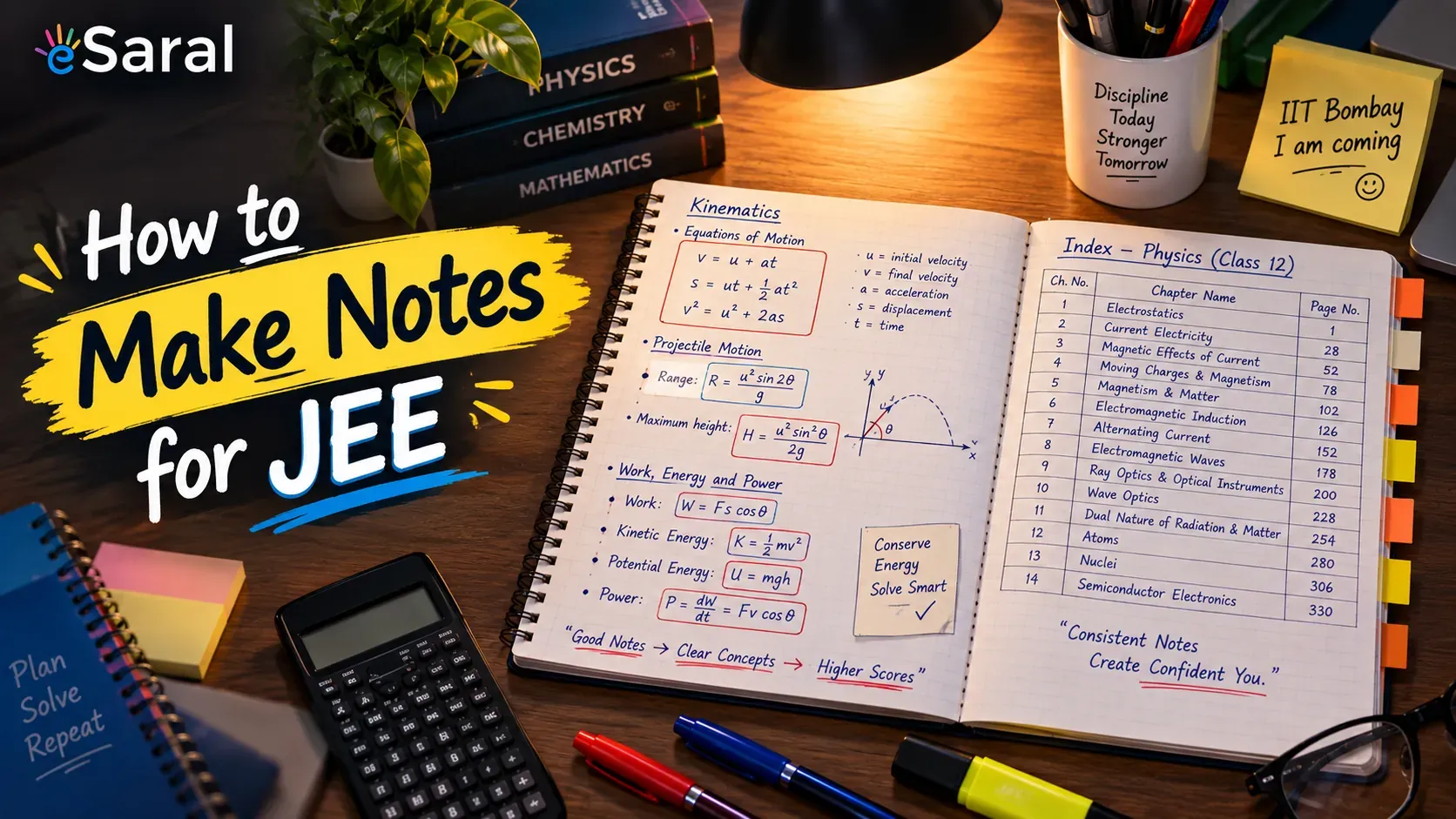
How to make Notes For JEE Smart Notes Strategy of an AIR 41
Learn how to make notes for JEE the way toppers do — indexing, shorthand, and smart short notes for JEE that cut revision time to just 5–7 days.
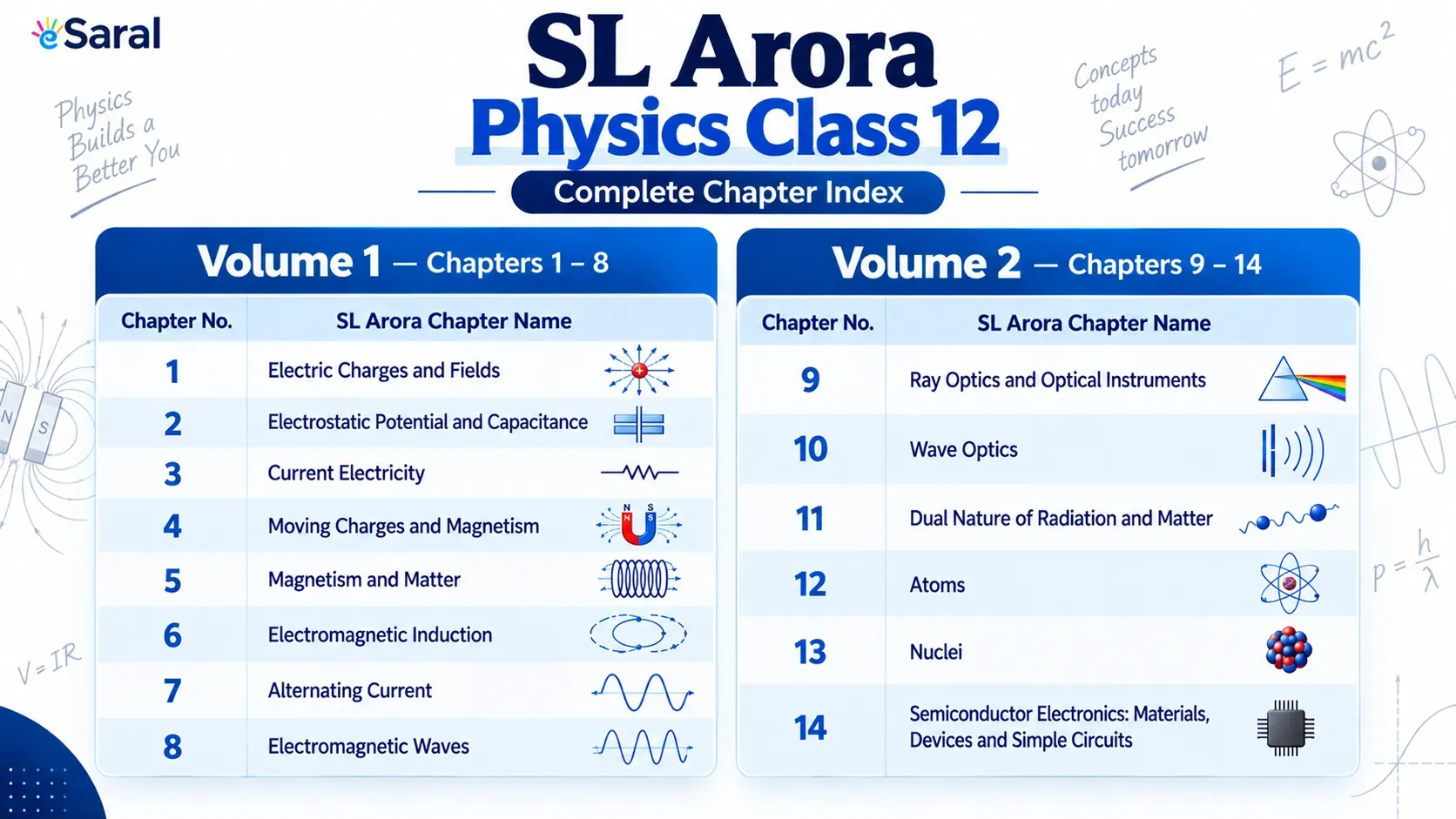
SL Arora Physics Class 12 Index – Chapter List for Volume 1 & 2
SL Arora Physics Class 12 index — complete chapter list for Volume 1 & 2, mapped to NCERT solutions for board, JEE Main, and NEET preparation.