
Difference Between Potentiometer and Voltmeter - Current Electricity || Class 12, JEE & NEET

eSaral Academic and Editorial Team
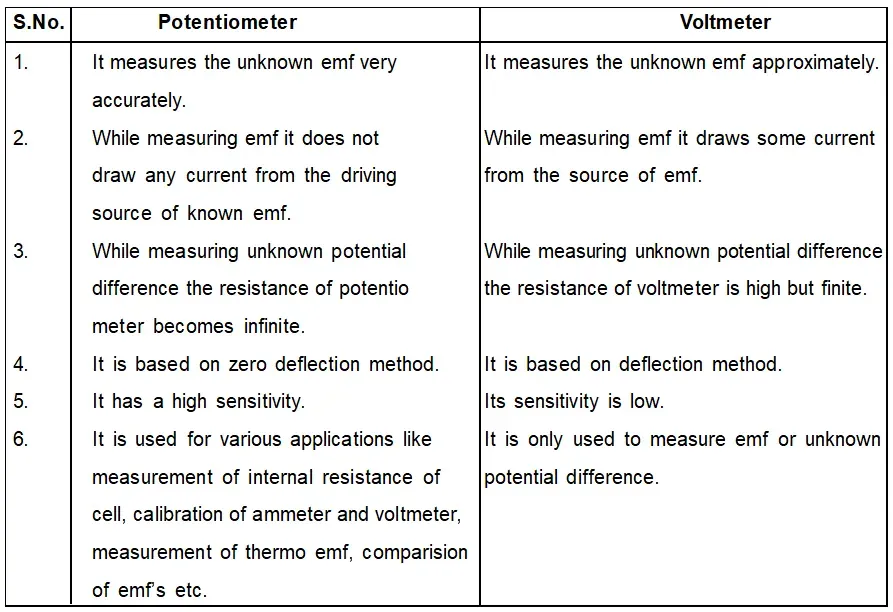
The Potentiometer and the Voltmeter both are the voltage measuring devices. The main Difference Between Potentiometer and Voltmeteris that the potentiometer measures the emf of the circuit whereas voltmeter measures the end terminal voltage of the circuit. The other differences between the Potentiometer and the voltmeter are explained below in the comparison chart.
Comparison Chart
Browse More Topics Related to Potentiometer:
- Potentiometer Working Principle
- Difference Between Potentiometer and Voltmeter
- Sensitivity of Potentiometer
- Uses of Potentiometer
- Advantages of Potentiometer
- Potentiometer Important Questions
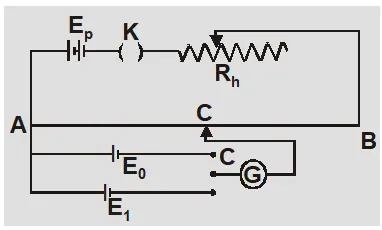
Standardization of Potentiometer
The process of determination of potential gradient on wire of potentiometer is known as standardisation of potentiometer. A standard cell is one whose emf remains constant. Cadmium cell with emf 1.0186 V at $20^{\circ}$C is used as a standard cell. In laboratory a Daniel cell with emf 1.08 V is usually used as a standard cell.
If $\ell_{0}$ is the balancing length for standard emf $E_{0}$ then potential gradient $x=\frac{E_{0}}{l_{0}}$

Key Differences:
The following are the key differences between Potentiometer and voltmeter.
- The Potentiometer is an instrument used for measuring the emf, whereas the voltmeter is a type of meter which measures the terminal voltage of the circuit.
- The Potentiometer accurately measures the potential difference because of zero internal resistance. Whereas, the voltmeter has a high internal resistance which causes the error in measurement. Thus the voltmeter approximately measures the voltage.
- The sensitivity of the Potentiometer is very high, i.e. it can measure small potential differences between the two points. The voltmeter has low sensitivity.
- The Potentiometer uses the deflection type instrument whereas the voltmeter uses the deflection type instrument.
- The Potentiometer has infinite internal resistance, whereas the Potentiometer has high measurable resistance.
Watch out the Video: Applications of Potentiometer & its Construction by Saransh Sir.
Conclusion
The Potentiometer and voltmeter both measures the emf in volts. The Potentiometer is used in a circuit where the accurate value of voltage is required. For approximate calculation, the voltmeter is used. Physics Revision Series by Saransh Sir (AIR 41 in IIT-JEE)
Also Read:
- Types and Effects of Electric Current
- Ohm’s Law and Resistance
- Combination of Resistances
- EMF and Internal Resistances of a Cell
- Cells Connected in Series, parallel and Mixed
- Kirchhoff’s Circuit Law
- Electric Currents in Conductors
- Wheatstone Bridge
- Post office Box
- Wheatstone Meter Bridge
- Moving Coil galvanometer
- Ammeter and Voltmeter
Team eSaral
eSaral Academic and Editorial Team
Team eSaral is the collective author profile for educational content created by eSaral’s teachers and academic contributors. The team draws on expertise from IIT graduates, doctors, experienced educators and subject specialists to develop resources for JEE, NEET and school students. Our articles aim to explain concepts clearly and help students study with confidence.
Related Posts

Plant Cell Diagram: Labelled Structure, Parts and Functions
Simple, labelled plant cell diagram with parts and functions. Covers plant cell structure for Class 6, 7, 8, 9, 10 and 11 students, CBSE-aligned.

Saransh Gupta Sir's Visit to IIT Patna: Hostel Life, Placements & Lessons for JEE Aspirants
Inside Saransh Gupta Sir's IIT Patna visit — hostel life, the library, placements, internships, and real advice for JEE aspirants from students living the IIT dream.
Molality Formula: Formula for Molality, Derivation & Solved Examples
Molality formula is $m = \dfrac{n}{W}$. Learn the formula of molality, its SI unit, derivation, relation with molarity, and solved examples for Class 11, JEE and NEET.
BITSAT Previous Year Question Paper PDF
Download BITSAT previous year question papers PDF. Get year-wise BITSAT PYQs, memory-based papers, exam pattern, and preparation tips to improve your BITSAT preparation.

Teachers’ Day 2026 at eSaral Gurukul: Celebrating the Bond Between Students, Teachers & Mentors
See how Teachers’ Day 2026 was celebrated at eSaral Gurukul, reflecting the bond among students, teachers, and mentors, and the role of guidance beyond academics.
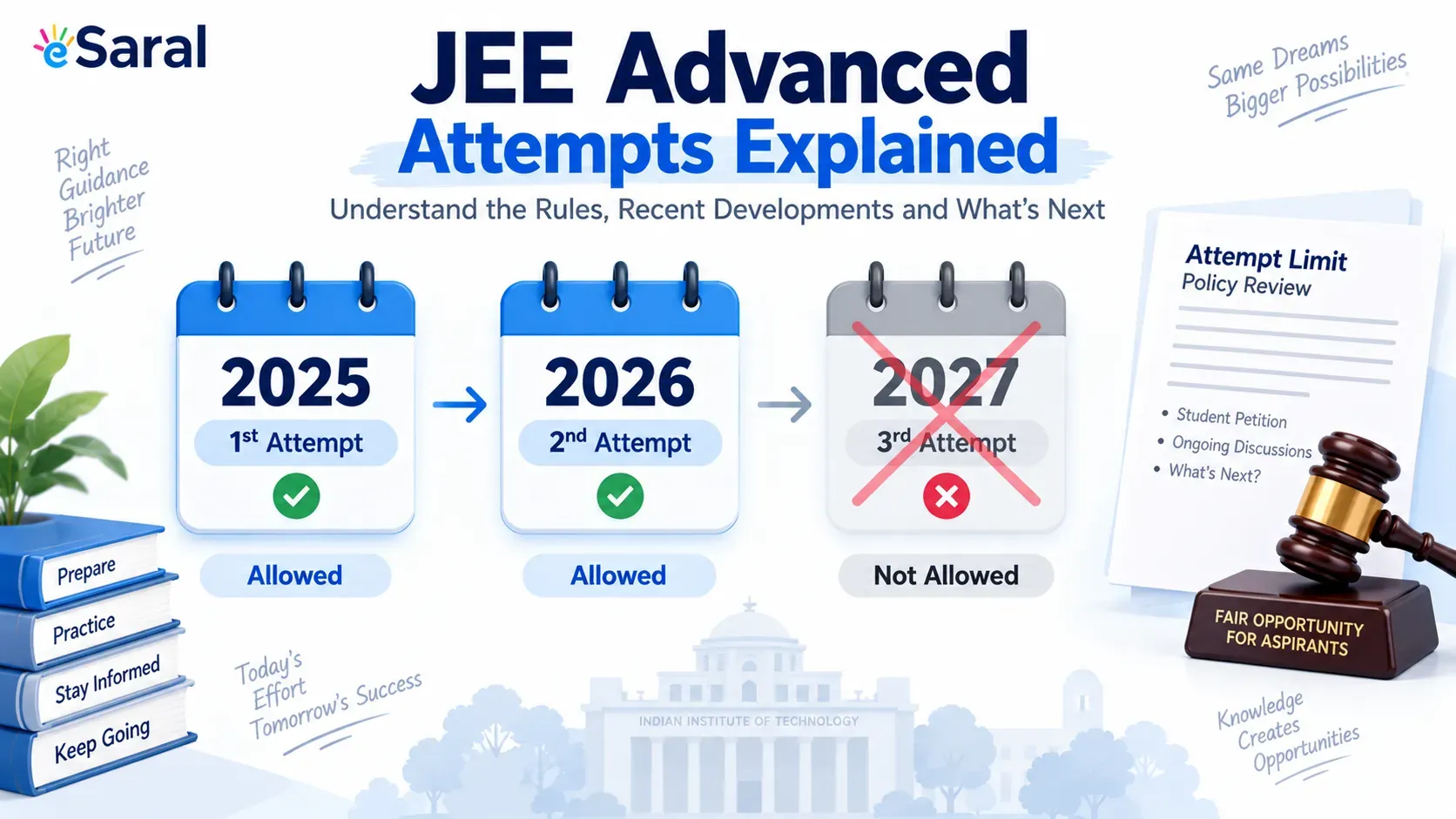
JEE Advanced Attempts: Can You Give It a Third Time? Rules Explained
JEE Advanced attempts: current rule is 2 consecutive years only: full eligibility criteria, the 2025 third-attempt controversy, and the latest 2026 petition news.

Best JEE Preparation App
Best JEE preparation app for Main & Advanced: AI mock tests, live doubt-solving, thousands of practice questions. JEE preparation app for droppers & Class 11-12.
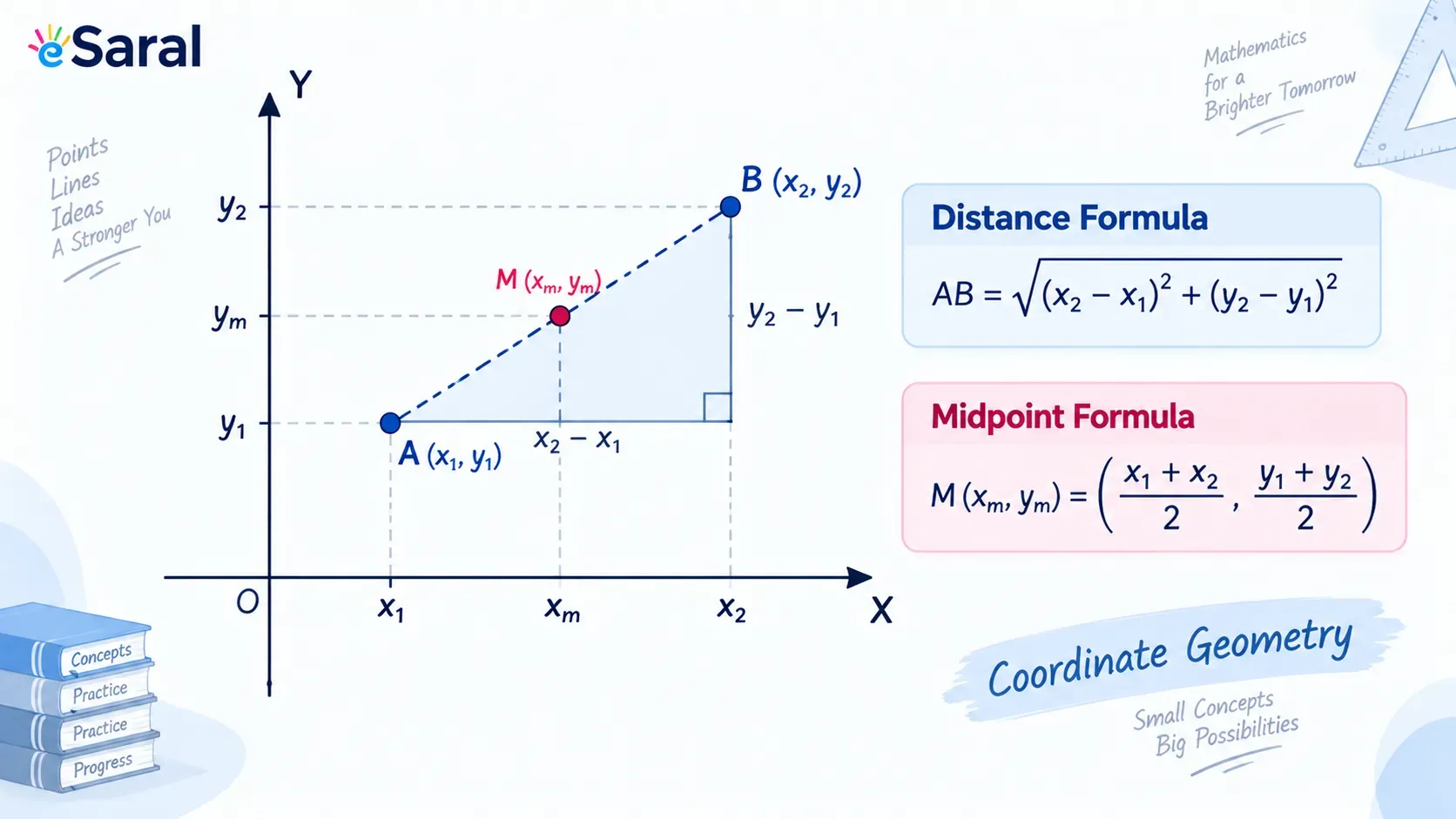
Coordinate Geometry Class 10: Formulas, Notes & Solved Examples
Coordinate geometry class 10: complete CBSE formulas — distance, section, midpoint and area of triangle — with derivation, notes and solved examples.
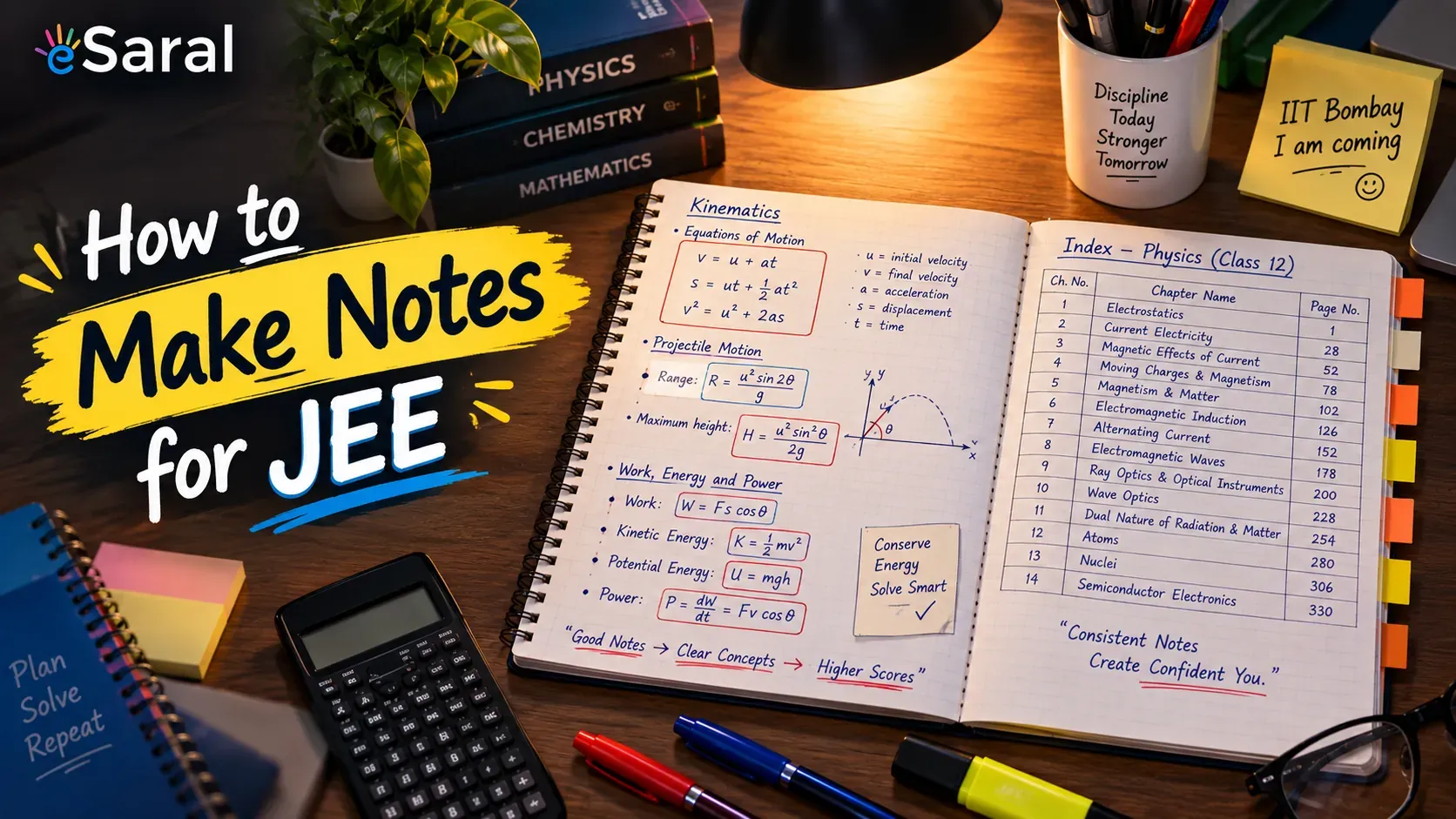
How to make Notes For JEE Smart Notes Strategy of an AIR 41
Learn how to make notes for JEE the way toppers do — indexing, shorthand, and smart short notes for JEE that cut revision time to just 5–7 days.
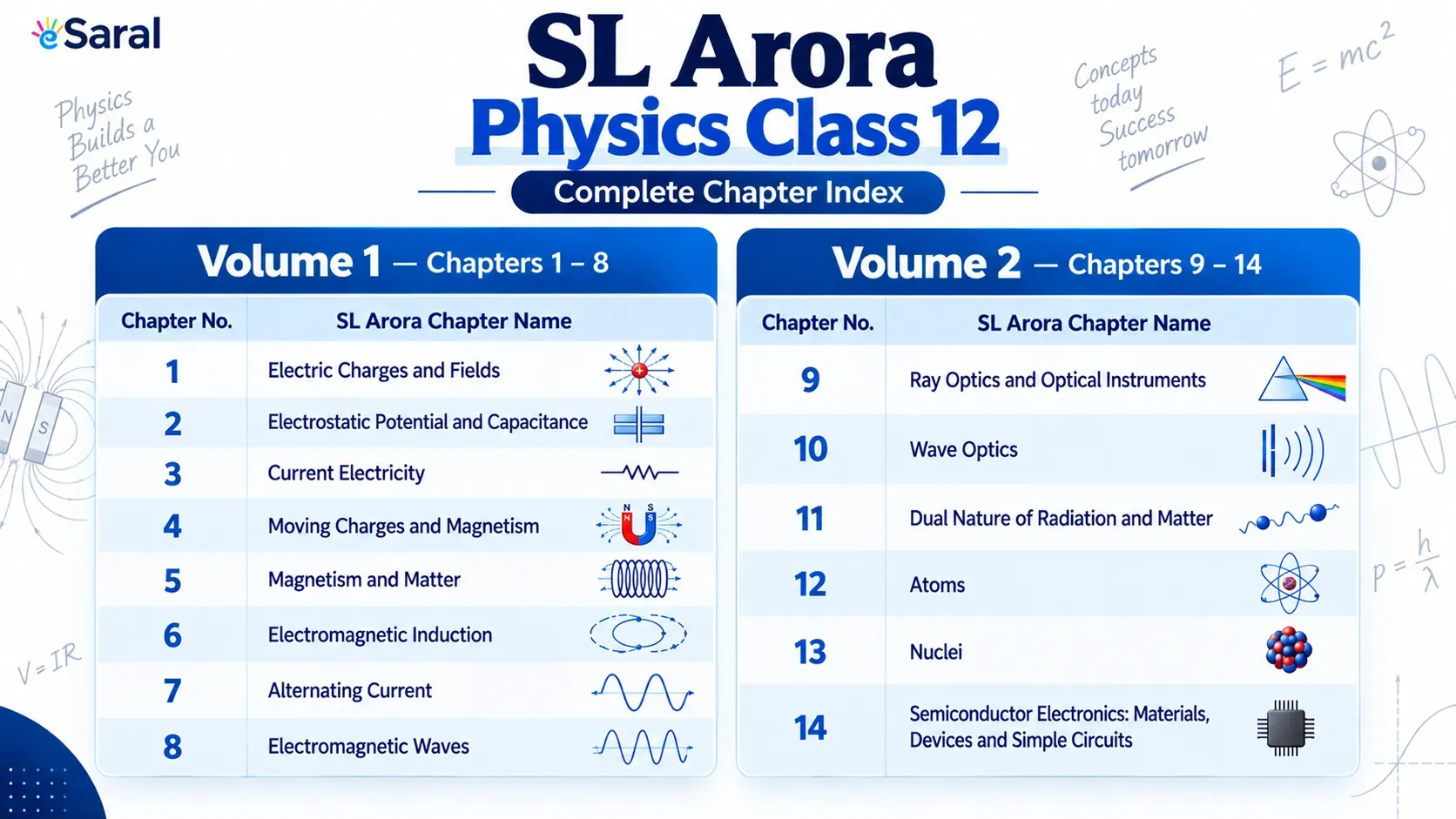
SL Arora Physics Class 12 Index – Chapter List for Volume 1 & 2
SL Arora Physics Class 12 index — complete chapter list for Volume 1 & 2, mapped to NCERT solutions for board, JEE Main, and NEET preparation.