
Elasticity (Physics) - NEET Previous Year Questions with Solutions

eSaral Academic and Editorial Team
Summary
Elasticity is a key NEET Physics topic under Mechanical Properties of Solids that explains how materials regain their original shape after deformation, focusing on stress, strain, elastic moduli, and their practical applications.
eSaral › NEET › Elasticity (Physics)

What Is Elasticity and Why Does NEET Ask It Every Year?
Elasticity is the property of a material that allows it to regain its original shape and size after the deforming force is removed. In the NEET Physics syllabus, this topic falls under Mechanical Properties of Solids (Class 11, Chapter 9) — one of the most predictable scoring chapters in the entire paper.
NTA (National Testing Agency) has consistently placed 1 to 2 questions from this chapter in almost every NEET paper since 2013. Unlike chapters such as Rotational Motion or Thermodynamics, elasticity questions are typically formula-based and logic-driven, which means a student who has practised enough PYQs can solve them in under 60 seconds.
The chapter tests your understanding of:
- How materials deform under applied forces
- The relationship between stress, strain, and the elastic moduli
- Real-world applications like wire stretching, rubber bands, and structural materials
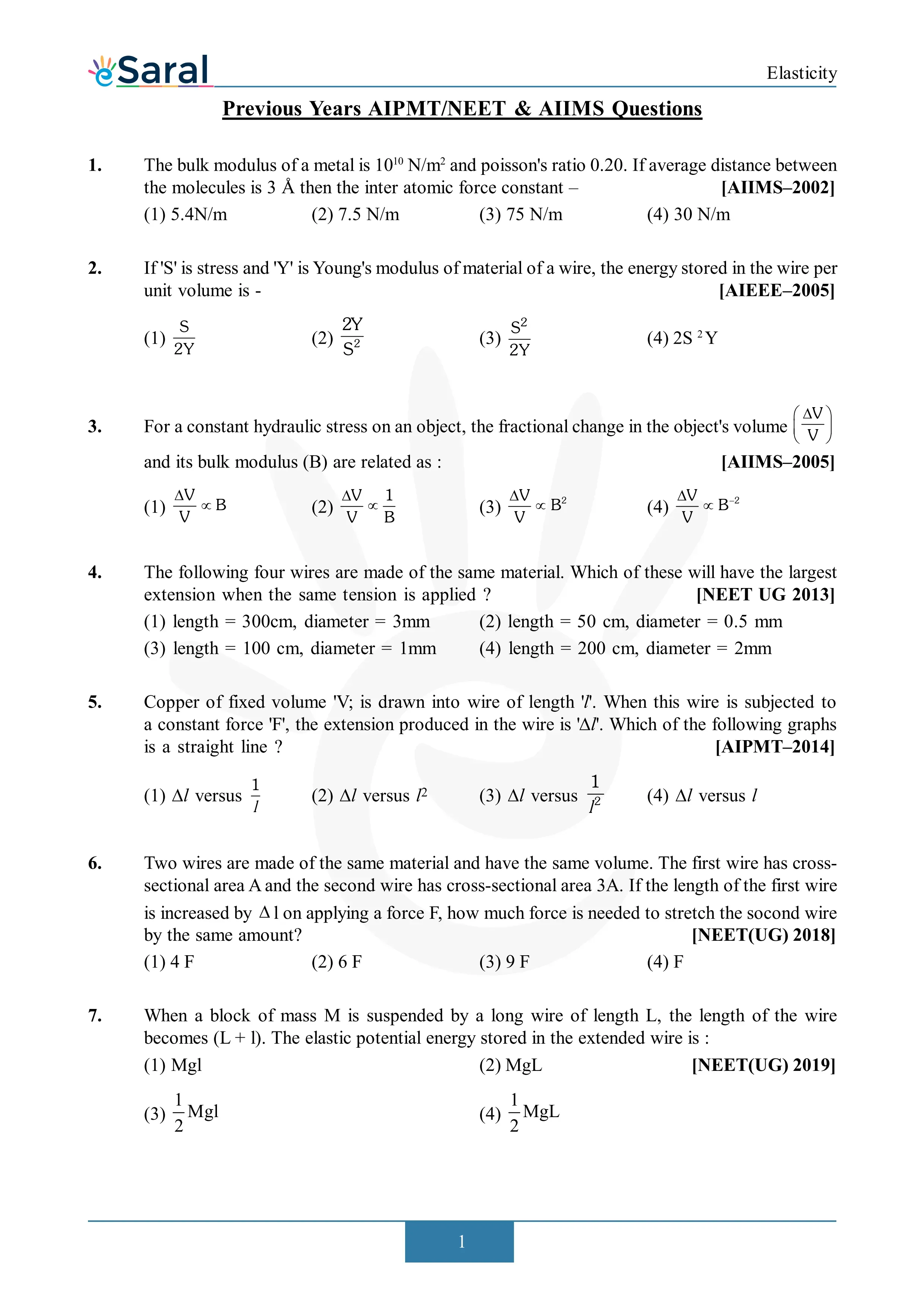
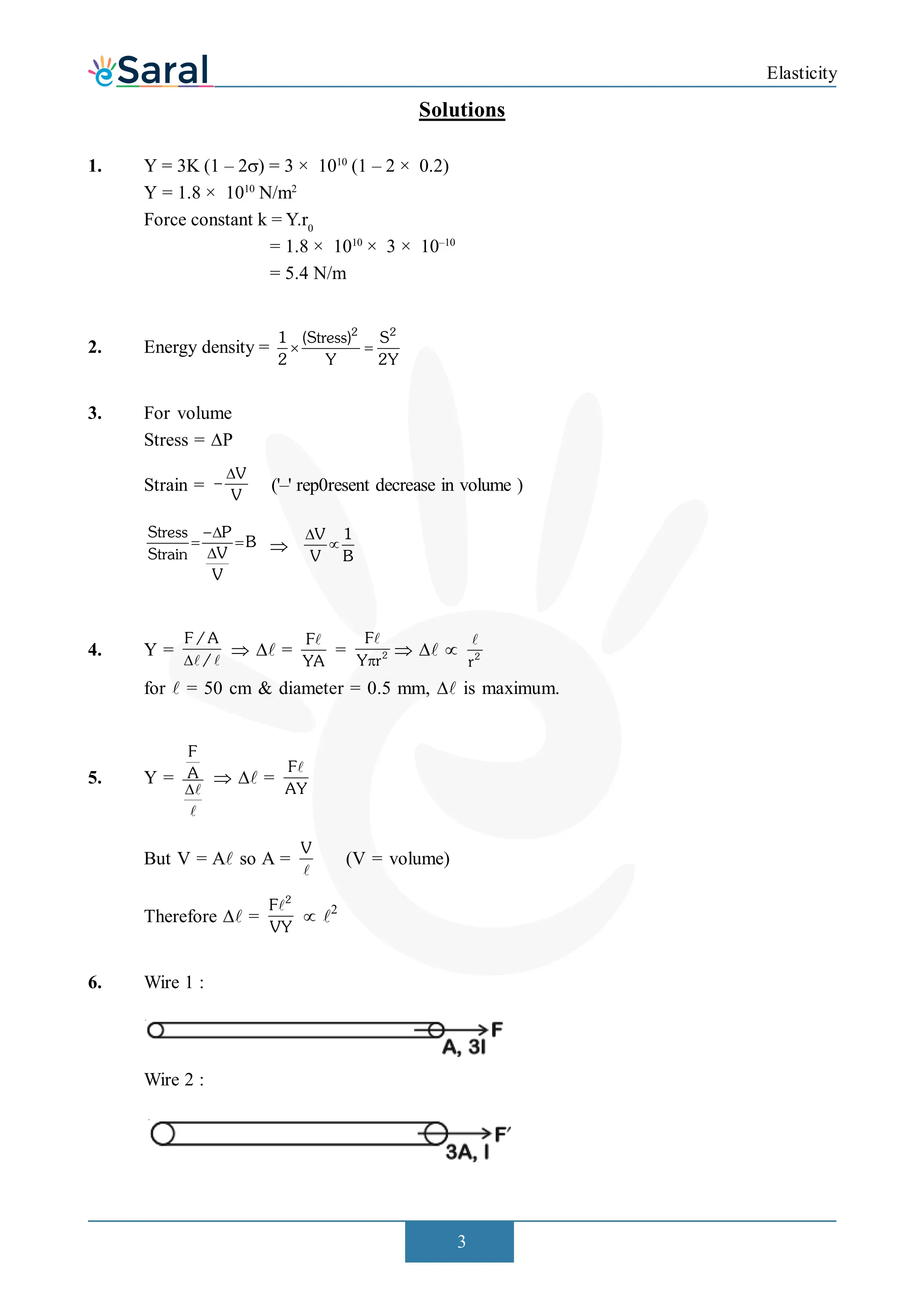
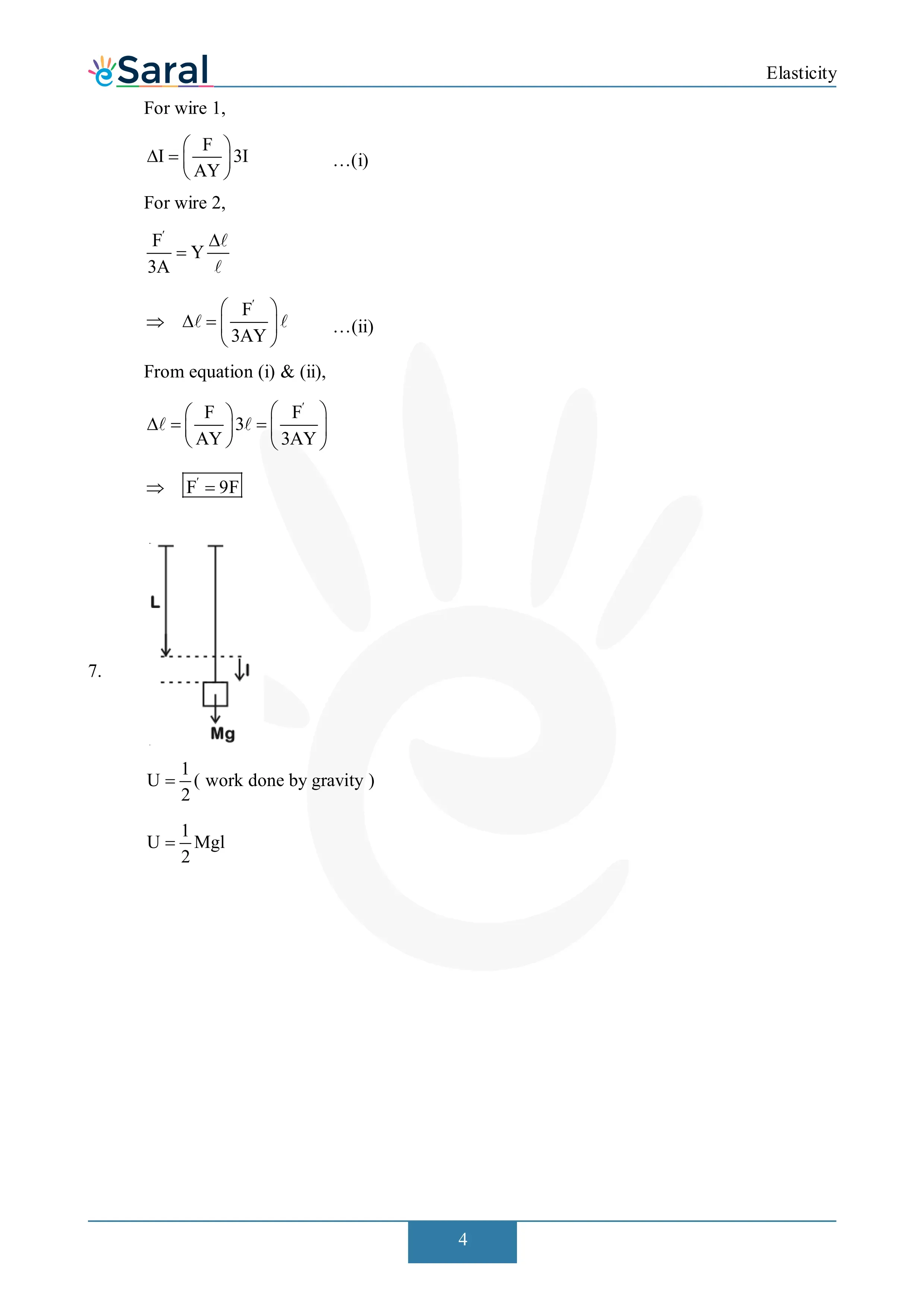
NEET PYQ with Solutions

Frequently Asked Questions
How many questions come from Elasticity in NEET every year?
NTA typically asks 1 to 2 questions from the Elasticity (Mechanical Properties of Solids) chapter in NEET. Each question carries 4 marks for a correct answer and results in a −1 deduction for a wrong answer. Given the formula-driven nature of this chapter, these are among the most reliably scorable questions in Physics.
Is Elasticity important for NEET, or can I skip it?
Elasticity should not be skipped. It consistently appears in NEET and requires relatively low study time compared to the marks it offers. The chapter has a fixed, predictable set of formulas and concepts. Students who prepare this chapter well almost always score full marks on it — making it a high-return topic in your NEET preparation strategy.
What is the difference between Young's modulus, Bulk modulus, and Shear modulus?
Young's modulus measures resistance to longitudinal (stretching/compressing) stress. Bulk modulus measures resistance to uniform pressure applied from all directions (volumetric change). Shear modulus (rigidity modulus) measures resistance to shape change without volume change. NEET tests all three, but Young's modulus appears most frequently in numerical problems.
Which is more elastic — steel or rubber? Why does NEET ask this?
Steel is more elastic than rubber. Elasticity in physics means the ability to return to original shape — not the ability to stretch far. Steel returns to its exact original shape under small deformations, giving it a very high Young's modulus. Rubber stretches a lot but does not follow Hooke's Law precisely. NEET asks this as a conceptual trap question.
Does Poisson's ratio have a unit? What is its value range?
Poisson's ratio has no unit — it is a dimensionless quantity. Its theoretical range is −1 to 0.5. For most common engineering materials (steel, copper, aluminium), Poisson's ratio lies between 0.25 and 0.35. A value of 0.5 indicates an incompressible material. NEET occasionally asks about its range and dimensions.
Team eSaral
eSaral Academic and Editorial Team
Team eSaral is the collective author profile for educational content created by eSaral’s teachers and academic contributors. The team draws on expertise from IIT graduates, doctors, experienced educators and subject specialists to develop resources for JEE, NEET and school students. Our articles aim to explain concepts clearly and help students study with confidence.
Related Posts

Plant Cell Diagram: Labelled Structure, Parts and Functions
Simple, labelled plant cell diagram with parts and functions. Covers plant cell structure for Class 6, 7, 8, 9, 10 and 11 students, CBSE-aligned.

Saransh Gupta Sir's Visit to IIT Patna: Hostel Life, Placements & Lessons for JEE Aspirants
Inside Saransh Gupta Sir's IIT Patna visit — hostel life, the library, placements, internships, and real advice for JEE aspirants from students living the IIT dream.
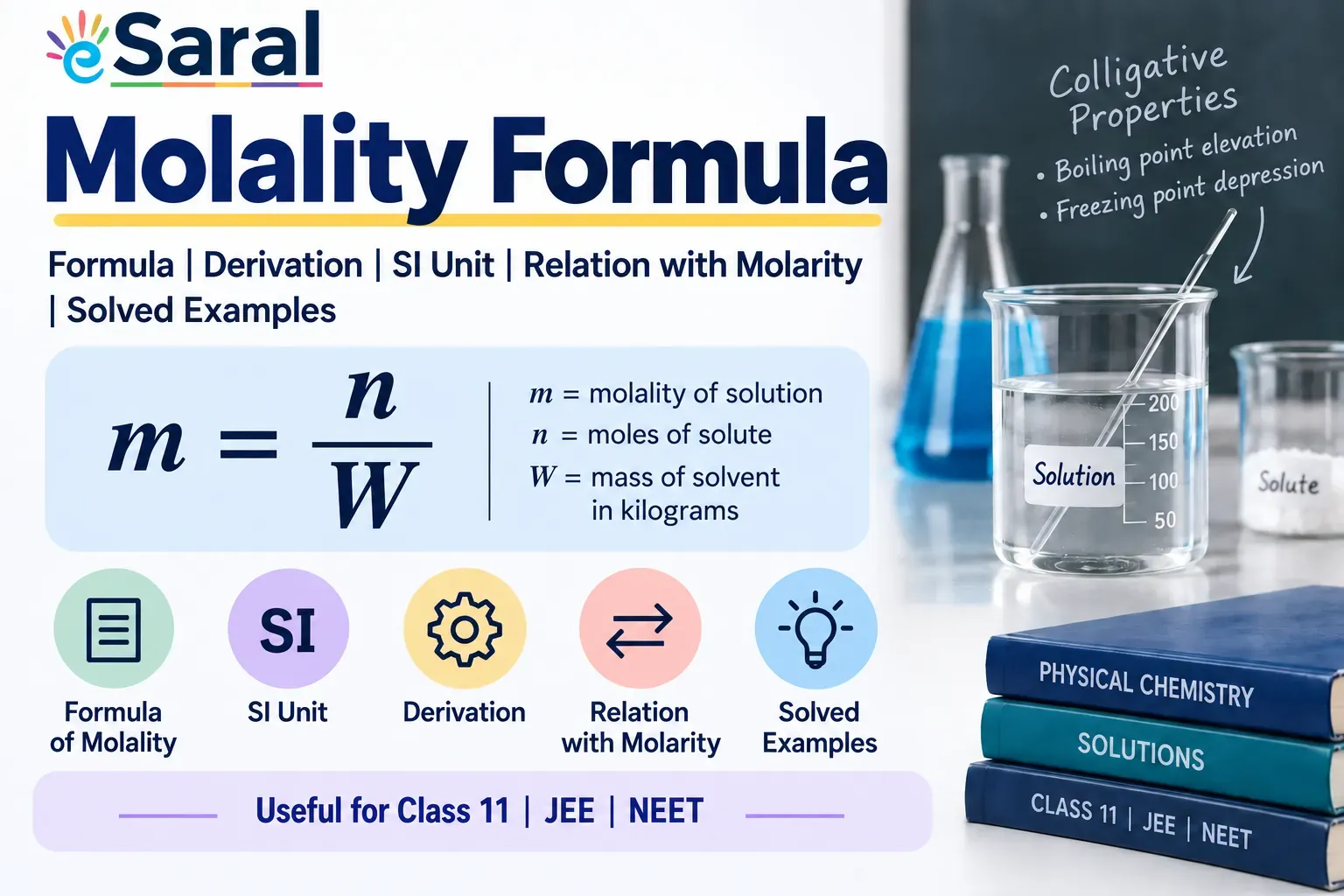
Molality Formula: Formula for Molality, Derivation & Solved Examples
Molality formula is $m = \dfrac{n}{W}$. Learn the formula of molality, its SI unit, derivation, relation with molarity, and solved examples for Class 11, JEE and NEET.
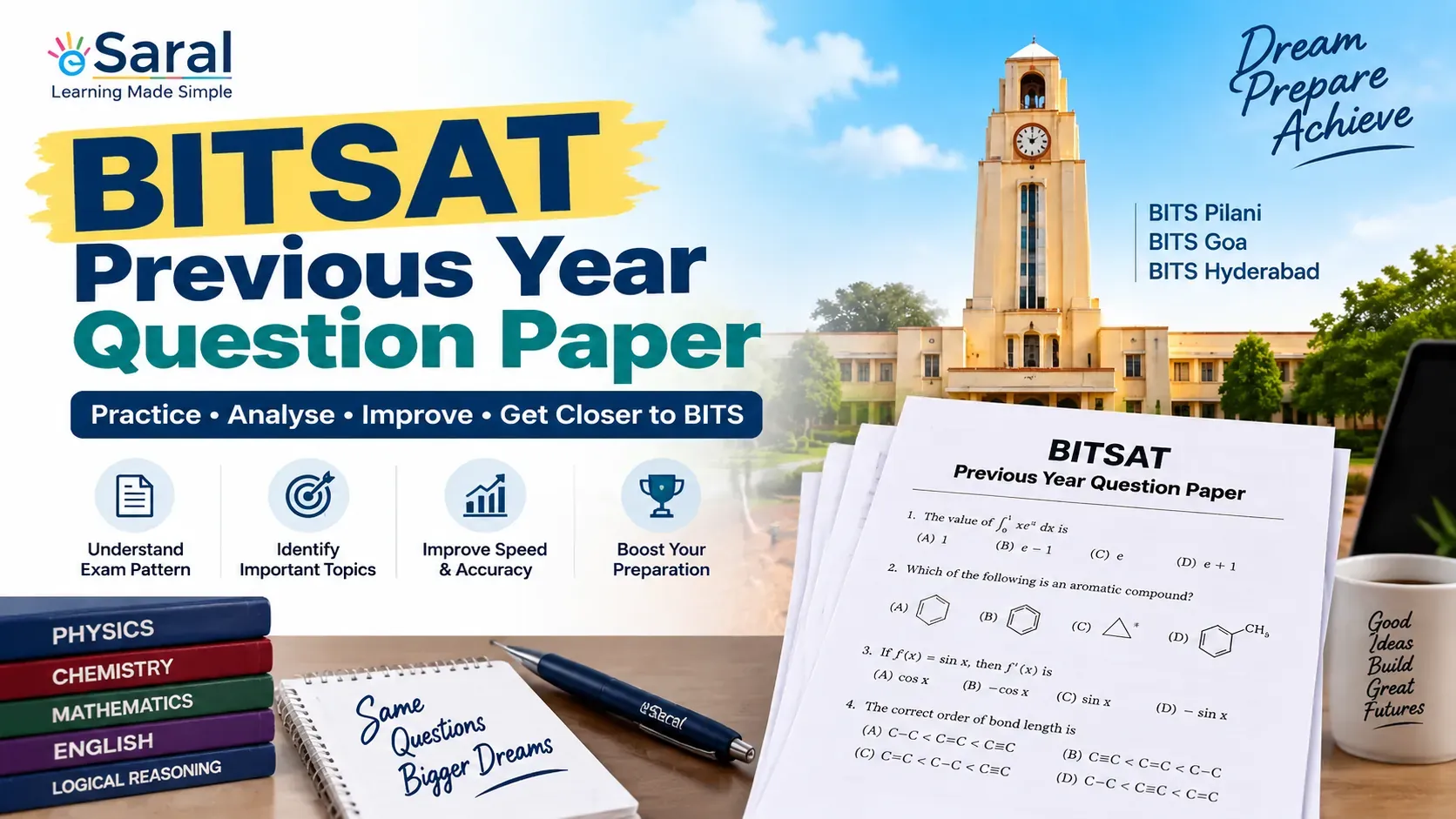
BITSAT Previous Year Question Paper PDF
Download BITSAT previous year question papers PDF. Get year-wise BITSAT PYQs, memory-based papers, exam pattern, and preparation tips to improve your BITSAT preparation.

Teachers’ Day 2026 at eSaral Gurukul: Celebrating the Bond Between Students, Teachers & Mentors
See how Teachers’ Day 2026 was celebrated at eSaral Gurukul, reflecting the bond among students, teachers, and mentors, and the role of guidance beyond academics.

JEE Advanced Attempts: Can You Give It a Third Time? Rules Explained
JEE Advanced attempts: current rule is 2 consecutive years only: full eligibility criteria, the 2025 third-attempt controversy, and the latest 2026 petition news.

Best JEE Preparation App
Best JEE preparation app for Main & Advanced: AI mock tests, live doubt-solving, thousands of practice questions. JEE preparation app for droppers & Class 11-12.
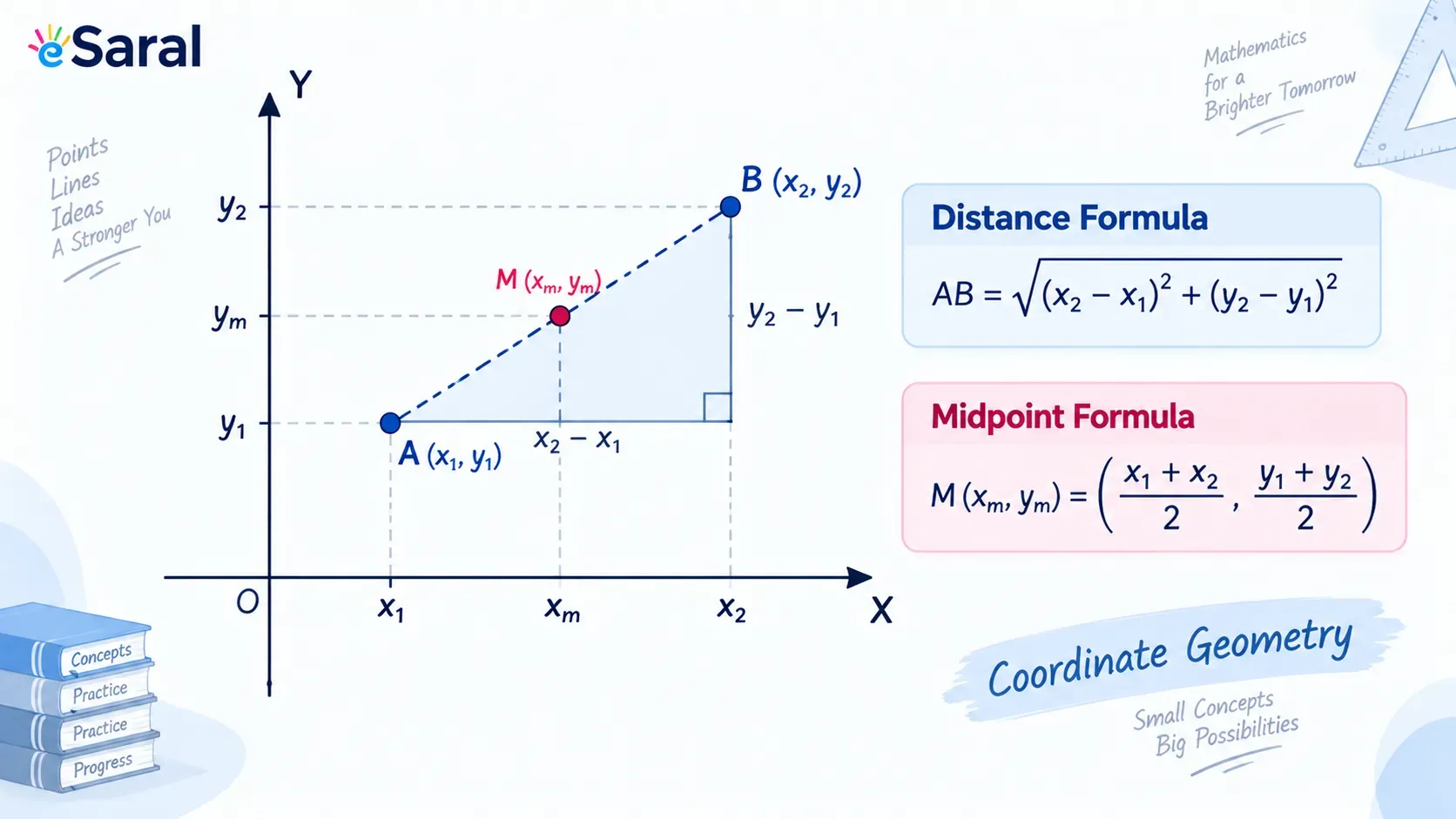
Coordinate Geometry Class 10: Formulas, Notes & Solved Examples
Coordinate geometry class 10: complete CBSE formulas — distance, section, midpoint and area of triangle — with derivation, notes and solved examples.

How to make Notes For JEE Smart Notes Strategy of an AIR 41
Learn how to make notes for JEE the way toppers do — indexing, shorthand, and smart short notes for JEE that cut revision time to just 5–7 days.
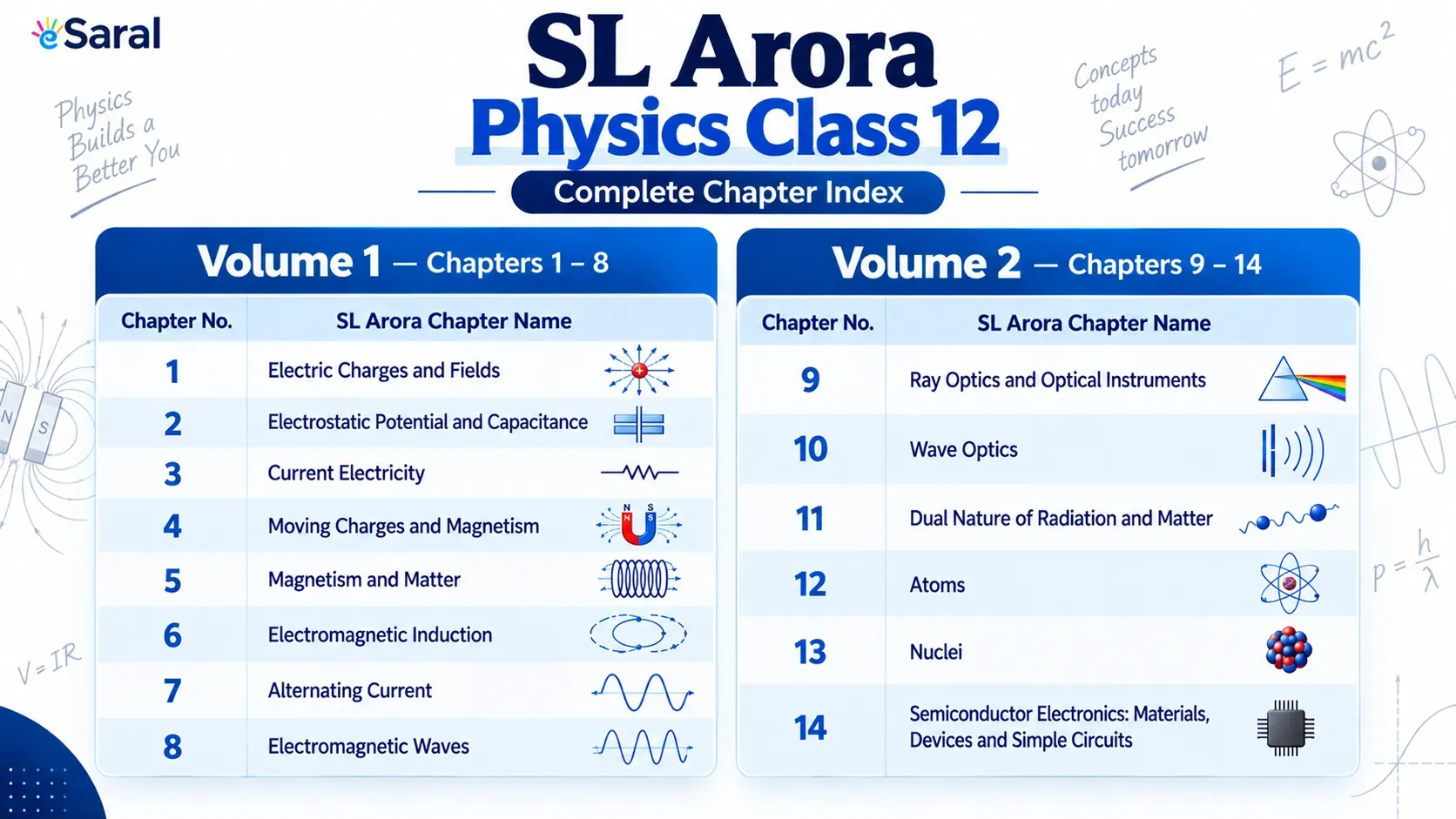
SL Arora Physics Class 12 Index – Chapter List for Volume 1 & 2
SL Arora Physics Class 12 index — complete chapter list for Volume 1 & 2, mapped to NCERT solutions for board, JEE Main, and NEET preparation.