
Electric Currents in Conductors | Mobility

eSaral Academic and Editorial Team
We now know an electric charge experiences a force when placed in electric field, if it starts to move it constitutes Electric Current. Here we are going to study the Electric Currents in Conductors when there is no electric field and when the conductor is placed in electric field. We will also learn about Mobility of charge carriers in the end. Contents:
Introduction to Conductors & Insulators
In an atom or a molecule, negatively charged electrons are strongly held by positively charged nucleus therefore the charges are bound to each other and are not free to move. But free charge particles do exist in upper strata of atmosphere called the ionosphere.
Matter is made up of molecules like a small water droplet contains approx 1019 molecules.
These molecules are closely packed such that the electrons are not attached to only one nuclei. In some materials, these electrons do not move even when electric field is applied, such materials are called insulators.
While in some materials (generally metals), some electrons are allowed free movement inside that material. These are known as conductors, they form electric currents in them when electric field is applied.
Although an electrical insulator is ordinarily thought of as a nonconducting material, it is in fact better described as a poor conductor or a substance of high resistance to the flow of electric current. Different insulating and conducting materials are compared with each other in this regard by means of a material constant known as resistivity. Electrical insulators are used to hold conductors in position, separating them from one another and from surrounding structures. They form a barrier between energized parts of an electric circuit and confine the flow of current to wires or other conducting paths as desired. [source]
Here we will be studying in details about Electric currents in conductors.
A few important points about conductors:
- Conductors are substances through which electric charges can flow easily.
- They are characterized by presence of a large number of free electrons $({10^{29}}$ electrons per m3)
- The number density of free electrons in a conductor is same throughout the conductor. This is because free electrons experience repulsive force between them and conductor allows movement of free electrons. Thus, free electrons are evenly scattered throughout the volume of conductor.
- These free electrons transport electric charge so are called as Conduction electrons.
Electric Current in Conductors with or without Electric field
a) Behavior of Conductor in absence of applied Potential Difference
- The free electrons present in a conductor gain energy surrounding and move randomly in a conductor.
[caption id="attachment_4555" align="aligncenter" width="251"]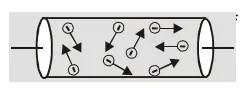 Random movement of free electrons in a conductor[/caption]
 - The speed gained by virtue of temperature is called as thermal speed of an electron.${1 \over 2}{\rm{mv}}_{{\rm{ms}}}^2 = {3 \over 2}{\rm{kT}}\quad $
So, Thermal speed $\quad {{\rm{v}}_{{\rm{ms}}}} = \sqrt {{{3{\rm{kT}}} \over {\rm{m}}}} $ where ${\rm{m}}$ is mass of electron.
At room temperature $T = 300{\rm{K}}\quad {{\rm{v}}_{{\rm{rms}}}} = {10^5}{\rm{m}}/{\rm{sec}}$
- The average distance traveled by a free electron between two consecutive collisions is called as Mean Free Path $\lambda .\left(\lambda-10 \mathrm{A}^{\circ}\right)$
Mean free path $\lambda = {{{\rm{ total distance travelled }}} \over {{\rm{ number of collisions }}}}$
[caption id="attachment_4556" align="aligncenter" width="226"]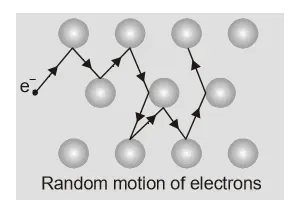 Collision of electrons due to random movement[/caption]
- The time taken by an electron between two successive collisions is called as Relaxation time.
$\tau .\left( {\tau - {{10}^{ - 14}}{\rm{s}}} \right)$Relaxation time $\tau = {{{\rm{ total time taken }}} \over {{\rm{ number of collisions }}}}$ - The thermal speed can be written as ${v_T} = {\lambda \over \tau }$
- In absence of applied potential difference electrons have random motion. The average displacement and average velocity is zero. There is no flow of current due to thermal motion of free electrons in a conductor.
b) Behavior of Conductor in presence of applied Potential Difference
- When two ends of conductors are joined to a battery then one end is at higher potential and another at lower potential. This produces an electric field inside the conductor from point of higher to lower potential i.e. $E = {v \over L}$
[caption id="attachment_4557" align="aligncenter" width="290"]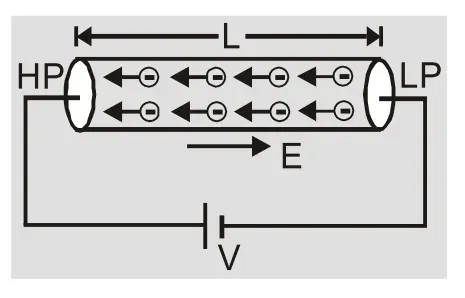 Conductors when battery is connected[/caption]
- The field exerts an electric force on free electrons causing acceleration of each electron.$\overrightarrow {\rm{F}} = {\rm{m}}\overrightarrow {\rm{a}} = - {\rm{e}}\overrightarrow {\rm{E}} $ So acceleration $\vec a = {{ - e\vec E} \over m}$
- The average velocity with which the free electrons are drifted towards the positive end of a conductor under the influence of an external electric field is called drift velocity vd.Using $\quad \vec v = \vec u + \vec a{\rm{t}}\quad $ we have ${{\vec{v}}_{d}}=\frac{-e\vec{E}}{m}\tau $$\left( {{v_d}~{{10}^{ - 4}}m/sec} \right)$
- The direction of drift velocity for electrons in a metal is opposite to that of applied field E.
- Relation between current and drift velocity
Let 'n' be the number density of free electrons and A be the area of cross-section of the conductor.Number of free electrons in a conductor of length L = nAL
Total charge on these free electrons $\Delta {\rm{q}} = $ neAl
Current ${\rm{I}} = {{\Delta {\rm{q}}} \over {\Delta {\rm{t}}}} = {\rm{neAL}}{{{{\rm{v}}_{\rm{d}}}} \over {\rm{L}}} = {\rm{neA}}{{\rm{v}}_{\rm{d}}}$
or $\quad {\rm{I}} = {\rm{neA}}{{\rm{v}}_{\rm{d}}}$
The current flowing through a conductor is directly proportional to the drift velocity $\left( {{\rm{I}} \propto {{\rm{v}}_{\rm{d}}}} \right)$ - The current density ${\rm{J}} = {{\rm{I}} \over {\rm{A}}} = {\rm{ne}}{{\rm{v}}_{\rm{d}}} = {\rm{ne}}\left( {{{{\rm{eE}}} \over {\rm{m}}}} \right)\tau = \left( {{{{\rm{n}}{{\rm{e}}^2}\tau } \over {\rm{m}}}} \right){\rm{E}}$So, $\quad J \propto E\quad $ or $\quad J = \sigma E$
where, $\sigma = {{{\rm{n}}{{\rm{e}}^2}\tau } \over {\rm{m}}}$ is specific conductivity of conductor which depends on temperature and nature of material.
$\vec J = \sigma \vec E$ is a microscopic form of ohm's law. - The drift velocity depends on the nature of metal through $\tau $, applied potential difference, length of the conductor.${v_d} = {{eE} \over m}\tau = {{eV} \over {mL}}\tau $
${{\rm{v}}_{\rm{d}}}$ is independent of radius or area of cross-section of a conductor. - The rise of temperature causes increase in ${{\rm{v}}_{{\rm{ms}}}}$ and hence a decrease in $\lambda $ and relaxation time $\tau $ causing a decrease in drift velocity.
Mobility
Conductivity arises from mobile charge carriers like electrons in metals, positively charged ions, and electrons in an ionized gas, positive and negative ions in an electrolyte. So there must be some difference in the movement of these different charge carriers. It is called Mobility. Mobility of a charge carrier is defined as drift velocity acquired per unit electric field. Mobility $\mu = {{{v_d}} \over E} = {{e\tau } \over m} = {e \over m}{{m\sigma } \over {n{e^2}}} = {\sigma \over {ne}}$
The unit is ${m^2}{V^{ - 1}}{s^{ - 1}}$ and dimensions are ${M^{ - 1}}{T^2}{A^1}$
The mobility depends on applied potential difference, length of conductor, number density of charge carriers, current in conductor, area of cross-section of conductor.
Mobility $\mu = {{{v_d}} \over E} = {{e\tau } \over m} = {e \over m}{{m\sigma } \over {n{e^2}}} = {\sigma \over {ne}}$
The unit is ${{\rm{m}}^2}{{\rm{V}}^{ - 1}}{{\rm{s}}^{ - 1}}$ and dimensions are ${{\rm{M}}^{ - 1}}{{\rm{T}}^2}{{\rm{A}}^1}$
The mobility depends on applied potential difference, length of conductor, number density of charge carriers, current in conductor, area of cross-section of conductor.
[esquestion]Though the drift velocity for electrons is small, an electric bulb lights up immediately as we turn the switch on. Why?
#sol#When switch is made on the electric field $\vec E$ responsible for setting up current propagates through wires at speed of light $3 \times {10^8}{\rm{m}}/{\rm{s}}$. So field is set up immediately in time ${\rm{L}}/{\rm{c}}$ causing electrons to drift and hence bulb lights up immediately. [/esquestion] Also Read:
- Types and Effects of Electric Current
- Ohm’s Law and Resistance
- Combination of Resistances
- EMF and Internal Resistances of a Cell
- Cells Connected in Series, parallel and Mixed
- Kirchhoff’s Circuit Law
- Electric Currents in Conductors
- Wheatstone Bridge
- Post office Box
- Wheatstone Meter Bridge
- Moving Coil galvanometer
- Ammeter and Voltmeter
- Potentiometer Working Principle
Team eSaral
eSaral Academic and Editorial Team
Team eSaral is the collective author profile for educational content created by eSaral’s teachers and academic contributors. The team draws on expertise from IIT graduates, doctors, experienced educators and subject specialists to develop resources for JEE, NEET and school students. Our articles aim to explain concepts clearly and help students study with confidence.
Related Posts

Plant Cell Diagram: Labelled Structure, Parts and Functions
Simple, labelled plant cell diagram with parts and functions. Covers plant cell structure for Class 6, 7, 8, 9, 10 and 11 students, CBSE-aligned.

Saransh Gupta Sir's Visit to IIT Patna: Hostel Life, Placements & Lessons for JEE Aspirants
Inside Saransh Gupta Sir's IIT Patna visit — hostel life, the library, placements, internships, and real advice for JEE aspirants from students living the IIT dream.
Molality Formula: Formula for Molality, Derivation & Solved Examples
Molality formula is $m = \dfrac{n}{W}$. Learn the formula of molality, its SI unit, derivation, relation with molarity, and solved examples for Class 11, JEE and NEET.

BITSAT Previous Year Question Paper PDF
Download BITSAT previous year question papers PDF. Get year-wise BITSAT PYQs, memory-based papers, exam pattern, and preparation tips to improve your BITSAT preparation.

Teachers’ Day 2026 at eSaral Gurukul: Celebrating the Bond Between Students, Teachers & Mentors
See how Teachers’ Day 2026 was celebrated at eSaral Gurukul, reflecting the bond among students, teachers, and mentors, and the role of guidance beyond academics.

JEE Advanced Attempts: Can You Give It a Third Time? Rules Explained
JEE Advanced attempts: current rule is 2 consecutive years only: full eligibility criteria, the 2025 third-attempt controversy, and the latest 2026 petition news.

Best JEE Preparation App
Best JEE preparation app for Main & Advanced: AI mock tests, live doubt-solving, thousands of practice questions. JEE preparation app for droppers & Class 11-12.
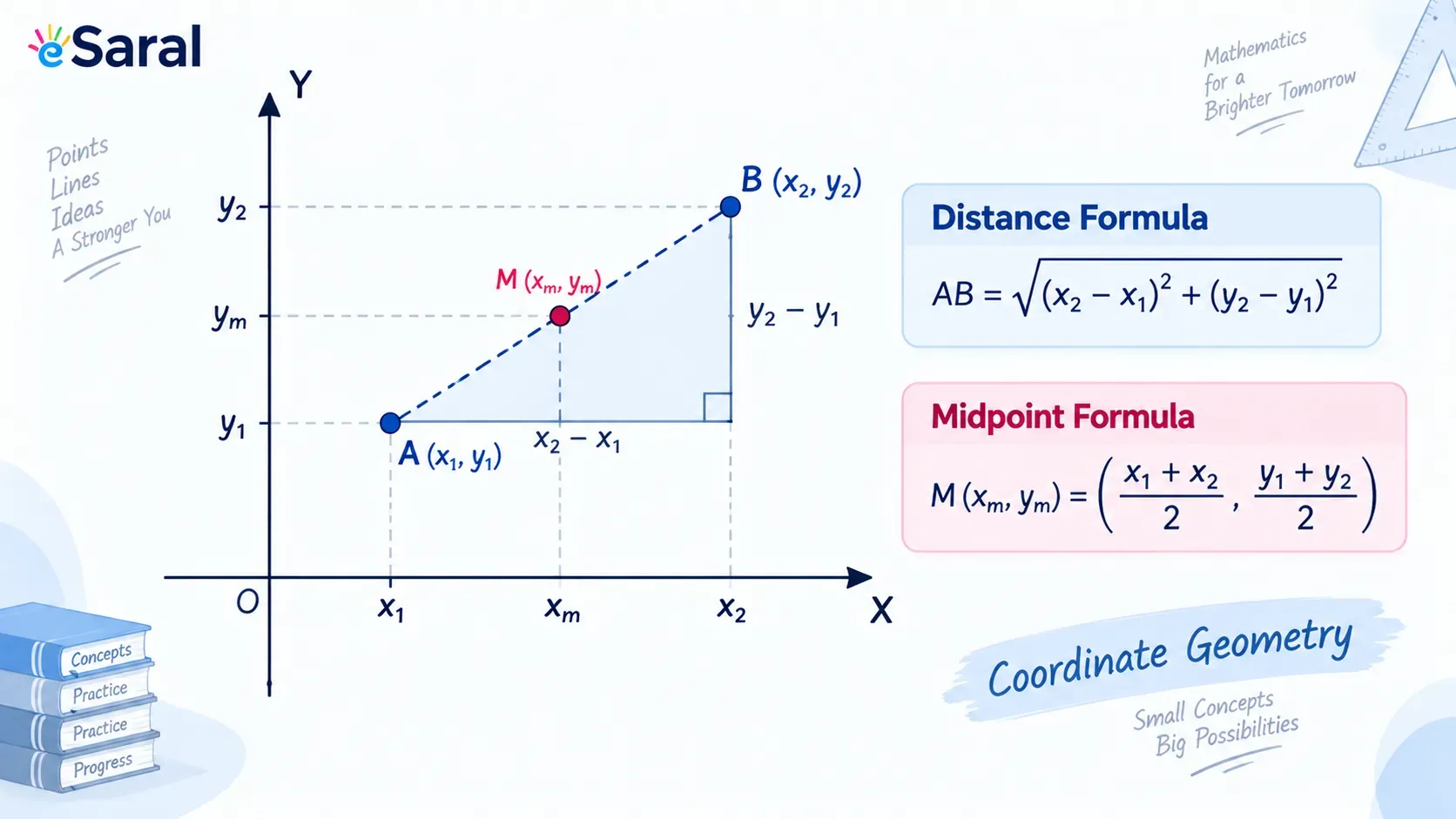
Coordinate Geometry Class 10: Formulas, Notes & Solved Examples
Coordinate geometry class 10: complete CBSE formulas — distance, section, midpoint and area of triangle — with derivation, notes and solved examples.
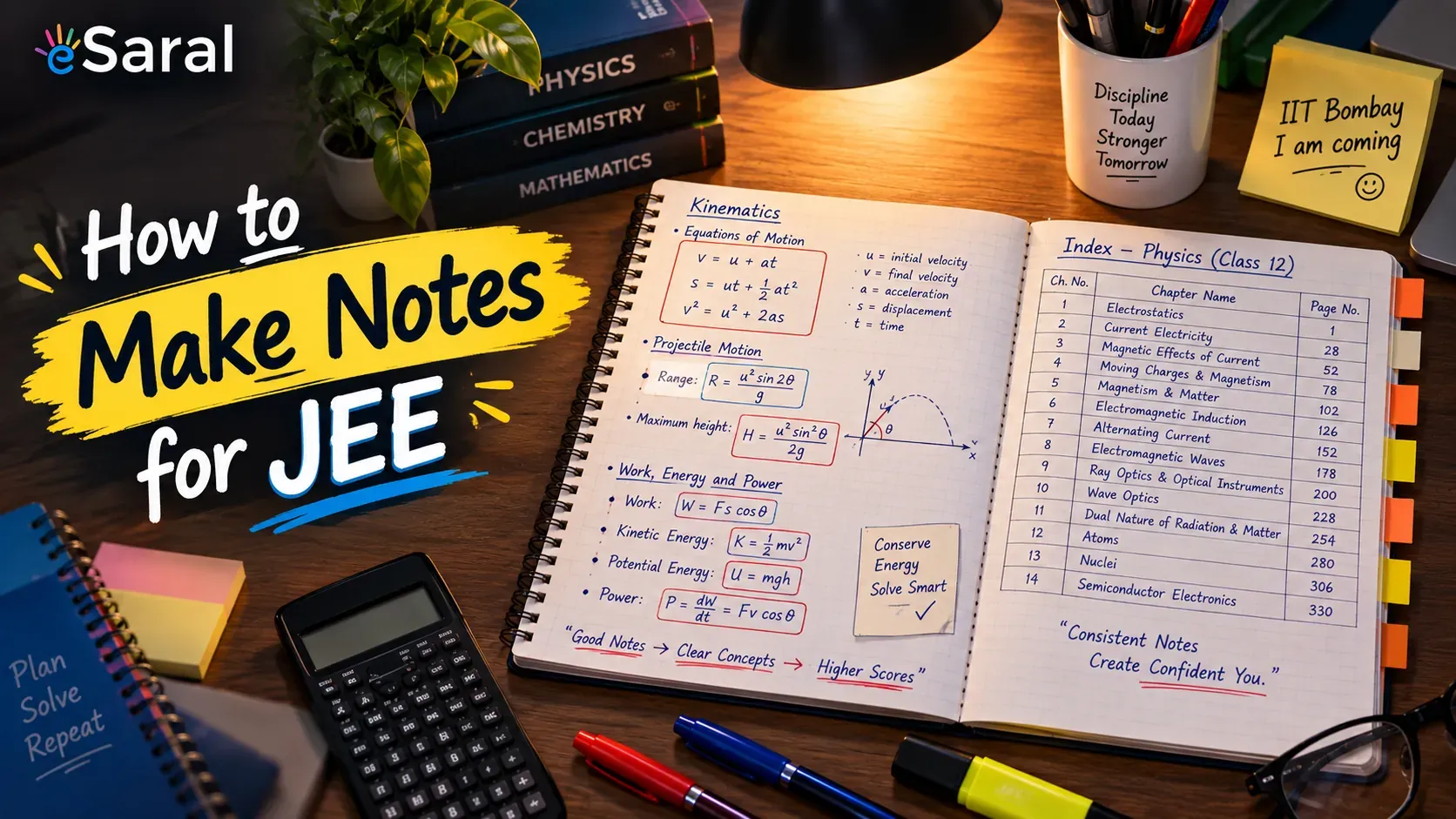
How to make Notes For JEE Smart Notes Strategy of an AIR 41
Learn how to make notes for JEE the way toppers do — indexing, shorthand, and smart short notes for JEE that cut revision time to just 5–7 days.
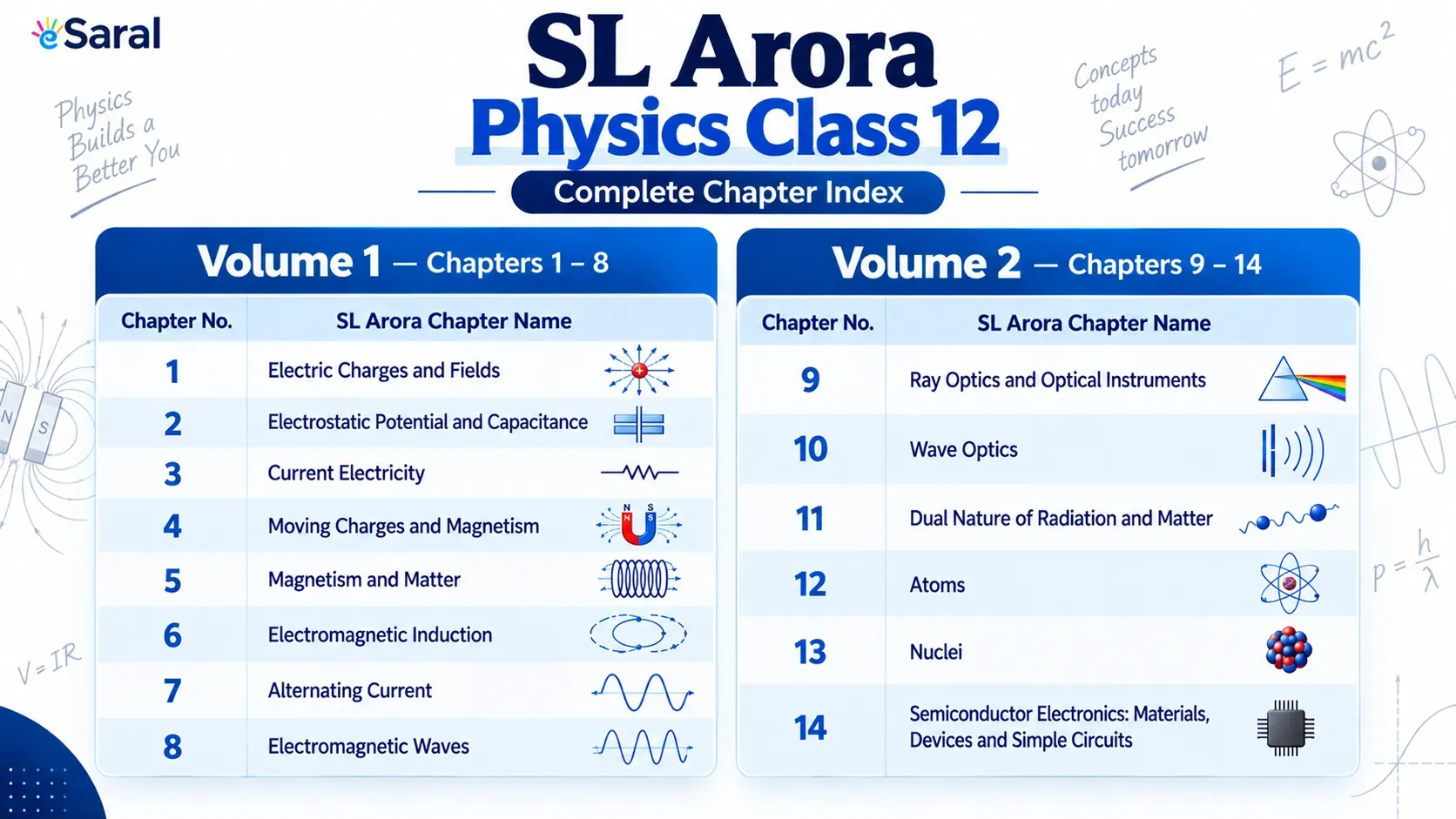
SL Arora Physics Class 12 Index – Chapter List for Volume 1 & 2
SL Arora Physics Class 12 index — complete chapter list for Volume 1 & 2, mapped to NCERT solutions for board, JEE Main, and NEET preparation.