
ElectroChemistry - JEE Advanced Previous Year Questions with Solutions

eSaral Academic and Editorial Team
Summary
Electrochemistry JEE Advanced previous year questions cover cell potential, the Nernst equation, Gibbs energy, molar conductivity, and solubility product calculations. Questions from 2009–2018 are solved here with step-by-step answers. Mastering these JEE Advanced PYQs is one of the fastest ways to gain 8–12 marks in the Physical Chemistry section.

Home » JEE Advanced PYQs » Electrochemistry JEE Advanced Previous Year Questions with Solutions

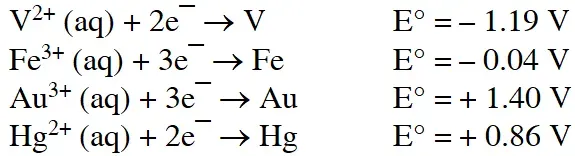
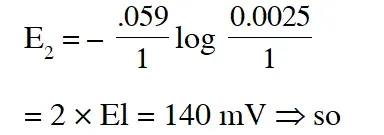
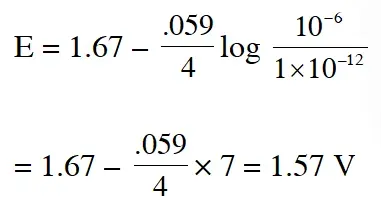
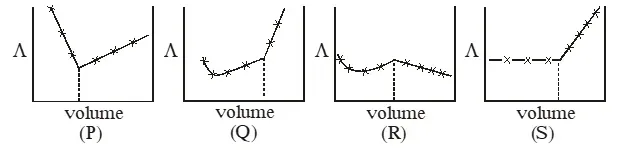
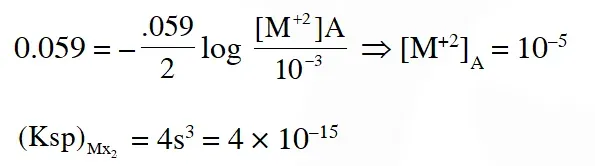
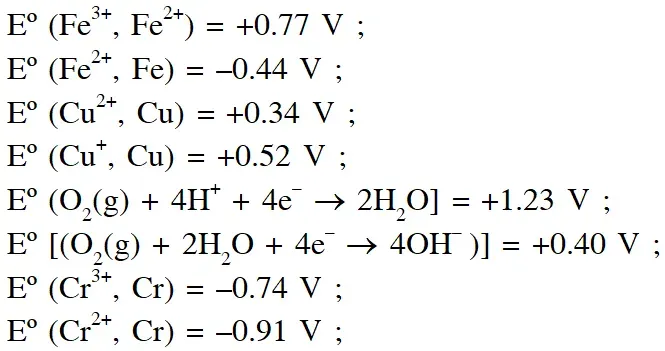
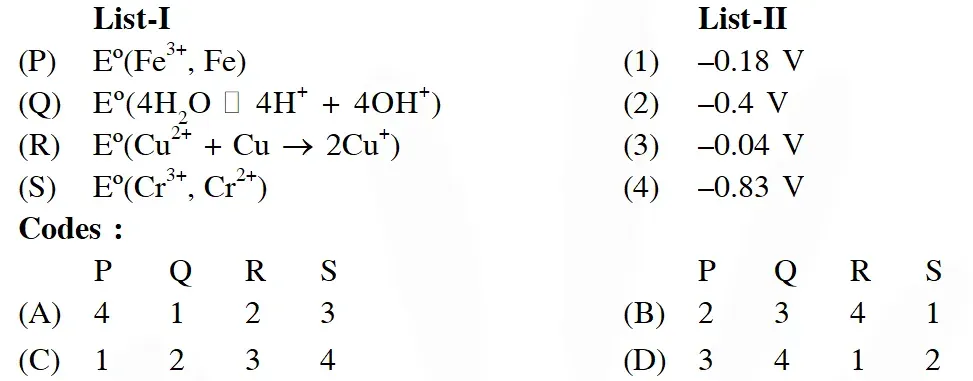
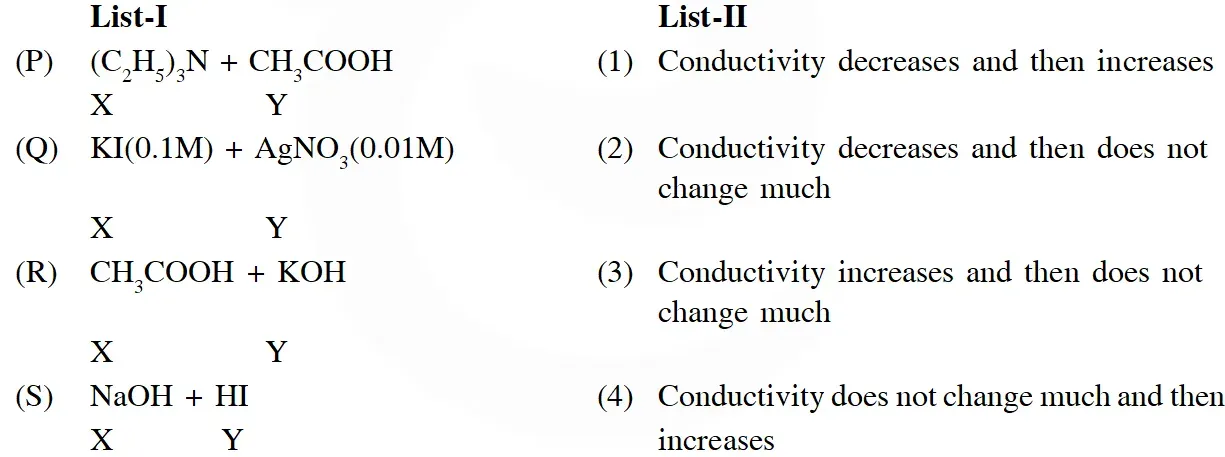
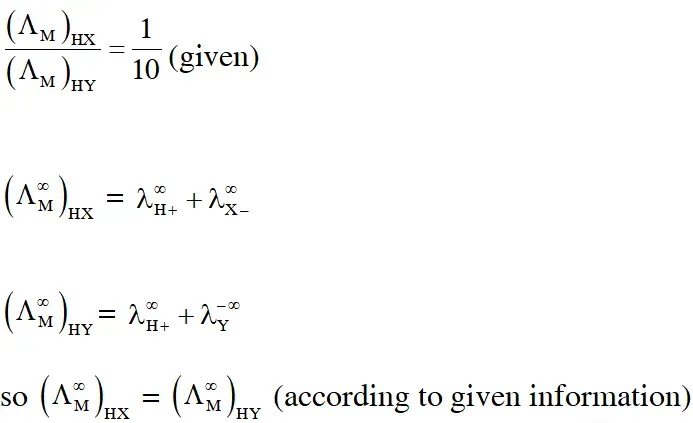
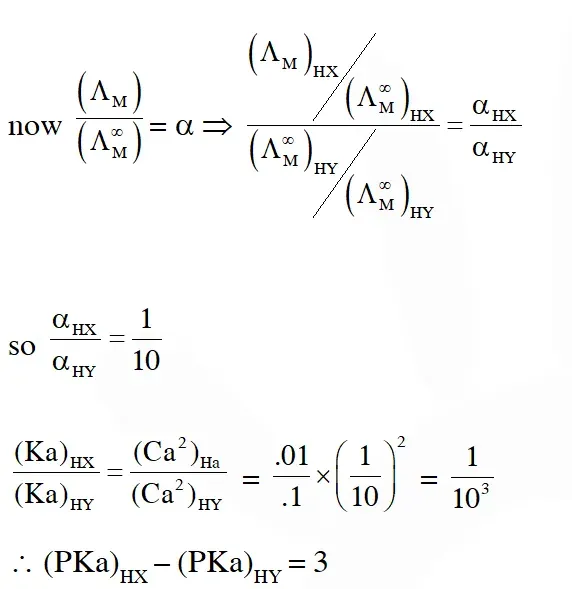
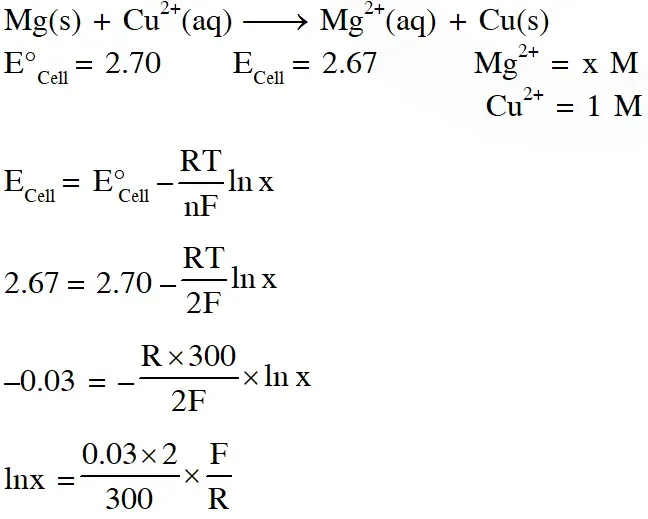
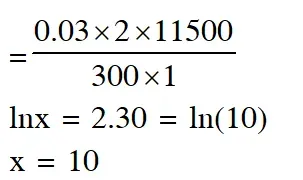
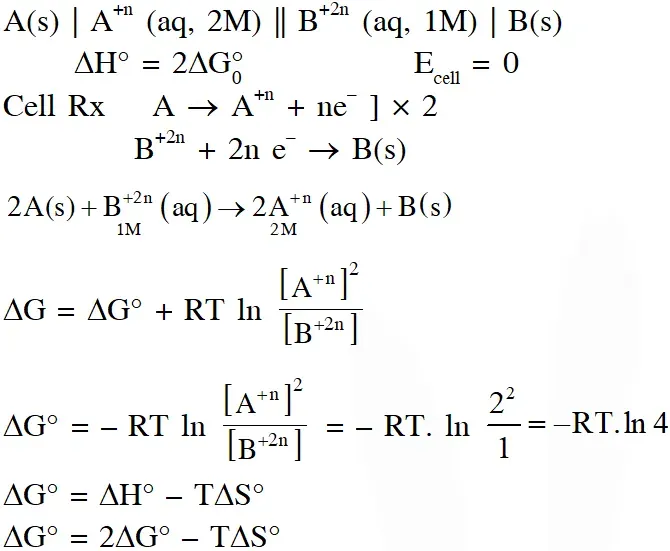
JEE Advanced Previous Year Questions of Chemistry with Solutions are available at eSaral. Practicing JEE Advanced Previous Year Papers Questions of Chemistry will help the JEE aspirants in realizing the question pattern as well as help in analyzing weak & strong areas. Simulator Previous Years JEE Advance Questions [esquestion] For the reaction of $\mathrm{NO}_{3}^{-}$ ion in an aqueous solution, $\mathrm{E}^{\circ}$ is +0.96 V. Values of $\mathrm{E}^{\circ}$ for some metal ions are given below The pair(s) of metal that is(are) oxidised by $\mathrm{NO}_{3}^{-}$ in aqueous solution is(are) (A) V and Hg (B) Hg and Fe (C) Fe and Au (D) Fe and V #tag# [JEE 2009] #sol# (A,B,D) (A,B,D) as $\mathrm{E}^{\circ}$ will be positive [/esquestion] Paragraph for Questions 2 to 3 The concentration of potassium ions inside a biological cell is at least twenty times higher than the outside. The resulting potential difference across the cell is important in several processes such as transmission of nerve impulses and maintaining the ion balance. A simple model for such a concentration cell involving a metal M is : $\mathrm{M}(\mathrm{s}) | \mathrm{M}^{+}\left(\mathrm{aq} ; 0.05 \text { molar) } \| \mathrm{M}^{+}(\mathrm{aq} ; 1 \mathrm{molar}) | \mathrm{M}(\mathrm{s})\right.$ For the above electrolytic cell the magnitude of the cell potential $\left|\mathrm{E}_{\mathrm{cell}}\right|$ = 70 mV. [esquestion] For the above cell :- (A) $\mathrm{E}_{\text {cell }}<0 ; \Delta \mathrm{G}>0$ (B) $\mathrm{E}_{\text {cell }}>0 ; \Delta \mathrm{G}<0$ (C) $\mathrm{E}_{\text {cell }}<0 ; \Delta \mathrm{G}^{0}>0$ (D) $\mathrm{E}_{\text {cell }}>0 ; \Delta \mathrm{G}^{\text {o }}<0$ #tag# [JEE 2010] #sol# (C) $\mathrm{E}_{1}=-\frac{059}{1} \log \frac{05}{1}=(+) \mathrm{ve} \Rightarrow \mathrm{so}$ [/esquestion] [esquestion] If the 0.05 molar solution of $\mathrm{M}^{+}$ is replaced by a 0.0025 molar $\mathrm{M}^{+}$ solution, then the magnitude of the cell potential would be :- (A) 35 mV (B) 70 mV (C) 140 mV (D) 700 mV #tag# [JEE 2010] #sol# (B) [/esquestion] [esquestion] Consider the following cell reaction : $2 \mathrm{Fe}_{(\mathrm{s})}+\mathrm{O}_{2(\mathrm{g})}+4 \mathrm{H}_{(\mathrm{aq})}^{+} \rightarrow 2 \mathrm{Fe}_{(\mathrm{aq})}^{2+}+2 \mathrm{H}_{2} \mathrm{O}(\ell) \quad \mathrm{E}^{\circ}=1.67 \mathrm{V}$ $\mathrm{At}\left[\mathrm{Fe}^{2+}\right]=10^{-3} \mathrm{M}, \mathrm{P}\left(\mathrm{O}_{2}\right)=0.1$ atm and $\mathrm{pH}=3,$ the cell potential at $25^{\circ} \mathrm{C}$ is – (A) 1.47 V (B) 1.77 V (C) 1.87 V (D) 1.57 V #tag# [JEE 2011] #sol# (D) [/esquestion] [esquestion] $\mathrm{AgNO}_{3}$ (aq.) was added to an aqueous KCl solution gradually and the conductivity of the solution was measured. the plot of conductance () versus the volume of $\mathrm{AgNO}_{3}$ is - (A) (P) (B) (Q) (C) (R) (D) (S) #tag# [JEE 2011] #sol# (D) [/esquestion] Paragraph for Question 6 and 7 The electrochemical cell shown below is a concentration cell. $\mathrm{M} | \mathrm{M}^{2+}$ (saturated solution of a sparingly soluble salt, $\mathrm{MX}_{2}$) | | $\mathbf{M}^{2+}$ (0.001 mol $\mathrm{dm}^{-3}$) | M The emf of the cell depends on the difference in concentrations of M2+ ions at the two electrodes. The emf of the cell at 298 K is 0.059V. [esquestion] The value of G $\left(\mathrm{kJ} \mathrm{mol}^{-1}\right)$ for the given cell is (take If = 96500 C $\mathrm{mol}^{-1}$) (A) –5.7 (B) 5.7 (C) 11.4 (D) –11.4. #tag# [JEE 2012] #sol# (B) [/esquestion] [esquestion] The solubility product $\left(\mathrm{K}_{\mathrm{sp}} ; \mathrm{mol}^{3} \mathrm{dm}^{-9}\right)$ of $\mathrm{MX}_{2}$ at 298 K based on the information available for the given concentration cell is (take 2.303 × R × 298/F = 0.059 V) (A) $1 \times 10^{-15}$ (B) $4 \times 10^{-15}$ (C) $1 \times 10^{-12}$ (D) $1 \times 10^{-12}$ #tag# #sol# (D) $\Delta \mathrm{G}=\frac{-2 \times 96500 \times .059}{1000}=11.4$ [/esquestion] [esquestion] The standard reduction potential data at $25^{\circ} \mathrm{C}$ is given below Match $\mathrm{E}^{\mathrm{o}}$ of the redox pair in List-I with the values given in List-II and select the correct answer using the code given below the lists : #tag# [JEE-Adv. 2013] #sol# (D) [/esquestion] [esquestion] An aqueous solution of X is added slowly to an aqueous solution of Y as shown in List-I. The variation in conductivity of these reactions is given in List-II. Match List-I with List-II and select the correct answer using the code given below the lists : #tag# [JEE-Adv. 2013] #sol# (A) $\left(\mathrm{C}_{2} \mathrm{H}_{5}\right)_{3} \mathrm{N}+\mathrm{CH}_{3} \mathrm{COOH} \Rightarrow$ Weak acid and weak base so conductivity increases and then does not change much so option 3 hence and (a) [/esquestion] [esquestion] In a galvanic cell , the salt bridge - (A) Does not participate chemically in the cell reaction (B) Stops the diffusion of ions from one electrode to another (C) Is necessary for the occurence of the cell reaction (D) Ensures mixing of the two electrolytic solutions #tag# [JEE-Adv. 2014] #sol# (A,B) Fact [/esquestion] [esquestion] The molar conductivity of a solution of a weak acid HX (0.01 M) is 10 times smaller than the molar conductivity of a solution of a weak acid HY (0.1 M). If $\lambda_{\mathrm{X}^{-}}^{0} \approx \lambda_{\mathrm{Y}^{-}}^{0}$ the difference in their $\mathrm{pK}_{\mathrm{a}}$ values $, \mathrm{pK}_{\mathrm{a}}(\mathrm{HX})-\mathrm{p} \mathrm{K}_{\mathrm{a}}(\mathrm{HY}),$ is (consider degree of ionization of both acids to be <<1). #tag# [JEE-Adv. 2015] #sol# 3 [/esquestion] [esquestion] All the energy released from the reaction X $\rightarrow \mathrm{Y}, \Delta_{\mathrm{r}} \mathrm{G}^{\circ}=-193 \mathrm{kJ} \mathrm{mol}^{-1}$ is used for the oxidizing $\mathrm{M}^{+}$ and $\mathrm{M}^{+} \rightarrow \mathrm{M}^{3+}+2 \mathrm{e}^{-}, \mathrm{E}^{\circ}=-0.25 \mathrm{V}$ Under standard conditions, the number of moles of M+ oxidized when one mole of X is converted to Y is $\left[\mathrm{F}=96500 \mathrm{C} \mathrm{mol}^{-1}\right]$ #tag# [JEE-Adv. 2015] #sol# 4 [/esquestion] [esquestion] For the electrochemical cell, $\mathrm{Mg}(\mathrm{s})\left|\mathrm{Mg}^{2+}(\mathrm{aq}, 1 \mathrm{M}) \| \mathrm{Cu}^{2+}(\mathrm{aq}, 1 \mathrm{M})\right| \mathrm{Cu}(\mathrm{s})$ the standard emf of the cell is 2.70 V at 300 K. When the concentration of $\mathrm{Mg}^{2+}$ is changed to x M, the cell potential changes to 2.67 V at 300 K. The value of x is____. (given, $\frac{\mathrm{F}}{\mathrm{R}}=11500 \mathrm{KV}^{-1}$ where F is the Faraday constant and R is the gas constant, ln(10) = 2.30) #tag# [JEE-Adv. 2018] #sol# 10 [/esquestion] [esquestion] Consider an electrochemical cell: $\mathrm{A}(\mathrm{s})\left|\mathrm{A}^{\mathrm{n}+}(\mathrm{aq}, 2 \mathrm{M}) \| \mathrm{B}^{2 \mathrm{n}+}(\mathrm{aq}, 1 \mathrm{M})\right| \mathrm{B}(\mathrm{s})$. The value of $\Delta \mathrm{H}^{\theta}$ for the cell reaction is twice that of $\Delta \mathrm{G}^{\theta}$ at 300 K. If the emf of the cell is zero, the $\Delta \mathrm{S}^{\theta}$ $\left(\text { in } \mathrm{JK}^{-1} \mathrm{mol}^{-1}\right)$ of the cell reaction per mole of B formed at 300 K is___. (Given : ln (2) = 0.7, R (universal gas constant) = $8.3 \mathrm{JK}^{-1} \mathrm{mol}^{-1}$. H, S and G are enthalpy, entropy and Gibbs energy, respectively.) #tag# [JEE-Adv. 2018] #sol# (-11.62) [/esquestion]





Once Electrochemistry - JEE Advanced PYQs (Chemistry) is complete, move to full-paper practice using the JEE Advanced exam paper.
Frequently Asked Questions
What is the difference between E° and E_cell in a concentration cell?
In a concentration cell, both electrodes use the same metal and ion — only the concentrations differ. E° = 0 because the standard electrode potentials cancel. E_cell is non-zero only because of the concentration gradient, calculated entirely via the Nernst equation. ΔG° is therefore zero, but ΔG is non-zero.
What is the Nernst equation and how is it used in JEE Advanced?
The Nernst equation is E_cell = E° − (RT/nF) × ln Q, simplified at 25°C to E = E° − (0.059/n) × log Q. In JEE Advanced, it is used to calculate cell potential at non-standard concentrations, find an unknown concentration from a known EMF, and derive ΔG or K_sp. Q13 (2018) and Q4 (2011) above are the best practice examples.
How many marks does Electrochemistry carry in JEE Advanced?
Electrochemistry typically contributes 8–12 marks across both papers in JEE Advanced. It appears every year without exception in the 2009–2023 record. Questions span single-correct, multi-correct, integer-type, and paragraph formats, making it one of the most versatile scoring chapters in Physical Chemistry
Which NCERT chapters should I read before solving Electrochemistry JEE Advanced PYQs?
Chapter 3 (Electrochemistry) of NCERT Class 12 Chemistry is the mandatory starting point. For connected topics, Chapter 7 (Equilibrium) in Class 11 and Chapter 6 (Thermodynamics) in Class 11 are important. The NCERT Solutions for Class 12 Chemistry on eSaral provide worked answers to every textbook exercise with concept notes. You can also refer to the NCERT Books for Class 12 for the official text
How do you calculate K_sp from electrochemical data in JEE Advanced?
First, find the concentration of M^n+ in the saturated solution using the Nernst equation applied to the concentration cell EMF. Then use the stoichiometry of the salt to express [anion] in terms of [cation] and compute K_sp = [M^n+][X⁻]^m. Q7 from JEE Advanced 2012 is the standard template for this calculation.
Is Electrochemistry easier to score in JEE Advanced than other Physical Chemistry chapters?
Yes, relatively. Electrochemistry has a smaller formula base than Chemical Kinetics or Thermodynamics. Once you are confident with the Nernst equation, ΔG = −nFE, and conductivity concepts, most questions reduce to careful substitution. Integer-type Electrochemistry questions (2015, 2018) are particularly good targets because they have no negative marking.
What is the role of a salt bridge, and why does JEE Advanced ask about it?
A salt bridge maintains electrical neutrality in each half-cell by allowing ions to migrate without mixing the solutions. It does not participate in the electrode reaction and does not allow bulk mixing of electrolytes. JEE Advanced 2014 tested this directly — students who had only memorised "salt bridge = KCl in agar" without understanding the mechanism lost marks on the multi-correct options.
Team eSaral
eSaral Academic and Editorial Team
Team eSaral is the collective author profile for educational content created by eSaral’s teachers and academic contributors. The team draws on expertise from IIT graduates, doctors, experienced educators and subject specialists to develop resources for JEE, NEET and school students. Our articles aim to explain concepts clearly and help students study with confidence.
Related Posts
Plant Cell Diagram: Labelled Structure, Parts and Functions
Simple, labelled plant cell diagram with parts and functions. Covers plant cell structure for Class 6, 7, 8, 9, 10 and 11 students, CBSE-aligned.

Saransh Gupta Sir's Visit to IIT Patna: Hostel Life, Placements & Lessons for JEE Aspirants
Inside Saransh Gupta Sir's IIT Patna visit — hostel life, the library, placements, internships, and real advice for JEE aspirants from students living the IIT dream.
Molality Formula: Formula for Molality, Derivation & Solved Examples
Molality formula is $m = \dfrac{n}{W}$. Learn the formula of molality, its SI unit, derivation, relation with molarity, and solved examples for Class 11, JEE and NEET.

BITSAT Previous Year Question Paper PDF
Download BITSAT previous year question papers PDF. Get year-wise BITSAT PYQs, memory-based papers, exam pattern, and preparation tips to improve your BITSAT preparation.

Teachers’ Day 2026 at eSaral Gurukul: Celebrating the Bond Between Students, Teachers & Mentors
See how Teachers’ Day 2026 was celebrated at eSaral Gurukul, reflecting the bond among students, teachers, and mentors, and the role of guidance beyond academics.

JEE Advanced Attempts: Can You Give It a Third Time? Rules Explained
JEE Advanced attempts: current rule is 2 consecutive years only: full eligibility criteria, the 2025 third-attempt controversy, and the latest 2026 petition news.

Best JEE Preparation App
Best JEE preparation app for Main & Advanced: AI mock tests, live doubt-solving, thousands of practice questions. JEE preparation app for droppers & Class 11-12.
Coordinate Geometry Class 10: Formulas, Notes & Solved Examples
Coordinate geometry class 10: complete CBSE formulas — distance, section, midpoint and area of triangle — with derivation, notes and solved examples.
How to make Notes For JEE Smart Notes Strategy of an AIR 41
Learn how to make notes for JEE the way toppers do — indexing, shorthand, and smart short notes for JEE that cut revision time to just 5–7 days.
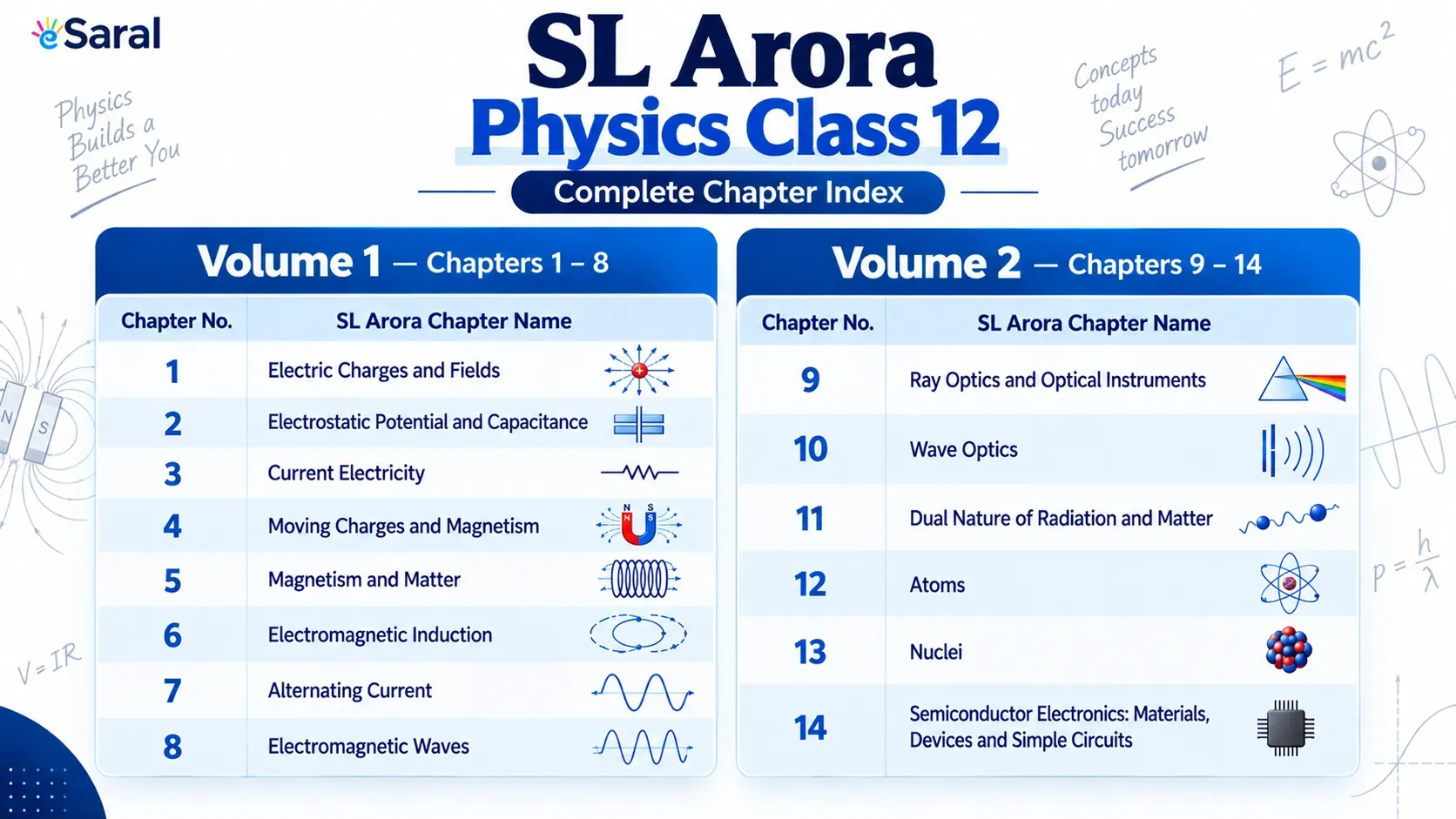
SL Arora Physics Class 12 Index – Chapter List for Volume 1 & 2
SL Arora Physics Class 12 index — complete chapter list for Volume 1 & 2, mapped to NCERT solutions for board, JEE Main, and NEET preparation.