
Electrostatics - NEET Previous Year Questions with Complete Solutions

eSaral Academic and Editorial Team
Summary
Electrostatics NEET PYQs: Master Coulomb’s law, electric field, Gauss’s law, potential, and capacitance with solved NEET previous year questions, shortcut techniques, expert tips, and common mistake analysis to boost Physics accuracy and speed.
.webp?2026-09-24T07%3A16%3A15.354Z)
eSaral › NEET › Neet test-series› Electrostatics - NEET Previous Year Questions with Complete Solutions

Why electrostatics is critical for NEET Physics
Electrostatics is the foundation of all electricity and magnetism in the NEET syllabus. Every concept here — charge, field, potential, capacitance — reappears in Current Electricity, Magnetism, and Electromagnetic Induction.
Students who master electrostatics effectively study three chapters at once. That compounding return makes it the smartest chapter to prioritise early in your NEET preparation.
💡 Expert tip · Saransh Gupta, IIT Bombay AIR-41
"Electrostatics is where 90% of students lose marks they never expected to lose. Solve at least 10 PYQs per sub-topic before moving on — not for speed, but for pattern recognition."
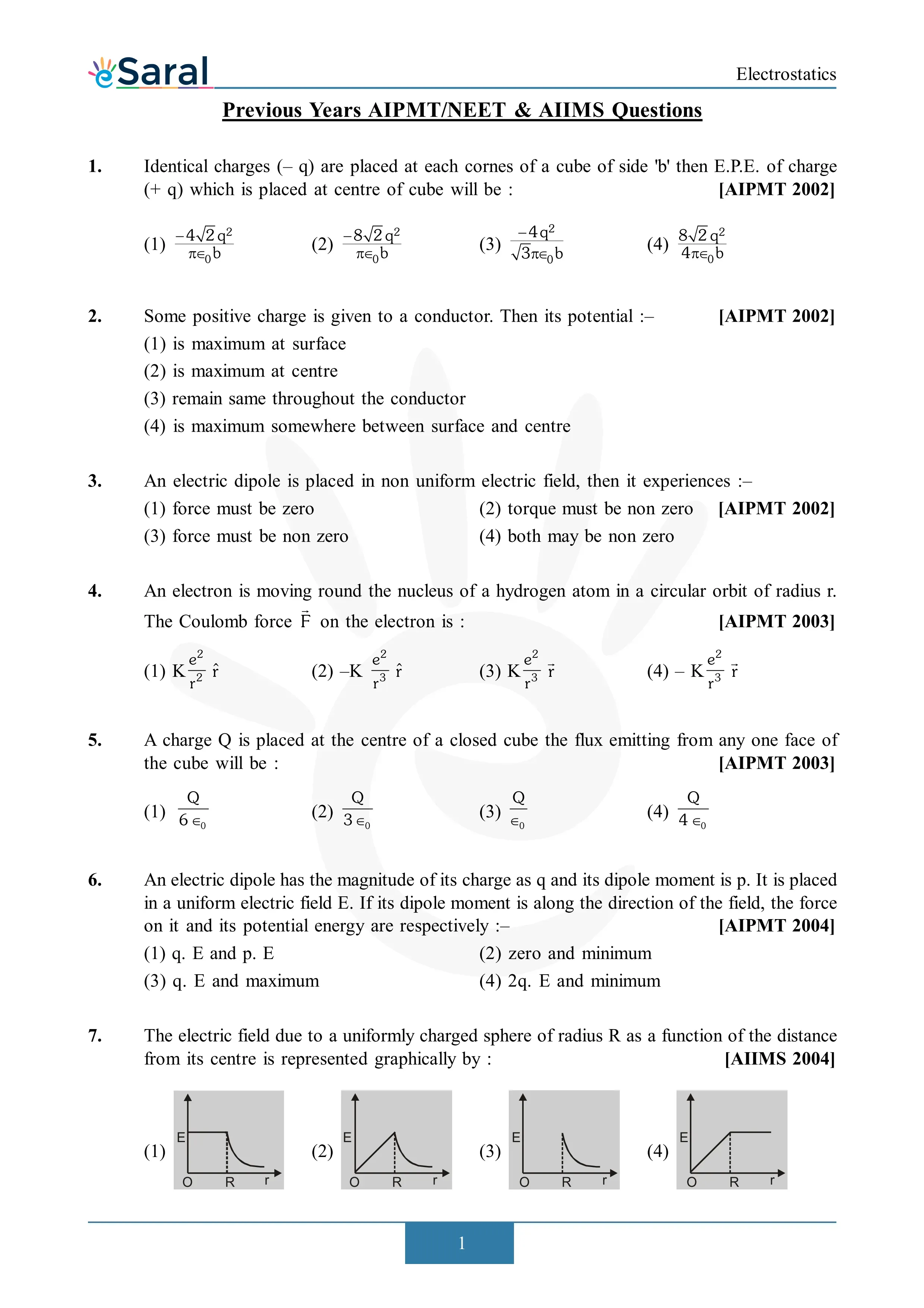
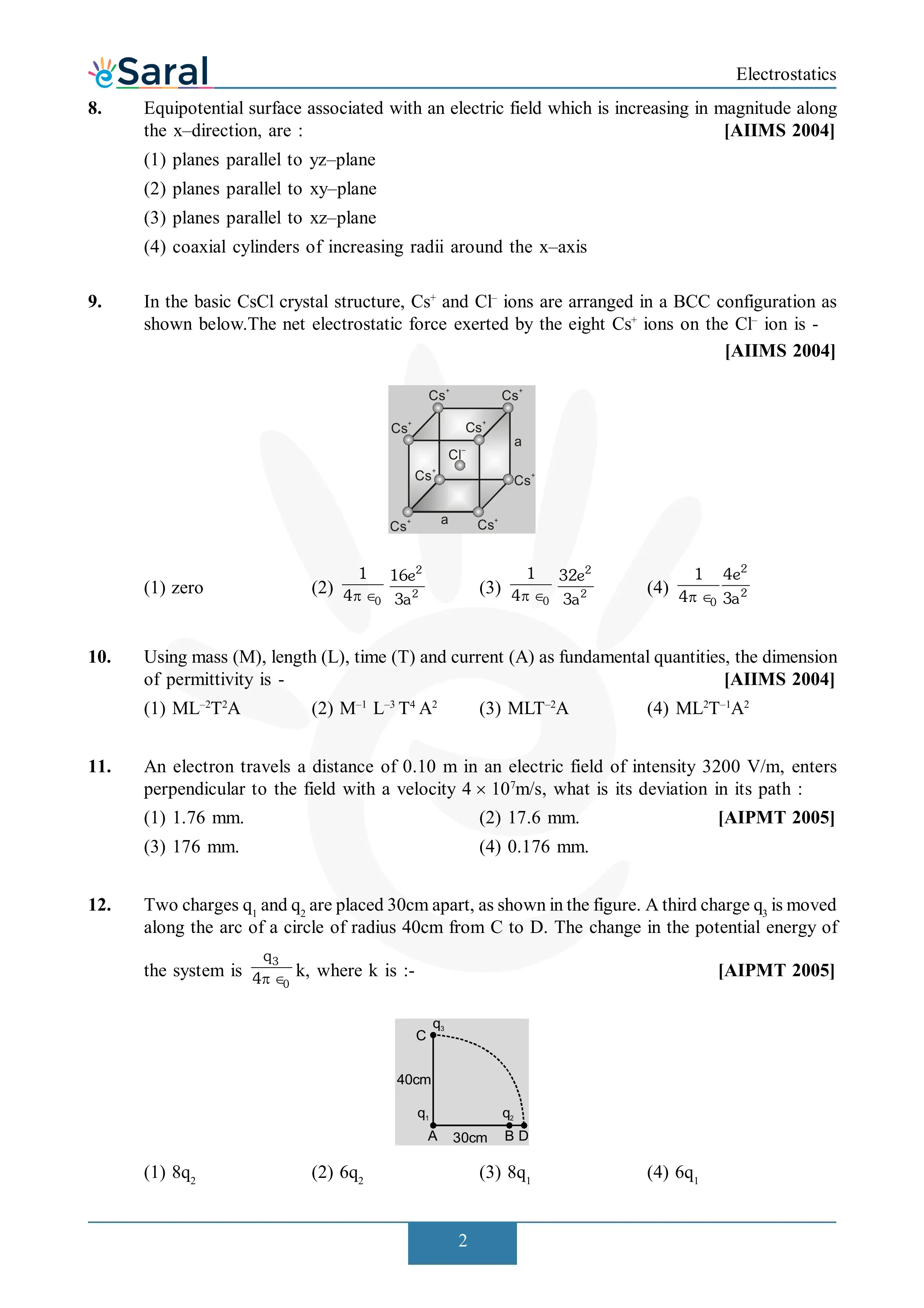
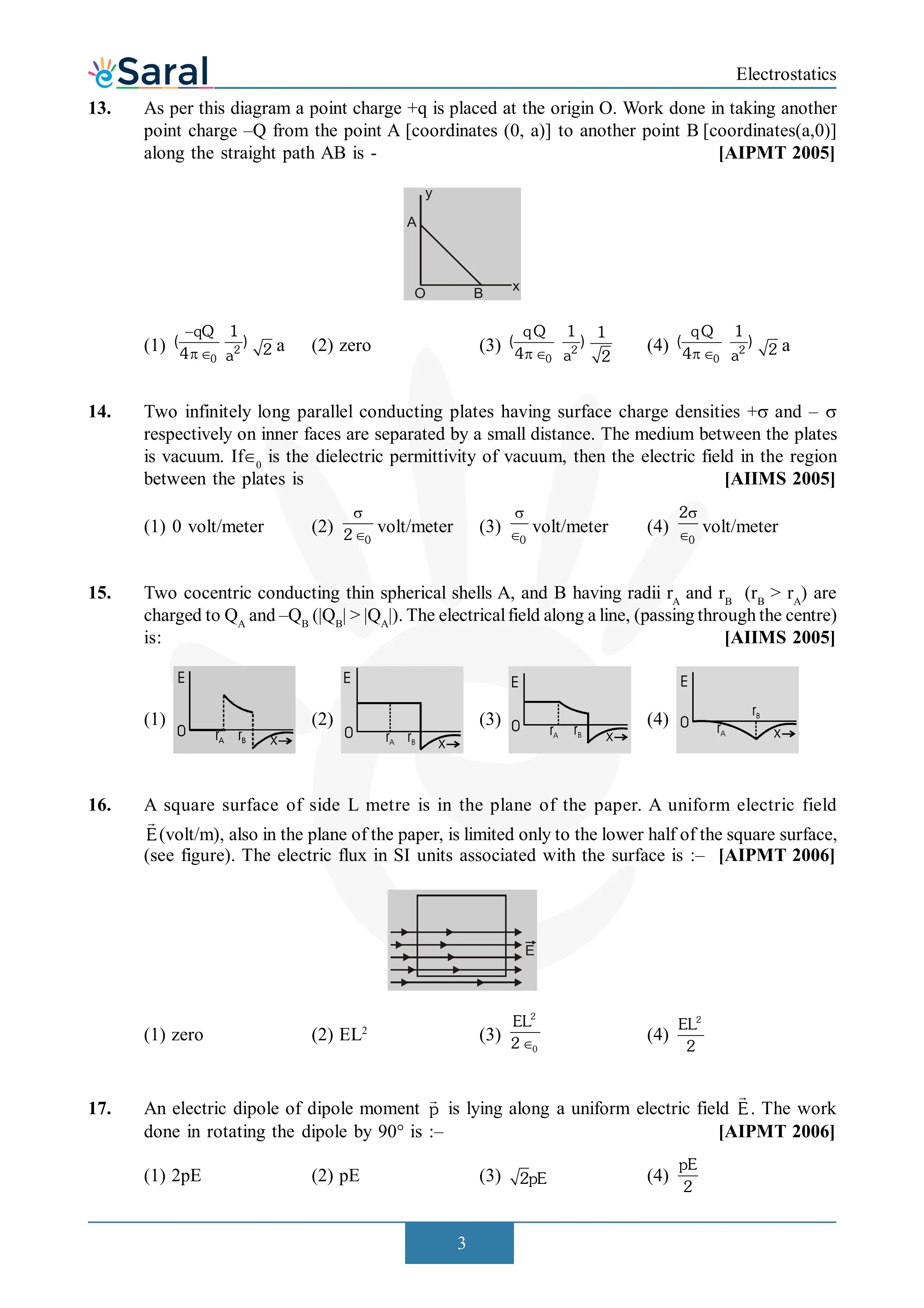
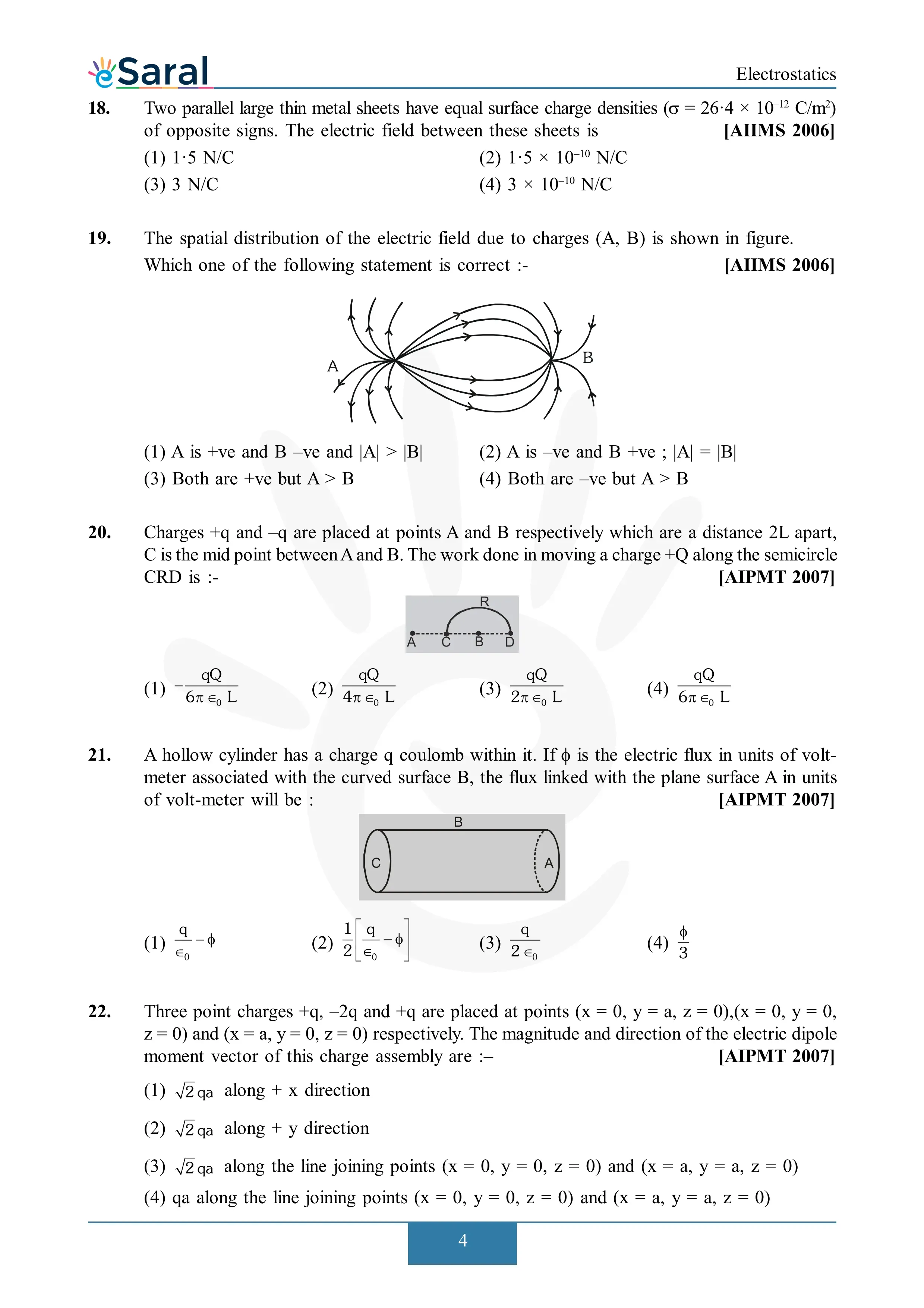
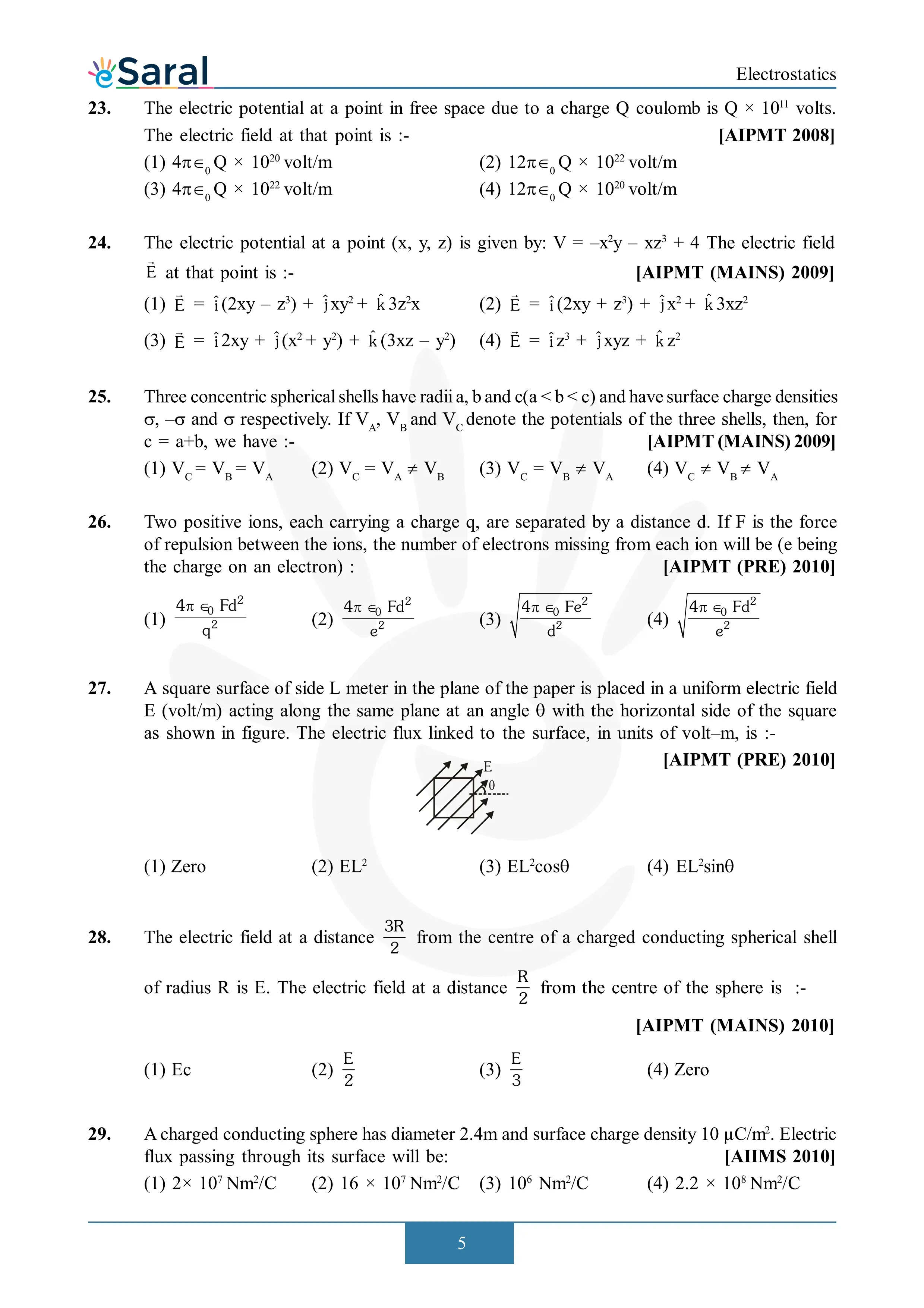
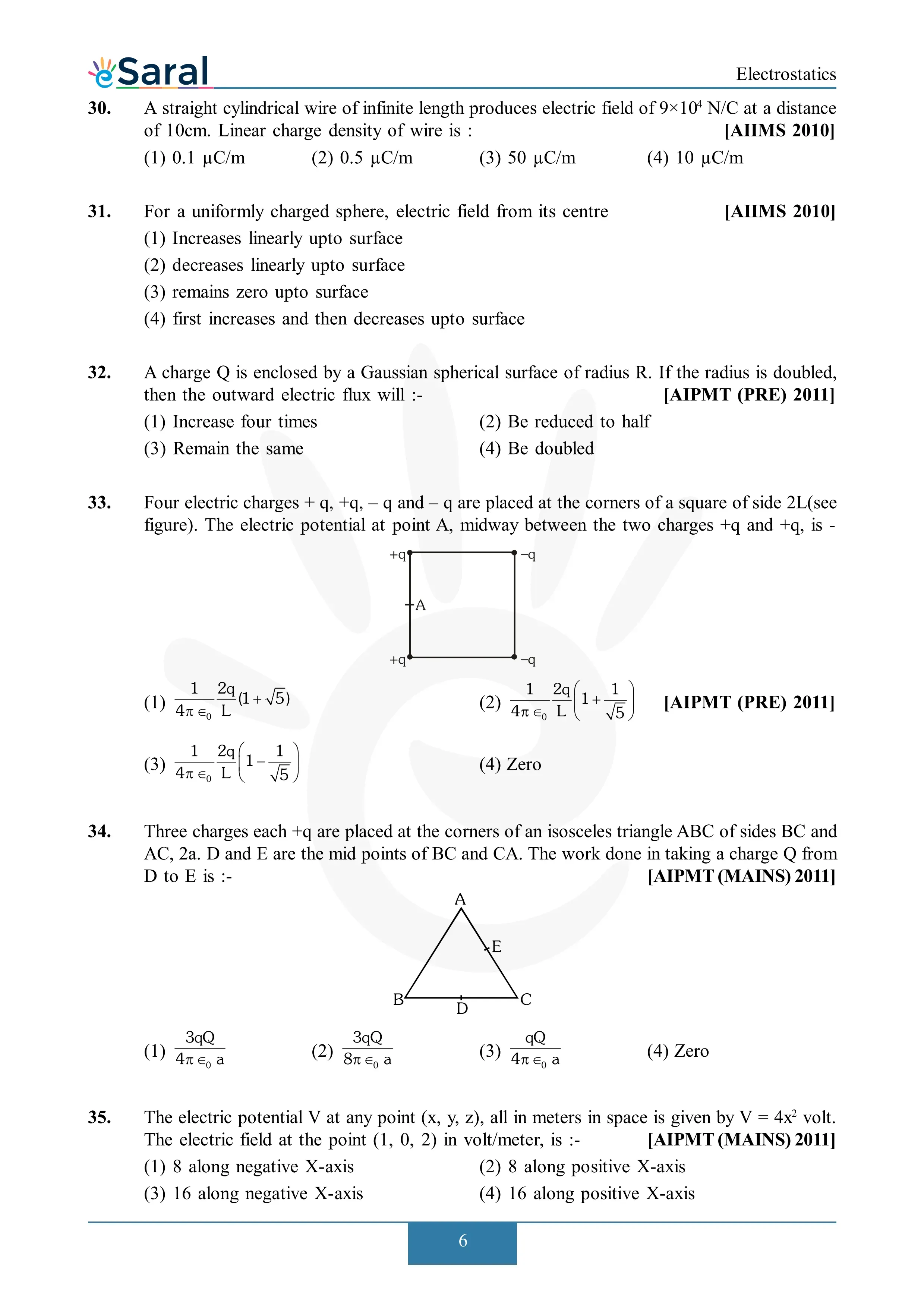
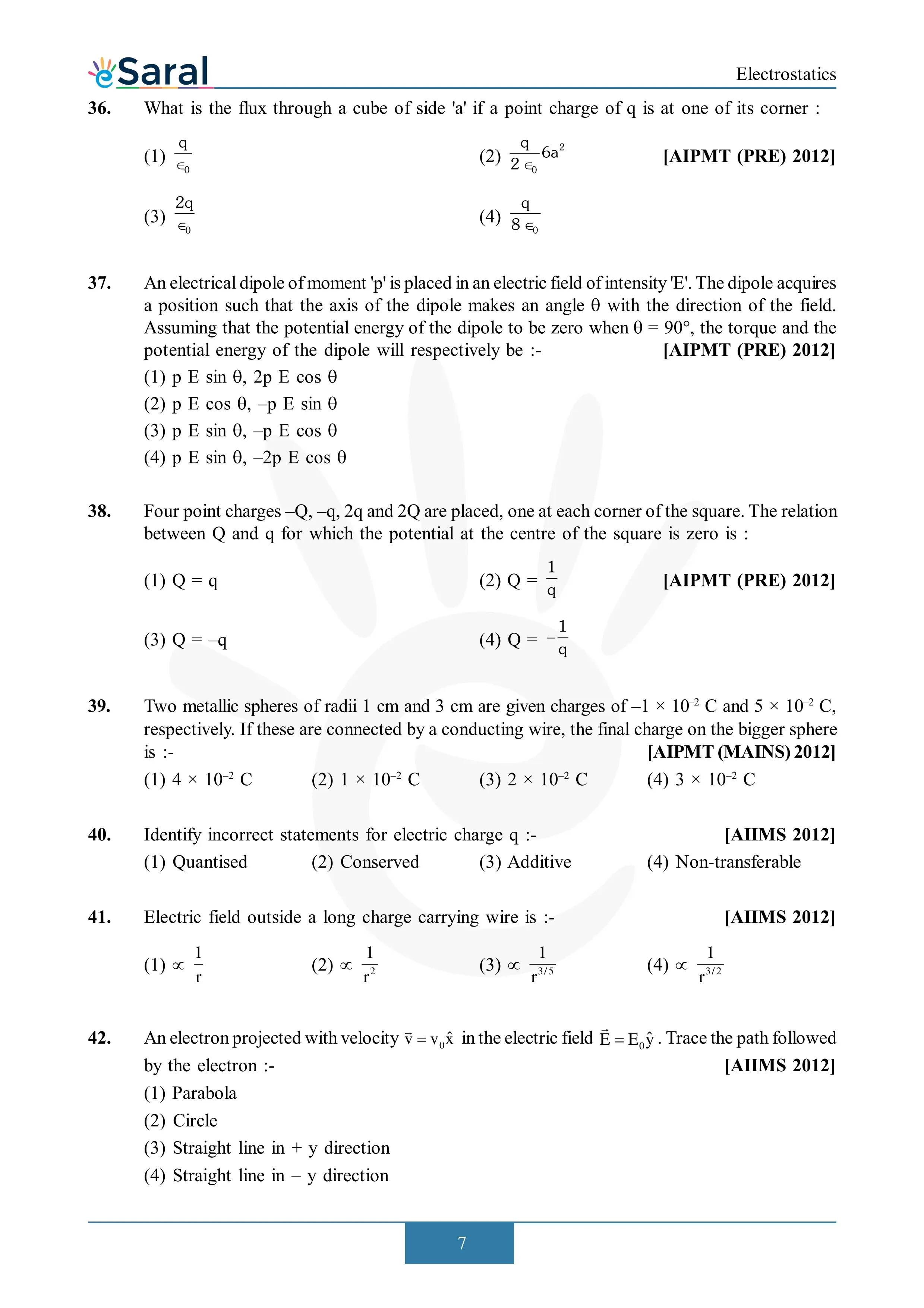
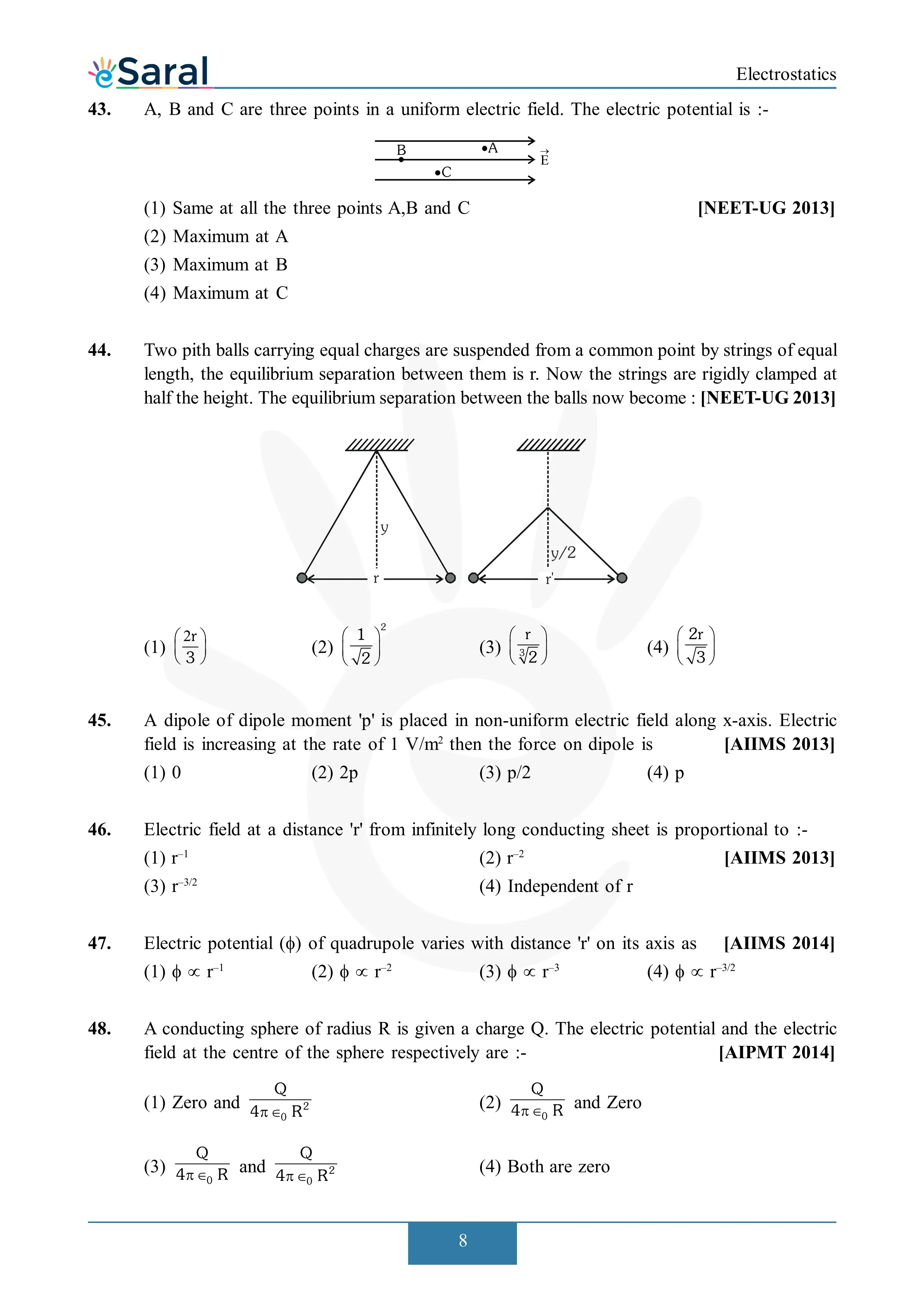
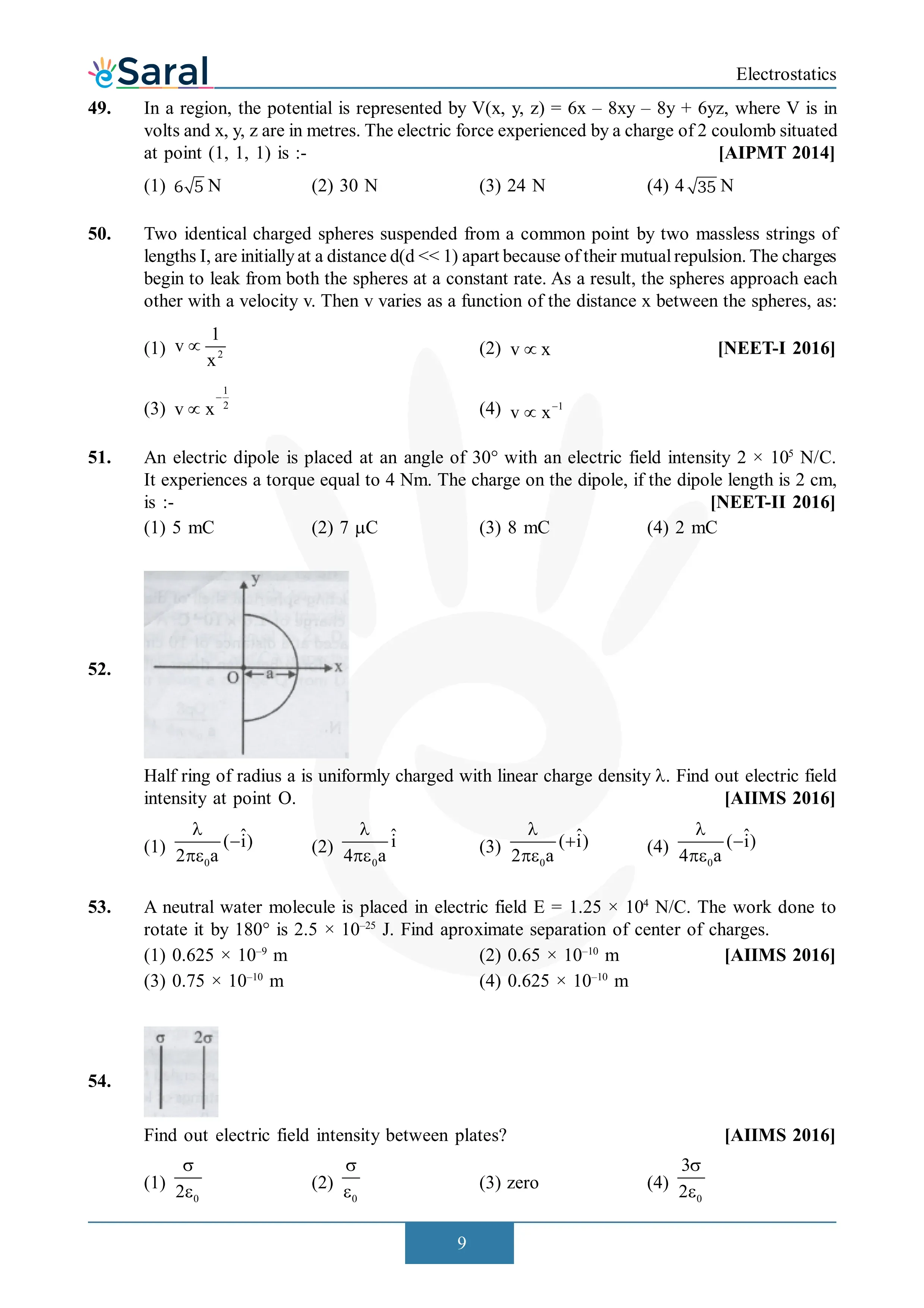
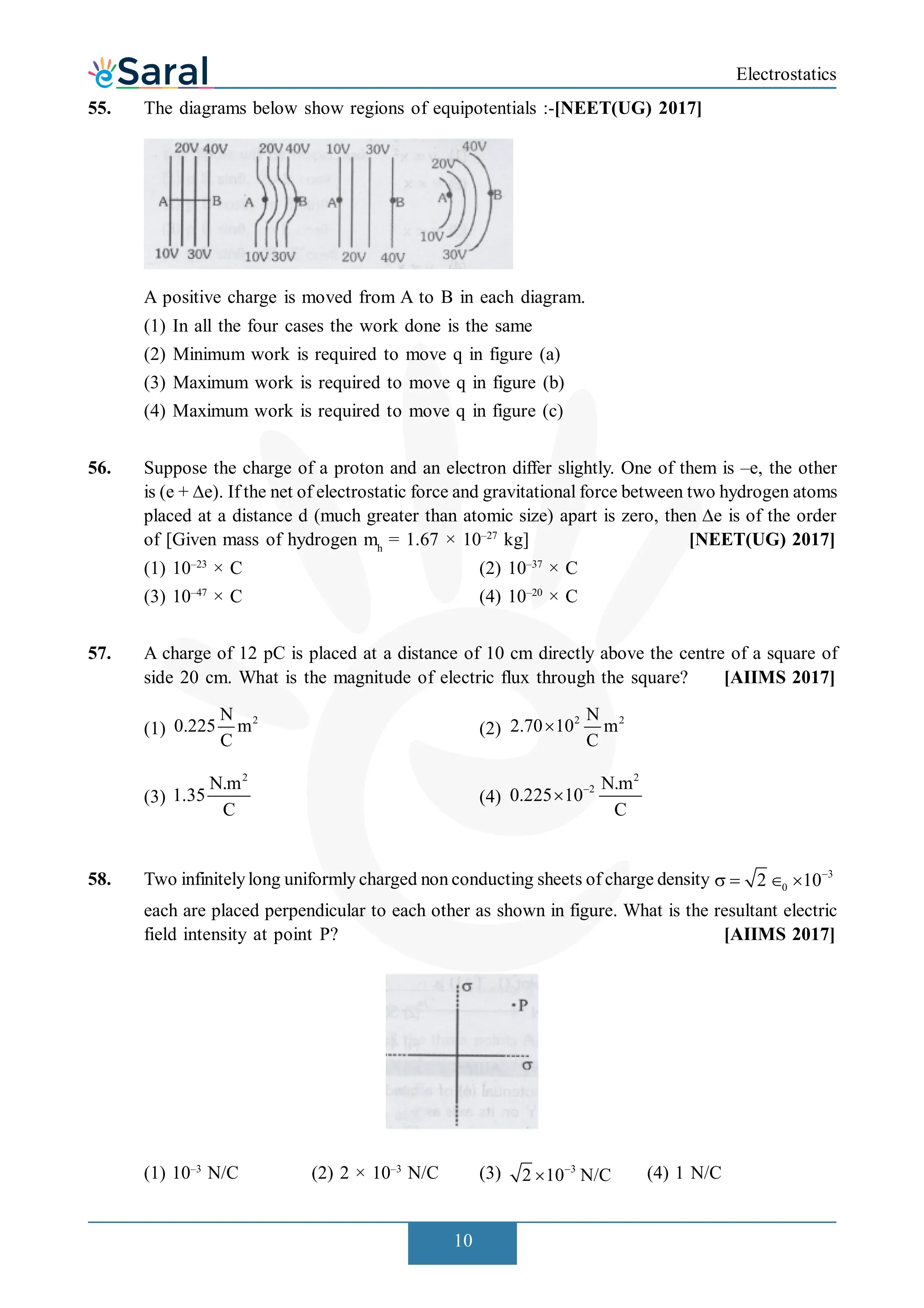
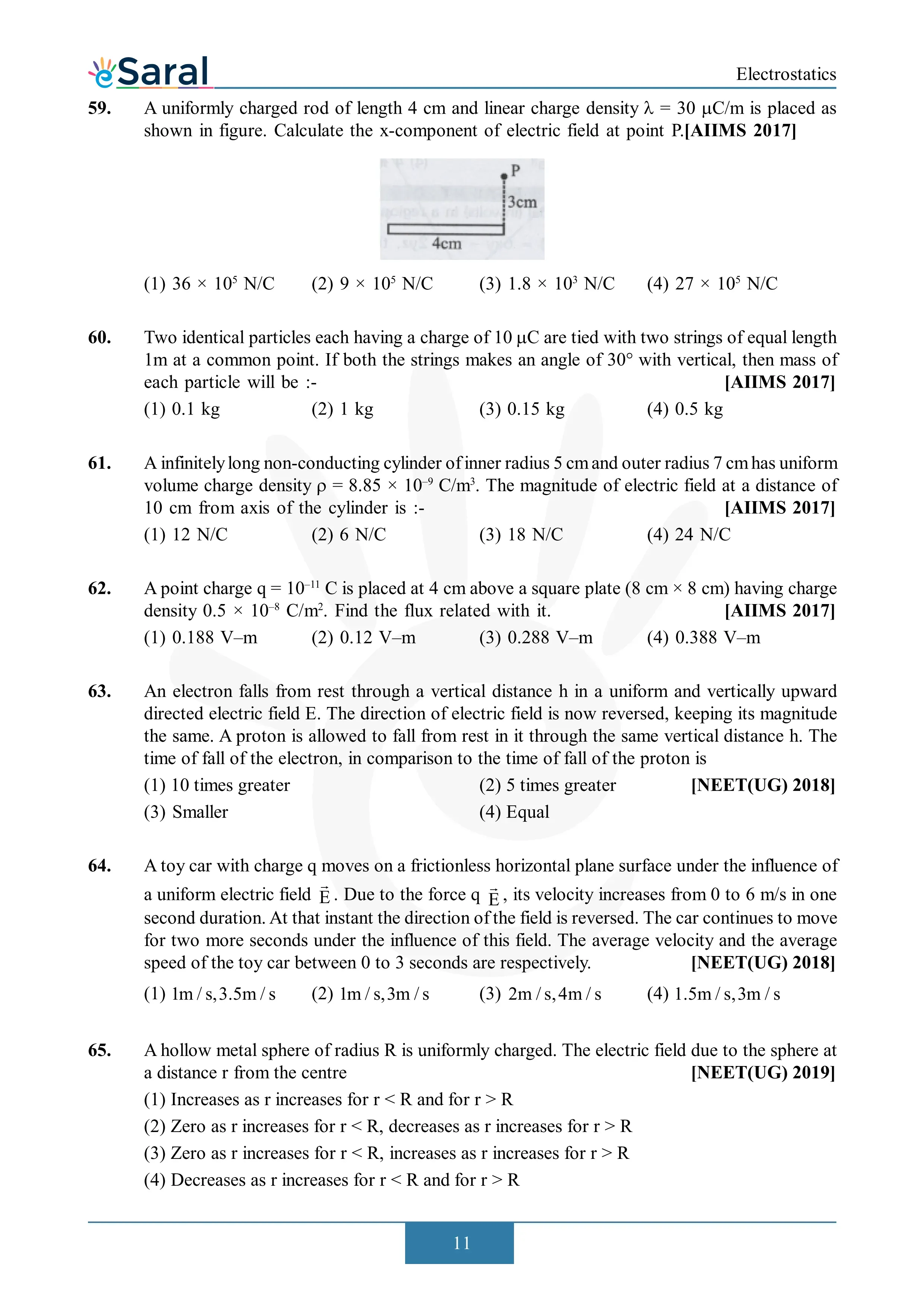
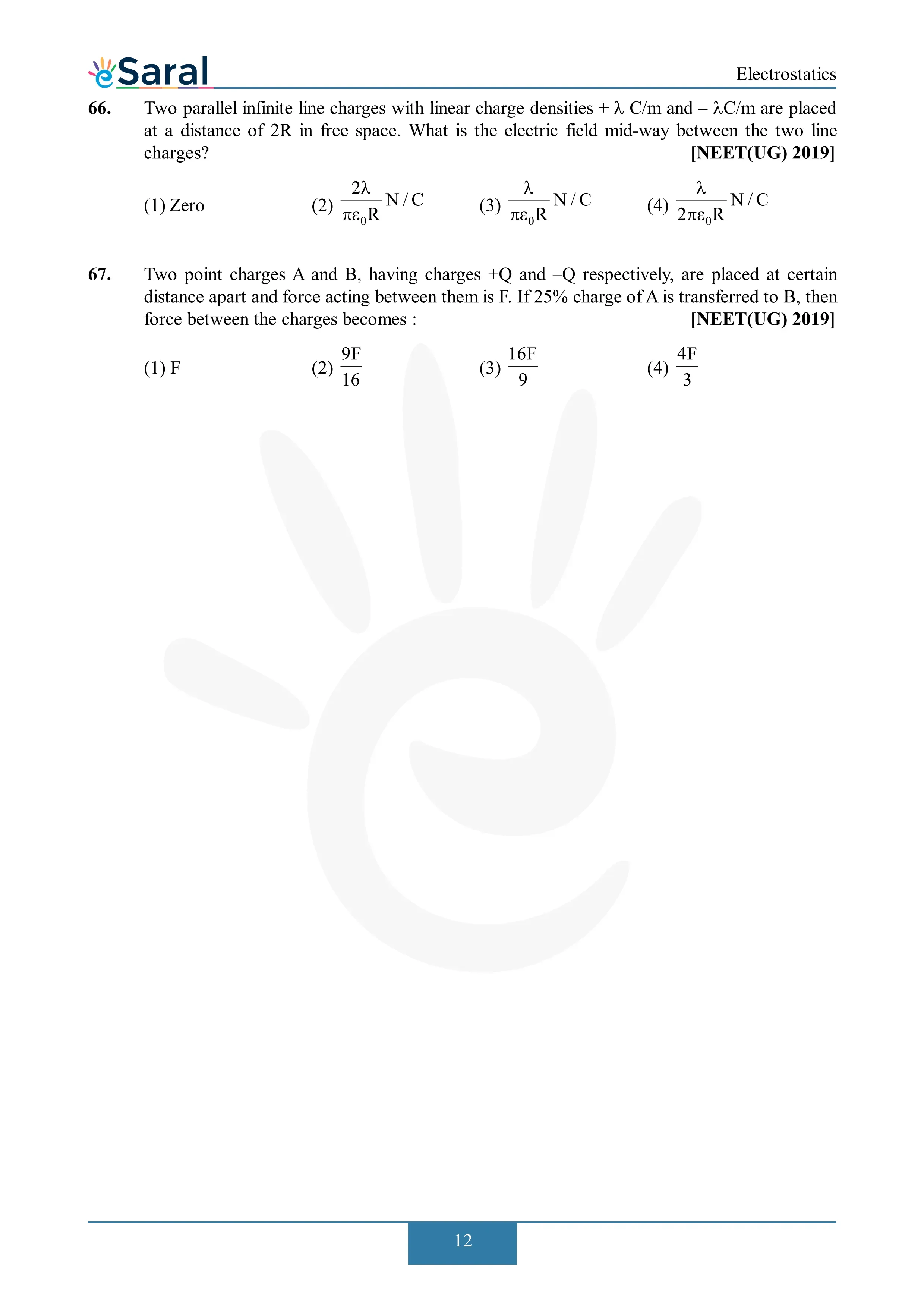
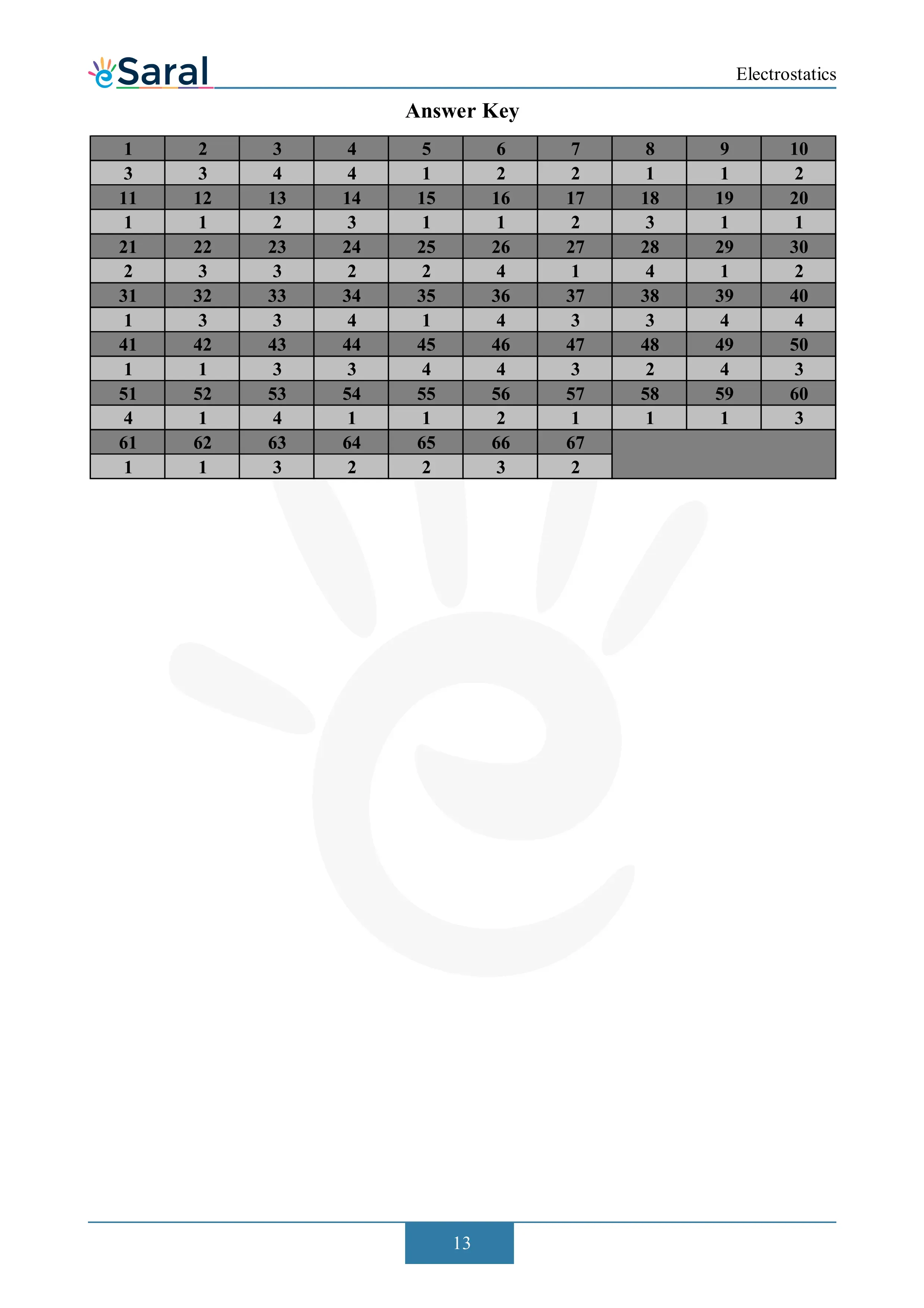
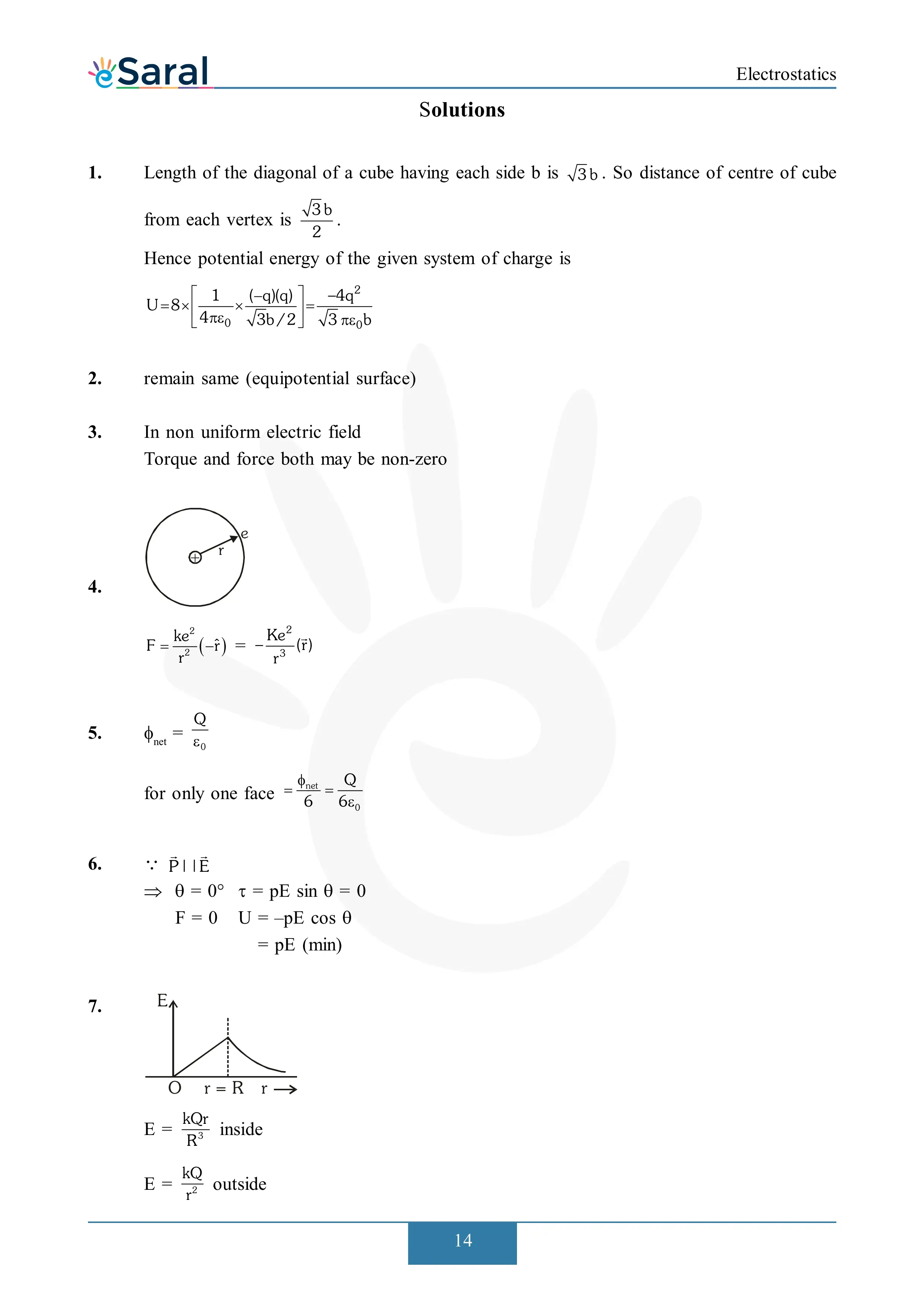
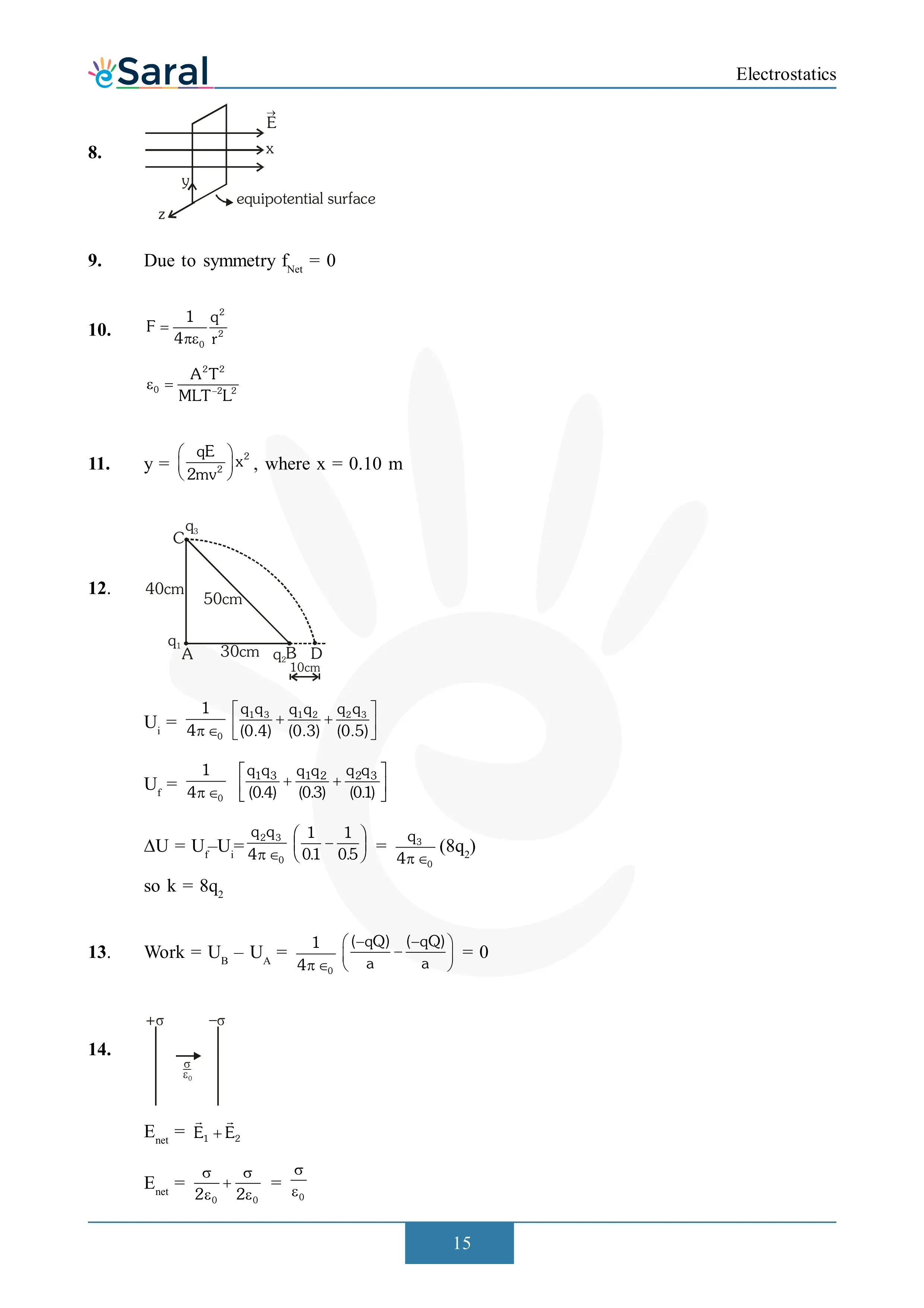
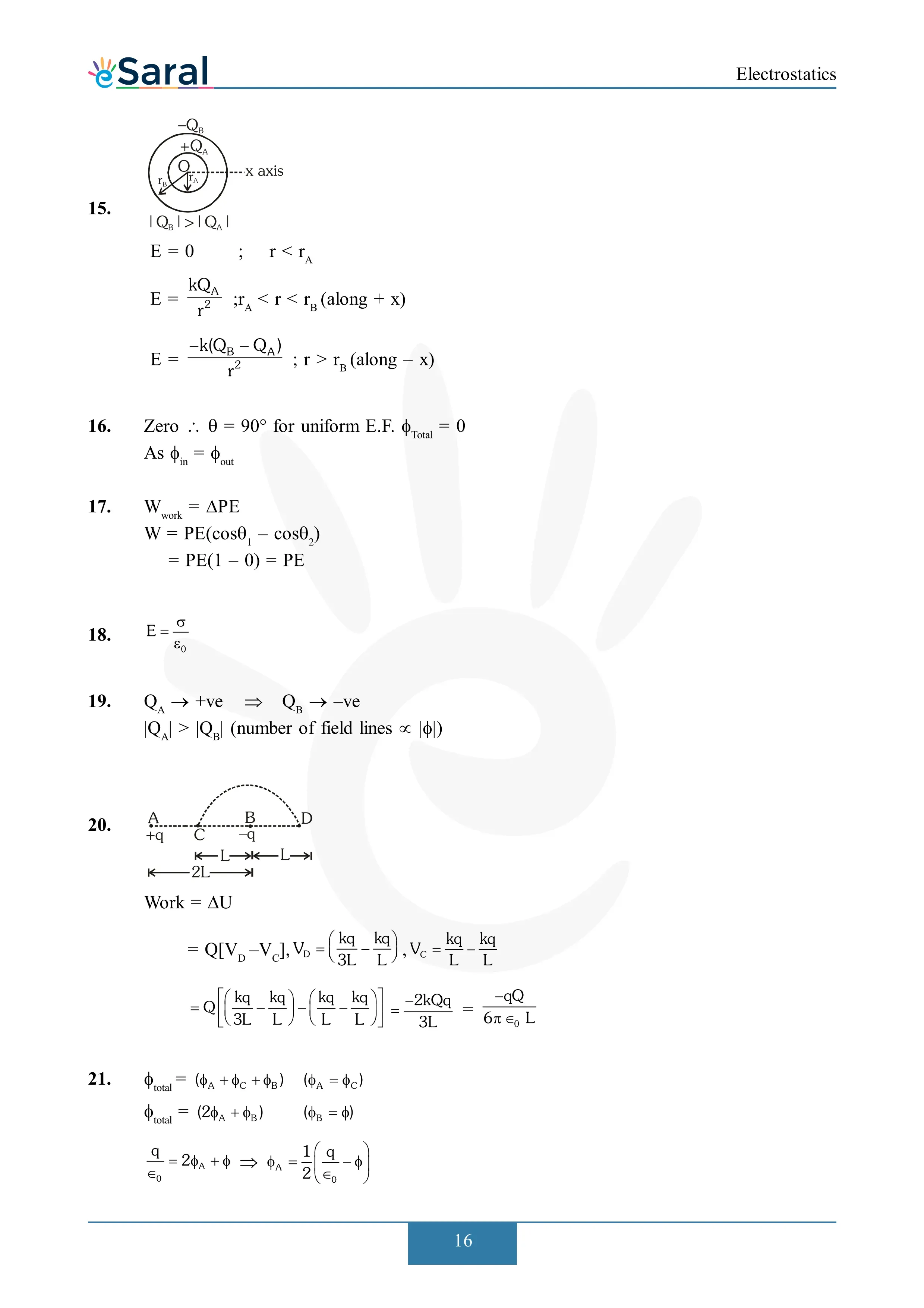
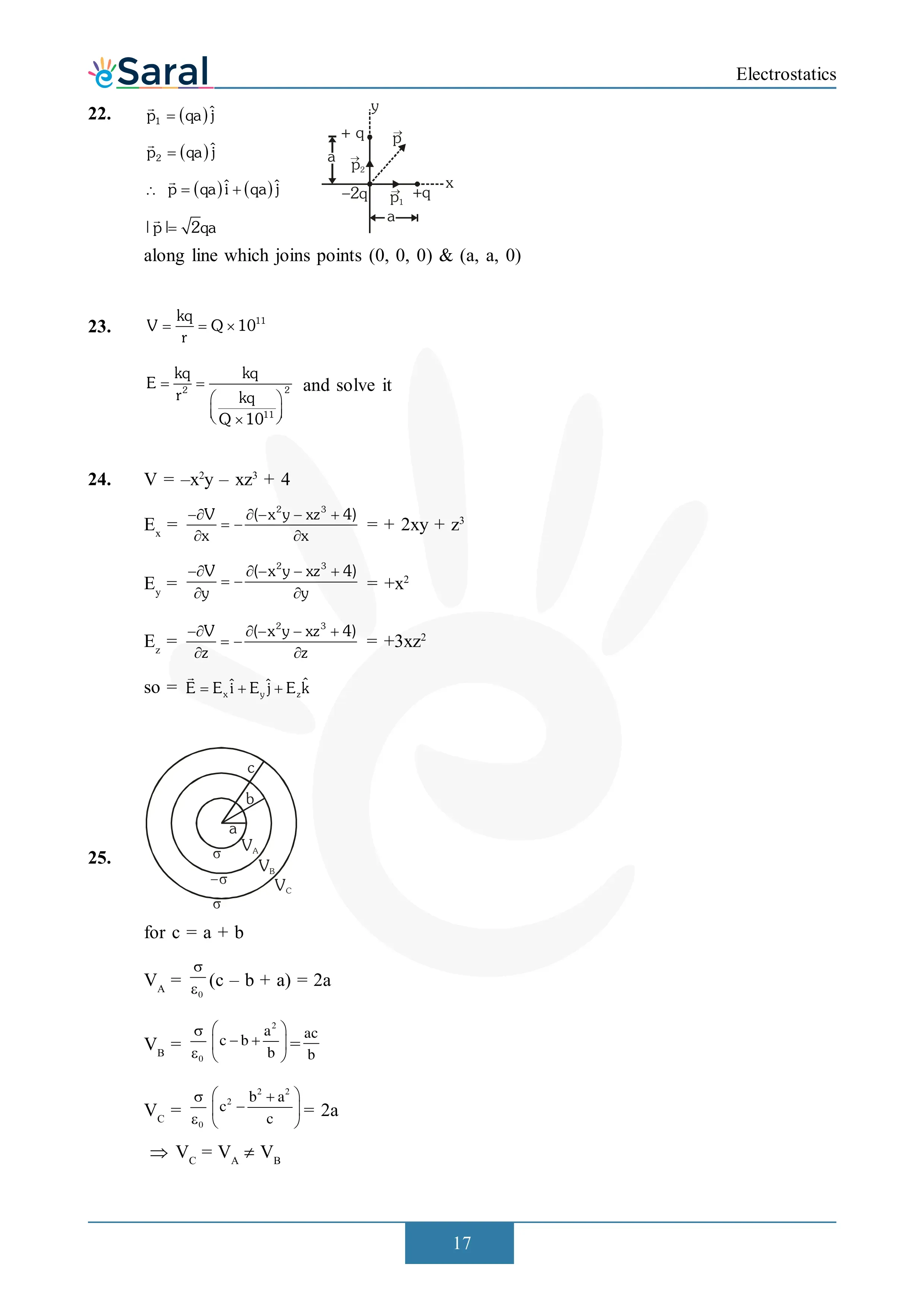
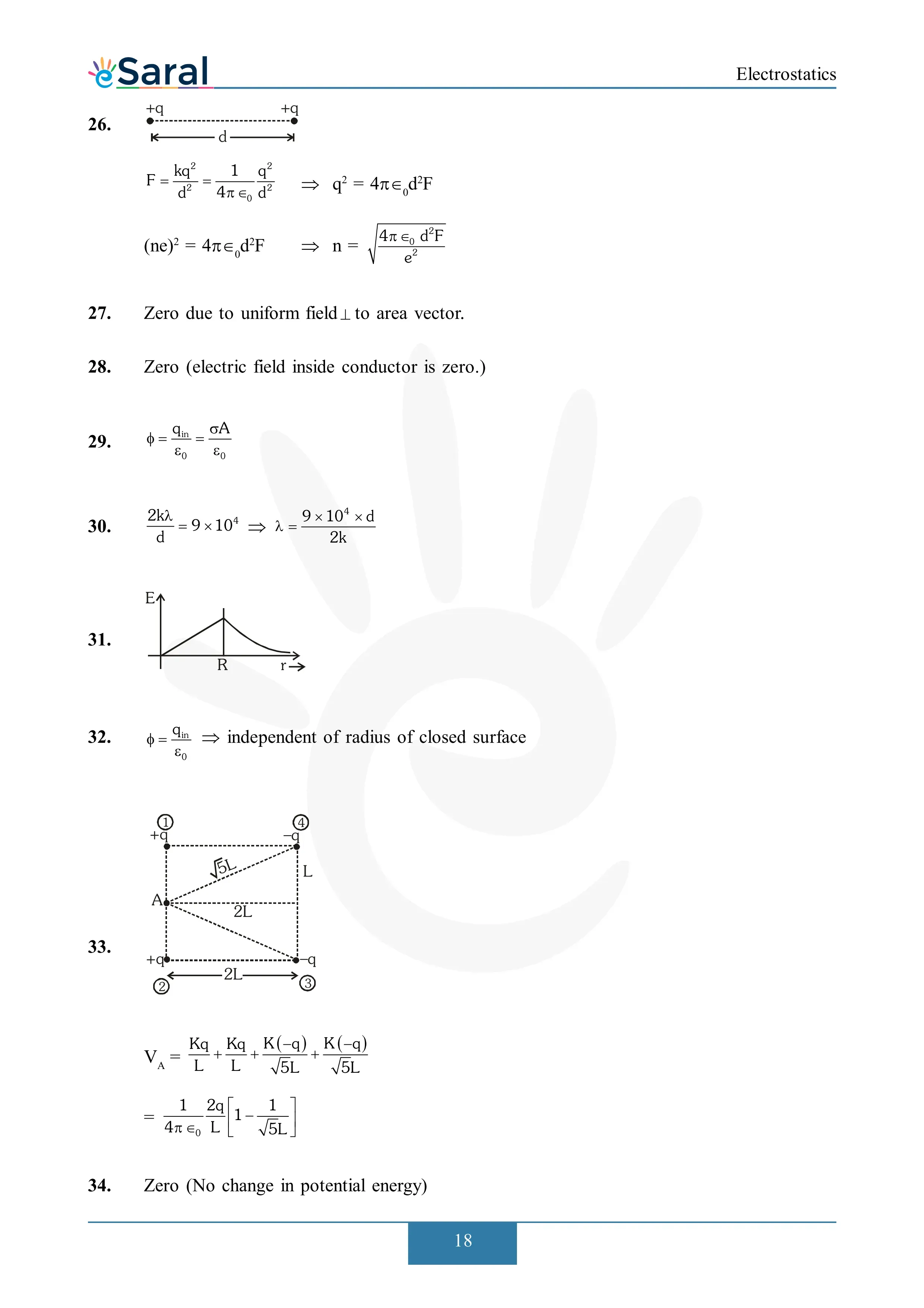
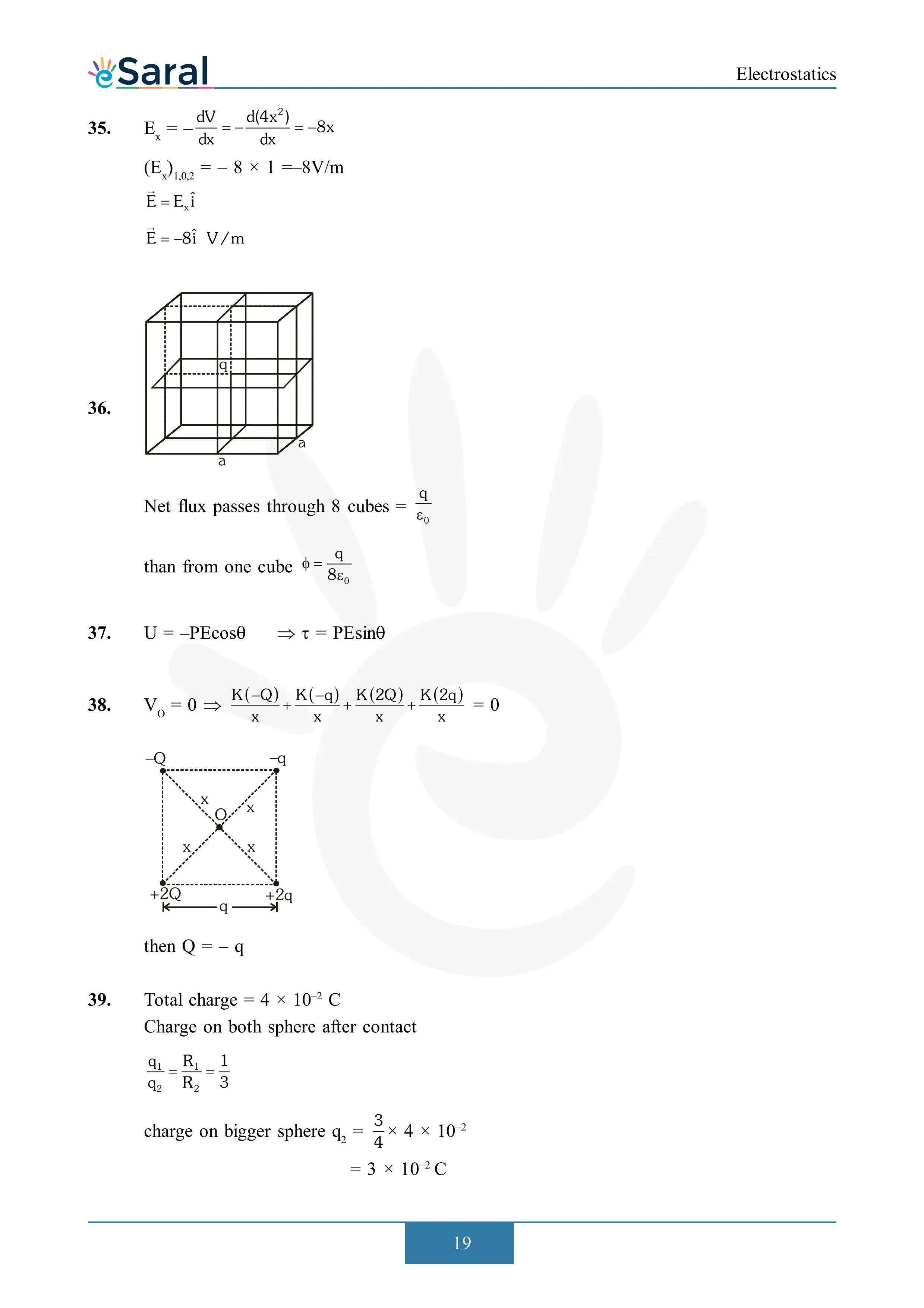
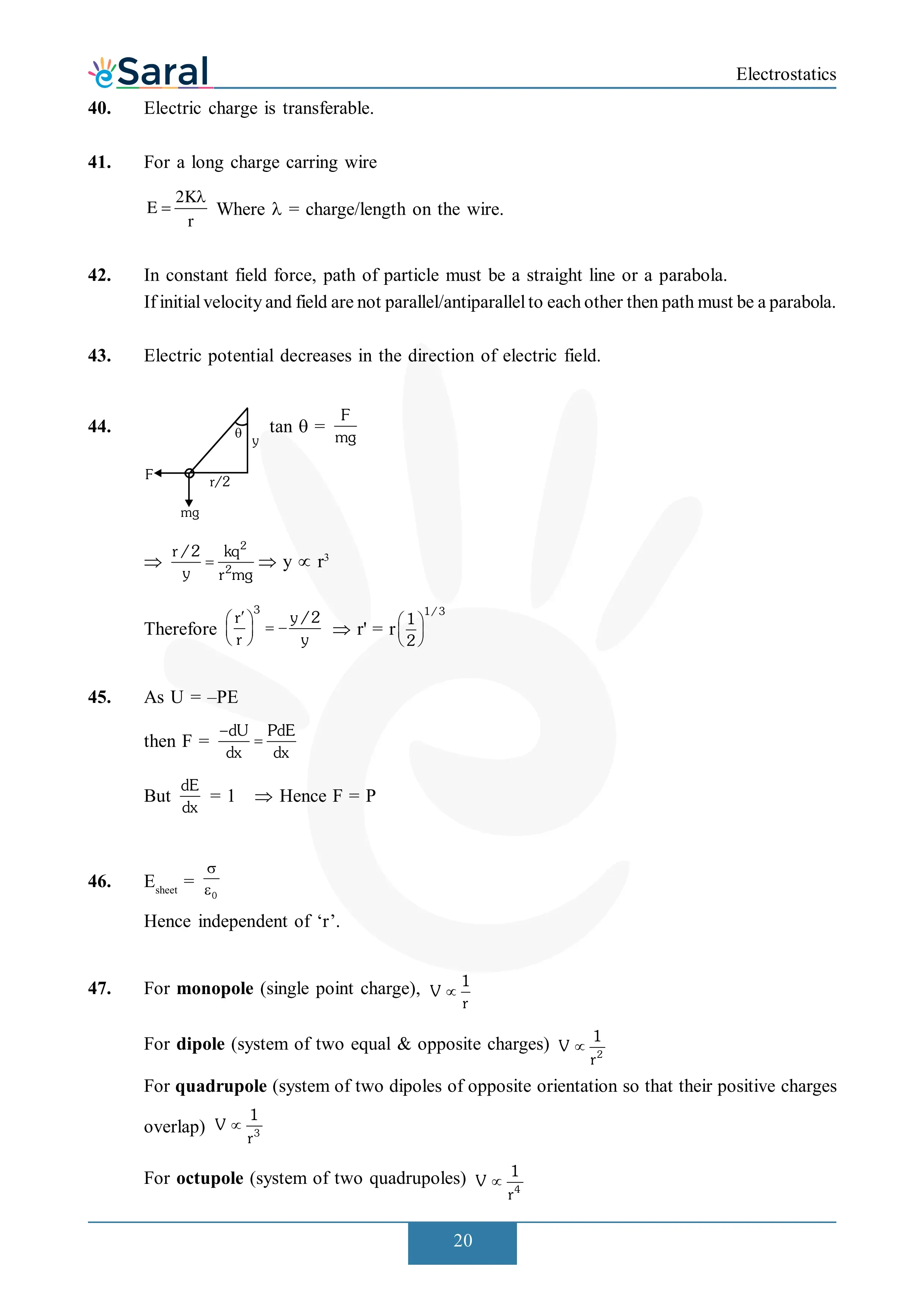
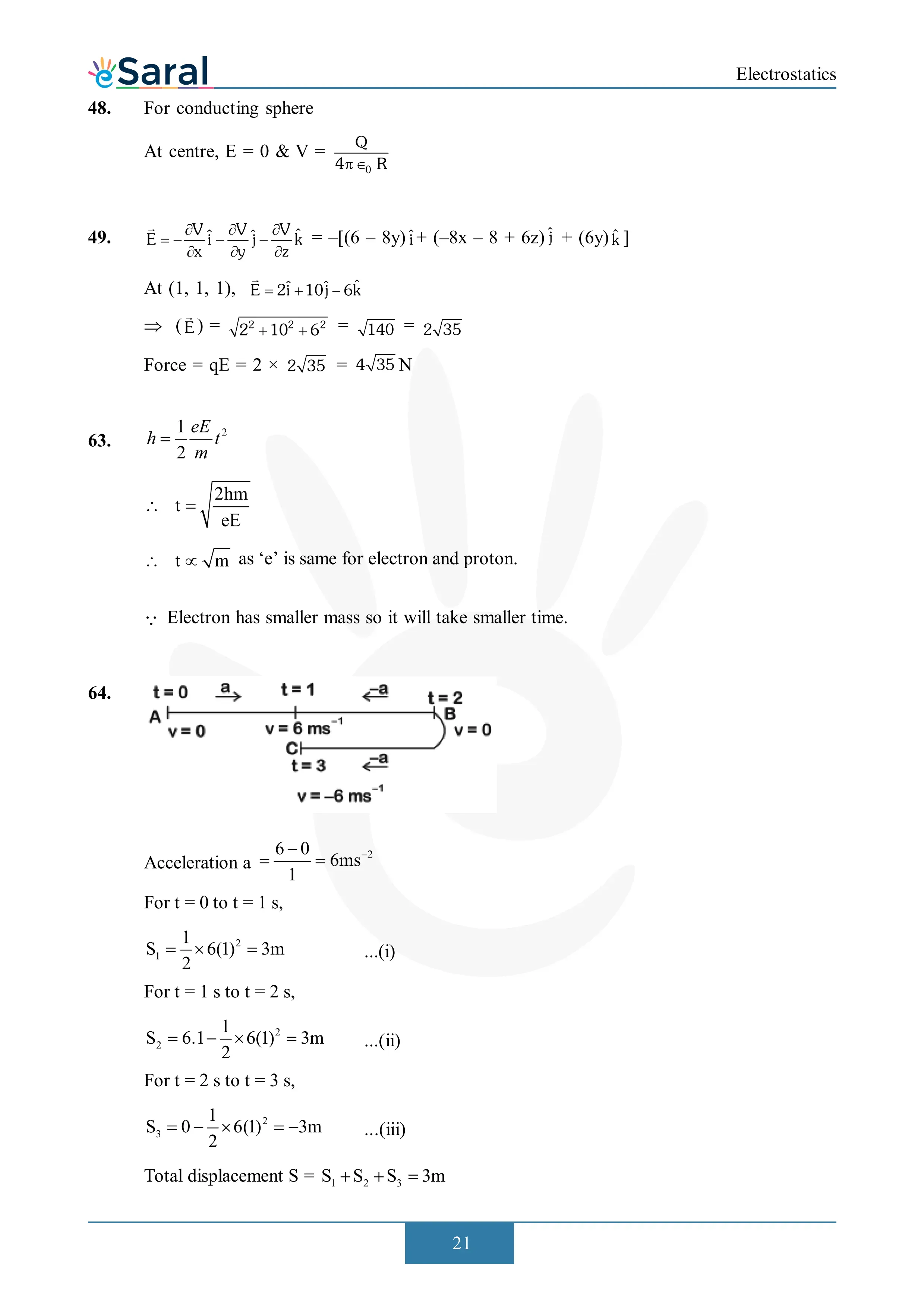
NEET PYQs with step-by-step solutions
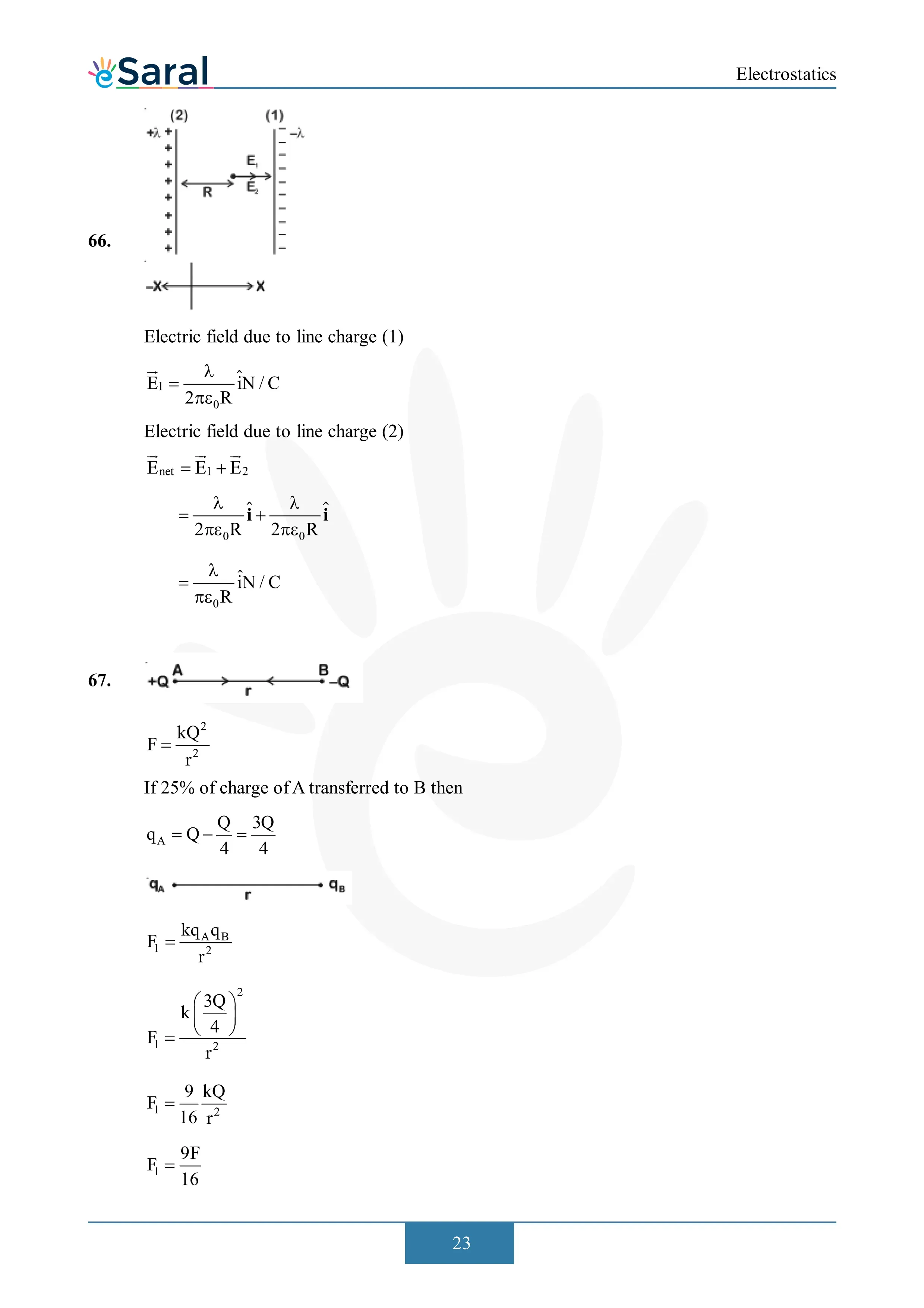
NEET 2022 · Coulomb's Law
Q:Two point charges +3 μC and −3 μC are placed 10 cm apart in vacuum. What is the electric force between them?
F = k × |q₁ × q₂| / r² F = (9×10⁹) × (3×10⁻⁶) × (3×10⁻⁶) / (0.1)² F = (9×10⁹) × (9×10⁻¹²) / 0.01 F = 8.1 N (attractive)
Key concept: Force is attractive because charges are opposite. Direction matters for vector superposition problems.
NEET 2021 · Electric Field
Q:An electric dipole of moment p is placed in a uniform field E. What is the torque when it makes angle θ with the field?
τ = pE sinθ θ = 90° → τ = pE (maximum) θ = 0° → τ = 0 (stable equilibrium) θ = 180° → τ = 0 (unstable equilibrium)
Key concept: θ = 0° is stable equilibrium. θ = 180° is unstable. NEET asks this distinction regularly.
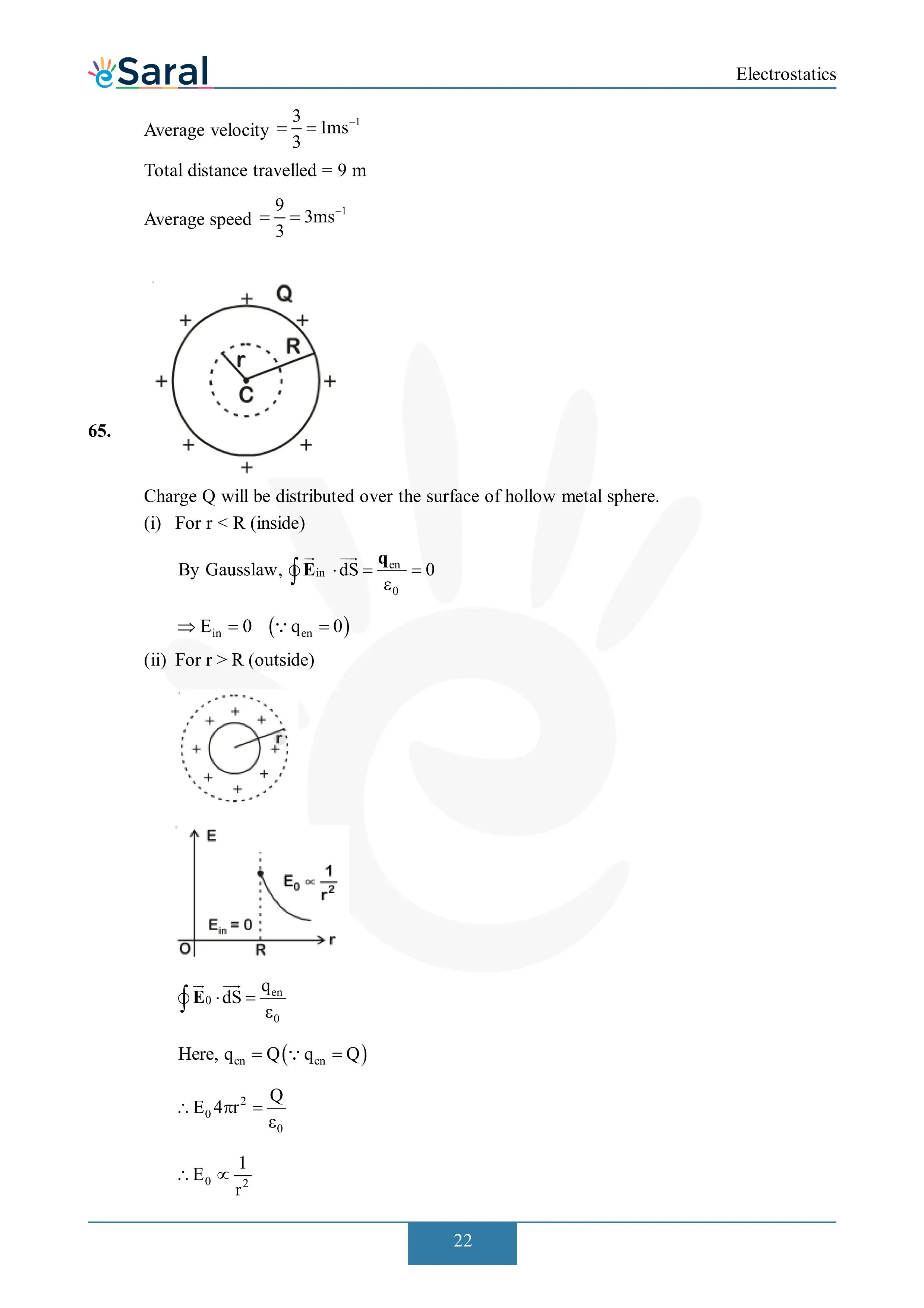
NEET 2023 · Gauss's Law
Q:A spherical shell of radius R carries a surface charge density σ. What is the electric field inside the shell?
Enclosed charge for Gaussian surface inside = 0 ∮ E · dA = Q_enc / ε₀ = 0 ∴ E = 0 (inside the shell)
Key concept: E inside a charged spherical shell is always zero. One of the most frequently tested Gauss's law results.
NEET 2019 · Capacitance
Q:Two capacitors of 4 μF and 6 μF are connected in series. What is the equivalent capacitance?
1/C_eq = 1/4 + 1/6 = 3/12 + 2/12 = 5/12 C_eq = 12/5 = 2.4 μF
Key concept: A series always gives a smaller equivalent capacitance than the smallest individual capacitor.
💡 Expert tip · Saransh Gupta, IIT Bombay AIR-41
"In NEET, capacitor problems almost always involve series-parallel combinations, energy stored, or the effect of a dielectric. Master these three question types and you will answer every capacitor question confidently."
How to solve electrostatics questions quickly in NEET?
NEET gives you roughly 80 seconds per Physics question. Here is the 3-step method used by eSaral's top-scoring students:
- 1
Identify the formula class (10 sec) — Is this Coulomb's law? Gauss's law? Capacitor energy? The first line of the question almost always gives this away. - 2
Write known values with units (20 sec) — List q₁, q₂, r, ε₀ etc. explicitly. Unit errors are the #1 cause of wrong answers in numerical electrostatics questions. - 3
Substitute and simplify (40 sec) — Use powers of 10 arithmetic. Most NEET answers are clean numbers — if you're getting a messy decimal, recheck units first.
Common mistakes to avoid in electrostatics
- Treating potential as a vector: Electric potential is scalar. Add potentials algebraically, not as vectors.
- Confusing E = 0 inside conductor with V = 0: E is zero but V equals the surface potential — it is non-zero.
- Wrong sign in work done: W = q(V₁ − V₂). Flipping this gives the wrong sign on every subsequent step.
- Series-parallel capacitor mix-up: In series, charge is equal. In parallel, voltage is equal.
- Ignoring permittivity of medium: In a medium with dielectric constant K, force becomes F/K and field becomes E/K.
Frequently Asked Questions
How many questions from electrostatics come in NEET every year?
NEET asks 3 to 5 questions from Electrostatics every year. Over the last 10 years (2015–2024), the chapter has contributed an average of 4–5 questions per paper. In NEET 2022 and 2023, 5 questions appeared, accounting for 20 marks.
Which electrostatics topics are most important for NEET?
Electric field due to charge distributions, capacitors with dielectrics, work done in an electric field, Gauss's law shell theorem, and electric potential due to a dipole. These five areas cover nearly 65% of all NEET electrostatics marks over the past decade.
How to solve electrostatics questions quickly in NEET?
Identify the formula class in 10 seconds, write all known values with units, then substitute using powers of 10 arithmetic. Most NEET electrostatics answers are clean numbers — a messy decimal usually means a unit error, not a conceptual mistake.
Does NEET ask numerical or conceptual questions from electrostatics?
NEET asks both. Roughly 60% of recent electrostatics questions are numerical (Coulomb's law, Gauss's law, capacitor formulas), while 40% are conceptual — correct statements about E inside a conductor, or the effect of inserting a dielectric.
What is the easiest sub-topic in electrostatics for NEET?
Coulomb's law and basic series-parallel capacitor combinations are the most formula-direct sub-topics. Students who memorise core formulas and practise 10–15 PYQs can reliably score 2–3 marks from these areas with minimal preparation time.
Team eSaral
eSaral Academic and Editorial Team
Team eSaral is the collective author profile for educational content created by eSaral’s teachers and academic contributors. The team draws on expertise from IIT graduates, doctors, experienced educators and subject specialists to develop resources for JEE, NEET and school students. Our articles aim to explain concepts clearly and help students study with confidence.
Related Posts
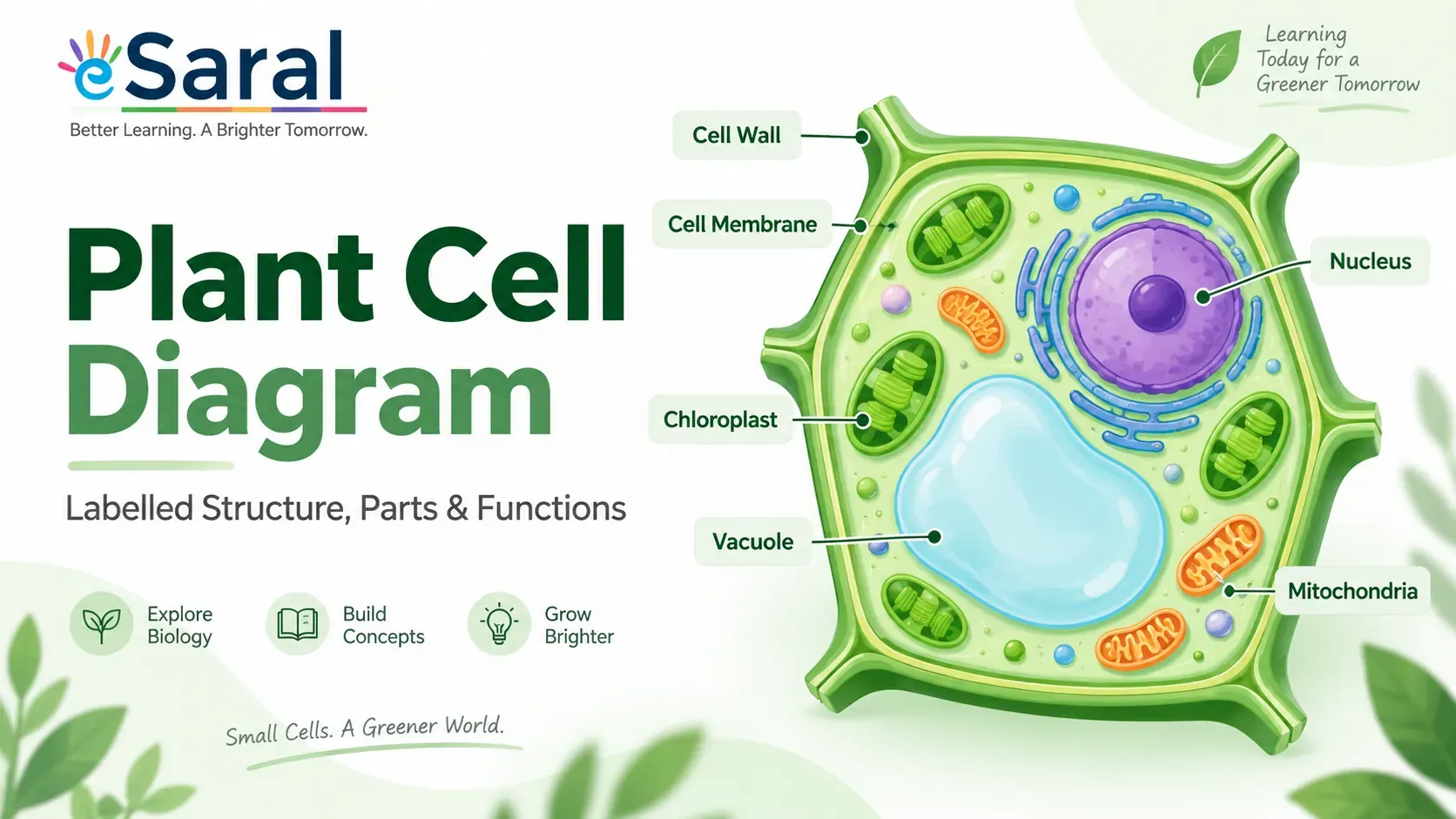
Plant Cell Diagram: Labelled Structure, Parts and Functions
Simple, labelled plant cell diagram with parts and functions. Covers plant cell structure for Class 6, 7, 8, 9, 10 and 11 students, CBSE-aligned.

Saransh Gupta Sir's Visit to IIT Patna: Hostel Life, Placements & Lessons for JEE Aspirants
Inside Saransh Gupta Sir's IIT Patna visit — hostel life, the library, placements, internships, and real advice for JEE aspirants from students living the IIT dream.
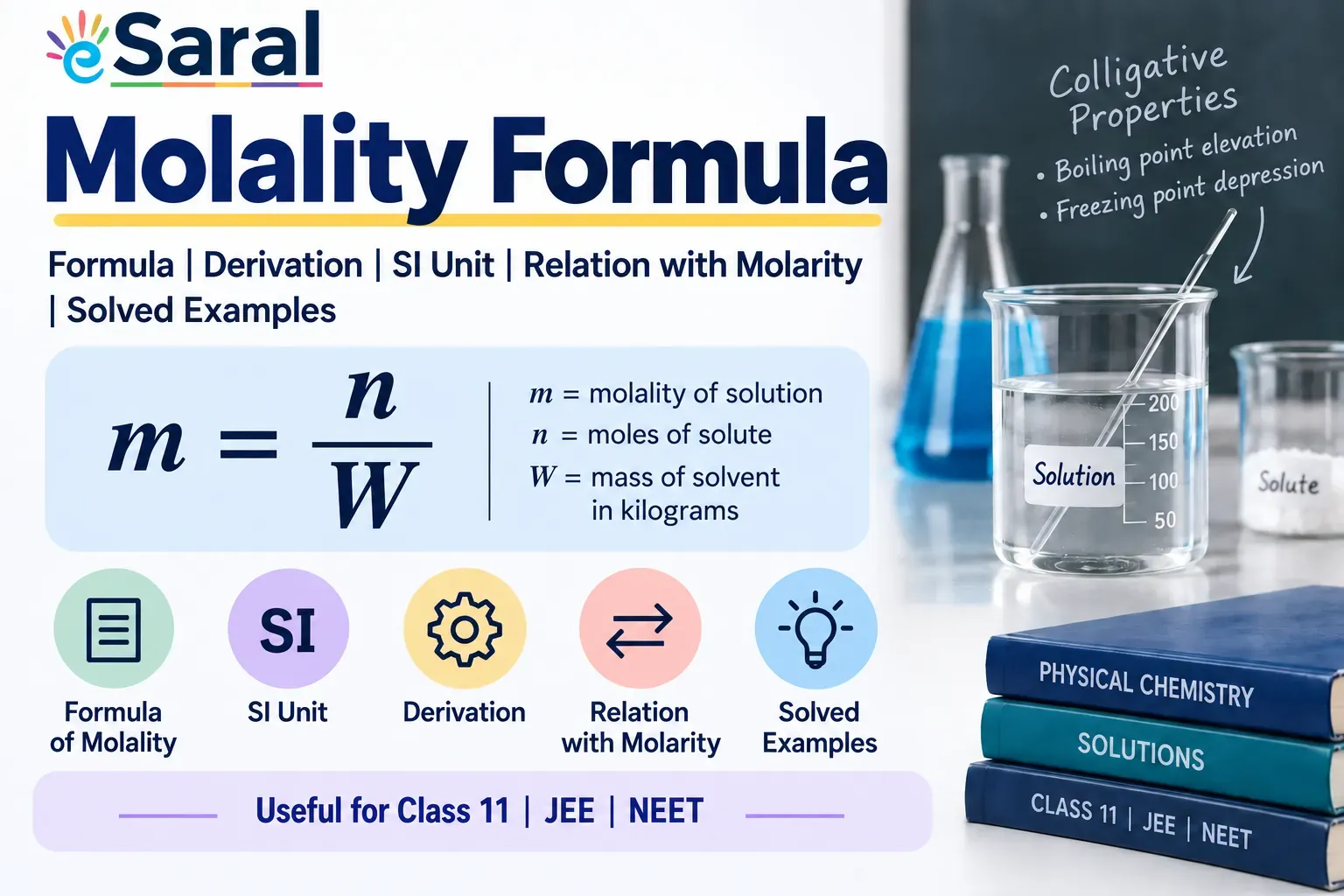
Molality Formula: Formula for Molality, Derivation & Solved Examples
Molality formula is $m = \dfrac{n}{W}$. Learn the formula of molality, its SI unit, derivation, relation with molarity, and solved examples for Class 11, JEE and NEET.
BITSAT Previous Year Question Paper PDF
Download BITSAT previous year question papers PDF. Get year-wise BITSAT PYQs, memory-based papers, exam pattern, and preparation tips to improve your BITSAT preparation.

Teachers’ Day 2026 at eSaral Gurukul: Celebrating the Bond Between Students, Teachers & Mentors
See how Teachers’ Day 2026 was celebrated at eSaral Gurukul, reflecting the bond among students, teachers, and mentors, and the role of guidance beyond academics.
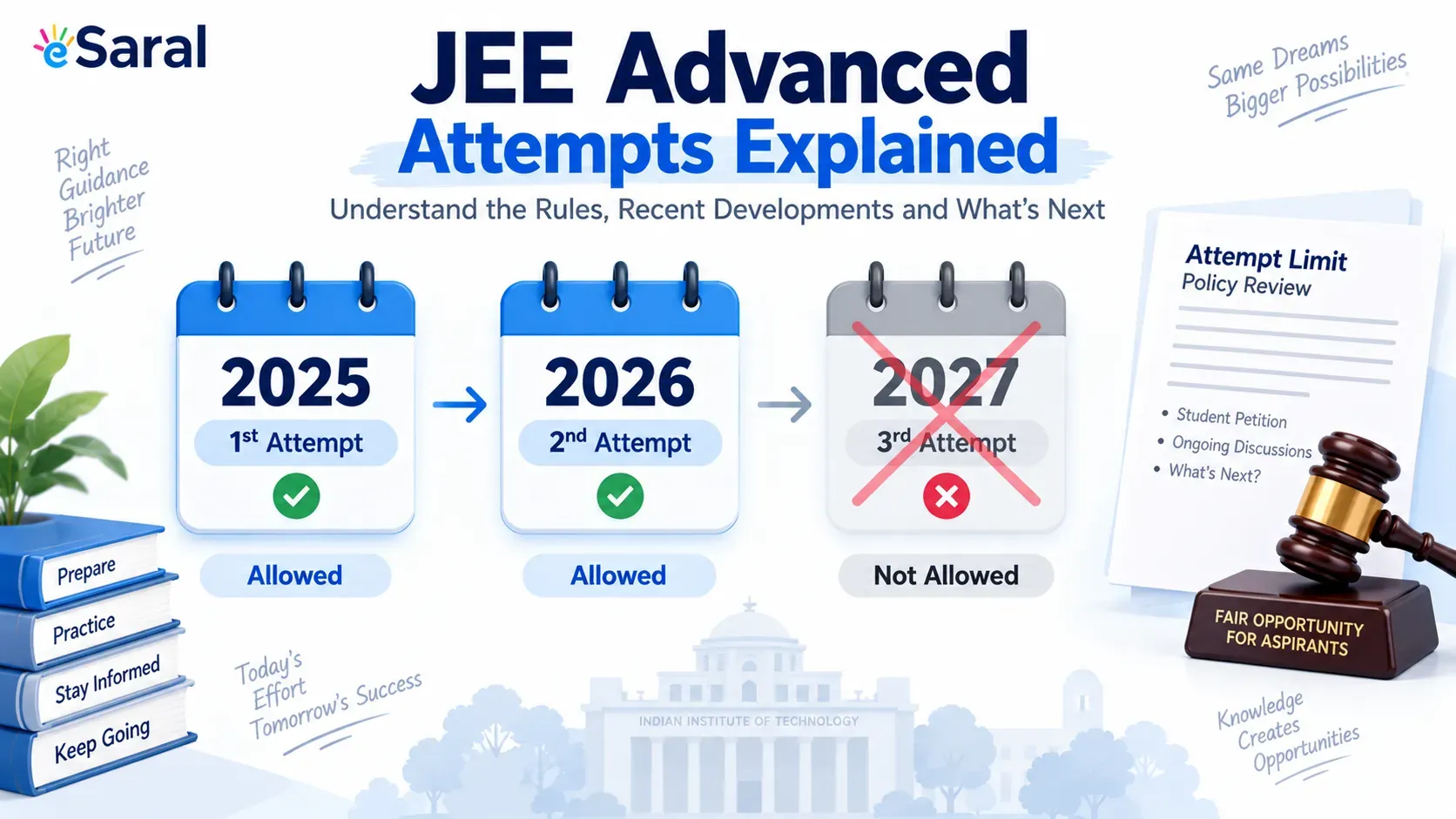
JEE Advanced Attempts: Can You Give It a Third Time? Rules Explained
JEE Advanced attempts: current rule is 2 consecutive years only: full eligibility criteria, the 2025 third-attempt controversy, and the latest 2026 petition news.

Best JEE Preparation App
Best JEE preparation app for Main & Advanced: AI mock tests, live doubt-solving, thousands of practice questions. JEE preparation app for droppers & Class 11-12.
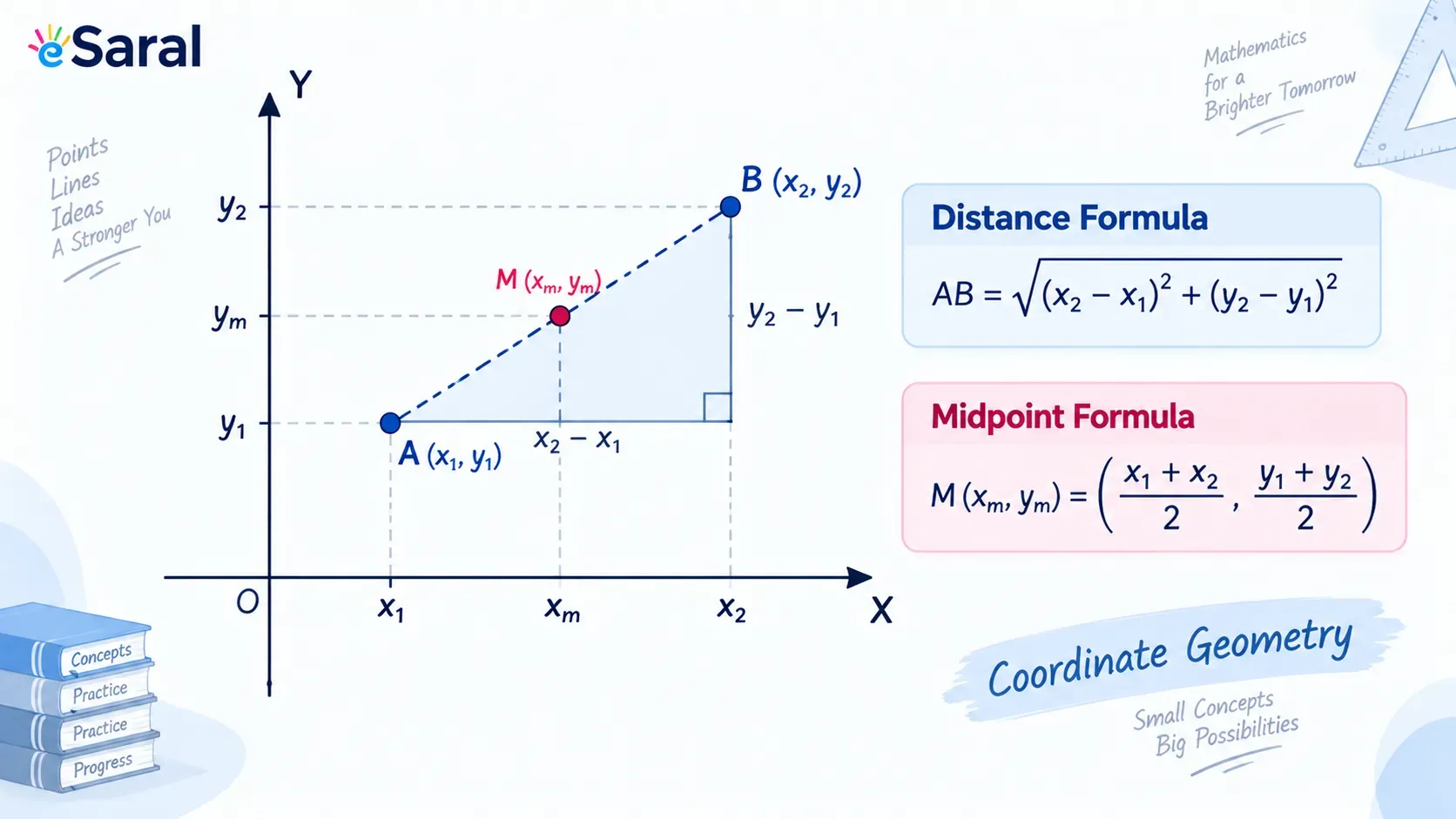
Coordinate Geometry Class 10: Formulas, Notes & Solved Examples
Coordinate geometry class 10: complete CBSE formulas — distance, section, midpoint and area of triangle — with derivation, notes and solved examples.
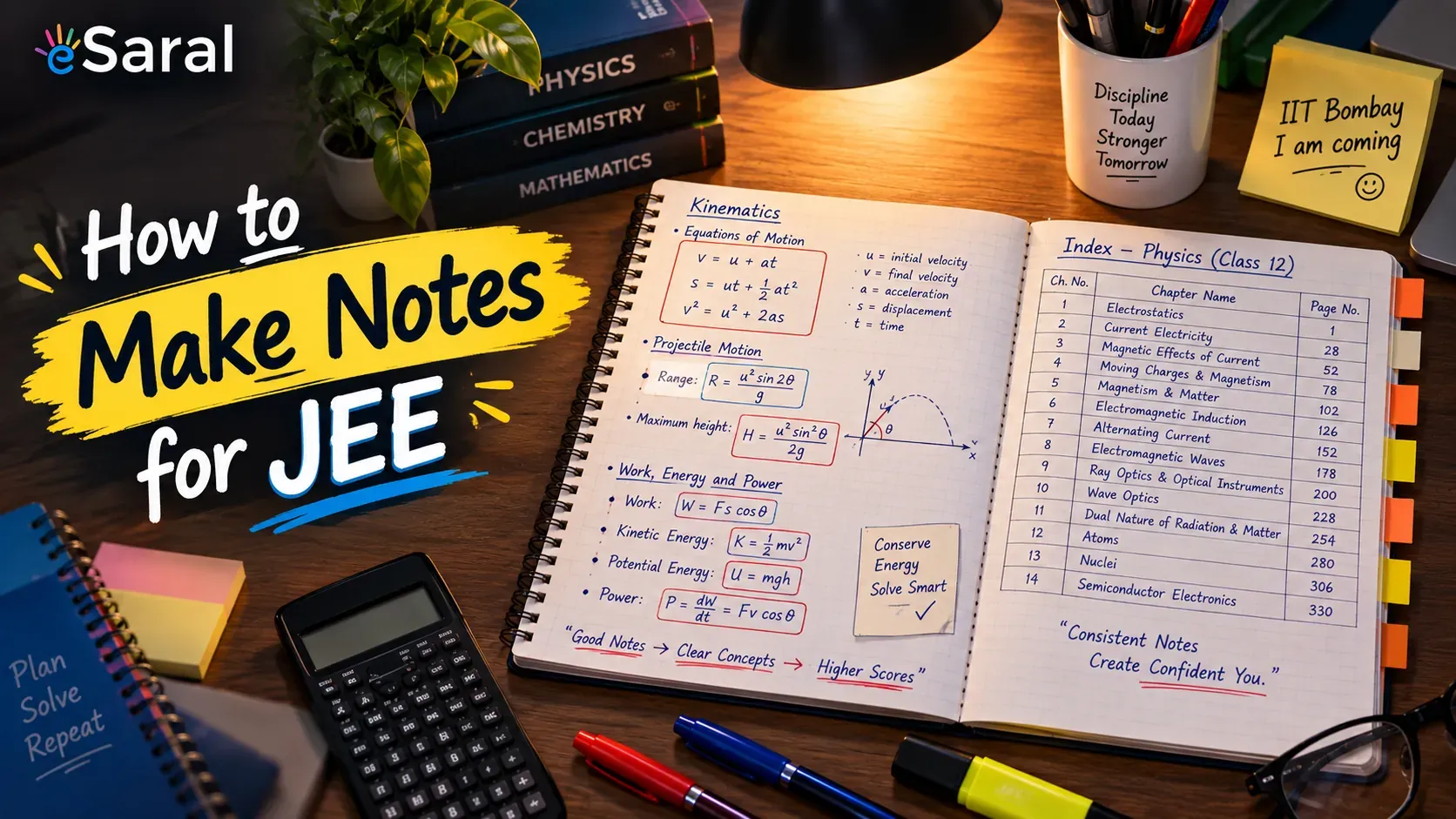
How to make Notes For JEE Smart Notes Strategy of an AIR 41
Learn how to make notes for JEE the way toppers do — indexing, shorthand, and smart short notes for JEE that cut revision time to just 5–7 days.
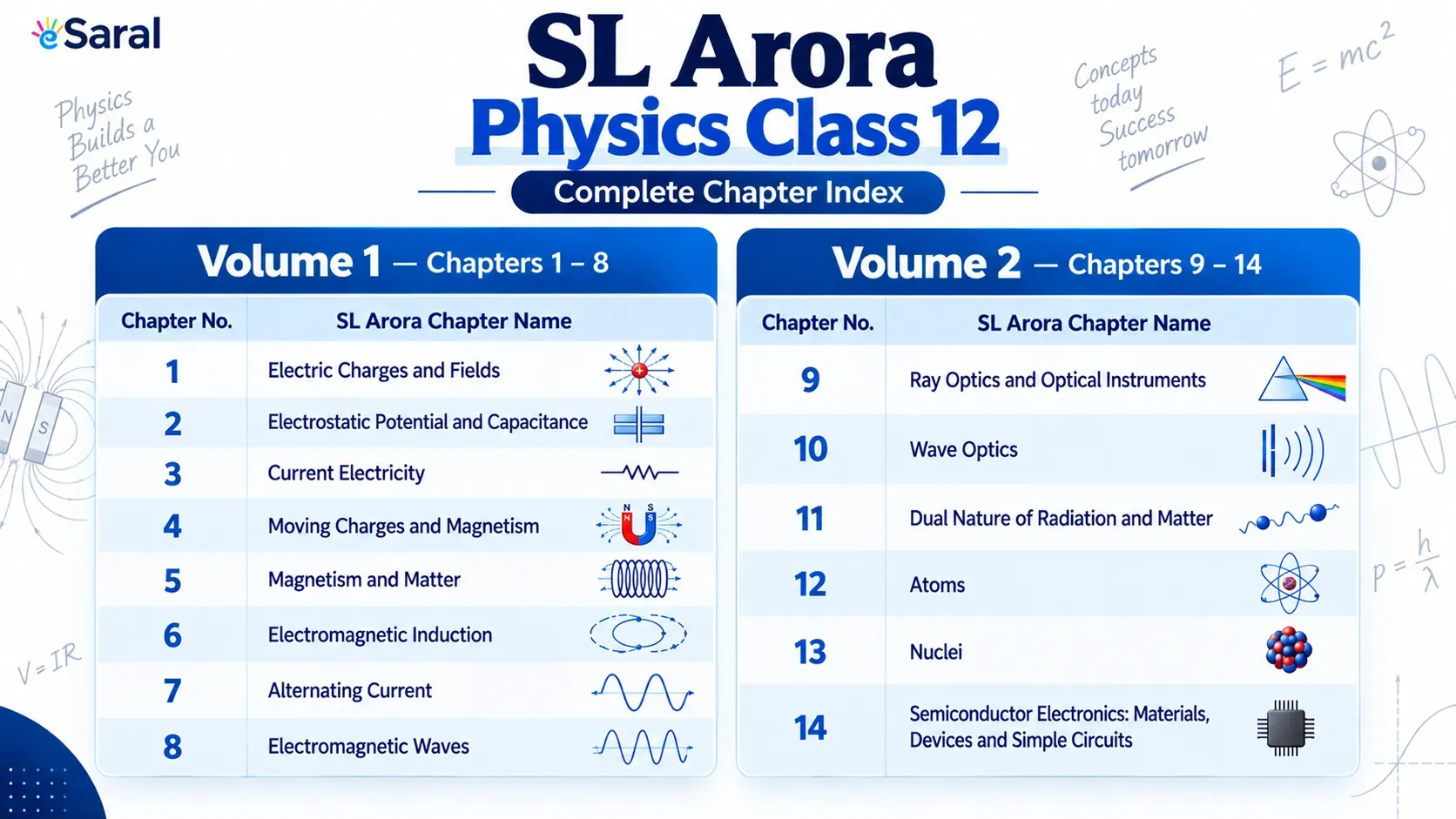
SL Arora Physics Class 12 Index – Chapter List for Volume 1 & 2
SL Arora Physics Class 12 index — complete chapter list for Volume 1 & 2, mapped to NCERT solutions for board, JEE Main, and NEET preparation.