
Ellipse - JEE Advanced Previous Year Questions with Solutions

eSaral Academic and Editorial Team
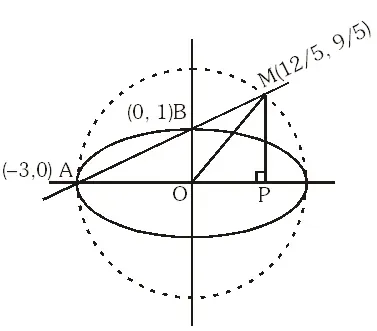
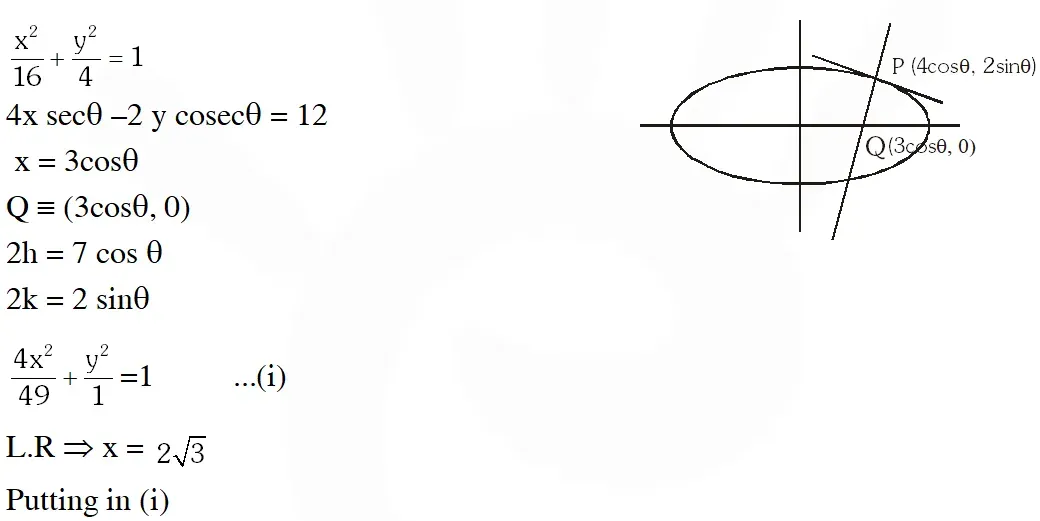
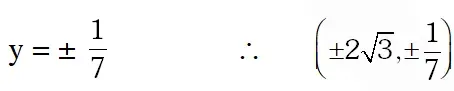
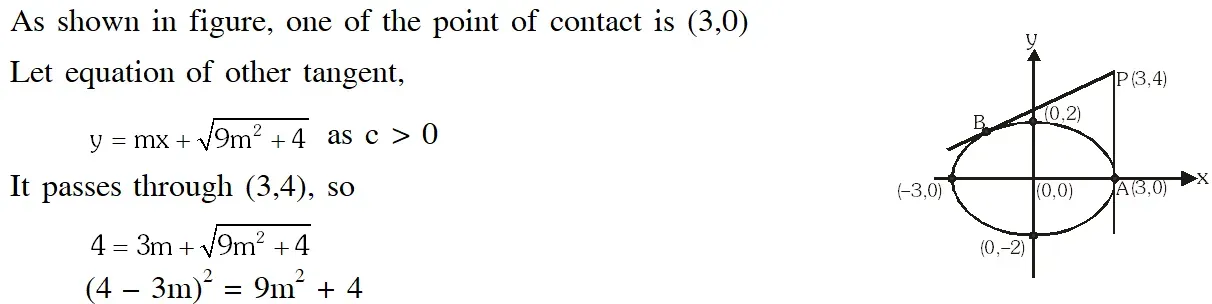
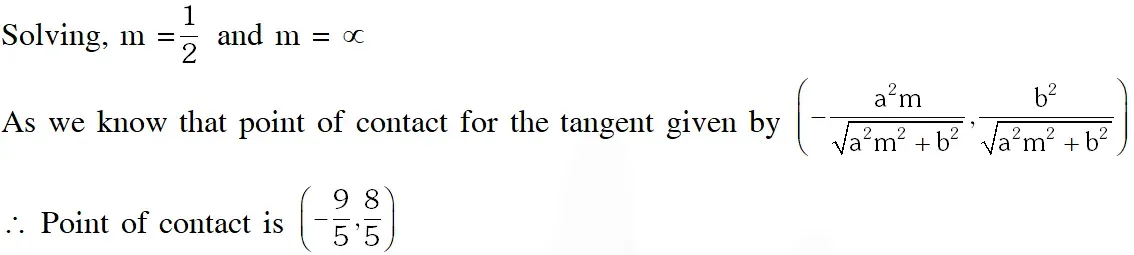
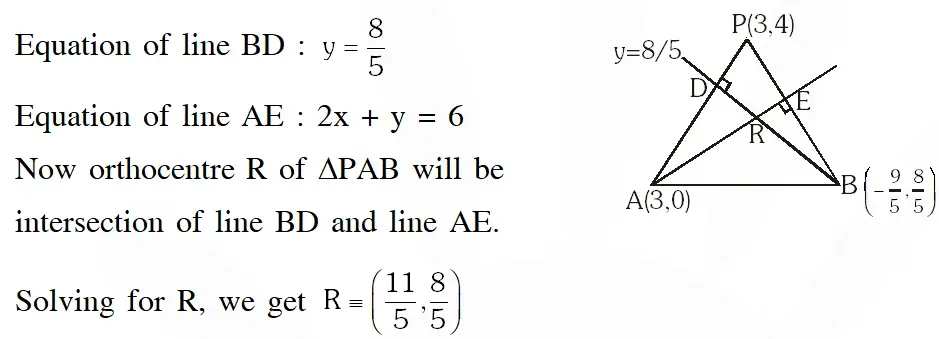
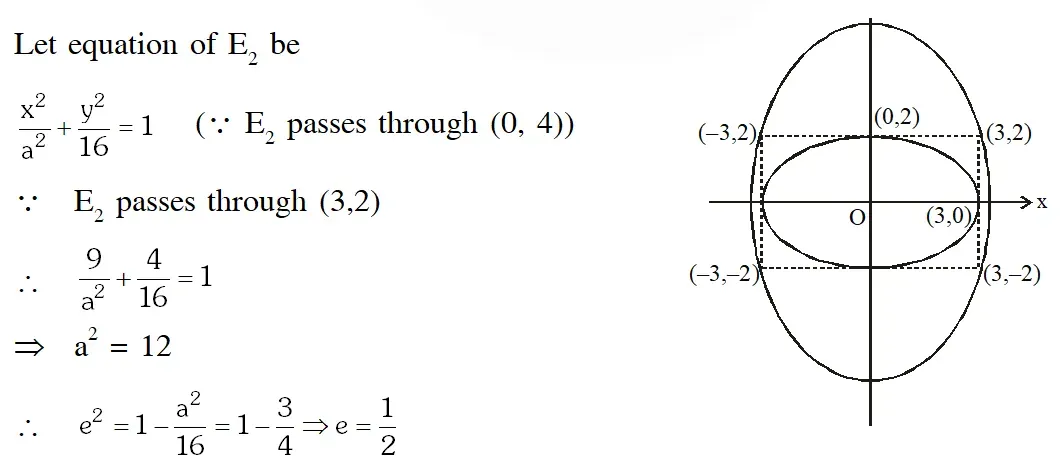
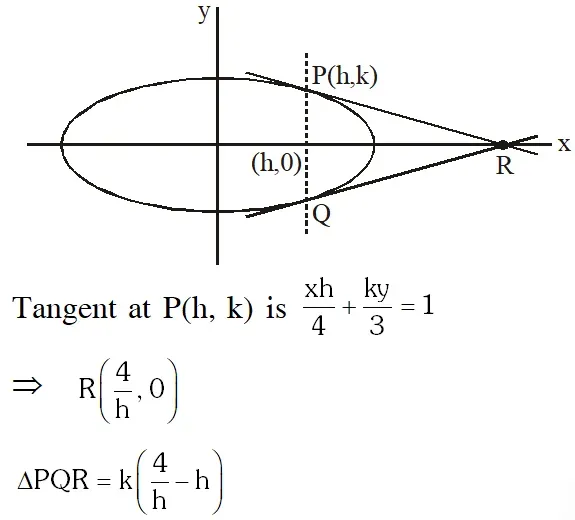
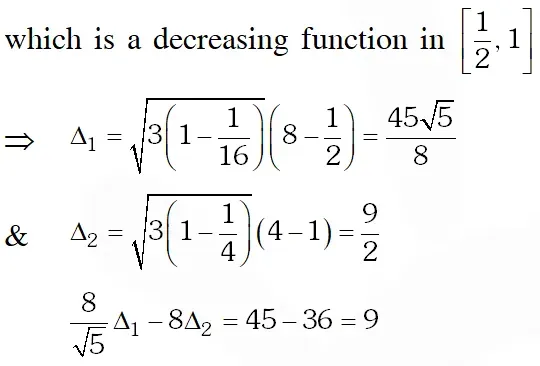
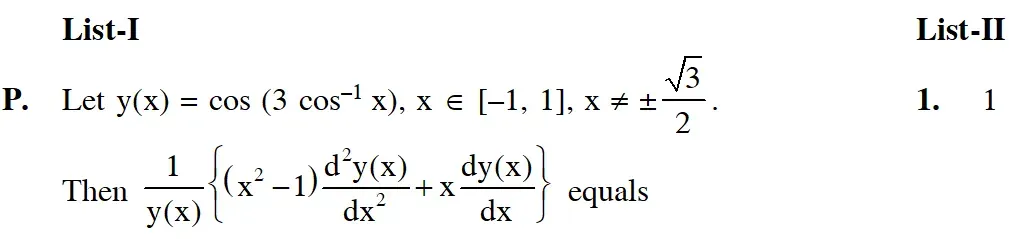
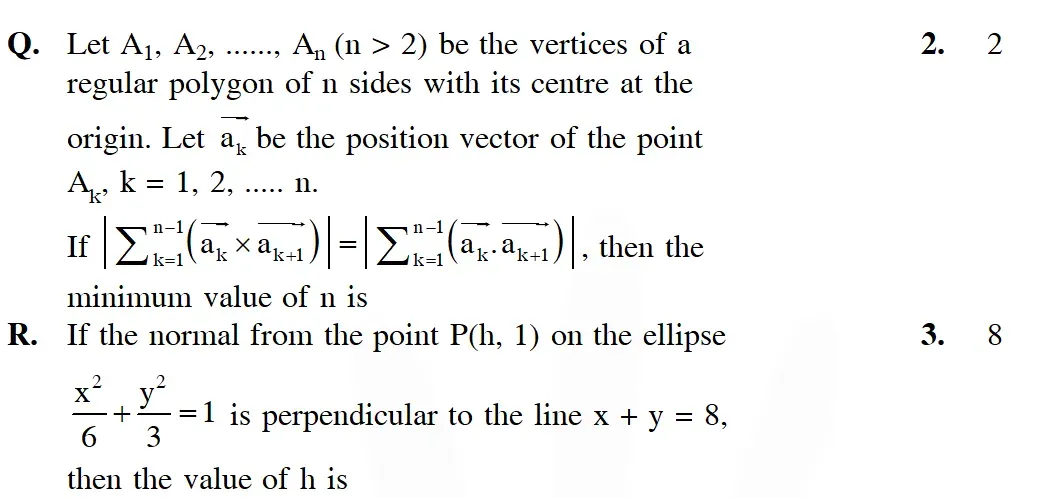
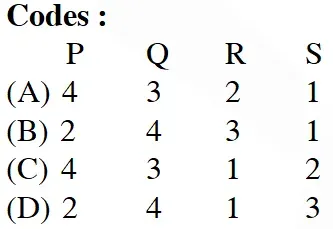
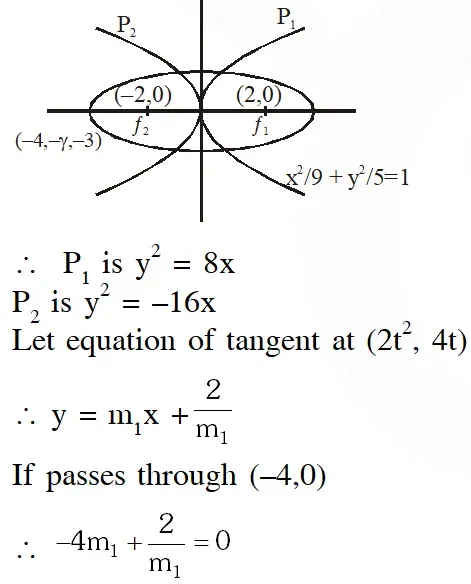
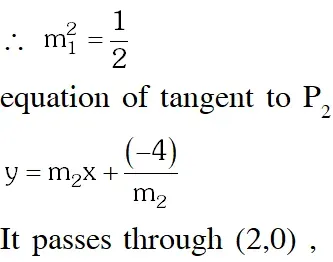
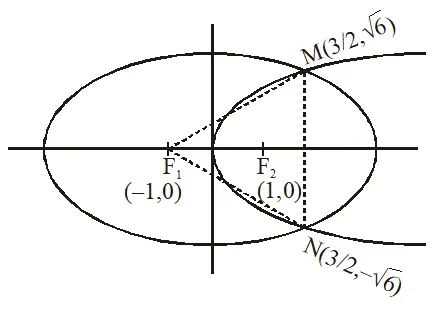
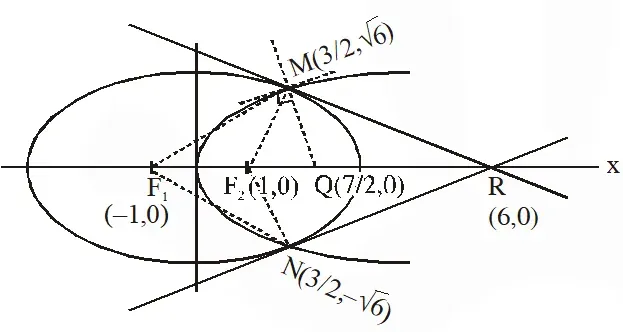
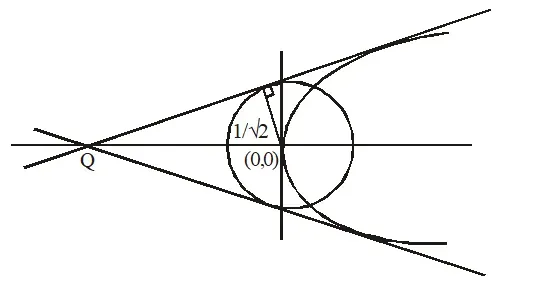
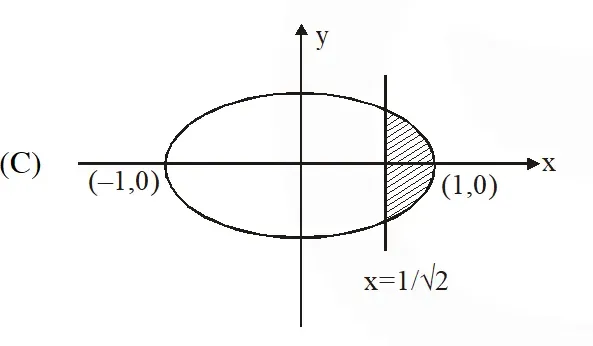
JEE Advanced Previous Year Questions of Math with Solutions are available at eSaral. Practicing JEE Advanced Previous Year Papers Questions of mathematics will help the JEE aspirants in realizing the question pattern as well as help in analyzing weak & strong areas. eSaral helps the students in clearing and understanding each topic in a better way. eSaral also provides complete chapter-wise notes of Class 11th and 12th both for all subjects. Besides this, eSaral also offers NCERT Solutions, Previous year questions for JEE Main and Advance, Practice questions, Test Series for JEE Main, JEE Advanced and NEET, Important questions of Physics, Chemistry, Math, and Biology and many more. Download eSaral app for free study material and video tutorials. [esquestion] The line passing through the extremity A of the major axis and extremity B of the minor axis of the ellipse $x^{2}+9 y^{2}=9$ meets its auxiliary circle at the point M. Then the area of the triangle with vertices at A, M and the origin O is (A) $\frac{31}{10}$ (B) $\frac{29}{10}$ (C) $\frac{21}{10}$ (D) $\frac{27}{10}$ #tag# [JEE 2009, 3] #sol# (D) Area of triangle $\mathrm{AOM}=\frac{1}{2} \mathrm{AO} . \mathrm{PM}$ $\Rightarrow$ Eqaution of $\mathrm{AM}$ is $\mathrm{y}=\frac{1}{3}(\mathrm{x}+3)$ $\mathrm{x}-3 \mathrm{y}+3=0$ which is chord of auxiliary circle $\mathrm{x}^{2}+\mathrm{y}^{2}=9$ and $\mathrm{PM}$ is ordinate of point $\mathrm{M}$ $\Rightarrow(3 \mathrm{y}-3)^{2}+\mathrm{y}^{2}=9 \Rightarrow \mathrm{y}=\frac{9}{5}=\mathrm{PM}$ $2 \cos \left(\frac{\mathrm{B}+\mathrm{C}}{2}\right) \cos \left(\frac{\mathrm{B}-\mathrm{C}}{2}\right)=4 \sin ^{2} \frac{\mathrm{A}}{2} \Rightarrow \cos \left(\frac{\mathrm{B}-\mathrm{C}}{2}\right)=2 \sin \frac{\mathrm{A}}{2}$ $\Rightarrow 2 \cos \frac{\mathrm{A}}{2} \cos \left(\frac{\mathrm{B}-\mathrm{C}}{2}\right)=2 \cdot 2 \sin \frac{\mathrm{A}}{2} \cdot \cos \frac{\mathrm{A}}{2} \Rightarrow 2 \sin \left(\frac{\mathrm{B}+\mathrm{C}}{2}\right) \cos \left(\frac{\mathrm{B}-\mathrm{C}}{2}\right)=2 \sin \mathrm{A}$ $\Rightarrow \sin \mathrm{B}+\sin \mathrm{C}=2 \sin \mathrm{A}$ $\Rightarrow \mathrm{b}+\mathrm{c}=2 \mathrm{a}$ $\Rightarrow$ locus is ellipse [/esquestion] [esquestion] The normal at a point $P$ on the ellipse $x^{2}+4 y^{2}=16$ meets the $x$ -axis at $Q .$ If $M$ is the mid point of the line segment $P Q$, then the locus of Mintersects the latus rectums of the given ellipse at the point (A) $\left(\pm \frac{3 \sqrt{5}}{2}, \pm \frac{2}{7}\right)$ (B) $\left(\pm \frac{3 \sqrt{5}}{2}, \pm \frac{\sqrt{19}}{4}\right)$ (C) $\left(\pm 2 \sqrt{3}, \pm \frac{1}{7}\right)$ (D) $\left(\pm 2 \sqrt{3}, \pm \frac{4 \sqrt{3}}{7}\right)$ #tag# [JEE 2009, 3] #sol# (C) [/esquestion] [esquestion] In a triangle PQR, let $\angle \mathrm{PQR}=30^{\circ}$ and the sides $\mathrm{PQ}$ and $\mathrm{QR}$ have lengths $10 \sqrt{3}$ and 10 , respectively. Then, which of the following statement(s) is (are) TRUE? (A) $\angle \mathrm{QPR}=45^{\circ}$ (B) The area of the triangle PQR is $25 \sqrt{3}$ and $\angle \mathrm{QRP}=120^{\circ}$ (C) The radius of the incircle of the triangle PQR is $10 \sqrt{3}-15$ (D) The area of the circumcircle of the triangle PQR is $100 \pi$. #tag# #sol# (B,C,D) $2 \cos \left(\frac{\mathrm{B}+\mathrm{C}}{2}\right) \cos \left(\frac{\mathrm{B}-\mathrm{C}}{2}\right)=4 \sin ^{2} \frac{\mathrm{A}}{2} \Rightarrow \cos \left(\frac{\mathrm{B}-\mathrm{C}}{2}\right)=2 \sin \frac{\mathrm{A}}{2}$ $\Rightarrow 2 \cos \frac{\mathrm{A}}{2} \cos \left(\frac{\mathrm{B}-\mathrm{C}}{2}\right)=2 \cdot 2 \sin \frac{\mathrm{A}}{2} \cdot \cos \frac{\mathrm{A}}{2} \Rightarrow 2 \sin \left(\frac{\mathrm{B}+\mathrm{C}}{2}\right) \cos \left(\frac{\mathrm{B}-\mathrm{C}}{2}\right)=2 \sin \mathrm{A}$ $\Rightarrow \sin \mathrm{B}+\sin \mathrm{C}=2 \sin \mathrm{A}$ $\Rightarrow \mathrm{b}+\mathrm{c}=2 \mathrm{a}$ $\Rightarrow$ locus is ellipse. Comprehension: $4 \mathrm{to} 5$ [/esquestion] Tangents are drawn from the point $\mathrm{P}(3,4)$ to the ellipse $\frac{\mathrm{x}^{2}}{9}+\frac{\mathrm{y}^{2}}{4}=1$ touching the ellipse at points A and B [esquestion] The coordinates of A and B are (A) (3,0) and (0,2) (B) $\left(-\frac{8}{5}, \frac{2 \sqrt{261}}{15}\right)$ and $\left(-\frac{9}{5}, \frac{8}{5}\right)$ (C) $\left(-\frac{8}{5}, \frac{2 \sqrt{161}}{15}\right)$ and $(0,2)$ (D) $(3,0)$ and $\left(-\frac{9}{5}, \frac{8}{5}\right)$ #tag# [JEE 2010, 3+3+3] #sol# (D) [/esquestion] [esquestion] The orthocenter of the triangle PAB is (A) $\left(5, \frac{8}{7}\right)$ (B) $\left(\frac{7}{5}, \frac{25}{8}\right)$ (C) $\left(\frac{11}{5}, \frac{8}{5}\right)$ (D) $\left(\frac{8}{25}, \frac{7}{5}\right)$ #tag# #sol# (C) [/esquestion] [esquestion] The equation of the locus of the point whose distances from the point P and the line AB are equal, is – (A) $9 x^{2}+y^{2}-6 x y-54 x-62 y+241=0$ (B) $x^{2}+9 y^{2}+6 x y-54 x+62 y-241=0$ (C) $9 x^{2}+9 y^{2}-6 x y-54 x-62 y-241=0$ (D) $x^{2}+y^{2}-2 x y+27 x+31 y-120=0$ #tag# #sol# (A) Equation of line $\mathrm{AB}$ is $\mathrm{x}+3 \mathrm{y}=3$ Now let the point be $(\mathrm{h}, \mathrm{k})$ According to question, $\left|\frac{h+3 k-3}{\sqrt{1^{2}+3^{2}}}\right|=\sqrt{(h-3)^{2}+(4-k)^{2}}$ After solving, we get $9 x^{2}+y^{2}-6 x y-54 x-62 y+241=0$ [/esquestion] [esquestion] The ellipse $\mathrm{E}_{1}: \frac{\mathrm{x}^{2}}{9}+\frac{\mathrm{x}^{2}}{4}=1$ is inscribed in a rectangle $\mathrm{R}$ whose sides are parallel to the coordinate axes. Another ellipse $\mathrm{E}_{2}$ passing through the point $(0,4)$ circumscribes the rectangle $\mathrm{R}$. The eccentricity of the ellipse $\mathrm{E}_{2}$ is $-$ (A) $\frac{\sqrt{2}}{2}$ (B) $\frac{\sqrt{3}}{2}$ (C) $\frac{1}{2}$ (D) $\frac{3}{4}$ #tag# [JEE 2012, 3M, –1M] #sol# (C) [/esquestion] [esquestion] A vertical line passing through the point (h,0) intersects the ellipse $\frac{x^{2}}{4}+\frac{y^{2}}{3}=1$ at the points $P$ and $Q$. Let the tangents to the ellipse at $P$ and $Q$ meet at the point $R .$ If $\Delta(h)=$ area of the triangle $P Q R, \Delta_{1}=\max _{1 / 2 \leq h \leq 1} \Delta(h)$ and $\Delta_{2}=\min _{1 / 2 \Delta \operatorname{Lh} \leq 1} \Delta(h),$ then $\frac{8}{\sqrt{5}} \Delta_{1}-8 \Delta_{2}=$ #tag# [JEE-Advanced 2013, 4, (–1)] #sol# (9) [/esquestion] [esquestion] #tag# [JEE(Advanced)-2014, 3(–1)] #sol# (A) [/esquestion] [esquestion] Suppose that the foci of the ellipse $\frac{x^{2}}{9}+\frac{y^{2}}{5}=1$ are $\left(f_{1}, 0\right)$ and $\left(f_{2}, 0\right)$ where $f_{1}>0$ and $f_{2}<0 .$ Let $\mathrm{P}_{1}$ and $\mathrm{P}_{2}$ be two parabolas with a common vertex at $(0,0)$ and with foci at $\left(f_{1}, 0\right)$ and $\left(2 f_{2}, 0\right),$ respectively. Let $\mathrm{T}_{1}$ be a tangent to $\mathrm{P}_{1}$ which passes through $\left(2 f_{2}, 0\right)$ and $\mathrm{T}_{2}$ be a tangent to $\mathrm{P}_{2}$ which passes through $\left(f_{1}, 0\right) .$ If $\mathrm{m}_{1}$ is the slope of $\mathrm{T}_{1}$ and $\mathrm{m}_{2}$ is the slope of $\mathrm{T}_{2},$ then the value of $\left(\frac{1}{\mathrm{m}_{1}^{2}}+\mathrm{m}_{2}^{2}\right)$ is #tag# [JEE 2015, 4M, –0M] #sol# 4 [/esquestion] [esquestion] Let $\mathrm{E}_{1}$ and $\mathrm{E}_{2}$ be two ellipses whose centers are at the origin. The major axes of $\mathrm{E}_{1}$ and $\mathrm{E}_{2}$ lie along the $\mathrm{x}$ -axis and the $\mathrm{y}$ -axis, respectively. Let $\mathrm{S}$ be the circle $\mathrm{x}^{2}+(\mathrm{y}-1)^{2}=2 .$ The straight line $\mathrm{x}+\mathrm{y}=3$ touches the curves $\mathrm{S}, \mathrm{E}_{1}$ and $\mathrm{E}_{2}$ at $\mathrm{P}, \mathrm{Q}$ and $\mathrm{R},$ respectively. Suppose that $\mathrm{PQ}=\mathrm{PR}=\frac{2 \sqrt{2}}{3} .$ If $\mathrm{e}_{1}$ and $\mathrm{e}_{2}$ are the eccentricities of $\mathrm{E}_{1}$ and $\mathrm{E}_{2},$ respectively, then the correct expression(s) is(are) (A) $\mathrm{e}_{1}^{2}+\mathrm{e}_{2}^{2}=\frac{43}{40}$ (B) $\mathrm{e}_{1} \mathrm{e}_{2}=\frac{\sqrt{7}}{2 \sqrt{10}}$ (C) $\left|\mathrm{e}_{1}^{2}-\mathrm{e}_{2}^{2}\right|=\frac{5}{8}$ (D) $\mathrm{e}_{1} \mathrm{e}_{2}=\frac{\sqrt{3}}{4}$ #tag# [JEE 2015, 4M, –0M] #sol# (A,B) Let $\mathrm{E}_{1}: \frac{\mathrm{x}^{2}}{\mathrm{a}^{2}}+\frac{\mathrm{y}^{2}}{\mathrm{b}^{2}}=1 \quad(\mathrm{a}>\mathrm{b})$ $\mathrm{\&} \quad \mathrm{E}_{2}: \frac{\mathrm{x}^{2}}{\mathrm{c}^{2}}+\frac{\mathrm{y}^{2}}{\mathrm{d}^{2}}=1 \quad(\mathrm{c}<\mathrm{d})$ $\& \quad \mathrm{S}: \mathrm{x}^{2}+(\mathrm{y}-1)^{2}=2$ $\mathrm{\&} \quad$ tangent to $\mathrm{E}_{1}, \mathrm{E}_{2} \& \mathrm{S}$ is $\mathrm{x}+\mathrm{y}=3$ Now, point of contact of $\mathrm{S} \&$ tangent is $\left(\mathrm{x}_{1}, \mathrm{y}_{1}\right)$ Let $\mathrm{x}=\mathrm{X} \quad \& \mathrm{y}-1=\mathrm{Y}$ $\therefore \quad \mathrm{X}^{2}+\mathrm{Y}^{2}=2$ $\mathrm{\&} \quad \mathrm{X}+\mathrm{Y}=2$ Let $\left(\mathrm{X}_{1}, \mathrm{Y}_{1}\right)$ be point of contact. $\therefore \quad \mathrm{X}_{1}+\mathrm{YY}_{1}=2$ $\therefore \quad \mathrm{X}_{1}=1 \& \mathrm{Y}_{1}=1$ $\therefore \quad \mathrm{x}_{1}=1 \& \mathrm{y}_{1}=2$ Now, parametric equation of $x+y=3$ is $\frac{x-1}{-\frac{1}{\sqrt{2}}}=\frac{y-2}{\frac{1}{\sqrt{2}}}=\pm \frac{2 \sqrt{2}}{3} \Rightarrow x=\frac{5}{3}, y=\frac{4}{3}$ $\Rightarrow \quad x=\frac{1}{3} \& y=\frac{8}{3}$ $\therefore \quad \mathrm{P} \equiv(1,2), \quad \mathrm{Q} \equiv\left(\frac{5}{3}, \frac{4}{3}\right) \quad \& \quad \mathrm{R}=\left(\frac{1}{3}, \frac{8}{3}\right)$ Now, equation tangent at $\mathrm{Q}$ on ellipse $\mathrm{E}_{1}$ $\frac{\mathrm{x} \cdot 5}{3 \mathrm{a}^{2}}+\frac{\mathrm{y} \cdot 4}{3 \mathrm{b}^{2}}=1$ Comparing it with $\mathrm{x}+\mathrm{y}=3$ $\therefore \quad \mathrm{a}^{2}=5 \& \mathrm{b}^{2}=4$ Now, $e_{1}^{2}=1-\frac{4}{5}=\frac{1}{5}$ Similarly, $e_{2}^{2}=\frac{7}{8}$ $\therefore \quad e_{1}^{2} e_{2}^{2}=\frac{7}{40} \Rightarrow e_{1} e_{2}=\frac{\sqrt{7}}{2 \sqrt{10}}$ $e_{1}^{2}+e_{2}^{2}=\frac{1}{5}+\frac{7}{8}=\frac{43}{40} ; \quad\left|e_{1}^{2}-e_{2}^{2}\right|=\left|\frac{1}{5}-\frac{7}{8}\right|=\frac{27}{40}$ $\therefore \quad(A) \&(B)$ [/esquestion] Let $\mathrm{F}_{1}\left(\mathrm{x}_{1}, 0\right)$ and $\mathrm{F}_{2}\left(\mathrm{x}_{2}, 0\right)$ for $\mathrm{x}_{1}<0$ and $\mathrm{x}_{2}>0,$ be the foci of the ellipse $\frac{\mathrm{x}^{2}}{9}+\frac{\mathrm{y}^{2}}{8}=1 .$ Suppose a parabola having vertex at the origin and focus at $\mathrm{F}_{2}$ intersects the ellipse at point $\mathrm{M}$ in the first quadrant and at point $\mathrm{N}$ in the fourth quadrant. [esquestion] The orthocentre of the triangle $F_{1} \mathrm{MN}$ is- (A) $\left(-\frac{9}{10}, 0\right)$ (B) $\left(\frac{2}{3}, 0\right)$ (C) $\left(\frac{9}{10}, 0\right)$ (D) $\left(\frac{2}{3}, \sqrt{6}\right)$ #tag# [JEE 2015, 4M, –0M] #sol# (A) Orthocentre lies on $\mathrm{x}$ -axis Equation of altitude through $\mathrm{M}: \mathrm{y}-\sqrt{6}=\frac{5}{2 \sqrt{6}}\left(\mathrm{x}-\frac{3}{2}\right)$ Equation of altitude through $\mathrm{F}_{1}: \mathrm{y}=0$ solving, we get orthocentre $\left(-\frac{9}{10}, 0\right)$ [/esquestion] [esquestion] If the tangents to the ellipse at M and N meet at R and the normal to the parabola at M meets the x-axis at Q, then the ratio of area of the triangle MQR to area of the quadrilateral $\mathrm{MF}_{1} \mathrm{NF}_{2}$ is- (A) 3 : 4 (B) 4 : 5 (C) 5 : 8 (D) 2 : 3 #tag# [JEE(Advanced)-2016] #sol# (C) Normal to parabola at $\mathrm{M}: \mathrm{y}-\sqrt{6}=-\frac{\sqrt{6}}{2.1}\left(\mathrm{x}-\frac{3}{2}\right)$ Solving it with $\mathrm{y}=0,$ we get $\mathrm{Q} \equiv\left(\frac{7}{2}, 0\right)$ Tangent to ellipse at $M: \frac{x \cdot \frac{3}{2}}{9}+\frac{y(\sqrt{6})}{8}=1$ Solving it with $y=0$, we get $R \equiv(6,0)$ $\therefore$ Area of triangle MQR $=\frac{1}{2} \cdot\left(6-\frac{7}{2}\right) \cdot \sqrt{6}=\frac{5 \sqrt{6}}{4}$ Area of quadrilateral $\mathrm{MF}_{1} \mathrm{NF}_{2}=2 \cdot \frac{1}{2} \cdot(1-(-1)) \cdot \sqrt{6}=2 \sqrt{6}$ Required ratio $=5: 8$ [/esquestion] [esquestion] Consider two straight lines, each of which is tangent to both the circle $x^{2}+y^{2}=\frac{1}{2}$ and the parabola $\mathrm{y}^{2}=4 \mathrm{x}$. Let these lines intersect at the point Q. Consider the ellipse whose center is at the origin O(0, 0) and whose semi-major axis is OQ. If the length of the minor axis of this ellipse is $\sqrt{2}$, then the which of the following statement(s) is (are) TRUE ? (A) For the ellipse, the eccentricity is $\frac{1}{\sqrt{2}}$ and the length of the latus rectum is 1 (B) For the ellipse, the eccentricity is $\frac{1}{2}$ and the length of the latus rectum is $\frac{1}{2}$ (C) The area of the region bounded by the ellipse between the lines $\mathrm{x}=\frac{1}{\sqrt{2}}$ and $\mathrm{x}=1$ is $\frac{1}{4 \sqrt{2}}(\pi-2)$ (D) The area of the region bounded by the ellipse between the lines $x=\frac{1}{\sqrt{2}}$ and $x=1$ is $\frac{1}{16}(\pi-2)$ #tag# [JEE(Advanced)-2016] #sol# (A,C) Let equation of common tangent is $\mathrm{y}=\mathrm{mx}+\frac{1}{\mathrm{m}}$ $\therefore \quad\left|\frac{0+0+\frac{1}{\mathrm{m}}}{\sqrt{1+\mathrm{m}^{2}}}\right|=\frac{1}{\sqrt{2}} \Rightarrow \mathrm{m}^{4}+\mathrm{m}^{2}-2=0 \Rightarrow \mathrm{m}=\pm 1$ Equation of common tangents are $\mathrm{y}=\mathrm{x}+1$ and $\mathrm{y}=-\mathrm{x}-1$ point $\mathrm{Q}$ is $(-1,0)$ $\therefore$ Equation of ellipse is $\frac{\mathrm{x}^{2}}{1}+\frac{\mathrm{y}^{2}}{1 / 2}=1$ (A) $\mathrm{e}=\sqrt{1-\frac{1}{2}}=\frac{1}{\sqrt{2}}$ and $\mathrm{LR}=\frac{2 \mathrm{b}^{2}}{\mathrm{a}}=1$ Area $2 . \int_{1 / \sqrt{2}}^{1} \frac{1}{\sqrt{2}} \cdot \sqrt{1-x^{2}} d x=\sqrt{2}\left[\frac{x}{2} \sqrt{1-x^{2}}+\frac{1}{2} \sin ^{-1} x\right]_{1 / \sqrt{2}}^{1}$ $=\sqrt{2}\left[\frac{\pi}{4}-\left(\frac{1}{4}+\frac{\pi}{8}\right)\right]=\sqrt{2}\left(\frac{\pi}{8}-\frac{1}{4}\right)=\frac{\pi-2}{4 \sqrt{2}}$ correct answer are (A) and (D) [/esquestion]

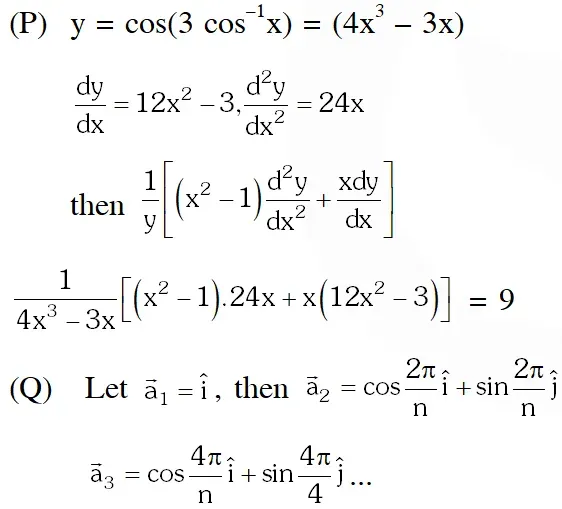
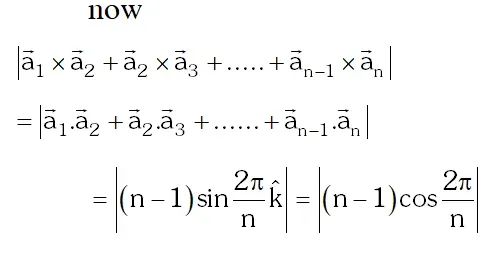
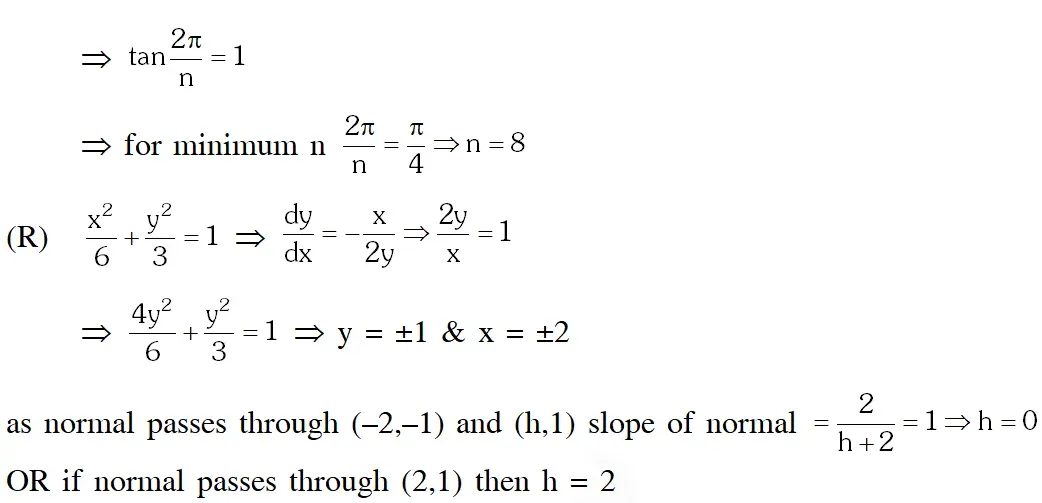
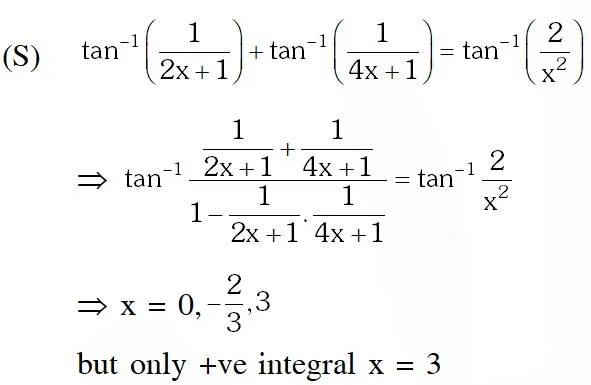

The Ellipse - JEE Advanced PYQs (Maths) set can be followed by original papers available in the JEE Advanced PYQ archive.
Team eSaral
eSaral Academic and Editorial Team
Team eSaral is the collective author profile for educational content created by eSaral’s teachers and academic contributors. The team draws on expertise from IIT graduates, doctors, experienced educators and subject specialists to develop resources for JEE, NEET and school students. Our articles aim to explain concepts clearly and help students study with confidence.
Related Posts
Plant Cell Diagram: Labelled Structure, Parts and Functions
Simple, labelled plant cell diagram with parts and functions. Covers plant cell structure for Class 6, 7, 8, 9, 10 and 11 students, CBSE-aligned.

Saransh Gupta Sir's Visit to IIT Patna: Hostel Life, Placements & Lessons for JEE Aspirants
Inside Saransh Gupta Sir's IIT Patna visit — hostel life, the library, placements, internships, and real advice for JEE aspirants from students living the IIT dream.
Molality Formula: Formula for Molality, Derivation & Solved Examples
Molality formula is $m = \dfrac{n}{W}$. Learn the formula of molality, its SI unit, derivation, relation with molarity, and solved examples for Class 11, JEE and NEET.

BITSAT Previous Year Question Paper PDF
Download BITSAT previous year question papers PDF. Get year-wise BITSAT PYQs, memory-based papers, exam pattern, and preparation tips to improve your BITSAT preparation.

Teachers’ Day 2026 at eSaral Gurukul: Celebrating the Bond Between Students, Teachers & Mentors
See how Teachers’ Day 2026 was celebrated at eSaral Gurukul, reflecting the bond among students, teachers, and mentors, and the role of guidance beyond academics.
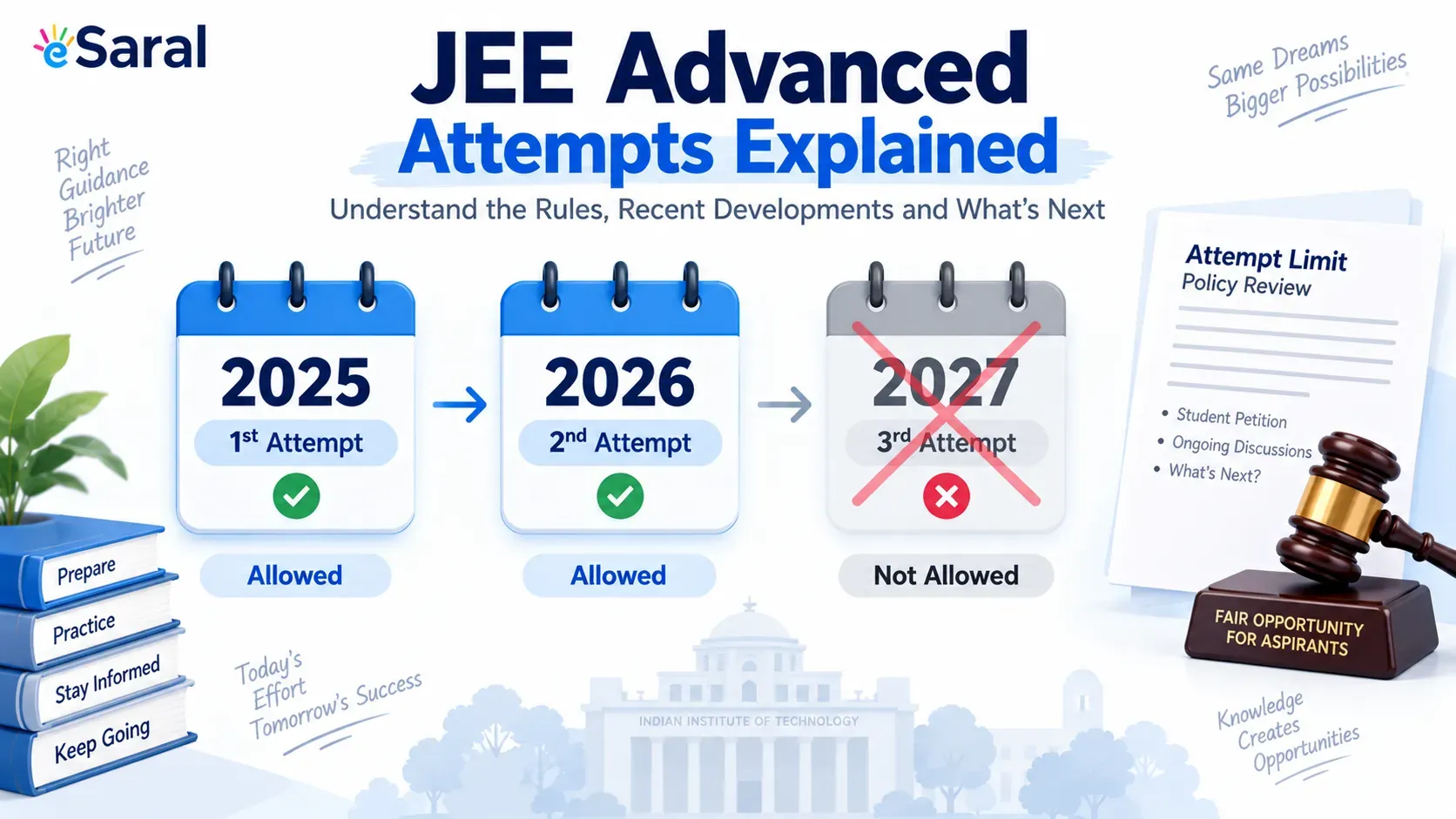
JEE Advanced Attempts: Can You Give It a Third Time? Rules Explained
JEE Advanced attempts: current rule is 2 consecutive years only: full eligibility criteria, the 2025 third-attempt controversy, and the latest 2026 petition news.

Best JEE Preparation App
Best JEE preparation app for Main & Advanced: AI mock tests, live doubt-solving, thousands of practice questions. JEE preparation app for droppers & Class 11-12.
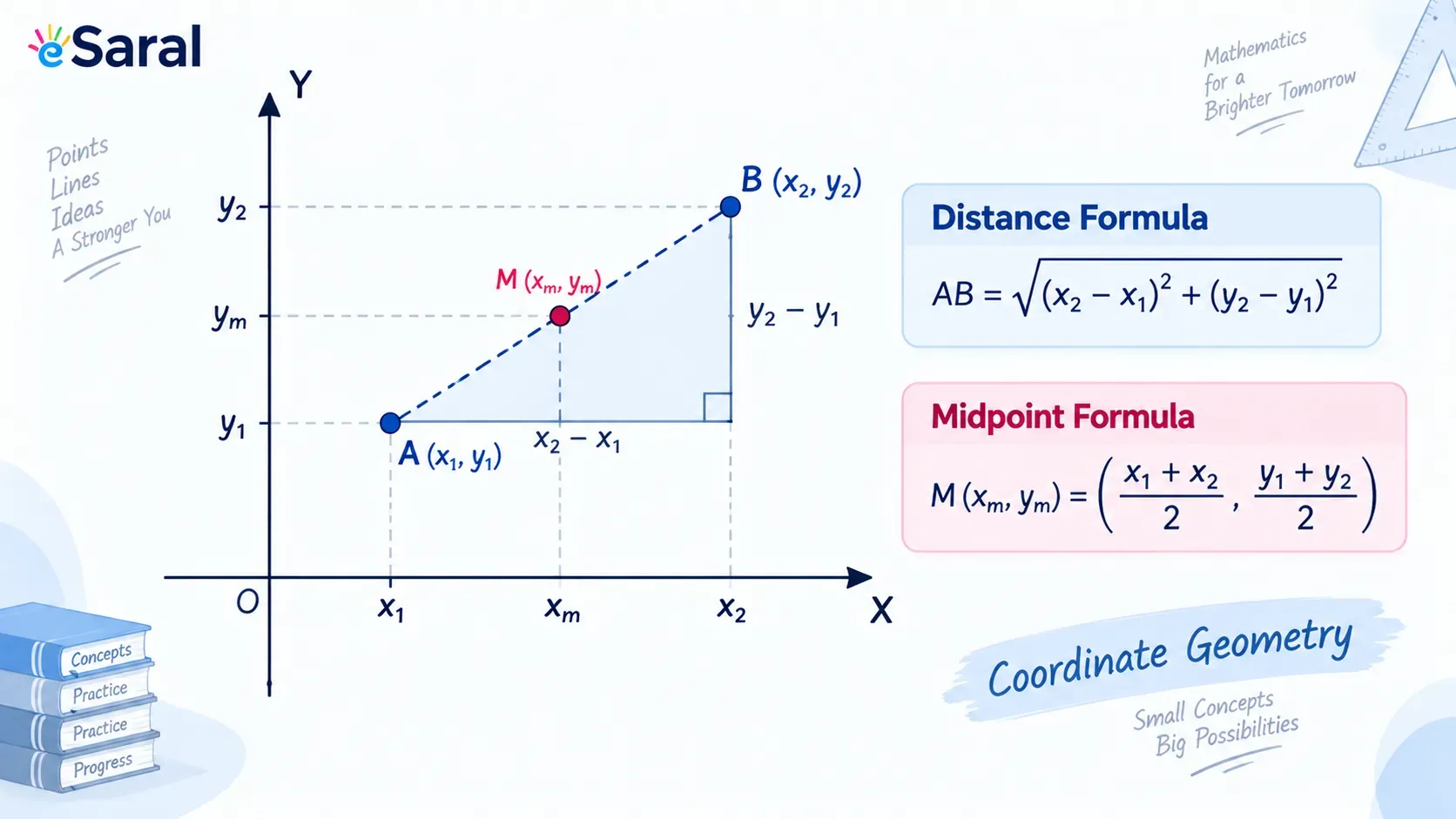
Coordinate Geometry Class 10: Formulas, Notes & Solved Examples
Coordinate geometry class 10: complete CBSE formulas — distance, section, midpoint and area of triangle — with derivation, notes and solved examples.
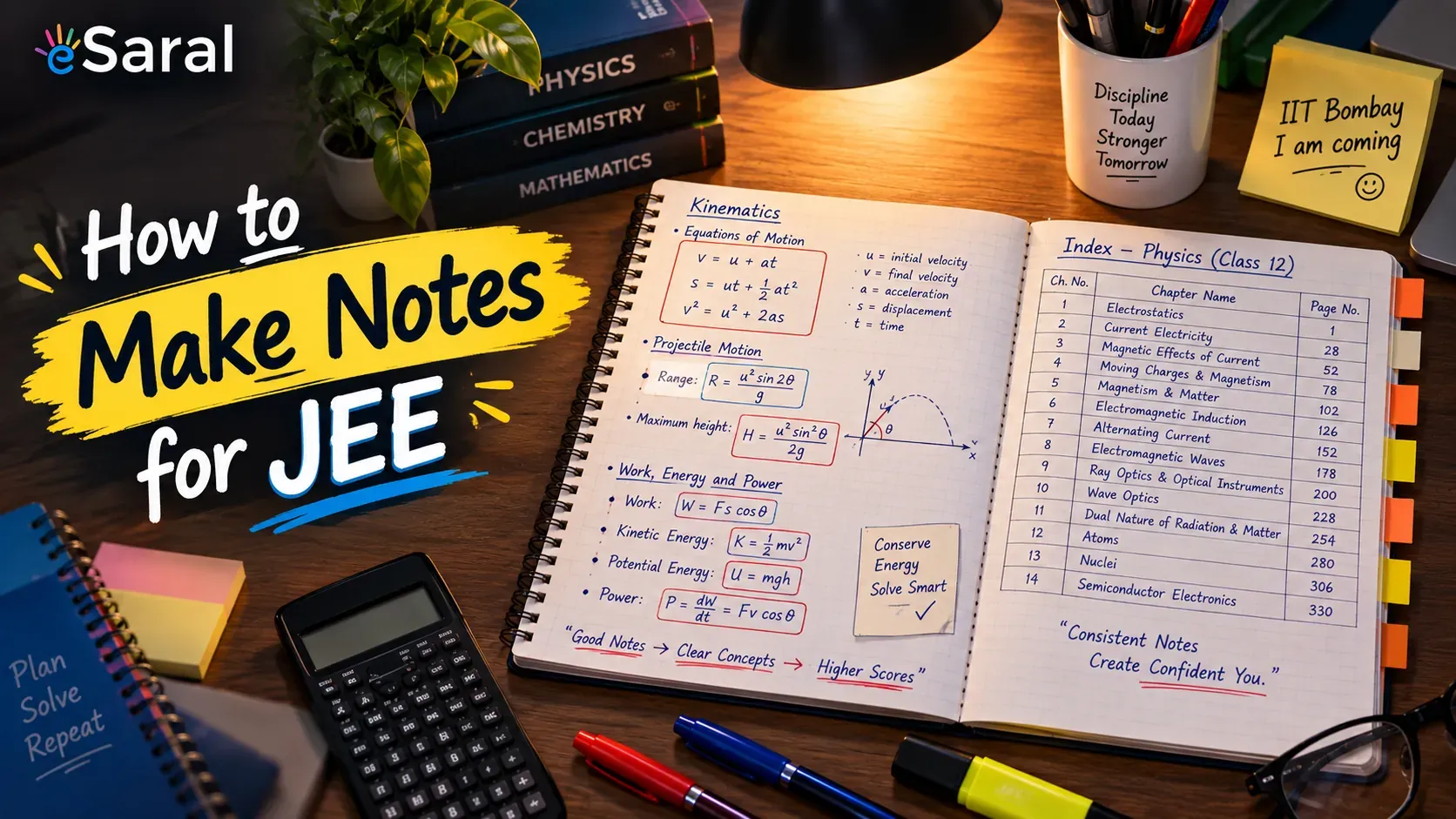
How to make Notes For JEE Smart Notes Strategy of an AIR 41
Learn how to make notes for JEE the way toppers do — indexing, shorthand, and smart short notes for JEE that cut revision time to just 5–7 days.
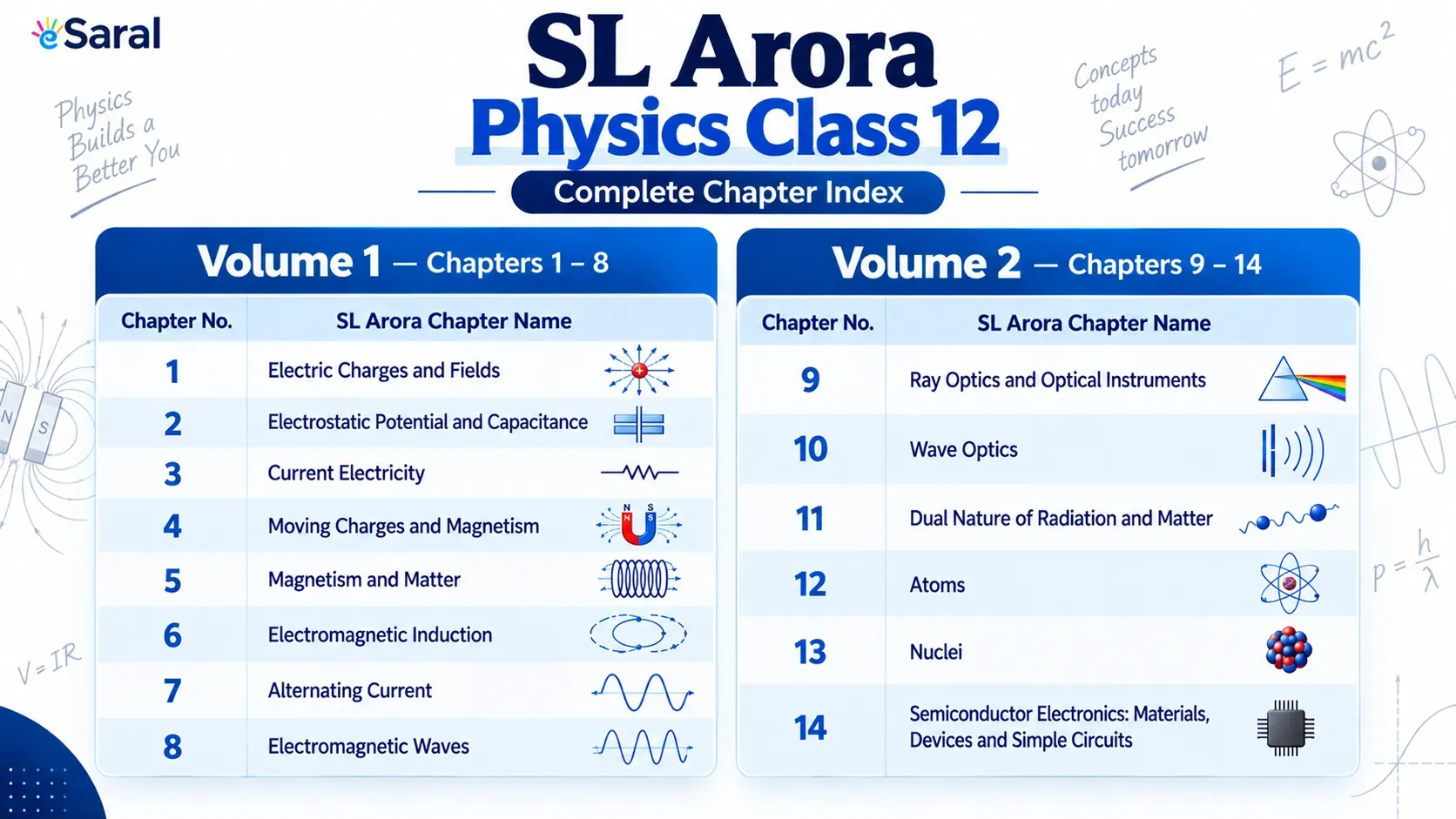
SL Arora Physics Class 12 Index – Chapter List for Volume 1 & 2
SL Arora Physics Class 12 index — complete chapter list for Volume 1 & 2, mapped to NCERT solutions for board, JEE Main, and NEET preparation.