
Gravitation - JEE Advanced Previous Year Questions with Solutions

eSaral Academic and Editorial Team
Summary
Gravitation JEE Advanced previous year questions cover escape velocity, orbital mechanics, gravitational potential, binary stars, and planetary motion. Questions are solved here with step-by-step explanations. Practicing these topic-wise PYQs is the fastest way to understand the question pattern and pinpoint your weak areas before the exam.

Home > JEE Advanced PYQs > Gravitation JEE Advanced Previous Year Questions

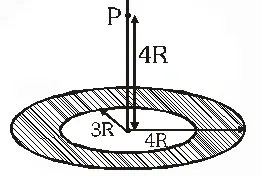
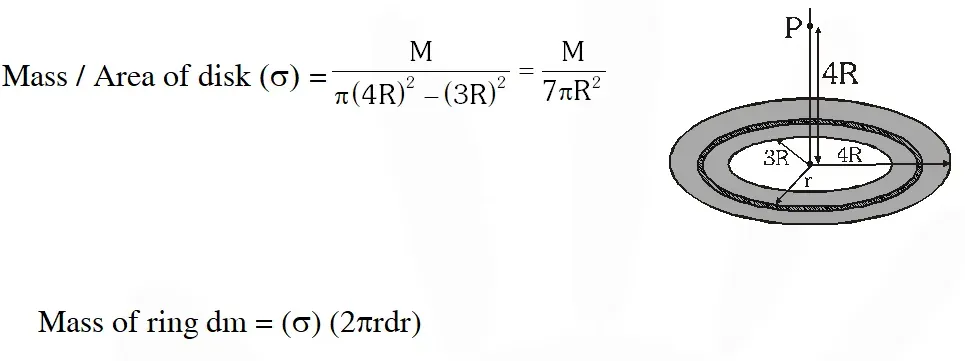
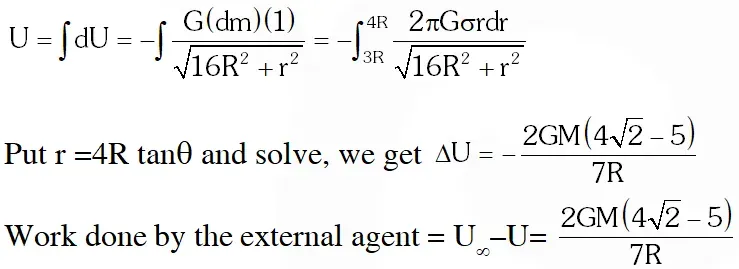
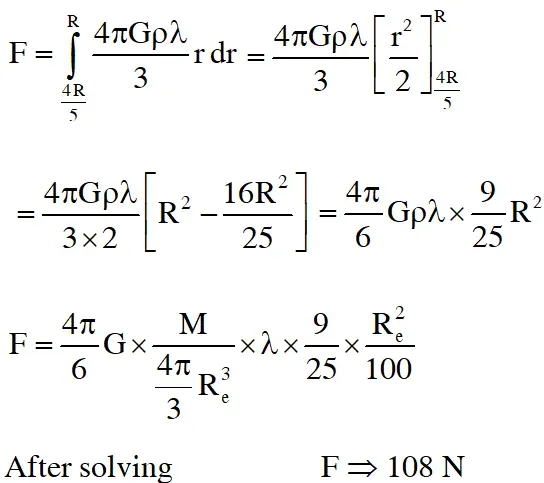
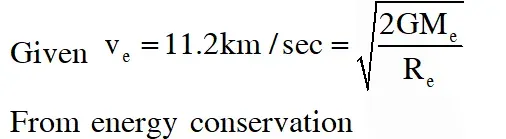
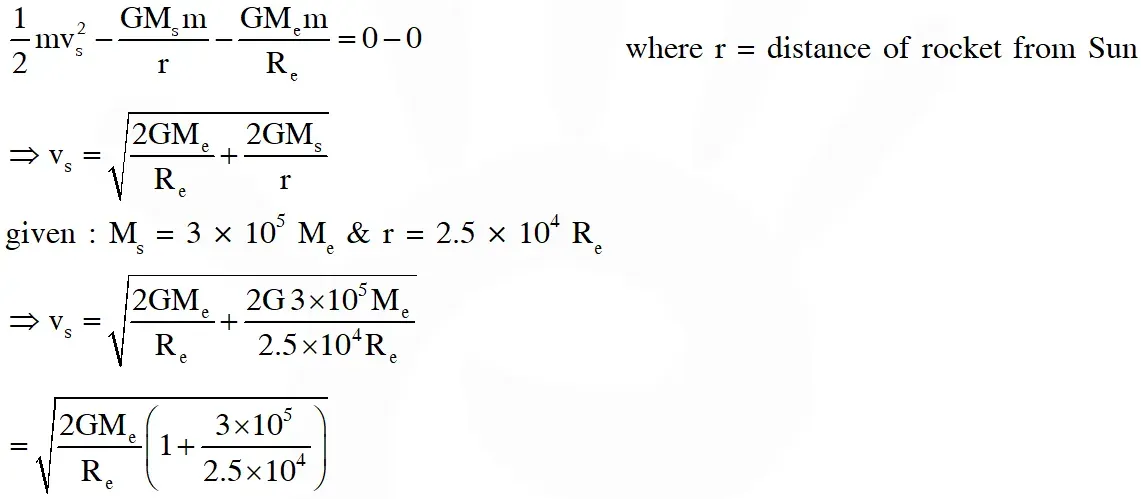
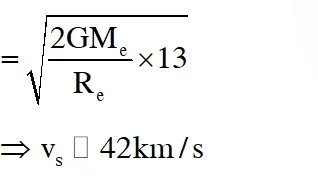
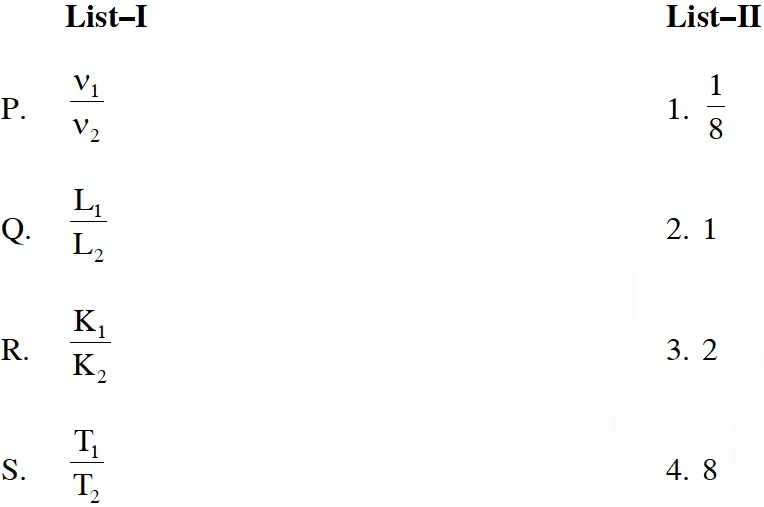
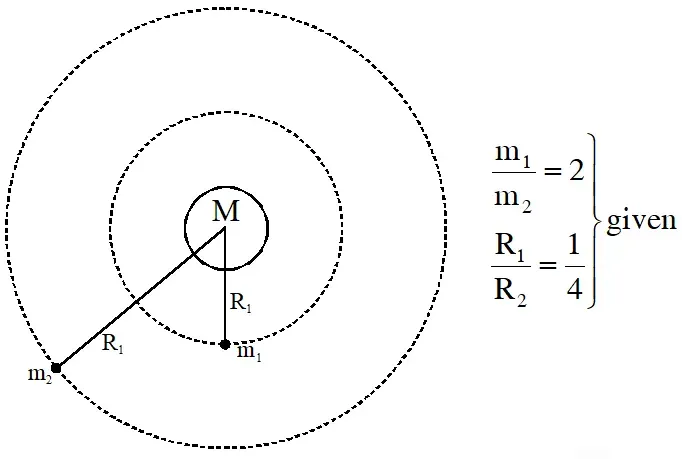
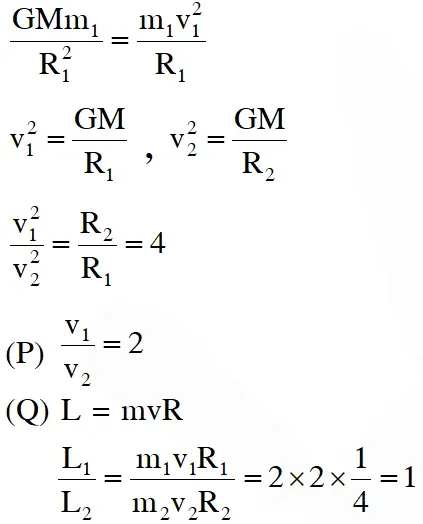
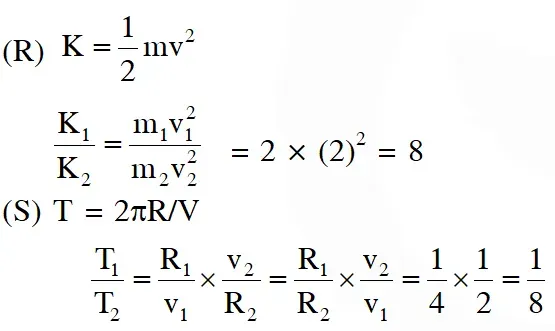
JEE Advanced Previous Year Questions of Physics with Solutions are available at eSaral. Practicing JEE Advanced Previous Year Papers Questions of Physics will help the JEE aspirants in realizing the question pattern as well as help in analyzing weak & strong areas. Get detailed Class 11th & 12th Physics Notes to prepare for Boards as well as competitive exams like IIT JEE, NEET etc. eSaral helps the students in clearing and understanding each topic in a better way. eSaral is providing complete chapter-wise notes of Class 11th and 12th both for all subjects. Download eSaral app for free study material and video tutorials. Click Here for JEE main Previous Year Topic Wise Questions of Physics with Solutions Simulator Previous Years JEE Advanced Questions [esquestion] Gravitational acceleration on the surface of a planet is \frac{\sqrt{6}}{11} \mathrm{g}, where g is the gravitational acceleration on the surface of the earth. The average mass density of the planet is \frac{2}{3} times that of the Earth. If the escape speed on the surface of the earth is taken to be 11 \mathrm{kms}^{-1}, the escape speed on the surface of the planet in \mathrm{kms}^{-1}will be - #tag# [IIT-JEE 2010] #sol# 3 [/esquestion] [esquestion] A binary star consists of two stars A \left(\operatorname{mass} 2.2 \mathrm{M}_{\mathrm{s}}\right) \text { and } \mathrm{B}\left(\mathrm{mass} 11 \mathrm{M}_{\mathrm{s}}\right), where MS is the mass of the sun. They are separated by distance d and are rotating about their centre of mass, which is stationary. The ratio of the total angular momentum of the binary star to the angular momentum of star B about the centre of mass is - #tag# [IIT-JEE 2010] #sol# 6 [/esquestion] [esquestion] A thin uniform annular disc (see figure) of mass M has outer radius 4R and inner radius 3R. The work required to take a unit mass from point P on its axis to infinity is #tag# [IIT-JEE 2010] #sol# (A) [/esquestion] [esquestion] A satellite is moving with a constant speed V in a circular orbit about the earth. An object of mass ‘m’ is ejected from the satellite such that it just escapes from the gravitational pull of the earth. At the time of its ejection, the kinetic energy of the object is : #tag# [IIT-JEE 2011] #sol# (B) [/esquestion] [esquestion] Two spherical planets P and Q have the same uniform density , masses $\mathbf{M}_{\mathrm{p}}$ and $\mathbf{M}_{\mathrm{Q}}$, and surface areas A and 4A, respectively. A spherical planet R also has uniform density and its mass is ($\mathrm{M}_{\mathrm{p}}$ + $\mathbf{M}_{\mathrm{Q}}$). The escape velocities from the planets P, Q and R, are $\mathrm{V}_{\mathrm{p}}, \mathrm{V}_{\mathrm{Q}}$ and $\mathrm{V}_{\mathrm{R}}$, respectively. Then (A) $\mathrm{V}_{\mathrm{Q}}>\mathrm{V}_{\mathrm{R}}>\mathrm{V}_{\mathrm{P}}$ (B) $\mathrm{V}_{\mathrm{R}}>\mathrm{V}_{\mathrm{Q}}>\mathrm{V}_{\mathrm{P}}$ (C) $\mathrm{V}_{\mathrm{R}} / \mathrm{V}_{\mathrm{P}}=3$ (D) $\mathrm{V}_{\mathrm{P}} / \mathrm{V}_{\mathrm{Q}}=1 / 2$ #tag# [IIT-JEE 2012] #sol# (B,D) Escape velocity $=\sqrt{\frac{2 G M}{R}} \propto \sqrt{\frac{4}{3} \pi R^{3}} \propto \sqrt{A r e a}$ [since density of each planet is same] [/esquestion] [esquestion] A planet of radius $\mathrm{R}=\frac{1}{10} \times(\text { radius of Earth })$ has the same mass density as Earth. Scientists dig a well of depth on it and lower a wire of the same length and of linear mass density $10^{-3}$ $\mathrm{kgm}^{-1}$ into it. If the wire is not touching anywhere, the force applied at the top of the wire by a person holding it in place is (take the radius of Earth = $6 \times 10^{6}$ m and the acceleration due to gravity on Earth is $10 \mathrm{ms}^{-2}$) – (A) 96 N (B) 108 N (C) 120 N (D) 150 N #tag# [JEE-Advance 2014] #sol# (B) $\mathrm{E}_{\mathrm{G}}=\frac{4 \pi \mathrm{Gr} \rho}{3}$ $\mathrm{dF}=\mathrm{E}_{\mathrm{G}} \lambda \mathrm{dr}$ [/esquestion] [esquestion] A rocket is launched normal to the surface of the Earth, away from the Sun, along the line joining the sun and the Earth. The Sun is $3 \times 10^{5}$ times heavier than the Earth and is at a distance $2.5 \times 10^{4}$ times larger than the radius of the Earth. The escape velocity from Earth's gravitational field is $\mathrm{v}_{\mathrm{e}}=11.2 \mathrm{km} \mathrm{s}^{-1}$. The minimum initial velocity (vs) required for the rocket to be able to leave the Sun-Earth system is closest to (Ignore the rotation and revolution of the Earth and the presence of any other planet) (A) $\mathrm{v}_{\mathrm{s}}=22 \mathrm{km} \mathrm{s}^{-1}$ (B) $\mathrm{v}_{\mathrm{s}}=72 \mathrm{km} \mathrm{s}^{-1}$ (C) $\mathrm{v}_{\mathrm{s}}=42 \mathrm{km} \mathrm{s}^{-1}$ (D) $\mathrm{v}_{\mathrm{s}}=62 \mathrm{km} \mathrm{s}^{-1}$ #tag# [JEE-Advance 2017] #sol# (C) [/esquestion] [esquestion] A planet of mass M, has two natural satellites with masses $\mathrm{m}_{1}$ and $\mathrm{m}_{2}$. The radii of their circular orbits are $\mathrm{R}_{1}$ and $\mathrm{R}_{2}$ respectively. Ignore the gravitational force between the satellites. Define $\mathrm{v}_{1}, \mathrm{L}_{1}, \mathrm{K}_{1}$ and $\mathrm{T}_{1}$ to be, respectively, the orbital speed, angular momentum, kinetic energy and time period of revolution of satellite 1 ; and $\mathrm{v}_{2}, \mathrm{L}_{2}, \mathrm{K}_{2}$ and $\mathrm{T}_{2}$ to be the corresponding quantities of satellite 2. Given $\mathrm{m}_{1} / \mathrm{m}_{2}=$ 2 and $\mathrm{R}_{1} / \mathrm{R}_{2}=1 / 4$, match the ratios in List-I to the numbers in List-II. #tag# [JEE-Advance 2018] #sol# (B) [/esquestion]






After solving Gravitation - JEE Advanced PYQs (Physics), try a complete section from the JEE Advanced exam paper.
Gravitation involves concepts such as gravitational fields, potential, orbital motion, and planetary motion, making it an important part of JEE Advanced Mechanics. Students interested in exploring more challenging Irodov problems for JEE Advanced can refer to Irodov Selected Questions for additional exposure to advanced Physics concepts.
Frequently Asked Questions
What is the escape velocity formula and how is it derived for JEE Advanced?
Escape velocity is $v_e = \sqrt{2GM/R}$, derived by setting the total mechanical energy (KE + PE) equal to zero. At escape, the object just reaches infinity with zero velocity: $\frac{1}{2}mv^2 - \frac{GMm}{R} = 0$. Solving gives $v_e = \sqrt{2gR}$ where $g = GM/R^2$ is surface gravity.
Is Gravitation important for JEE Advanced or only JEE Main?
Gravitation is important for both, but JEE Advanced tests it at a deeper level. JEE Main questions usually test direct formula application. JEE Advanced questions involve multi-step reasoning — for example, combining gravitational potential with work-energy theorem, or analysing binary star systems using centre-of-mass dynamics.
How many questions come from Gravitation in JEE Advanced each year?
Gravitation typically contributes 1 to 3 questions per JEE Advanced paper. The exact count varies by year, but the topic has appeared in almost every paper since 2010. Given its consistent presence and moderate difficulty, it offers one of the best effort-to-marks ratios among all mechanics chapters.
What is Kepler's Third Law and how is it tested in JEE Advanced?
Kepler's Third Law states $T^2 \propto R^3$ — the square of the orbital period is proportional to the cube of the semi-major axis. In JEE Advanced, it most commonly appears in ratio problems (Q8 from 2018 is a direct example) or in deriving the time period of a satellite at a given orbital radius. The derivation from $\frac{GMm}{R^2} = \frac{m\cdot4\pi^2 R}{T^2}$ is frequently required
Which chapters should I study alongside Gravitation for JEE Advanced?
Gravitation overlaps heavily with Circular Motion (centripetal force in orbits), Energy Methods (work-energy theorem for escape problems), and Rotational Mechanics (angular momentum in binary stars). Strengthening these three chapters in parallel makes Gravitation significantly easier. You can also cross-reference NCERT Class 11 Physics solutions for the foundational mechanics chapters
How do I solve binary star problems in JEE Advanced?
For binary star problems, identify the centre of mass first. Both stars orbit the centre of mass with the same angular velocity $\omega$. Use $r_1 m_1 = r_2 m_2$ to find individual radii, then compute angular momenta or kinetic energies as $L = m_i r_i^2 \omega$ and $K = \frac{1}{2}m_i r_i^2 \omega^2$ separately before taking ratios.
Team eSaral
eSaral Academic and Editorial Team
Team eSaral is the collective author profile for educational content created by eSaral’s teachers and academic contributors. The team draws on expertise from IIT graduates, doctors, experienced educators and subject specialists to develop resources for JEE, NEET and school students. Our articles aim to explain concepts clearly and help students study with confidence.
Related Posts
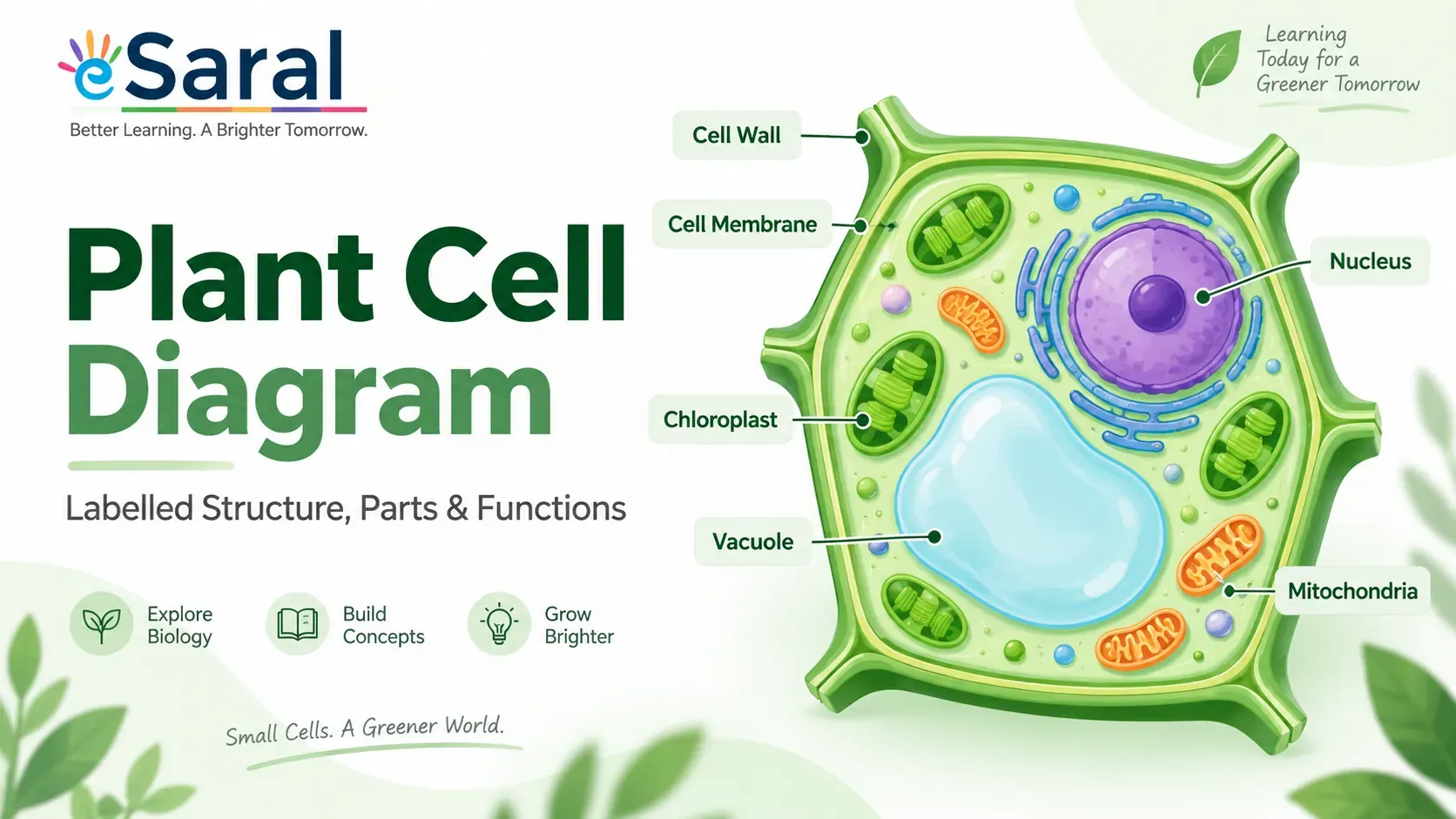
Plant Cell Diagram: Labelled Structure, Parts and Functions
Simple, labelled plant cell diagram with parts and functions. Covers plant cell structure for Class 6, 7, 8, 9, 10 and 11 students, CBSE-aligned.

Saransh Gupta Sir's Visit to IIT Patna: Hostel Life, Placements & Lessons for JEE Aspirants
Inside Saransh Gupta Sir's IIT Patna visit — hostel life, the library, placements, internships, and real advice for JEE aspirants from students living the IIT dream.
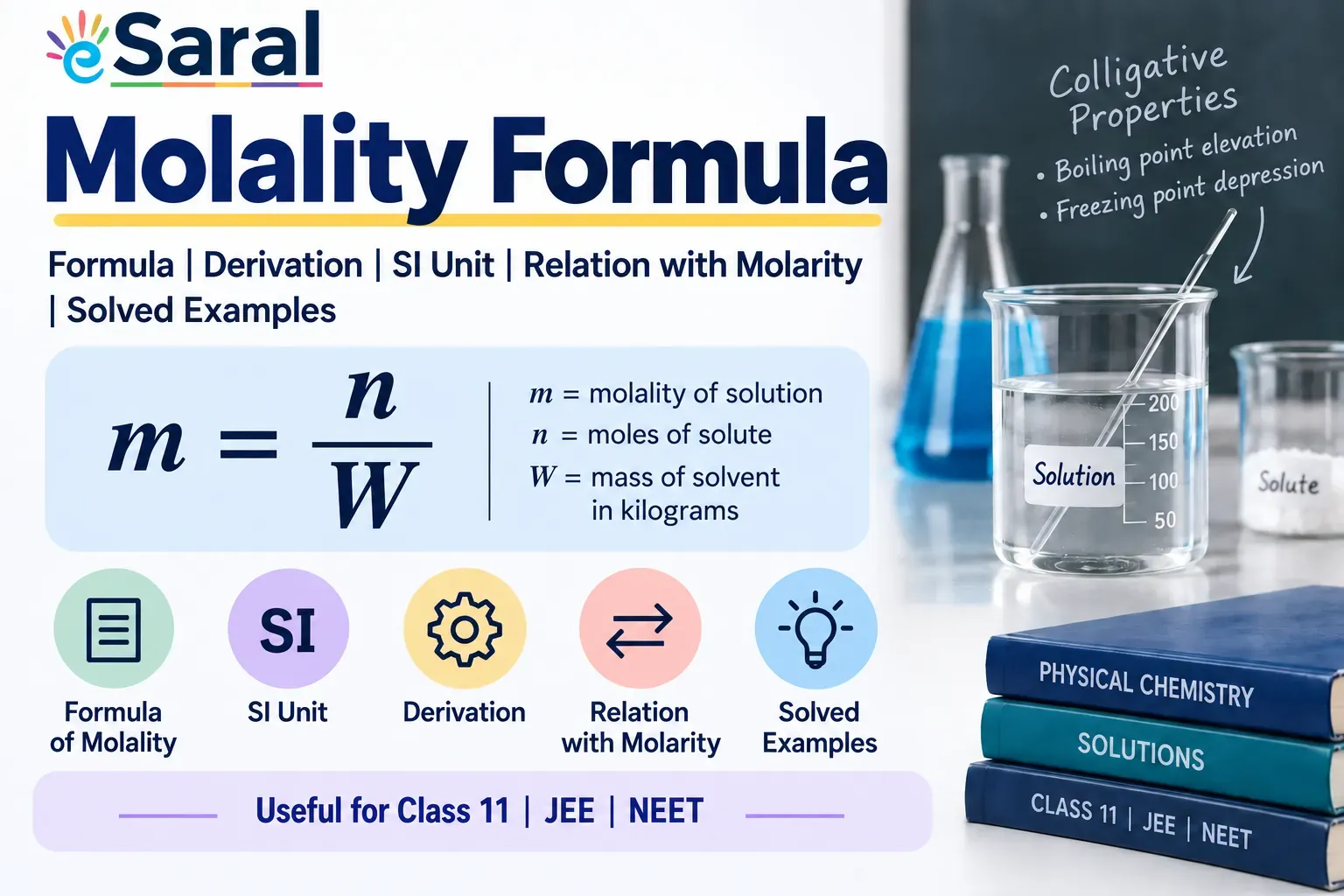
Molality Formula: Formula for Molality, Derivation & Solved Examples
Molality formula is $m = \dfrac{n}{W}$. Learn the formula of molality, its SI unit, derivation, relation with molarity, and solved examples for Class 11, JEE and NEET.
BITSAT Previous Year Question Paper PDF
Download BITSAT previous year question papers PDF. Get year-wise BITSAT PYQs, memory-based papers, exam pattern, and preparation tips to improve your BITSAT preparation.

Teachers’ Day 2026 at eSaral Gurukul: Celebrating the Bond Between Students, Teachers & Mentors
See how Teachers’ Day 2026 was celebrated at eSaral Gurukul, reflecting the bond among students, teachers, and mentors, and the role of guidance beyond academics.
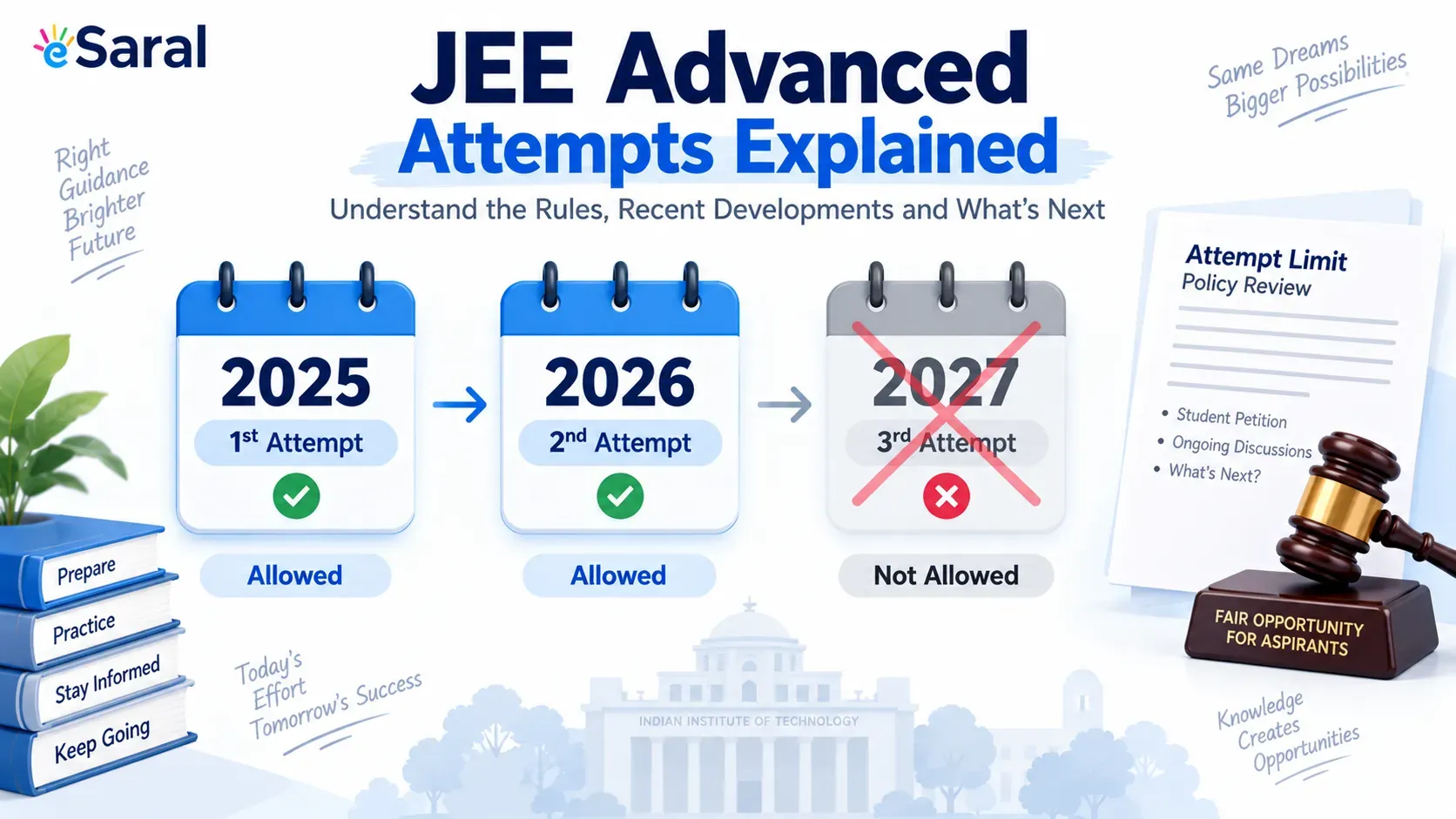
JEE Advanced Attempts: Can You Give It a Third Time? Rules Explained
JEE Advanced attempts: current rule is 2 consecutive years only: full eligibility criteria, the 2025 third-attempt controversy, and the latest 2026 petition news.

Best JEE Preparation App
Best JEE preparation app for Main & Advanced: AI mock tests, live doubt-solving, thousands of practice questions. JEE preparation app for droppers & Class 11-12.
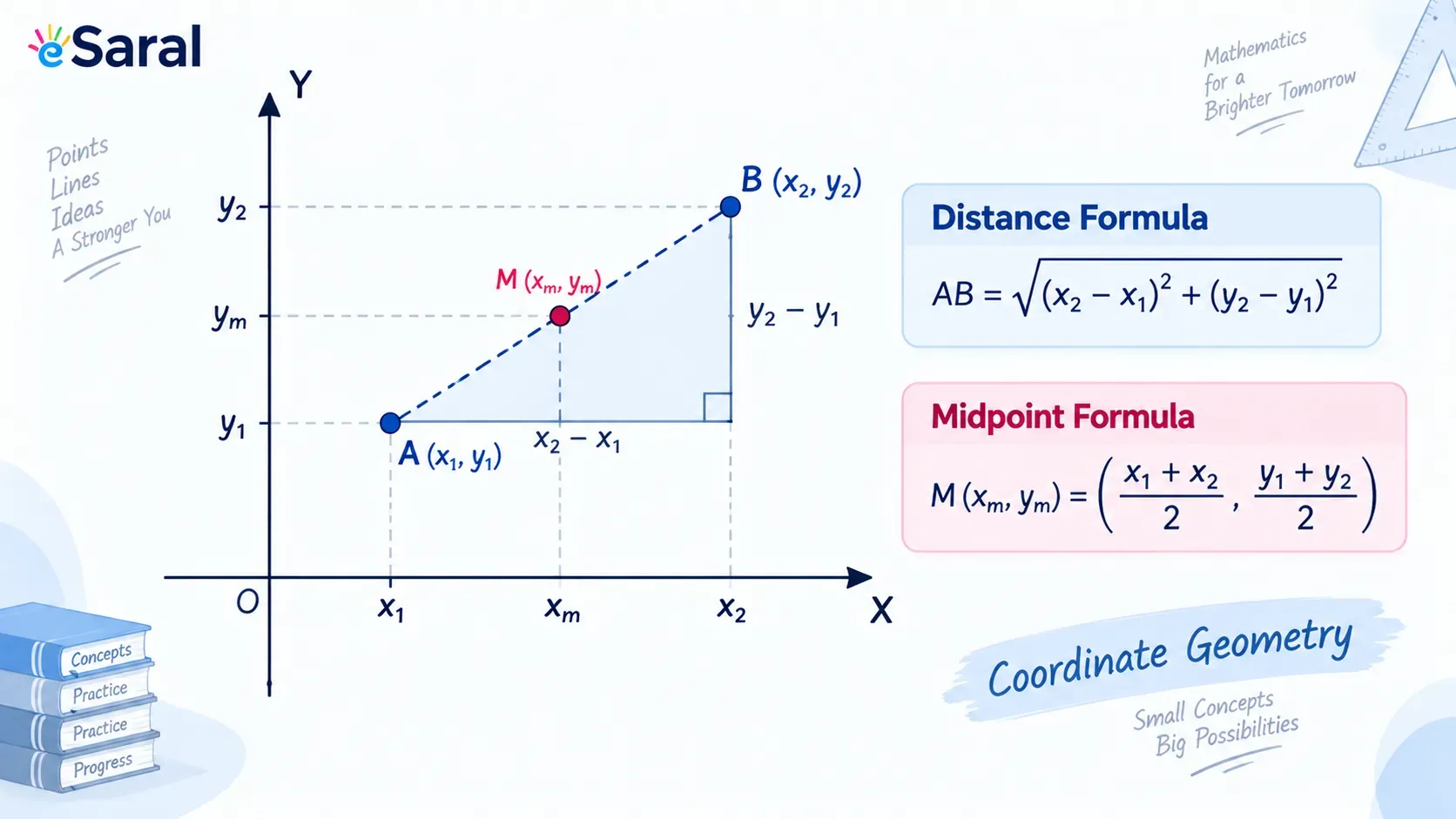
Coordinate Geometry Class 10: Formulas, Notes & Solved Examples
Coordinate geometry class 10: complete CBSE formulas — distance, section, midpoint and area of triangle — with derivation, notes and solved examples.
How to make Notes For JEE Smart Notes Strategy of an AIR 41
Learn how to make notes for JEE the way toppers do — indexing, shorthand, and smart short notes for JEE that cut revision time to just 5–7 days.
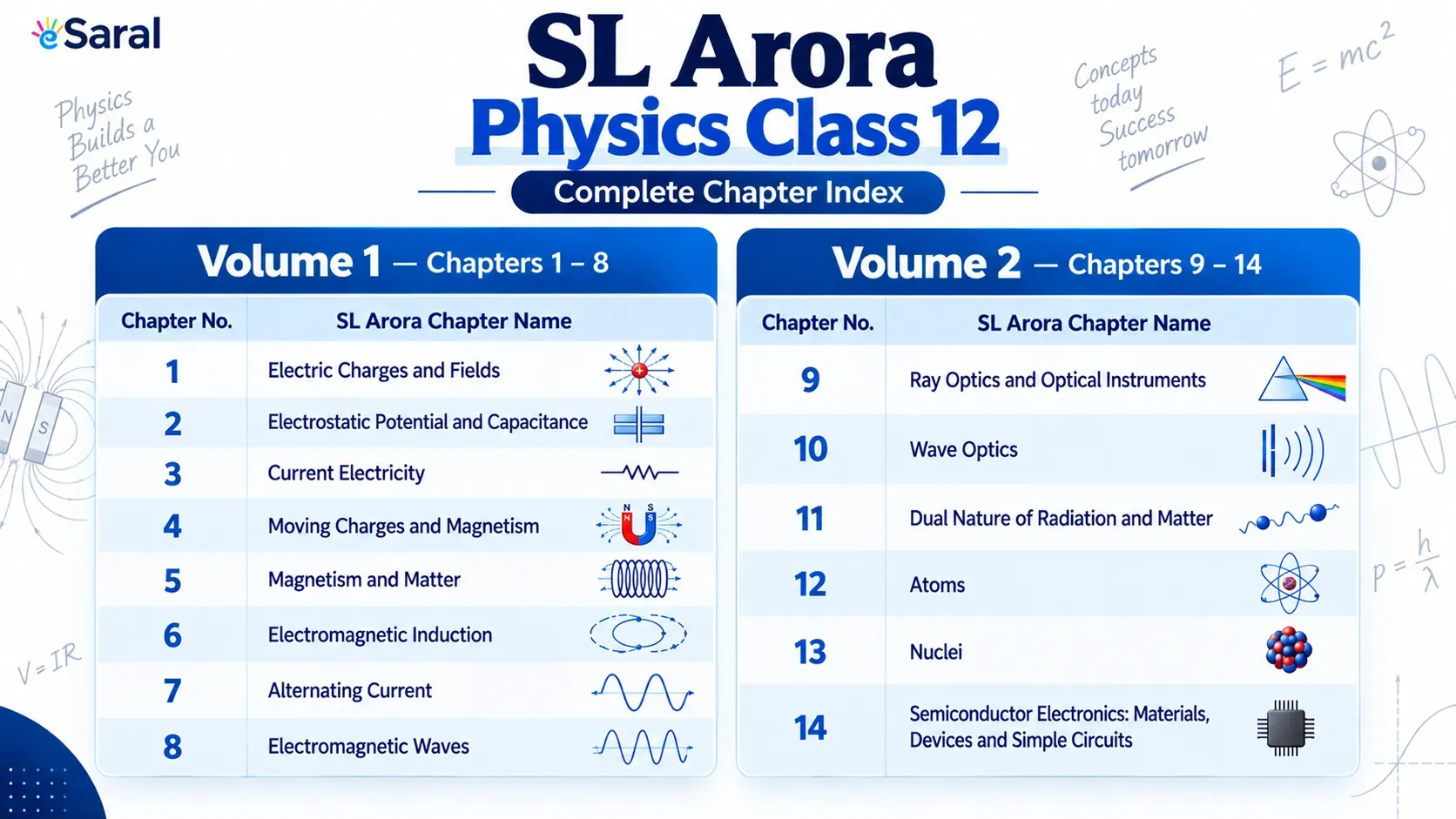
SL Arora Physics Class 12 Index – Chapter List for Volume 1 & 2
SL Arora Physics Class 12 index — complete chapter list for Volume 1 & 2, mapped to NCERT solutions for board, JEE Main, and NEET preparation.