
Ionic Equilibrium - JEE Main Previous Year Questions with Solutions
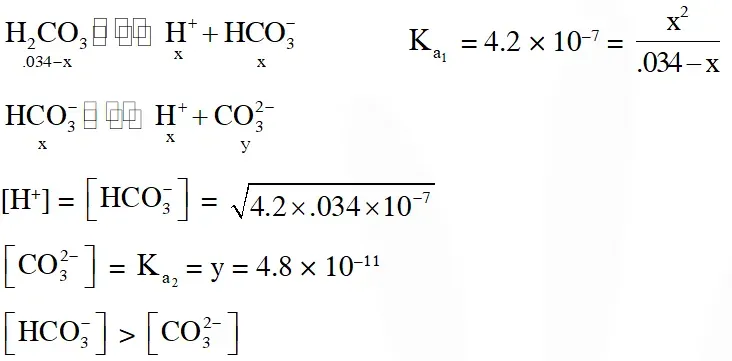
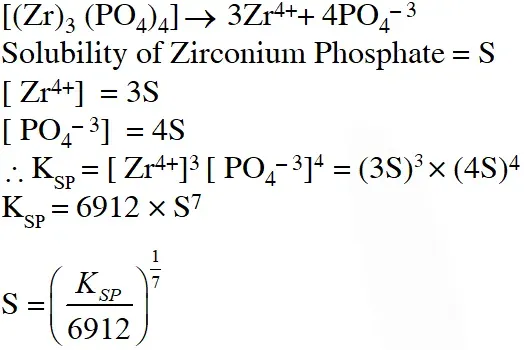
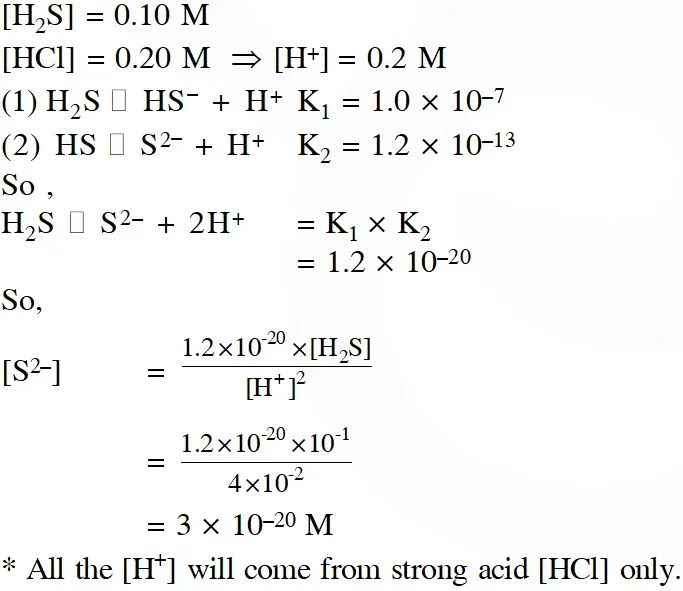
JEE Main Previous Year Papers Questions of Chemistry With Solutions are available at eSaral. Simulator Previous Years AIEEE/JEE Mains Questions [esquestion] Solid Ba$\left(\mathrm{NO}_{3}\right)_{2}$ is gradully dissolved in a 1.0 × $10^{-4} \mathrm{M} \mathrm{Na}_{2} \mathrm{CO}_{3}$ solution.At what concentration of Ba2+ will a precipitate begin to form? $\left(\mathrm{K}_{\mathrm{SP}} \text { for } \mathrm{Ba} \mathrm{CO}_{3}=5.1 \times 10^{-9}\right)$ (A) $8.1 \times 10^{-8} \mathrm{M}$ (B) $8.1 \times 10^{-7} \mathrm{M}$ (C) $4.1 \times 10^{-5} \mathrm{M}$ (D) $5.1 \times 10^{-5} \mathrm{M}$ #tag# [AIEEE-2009,JEE-MAIN(Online)–2013] #sol# (D) $5.1 \times 10^{-9}=\left[\mathrm{Ba}^{+2}\right]\left[10^{-4}\right]$ $\left[\mathrm{Ba}^{+2}\right]=5.1 \times 10^{-5} \mathrm{M}$ [/esquestion] [esquestion] At 25° C, the solubility producct of $\mathrm{Mg}(\mathrm{OH})_{2}$ is $1.0 \times 10^{-11}$. At which pH, will $\mathrm{Mg}^{2+}$ ions start precipitating in the form of $\mathrm{Mg}(\mathrm{OH})_{2}$ from a solution of 0.001 M $\mathrm{Mg}^{2+}$ ions? (A) 8 (B) 9 (C) 10 (D) 11 #tag# [AIEEE–2010] #sol# (C) $10^{-11}=\left[\mathrm{Mg}^{+2}\right]\left[\mathrm{OH}^{-}\right]^{2}$ $10^{-11}=\left(10^{-3}\right)\left[\mathrm{OH}^{-}\right]^{2}$ $\left[\mathrm{OH}^{-}\right]=10^{-4} \quad \mathrm{pOH}=4 \quad \mathrm{pH}=11$ [/esquestion] [esquestion] In aqueous solution the ionization constants for carbonic acid are $\mathrm{K}_{1}=4.2 \times 10^{-7}$ and $\mathrm{K}_{2}=4.8$ $\times 10^{-11}$ Select the correct statement for a saturated 0.034 M solution of the carbonic acid :- (A) The concentration of $\mathrm{H}^{+}$ is double that of $\mathrm{CO}_{3}^{2-}$ (B) The concentration of $\mathrm{CO}_{3}^{2-}$ is $0.034 \mathrm{M}$ (C) The concentration of $\mathrm{CO}_{3}^{2-}$ is greater than that of $\mathrm{HCO}_{3}^{-}$ (D) The concentrations of $\mathrm{H}^{+}$ and $\mathrm{HCO}_{3}^{-}$ are approximately equal #tag# [AIEEE–2010] #sol# (D) [/esquestion] [esquestion] Solubility product of silver bromide is $5.0 \times 10^{-13}$. The quantity of potassium bromide (molar mass taken as 120 g $\left.\mathrm{mol}^{-1}\right)$ to be added to 1 litre of 0.05 M solution of silver nitrate to start the precipitation of AgBr is :- (A) $5.0 \times 10^{-8} \mathrm{g}$ (B) $1.2 \times 10^{-10} \mathrm{g}$ (C) $1.2 \times 10^{-9} \mathrm{g}$ (D) $6.2 \times 10^{-5} \mathrm{g}$ #tag# [AIEEE–2010] #sol# (C) $\left[\mathrm{Ag}^{+}\right]\left[\mathrm{Br}^{-}\right]=\mathrm{Ksp}$ $[0.05]\left[\frac{\mathrm{W}}{120}\right]=5 \times 10^{-13}$ $\mathrm{w}=\frac{120 \times 5 \times 10^{-13}}{5 \times 10^{-2}}=120 \times 10^{-11}=12 \times 10^{-10}$ $=1.2 \times 10^{-9} \mathrm{g}$ [/esquestion] [esquestion] An acid HA ionises as The pH of 1.0 M solution is 5. Its dissociation constant would be :- (A) $1 \times 10^{-10}$ (B) 5 (C) $5 \times 10^{-8}$ (D) $1 \times 10^{-5}$ #tag# [AIEEE–2011] #sol# (A) $\left[\mathrm{H}^{+}\right]=10^{-5}=\mathrm{C}_{\mathrm{o}} \alpha$ $\alpha=10^{-5}$ [/esquestion] [esquestion] The $\mathrm{K}_{\mathrm{sp}}$ for $\mathrm{Cr}(\mathrm{OH})_{3}$ is $1.6 \times 10^{-30}$ The molar solubility of this compound in water is :- (A) $\sqrt[2]{1.6 \times 10^{-30}}$ (B) $\sqrt[4]{1.6 \times 10^{-30}}$ (C) $\sqrt[4]{1.6 \times 10^{-30} / 27}$ (D) $1.6 \times 10^{-30 / 27}$ #tag# [AIEEE–2011] #sol# (C) $\mathrm{Ksp}=1.6 \times 10^{-30}=27 \mathrm{S}^{4}$ $S^{4}=\left[\frac{1.6 \times 10^{-30}}{27}\right]$ $S=\left[\frac{1.6 \times 10^{-30}}{27}\right]^{1 / 4}$ [/esquestion] [esquestion] The pH of a 0.1 molar solution of the acid HQ is 3. The value of the ionization constant, Ka of this acid is :- (A) $1 \times 10^{-7}$ (B) $3 \times 10^{-7}$ (C) $1 \times 10^{-3}$ (D) $1 \times 10^{-5}$ #tag# [AIEEE–2012] #sol# (D) [\mathrm{HQ}]=0.10 \mathrm{M} \mathrm{pH}=3 \quad ;\left[\mathrm{H}^{+}\right]=10^{-3}=\mathrm{C}_{0} \alpha \alpha=10^{-2} [/esquestion] [esquestion] If $\mathrm{K}_{\mathrm{sp}}$ of $\mathrm{CaF}_{2}$ at $25^{\circ} \mathrm{C}$ is $1.7 \times 10^{-10}$ , the combination amongst the following which gives a precipitate of $\mathrm{CaF}_{2}$ is :- (A) $1 \times 10^{-2} \mathrm{M} \mathrm{Ca}^{2+}$ and $1 \times 10^{-5} \mathrm{M} \mathrm{F}^{-}$ (B) $1 \times 10^{-4} \mathrm{M} \mathrm{Ca}^{2+}$ and $1 \times 10^{-4} \mathrm{M} \mathrm{F}^{-}$ (C) $1 \times 10^{-3} \mathrm{M} \mathrm{Ca}^{2+}$ and $1 \times 10^{-5} \mathrm{M} \mathrm{F}^{-}$ (D) $1 \times 10^{-2} \mathrm{M} \mathrm{Ca}^{2+}$ and $1 \times 10^{-3} \mathrm{M} \mathrm{F}^{-}$ #tag#[JEE-MAIN(online)–2012] #sol# (D) [/esquestion] [esquestion] How many litres of water must be added to 1 litre of an aqueous solution of HCl with a pH of 1 to create an aqueous solution with pH of 2 ? (A) 0.1 L (B) 0.9 L (C) 2.0 L (D) 9.0 L #tag# [AIEEE–2013] #sol# (D) \left(10^{-1}\right)(1)=\left(10^{-2}\right)(1+\mathrm{v}) 10=\mathrm{v}+1 v = 9L [/esquestion] [esquestion] What would be the pH of a solution obtained by mixing 5 g of acetic acid and 7.5 g of sodium acetate and making the volume equal to 500 mL? $\left(\mathrm{Ka}=1.75 \times 10^{-5}, \mathrm{pKa}=4.76\right)$ (A) 4.76 < pH < 5.0 (B) pH < 4.70 (C) pH of solution will be equal to pH of acetic acid (D) pH = 4.70 #tag# [JEE-MAIN(Online)–2013] #sol# (A) [/esquestion] [esquestion] Which one of the following arrangements represents the correct order of solubilities of sparingly soluble salts $\mathrm{Hg}_{2} \mathrm{Cl}_{2}, \mathrm{Cr}_{2}\left(\mathrm{SO}_{4}\right)_{3}, \mathrm{BaSO}_{4}$ and $\mathrm{CrCl}_{3}$ respectively ? (A) $\left(\frac{\mathrm{K}_{\mathrm{sp}}}{4}\right)^{\frac{1}{3}},\left(\frac{\mathrm{K}_{\mathrm{sp}}}{108}\right)^{\frac{1}{3}},\left(\mathrm{K}_{\mathrm{sp}}\right)^{\frac{1}{2}},\left(\frac{\mathrm{K}_{\mathrm{sp}}}{27}\right)^{\frac{1}{4}}$ (B) $\left(\mathrm{K}_{\mathrm{ap}}\right)^{\frac{1}{2}},\left(\frac{\mathrm{K}_{\mathrm{sp}}}{4}\right)^{\frac{1}{3}},\left(\frac{\mathrm{K}_{\mathrm{gp}}}{27}\right)^{\frac{1}{4}},\left(\frac{\mathrm{K}_{\mathrm{sp}}}{108}\right)^{\frac{1}{3}}$ (C) $\left(\mathrm{K}_{\mathrm{sp}}\right)^{\frac{1}{2}},\left(\frac{\mathrm{K}_{\mathrm{sp}}}{108}\right)^{\frac{1}{3}},\left(\frac{\mathrm{K}_{\mathrm{sp}}}{27}\right)^{\frac{1}{4}},\left(\frac{\mathrm{K}_{\mathrm{sp}}}{4}\right)^{\frac{1}{3}}$ $(\mathrm{D})\left(\frac{\mathrm{K}_{\mathrm{sp}}}{108}\right)^{\frac{1}{3}},\left(\frac{\mathrm{K}_{\mathrm{sp}}}{27}\right)^{\frac{1}{4}},\left(\mathrm{K}_{\mathrm{sp}}\right)^{\frac{1}{2}},\left(\frac{\mathrm{K}_{\mathrm{sp}}}{4}\right)^{\frac{1}{3}}$ #tag# [JEE-MAIN(Online)–2013] #sol# (A) [/esquestion] [esquestion] NaOH is a strong base. What will be pH of 5.0 × $10^{-2} \mathrm{M}$ NaOH solution ? (log2 = 0.3) (A) 13.70 (B) 13.00 (C) 14.00 (D) 12.70 #tag# [JEE-MAIN(Online)–2013] #sol# (D) [/esquestion] [esquestion] Zirconium phosphate $\left[\mathrm{Zr}_{3}\left(\mathrm{PO}_{4}\right)_{4}\right]$ dissociates into three zirconium cations of charge +4 and four phosphate anions of charge –3. If molar solubility of zirconium phosphate is denoted by S and its solubility product by $\mathrm{K}_{\mathrm{sp}}$ then which of the following relationship between S and $\mathrm{K}_{\mathrm{sp}}$is correct ? (A) $\mathrm{S}=\left\{\mathrm{K}_{\mathrm{sp}} / 144\right\}^{1 / 7}$ (B) $\mathrm{S}=\left\{\mathrm{K}_{\mathrm{sp}} /(6912)^{1 / 7}\right\}$ (C) $\mathrm{S}=\left(\mathrm{K}_{\mathrm{sp}} / 6912\right)^{1 / 7}$ (D) $\mathrm{S}=\left\{\mathrm{K}_{\mathrm{sp}} / 6912\right\}^{7}$ #tag# [JEE-MAIN(Online)–2014] #sol# (C) [/esquestion] [esquestion] In some solutions, the concentration of $\mathrm{H}_{3} \mathrm{O}^{+}$ remains constant even when small amounts of strong acid or strong base are added to them. These solutions are known as :- (A) Colloidal solutions (B) True solutions (C) Ideal solutions (D) Buffer solutions #tag# [JEE-MAIN(Online)–2014] #sol# (D) [/esquestion] [esquestion] An aqueous solution contains 0.10 M $\mathrm{H}_{2} \mathrm{S}$ and 0.20 M HCl. If the equilibrium constants for the formation of HS– from H2S is 1.0 × $10^{-7}$ and that of $\mathrm{S}^{2-}$ from $\mathrm{HS}^{-}$ ions is 1.2×$10^{-13}$ then the concentration of $\mathrm{S}^{2-}$ ions in aqueous solution is : (A) $3 \times 10^{-20}$ (B) $6 \times 10^{-21}$ (C) $5 \times 10^{-19}$ (D) $5 \times 10^{-8}$ #tag# [JEE-MAIN–2018] #sol# (A) [/esquestion]



Ionic Equilibrium is only one part of the larger collection; explore the JEE Mains PYQ chapter wise page for the remaining Chemistry chapters.
Want the exam-format version, unsolved? Head to our JEE Main previous year question paper for full papers rather than isolated Ionic Equilibrium extracts.
Team eSaral
Related Posts
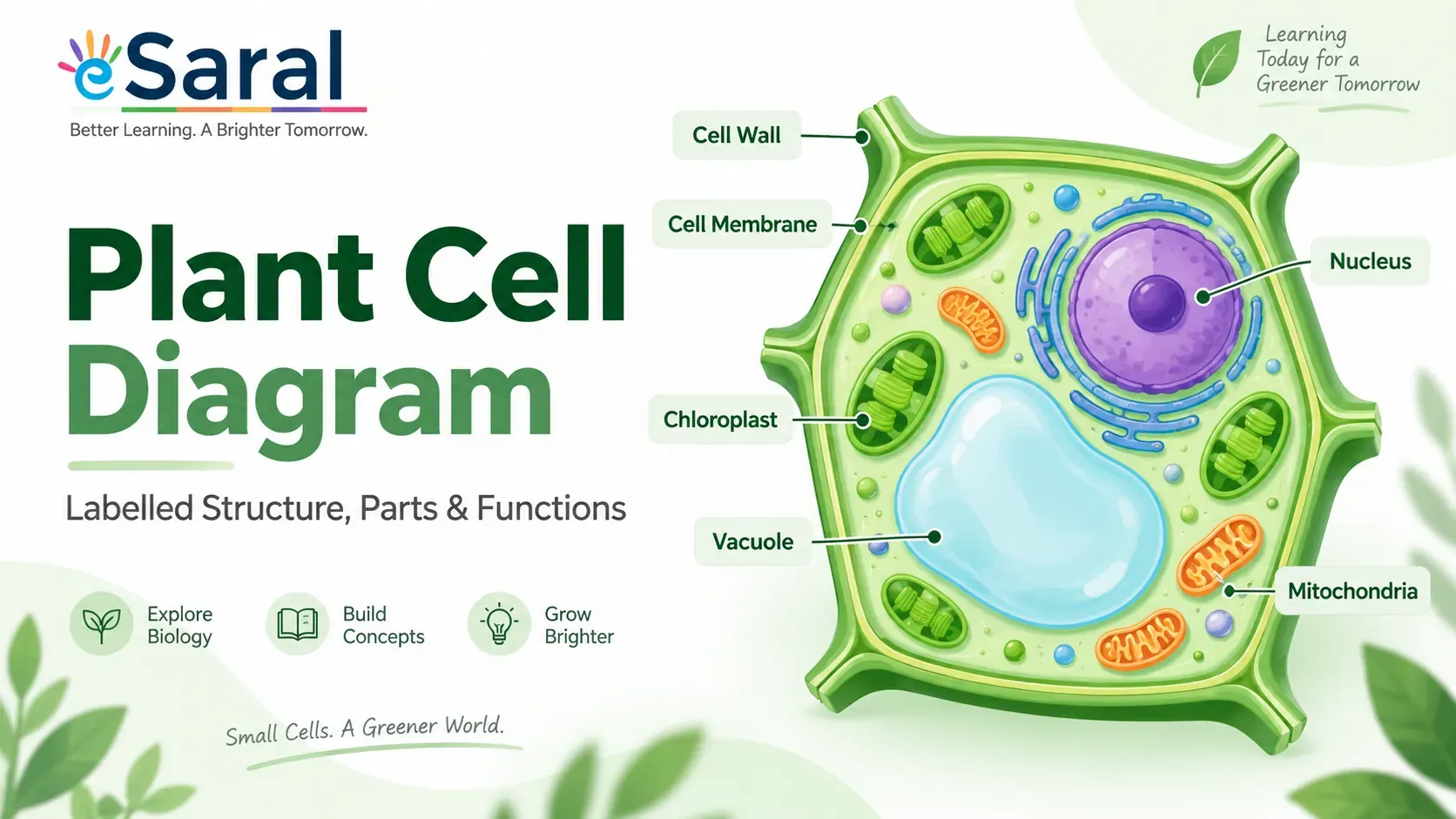
Plant Cell Diagram: Labelled Structure, Parts and Functions
Simple, labelled plant cell diagram with parts and functions. Covers plant cell structure for Class 6, 7, 8, 9, 10 and 11 students, CBSE-aligned.

Saransh Gupta Sir's Visit to IIT Patna: Hostel Life, Placements & Lessons for JEE Aspirants
Inside Saransh Gupta Sir's IIT Patna visit — hostel life, the library, placements, internships, and real advice for JEE aspirants from students living the IIT dream.
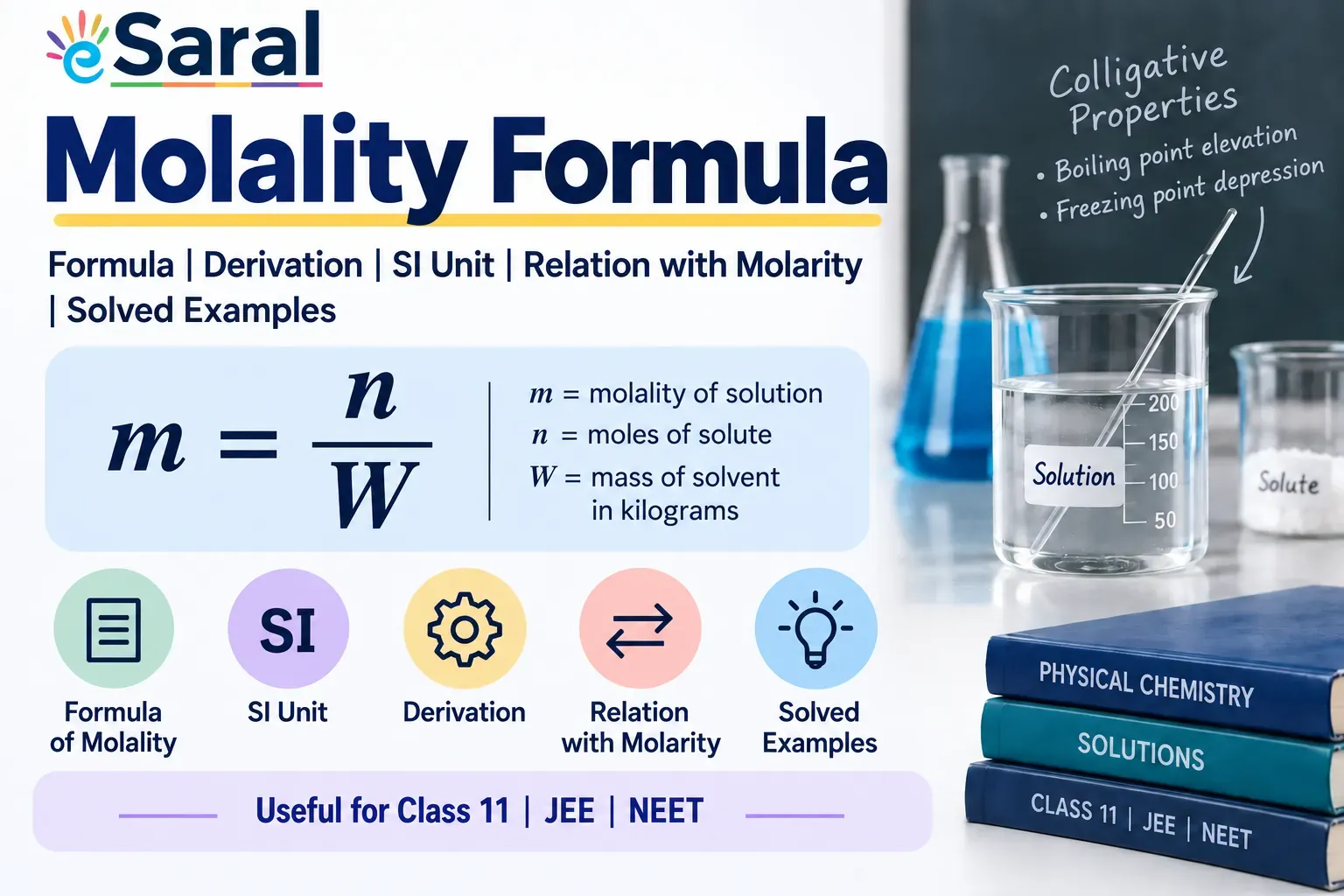
Molality Formula: Formula for Molality, Derivation & Solved Examples
Molality formula is $m = \dfrac{n}{W}$. Learn the formula of molality, its SI unit, derivation, relation with molarity, and solved examples for Class 11, JEE and NEET.
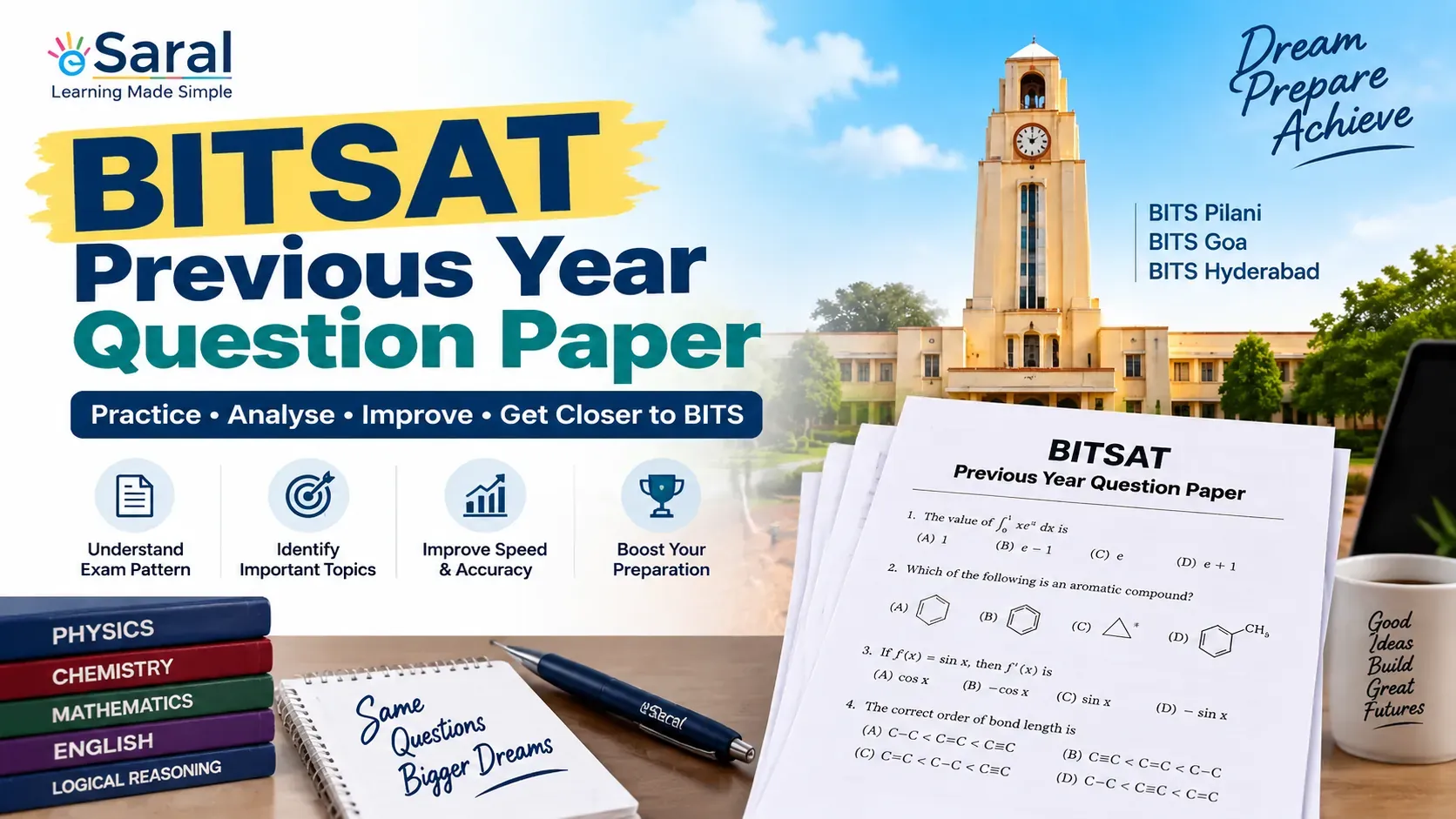
BITSAT Previous Year Question Paper PDF
Download BITSAT previous year question papers PDF. Get year-wise BITSAT PYQs, memory-based papers, exam pattern, and preparation tips to improve your BITSAT preparation.

Teachers’ Day 2026 at eSaral Gurukul: Celebrating the Bond Between Students, Teachers & Mentors
See how Teachers’ Day 2026 was celebrated at eSaral Gurukul, reflecting the bond among students, teachers, and mentors, and the role of guidance beyond academics.
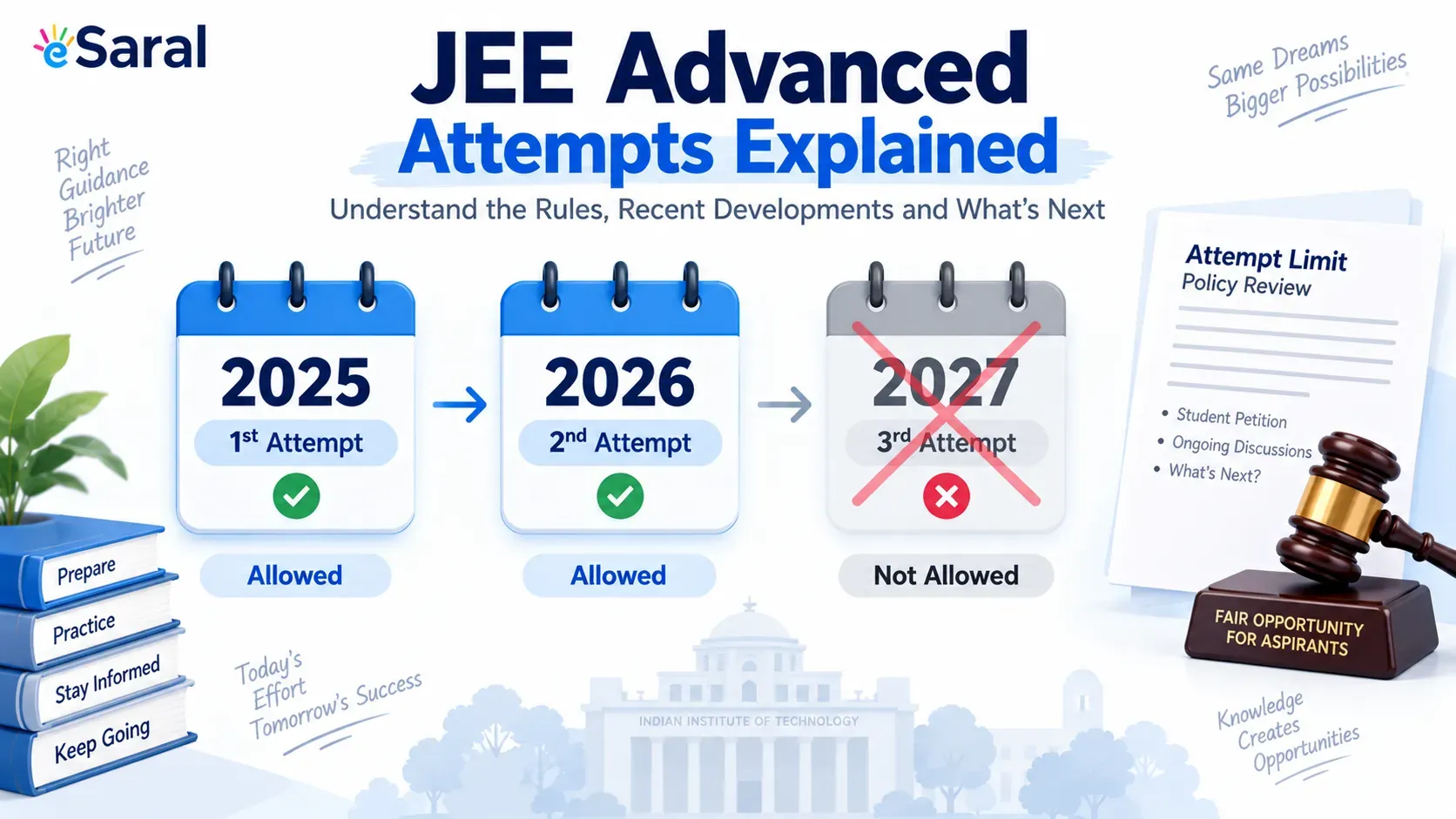
JEE Advanced Attempts: Can You Give It a Third Time? Rules Explained
JEE Advanced attempts: current rule is 2 consecutive years only: full eligibility criteria, the 2025 third-attempt controversy, and the latest 2026 petition news.

Best JEE Preparation App
Best JEE preparation app for Main & Advanced: AI mock tests, live doubt-solving, thousands of practice questions. JEE preparation app for droppers & Class 11-12.
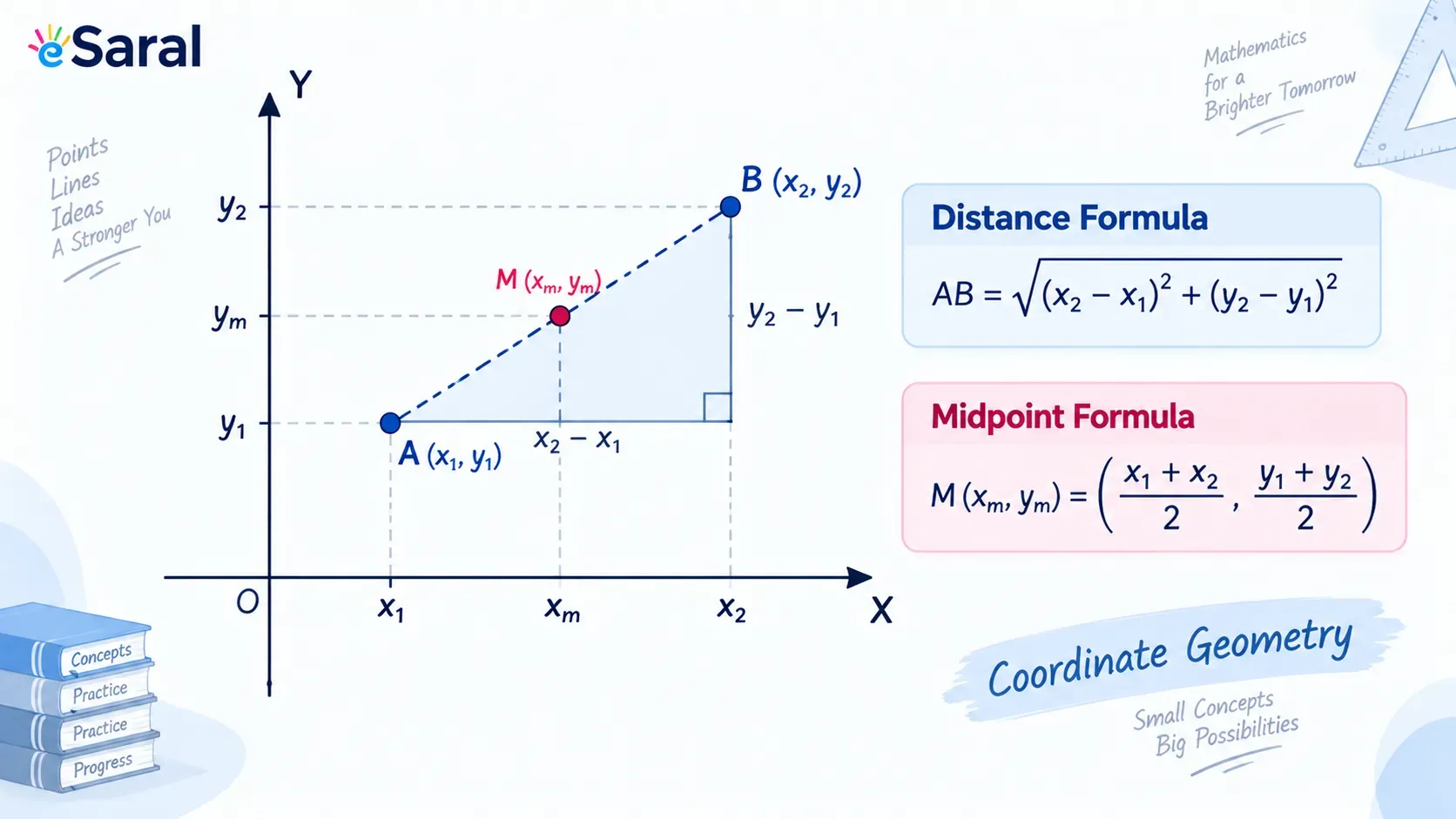
Coordinate Geometry Class 10: Formulas, Notes & Solved Examples
Coordinate geometry class 10: complete CBSE formulas — distance, section, midpoint and area of triangle — with derivation, notes and solved examples.
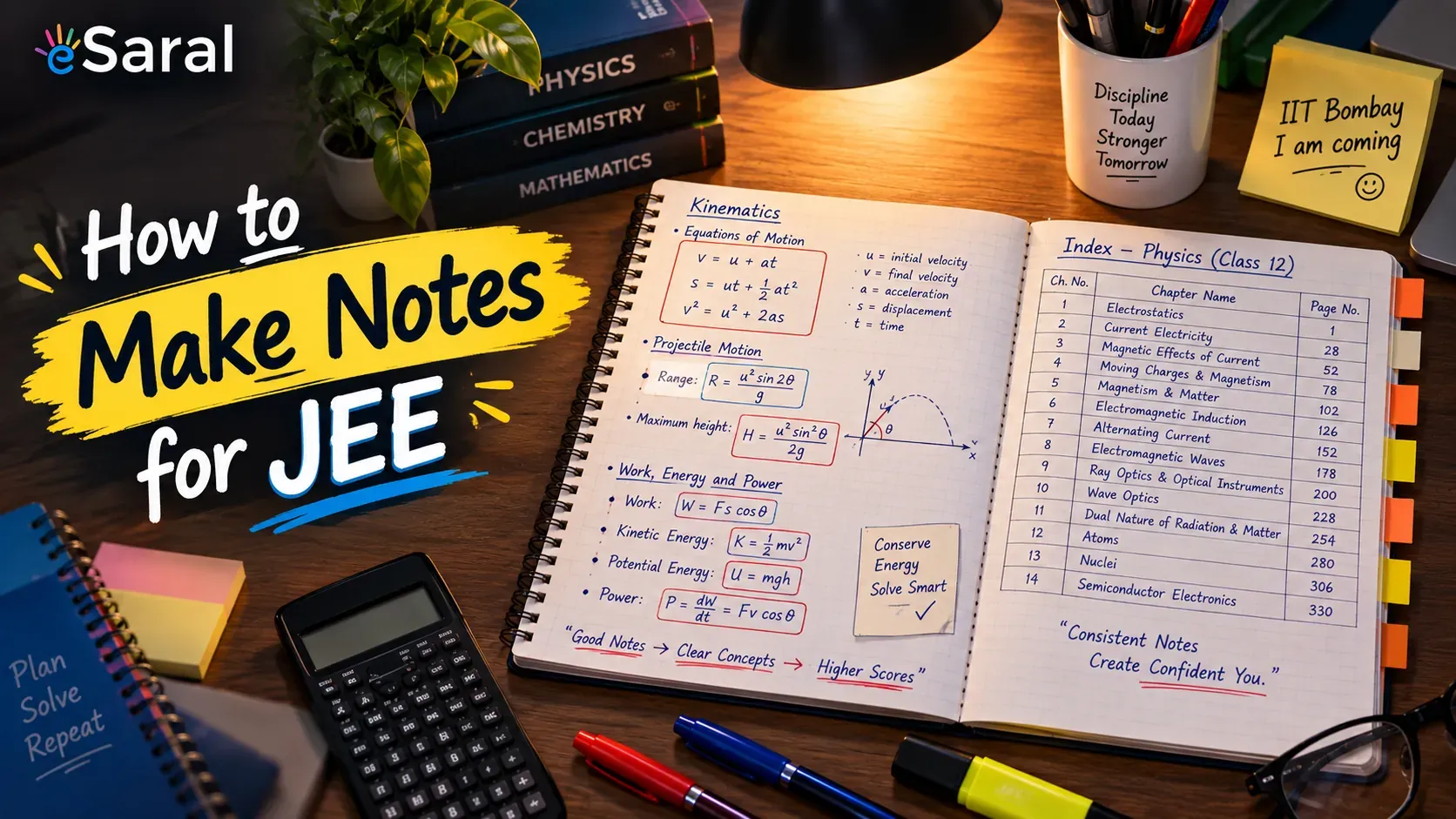
How to make Notes For JEE Smart Notes Strategy of an AIR 41
Learn how to make notes for JEE the way toppers do — indexing, shorthand, and smart short notes for JEE that cut revision time to just 5–7 days.
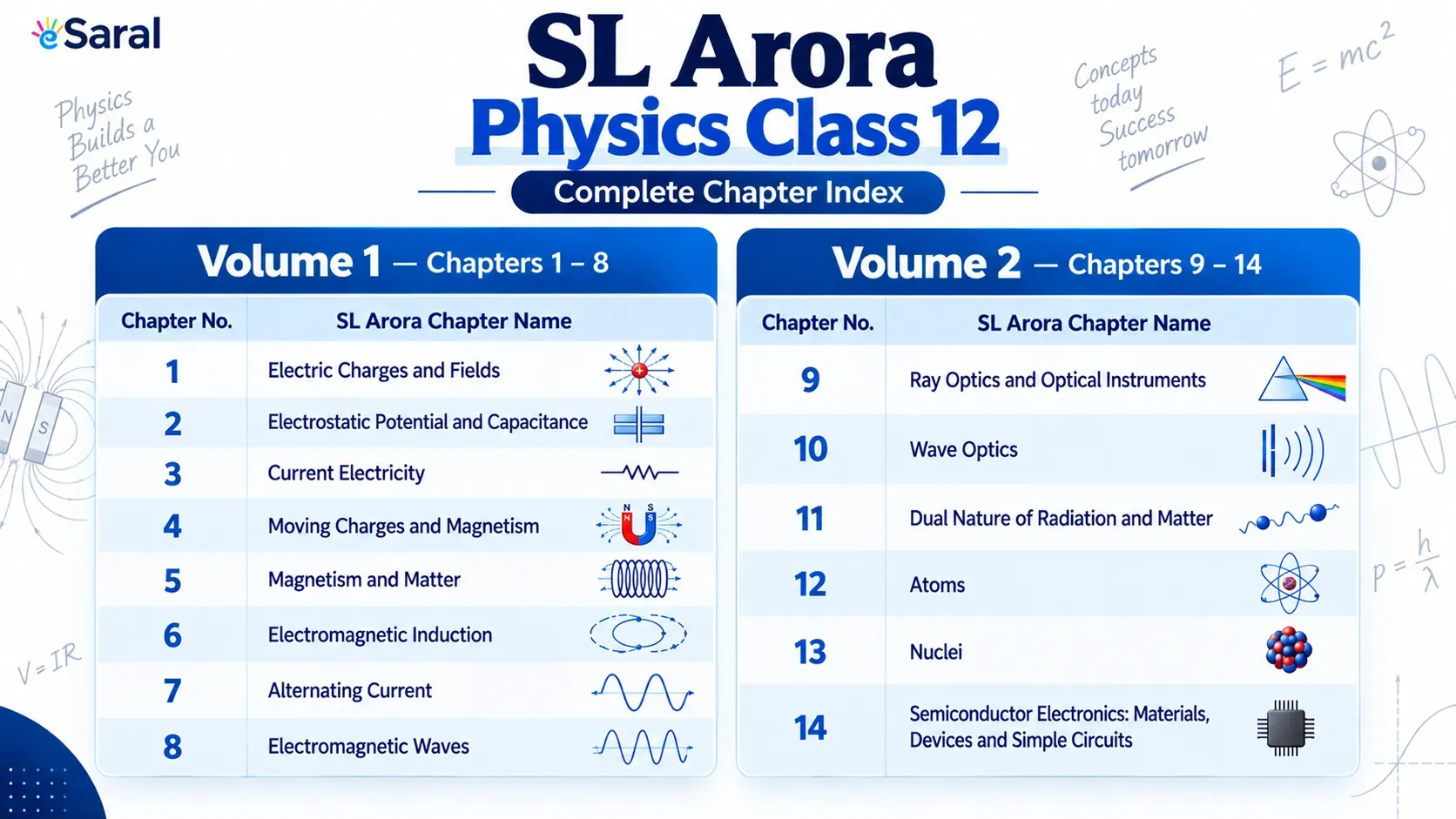
SL Arora Physics Class 12 Index – Chapter List for Volume 1 & 2
SL Arora Physics Class 12 index — complete chapter list for Volume 1 & 2, mapped to NCERT solutions for board, JEE Main, and NEET preparation.