
Kinetic Theory of Gases - JEE Advanced Previous Year Questions with Solutions

eSaral Academic and Editorial Team
Summary
Kinetic Theory of Gases JEE Advanced previous year questions test concepts like rms speed, gas mixture properties, ideal gas conditions, and energy per mole. JEE Advanced has consistently asked 1–2 questions from this topic, often multi-correct type. Mastering the core formulae and their applications is enough to score full marks here.

Home > JEE Advanced PYQs > Kinetic Theory of Gases – JEE Advanced PYQs

JEE Advanced Previous Year Questions of Physics with Solutions are available at eSaral. Practicing JEE Advanced Previous Year Papers Questions of Physics will help the JEE aspirants in realizing the question pattern as well as help in analyzing weak & strong areas. Get detailed Class 11th & 12th Physics Notes to prepare for Boards as well as competitive exams like IIT JEE, NEET etc. eSaral helps the students in clearing and understanding each topic in a better way. eSaral is providing complete chapter-wise notes of Class 11th and 12th both for all subjects. Click Here for JEE main Previous Year Topic Wise Questions of Physics with Solutions Download eSaral app for free study material and video tutorials. Simulator Previous Years JEE Advanced Questions [esquestion] A real gas behaves like an ideal gas if its ? (A) pressure and temperature are both high (B) pressure and temperature are both low (C) pressure is high and temperature is low (D) pressure is low and temperature is high #tag# #sol# (D) $\operatorname{High} \vec{P},$ Low $P$ [/esquestion] [esquestion] A mixture of 2 moles of helium gas (atomic mass = 4 amu) and 1 mole of argon gas (atomic mass = 40 amu) is kept at 300 K in a container. The ratio of the rms speeds $\left(\frac{v_{r m s}(\text {helium})}{v_{r m s}(\text {arg on})}\right)$ is ? (A) 0.32 (B) 0.45 (C) 2.24 (D) 3.16 #tag# [JEE-2012] #sol# (D) $v_{m s}=\sqrt{\frac{3 R T}{M}} ; \frac{\left(v_{m s}\right)_{H e}}{\left(v_{m s}\right)_{A r}}=\sqrt{\frac{M_{A r}}{M_{H e}}}=\sqrt{\frac{40}{4}}=\sqrt{10}=3.16$ [/esquestion] [esquestion] Two non-reactive monoatomic ideal gases have their atomic masses in the ratio 2 : 3. The ratio of their partial pressures, when enclosed in a vessel kept at a constant temperature, is 4 : 3. The ratio of their densities is :- (A) 1 : 4 (B) 1 : 2 (C) 6 : 9 (D) 8 : 9 #tag# [JEE-2013] #sol# (D) $\mathrm{P}=\frac{\rho}{\mathrm{M}} \mathrm{RT}$ $\Rightarrow \frac{\mathrm{P}_{1}}{\mathrm{P}_{2}}=\frac{\rho_{1} \mathrm{M}_{2}}{\rho_{2} \mathrm{M}_{1}}=\frac{4}{3} \Rightarrow \frac{\rho_{1}}{\rho_{2}}=\frac{4}{3} \times \frac{2}{3}=\frac{8}{9}$ [/esquestion] [esquestion] A container of fixed volume has a mixutre of one mole of hydrogen and one mole of helium in equilibrium at temperature T. Assuming the gases are ideal, the correct statement(s) is (are) :- (A) The average energy per mole of the gas mixture is 2RT. (B) The ratio of speed of sound in the gas mixture to that in helium gas is $\sqrt{6 / 5}$. (C) The ratio of the rms speed of helium atoms to that of hydrogen molecules is 1/2. (D) The ratio of the rms speed of helium atoms to that of hydrogen molecules is $1 / \sqrt{2}$. #tag# [JEE-Advance-2015] #sol# (A,B,D) $C_{V(\operatorname{mix})}=\frac{(1)\left(\frac{3}{2} R\right)+(1)\left(\frac{5}{2} R\right)}{2}=2 R$ $\mathrm{C}_{\mathrm{P}(\mathrm{mix})}=3 \mathrm{R} \quad \gamma_{\operatorname{mix}}=\frac{3}{2} \Rightarrow \mathrm{f}=4$ Average energy/mole $=\mathrm{f} \frac{1}{2} \mathrm{RT}=2 \mathrm{RT}$ $\frac{\left(\mathrm{V}_{\mathrm{sound}}\right)_{\mathrm{mixture}}}{\left(\mathrm{V}_{\mathrm{sound}}\right)_{\mathrm{He}}}=\frac{\sqrt{\frac{\mathrm{RT}}{2}}}{\sqrt{\frac{5 \mathrm{RT}}{12}}}=\sqrt{\frac{6}{5}}$ $\frac{\left(\mathrm{V}_{\mathrm{rms}}\right)_{\mathrm{He}}}{\left(\mathrm{V}_{\mathrm{rms}}\right)_{\mathrm{H}_{2}}}=\frac{\sqrt{\frac{3 \mathrm{RT}}{4}}}{\sqrt{\frac{3 \mathrm{RT}}{2}}}=\frac{1}{\sqrt{2}}$ $\therefore(\mathrm{A}, \mathrm{B}, \mathrm{D})$ [/esquestion]
For students who want to go beyond these PYQs, Irodov Selected Questions for JEE Advanced offers an opportunity to explore challenging problems and apply Physics concepts in varied
After working through Kinematics (1D) - JEE Advanced PYQs (Physics), test your timing with real papers from the JEE Advanced exam paper archive.
Frequently Asked Questions
Does the number of moles affect the rms speed of a gas?
No. The rms speed formula is $v_{rms} = \sqrt{3RT/M}$, which depends only on temperature T and molar mass M. The number of moles is irrelevant when comparing rms speeds of two gases at the same temperature, as seen in the 2012 JEE Advanced helium-argon question.
What is the condition for a real gas to behave like an ideal gas?
A real gas behaves like an ideal gas at low pressure and high temperature. Low pressure increases the intermolecular distance (reducing attraction forces), and high temperature ensures kinetic energy dominates over intermolecular potential energy. This is the direct answer to the 2012 JEE Advanced question on this topic.
How do you calculate the speed of sound in a gas mixture?
First, find the effective $\gamma_{mix}$ and $M_{mix}$ of the mixture using weighted averages. Then apply $v_{sound} = \sqrt{\gamma_{mix} RT / M_{mix}}$. For a 1:1 molar mixture of He and H₂, $\gamma_{mix} = 3/2$ and $M_{mix} = 3$ g/mol, giving a sound speed ratio of $\sqrt{6/5}$ compared to pure He.
How many questions come from Kinetic Theory in JEE Advanced?
Typically 1–2 questions per year appear from Kinetic Theory in JEE Advanced. From 2012–2015, every paper had at least one question from this topic. Since 2016, it sometimes appears as part of a multi-topic thermodynamics question. Consistent preparation ensures you never drop marks here.
Where can I find more JEE Advanced Physics previous year questions with solutions?
All JEE Advanced Physics PYQs with chapter-wise solutions are available on eSaral, taught by IIT Bombay faculty with verified All India Ranks. You can also supplement your preparation using NCERT Solutions for Class 12 Physics for thermodynamics topics that connect with Kinetic Theory at the advanced level.
What are the degrees of freedom for monoatomic, diatomic, and triatomic gases?
Monoatomic gases (He, Ar) have 3 degrees of freedom (translational only). Diatomic gases (H₂, N₂, O₂) have 5 degrees of freedom at room temperature (3 translational + 2 rotational). Non-linear triatomic gases have 6. This directly determines $C_V = (f/2)R$ and $\gamma = 1 + 2/f$.
Team eSaral
eSaral Academic and Editorial Team
Team eSaral is the collective author profile for educational content created by eSaral’s teachers and academic contributors. The team draws on expertise from IIT graduates, doctors, experienced educators and subject specialists to develop resources for JEE, NEET and school students. Our articles aim to explain concepts clearly and help students study with confidence.
Related Posts

Plant Cell Diagram: Labelled Structure, Parts and Functions
Simple, labelled plant cell diagram with parts and functions. Covers plant cell structure for Class 6, 7, 8, 9, 10 and 11 students, CBSE-aligned.

Saransh Gupta Sir's Visit to IIT Patna: Hostel Life, Placements & Lessons for JEE Aspirants
Inside Saransh Gupta Sir's IIT Patna visit — hostel life, the library, placements, internships, and real advice for JEE aspirants from students living the IIT dream.
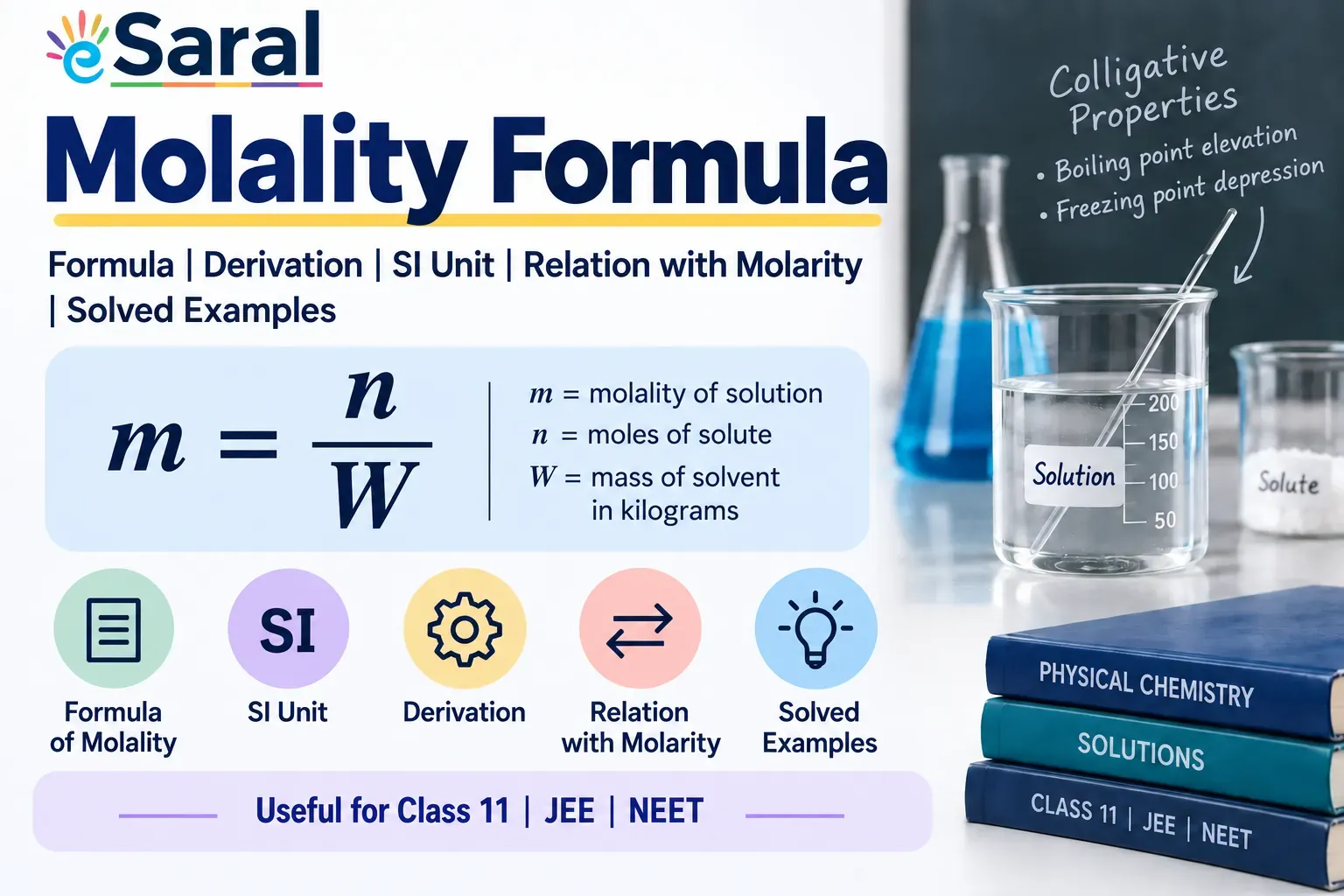
Molality Formula: Formula for Molality, Derivation & Solved Examples
Molality formula is $m = \dfrac{n}{W}$. Learn the formula of molality, its SI unit, derivation, relation with molarity, and solved examples for Class 11, JEE and NEET.
BITSAT Previous Year Question Paper PDF
Download BITSAT previous year question papers PDF. Get year-wise BITSAT PYQs, memory-based papers, exam pattern, and preparation tips to improve your BITSAT preparation.

Teachers’ Day 2026 at eSaral Gurukul: Celebrating the Bond Between Students, Teachers & Mentors
See how Teachers’ Day 2026 was celebrated at eSaral Gurukul, reflecting the bond among students, teachers, and mentors, and the role of guidance beyond academics.

JEE Advanced Attempts: Can You Give It a Third Time? Rules Explained
JEE Advanced attempts: current rule is 2 consecutive years only: full eligibility criteria, the 2025 third-attempt controversy, and the latest 2026 petition news.

Best JEE Preparation App
Best JEE preparation app for Main & Advanced: AI mock tests, live doubt-solving, thousands of practice questions. JEE preparation app for droppers & Class 11-12.
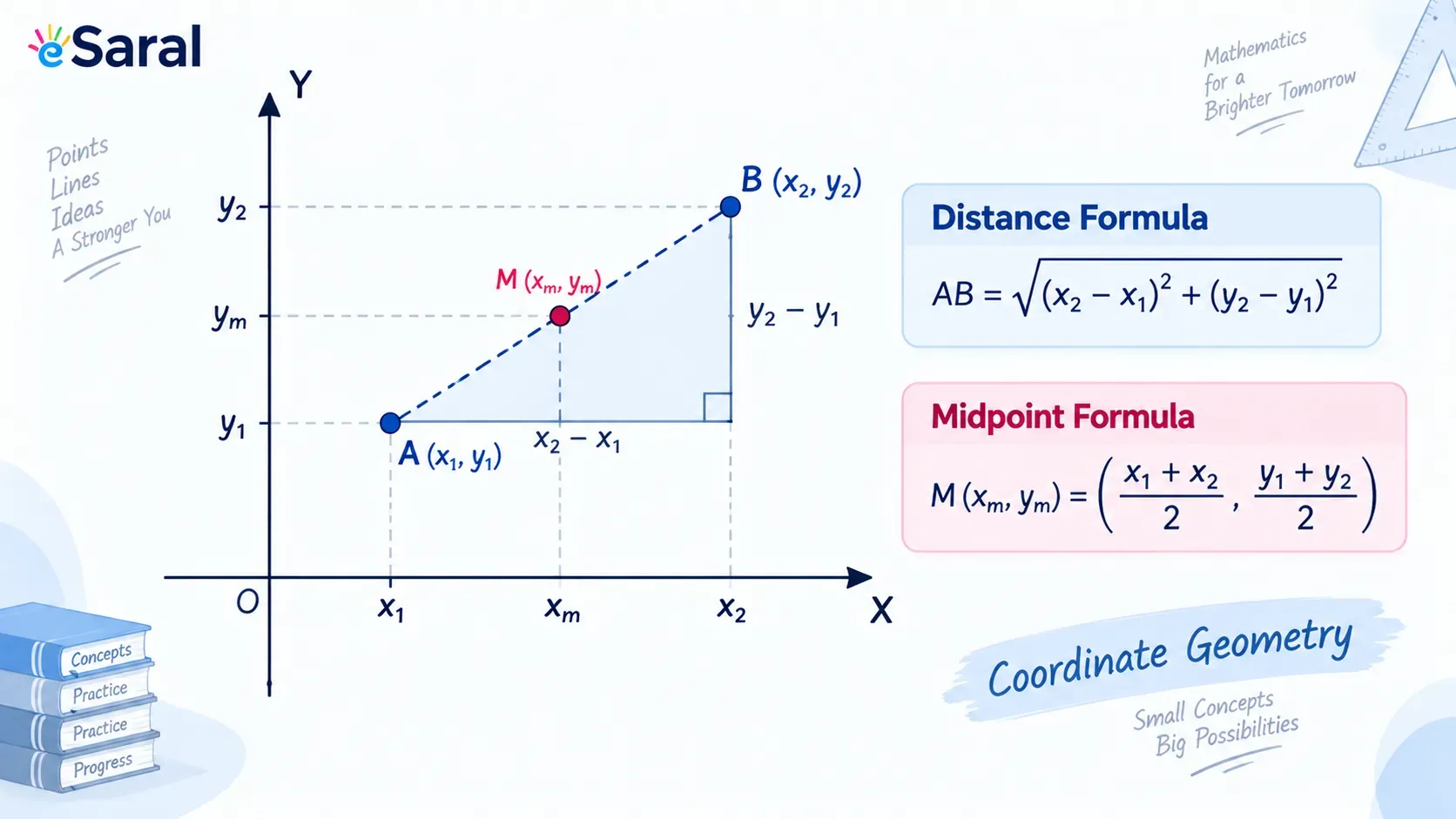
Coordinate Geometry Class 10: Formulas, Notes & Solved Examples
Coordinate geometry class 10: complete CBSE formulas — distance, section, midpoint and area of triangle — with derivation, notes and solved examples.

How to make Notes For JEE Smart Notes Strategy of an AIR 41
Learn how to make notes for JEE the way toppers do — indexing, shorthand, and smart short notes for JEE that cut revision time to just 5–7 days.
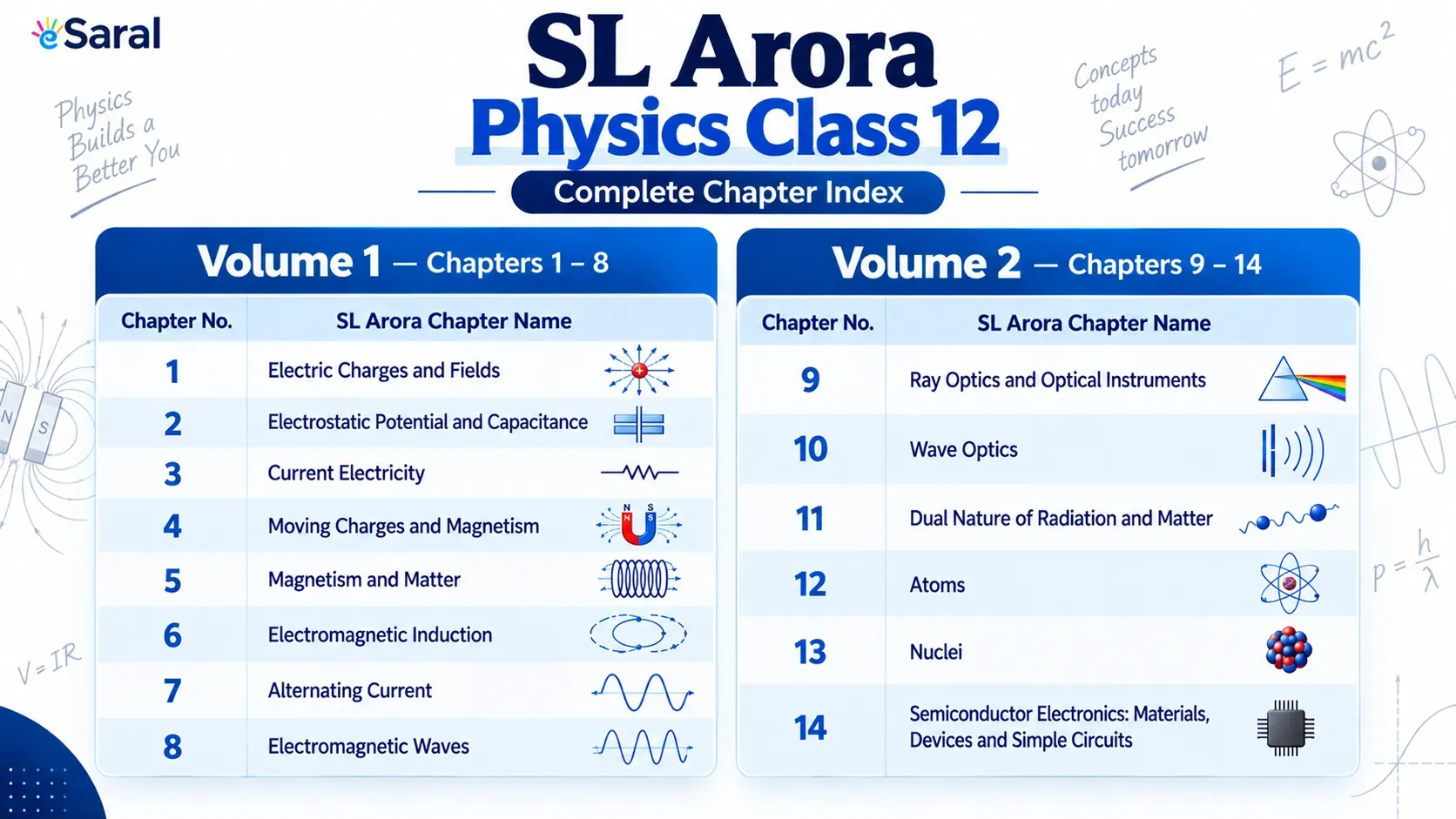
SL Arora Physics Class 12 Index – Chapter List for Volume 1 & 2
SL Arora Physics Class 12 index — complete chapter list for Volume 1 & 2, mapped to NCERT solutions for board, JEE Main, and NEET preparation.