
Kirchhoff’s Circuit Laws - KCL & KVL | Symmetric line method

eSaral Academic and Editorial Team
We have studies Ohm's law but in real life we have to deal with a lot complex circuits. To calculate current and potential differences across them we require something else. So here we will know about Kirchhoff's circuit laws. Contents:
- Kirchhoff's circuit laws
- Kirchhoff’s First Law or Kirchhoff’s Current Law
- Kirchhoff’s Second Law or Kirchhoff’s Voltage Law
- Dissimilar cells in Parallel
- Symmetric line method
Kirchhoff’s Circuit Laws
Gustav Kirchhoff, a German physicist, in 1825 developed a set of rules or laws to find the voltages and currents circulating in complex circuits where working only with Ohm's law don't suffice. There are majorly two laws to calculate current and potential difference along different loops present in a circuit known as Kirchhoff's circuit laws. For the calculations, to obtain circuit equations these laws are useful.
The first rule, the junction theorem, states that the sum of the currents into a specific junction in the circuit equals the sum of the currents out of the same junction. Electric charge is conserved: it does not suddenly appear or disappear; it does not pile up at one point and thin out at another.
The second rule, the loop equation, states that around each loop in an electric circuit the sum of the emf’s (electromotive forces, or voltages, of energy sources such as batteries and generators) is equal to the sum of the potential drops, or voltages across each of the resistances, in the same loop. All the energy imparted by the energy sources to the charged particles that carry the current is just equivalent to that lost by the charge carriers in useful work and heat dissipation around each loop of the circuit. [source]
Kirchhoff’s First Law or Kirchhoff’s Current Law (KCL)
In any electrical network, the algebraic sum of currents meeting at a junction is always zero i.e. ∑I = 0
This law is also called as Junction rule.
$I_{1}-I_{2}+I_{3}+I_{4}-I_{5}=0$
or $\mathrm{I}_{1}+\mathrm{I}_{3}+\mathrm{I}_{4}=\mathrm{I}_{2}+\mathrm{I}_{5}$
- The sum of currents flowing towards a junction is equal to the sum of currents leaving the junction.
- By convention, the current directed towards the junction is positive while those directed away from the junction is taken as negative.
[caption id="attachment_4624" align="aligncenter" width="173"]
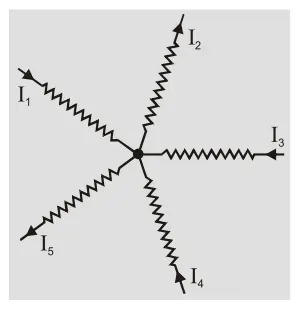 Kirchhoff’s Current Law[/caption]
 - The first law is in accordance with conservation of charge.
- The charges do not accumulate at a junction. The total charge entering a junction is equal to total charge leaving the junction.
Kirchhoff’s Second Law or Kirchhoff’s Voltage Law (KVL)
The algebraic sum of all the potential drops and emf’s along any closed path in a network is zero. i.e. ∑V = 0
This law is also called as Loop rule.
- The second law is in accordance with conservation of energy.
- According to second law the electric energy given to the charge by a source of emf is lost in passing through resistance.
- The change in potential in covering a resistance in the direction of current is negative (–IR) while in opposite direction it is positive.
The potential falls along direction of current. The potential fall is taken as negative while potential rise is taken as positive.
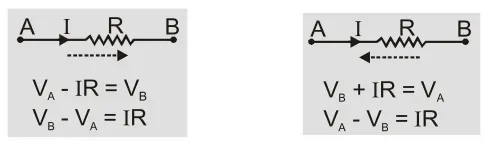
- The emf of source is taken as positive when it is traversed from negative to positive terminal while it is taken as negative when it is traversed from positive to negative irrespective of the direction of current.
[caption id="attachment_4626" align="aligncenter" width="383"]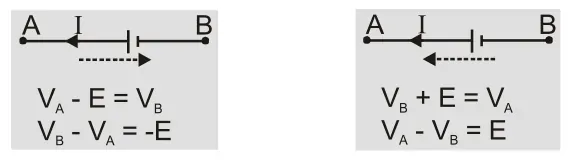 Kirchhoff’s Voltage Law[/caption]
 - If there are $n$ loops, there will be $(n - 1)$ equations according to loop rule.
- The algebraic sum of products of currents and resistances in a closed loop is equal to sum of emf's applied in the circuit i.e. ∑E =∑IR
Dissimilar cells in Parallel
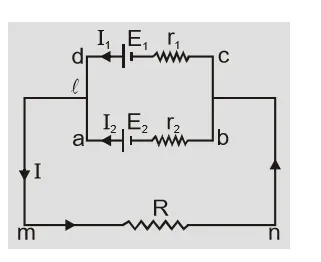
Let two cells of emf ${E_1}$ and ${E_2}$ with internal resistances ${r_1}$ and ${r_2}$ be connected in parallel to an external resistance$R$.
Applying loop rule to loop ${\rm{d}}$${\rm{l}}$${\rm{m}}$${\rm{n}}$${\rm{c}}$${\rm{d}}$ $ - {\rm{IR}} - {{\rm{I}}_1}{{\rm{r}}_1} + {{\rm{E}}_1} = 0\quad \ldots \ldots $ (1)
Applying loop rule to loop ${\rm{a}}$${\rm{l}}$${\rm{m}}$${\rm{n}}$${\rm{b}}$${\rm{a}}$ $ - {\rm{IR}} - {{\rm{I}}_2}{{\rm{r}}_2} + {{\rm{E}}_2} = 0\quad \ldots \ldots $ (2)
Applying first rule at junction $\ell {\rm{I}} = {{\rm{I}}_1} + {{\rm{I}}_2}$
Multiply equation 1 by ${r_2}$ and eqn. 2 by ${r_1}$ and put ${I_2} = I - {I_1}$ we get
$ - {\rm{IR}}{{\rm{r}}_2} - {{\rm{I}}_1}{{\rm{r}}_1}{{\rm{r}}_2} + {{\rm{E}}_1}{{\rm{r}}_2} = 0\quad $ and $\quad - {\rm{IR}}{{\rm{r}}_1} - \left( {{\rm{I}} - {{\rm{I}}_4}} \right){{\rm{r}}_2}{{\rm{r}}_1} + {{\rm{E}}_2}{{\rm{r}}_1} = 0$
[caption id="attachment_4627" align="aligncenter" width="222"] Dissimilar cells in Parallel[/caption]
On adding these we get $\mathrm{E}_{1} \mathrm{r}_{2}+\mathrm{E}_{2} \mathrm{r}_{1}=\mathrm{IR}\left(\mathrm{r}_{1}+\mathrm{r}_{2}\right)+\mathrm{Ir}_{1} \mathrm{r}_{2}$
$=\mathrm{I}\left(\mathrm{r}_{1}+\mathrm{r}_{2}\right)\left[\mathrm{R}+\frac{\mathrm{r}_{1} \mathrm{r}_{2}}{\mathrm{r}_{1}+\mathrm{r}_{2}}\right]$
Or, $\quad {\rm{I}} = {{\left( {{{\rm{E}}_{{{\rm{f}}_2}}} + {{\rm{E}}_2}{{\rm{r}}_1}} \right)/{{\rm{r}}_1} + {{\rm{r}}_2}} \over {{\rm{R}} + {{{{\rm{r}}_1}{{\rm{r}}_2}} \over {{{\rm{r}}_1} + {{\rm{r}}_2}}}}} = {{{{\rm{E}}_{{\rm{eq}}}}} \over {{\rm{R}} + {{\rm{r}}_{{\rm{eq}}}}}}$
[caption id="attachment_4628" align="aligncenter" width="198"] Equivalent Cell[/caption] Two dissimilar cells in parallel are equivalent to a single cell of internal resistance ${{\rm{r}}_{{\rm{eq}}}} = {{{{\rm{r}}_{\rm{r}}} \cdot {{\rm{r}}_2}} \over {{{\rm{r}}_1} + {{\rm{r}}_2}}}$
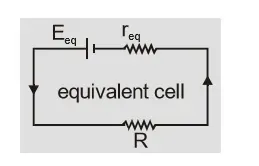
and ${\rm{emf}} {{\rm{E}}_{{\rm{eq}}}} = {{{{\rm{E}}_1}{{\rm{r}}_2} + {{\rm{E}}_2}{{\rm{r}}_1}} \over {{{\rm{r}}_1} + {{\rm{r}}_2}}} = {{{{\rm{r}}_1}{{\rm{r}}_2}} \over {{{\rm{r}}_1} + {{\rm{r}}_2}}}\left[ {{{{{\rm{E}}_1}} \over {{{\rm{r}}_1}}} + {{{{\rm{E}}_2}} \over {{{\rm{r}}_2}}}} \right]$
Symmetric line method
If a circuit is symmetric about a line then all points lying on line of symmetry are at same potential.
In this method, we divide the circuit in two equal parts and double the resistance of one part.
Example: In above question DF is line of symmetry so D and F are at same potential.
Now ${{\rm{R}} \over 2}$ is in parallel to ${\rm{R}}({\rm{CD}}) = {{{\rm{R}} \times {\rm{R}}/2} \over {{\rm{R}} + {\rm{R}}/2}} = {{\rm{R}} \over 3}$
This ${{\rm{R}} \over 3}$ is in series with ${\rm{R}}({\rm{AC}}) = {\rm{R}} + {\rm{R}}/3 = 4{\rm{R}}/3$
This ${{\rm{4R}} \over 3}$ is in parallel with ${\rm{R}}({\rm{AD}}) = 4{\rm{R}}/7\quad $
So ${{\rm{R}}_{{\rm{eq}}}} = {{2 \times 4{\rm{R}}} \over 7} = {{8{\rm{R}}} \over 7}$
Solved Examples
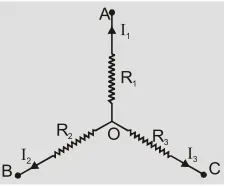
[esquestion]A circuit has a section ABC. If the potential at points $A, B$ and $C$ are ${V_1},{V_2}\&\,\,{V_3}$ then calculate potential at O. #sol#Applying junction rule at O $\quad - {I_1} - {I_2} - {I_3} = 0$ or $\quad {I_1} + {I_2} + {I_3} = 0$ Let ${V_0}$ be potential at O then ${{\rm{V}}_0} - {{\rm{V}}_1} = {{\rm{I}}_1}{{\rm{R}}_1},\quad {{\rm{V}}_0} - {{\rm{V}}_2} = {{\rm{I}}_2}{{\rm{R}}_2},\quad {{\rm{V}}_0} - {{\rm{V}}_3} = {{\rm{I}}_3}{{\rm{R}}_3}$ so $\quad {{\rm{I}}_1} = {{{{\rm{V}}_0} - {{\rm{V}}_1}} \over {{{\rm{R}}_1}}},\quad {{\rm{I}}_2} = {{{{\rm{V}}_0} - {{\rm{V}}_2}} \over {{{\rm{R}}_2}}},{{\rm{I}}_3} = {{{{\rm{V}}_0} - {{\rm{V}}_3}} \over {{{\rm{R}}_3}}}$ adding them we get $\quad {{\rm{V}}_0}\left[ {{1 \over {{{\rm{R}}_1}}} + {1 \over {{{\rm{R}}_2}}} + {1 \over {{{\rm{R}}_3}}}} \right] - \left[ {{{{{\rm{V}}_1}} \over {{{\rm{R}}_1}}} + {{{{\rm{V}}_2}} \over {{{\rm{R}}_2}}} + {{{{\rm{V}}_3}} \over {{{\rm{R}}_3}}}} \right] = 0$ or $\quad {V_0} = {{{V_1}} \over {{R_1}}} + {{{V_2}} \over {{R_2}}} + {{{V_3}} \over {{R_3}}}/{1 \over {{R_1}}} + {1 \over {{R_2}}} + {1 \over {{R_3}}}$ [/esquestion] Also Read:
- Types and Effects of Electric Current
- Ohm’s Law and Resistance
- Combination of Resistances
- EMF and Internal Resistances of a Cell
- Cells Connected in Series, parallel and Mixed
- Kirchhoff’s Circuit Law
- Electric Currents in Conductors
- Wheatstone Bridge
- Post office Box
- Wheatstone Meter Bridge
- Moving Coil galvanometer
- Ammeter and Voltmeter
- Potentiometer Working Principle
Team eSaral
eSaral Academic and Editorial Team
Team eSaral is the collective author profile for educational content created by eSaral’s teachers and academic contributors. The team draws on expertise from IIT graduates, doctors, experienced educators and subject specialists to develop resources for JEE, NEET and school students. Our articles aim to explain concepts clearly and help students study with confidence.
Related Posts

Plant Cell Diagram: Labelled Structure, Parts and Functions
Simple, labelled plant cell diagram with parts and functions. Covers plant cell structure for Class 6, 7, 8, 9, 10 and 11 students, CBSE-aligned.

Saransh Gupta Sir's Visit to IIT Patna: Hostel Life, Placements & Lessons for JEE Aspirants
Inside Saransh Gupta Sir's IIT Patna visit — hostel life, the library, placements, internships, and real advice for JEE aspirants from students living the IIT dream.
Molality Formula: Formula for Molality, Derivation & Solved Examples
Molality formula is $m = \dfrac{n}{W}$. Learn the formula of molality, its SI unit, derivation, relation with molarity, and solved examples for Class 11, JEE and NEET.

BITSAT Previous Year Question Paper PDF
Download BITSAT previous year question papers PDF. Get year-wise BITSAT PYQs, memory-based papers, exam pattern, and preparation tips to improve your BITSAT preparation.

Teachers’ Day 2026 at eSaral Gurukul: Celebrating the Bond Between Students, Teachers & Mentors
See how Teachers’ Day 2026 was celebrated at eSaral Gurukul, reflecting the bond among students, teachers, and mentors, and the role of guidance beyond academics.

JEE Advanced Attempts: Can You Give It a Third Time? Rules Explained
JEE Advanced attempts: current rule is 2 consecutive years only: full eligibility criteria, the 2025 third-attempt controversy, and the latest 2026 petition news.

Best JEE Preparation App
Best JEE preparation app for Main & Advanced: AI mock tests, live doubt-solving, thousands of practice questions. JEE preparation app for droppers & Class 11-12.
Coordinate Geometry Class 10: Formulas, Notes & Solved Examples
Coordinate geometry class 10: complete CBSE formulas — distance, section, midpoint and area of triangle — with derivation, notes and solved examples.
How to make Notes For JEE Smart Notes Strategy of an AIR 41
Learn how to make notes for JEE the way toppers do — indexing, shorthand, and smart short notes for JEE that cut revision time to just 5–7 days.
SL Arora Physics Class 12 Index – Chapter List for Volume 1 & 2
SL Arora Physics Class 12 index — complete chapter list for Volume 1 & 2, mapped to NCERT solutions for board, JEE Main, and NEET preparation.