
Magnetic Field due to a Short Bar Magnet | Magnetic Dipole - Class 12 physics Notes

eSaral Academic and Editorial Team
Summary
<p><strong>Magnetic Field due to a Short Bar Magnet</strong> explains the magnetic field expressions at axial, equatorial, and arbitrary points around a magnetic dipole, highlighting their magnitudes, directions, and key relationships used in Class 12 Physics and JEE preparation.</p>
eSaral › Class 12 ›Magnetic Field due to a Short Bar Magnet

🚀 Checkout eSaral Courses
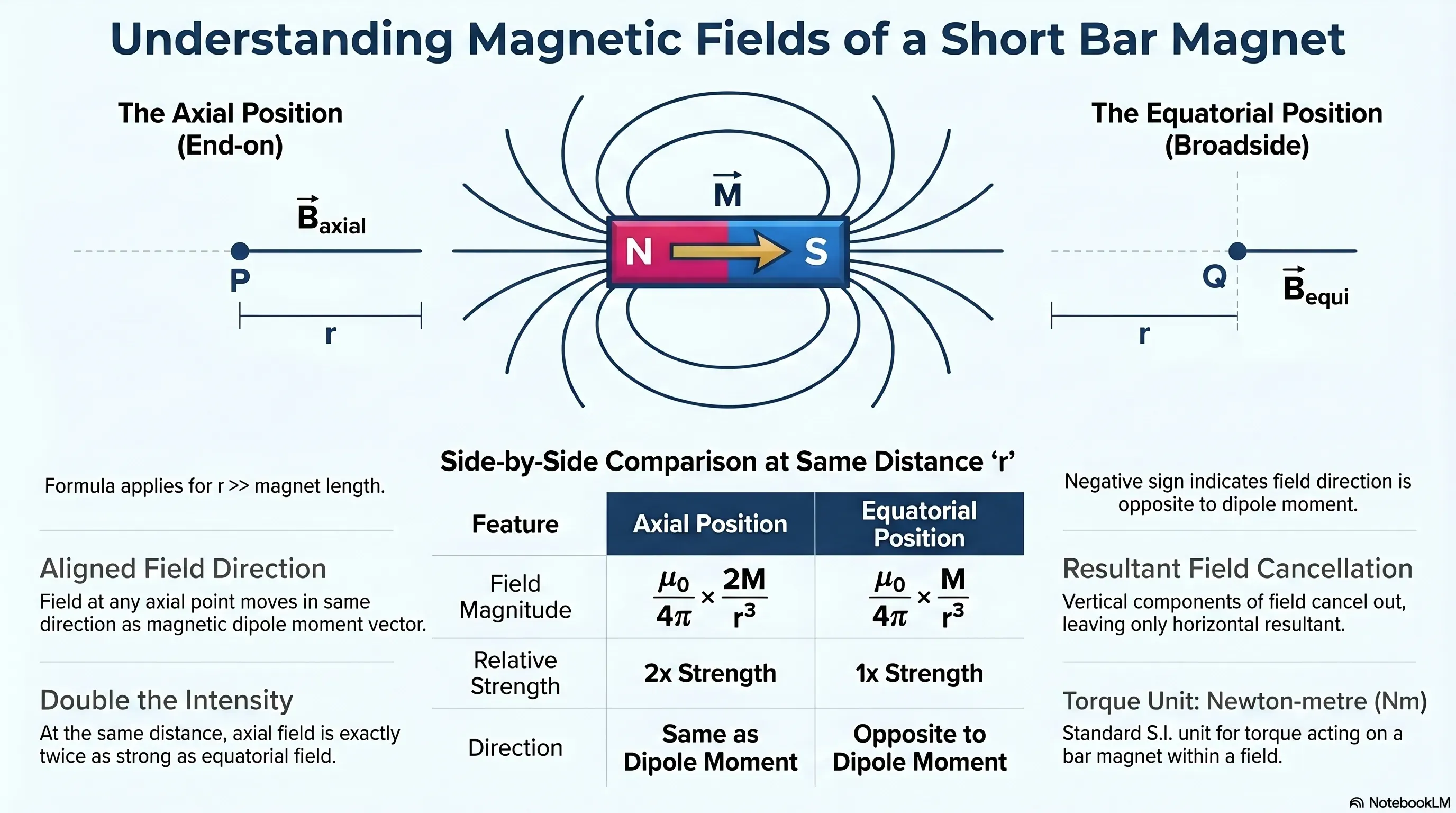
The magnetic field due to a short bar magnet at any point on the axial line is twice the magnetic field at a point on the equatorial line of that magnet at the same distance. S.l. unit of torque acting on the bar magnet is Nm.
Magnetic field due to a short bar magnet (magnetic dipole) :
On Axial Point or End on Position
The magnetic field $\overrightarrow{ B }_{\text {axial }}$ at a point P due to bar magnet will be the resultant of the magnetic fields $\overrightarrow{ B _{1}}$ due to N-pole of magnet and $\overrightarrow{ B _{2}}$ due to S-pole of magnet.
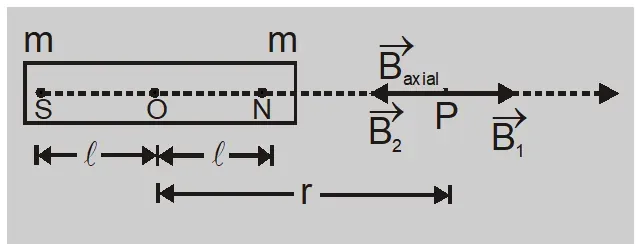
$\overrightarrow{ B }_{\text {axial }}=\overrightarrow{ B _{1}}+\overrightarrow{ B _{2}}$
$\overrightarrow{ B }_{1}=\frac{\mu_{0}}{4 \pi} \frac{ m }{( r -\ell)^{2}}(\hat{ r })$ and $\overrightarrow{ B }_{2}=\frac{\mu_{0}}{4 \pi} \frac{ m }{( r +\ell)^{2}}(-\hat{ r })$
$\therefore \quad \vec{B}_{\text {axal }}=\left[\frac{\mu_{0}}{4 \pi} \frac{m}{(r-\ell)^{2}}-\frac{\mu_{0}}{4 \pi} \frac{m}{(r+\ell)^{2}}\right]$
$\hat{\mathrm{r}}=\frac{\mu_{0} \mathrm{~m}}{4 \pi}\left[\frac{4 \mathrm{r} \ell}{(\mathrm{r}-\ell)^{2}(\mathrm{r}+\ell)^{2}}\right] \hat{\mathrm{r}}$
$\overrightarrow{ B }_{ axial }=\frac{\mu_{0}}{4 \pi} \frac{2 \overrightarrow{ Mr }}{\left( r ^{2}-\ell^{2}\right)^{2}}$
Magnetic field due to a bar magnet at an axial point has same direction as that of its magnetic dipole moment vector.
For a bar magnet of very small length $\ell<< r \overrightarrow{ B }_{ axial }=\frac{\mu_{0}}{4 \pi} \frac{2 \overrightarrow{ M }}{r^{3}}$
Browse More Topics Related Magnetism:
On Equatorial Point or Broadside Position
The magnetic field $\overrightarrow{ B }_{\text {equi }}$ at a point P due to bar magnet will be the resultant of the magnetic fields $\overrightarrow{ B _{1}}$ due to N-pole of magnet and $\overrightarrow{ B _{2}}$ due to S-pole of magnet $\overrightarrow{ B }_{ equi }=\overrightarrow{ B _{1}}+\overrightarrow{ B _{2}}$ due to S-pole of magnet $\overrightarrow{ B }_{ equ i }=\overrightarrow{ B _{1}}+\overrightarrow{ B _{2}}$
$\left|\overrightarrow{ B }_{1}\right|=\frac{\mu_{0}}{4 \pi} \frac{ m }{ NP ^{2}}=\frac{\mu_{0}}{4 \pi} \frac{ m }{ r ^{2}+\ell^{2}}$ along $NP$
$\left|\overrightarrow{ B }_{2}\right|=\frac{\mu_{0}}{4 \pi} \frac{ m }{ SP ^{2}}=\frac{\mu_{0}}{4 \pi} \frac{ m }{\left( r ^{2}+\ell^{2}\right)}$ along $PS$
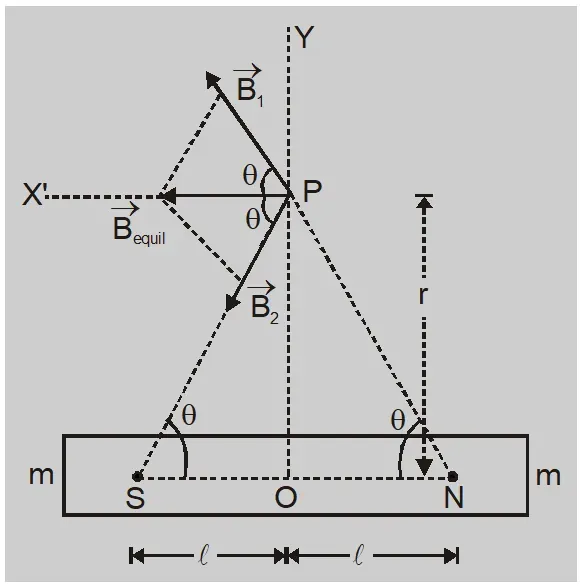
So $\left|\vec{B}_{1}\right|=\left|\vec{B}_{2}\right|$ On resolving $\vec{B}_{1}$ and $\overrightarrow{ B _{2}}$ along PX' and PY we find $\left|\vec{B}_{1}\right|$ $\sin \theta$ and $|\overrightarrow {{B_2}} |\,\sin \theta $
are equal and opposite so they cancel each other. So resultant field
$\overrightarrow{\mathrm{B}}_{\text {equi }}=\overrightarrow{\mathrm{B}}_{1} \cos \theta(-\hat{\mathrm{r}})+\overrightarrow{\mathrm{B}}_{2} \cos \theta(-\hat{\mathrm{r}})$
$=\left[\frac{\mu_{0}}{4 \pi} \frac{m}{\left(r^{2}+\ell^{2}\right)} \cos \theta+\frac{\mu_{0}}{4 \pi} \frac{m}{\left(r^{2}+\ell^{2}\right)} \cos \theta\right](-\hat{r})$
$=2 \cdot \frac{\mu_{0}}{4 \pi} \frac{ m }{\left( r ^{2}+\ell^{2}\right)} \cdot \frac{\ell}{\sqrt{ r ^{2}+\ell^{2}}}(-\hat{ r })$
$\overrightarrow{ B }_{ equi }=-\frac{\mu_{0}}{4 \pi} \frac{\overrightarrow{ M }}{\left( r ^{2}+\ell^{2}\right)^{\frac{3}{2}}}$
$\overrightarrow{ B }_{ equi }=-\frac{\mu_{0}}{4 \pi} \frac{\overrightarrow{ M }}{\left( r ^{2}+\ell^{2}\right)^{\frac{3}{2}}}$
The direction of magnetic field at a point on equitorial line is opposite to magnetic dipole moment vector.
For a bar magnet of very small length $\overrightarrow{ B }_{ equi }=-\frac{\mu_{0}}{4 \pi} \frac{\overrightarrow{ M }}{r^{3}}$
At An Arbitrary Point
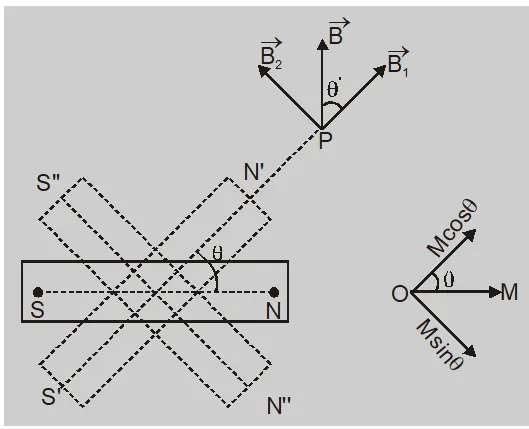
The point P is on axial line of magnet S'N' with magnetic moment Mcos$\theta $ Magnetic flux density $B _{1}=\frac{\mu_{0}}{4 \pi} \frac{2 M \cos \theta}{ r ^{3}}$
The point P is simultaneously on the equatorial line of other magnet N"S" with magnetic moment Msin $\theta $ Magnetic flux density $B _{2}=\frac{\mu_{0}}{4 \pi} \frac{ M \sin \theta}{ r ^{3}}$
Total magnetic flux density at P.
$B =\sqrt{ B _{1}^{2}+ B _{2}^{2}}=\frac{\mu_{0}}{4 \pi} \frac{ M }{ r ^{3}} \sqrt{4 \cos ^{2} \theta+\sin ^{2} \theta}$ or
$\tan \theta^{\prime}=\frac{B_{2}}{B_{1}}=\frac{\frac{\mu_{0}}{4 \pi} \frac{M \sin \theta}{r^{3}}}{\frac{\mu_{0}}{4 \pi} \frac{2 M \cos \theta}{r^{3}}}=\frac{1}{2} \tan \theta$ or $\theta^{\prime}=\tan ^{-1}\left(\frac{1}{2} \tan \theta\right)$
Also Read:
Click here for the Video tutorials of Magnetic Effect of Current Class 12
About eSaral At eSaral we are offering a complete platform for IIT-JEE & NEET preparation. The main mission behind eSaral is to provide education to each and every student in India by eliminating the Geographic and Economic factors, as a nation’s progress and development depends on the availability of quality education to each and every one. With the blend of education & technology, eSaral team made the learning personalized & adaptive for everyone.
For free video lectures and complete study material, Download eSaral APP.
Frequently Asked Questions
What is the magnetic field at the equatorial point of a short bar magnet?
The magnetic field at the equatorial point is B = (μ₀/4π)(M/r³), directed opposite to the magnetic dipole moment M. It is exactly half the axial field at the same distance. The general formula without the short-magnet approximation is B = μ₀M / [4π(r² + ℓ²)^(3/2)].
Why is the axial field twice the equatorial field?
For a short bar magnet at the same distance r, the axial formula gives 2M/r³ and the equatorial formula gives M/r³. The factor of 2 arises because at the axial point both poles contribute fields in the same direction, whereas at the equatorial point the perpendicular components cancel, halving the net result.
What is the formula for the magnetic field at an arbitrary point?
At a point P at distance r and angle θ from the magnetic axis, the field magnitude is B = (μ₀M/4πr³)√(3cos²θ + 1). The direction makes angle θ′ = tan⁻¹(tanθ/2) with the radial direction toward P. Substituting θ = 0° gives the axial result and θ = 90° gives the equatorial result.
What is the SI unit of magnetic dipole moment and torque on a bar magnet?
The SI unit of magnetic dipole moment (M) is A·m² (ampere metre squared). The SI unit of torque acting on a bar magnet placed in a uniform magnetic field is N·m (newton metre), same as the SI unit of work. The torque formula is τ = MB sinθ.
What is the direction of the magnetic field at the equatorial point compared to M?
The magnetic field at the equatorial point is antiparallel (opposite in direction) to the magnetic dipole moment vector M. This is a critical sign distinction: the axial field is parallel to M, while the equatorial field is antiparallel. Many board and competitive exam questions specifically test this directional knowledge.
Team eSaral
eSaral Academic and Editorial Team
Team eSaral is the collective author profile for educational content created by eSaral’s teachers and academic contributors. The team draws on expertise from IIT graduates, doctors, experienced educators and subject specialists to develop resources for JEE, NEET and school students. Our articles aim to explain concepts clearly and help students study with confidence.
Related Posts

Plant Cell Diagram: Labelled Structure, Parts and Functions
Simple, labelled plant cell diagram with parts and functions. Covers plant cell structure for Class 6, 7, 8, 9, 10 and 11 students, CBSE-aligned.

Saransh Gupta Sir's Visit to IIT Patna: Hostel Life, Placements & Lessons for JEE Aspirants
Inside Saransh Gupta Sir's IIT Patna visit — hostel life, the library, placements, internships, and real advice for JEE aspirants from students living the IIT dream.
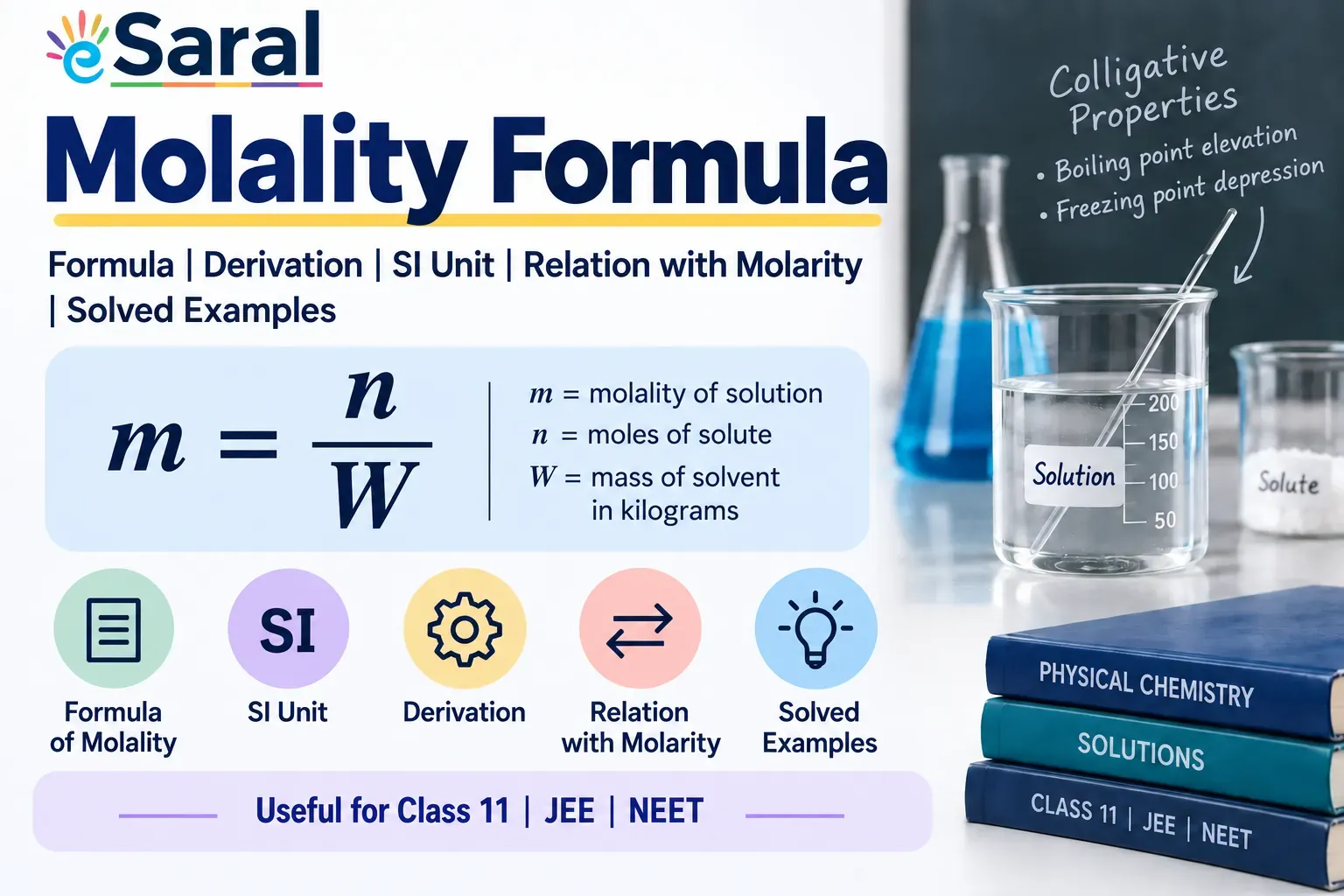
Molality Formula: Formula for Molality, Derivation & Solved Examples
Molality formula is $m = \dfrac{n}{W}$. Learn the formula of molality, its SI unit, derivation, relation with molarity, and solved examples for Class 11, JEE and NEET.

BITSAT Previous Year Question Paper PDF
Download BITSAT previous year question papers PDF. Get year-wise BITSAT PYQs, memory-based papers, exam pattern, and preparation tips to improve your BITSAT preparation.

Teachers’ Day 2026 at eSaral Gurukul: Celebrating the Bond Between Students, Teachers & Mentors
See how Teachers’ Day 2026 was celebrated at eSaral Gurukul, reflecting the bond among students, teachers, and mentors, and the role of guidance beyond academics.

JEE Advanced Attempts: Can You Give It a Third Time? Rules Explained
JEE Advanced attempts: current rule is 2 consecutive years only: full eligibility criteria, the 2025 third-attempt controversy, and the latest 2026 petition news.

Best JEE Preparation App
Best JEE preparation app for Main & Advanced: AI mock tests, live doubt-solving, thousands of practice questions. JEE preparation app for droppers & Class 11-12.
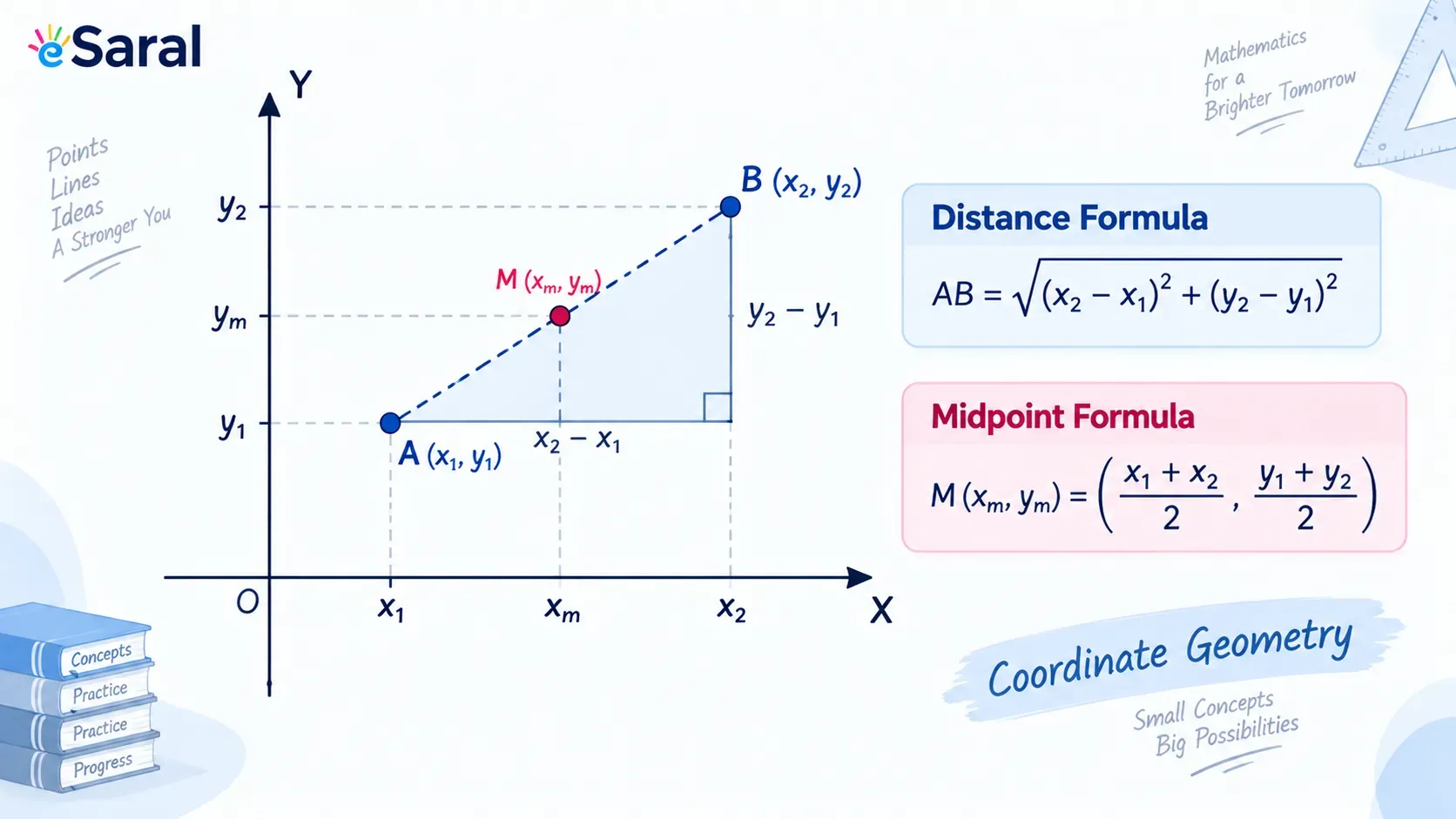
Coordinate Geometry Class 10: Formulas, Notes & Solved Examples
Coordinate geometry class 10: complete CBSE formulas — distance, section, midpoint and area of triangle — with derivation, notes and solved examples.

How to make Notes For JEE Smart Notes Strategy of an AIR 41
Learn how to make notes for JEE the way toppers do — indexing, shorthand, and smart short notes for JEE that cut revision time to just 5–7 days.
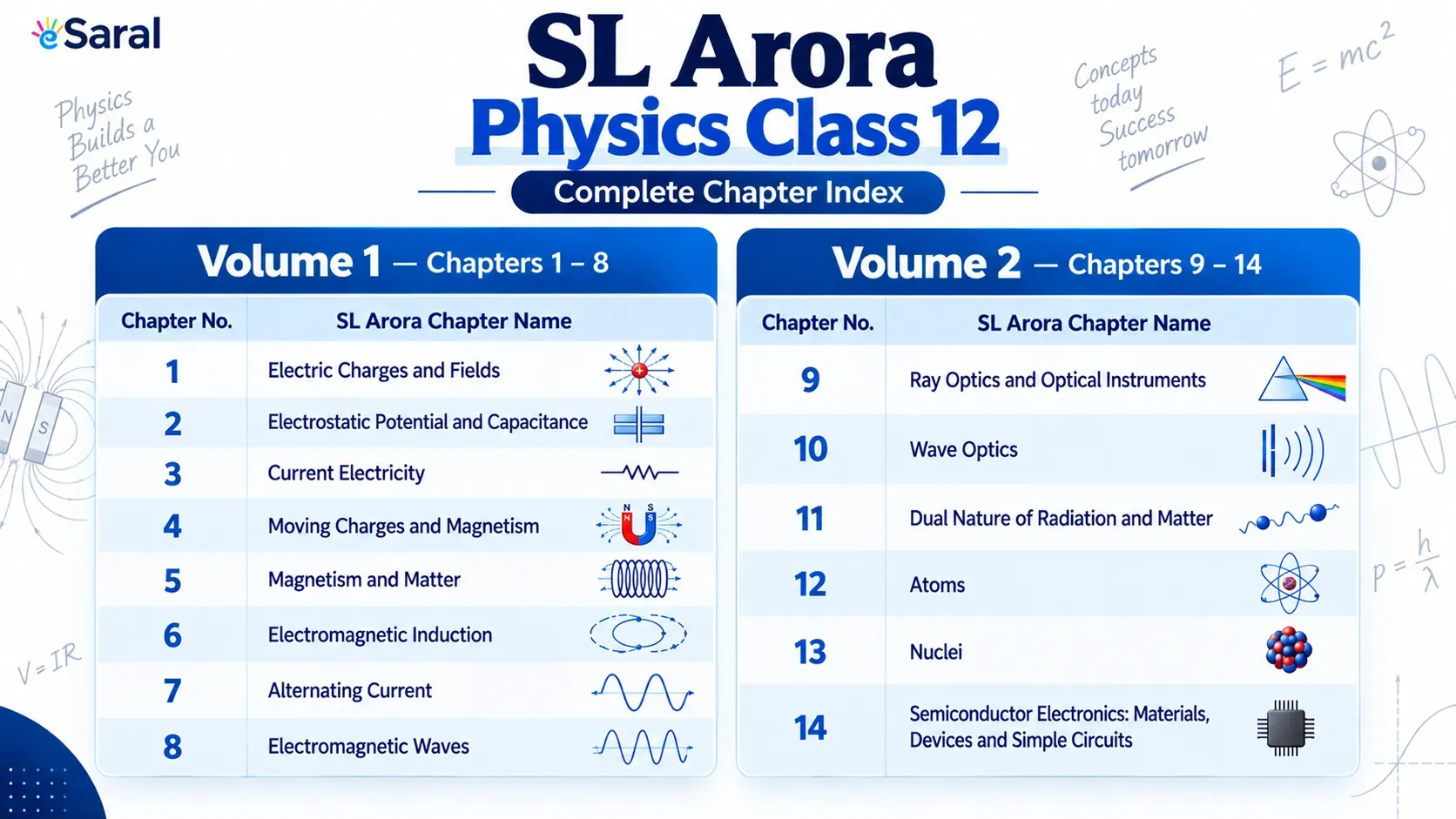
SL Arora Physics Class 12 Index – Chapter List for Volume 1 & 2
SL Arora Physics Class 12 index — complete chapter list for Volume 1 & 2, mapped to NCERT solutions for board, JEE Main, and NEET preparation.