
Metallurgy - JEE Advanced Previous Year Questions with Solutions

eSaral Academic and Editorial Team
Summary
Metallurgy JEE Advanced previous year questions cover copper extraction from chalcopyrite, self-reduction, electrolytic refining, carbon-based reduction, cyanide extraction of silver, and ore identification. Each question carries high weightage. Solving these PYQs with solutions helps JEE aspirants understand question patterns, master reaction mechanisms, and avoid common mistakes in this high-scoring chapter.

eSaral > JEE Advanced PYQ > Metallurgy

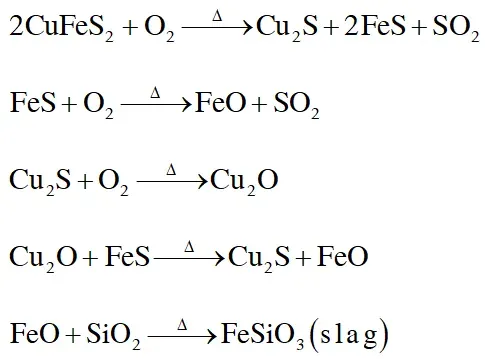
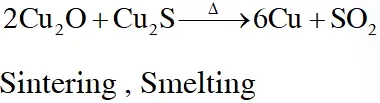
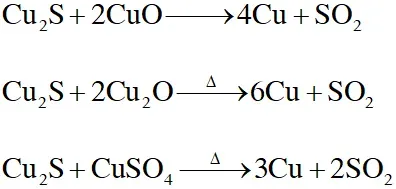
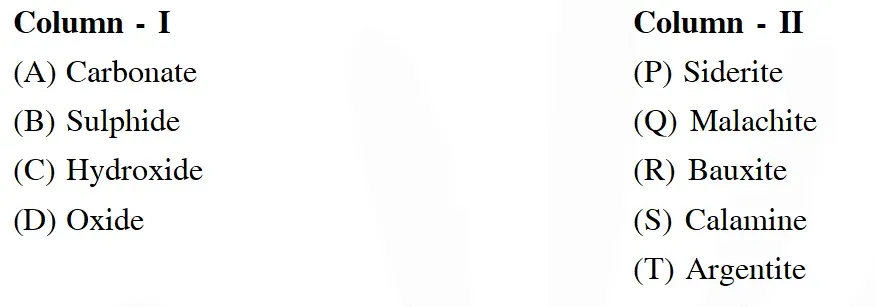
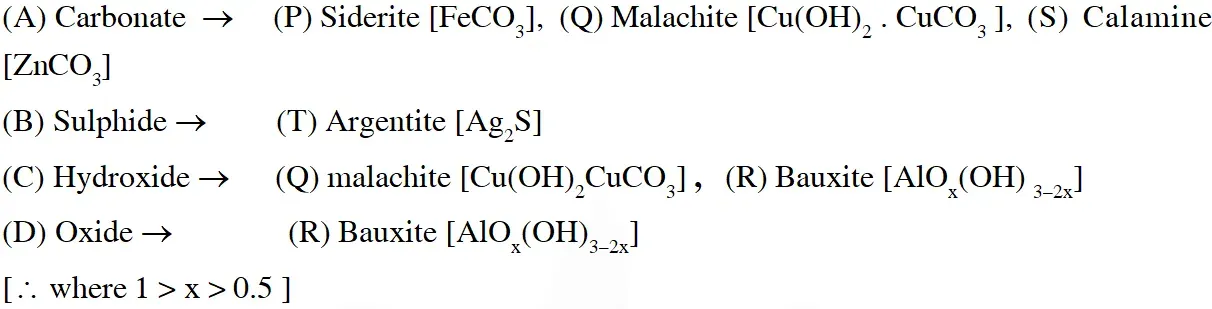
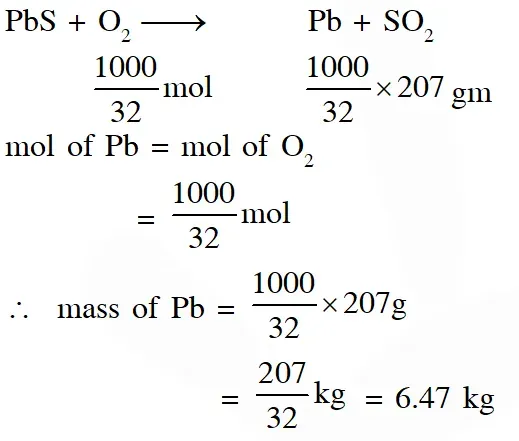
JEE Advanced Previous Year Questions of Chemistry with Solutions are available at eSaral. Practicing JEE Advanced Previous Year Papers Questions of Chemistry will help the JEE aspirants in realizing the question pattern as well as help in analyzing weak & strong areas. Simulator Previous Years JEE Advance Questions Paragraph for questions 1 to 3 Copper is the most nobel of the first row transition metals and occurs in small deposits in several countries. Ores of copper include chalcanthite $\left(\mathrm{CuSO}_{4}, 5 \mathrm{H}_{2} \mathrm{O}\right),$ atacamite $\left(\mathrm{Cu}_{2} \mathrm{Cl}(\mathrm{OH})_{3}\right),$ cuprite $\left(\mathrm{Cu}_{2} \mathrm{O}\right),$ copper glance (Cu.S) and malachite $\left(\mathrm{Cu}_{2}(\mathrm{OH})_{2} \mathrm{CO}_{3}\right) .$ However, $80 \%$ of the world copper production comes from the ore chalcopyrite (CuFeS_{2} ) . \text { The extraction of copper from chalcopyrite involves partial roasting, removal of iron and self-reduction. [esquestion] Partial roasting of chalcopyrite produces :- (A) $\mathrm{Cu}_{2} \mathrm{S}$ and $\mathrm{FeO}$ (B) $\mathrm{Cu}_{2} \mathrm{O}$ and FeO (C) $\mathrm{CuS}$ and $\mathrm{Fe}_{2} \mathrm{O}_{3}$ (D) $\mathrm{Cu}_{2} \mathrm{O}$ and $\mathrm{Fe}_{2} \mathrm{O}_{3}$ #tag# [JEE-2010] #sol# (A) [/esquestion] [esquestion] Iron is removed from chalcopyrite as :- (A) FeO (B) FeS (C) $\mathrm{Fe}_{2} \mathrm{O}_{3}$ (D) FeSiO $_{3}$ #tag# [JEE-2010] #sol# (D) [/esquestion] [esquestion] In self-reduction, the reducing species is :- (A) S (B) $\mathrm{O}^{2-}$ (C) $\mathrm{S}^{2-}$ (D) $\mathrm{SO}_{2}$ #tag# [JEE-2010] #sol# (C) [/esquestion] [esquestion] Extraction of metal from the ore cassiterite involves – (A) carbon reduction of an oxide ore (B) self-reduction of a sulphide ore (C) removal of copper impurity (D) removal of iron impurity #tag# [JEE-2011] #sol# (A,C,D) $\mathrm{SnO}_{2}+2 \mathrm{C} \rightarrow \mathrm{Sn}+2 \mathrm{CO}$ Cassetrite contains impurity of Wolframite (FeWO,), Which is a ferro magnatic. [/esquestion] [esquestion] Oxidation states of the metal in the minerals haematite and magnetite, respectively, are – (A) II, III in haematite and III in magnetite (B) II, III in haematite and II in magnetite (C) II in haematite and II, III in magnetite (D) III in haematite and II, III in magnetite #tag# [JEE-2011] #sol# (D) Haematite Ore $\Rightarrow \mathrm{Fe}_{2} \mathrm{O}_{3} ;$ Oxidation state $(+3)$ magnetite ore $\Rightarrow \mathrm{Fe}_{3} \mathrm{O}_{4}\left(\mathrm{FeO}+\mathrm{Fe}_{2} \mathrm{O}_{3}\right)=$ Oxidation state of $(+2 \&+3)$ [/esquestion] [esquestion] In the cyanide extraction process of silver from argentite ore, the oxidizing and reducing agents used are : (A) $\mathrm{O}_{2}$ and CO respectively. (B) $\mathrm{O}_{2}$ and $\mathrm{Zn}$ dust respectively. (C) $\mathrm{HNO}_{3}$ and $\mathrm{Zn}$ dust respectively. (D) $\mathrm{HNO}_{3}$ and CO respectively. #tag# [JEE-2012] #sol# (B) $2 \mathrm{Ag}+4 \mathrm{NaCN}+\mathrm{H}_{2} \mathrm{O}+\frac{1}{2} \mathrm{O}_{2}(\text { air }) \longrightarrow 2 \mathrm{Na}\left[\mathrm{Ag}(\mathrm{CN})_{2}\right]+2 \mathrm{NaOH},$ Here $\mathrm{O}_{2}$ is oxidising agent $\& \mathrm{Zn}^{-}$ dust act as reducing agent. [/esquestion] [esquestion] Sulfide ores are common for the metals – (A) Ag, Cu and Pb (B) Ag, Cu and Sn (B) Ag, Cu and Sn (D) Al, Cu and Pb #tag# [JEE-2013] #sol# (A) [/esquestion] [esquestion] The carbon-based reduction method is NOT used for the extraction of - (A) $\operatorname{tin}$ from $\mathrm{SnO}_{2}$ (B) Iron from $\mathrm{Fe}_{2} \mathrm{O}_{3}$ (C) aluminium from $\mathrm{Al}_{2} \mathrm{O}_{3}$ (D) magnesium from $\mathrm{MgCO}_{3} . \mathrm{CaCO}_{3}$ #tag# [JEE-2013] #sol# (C,D) Being a more reactive metal "Al" and "Mg" can be reduced by electrolytic reduction. [/esquestion] [esquestion] Upon heating with $\mathrm{Cu}_{2} \mathrm{S},$ the reagent(s) that give copper metal is/are (A) CuFeS $_{2}$ (B) CuO (C) $\mathrm{Cu}_{2} \mathrm{O}$ (D) $\mathrm{CuSO}_{4}$ #tag# [JEE Adv. 2015] #sol# (A,C,D) [/esquestion] [esquestion] Copper is purified by electrolytic refining of blister copper. The correct statement(s) about this process is (are) - (A) Impure Cu strip is used as cathode (B) Acidified aqueuous $\mathrm{CuSO}_{4}$ is used as electrolyte (C) Pure Cu deposits at cathode (D) Impurities settle as anode-mud #tag# [JEE Adv. 2015] #sol# (B,C,D) Impure "Cu" act as a Anode . While " Pure thin strips of Cu act as cathode and aqueous solution of $\mathrm{CuSO}_{4}$ act as electrolyte. [/esquestion] [esquestion] Match the anionic species given in Column-I that are present in the ore(s) given in Column-II – #tag# [JEE Adv. 2015] #sol# $(A \rightarrow P, Q, S, B \rightarrow T, C \rightarrow Q, R, D \rightarrow R)$ Name of ores & their metals. [/esquestion] [esquestion] Galena (an ore) is partially oxidized by passing air through it at high temperature. After some time, the passage of air is stopped, but the heating is continued in a closed furnance such that the contents undergo self-reduction. The weight (in kg) of Pb produced per kg of $\mathrm{O}_{2}$ consumed is ______ . (Atomic weights in $\left.\mathrm{g} \text { mol }^{-1}: \mathrm{O}=16, \mathrm{S}=32, \mathrm{Pb}=207\right)$ #tag# [JEE Adv. 2018] #sol# 6.47 [/esquestion]
The JEE Advanced PYQ archive helps students see how Metallurgy - JEE Advanced PYQs (Chemistry) is tested across years.
Frequently Asked Questions
Why can't carbon reduce aluminium oxide in metallurgy?
Carbon cannot reduce Al₂O₃ because aluminium is more reactive than carbon and sits higher in the electrochemical series. The Gibbs free energy change for carbon reduction of Al₂O₃ is not sufficiently negative at achievable temperatures. Aluminium is therefore extracted by electrolytic reduction (Hall–Héroult process) using molten cryolite as solvent
Which ores of copper are most important for JEE Advanced?
Chalcopyrite (CuFeS₂) is the single most important copper ore for JEE Advanced — 80% of world production comes from it, and it was the basis of an entire 3-question paragraph in JEE Advanced 2010. Copper glance (Cu₂S), cuprite (Cu₂O), and malachite (Cu₂(OH)₂CO₃) are secondary ores worth knowing for matching and identification questions.
What is the weightage of Metallurgy in JEE Advanced?
Metallurgy typically carries 4–8 marks in JEE Advanced Chemistry, appearing as 1–2 questions. While not the heaviest chapter, it is high-scoring because the question patterns repeat consistently across years. Spending 3–4 focused hours on PYQs and reaction mechanisms can reliably secure full marks from this chapter.
What are the roles of anode, cathode, and electrolyte in electrolytic refining of copper?
In electrolytic refining of blister copper: the impure copper block is the anode (it oxidises and dissolves), pure thin copper strips are the cathode (pure Cu²⁺ ions deposit here), and acidified CuSO₄ solution is the electrolyte. Noble impurities (gold, silver, platinum) do not dissolve and collect as anode mud. This was tested in JEE Advanced 2015 as a multi-correct question.
What is the difference between haematite and magnetite in terms of oxidation states?
Haematite (Fe₂O₃) contains iron exclusively in the +3 oxidation state. Magnetite (Fe₃O₄) is a mixed oxide (FeO·Fe₂O₃) containing iron in both +2 and +3 oxidation states simultaneously. This distinction was directly tested in JEE Advanced 2011 and is a frequent source of errors in single-correct questions.
What is self-reduction in metallurgy and which metals use it?
Self-reduction is an extraction method where the sulphide ore itself acts as the reducing agent — no external reducing agent like carbon or hydrogen is needed. The ore is partially roasted to form an oxide, which then reacts with the remaining sulphide. Copper (from Cu₂S) and lead (from PbS/galena) are the primary examples tested in JEE Advanced. The reducing species in copper self-reduction is S²⁻.
Team eSaral
eSaral Academic and Editorial Team
Team eSaral is the collective author profile for educational content created by eSaral’s teachers and academic contributors. The team draws on expertise from IIT graduates, doctors, experienced educators and subject specialists to develop resources for JEE, NEET and school students. Our articles aim to explain concepts clearly and help students study with confidence.
Related Posts
Plant Cell Diagram: Labelled Structure, Parts and Functions
Simple, labelled plant cell diagram with parts and functions. Covers plant cell structure for Class 6, 7, 8, 9, 10 and 11 students, CBSE-aligned.
Saransh Gupta Sir's Visit to IIT Patna: Hostel Life, Placements & Lessons for JEE Aspirants
Inside Saransh Gupta Sir's IIT Patna visit — hostel life, the library, placements, internships, and real advice for JEE aspirants from students living the IIT dream.
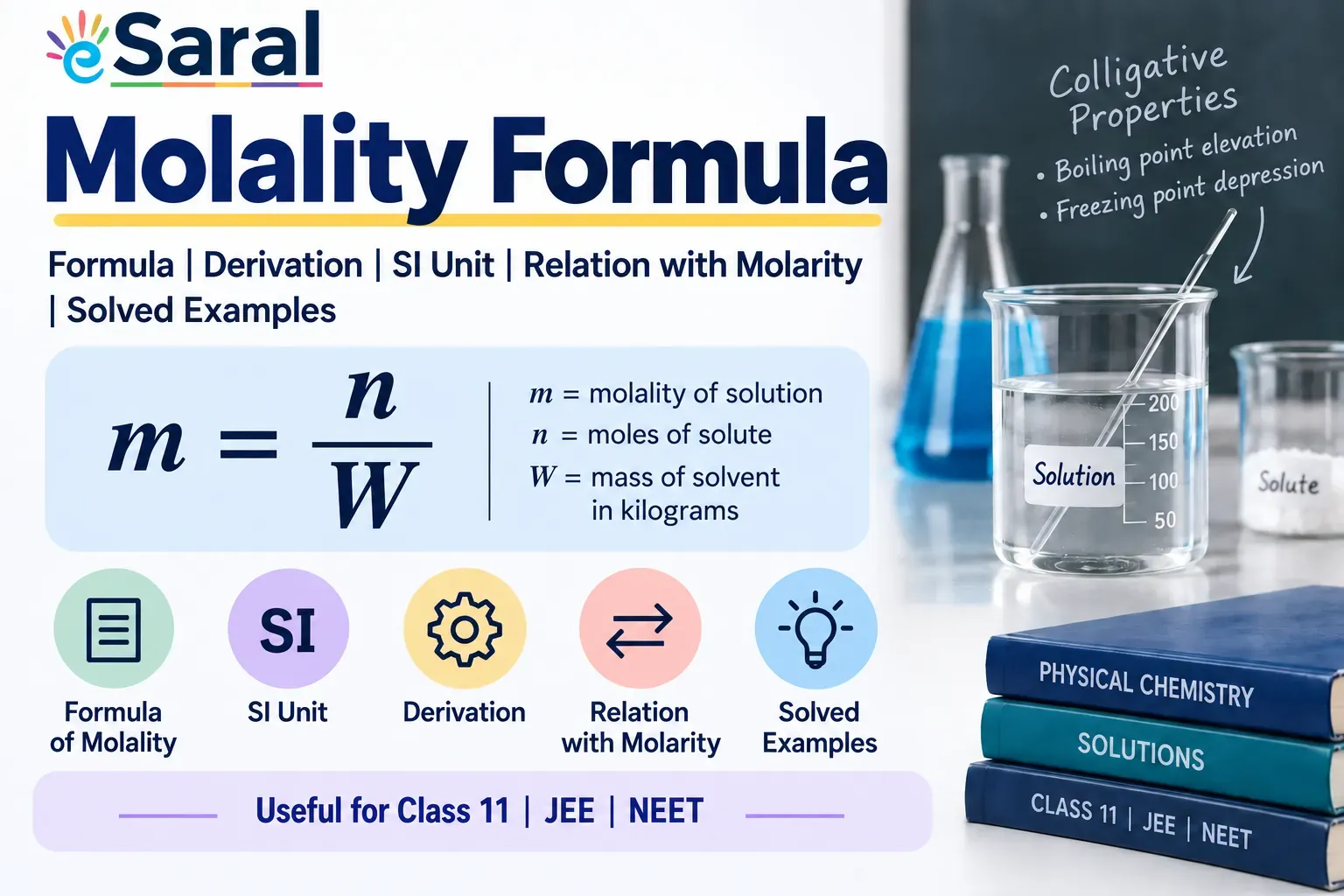
Molality Formula: Formula for Molality, Derivation & Solved Examples
Molality formula is $m = \dfrac{n}{W}$. Learn the formula of molality, its SI unit, derivation, relation with molarity, and solved examples for Class 11, JEE and NEET.
BITSAT Previous Year Question Paper PDF
Download BITSAT previous year question papers PDF. Get year-wise BITSAT PYQs, memory-based papers, exam pattern, and preparation tips to improve your BITSAT preparation.

Teachers’ Day 2026 at eSaral Gurukul: Celebrating the Bond Between Students, Teachers & Mentors
See how Teachers’ Day 2026 was celebrated at eSaral Gurukul, reflecting the bond among students, teachers, and mentors, and the role of guidance beyond academics.
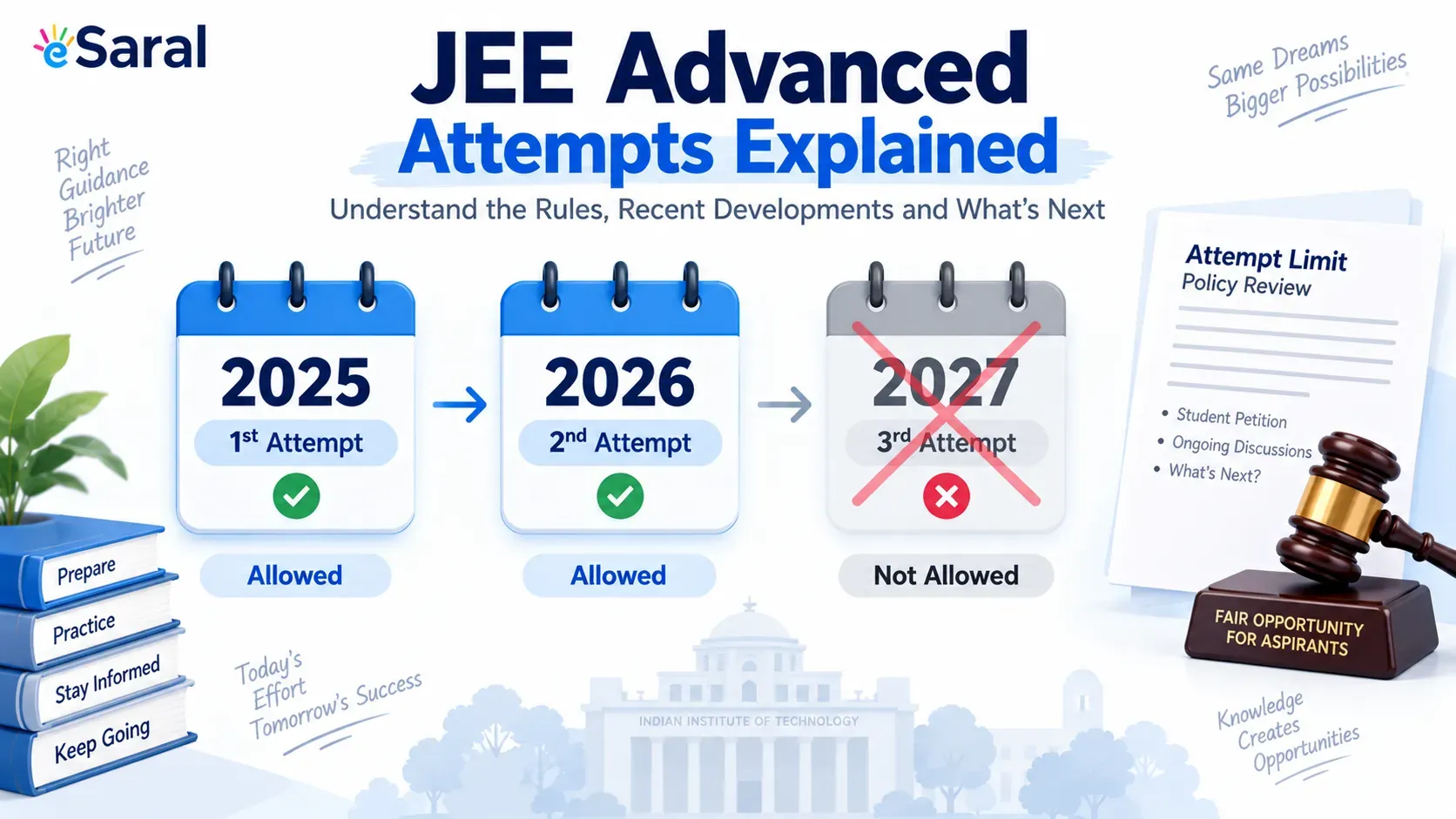
JEE Advanced Attempts: Can You Give It a Third Time? Rules Explained
JEE Advanced attempts: current rule is 2 consecutive years only: full eligibility criteria, the 2025 third-attempt controversy, and the latest 2026 petition news.

Best JEE Preparation App
Best JEE preparation app for Main & Advanced: AI mock tests, live doubt-solving, thousands of practice questions. JEE preparation app for droppers & Class 11-12.
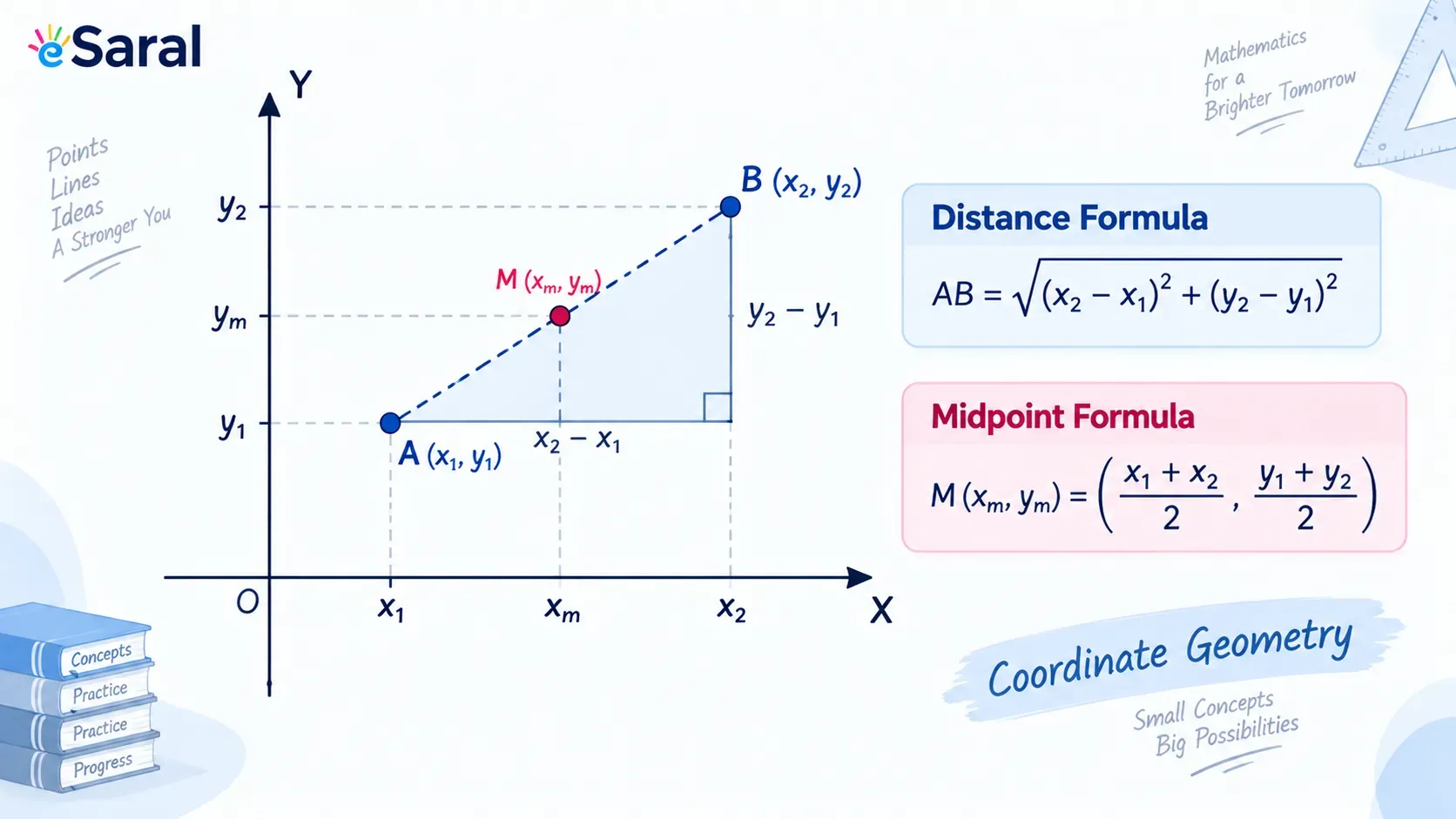
Coordinate Geometry Class 10: Formulas, Notes & Solved Examples
Coordinate geometry class 10: complete CBSE formulas — distance, section, midpoint and area of triangle — with derivation, notes and solved examples.
How to make Notes For JEE Smart Notes Strategy of an AIR 41
Learn how to make notes for JEE the way toppers do — indexing, shorthand, and smart short notes for JEE that cut revision time to just 5–7 days.
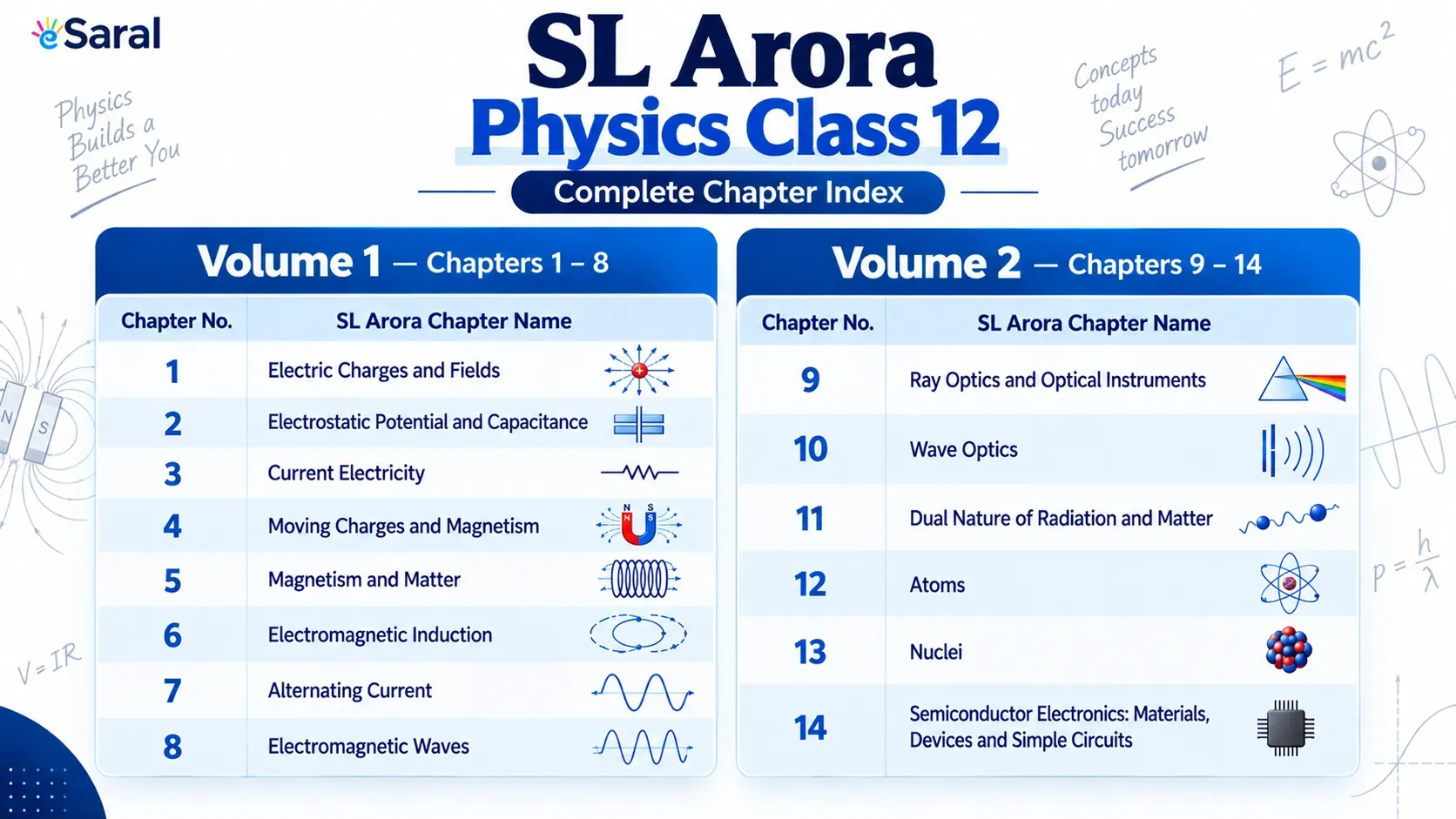
SL Arora Physics Class 12 Index – Chapter List for Volume 1 & 2
SL Arora Physics Class 12 index — complete chapter list for Volume 1 & 2, mapped to NCERT solutions for board, JEE Main, and NEET preparation.