
Mind Maps for Wave Optics Revision - Class XII, JEE, NEET

eSaral Academic and Editorial Team
Summary
<p><strong>Wave Optics Mind Maps</strong> provide a quick visual revision of key concepts, formulas, and applications such as interference, diffraction, polarization, fringe width, and resolving power, helping Class 12 students master JEE and NEET questions efficiently.</p>
eSaral › Class 12 ›Mind Maps for Wave Optics Revision

🚀 Checkout eSaral Courses
Why Wave Optics Needs a Different Revision Strategy
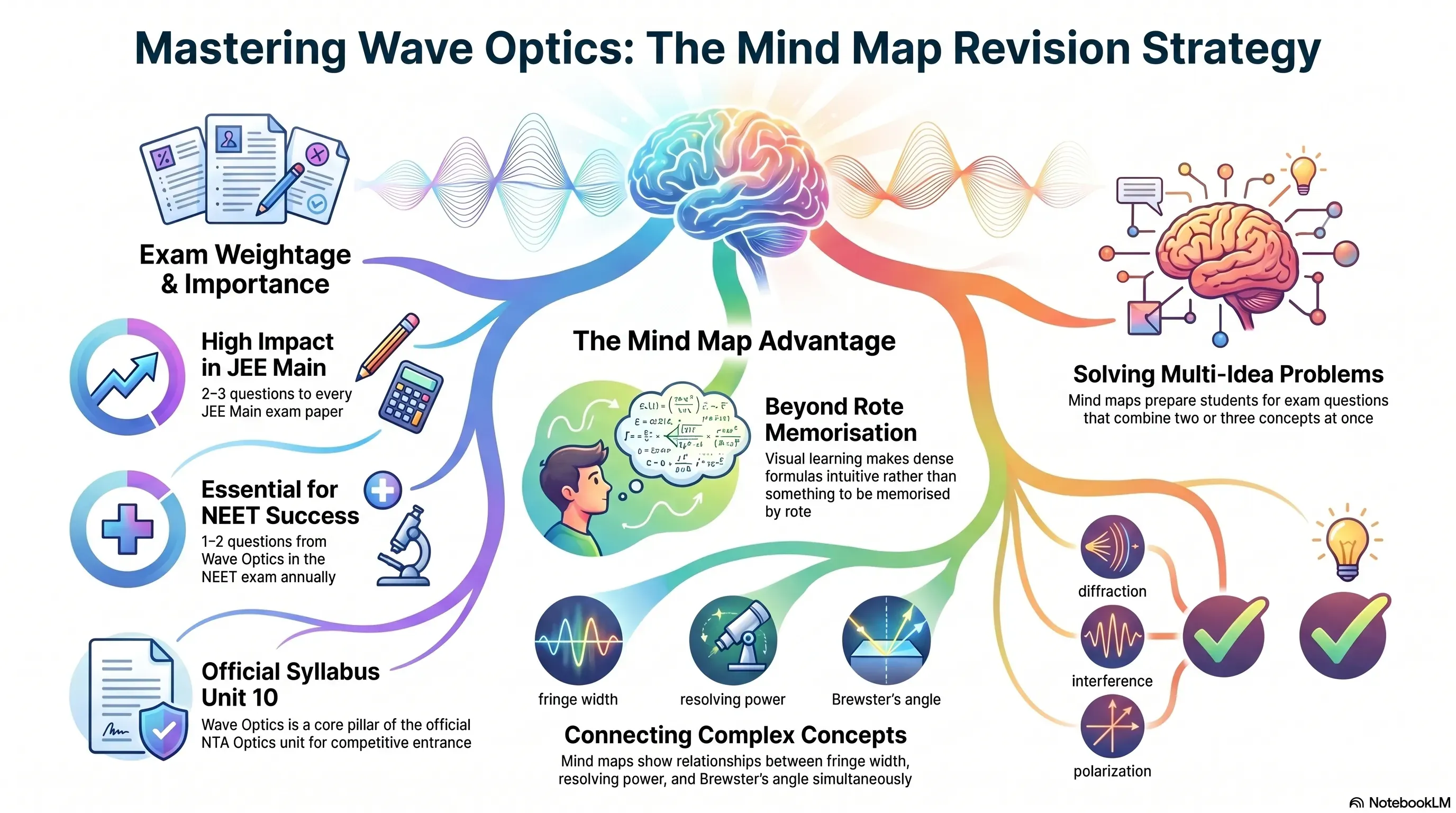
Wave Optics is one of the most formula-dense chapters in the Class 12 Physics syllabus. According to the official NTA JEE Main syllabus, it falls under Unit 10 (Optics) — a unit that consistently contributes 2–3 questions in JEE Main and 1–2 questions in NEET every year. Students preparing with eSaral's Kota-quality online courses frequently report this chapter as a turning point — once the concepts click visually, the formulas become intuitive rather than something to memorise by rote.
The challenge with Wave Optics is that it involves both conceptual understanding (wave nature of light, Huygens' construction) and precise formula application (fringe width, resolving power, Brewster's angle). A linear set of notes does not serve revision well here. Mind maps, by contrast, let you see all relationships between concepts simultaneously — which is exactly how questions appear in JEE and NEET: combining two or three ideas in a single problem.
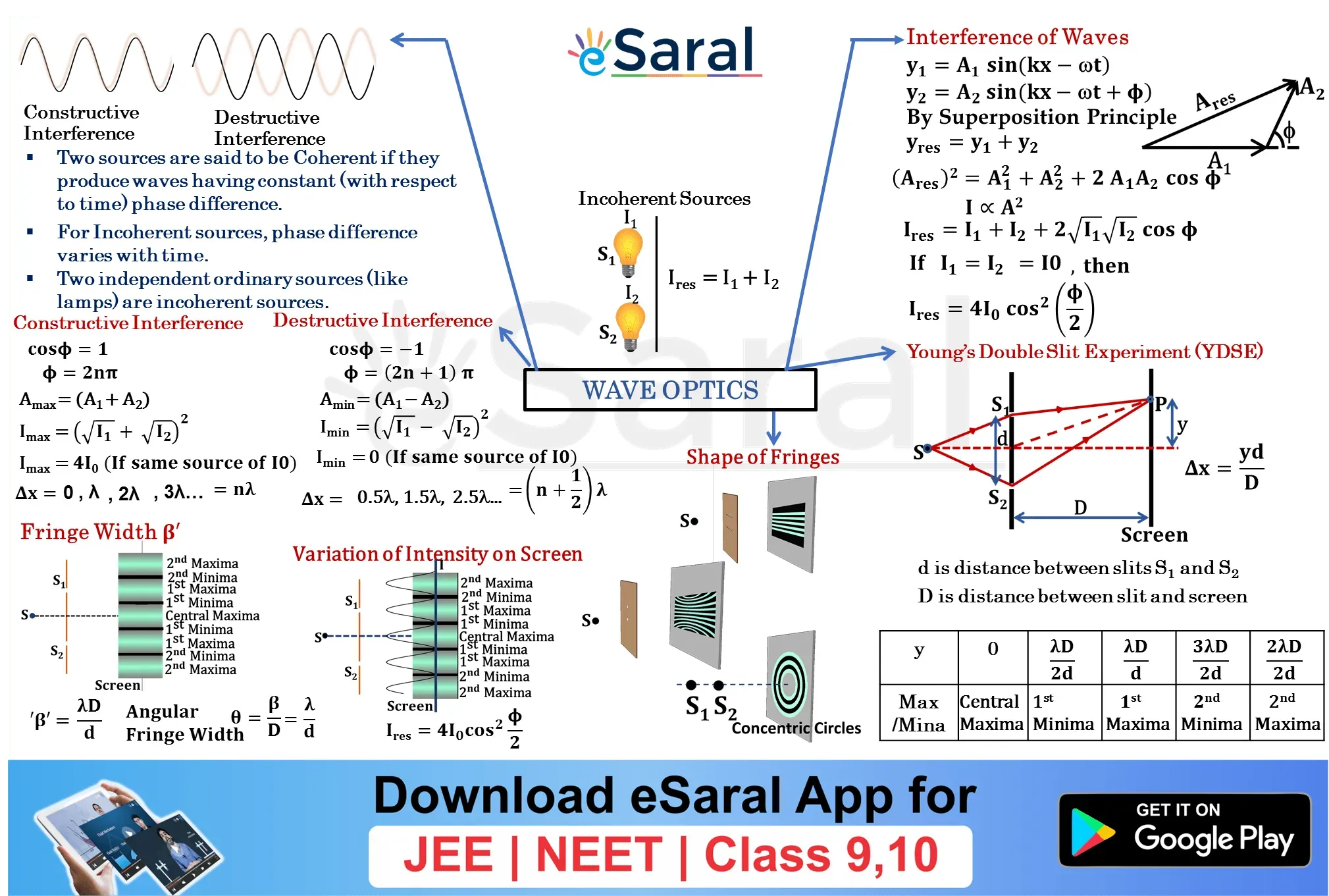
Wave Optics in Class 12 comprises a variety of cases with important formulae and key points. So here is the mind map to help you remember all the key formulae and important concepts on finger tips. MIND MAP - 1 Download
MIND MAP 2 Download
Frequently Asked Questions
What is Wave Optics in Class 12?
Wave Optics is Chapter 10 in the NCERT Class 12 Physics textbook. It explains the behaviour of light as a wave — covering Huygens' principle, interference, diffraction, and polarisation. It is prescribed in both the CBSE board syllabus and the official NTA syllabus for JEE Main and NEET.
How many questions come from Wave Optics in JEE Main?
JEE Main typically includes 2–3 questions from the entire Optics unit (Ray Optics + Wave Optics) per session. Wave Optics specifically contributes 1–2 questions, most commonly from YDSE, single-slit diffraction, and Malus' Law. Based on NTA's question distribution trends from 2019–2026 YDSE is the single most frequently tested topic.
How many questions come from Wave Optics in NEET?
NEET usually has 1–2 questions from Wave Optics per year. Topics most likely to appear include YDSE fringe width calculations, Brewster's angle, and Malus' Law. Conceptual questions on Huygens' principle also appear regularly.
Is Malus' Law important for JEE and NEET?
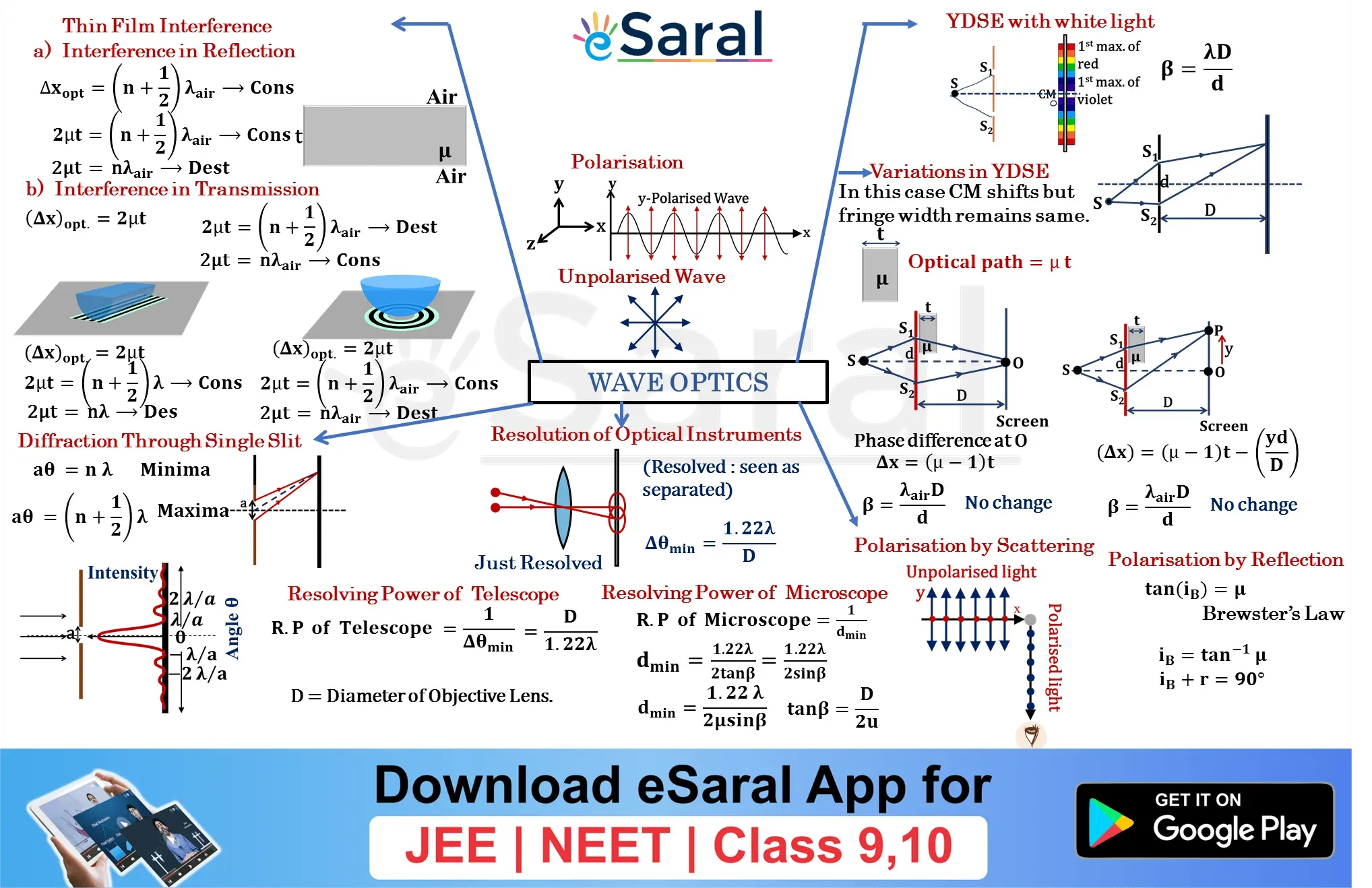
Yes. Malus' Law (I = I₀cos²θ) is tested directly in both JEE Main and NEET. A user comment on this page noted it was missing from an earlier version of the mind maps — it is now included in Mind Map 2. Practise problems involving intensity ratios and polariser angle variations.
Can I revise the entire Wave Optics chapter using only these mind maps?
Mind maps are best used for revision, not first-time study. They consolidate all formulas and concept relationships on one page, making them ideal for last-minute revision before exams. For complete concept-building, pair them with NCERT theory and eSaral's video lectures by IIT Bombay faculty.
Team eSaral
eSaral Academic and Editorial Team
Team eSaral is the collective author profile for educational content created by eSaral’s teachers and academic contributors. The team draws on expertise from IIT graduates, doctors, experienced educators and subject specialists to develop resources for JEE, NEET and school students. Our articles aim to explain concepts clearly and help students study with confidence.
Related Posts
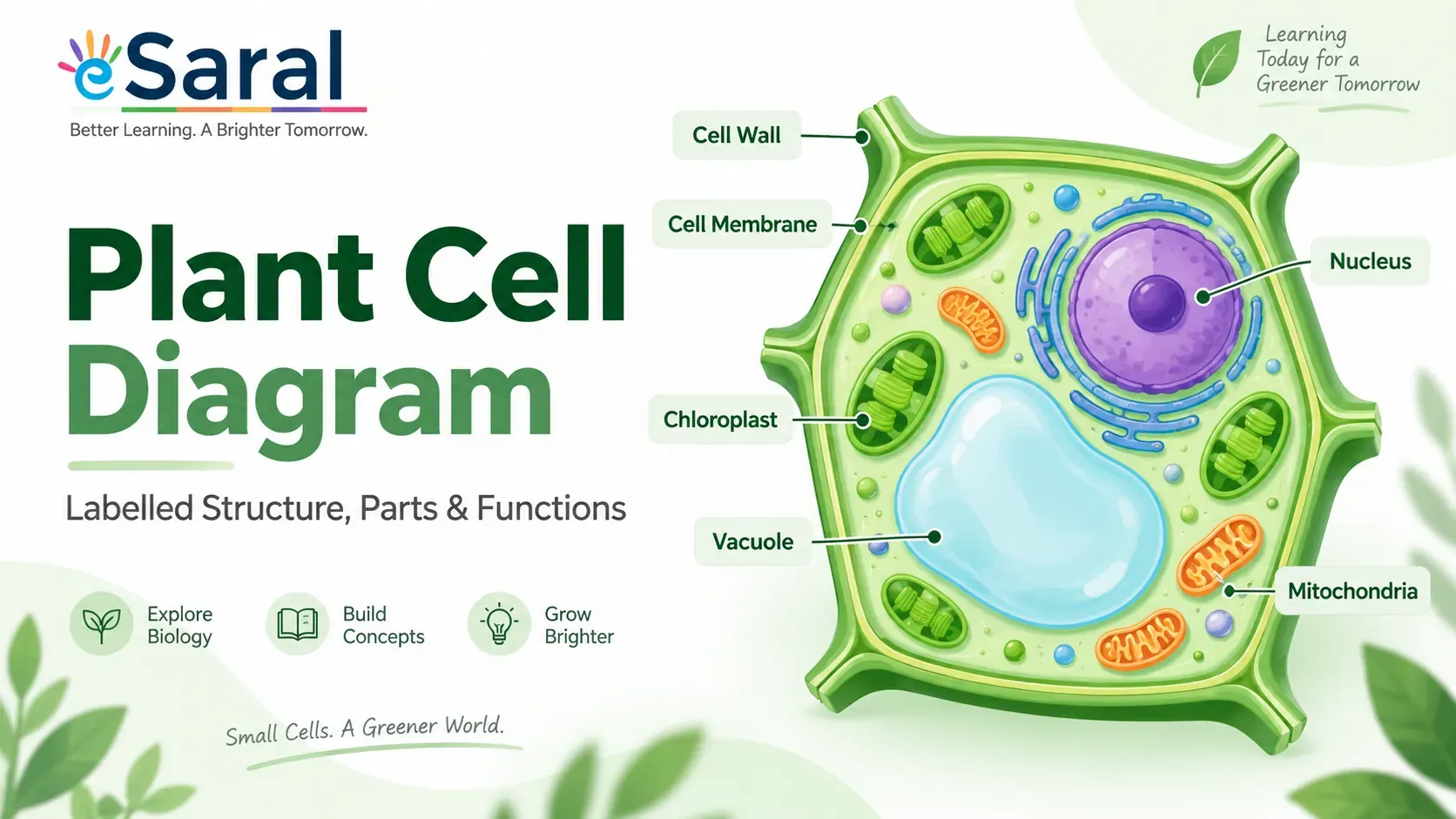
Plant Cell Diagram: Labelled Structure, Parts and Functions
Simple, labelled plant cell diagram with parts and functions. Covers plant cell structure for Class 6, 7, 8, 9, 10 and 11 students, CBSE-aligned.
Saransh Gupta Sir's Visit to IIT Patna: Hostel Life, Placements & Lessons for JEE Aspirants
Inside Saransh Gupta Sir's IIT Patna visit — hostel life, the library, placements, internships, and real advice for JEE aspirants from students living the IIT dream.
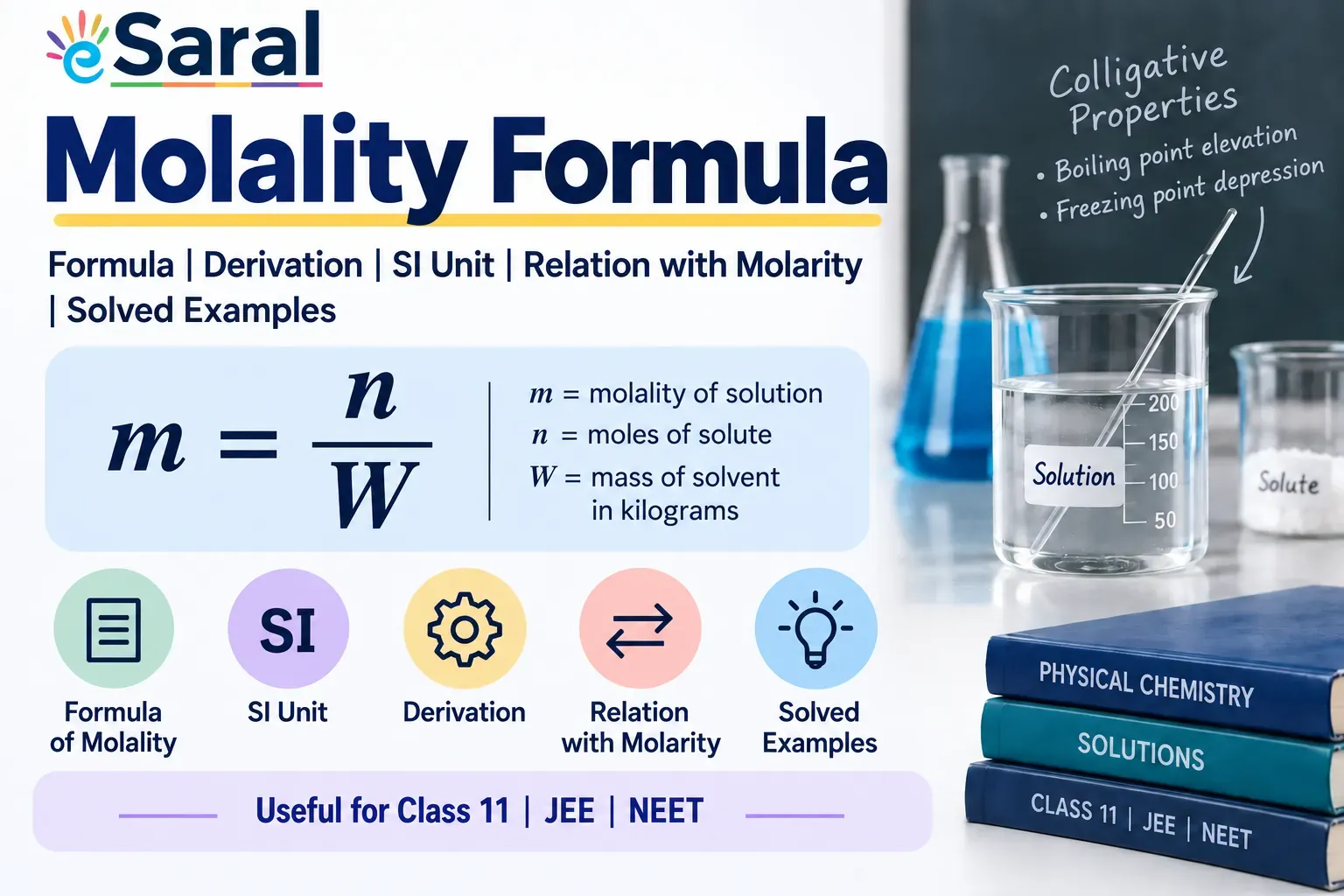
Molality Formula: Formula for Molality, Derivation & Solved Examples
Molality formula is $m = \dfrac{n}{W}$. Learn the formula of molality, its SI unit, derivation, relation with molarity, and solved examples for Class 11, JEE and NEET.
BITSAT Previous Year Question Paper PDF
Download BITSAT previous year question papers PDF. Get year-wise BITSAT PYQs, memory-based papers, exam pattern, and preparation tips to improve your BITSAT preparation.

Teachers’ Day 2026 at eSaral Gurukul: Celebrating the Bond Between Students, Teachers & Mentors
See how Teachers’ Day 2026 was celebrated at eSaral Gurukul, reflecting the bond among students, teachers, and mentors, and the role of guidance beyond academics.
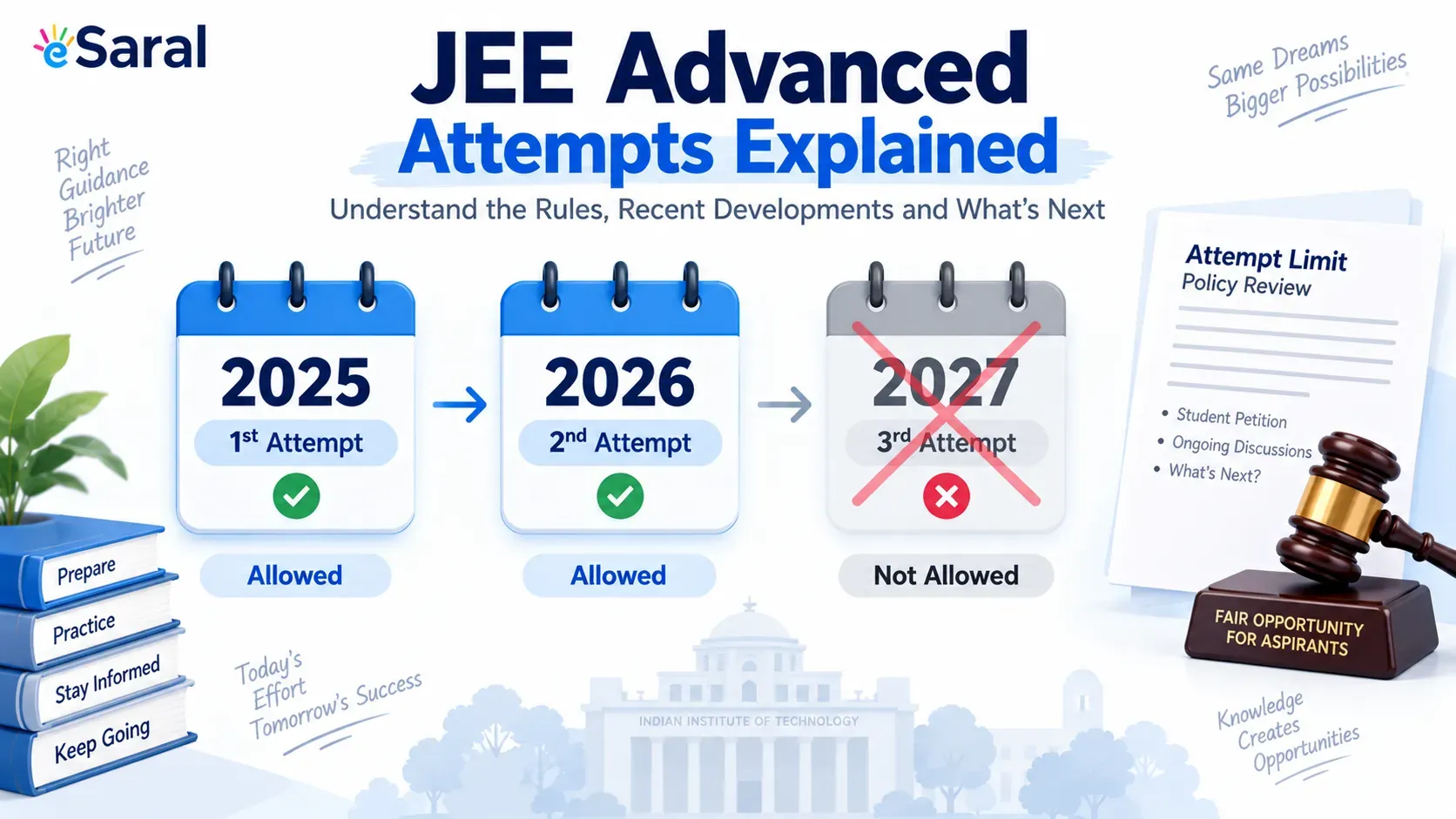
JEE Advanced Attempts: Can You Give It a Third Time? Rules Explained
JEE Advanced attempts: current rule is 2 consecutive years only: full eligibility criteria, the 2025 third-attempt controversy, and the latest 2026 petition news.

Best JEE Preparation App
Best JEE preparation app for Main & Advanced: AI mock tests, live doubt-solving, thousands of practice questions. JEE preparation app for droppers & Class 11-12.
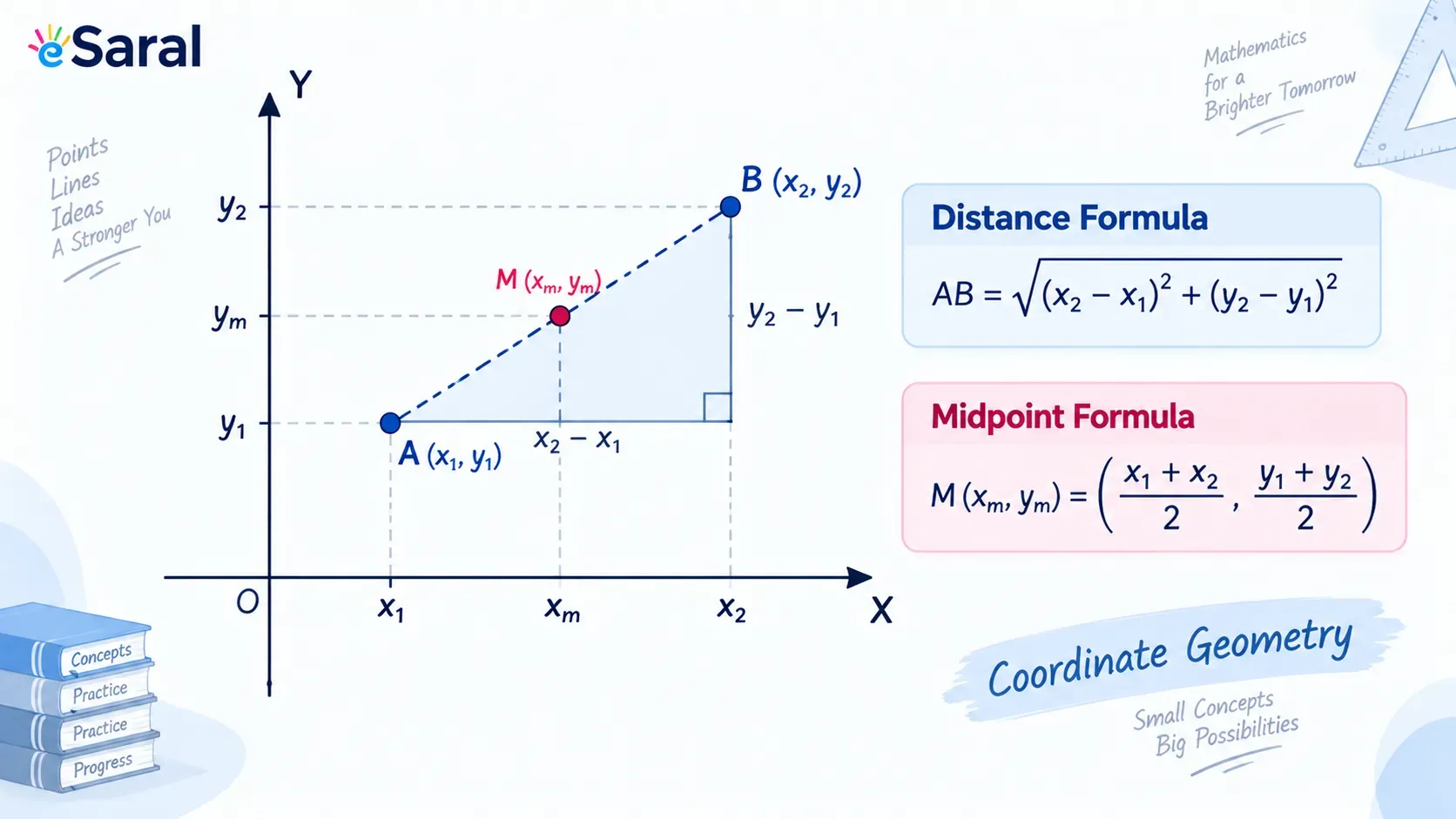
Coordinate Geometry Class 10: Formulas, Notes & Solved Examples
Coordinate geometry class 10: complete CBSE formulas — distance, section, midpoint and area of triangle — with derivation, notes and solved examples.
How to make Notes For JEE Smart Notes Strategy of an AIR 41
Learn how to make notes for JEE the way toppers do — indexing, shorthand, and smart short notes for JEE that cut revision time to just 5–7 days.
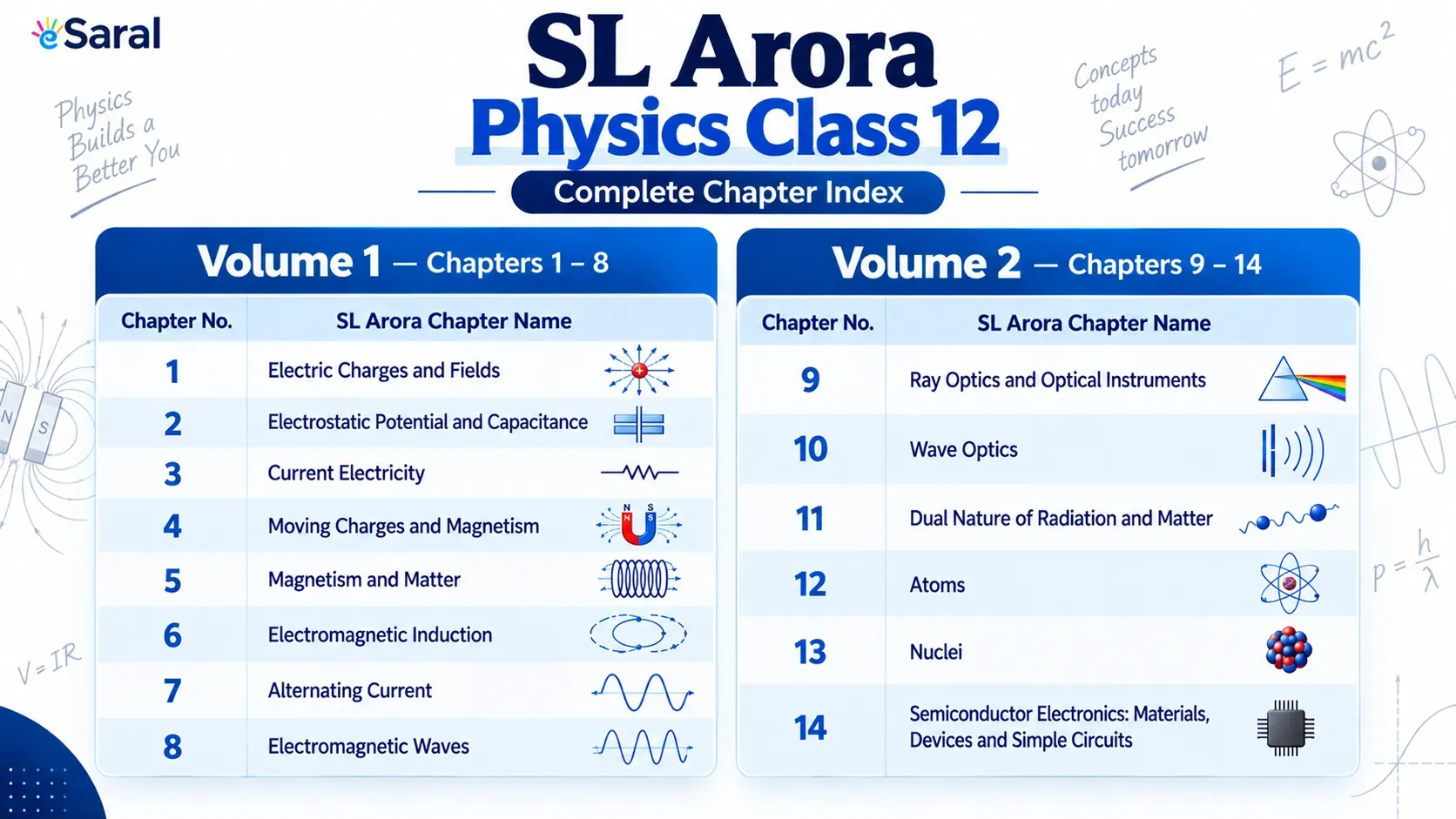
SL Arora Physics Class 12 Index – Chapter List for Volume 1 & 2
SL Arora Physics Class 12 index — complete chapter list for Volume 1 & 2, mapped to NCERT solutions for board, JEE Main, and NEET preparation.