
NCERT Solutions for Class 11 Biology chapter 14 Respiration in Plants PDF - eSaral

eSaral Academic and Editorial Team
NCERT Solutions for Class 11 Biology chapter 14 Respiration in Plants PDF
Hey, are you a class 11 student and looking for ways to download NCERT Solutions for Class 11 Biology chapter 14 Respiration in Plants PDF? If yes. Then read this post till the end.
In this article, we have listed NCERT Solutions for Class 11 Biology chapter 14 Respiration in Plants in PDF that are prepared by Kota’s top Doctor’s Faculties by keeping Simplicity in mind.
If you want to learn and understand class 11 Biology chapter 14 "Respiration in Plants" in an easy way then you can use these solutions PDF.
NCERT Solutions helps students to Practice important concepts of subjects easily. Class 11 Biology solutions provide detailed explanations of all the NCERT questions that students can use to clear their doubts instantly.
If you want to score high in your class 11 Biology Exam then it is very important for you to have a good knowledge of all the important topics, so to learn and practice those topics you can use eSaral NCERT Solutions.
In this article, we have listed NCERT Solutions for Class 11 Biology chapter 14 Respiration in Plants PDF that you can download to start your preparations anytime.
So, without wasting more time Let’s start.
Download NCERT Solutions for Class 11 Biology chapter 14 Respiration in Plants PDF
Question 1: Differentiate between
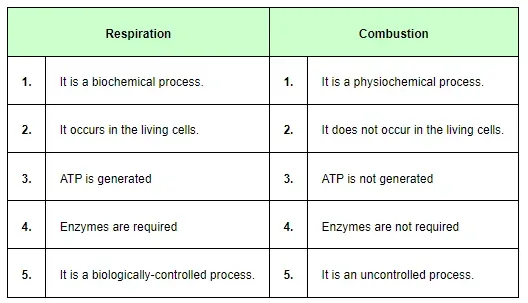
(a) Respiration and Combustion
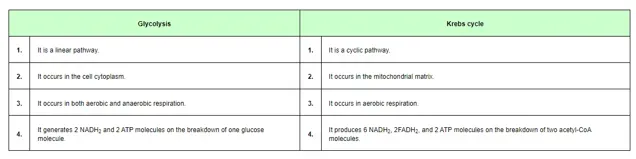
(b) Glycolysis and Krebs' cycle
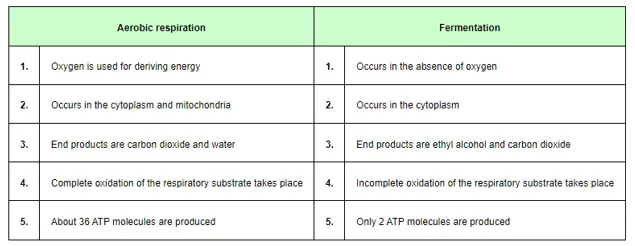
(c) Aerobic respiration and Fermentation
Solution. (a) Respiration and combustion
(b) Glycolysis and Krebs cycle
(c) Aerobic respiration and fermentation
Question 2: What are respiratory substrates? Name the most common respiratory substrate.
Solution. The compounds oxidised during the process of respiration are called respiratory substrates. Carbohydrates, especially glucose, act as respiratory substrates. Fats, proteins, and organic acids also act as respiratory substrates.
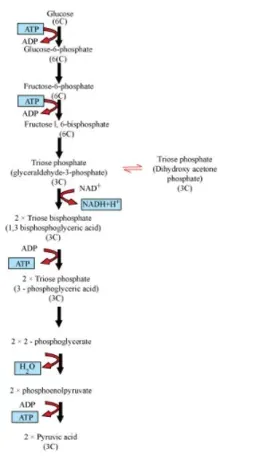
Question 3: Give the schematic representation of glycolysis?
Solution.
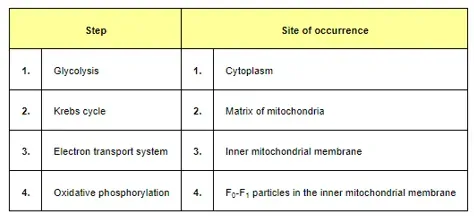
Question 4: What are the main steps in aerobic respiration? Where does it take place?
Solution. The major steps in aerobic respiration and the sites where they occur are listed in the given table.
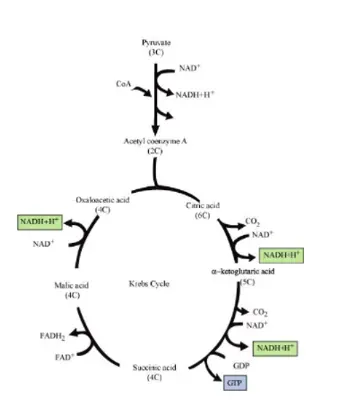
Question 5: Give the schematic representation of an overall view of Krebs cycle.
Solution.
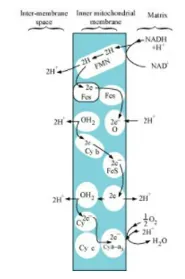
Question 6: Explain ETS.
Solution. ETS or electron transport system is located in the inner mitochondrial membrane. It helps in releasing and utilizing the energy stored in $\mathrm{NADH}+\mathrm{H}^{+}$and $\mathrm{FADH}_{2}$. NADH which is formed during gly and citric acid cycle, gets oxidized by NADH dehydrogenase (complex 1). The electrons so generated get transferred to ubiquinone through FMN. In a similar manner, FADH (complex II) qenerater citric acid ate fransferrer to ubicuinone. The electrons from ubiquinone are received by cytochrome $\mathrm{bc}_{1}$ (complex III) and further get transferred to cytochrome c. The cytochrome $\mathrm{c}$ acte bile and cytochrome co oxidase comnlex containino cutochrome a and $a_{3}$ alona with conner $c$
During the transfer of electrons from each complex, the process is accompanied by the production of ATP from ADP and inorganic phosphate by the action ATP synthase (complex $\mathbf{V}$ ). The amount of ATP produced depends on the molecule, which has been oxidized. 2 ATP molecules are
produced by the oxidation of one molecule of NADH. One molecule of FADH $_{2}$, on oxidation, gives 3 ATP molecules
Question 7: Distinguish between the following:
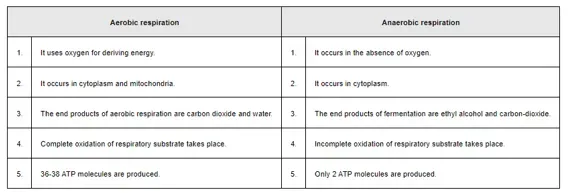
(a) Aerobic respiration and Anaerobic respiration
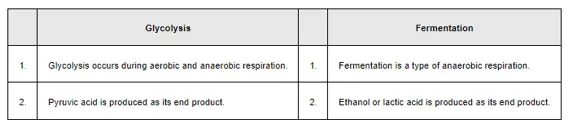
(b) Glycolysis and Fermentation
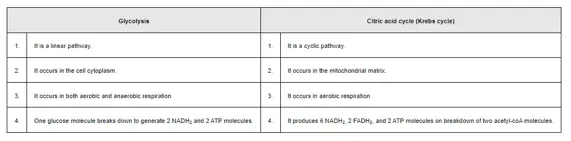
(c) Glycolysis and Citric acid Cycle
Solution. (a) Aerobic respiration and Anaerobic respiration
(b) Glycolysis and Fermentation
(c) Glycolysis and citric acid cycle
Question 8: What are the assumptions made during the calculation of net gain of ATP?
Solution. For theoretical calculation of ATP molecules, various assumptions are made, which are as follows.
(a) It is assumed that various parts of aerobic respiration such as glycolysis, TCA cycle, and ETS occur in a sequential and orderly pathway.
(b) NADH produced during the process of glycolysis enters into mitochondria to undergo oxidative phosphorylation.
(c) Glucose molecule is assumed to be the only substrate while it is assumed that no other molecule enters the pathway at intermediate stages.
(d) The intermediates produced during respiration are not utilized in any other process.
Question 9: Discuss “The respiratory pathway is an amphibolic pathway.”
Solution. Respiration is generally assumed to be a catabolic process because during respiration, various substrates are broken down for deriving energy. Carbohydrates are broken down to glucose before entering respiratory pathways. Fats get converted into fatty acids and glycerol whereas fatty acids get converted into acetyl CoA before entering the respiration. In a similar manner, proteins are converted into amino acids. which enter respiration after deamination
Therefore, respiration can be termed as amphibolic pathway as it involves both anabolism and catabolism.
Question 10: Define RQ. What is its value for fats?
Solution. Respiratory quotient $(\mathrm{RQ})$ or respiratory ratio can be defined as the ratio of the volume of $\mathrm{CO}_{2}$ evolved to the volume of $\mathrm{O}_{2}$ consumed during respiration. The value of respiratory quotient depends on the type of respiratory substrate. Its value is one for carbohydrates. However, it is always less than one for fats as fats consume more oxygen for respiration than carbohydrates
It can be illustrated through the example of tripalmitin fatty acid, which consumes 145 molecules of $\mathrm{O}_{2}$ for respiration while 102 molecules of $\mathrm{CO}_{2}$ are evolved. The $\mathrm{RQ}$ value for tripalmitin is $0.7$.
Question 11: What is oxidative phosphorylation?
Solution. Oxidative phosphorylation is a process in which electrons are transferred from electron donors to oxygen, which acts as electron acceptor. The oxidation-reduction reactions are involved in the formation proton gradient. The main role in oxidative phosphorylation is played by the enzyme ATP synthase (complex $\mathrm{V}$ ). This enzyme complex consists of $\mathrm{F}_{0}$ and $\mathrm{F}_{1}$ components. The $\mathrm{F}_{1}$ headpiece is a periphera orotein complex and contains the site for ATP synthesis from ADP and inorganic phosphate. $\mathrm{F}_{0}$ component is a part of membrane protein complex, which acts as a channel for crossing of the protons from inner
mitochondrial membrane to the mitochondrial matrix. For every two protons passing through $\mathrm{F}_{0}-\mathrm{F}_{1}$ complex, synthesis of one ATP molecule take
Question 12: What is the significance of step-wise release of energy in respiration?
Solution. The process of aerobic respiration is divided into four phases - glycolysis, TCA cycle, ETS, and oxidative phosphorylation. It is generally assumed that the process of respiration and production of ATP in each 'ase takes place in a step-wise manner. The product of one pathway forms the substrate of the other pathway. Various molecules produced during respiration are involved in other biochemical processes. iratory substrates enter and withdraw from pathway on necessity. ATP gets utilized wherever required and enzymatic rates are generally controlled. Thus, the step-wise release of energy makes the phase takcol The respiratol stem more efficient in extracting and storing energy
Also Read,
Class 11 Chemistry Notes Download.
Class 11 Biology Book Chapterwise Download.
Class 11 Biology Exemplar Chapterwise Download.
If you have any Confusion related to NCERT Solutions for Class 11 Biology chapter 14 Respiration in Plants PDF then feel free to ask in the comments section down below.
Photosynthesis and Respiration are taught back to back for a reason — the C3/C4 distinction in Table 13.1 Biology Class 11 Solutions explains half of what this chapter assumes you already know.
For a quick fact-check on the molecule central to this topic, the Formula of Glucose page has it in one place.
If a different chapter's solutions are needed next, there's no reason to search page by page — the whole book is linked here: class 11 biology ncert pdf.
To watch Free Learning Videos on Class 11 Biology by Kota’s top Doctor’s Faculties Install the eSaral App
Team eSaral
eSaral Academic and Editorial Team
Team eSaral is the collective author profile for educational content created by eSaral’s teachers and academic contributors. The team draws on expertise from IIT graduates, doctors, experienced educators and subject specialists to develop resources for JEE, NEET and school students. Our articles aim to explain concepts clearly and help students study with confidence.
Related Posts
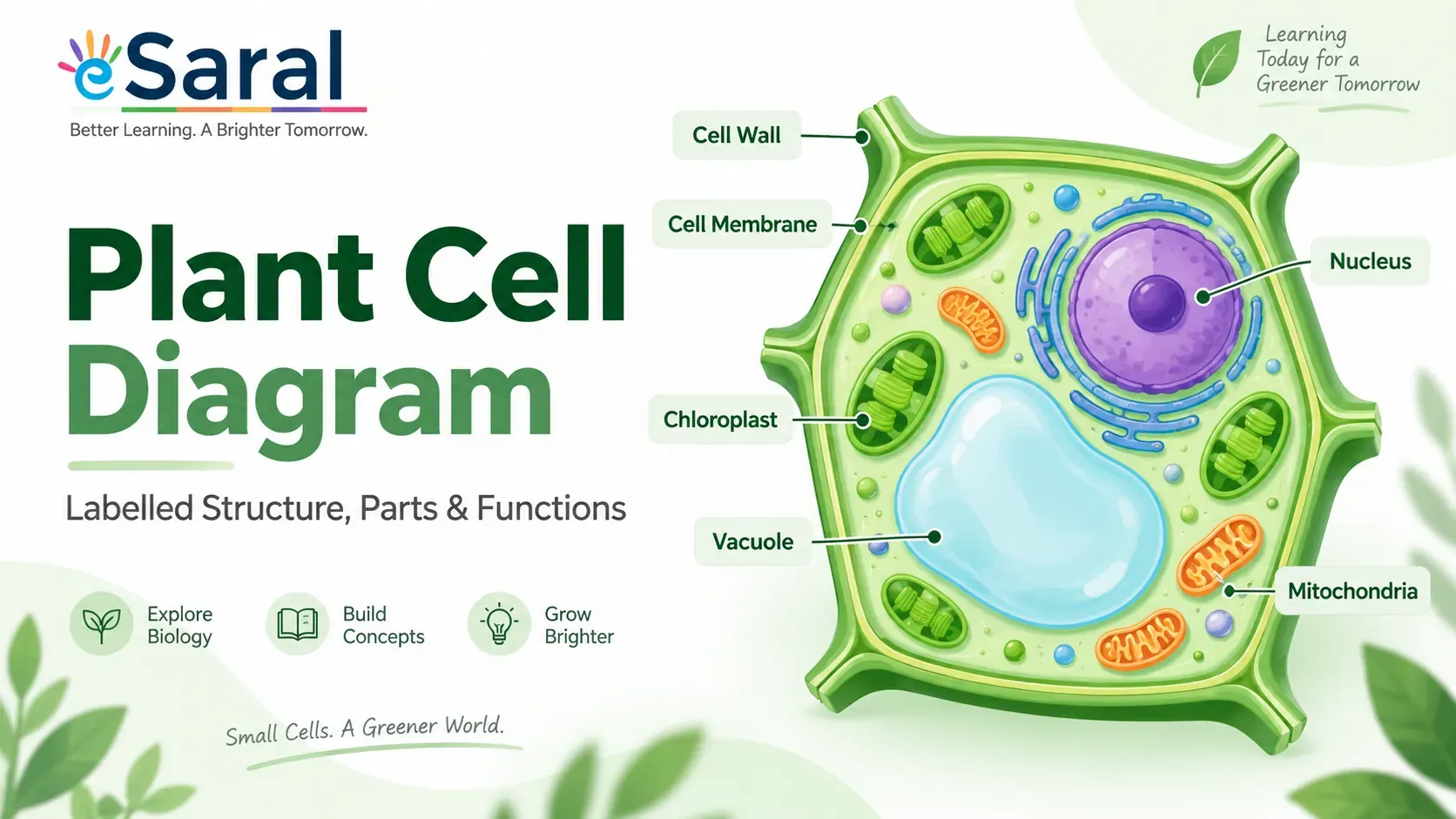
Plant Cell Diagram: Labelled Structure, Parts and Functions
Simple, labelled plant cell diagram with parts and functions. Covers plant cell structure for Class 6, 7, 8, 9, 10 and 11 students, CBSE-aligned.
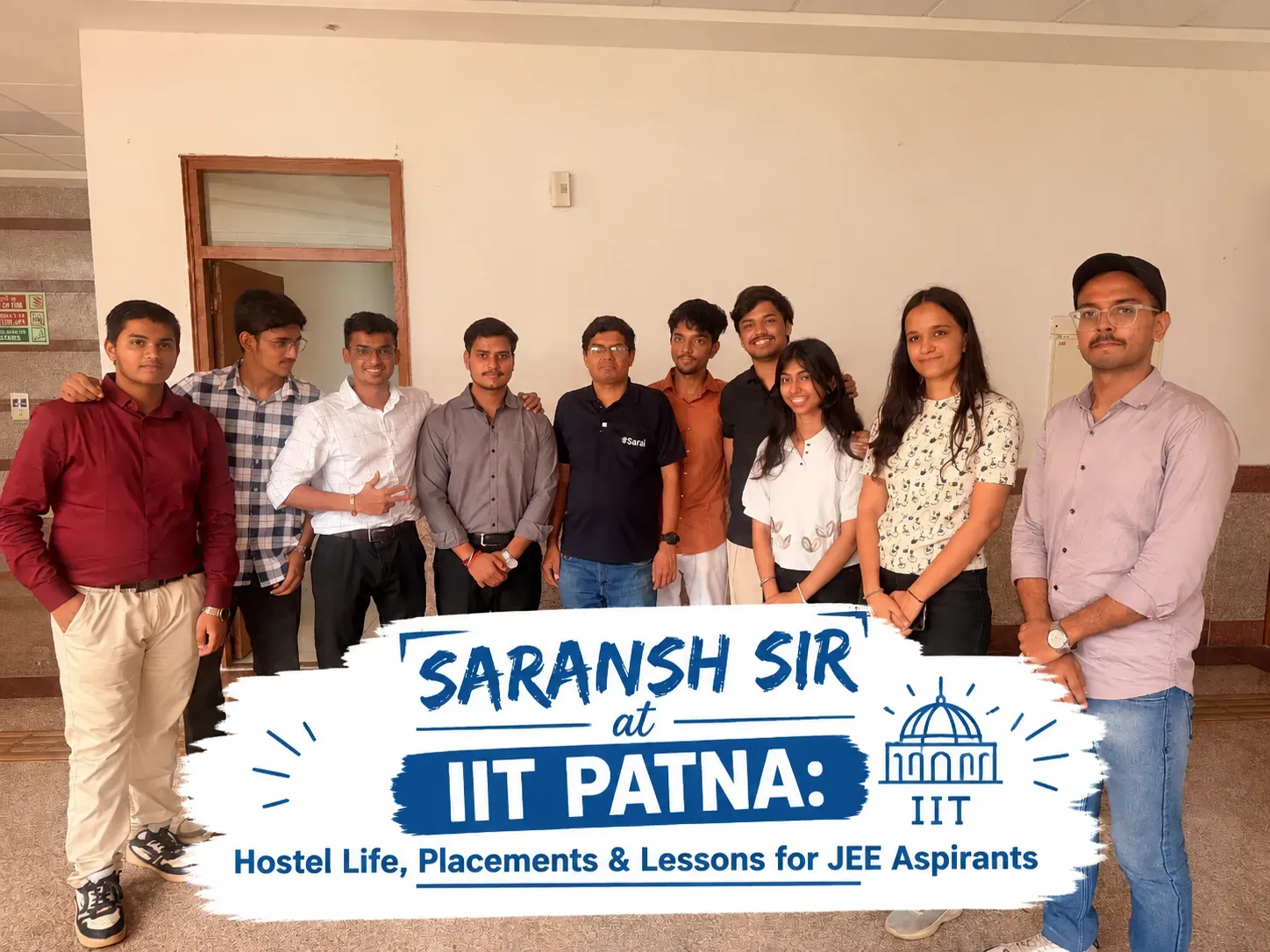
Saransh Gupta Sir's Visit to IIT Patna: Hostel Life, Placements & Lessons for JEE Aspirants
Inside Saransh Gupta Sir's IIT Patna visit — hostel life, the library, placements, internships, and real advice for JEE aspirants from students living the IIT dream.
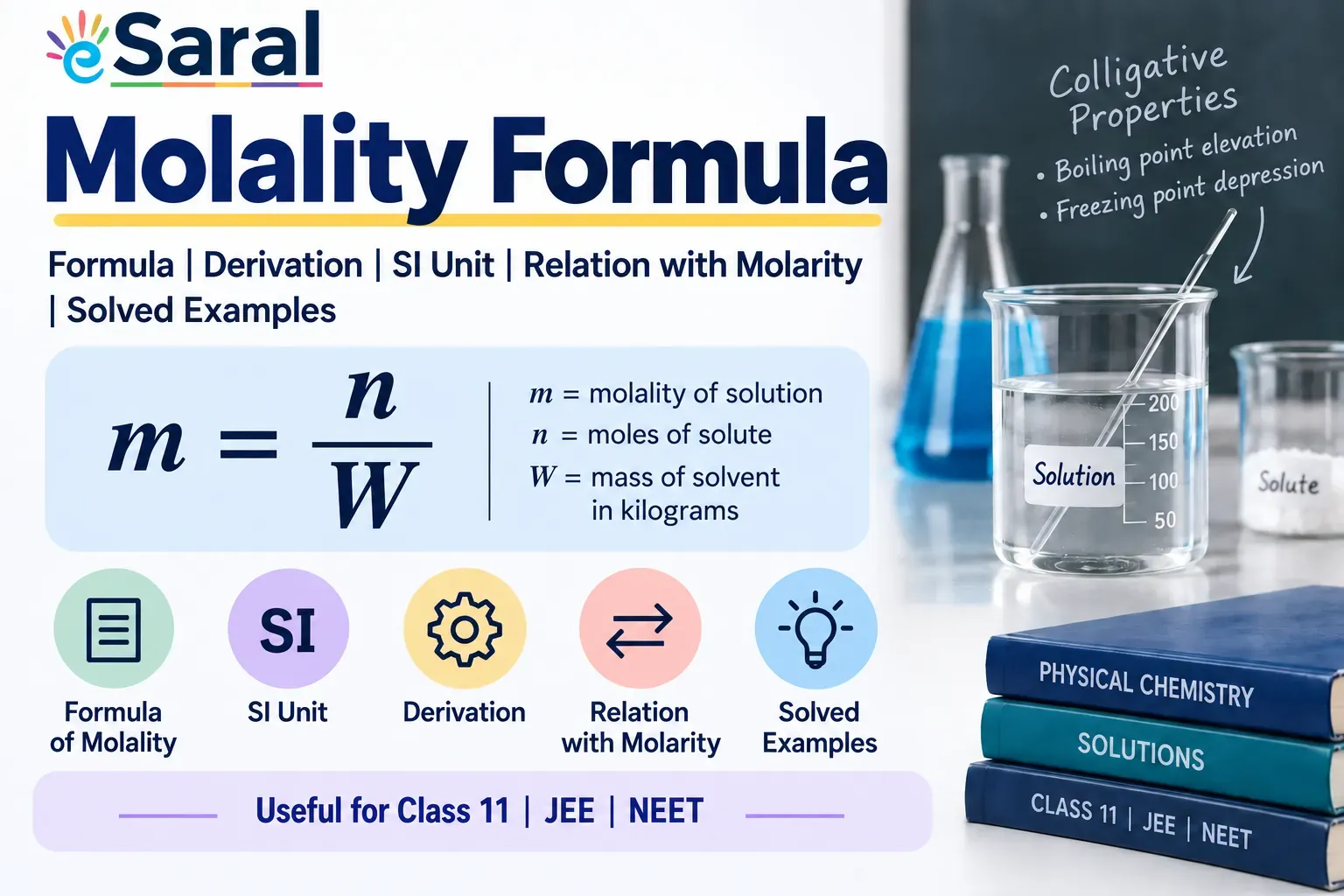
Molality Formula: Formula for Molality, Derivation & Solved Examples
Molality formula is $m = \dfrac{n}{W}$. Learn the formula of molality, its SI unit, derivation, relation with molarity, and solved examples for Class 11, JEE and NEET.
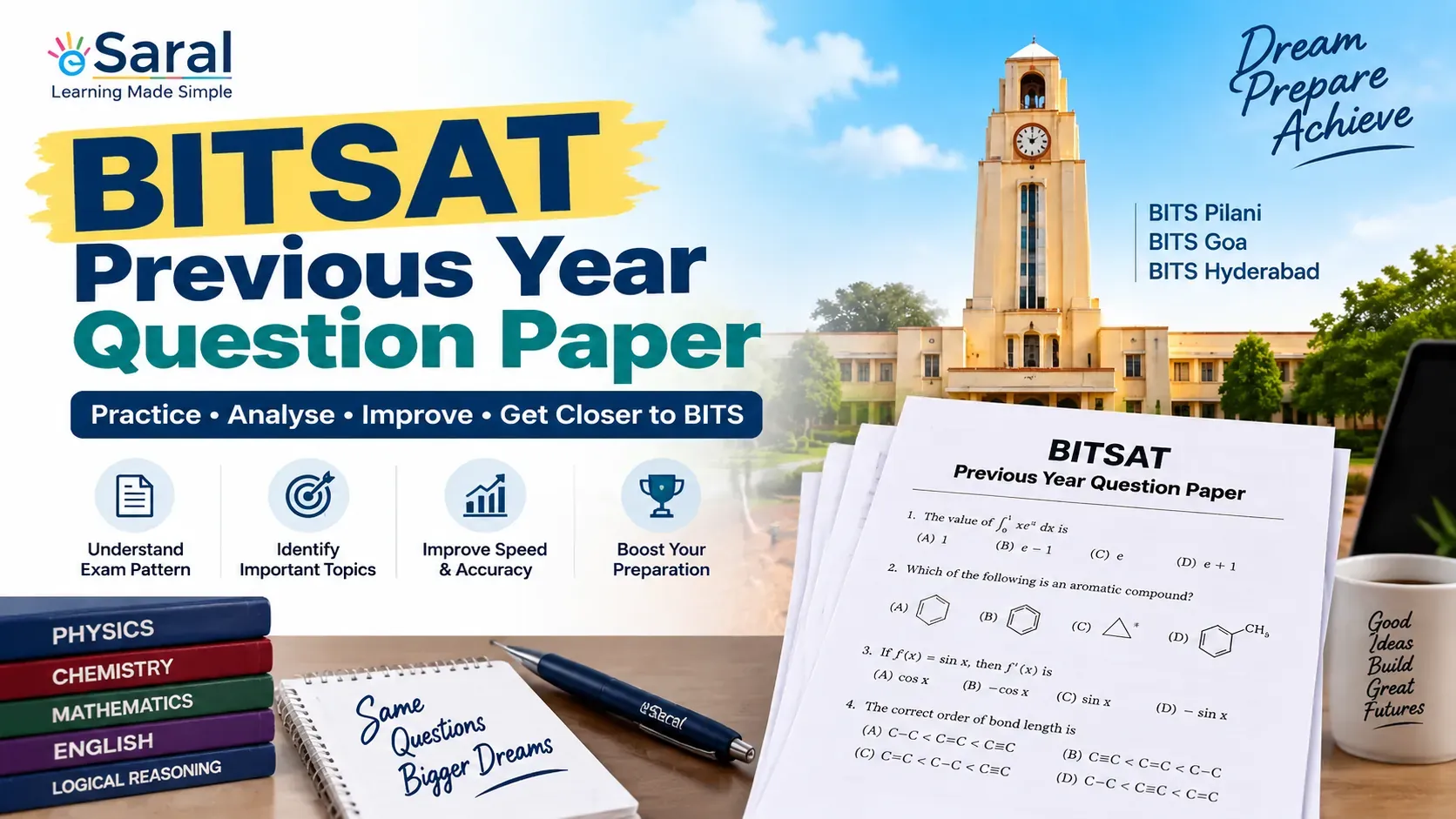
BITSAT Previous Year Question Paper PDF
Download BITSAT previous year question papers PDF. Get year-wise BITSAT PYQs, memory-based papers, exam pattern, and preparation tips to improve your BITSAT preparation.

Teachers’ Day 2026 at eSaral Gurukul: Celebrating the Bond Between Students, Teachers & Mentors
See how Teachers’ Day 2026 was celebrated at eSaral Gurukul, reflecting the bond among students, teachers, and mentors, and the role of guidance beyond academics.
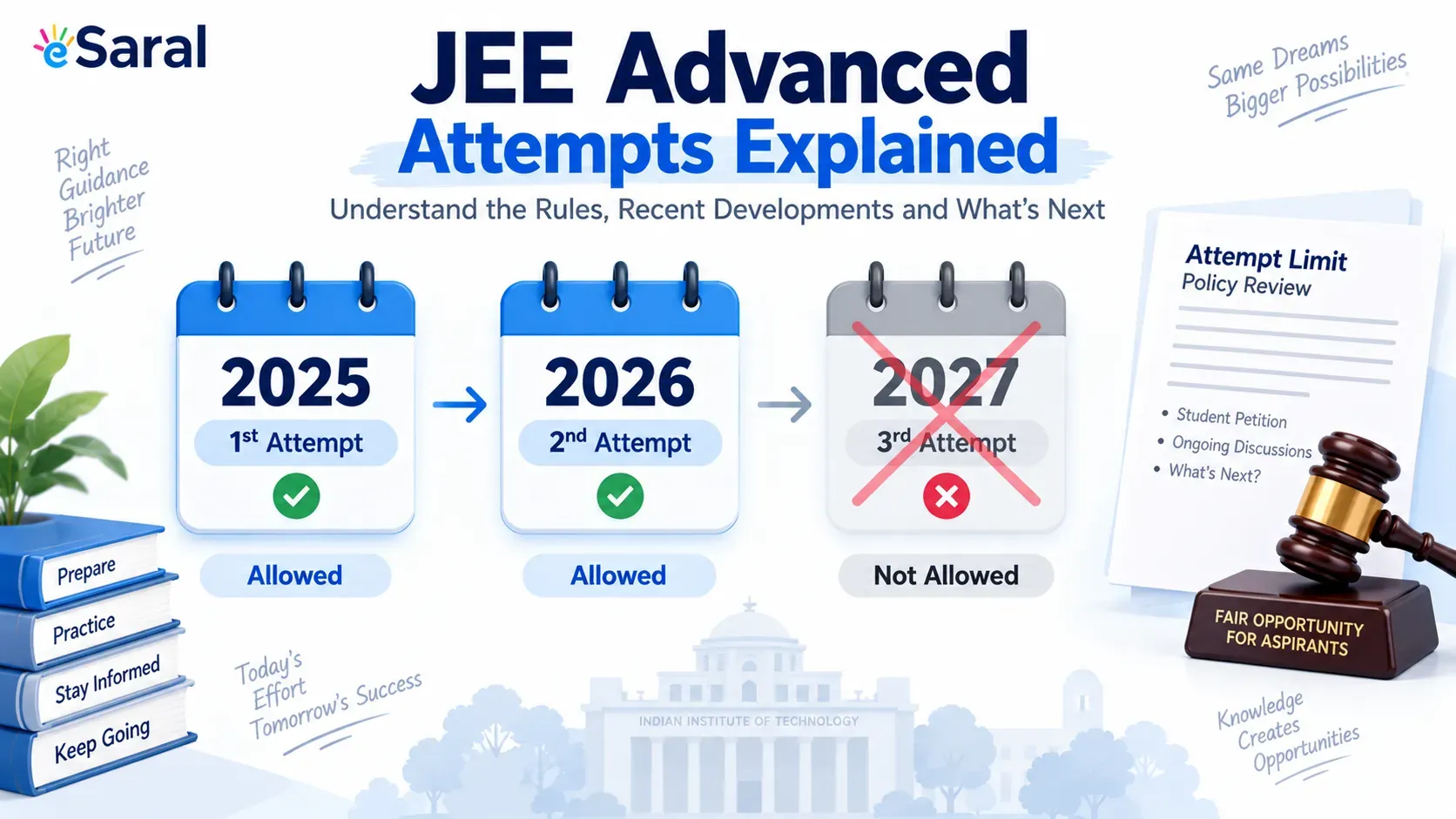
JEE Advanced Attempts: Can You Give It a Third Time? Rules Explained
JEE Advanced attempts: current rule is 2 consecutive years only: full eligibility criteria, the 2025 third-attempt controversy, and the latest 2026 petition news.

Best JEE Preparation App
Best JEE preparation app for Main & Advanced: AI mock tests, live doubt-solving, thousands of practice questions. JEE preparation app for droppers & Class 11-12.
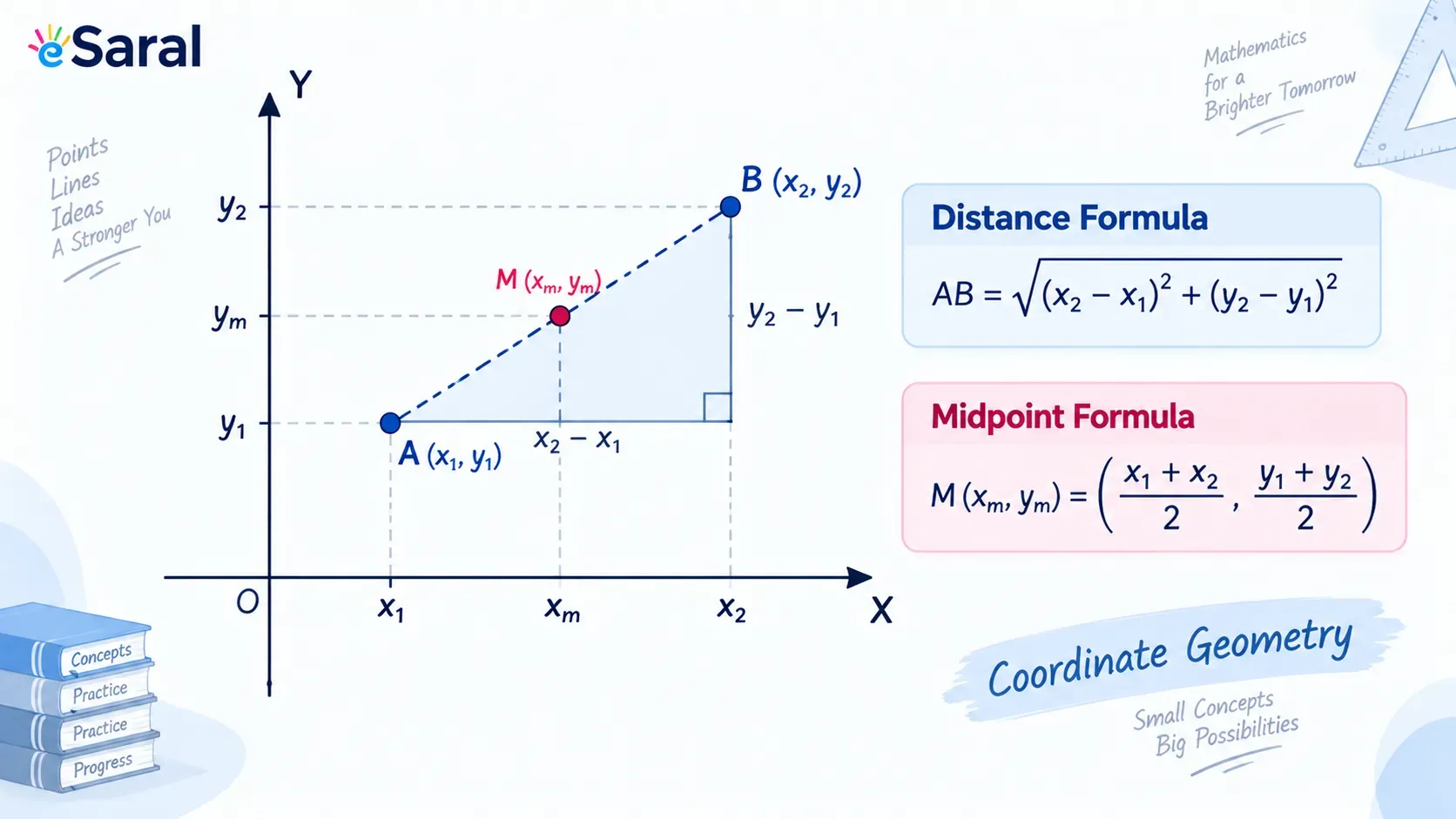
Coordinate Geometry Class 10: Formulas, Notes & Solved Examples
Coordinate geometry class 10: complete CBSE formulas — distance, section, midpoint and area of triangle — with derivation, notes and solved examples.
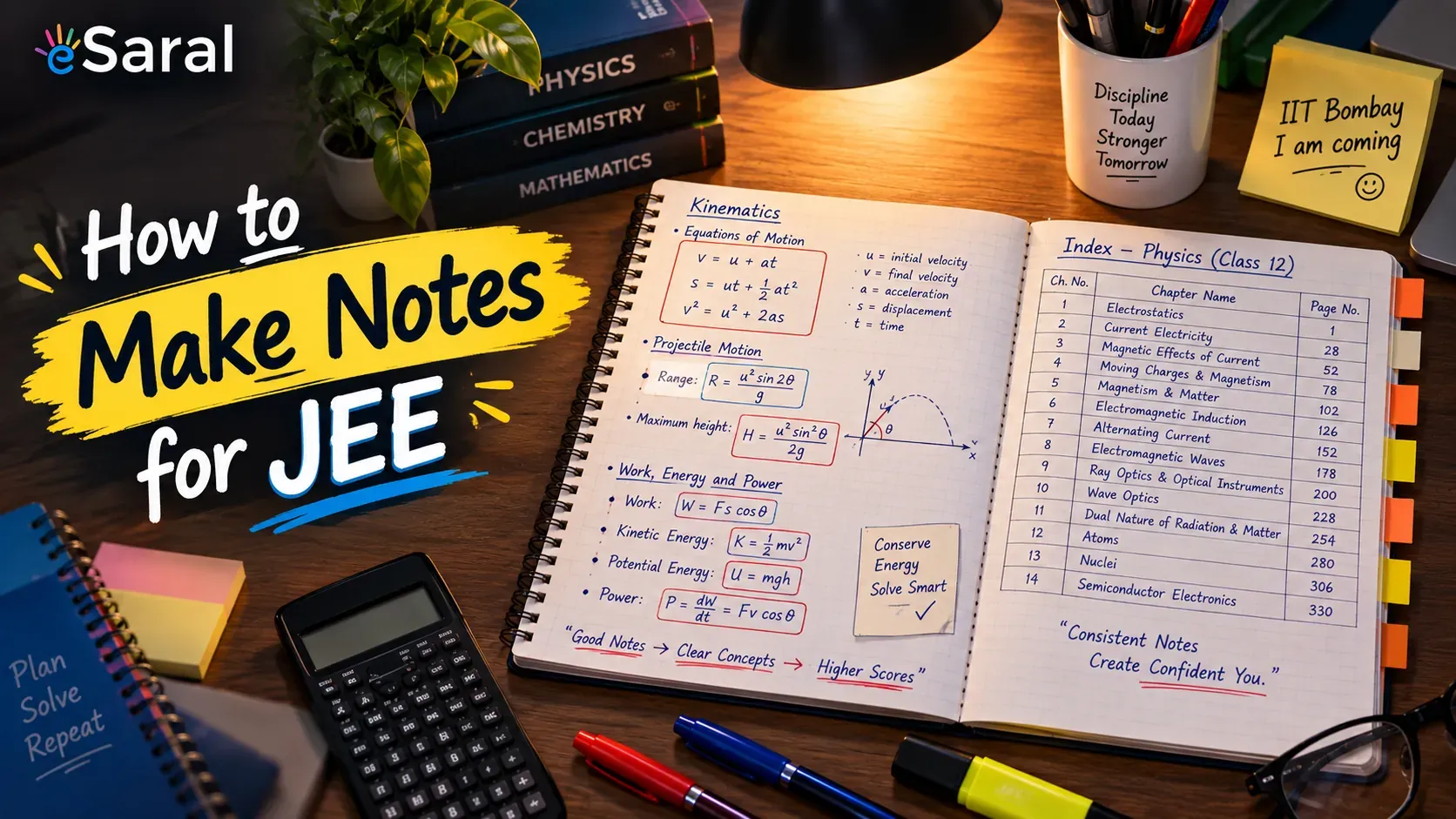
How to make Notes For JEE Smart Notes Strategy of an AIR 41
Learn how to make notes for JEE the way toppers do — indexing, shorthand, and smart short notes for JEE that cut revision time to just 5–7 days.
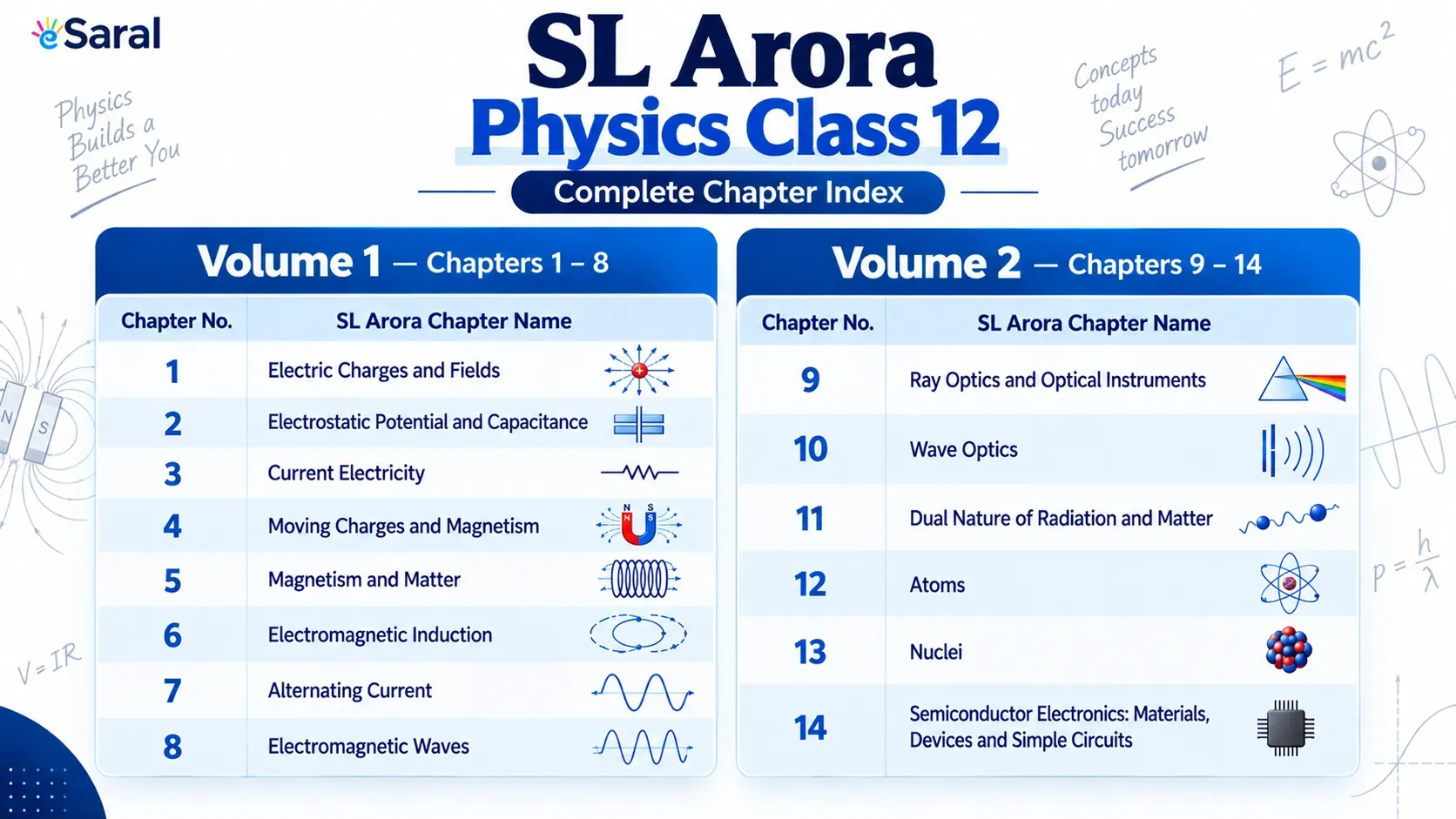
SL Arora Physics Class 12 Index – Chapter List for Volume 1 & 2
SL Arora Physics Class 12 index — complete chapter list for Volume 1 & 2, mapped to NCERT solutions for board, JEE Main, and NEET preparation.