
NCERT Solutions for Class 12 Maths Chapter 10 Exercise 10.2 Vector Algebra - PDF Download

eSaral Academic and Editorial Team
NCERT solutions for class 12 maths chapter 10 exercise 10.2 Vector Algebra covers some significant topics in this exercise such as addition of vectors, multiplication of a vector by a scalar, components of a vector, vector joining two points and section formula. These topics are explained in detail with utmost care and according to guidelines of CBSE by subject matter experts of eSaral to prepare for exams. Additionally, you will be able to solve the questions by going through these concepts.
There are a total of 19 questions in ex 10.2 class 12 maths chapter 10 with medium to difficult level that cover all the topics mentioned above. Exercise 10.2 has some questions which are based on many formulas so you need to remember those formulas to solve exercise questions with ease. NCERT solutions for ex 10.2 class 12 maths are provided here in PDF format which can be accessed for practicing questions. You can easily download the free PDF of these solutions from eSaral and start your preparation for board exams.
Topics Covered in Exercise 10.2 Class 12 Mathematics Questions
NCERT solutions for ex 10.2 class 12 maths are based on some important topics like addition of vectors, multiplication of a vector by a scalar, components of a vector, vector joining two points and section formula. All these topics are explained deeply by subject experts of eSaral.
- Addition of Vectors
You will learn two laws in addition of vectors.
Triangle law of vector addition - Triangle law of vector addition will teach that the initial point of one vector coincides with the terminal point of the other vector.
This can be expressed as $\overrightarrow{\mathrm{AC}}=\overrightarrow{\mathrm{AB}}+\overrightarrow{\mathrm{BC}}$
Parallelogram law of vector addition - If we have two vectors represented by the two adjacent sides of a parallelogram in magnitude and direction, then their sum $\vec{a}+\vec{b}$ is represented in magnitude and direction by the diagonal of the parallelogram through their common point. This is known as the parallelogram law of vector addition.
$\overrightarrow{\mathrm{OA}}+\overrightarrow{\mathrm{OB}}=\overrightarrow{\mathrm{OC}}$
- Properties of vector addition
Property 1: For any two vectors $\vec{a}$ and $\vec{b}$ ,
$\vec{a}+\vec{b}=\vec{b}+\vec{a}$
Property 2: For any three vectors a, b and c
$(\vec{a}+\vec{b})+\vec{c}=\vec{a}+(\vec{b}+\vec{c})$
Additive Identity - For any vector a,
$\vec{a}+\overrightarrow{0}=\overrightarrow{0}+\vec{a}=\vec{a}$
- Multiplication of a Vector by a Scalar
Let $\vec{a}$ be a given vector and λ a scalar. Then the product of the vector $\vec{a}$ by the scalar λ, denoted as $\lambda \vec{a}$ , is called the multiplication of vector $\vec{a}$ by the scalar λ.
$\lambda \vec{a}$ is also a vector, collinear to the vector $\vec{a}$ . The vector $\lambda \vec{a}$ has the direction same (or opposite) to that of vector $\vec{a}$ according as the value of λ is positive (or negative). Also, the magnitude of vector $\lambda \vec{a}$ is |λ| times the magnitude of the vector $\vec{a}$ .
$|\lambda \vec{a}|=|\lambda||\vec{a}|$
The vector $-\vec{a}$ is called the negative (or additive inverse) of vector $\vec{a}$ and we always have
$\vec{a}+(-\vec{a})=(-\vec{a})+\vec{a}=\overrightarrow{0}$
- Components of a vector
$\vec{r}$ = $x \hat{i}+y \hat{j}+z \hat{k}$
This form of any vector is called its component form. Where x, y and z are called as the scalar components of $\vec{r}$, and $x \hat{i}, y \hat{j}$ and $z \hat{k}$ are called the vector components of $\vec{r}$ along the respective axes. Sometimes x, y and z are also termed as rectangular components.
- Vector joining two points
The magnitude of vector $\overrightarrow{\mathrm{P}_1 \mathrm{P}_2}$ is given by
$\left|\overrightarrow{\mathrm{P}_1 \mathrm{P}_2}\right|=\sqrt{\left(x_2-x_1\right)^2+\left(y_2-y_1\right)^2+\left(z_2-z_1\right)^2}$
- Section formula
To find the position of a line segment we use the section formula method that divides a vector in two ways- externally and internally in a given ratio.
Case 1 - When PQ is divided by R internally
where m and n are positive scalars, we say that the point R divides $\overrightarrow{\mathrm{PQ}}$ internally in the ratio of m : n which is given by
$\overrightarrow{\mathrm{OR}}=\frac{m \vec{b}+n \vec{a}}{m+n}$
Case 2 - When PQ is divided by R externally
the position vector of the point R which divides the line segment PQ externally in the ratio m : n is given by
$\overrightarrow{\mathrm{OR}}=\frac{m \vec{b}-n \vec{a}}{m-n}$
Tips for Solving Exercise 10.2 Class 12 Chapter 10 Differential Equations
NCERT solutions class 12 maths chapter 10 ex 10.2 can be solved by following the tips provided by eSaral’s experts of mathematics.
- This exercise has questions based on some properties that must be practiced before solving questions.
- There are some important formulas based on the vectors so you need to learn these formulas for better understanding of questions included in ex 10.2.
- Ex 10.2 class 12 maths solutions have essential concepts that you must study thoroughly for answering the question of exercise and for the questions asked in board exams.
Importance of Solving Ex 10.2 Class 12 Maths Chapter 10 Differential Equations
Solving questions in NCERT solutions for class 12 maths chapter 10 ex 10.2 will benefit you in so many ways. Here, we have provided some of the benefits that will help you in board exams.
- eSaral provides students an in-depth knowledge of topics related to ex 10.2 and more precise solutions for each question so that students can evaluate their preparation and secure high marks in exams.
- There are many questions in ex 10.2 class 12 maths ch 10 that are based on properties of vector addition, some section formulas that are explained in simple language for better understanding of questions.
- Practicing questions in NCERT solutions will provide you concept clarity that will help you to solve questions asked in board exams.
- By revising the concepts and solving questions in NCERT solutions for class 12 maths chapter 10 ex 10.2 will improve your problem solving skills.
Frequently Asked Questions
Question 1. Write the section formula when R divides PQ internally?
Answer 1. When R divides PQ internally then the formula is $\overrightarrow{\mathrm{OR}}=\frac{m \vec{b}+n \vec{a}}{m+n}$
Question 2. Write the two laws of addition of vectors?
Answer 2. The two laws of addition of vectors are as follows.
- Triangle law of vector addition
- Parallelogram law of vector addition
|
1. |
Addition of Vectors |
|
|
|
2. |
Multiplication of a Vector by a Scalar |
|
|
Team eSaral
eSaral Academic and Editorial Team
Team eSaral is the collective author profile for educational content created by eSaral’s teachers and academic contributors. The team draws on expertise from IIT graduates, doctors, experienced educators and subject specialists to develop resources for JEE, NEET and school students. Our articles aim to explain concepts clearly and help students study with confidence.
Related Posts
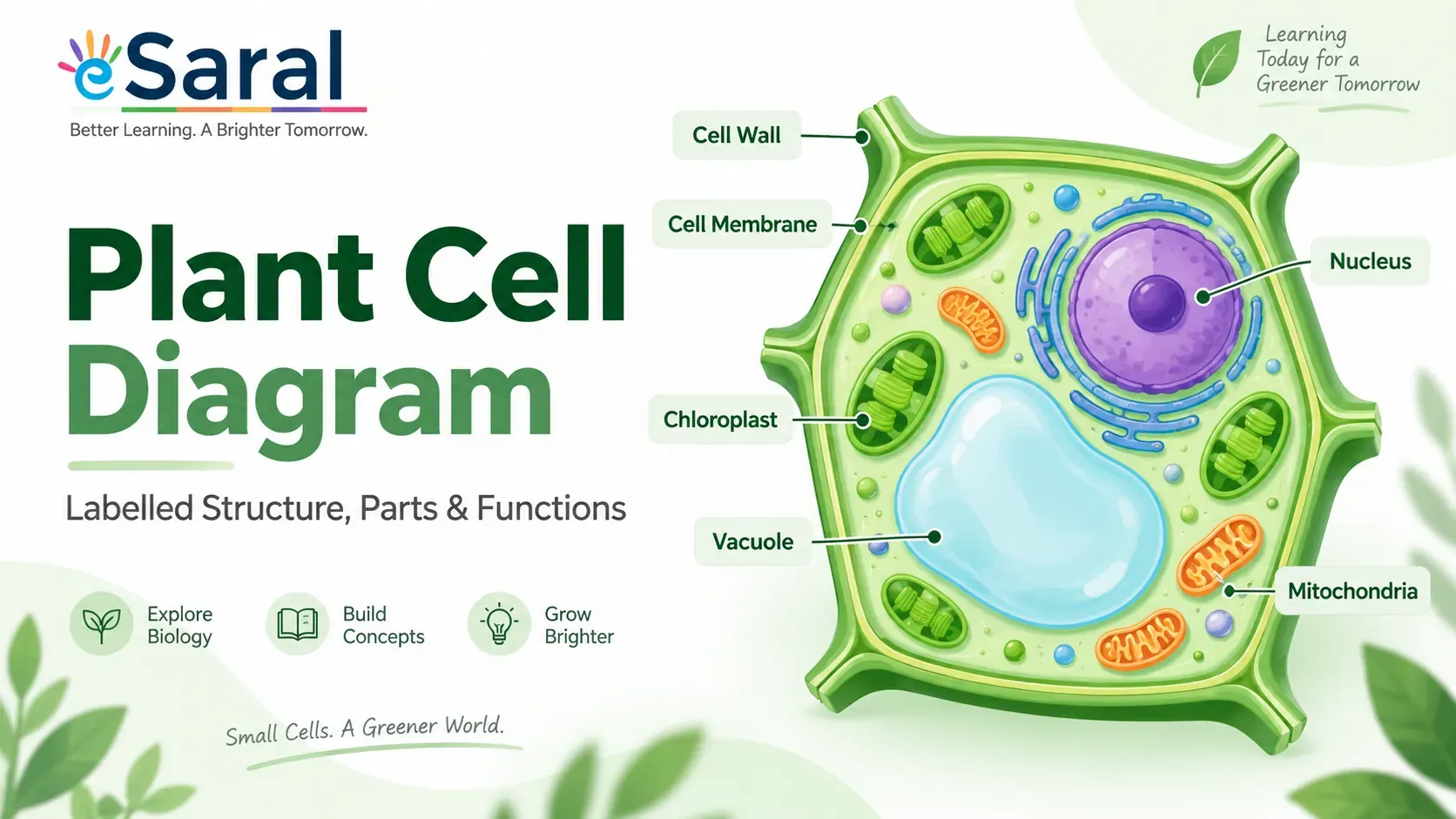
Plant Cell Diagram: Labelled Structure, Parts and Functions
Simple, labelled plant cell diagram with parts and functions. Covers plant cell structure for Class 6, 7, 8, 9, 10 and 11 students, CBSE-aligned.
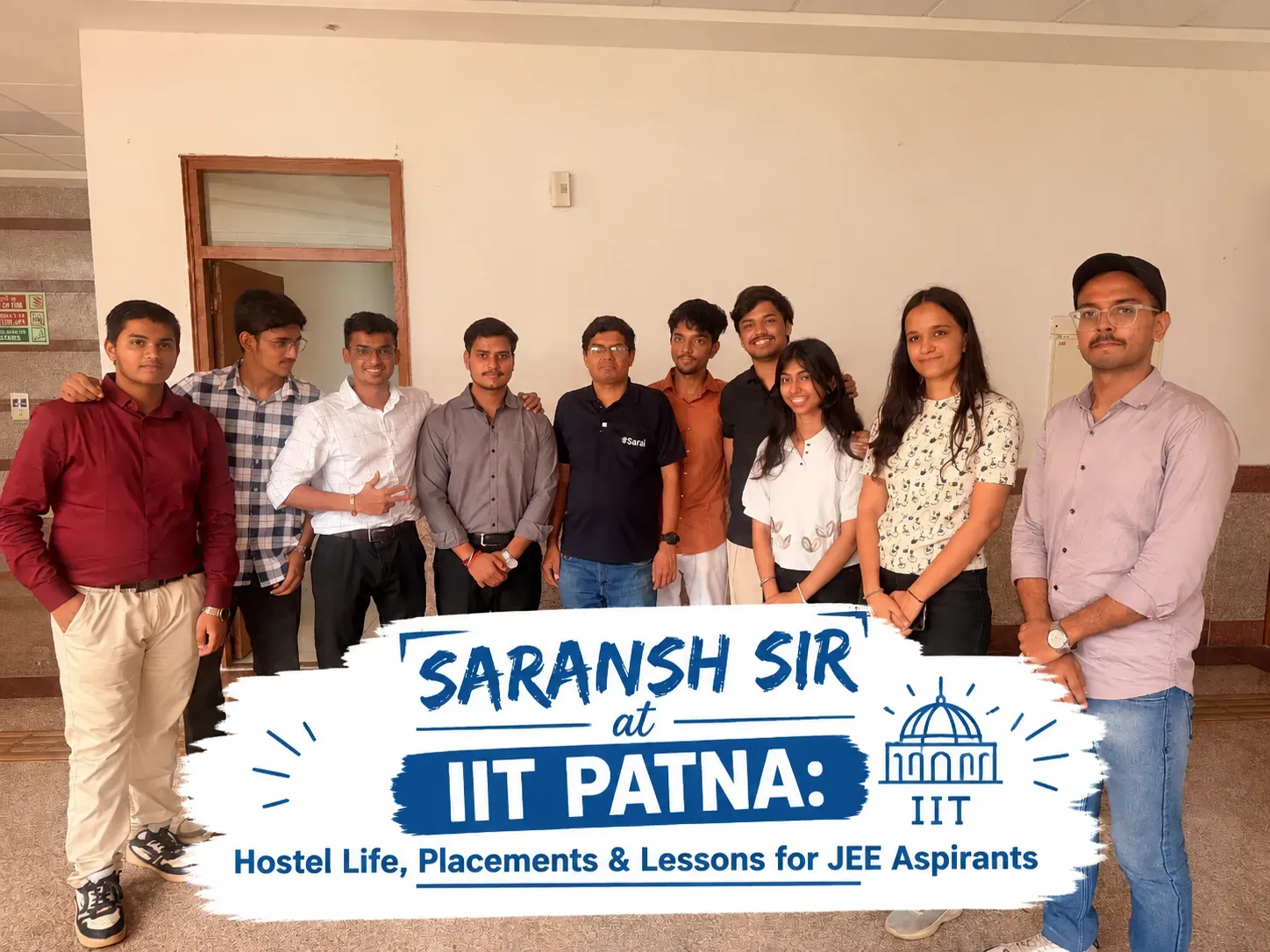
Saransh Gupta Sir's Visit to IIT Patna: Hostel Life, Placements & Lessons for JEE Aspirants
Inside Saransh Gupta Sir's IIT Patna visit — hostel life, the library, placements, internships, and real advice for JEE aspirants from students living the IIT dream.
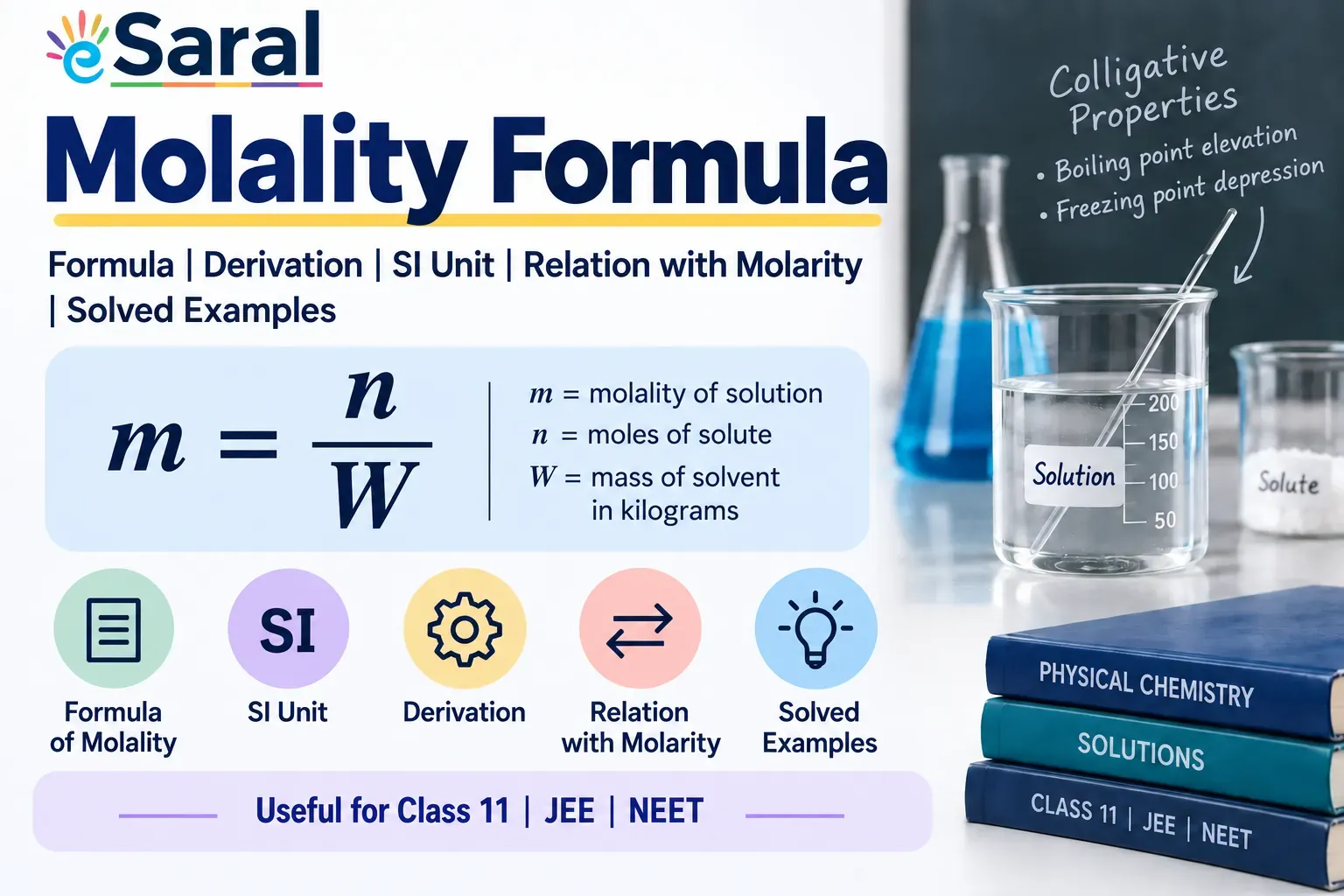
Molality Formula: Formula for Molality, Derivation & Solved Examples
Molality formula is $m = \dfrac{n}{W}$. Learn the formula of molality, its SI unit, derivation, relation with molarity, and solved examples for Class 11, JEE and NEET.
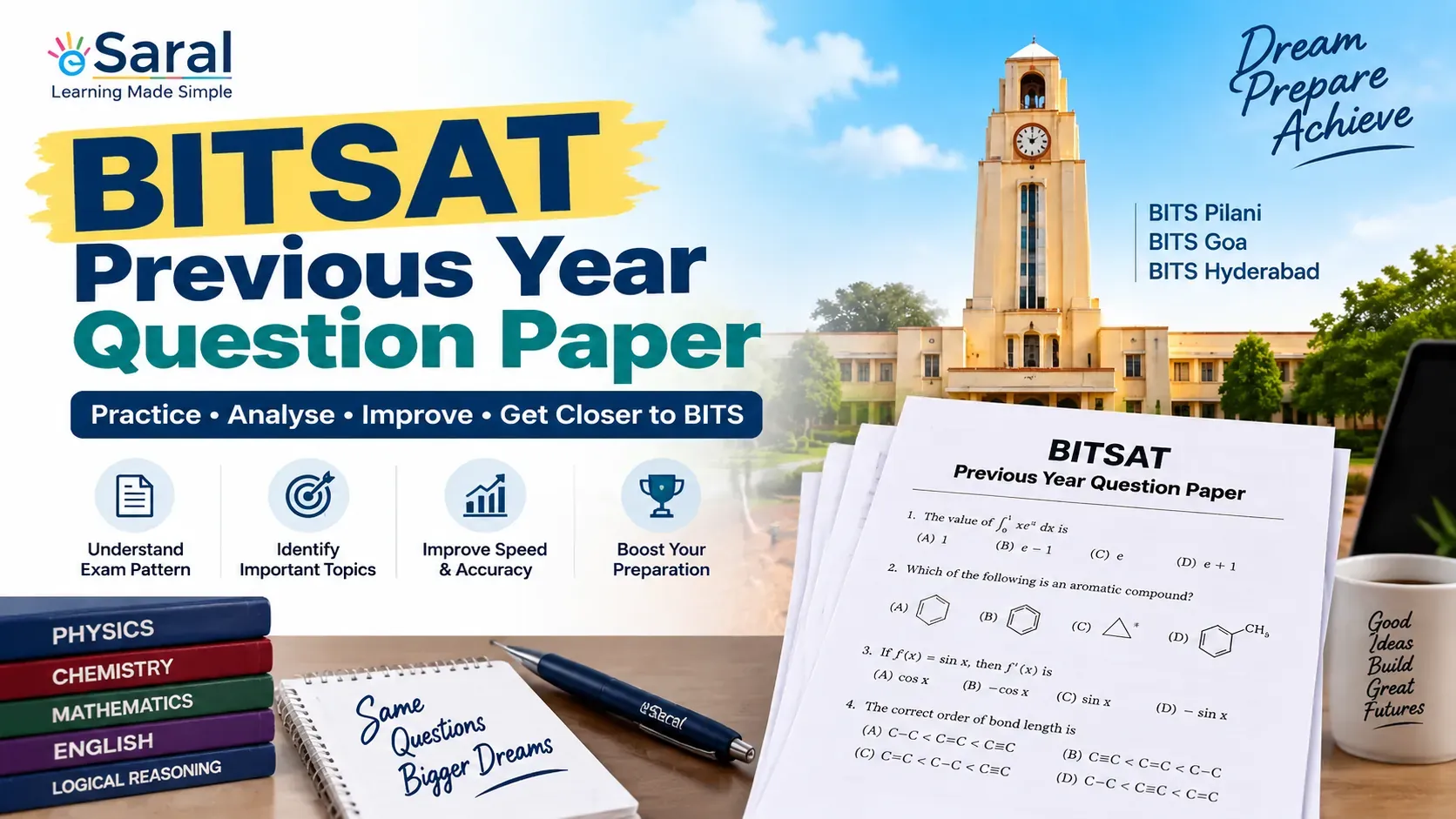
BITSAT Previous Year Question Paper PDF
Download BITSAT previous year question papers PDF. Get year-wise BITSAT PYQs, memory-based papers, exam pattern, and preparation tips to improve your BITSAT preparation.

Teachers’ Day 2026 at eSaral Gurukul: Celebrating the Bond Between Students, Teachers & Mentors
See how Teachers’ Day 2026 was celebrated at eSaral Gurukul, reflecting the bond among students, teachers, and mentors, and the role of guidance beyond academics.
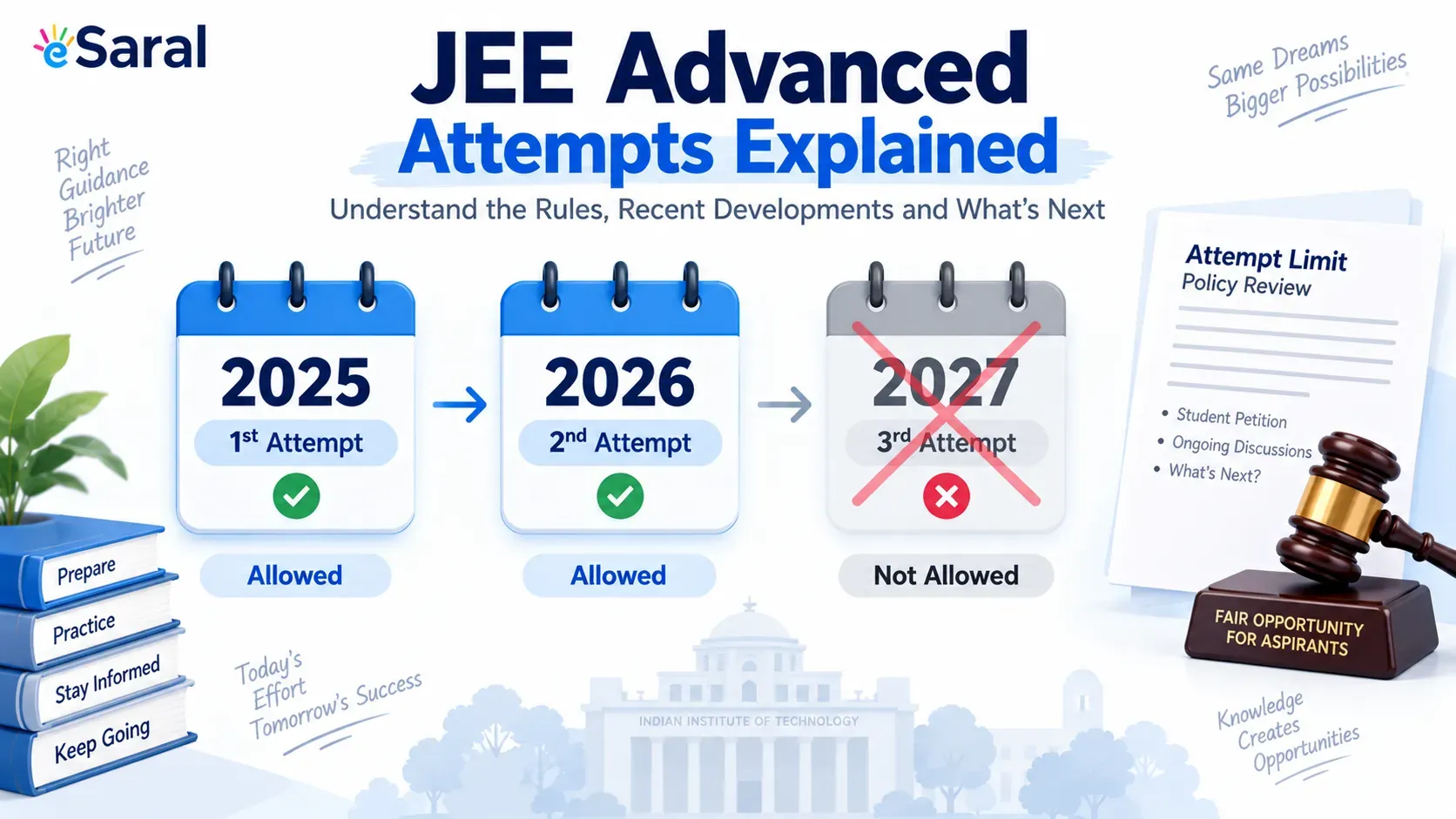
JEE Advanced Attempts: Can You Give It a Third Time? Rules Explained
JEE Advanced attempts: current rule is 2 consecutive years only: full eligibility criteria, the 2025 third-attempt controversy, and the latest 2026 petition news.

Best JEE Preparation App
Best JEE preparation app for Main & Advanced: AI mock tests, live doubt-solving, thousands of practice questions. JEE preparation app for droppers & Class 11-12.
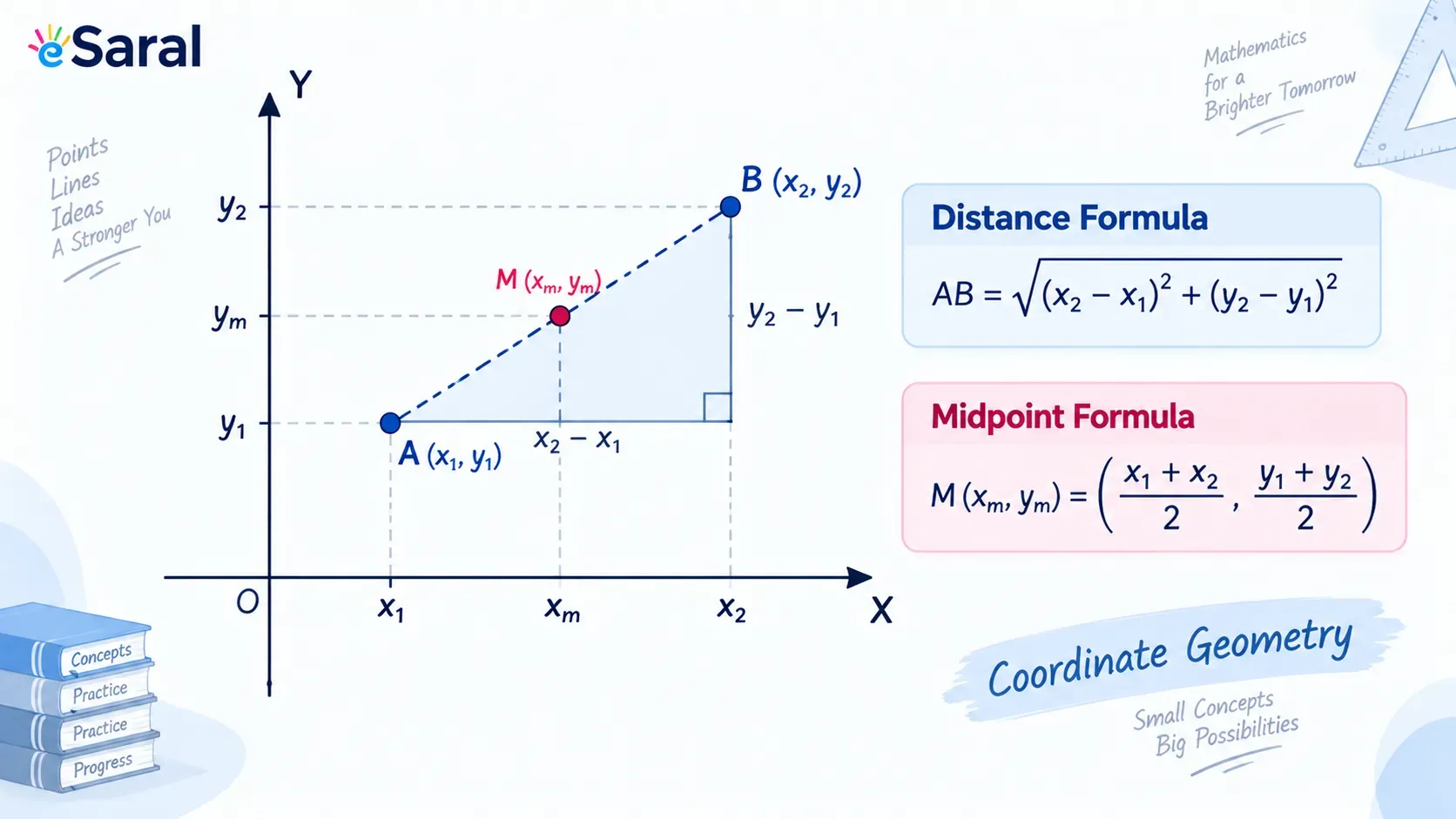
Coordinate Geometry Class 10: Formulas, Notes & Solved Examples
Coordinate geometry class 10: complete CBSE formulas — distance, section, midpoint and area of triangle — with derivation, notes and solved examples.
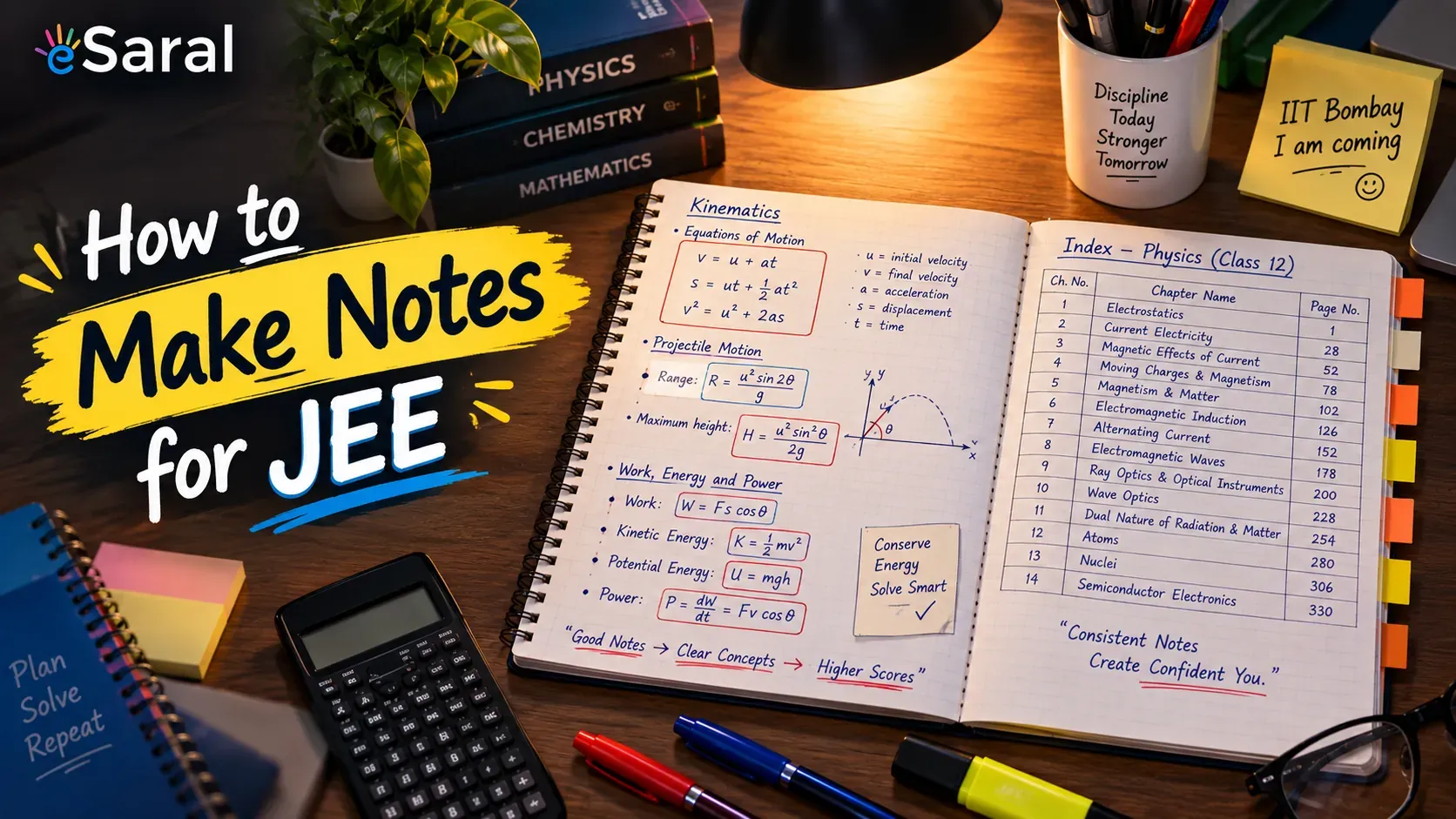
How to make Notes For JEE Smart Notes Strategy of an AIR 41
Learn how to make notes for JEE the way toppers do — indexing, shorthand, and smart short notes for JEE that cut revision time to just 5–7 days.
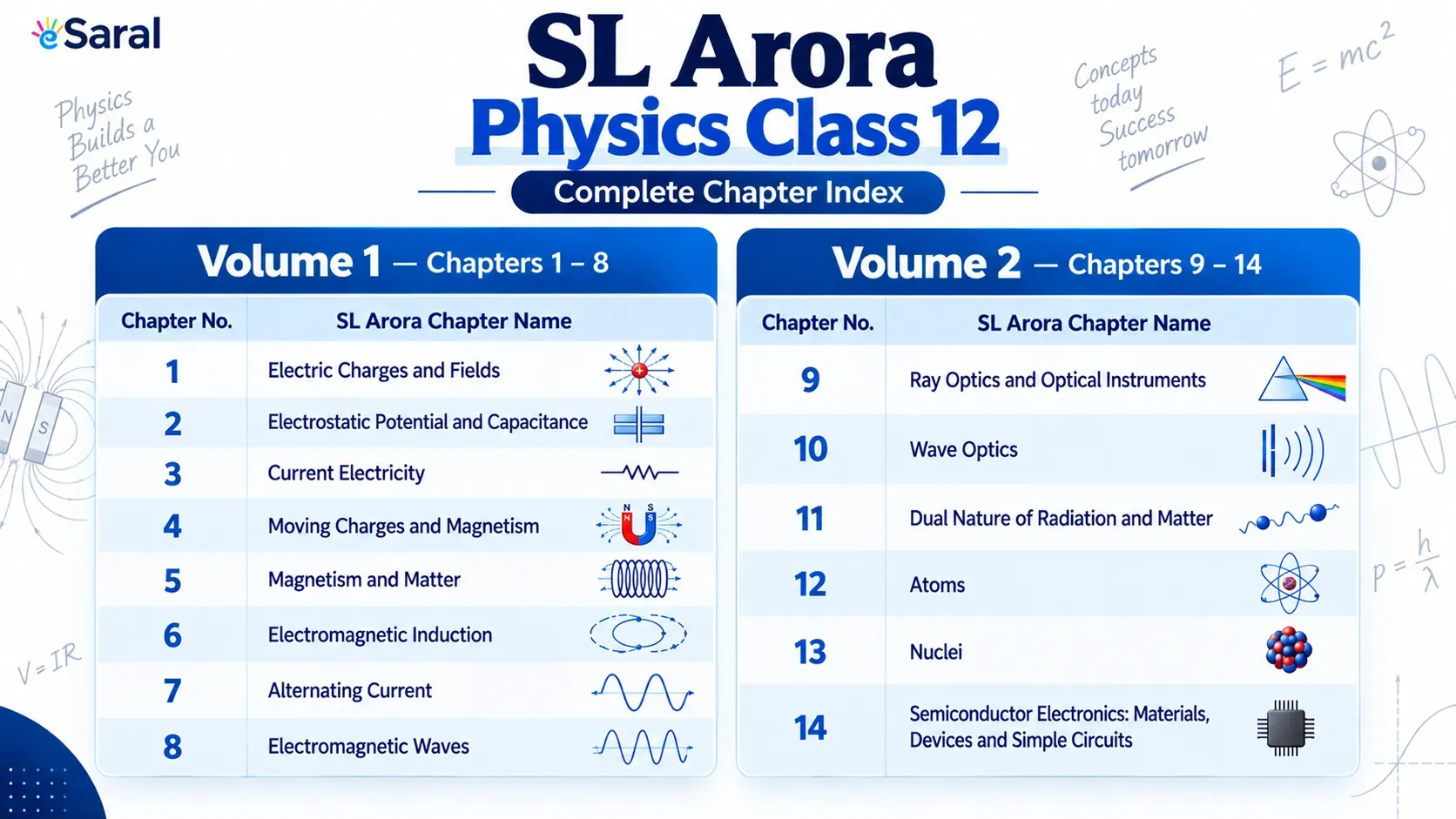
SL Arora Physics Class 12 Index – Chapter List for Volume 1 & 2
SL Arora Physics Class 12 index — complete chapter list for Volume 1 & 2, mapped to NCERT solutions for board, JEE Main, and NEET preparation.