
NCERT Solutions for Class 12 Maths Chapter 7 Exercise 7.1 Integrals - PDF Download

eSaral Academic and Editorial Team
NCERT solutions for class 12 maths chapter 7 exercise 7.1 Integrals requires us to determine the integration as an inverse process of differentiation and some properties of indefinite integral. Since differentiation and integration are closely connected, NCERT solutions developed by subject experts of eSaral help students understand the differences between the two processes so they can better understand the concepts. Solutions of ex 7.1 class 12 maths chapter 7 are created in simple language to give you better understanding of topics and concepts.
There are a total of 22 questions in exercise 7.1 class 12 maths ch 7 in which some of the questions are simple to solve and some questions require a better comprehension of properties of indefinite integral. NCERT solutions are provided here for you to comprehend the basic concepts of topics mentioned in ex 7.1 class 12 maths that help in preparing for exams. You can also download the Pdf version of these solutions to practice questions. The link to download the PDF for free is given below.
Topics Covered in Exercise 7.1 Class 12 Mathematics Questions
Ex 7.1 class 12 maths solutions covers the topics of integration as an inverse process of differentiation and some properties of indefinite integral which are explained below.
1. | Integration as an Inverse Process of Differentiation | Some properties of indefinite integral |
- Integration as an Inverse Process of Differentiation
Integration is the inverse process of differentiation. Instead of differentiating a function, we are given the derivative of a function and asked to find its primitive, i.e., the original function. Such a process is called integration or anti differentiation.
Let’s take a example $\frac{d}{d x}(\sin x)=\cos x$ …..(1)
$\frac{d}{d x}\left(\frac{x^3}{3}\right)=x^2$ …..(2)
And $\frac{d}{d x}\left(e^x\right)=e^x$ ….(3)
The function cos x in (1) is the derived function of sin x, as we can see. Sin x is referred to as the antiderivative (or integral) of cos x. Similar to this, in (2) and (3), x33 and ex, respectively, represent the anti derivatives (or integrals) of x2 and ex.
Again, we note that for any real number C, treated as constant function, its derivative is zero and hence, we can write (1), (2) and (3) as follows :
$\frac{d}{d x}(\sin x+\mathrm{C})=\cos x, \frac{d}{d x}\left(\frac{x^3}{3}+\mathrm{C}\right)=x^2$ and $\frac{d}{d x}\left(e^x+\mathrm{C}\right)=e^x$
Consequently, anti derivatives (or integrals) of the functions mentioned above are not unique. Actually, there exist infinitely many anti derivatives of each of these functions which can be obtained by choosing C arbitrarily from the set of real numbers. For this reason C is customarily referred to as an arbitrary constant. In fact, C is the parameter by varying which one gets different antiderivatives (or integrals) of the given function.
More generally, if there is a function F such that $\frac{d}{d x} \mathrm{~F}(x)=f(x), \forall x \in \mathrm{I}$ (interval), then for any arbitrary real number C, (also called constant of integration)
$\frac{d}{d x}[\mathrm{~F}(x)+\mathrm{C}]=f(x), x \in \mathrm{I}$
Thus, {F + C, C ∈ R} denotes a family of antiderivatives of f.
Some properties of indefinite integral
Some properties of indefinite integrals will be derived in this subsection.
(I) The process of differentiation and integration are inverses of each other in the sense of the following results :
$\frac{d}{d x} \int f(x) d x=f(x)$ and
$\int f^{\prime}(x) d x=f(x)+\mathrm{C}$ , where C is any arbitrary constant.
(II) Two indefinite integrals with the same derivative lead to the same family of curves and so they are equivalent.
(III) $\int[f(x)+g(x)] d x=\int f(x) d x+\int g(x) d x$
(IV) For any real number k, $\int k f(x) d x=k \int f(x) d x$
(V) Properties (III) and (IV) can be generalised to a finite number of functions f1 , f2 , ..., fn and the real numbers, k1 , k2 , ..., kn giving
$\begin{aligned} & \int\left[k_1 f_1(x)+k_2 f_2(x)+\ldots+k_n f_n(x)\right] d x \\ & =k_1 \int f_1(x) d x+k_2 \int f_2(x) d x+\ldots+k_n \int f_n(x) d x .\end{aligned}$
Tips for Solving Exercise 7.1 Class 12 Chapter 7 Integrals
Ex 7.1 class 12 maths solutions combined useful and important tips by experts of eSaral to solve questions with ease.
- The questions require more observation than calculation. However, here we provide lists of several formulas that students must understand and remember.
- There are two main properties in ex 7.1 class 12 maths chapter 7. Students should make it a point to revise the proofs for both of them in order to gain a deeper comprehension of the topic.
- Students should also solve the examples given in ex 7.1 class 12 maths to be able to understand the concepts and theorems properly.
Importance of Solving Ex 7.1 Class 12 Maths Chapter 7 Integrals
You will get a lot of benefits by solving ex 7.1 class 12 maths chapter 7. There are some of the benefits provided by expert teachers of eSaral which you can check below.
- NCERT solutions class 12 maths chapter 7 ex 7.1 is about integration as an inverse process of differentiation. These topics have been explained by subject experts of eSaral to help you solve the ex 7.1 without any confusion.
- Ex 7.1 class 12 maths solutions have provided precise knowledge of properties and theorems that is essential for understanding the nature of questions.
- These solutions are also available in PDF format that will help you grasp the accurate answers to all the questions of exercise 7.1.
- Students must practice the exercise and revise the concepts for better comprehension of questions asked in board exams.
Frequently Asked Questions
Question 1. What is integration in class 12 maths chapter 7 exercise 7.1?
Integration is the inverse process of differentiation. In the differential calculus, we are given a function and we have to find the derivative or differential of this function, but in the integral calculus, we are to find a function whose differential is given. Thus, integration is a process which is the inverse of differentiation
Question 2. Can I get a complete solution of exercise 7.1 class 12 maths chapter 7?
Yes, you can get a complete NCERT solution for ex 7.1 class 12 maths chapter 7 at eSaral. These solutions have included all the concepts, properties, important terms and theorems related to exercise 7.1 to help you score good in exams. You can download the NCERT PDF from the official website of eSaral and practice all the questions.
Team eSaral
eSaral Academic and Editorial Team
Team eSaral is the collective author profile for educational content created by eSaral’s teachers and academic contributors. The team draws on expertise from IIT graduates, doctors, experienced educators and subject specialists to develop resources for JEE, NEET and school students. Our articles aim to explain concepts clearly and help students study with confidence.
Related Posts
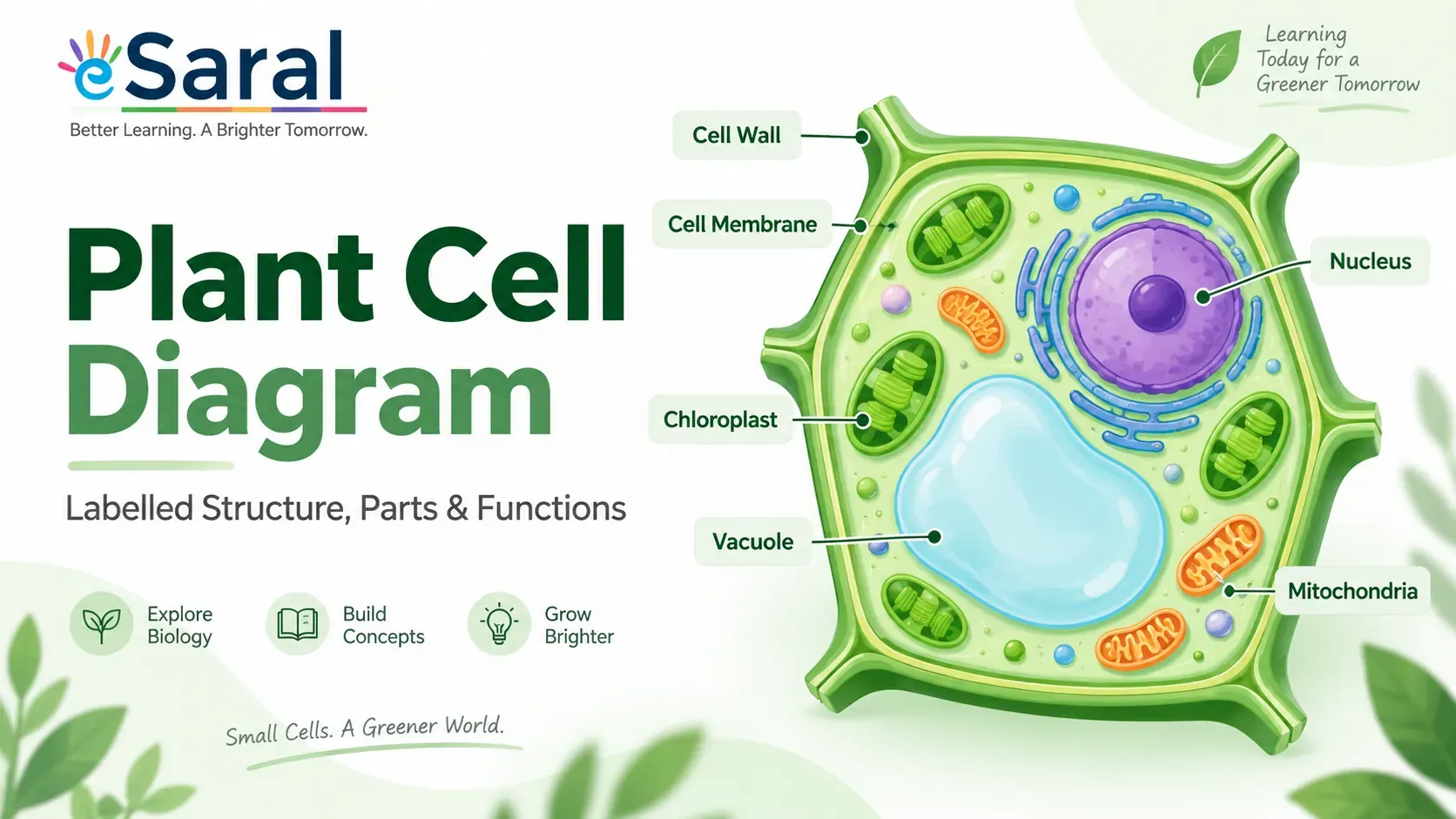
Plant Cell Diagram: Labelled Structure, Parts and Functions
Simple, labelled plant cell diagram with parts and functions. Covers plant cell structure for Class 6, 7, 8, 9, 10 and 11 students, CBSE-aligned.

Saransh Gupta Sir's Visit to IIT Patna: Hostel Life, Placements & Lessons for JEE Aspirants
Inside Saransh Gupta Sir's IIT Patna visit — hostel life, the library, placements, internships, and real advice for JEE aspirants from students living the IIT dream.
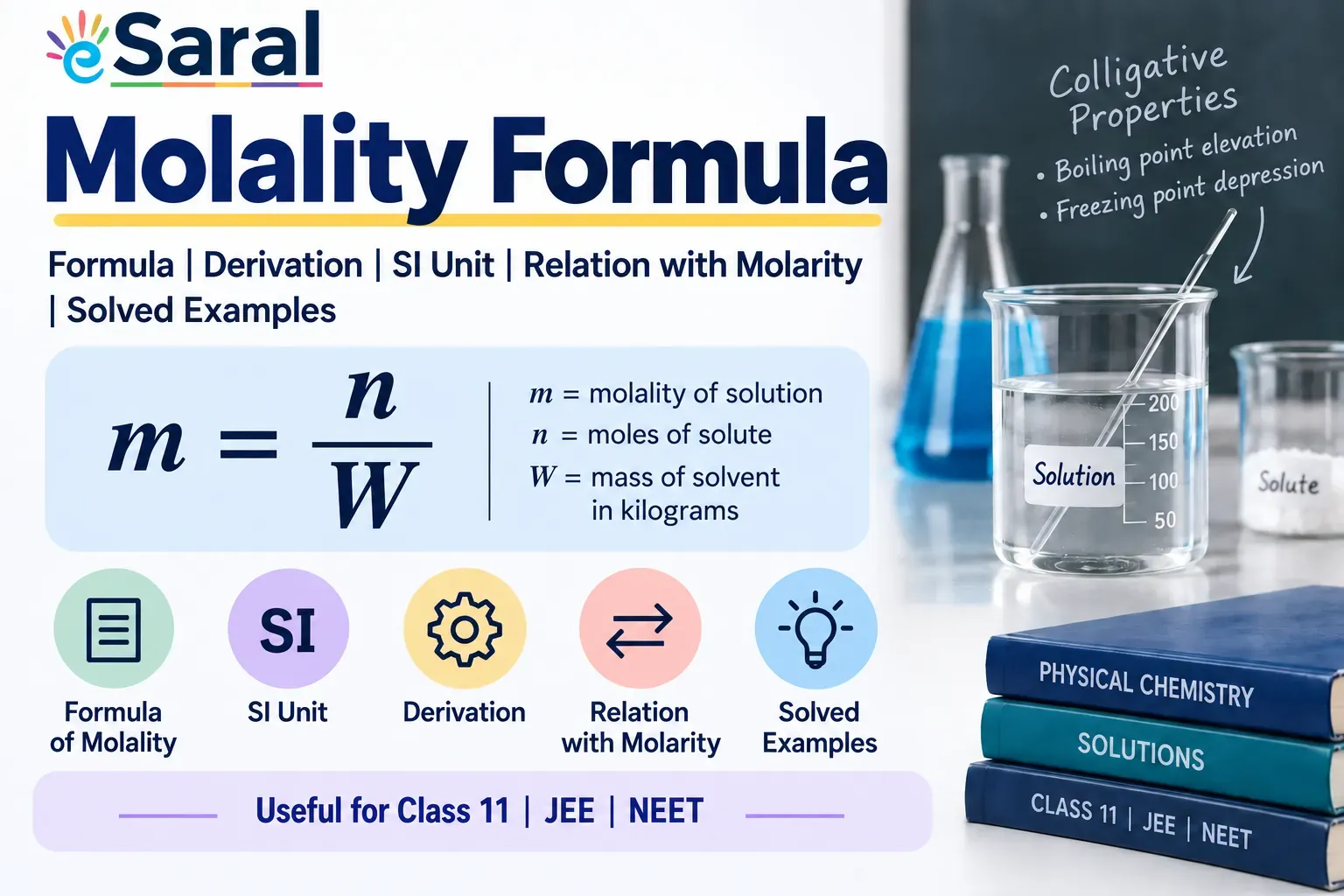
Molality Formula: Formula for Molality, Derivation & Solved Examples
Molality formula is $m = \dfrac{n}{W}$. Learn the formula of molality, its SI unit, derivation, relation with molarity, and solved examples for Class 11, JEE and NEET.
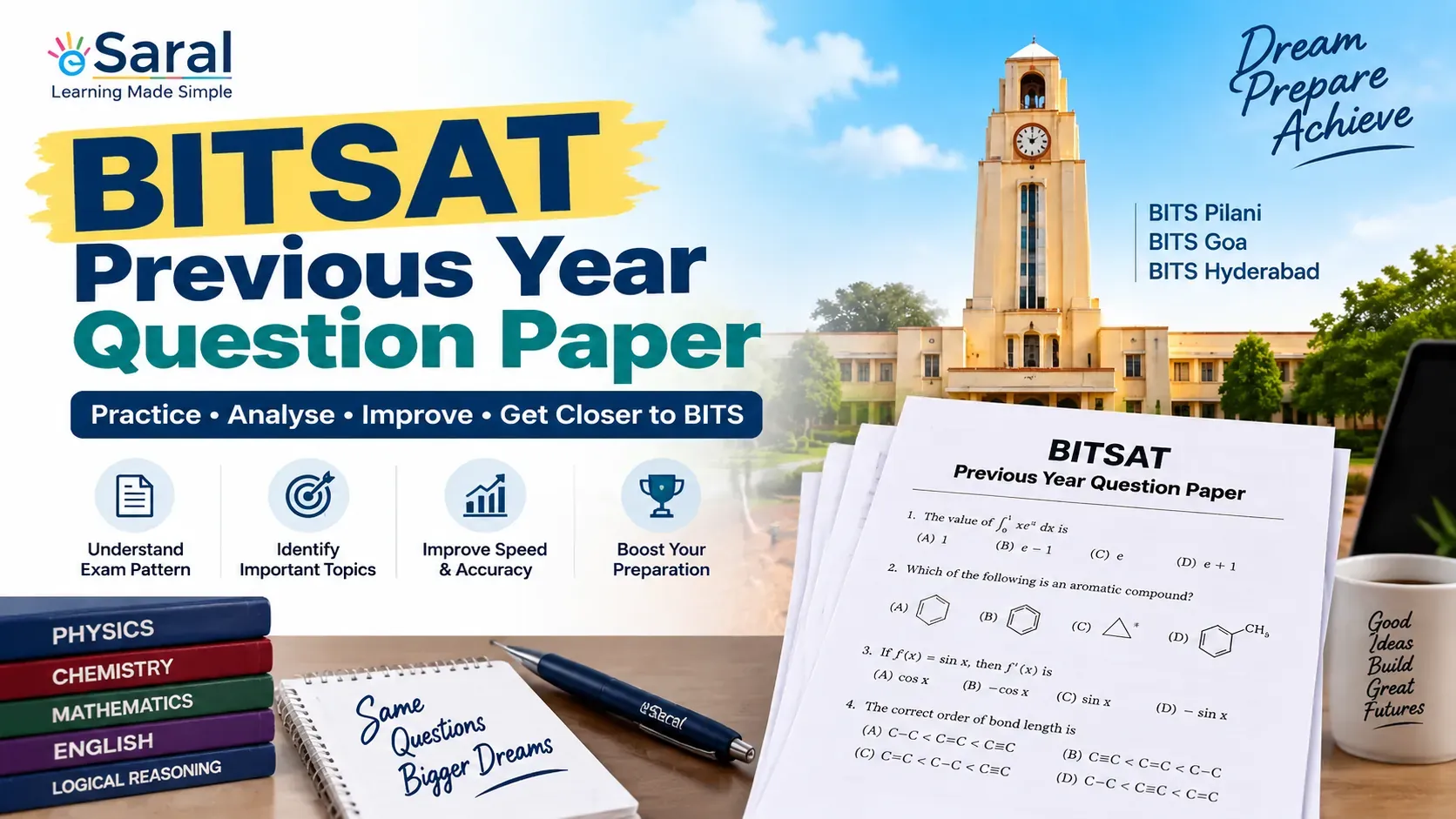
BITSAT Previous Year Question Paper PDF
Download BITSAT previous year question papers PDF. Get year-wise BITSAT PYQs, memory-based papers, exam pattern, and preparation tips to improve your BITSAT preparation.

Teachers’ Day 2026 at eSaral Gurukul: Celebrating the Bond Between Students, Teachers & Mentors
See how Teachers’ Day 2026 was celebrated at eSaral Gurukul, reflecting the bond among students, teachers, and mentors, and the role of guidance beyond academics.
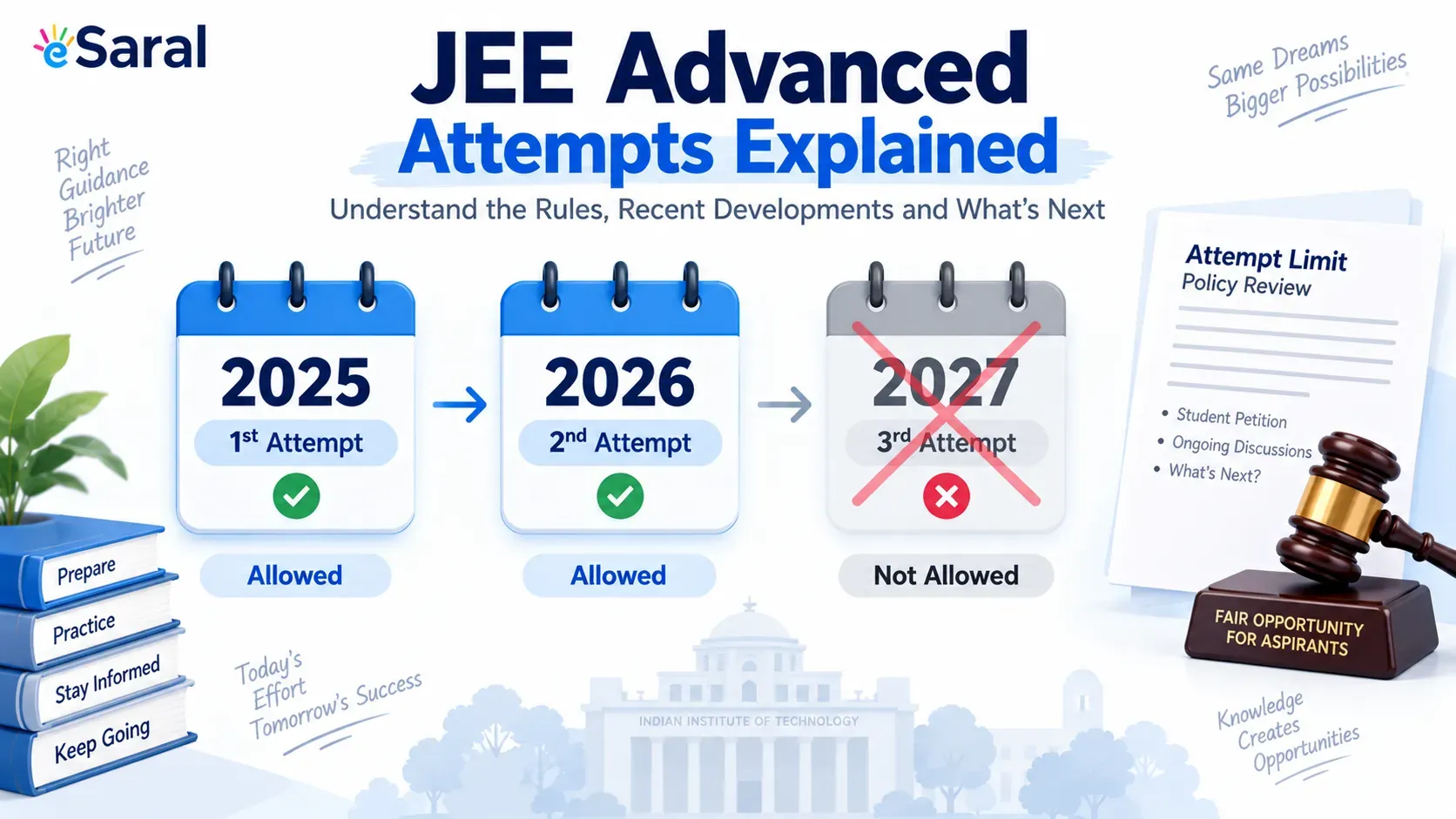
JEE Advanced Attempts: Can You Give It a Third Time? Rules Explained
JEE Advanced attempts: current rule is 2 consecutive years only: full eligibility criteria, the 2025 third-attempt controversy, and the latest 2026 petition news.

Best JEE Preparation App
Best JEE preparation app for Main & Advanced: AI mock tests, live doubt-solving, thousands of practice questions. JEE preparation app for droppers & Class 11-12.
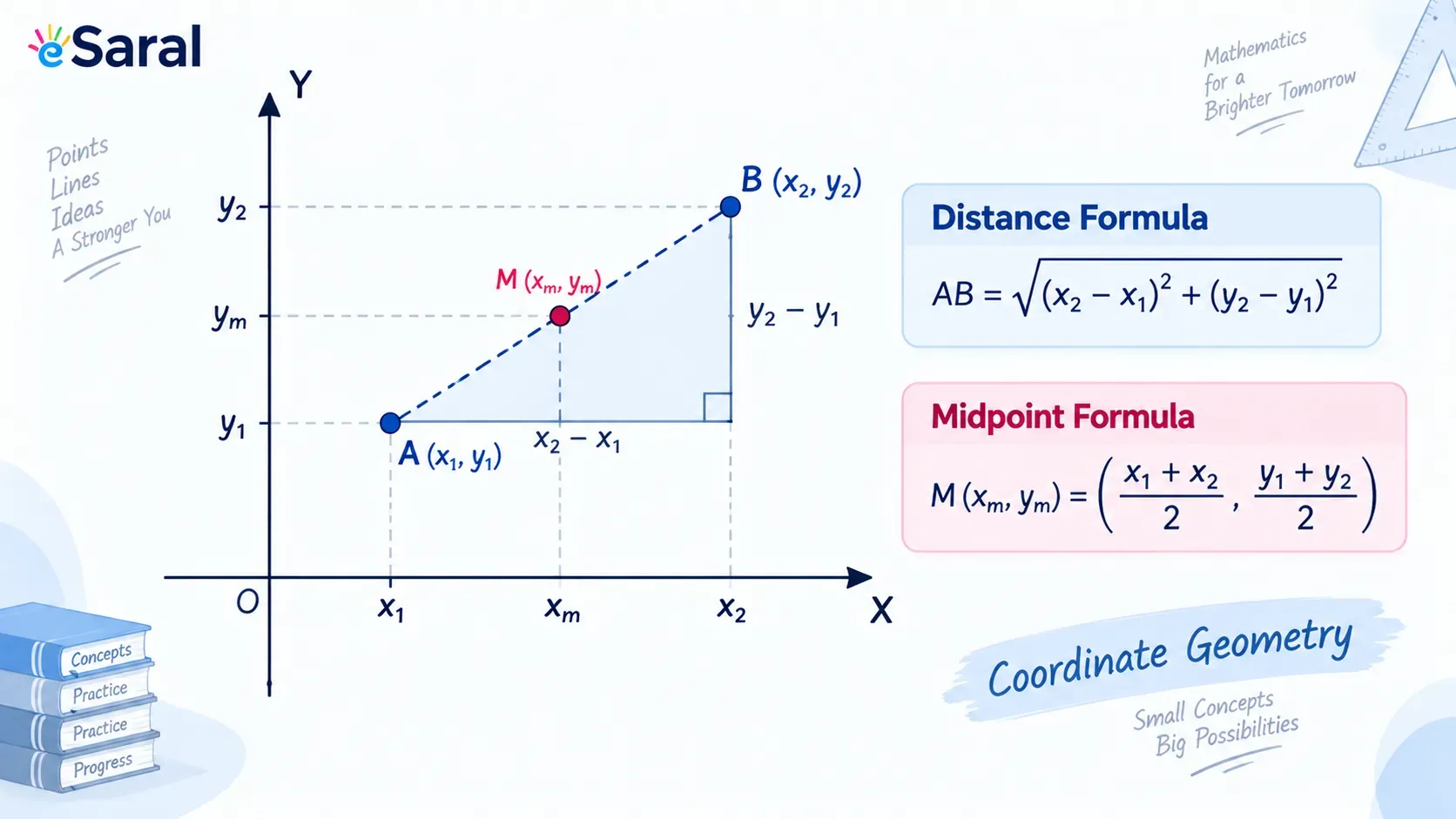
Coordinate Geometry Class 10: Formulas, Notes & Solved Examples
Coordinate geometry class 10: complete CBSE formulas — distance, section, midpoint and area of triangle — with derivation, notes and solved examples.
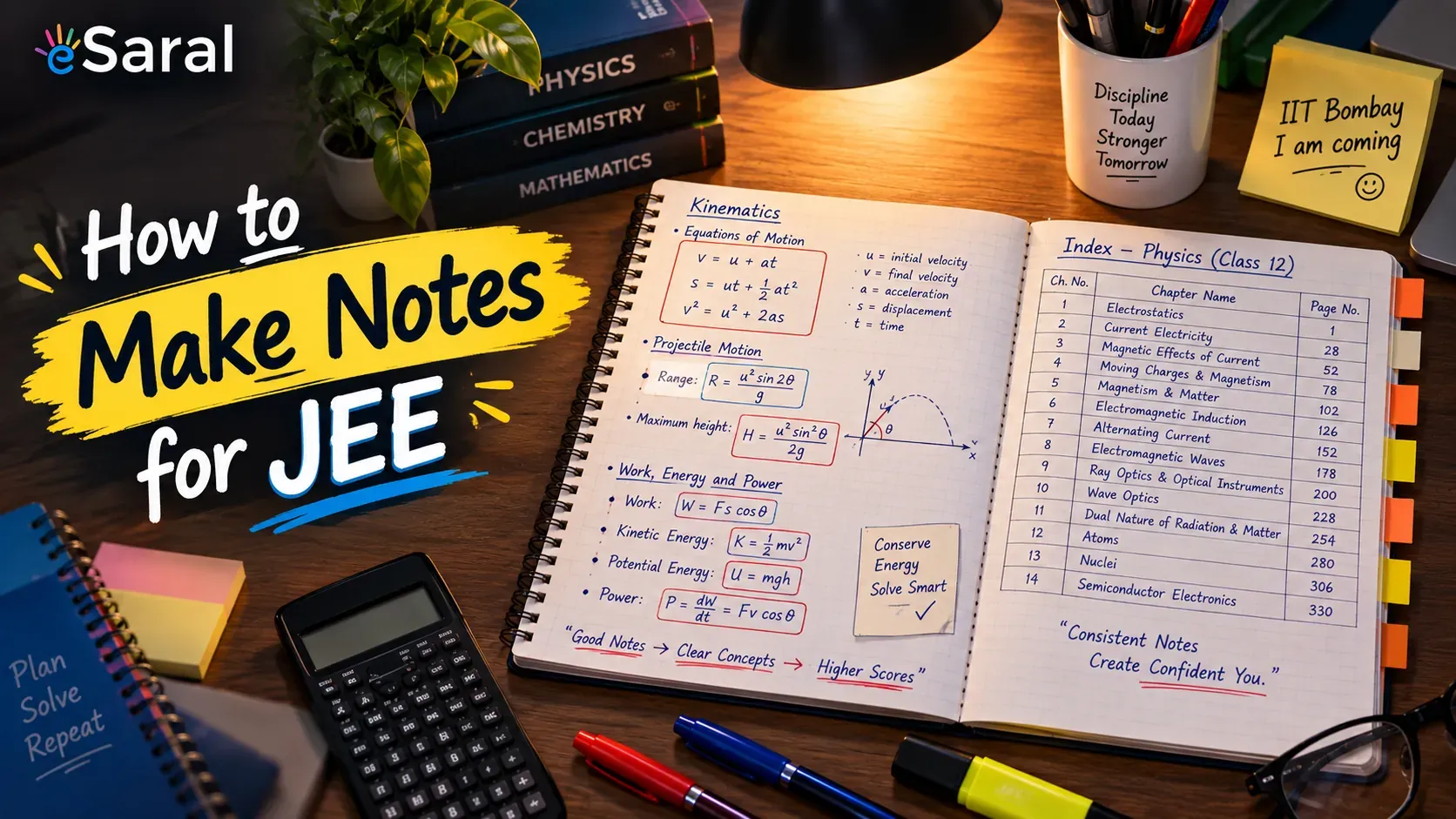
How to make Notes For JEE Smart Notes Strategy of an AIR 41
Learn how to make notes for JEE the way toppers do — indexing, shorthand, and smart short notes for JEE that cut revision time to just 5–7 days.
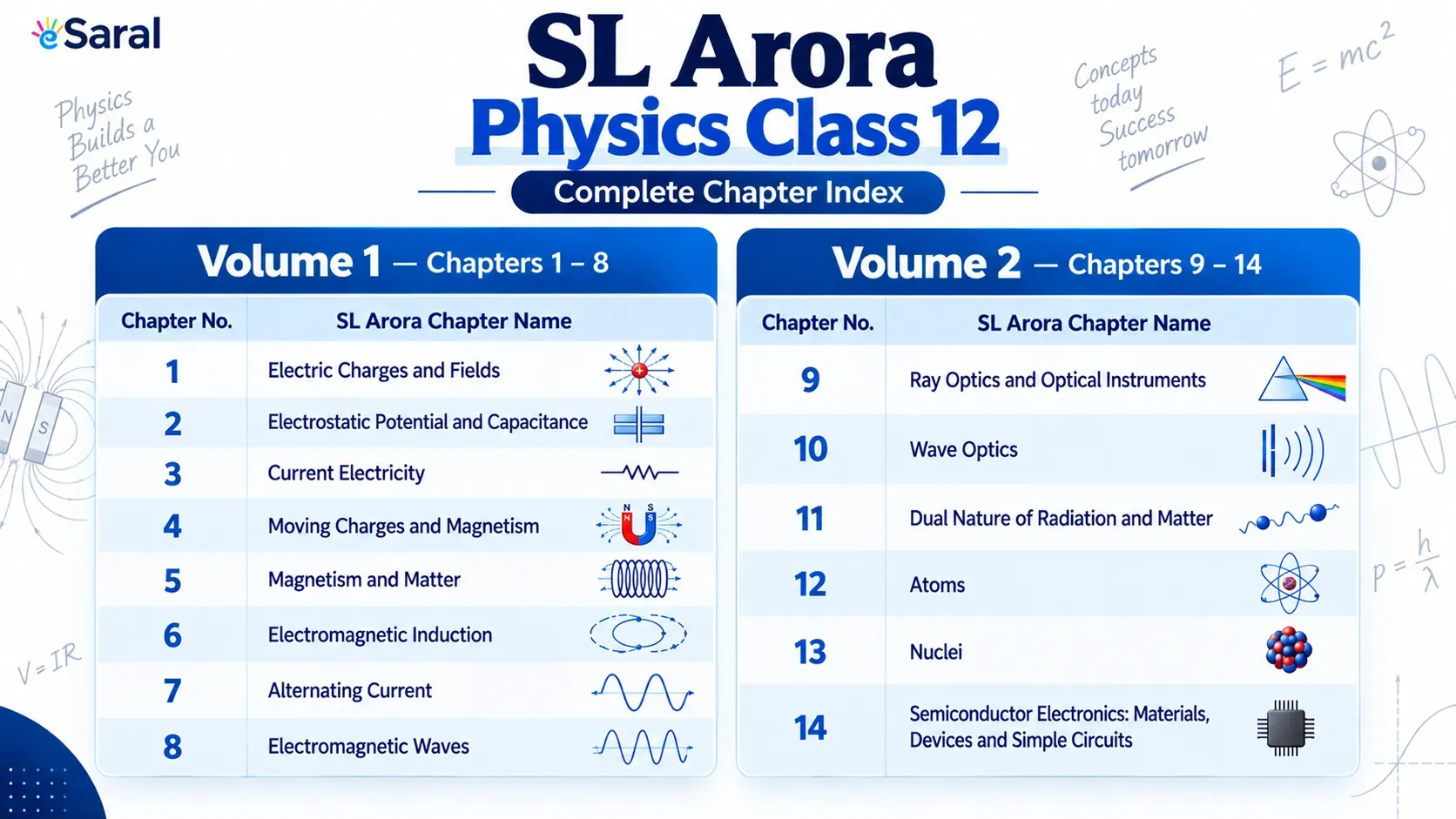
SL Arora Physics Class 12 Index – Chapter List for Volume 1 & 2
SL Arora Physics Class 12 index — complete chapter list for Volume 1 & 2, mapped to NCERT solutions for board, JEE Main, and NEET preparation.