
NCERT Solutions for Class 12 Maths Chapter 7 Exercise 7.8 Integrals - PDF Download

eSaral Academic and Editorial Team
NCERT solutions for class 12 maths chapter 7 exercise 7.8 Integrals describes the definite integral. The representation of definite integrals as a limit of a sum and their notation are covered in this section. This exercise also elaborates the fundamental theorem of Calculus including all the different aspects of integral calculus. By using antiderivatives, these theorems will allow you to assess definite integrals. Ex 7.8 class 12 maths solutions are developed by the subject experts of eSaral to provide in-depth knowledge of definite integrals and the fundamental theorem of calculus.
Students can solve questions of ex 7.8 class 12 maths chapter 7 by learning and understanding the concepts of definite integrals and fundamental theorems of calculus explained by eSaral’s expert teachers. Ex 7.8 class 12 maths ch 7 has a total of 22 questions that requires an understanding of definite integrals and essential theorems of integral calculus. In order to solve this exercise, you must comprehend the properties and theorems of integral calculus.
Class 12 maths chapter 7 exercise 7.8 NCERT solutions are provided here in PDF format to score high marks in exams. These solution PDFs can be downloaded for free at eSaral’s official website and can be practiced anytime for preparing exams.
Topics Covered in Exercise 7.8 Class 12 Mathematics Questions
Ex 7.8 class 12 maths chapter 7 describes an essential topic of definite integral and the fundamental theorems of calculus.
- Definite Integral
The definite integral has a unique value. A definite integral is denoted by $\int_a^b f(x) d x$ , where a is called the lower limit of the integral and b is called the upper limit of the integral. The definite integral is introduced either as the limit of a sum or if it has an antiderivative F in the interval [a, b], then its value is the difference between the values of F at the end points, i.e., F(b) – F(a).
- Fundamental Theorem of Calculus
- Area function
We have defined $\int_a^b f(x) d x$ as the area of the region bounded by the curve y = f (x), a ≤ x ≤ b, the x-axis and the ordinates x = a and x = b. Let x be a given point in [a, b]. Then $\int_a^x f(x) d x$ represents the Area function A (x).
The fundamental theorems of integral calculus are derived from this concept of area function.
- First fundamental theorem of integral calculus
Theorem 1: Let f be a continuous function on the closed interval [a, b] and let A(x) be the area function. Then A′(x) = f (x), for all x ∈ [a, b].
- Second fundamental theorem of integral calculus
Below, we provide a significant theorem that allows us to use antiderivatives to evaluate definite integrals.
Theorem 2: Let f be a continuous function defined on the closed interval [a, b] and F be an antiderivative of f. Then $\int_a^b f(x) d x=[\mathbf{F}(x)]_a^b=\mathbf{F}(b)-\mathbf{F}(a)$
Important Points
(i) In words, Theorem 2 tells us that $\int_a^b f(x) d x$ = (value of the anti derivative F of f at the upper limit b – value of the same anti derivative at the lower limit a).
(ii) This theorem is very useful, because it gives us a method of calculating the definite integral more easily, without calculating the limit of a sum.
(iii) The crucial operation in evaluating a definite integral is that of finding a function whose derivative is equal to the integrand. This strengthens the relationship between differentiation and integration.
(iv) In $\int_a^b f(x) d x$ , the function f needs to be well defined and continuous in [a, b].
Tips for Solving Exercise 7.8 Class 12 Chapter 7 Integrals
Class 12 maths chapter 7 exercise 7.8 NCERT solutions offers a variety of questions based on calculating the antiderivative of definite integrals and basic calculus theorems. Our subject experts of eSaral have provided some useful tips for solving ex 7.8 class 12 maths chapter 7.
- Before solving ex 7.8 class 12 maths chapter 7, you must comprehend the definite integrals as the limit of sums.
- There are two important theorems based on integral calculus which you must study for better understanding of concepts.
- To avoid making mistakes in calculations, students should strive to adopt a comprehensive learning strategy.
Importance of Solving Ex 7.8 Class 12 Maths Chapter 7 Integrals
You will get numerous benefits, by solving questions in ex 7.8 class 12 maths NCERT solutions. eSaral’s experts of mathematics have combined some of the benefits here that can be checked below.
- This exercise has questions based on significant topics such as definite integral and fundamental theorems of calculus which are explained in simple language by subject experts of eSaral.
- All the questions in ex 7.8 class 12 maths chapter 7 are solved in stepwise manner to help you understand the concepts used in each question.
- Practicing and revising the questions will help you to remember the theorems and methods that will help you to solve questions asked in exams.
- Answers provided in NCERT solutions for the questions of ex 7.8 class 12 maths are accurate as they are solved by experienced teachers of eSaral which can be trusted without any doubt.
Frequently Asked Questions
Question 1. What is a definite integral?
Answer 1. The definite integral is introduced either as the limit of a sum or if it has an antiderivative F in the interval [a, b], then its value is the difference between the values of F at the end points. The definite integral has a unique value. A definite integral is denoted by $\int_a^b f(x) d x$ , where a is called the lower limit of the integral and b is called the upper limit of the integral.
Question 2. Can a definite integral be zero?
Answer 2. Yes, the value of a definite integral can be positive, negative and zero.
|
1. |
Definite Integral |
|
|
2. |
Fundamental Theorem of Calculus |
|
Team eSaral
eSaral Academic and Editorial Team
Team eSaral is the collective author profile for educational content created by eSaral’s teachers and academic contributors. The team draws on expertise from IIT graduates, doctors, experienced educators and subject specialists to develop resources for JEE, NEET and school students. Our articles aim to explain concepts clearly and help students study with confidence.
Related Posts

Plant Cell Diagram: Labelled Structure, Parts and Functions
Simple, labelled plant cell diagram with parts and functions. Covers plant cell structure for Class 6, 7, 8, 9, 10 and 11 students, CBSE-aligned.

Saransh Gupta Sir's Visit to IIT Patna: Hostel Life, Placements & Lessons for JEE Aspirants
Inside Saransh Gupta Sir's IIT Patna visit — hostel life, the library, placements, internships, and real advice for JEE aspirants from students living the IIT dream.
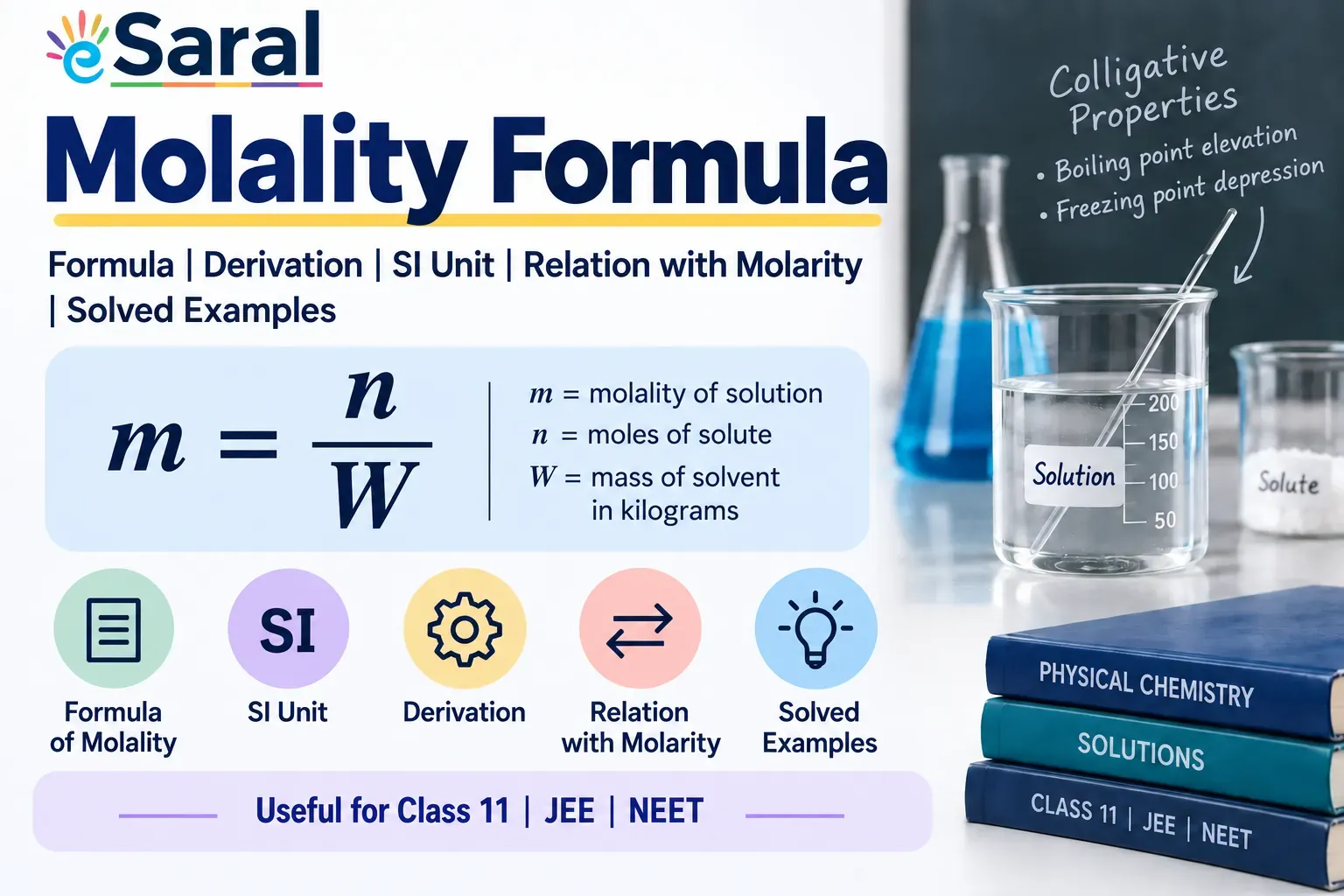
Molality Formula: Formula for Molality, Derivation & Solved Examples
Molality formula is $m = \dfrac{n}{W}$. Learn the formula of molality, its SI unit, derivation, relation with molarity, and solved examples for Class 11, JEE and NEET.

BITSAT Previous Year Question Paper PDF
Download BITSAT previous year question papers PDF. Get year-wise BITSAT PYQs, memory-based papers, exam pattern, and preparation tips to improve your BITSAT preparation.

Teachers’ Day 2026 at eSaral Gurukul: Celebrating the Bond Between Students, Teachers & Mentors
See how Teachers’ Day 2026 was celebrated at eSaral Gurukul, reflecting the bond among students, teachers, and mentors, and the role of guidance beyond academics.

JEE Advanced Attempts: Can You Give It a Third Time? Rules Explained
JEE Advanced attempts: current rule is 2 consecutive years only: full eligibility criteria, the 2025 third-attempt controversy, and the latest 2026 petition news.

Best JEE Preparation App
Best JEE preparation app for Main & Advanced: AI mock tests, live doubt-solving, thousands of practice questions. JEE preparation app for droppers & Class 11-12.
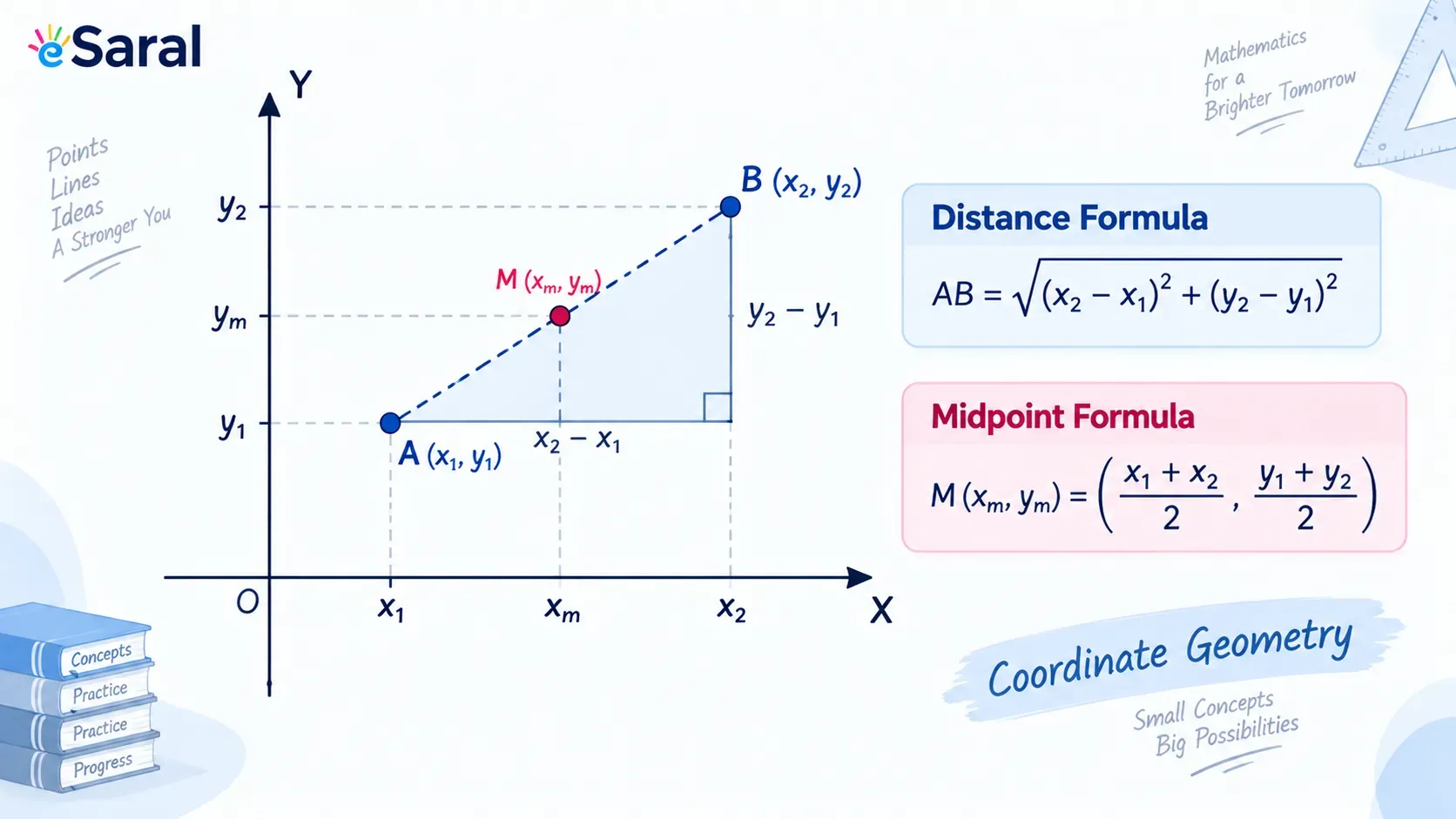
Coordinate Geometry Class 10: Formulas, Notes & Solved Examples
Coordinate geometry class 10: complete CBSE formulas — distance, section, midpoint and area of triangle — with derivation, notes and solved examples.

How to make Notes For JEE Smart Notes Strategy of an AIR 41
Learn how to make notes for JEE the way toppers do — indexing, shorthand, and smart short notes for JEE that cut revision time to just 5–7 days.
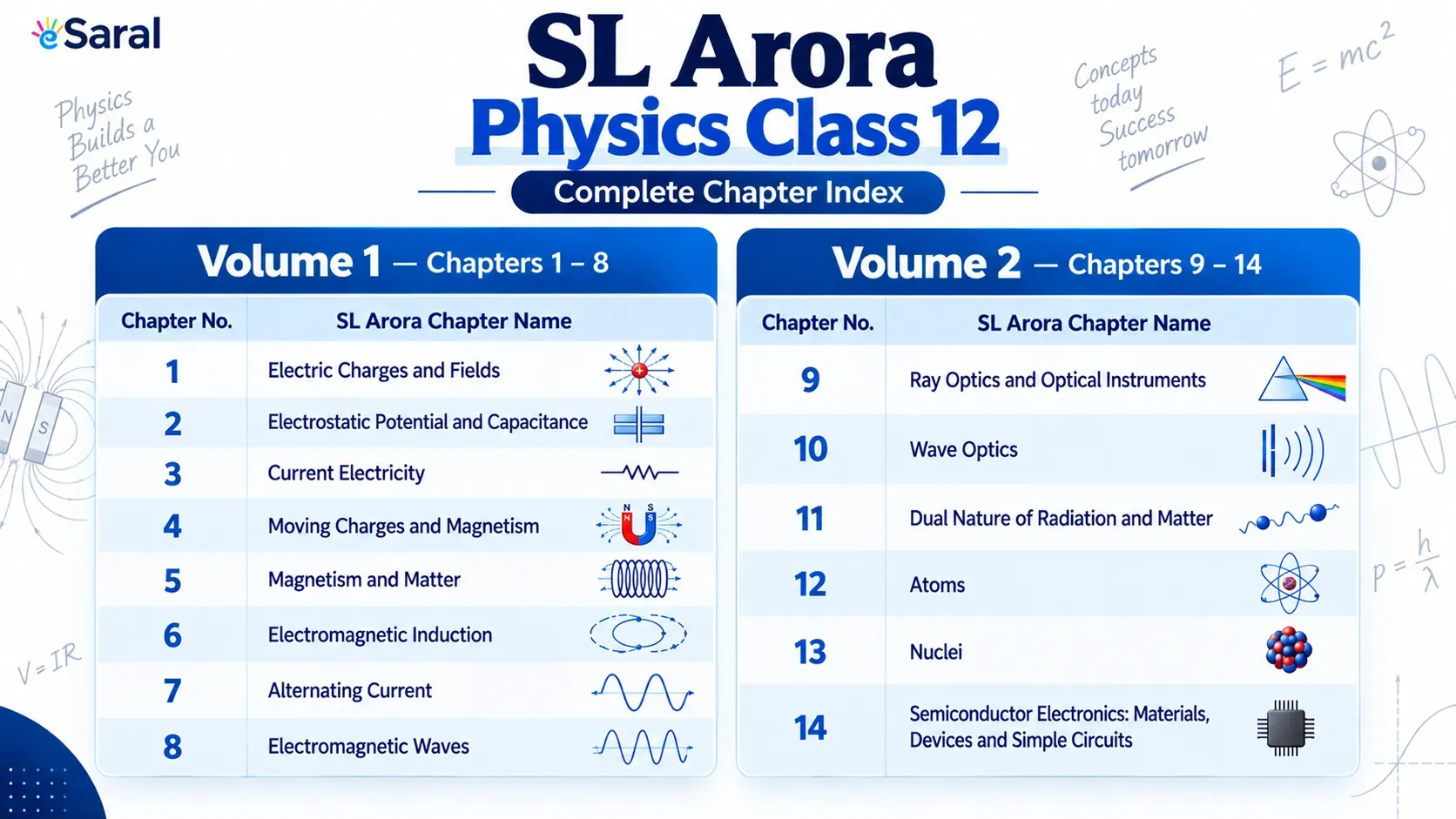
SL Arora Physics Class 12 Index – Chapter List for Volume 1 & 2
SL Arora Physics Class 12 index — complete chapter list for Volume 1 & 2, mapped to NCERT solutions for board, JEE Main, and NEET preparation.