
NEET 2025 Chemistry Weightage By NTA - PDF Download

eSaral Academic and Editorial Team
Summary
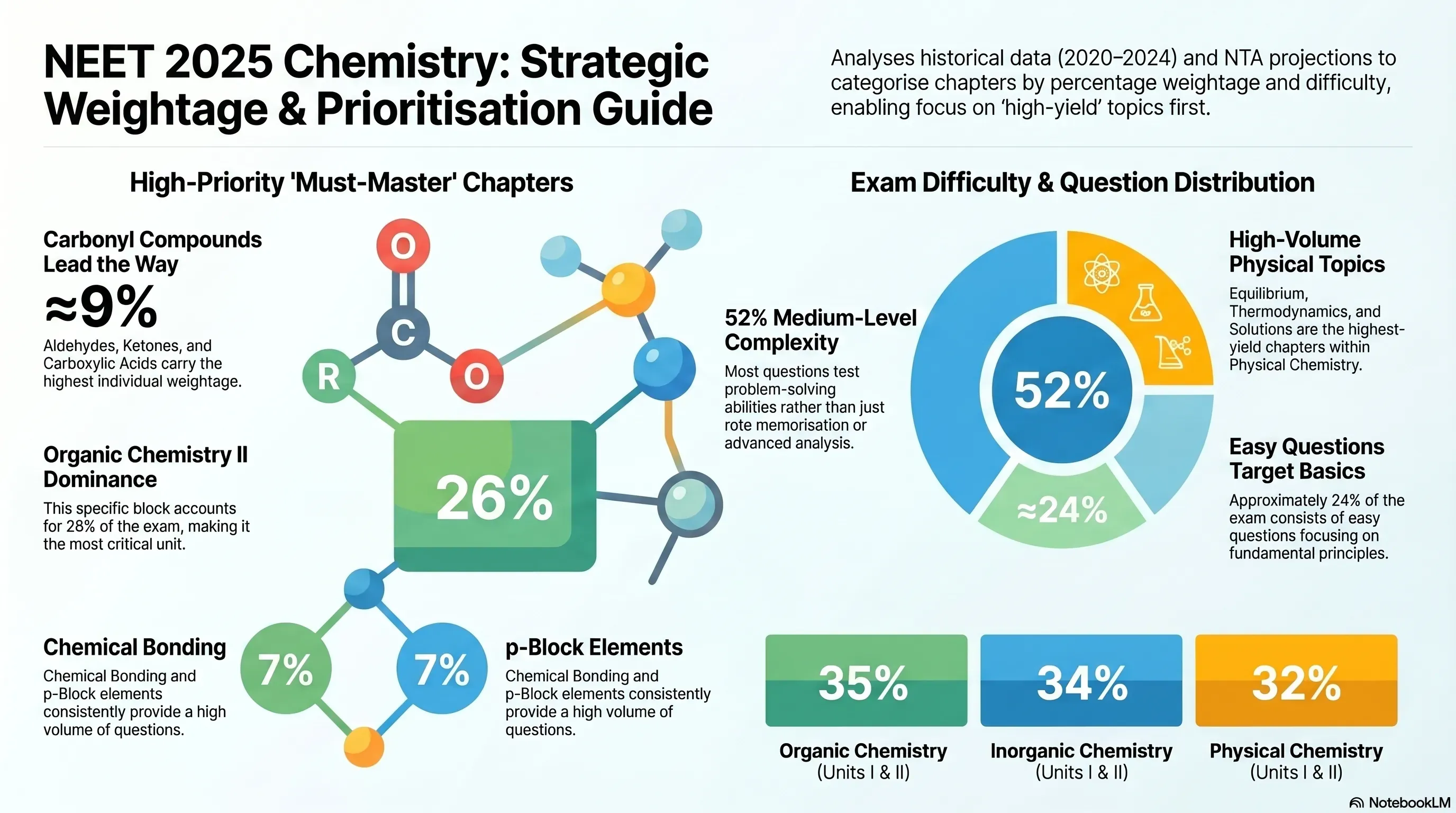
Explore NEET Chemistry chapter-wise weightage to prioritize high-scoring topics such as Aldehydes, Ketones & Carboxylic Acids, Chemical Bonding, Hydrocarbons, Thermodynamics, Coordination Compounds, and Electrochemistry for efficient exam preparation.
esaral>NEET> NEET 2025 Chemistry Weightage By NTA - PDF Download

NEET Chemistry Chapter wise Weightage 2025
The Chemistry NEET Chapter wise Weightage 2025 is an important resource for NEET candidates . Chemistry plays a pivotal role in the NEET exam so you must effectively divide your study time among these chapters, even though all of the chapters in the Chemistry section are crucial. You can use this information to determine which chapters will carry the most weight in the NEET 2025 Chemistry exam and you can prioritize your chapters accordingly
NEET Chapter Wise Weightage 2025 for Chemistry | |
Chapters/Topics | Weightage (%) |
Organic Chemistry: Some Basic Principles and Techniques | 5% |
Alcohols, Phenols and Ethers | 4% |
Redox Reactions | 3% |
Structure of Atom | 4% |
Thermodynamics | 5% |
Electrochemistry | 5% |
Hydrocarbons | 7% |
The p-Block Elements (XII) | 6% |
The p-Block Elements | 6% |
Chemical Bonding and Molecular Structure | 7% |
Classification of Elements and Periodicity in Properties | 2% |
Equilibrium | 6% |
Chemical Kinetics | 5% |
Biomolecules | 4% |
Haloalkanes and Haloarenes | 4% |
Solutions | 4% |
Some Basic Concepts of Chemistry | 4% |
Coordination Compounds | 5% |
Aldehydes, Ketones and Carboxylic Acids | 9% |
Amines | 5% |
The d and f-Block Elements | 6% |
NEET Chemistry Chapter Wise Weightage
|
Weightage |
Chemistry Chapters |
|
High (8-10 questions) |
|
|
Medium (5-7 questions) |
|
|
Low (1-3 questions) |
|
Chapters and Topics | Average Question Breakup from the Chapter and Topic | Weightage of the Chapter and Topic (In percentage) |
Inorganic Chemistry-I | ||
Chemical Bonding | 4 | 9% |
p-block | 3 | 7% |
Periodic Table & Periodicity in Properties | 2 | 4% |
s-block | 1 | 3% |
Hydrogen | 1 | 2% |
Inorganic Chemistry-II | ||
Coordination Compounds | 3 | 6% |
d-block & f-block Elements | 2 | 4% |
Metallurgy | 1 | 2% |
Qualitative Analysis | 1 | 2% |
Organic Chemistry-I | ||
General Organic Chemistry | 2 | 5% |
Hydrocarbons | 2 | 4% |
Organic Chemistry-II | ||
Aromatic Compounds | 3 | 6% |
Alkyl Halide, Alcohol, and Ether | 2 | 4% |
Biomolecules | 2 | 4% |
Carbonyl Compounds | 2 | 4% |
IUPAC & Isomerism | 2 | 4% |
Organic Compounds Containing Nitrogen | 2 | 3% |
Aldehydes, Ketones, and Carboxylic Acids | 2 | 3% |
Chemistry in Everyday Life | 2 | 3% |
Polymer | 1 | 2% |
Haloalkane | 1 | 2% |
Environmental Chemistry | 1 | 2% |
Practical Organic Chemistry | 1 | 2% |
Physical Chemistry-I | 17% | |
Atomic Structure & Nuclear Chemistry | 1 | 3% |
Chemical Equilibrium | 1 | 3% |
Ionic Equilibrium | 2 | 4% |
Redox Reactions | 1 | 2% |
Gaseous State | 1 | 3% |
Mole Concept | 2 | 5% |
Thermodynamics and Thermochemistry | 1 | 3% |
Physical Chemistry-II | ||
Chemical Kinetics | 2 | 4% |
Solution & Colligative Properties | 2 | 4% |
Electrochemistry | 1 | 3% |
Solid State | 1 | 3% |
Surface Chemistry | 1 | 2% |
Chapter-Wise Weightage Analysis of NEET Chemistry (2020-2024)
NEET Chemistry questions are divided in easy, medium, and hard. Easy questions emphasize basic principles, medium-level questions test problem-solving abilities and hard questions focus on analytical and advanced conceptual understanding.
Chapter | Easy | Medium | Hard | Total | Average Q/yr | Weightage |
Alcohols, Phenols and Ethers | 1 | 6 | 0 | 7 | 1.40 | 2.66% |
Aldehydes, Ketones and Carboxylic Acids | 1 | 9 | 9 | 19 | 3.80 | 7.22% |
Amines | 1 | 7 | 2 | 10 | 2.00 | 3.80% |
Biomolecules | 3 | 4 | 1 | 8 | 1.60 | 3.04% |
Chemical Bonding and Molecular Structure | 2 | 6 | 5 | 13 | 2.60 | 4.94% |
Chemical Kinetics | 4 | 2 | 5 | 11 | 2.20 | 4.18% |
Classification of Elements and Periodicity in Properties | 3 | 1 | 1 | 5 | 1.00 | 1.90% |
Coordination Compounds | 2 | 5 | 4 | 11 | 2.20 | 4.18% |
Electrochemistry | 2 | 3 | 5 | 10 | 2.00 | 3.80% |
Environmental Chemistry | 2 | 1 | 0 | 3 | 0.60 | 1.14% |
Equilibrium | 3 | 6 | 2 | 11 | 2.20 | 4.18% |
General Principles and Processes of Isolation of Elements | 2 | 5 | 0 | 7 | 1.40 | 2.66% |
Haloalkanes and Haloarenes | 5 | 3 | 0 | 8 | 1.60 | 3.04% |
Hydrocarbons | 1 | 9 | 3 | 13 | 2.60 | 4.94% |
Hydrogen | 0 | 4 | 0 | 4 | 0.80 | 1.52% |
Organic Chemistry: Some Basic Principles and Techniques | 4 | 6 | 2 | 12 | 2.40 | 4.56% |
Polymers | 1 | 2 | 1 | 4 | 0.80 | 1.52% |
Redox Reactions | 1 | 3 | 1 | 5 | 1.00 | 1.90% |
Solutions | 1 | 3 | 3 | 7 | 1.40 | 2.66% |
Some Basic Concepts of Chemistry | 1 | 4 | 5 | 10 | 2.00 | 3.80% |
States of Matter | 2 | 4 | 1 | 7 | 1.40 | 2.66% |
Structure of Atom | 2 | 3 | 3 | 8 | 1.60 | 3.04% |
Surface Chemistry | 1 | 3 | 1 | 5 | 1.00 | 1.90% |
The d and f-Block Elements | 2 | 12 | 2 | 16 | 3.20 | 6.08% |
The p-Block Elements | 2 | 7 | 0 | 9 | 1.80 | 3.42% |
The p-Block Elements (XII) | 4 | 4 | 1 | 9 | 1.80 | 3.42% |
The s-Block Elements | 4 | 4 | 2 | 10 | 2.00 | 3.80% |
The Solid State | 2 | 2 | 3 | 7 | 1.40 | 2.66% |
Thermodynamics | 2 | 6 | 2 | 10 | 2.00 | 3.80% |
Chemistry in Everyday Life | 1 | 1 | 1 | 3 | 0.60 | 1.14% |
Principles of Qualitative Analysis | 0 | 1 | 0 | 1 | 0.20 | 0.38% |
Total | 62 | 136 | 65 | 263 | 52.60 | 100.00% |
Benefits of Chemistry Syllabus
The syllabus for the subjects such as physics, chemistry, etc., helps candidates to ensure the course description, learning outcomes, prerequisites, grading criteria, and more. A properly organized syllabus benefits students in so many ways.
- The syllabus requires students to think about the subject and organize their NEET preparation strategy right at the beginning. You can develop a proper understanding and can prepare a clear study plan for the entire NEET exam for 2025.
- The syllabus for chemistry helps you to understand how the subject fits into your educational plans.
- When the NEET aspirants know what they have to learn in the chemistry syllabus, they can plan accordingly for exams. Thus, the syllabus helps to communicate or convey the expectations of students for different projects.
- A syllabus for chemistry for NEET aspirant is a useful means to eliminate misconceptions and clarify their idea of the weightage. Thus, it reduces confusion and the mistakes while preparing for the chemistry NEET exam.
Frequently Asked Questions
Which chapter has the highest weightage in NEET Chemistry 2025?
Aldehydes, Ketones and Carboxylic Acids carries the highest weightage at approximately 7.22% based on 2020–2024 NEET paper analysis, with an average of 3.8 questions per year. It also has the highest number of hard-difficulty questions, making it both high-yield and high-effort. Mastering reaction mechanisms and named reactions from this chapter is non-negotiable for a 600+ NEET score.
How many questions come from Organic Chemistry in NEET?
Organic Chemistry typically contributes 17–18 questions out of 50 in the Chemistry section — roughly 35% of the Chemistry paper. Key chapters include Aldehydes/Ketones/Carboxylic Acids, Hydrocarbons, Amines, Haloalkanes, Alcohols/Phenols/Ethers, and Organic Chemistry Basics. Together these chapters can earn you 60–70 marks if prepared thoroughly.
What is the total marks for Chemistry in NEET 2025?
Chemistry carries 180 marks out of the total 720 marks in NEET 2025. The paper contains 50 Chemistry questions (45 to be attempted), each worth 4 marks. Negative marking of −1 applies per wrong answer. A score of 150+ in Chemistry is typically needed for a top-5000 All India Rank.
Should I follow NCERT or reference books for NEET Chemistry?
NCERT textbooks are the primary source for NEET Chemistry — NTA frames questions directly from NCERT content, especially for Inorganic and Organic chapters. Reference books are useful for Physical Chemistry numericals and for extra practice. Complete NCERT thoroughly first, then use NCERT Solutions for Class 12 Chemistry to verify your understanding before moving to supplementary resources.
How many chapters are in the NEET Chemistry syllabus 2025?
The NEET 2025 Chemistry syllabus, as defined by NTA, covers 31 chapters drawn from Class 11 and Class 12 NCERT textbooks. These span Physical Chemistry (11 chapters), Organic Chemistry (12 chapters), and Inorganic Chemistry (8 chapters). The complete chapter list is published on the official NTA website at nta.ac.in.
Team eSaral
eSaral Academic and Editorial Team
Team eSaral is the collective author profile for educational content created by eSaral’s teachers and academic contributors. The team draws on expertise from IIT graduates, doctors, experienced educators and subject specialists to develop resources for JEE, NEET and school students. Our articles aim to explain concepts clearly and help students study with confidence.
Related Posts
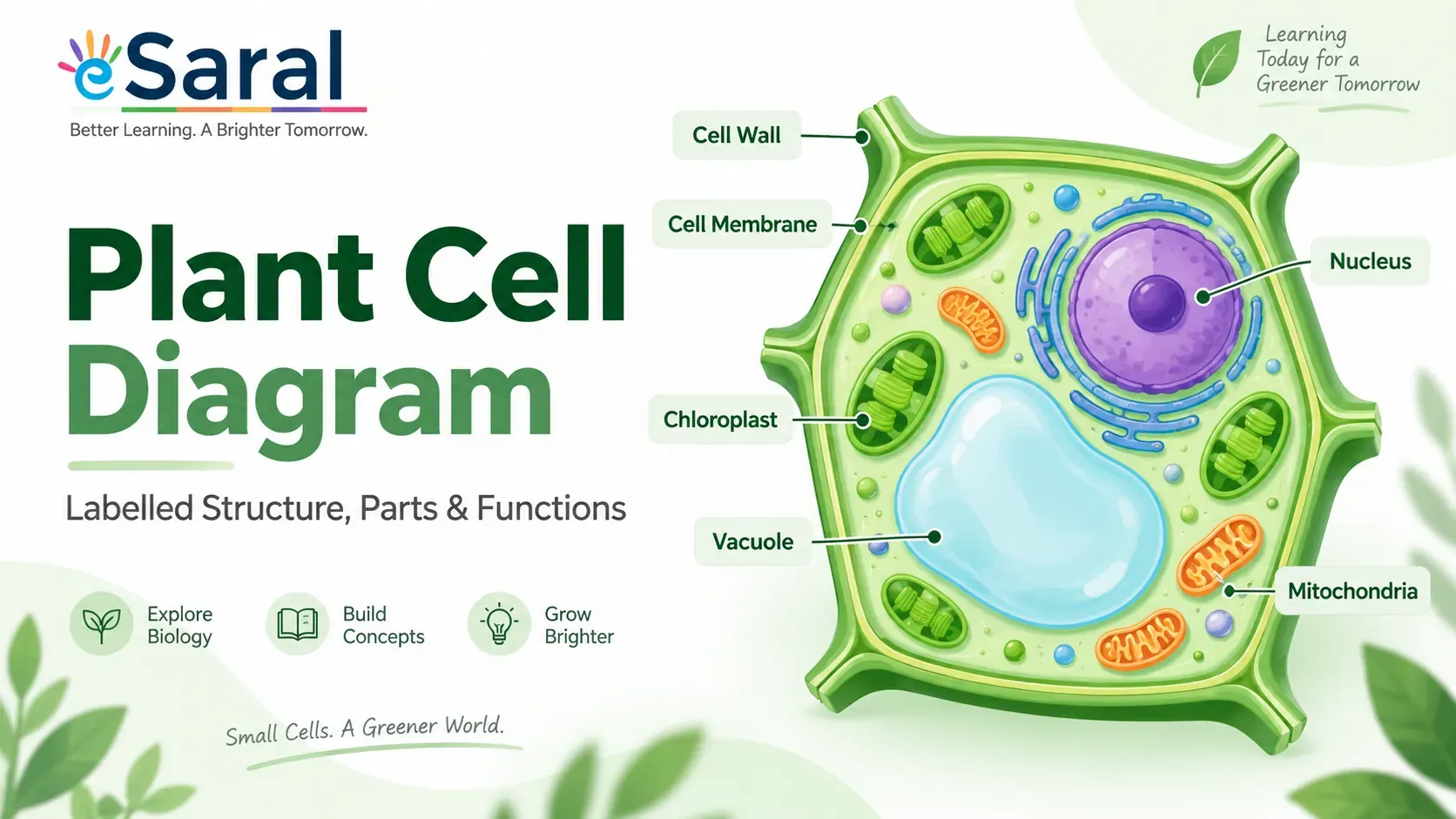
Plant Cell Diagram: Labelled Structure, Parts and Functions
Simple, labelled plant cell diagram with parts and functions. Covers plant cell structure for Class 6, 7, 8, 9, 10 and 11 students, CBSE-aligned.
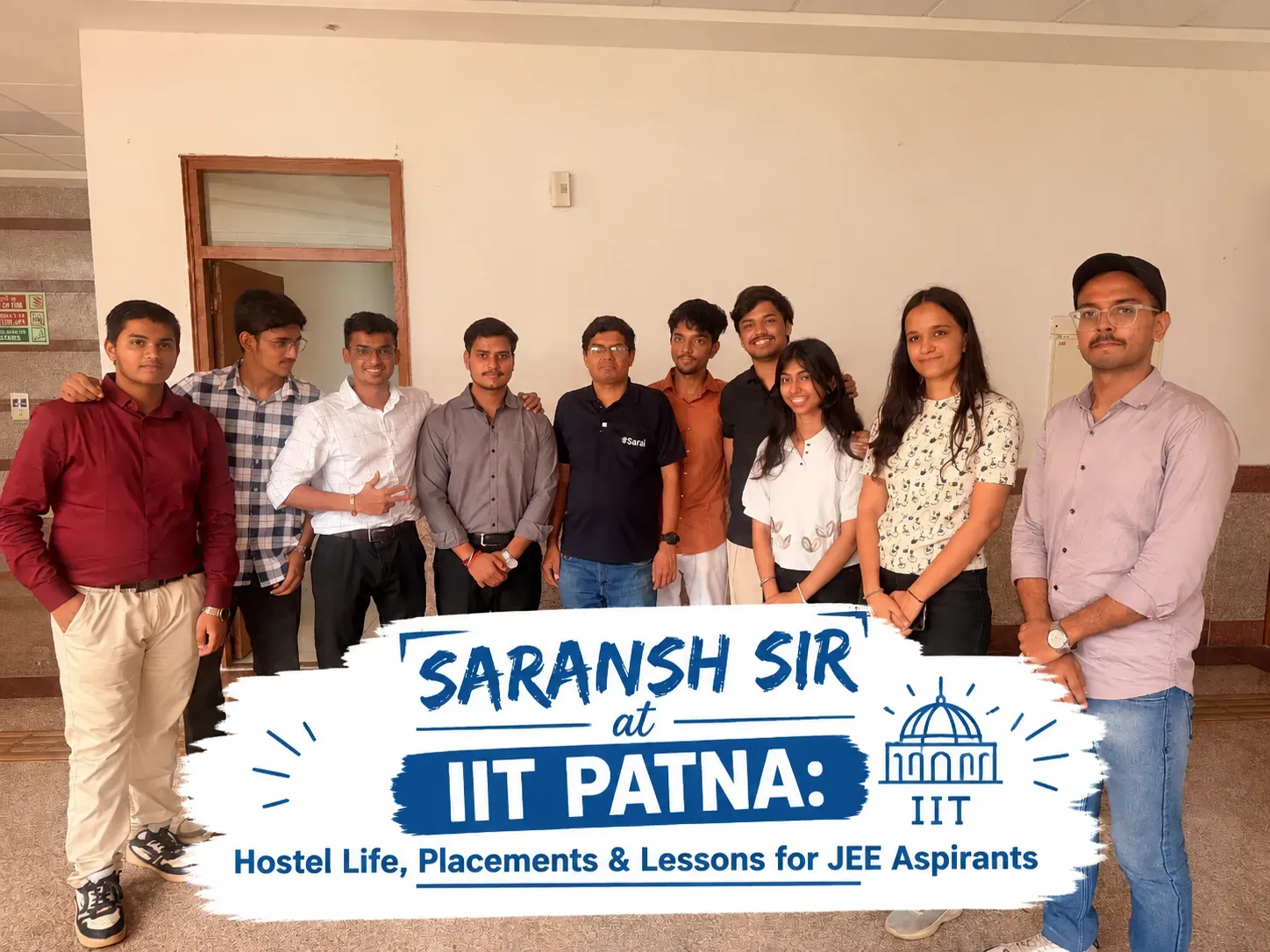
Saransh Gupta Sir's Visit to IIT Patna: Hostel Life, Placements & Lessons for JEE Aspirants
Inside Saransh Gupta Sir's IIT Patna visit — hostel life, the library, placements, internships, and real advice for JEE aspirants from students living the IIT dream.
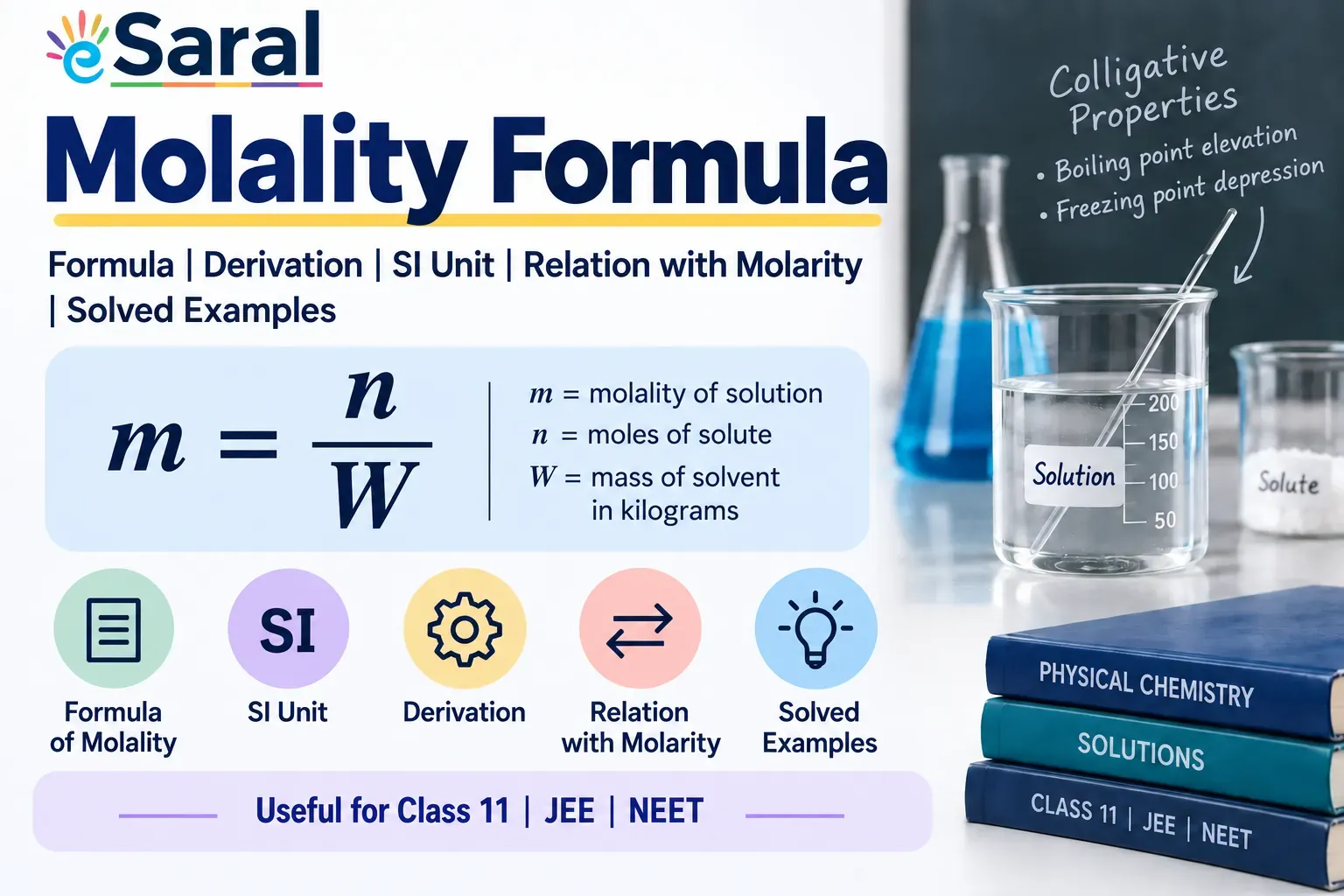
Molality Formula: Formula for Molality, Derivation & Solved Examples
Molality formula is $m = \dfrac{n}{W}$. Learn the formula of molality, its SI unit, derivation, relation with molarity, and solved examples for Class 11, JEE and NEET.
BITSAT Previous Year Question Paper PDF
Download BITSAT previous year question papers PDF. Get year-wise BITSAT PYQs, memory-based papers, exam pattern, and preparation tips to improve your BITSAT preparation.

Teachers’ Day 2026 at eSaral Gurukul: Celebrating the Bond Between Students, Teachers & Mentors
See how Teachers’ Day 2026 was celebrated at eSaral Gurukul, reflecting the bond among students, teachers, and mentors, and the role of guidance beyond academics.
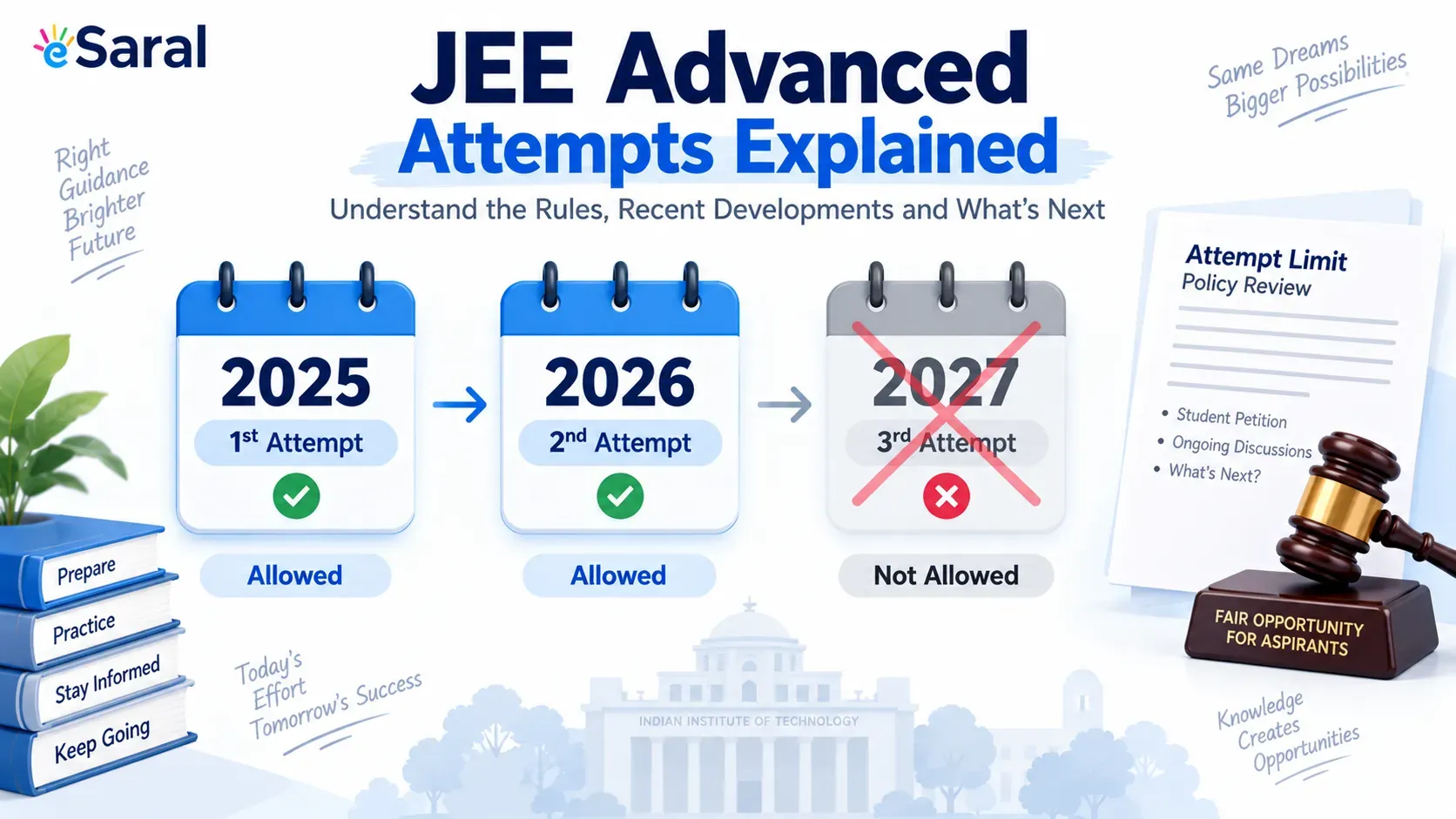
JEE Advanced Attempts: Can You Give It a Third Time? Rules Explained
JEE Advanced attempts: current rule is 2 consecutive years only: full eligibility criteria, the 2025 third-attempt controversy, and the latest 2026 petition news.

Best JEE Preparation App
Best JEE preparation app for Main & Advanced: AI mock tests, live doubt-solving, thousands of practice questions. JEE preparation app for droppers & Class 11-12.
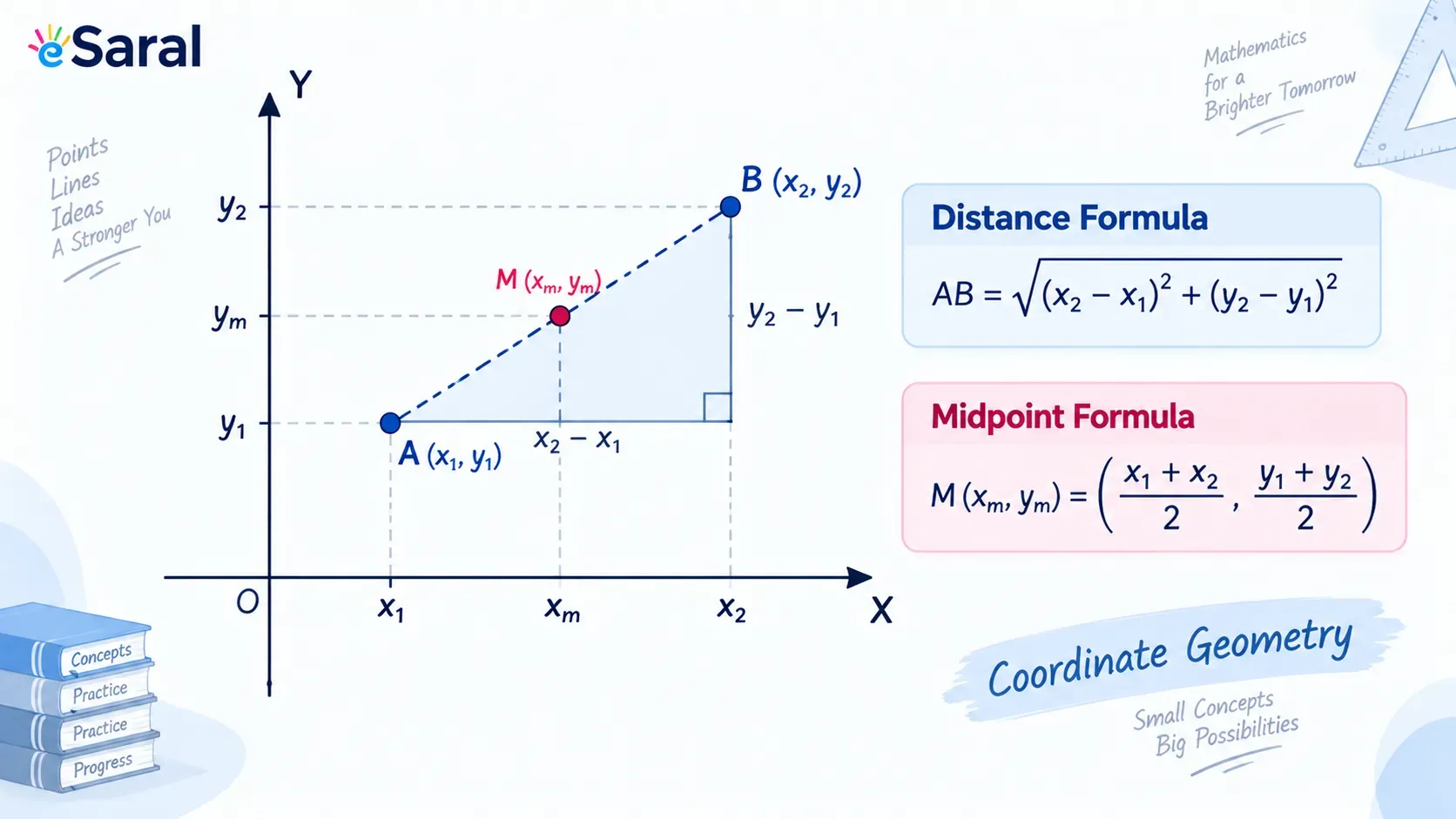
Coordinate Geometry Class 10: Formulas, Notes & Solved Examples
Coordinate geometry class 10: complete CBSE formulas — distance, section, midpoint and area of triangle — with derivation, notes and solved examples.
How to make Notes For JEE Smart Notes Strategy of an AIR 41
Learn how to make notes for JEE the way toppers do — indexing, shorthand, and smart short notes for JEE that cut revision time to just 5–7 days.
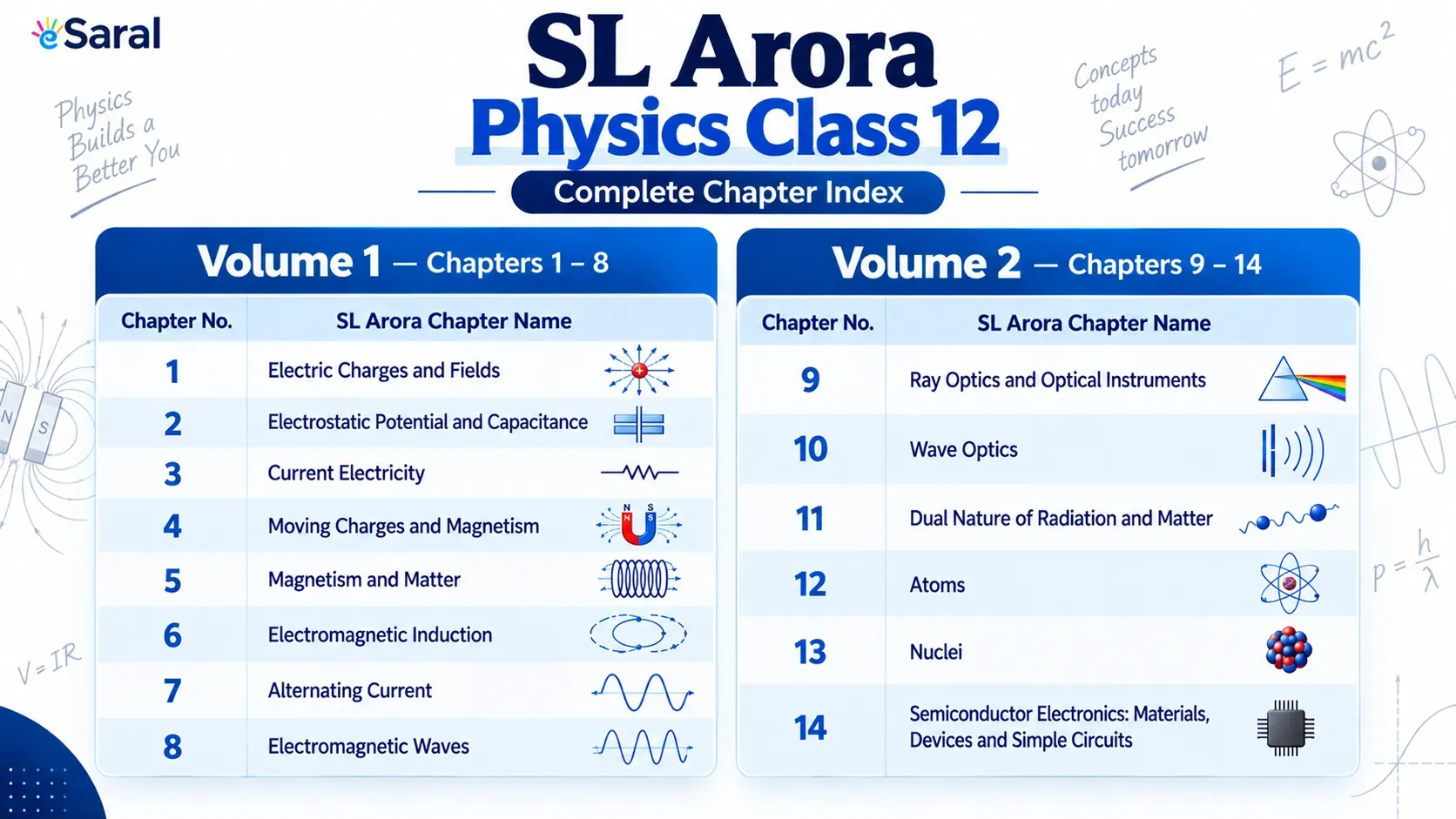
SL Arora Physics Class 12 Index – Chapter List for Volume 1 & 2
SL Arora Physics Class 12 index — complete chapter list for Volume 1 & 2, mapped to NCERT solutions for board, JEE Main, and NEET preparation.