
Periodic Table - NEET Previous Year Questions with Complete Solutions

eSaral Academic and Editorial Team
Summary
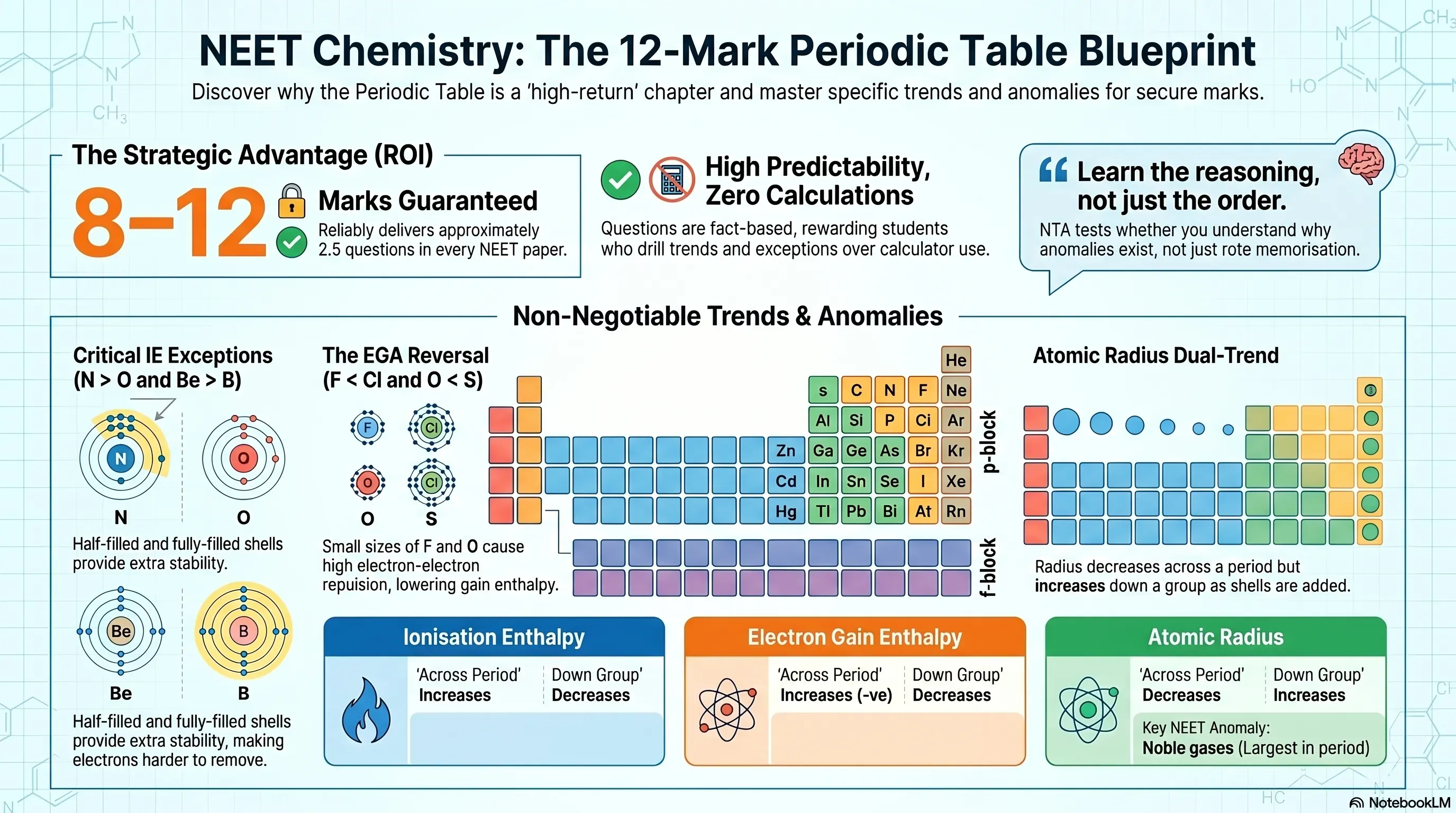
<p>The Periodic Table chapter is one of the most scoring and predictable NEET Chemistry topics, where mastering periodic trends, ionisation enthalpy anomalies, electron gain enthalpy, electronegativity, block classification, and diagonal relationships can consistently secure 8–12 marks every year with minimal calculation effort.</p>
eSaral › NEET ›Periodic Table - NEET Previous Year Questions with Complete Solutions

Why the Periodic Table Is a High-Return Chapter for NEET
The Periodic Table chapter (Class 11, Chapter 3) is one of the most predictable scoring chapters in NEET UG Chemistry. The reason is simple: the number of genuinely distinct concepts NTA can test is finite, the question types repeat across years, and the answers are fact-based — not calculation-heavy.
A student who masters this chapter correctly will almost never get these questions wrong. That makes it a guaranteed 8–12 marks in every NEET paper.
What makes this chapter especially attractive is its nature: it is memory and concept-based, not formula-heavy. Unlike Physical Chemistry calculations or complex Organic mechanisms, Periodic Table questions reward students who have spent time understanding trends and exceptions — not students who spent the most hours with a calculator.
💡 Expert Tip by eSaral Chemistry Faculty: "The Periodic Table chapter is where disciplined students separate themselves from average ones. Average students read it once and move on. Disciplined students drill the trends, exceptions, and anomalies until they become reflex. Every year, 2–3 marks are sitting here for the taking — do not leave them on the table."
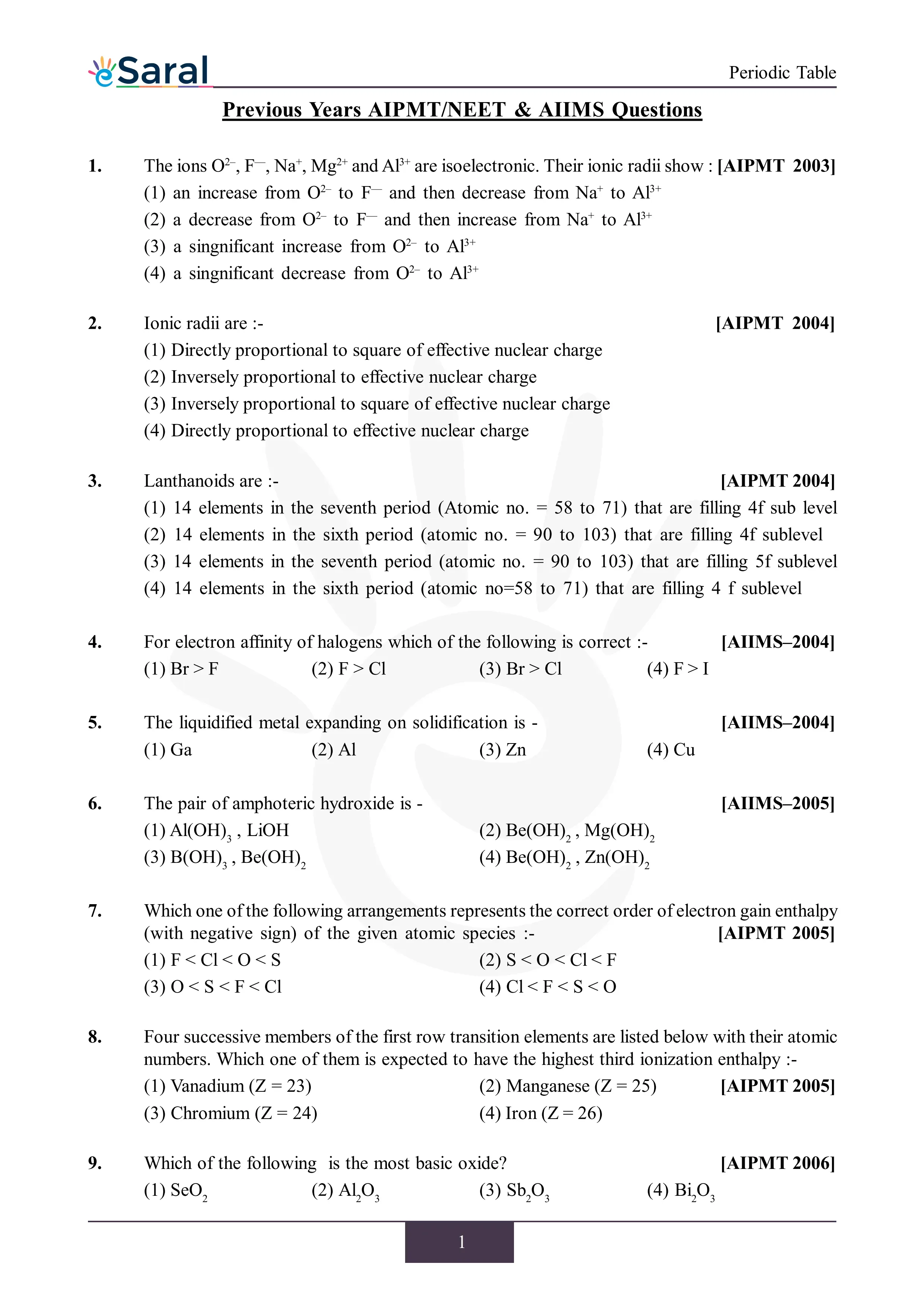
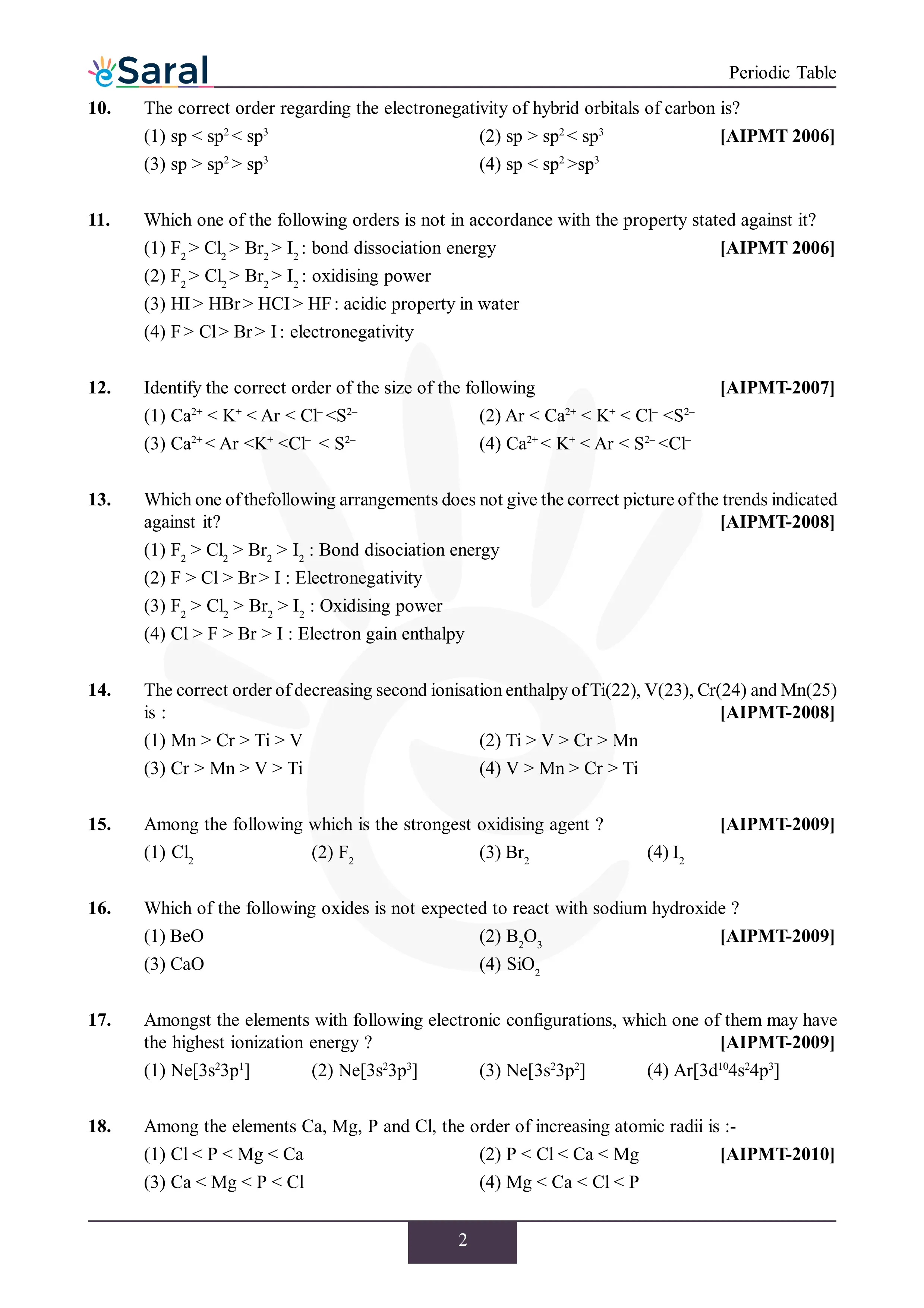
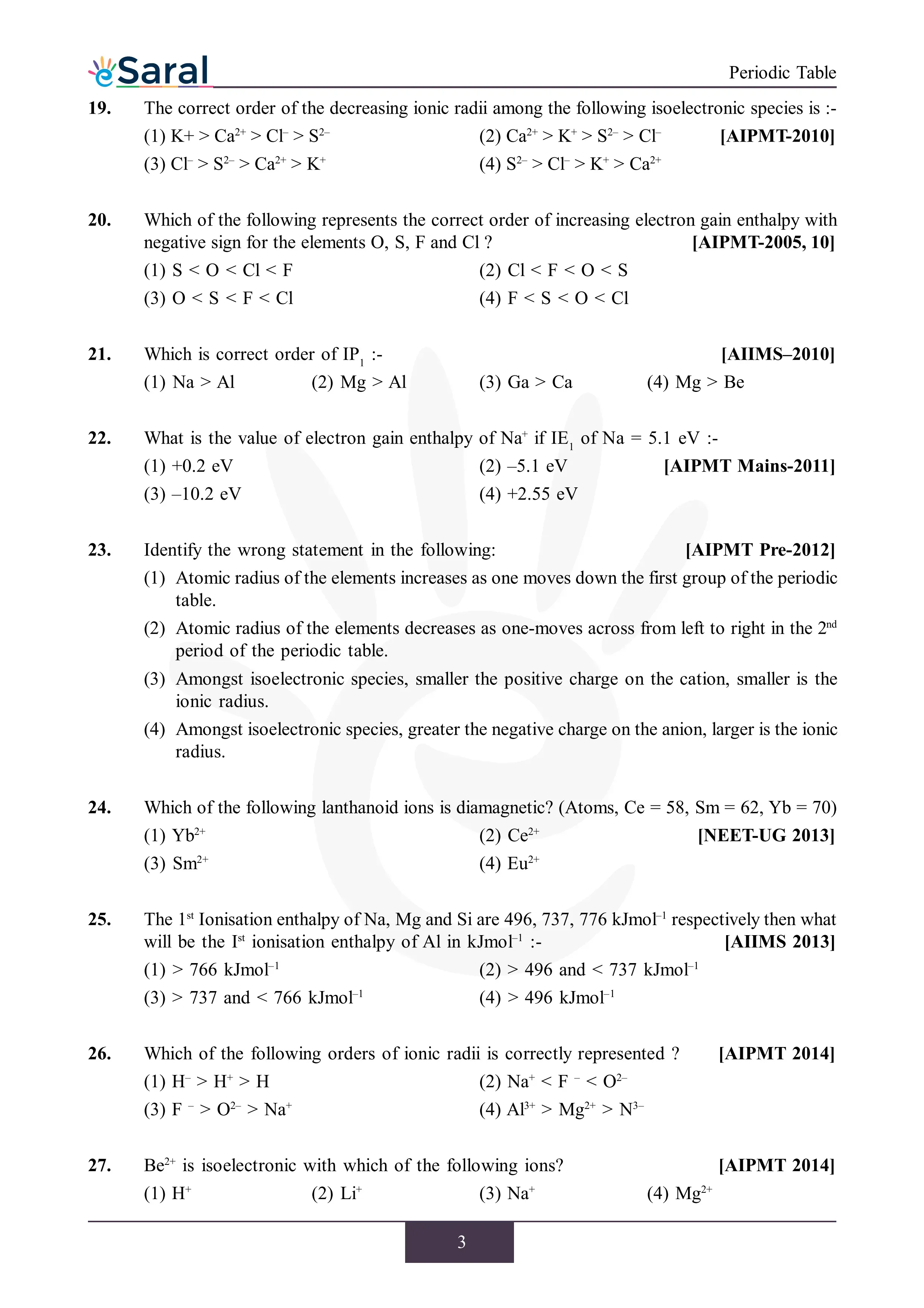
NEET Previous Year Questions — Periodic Table
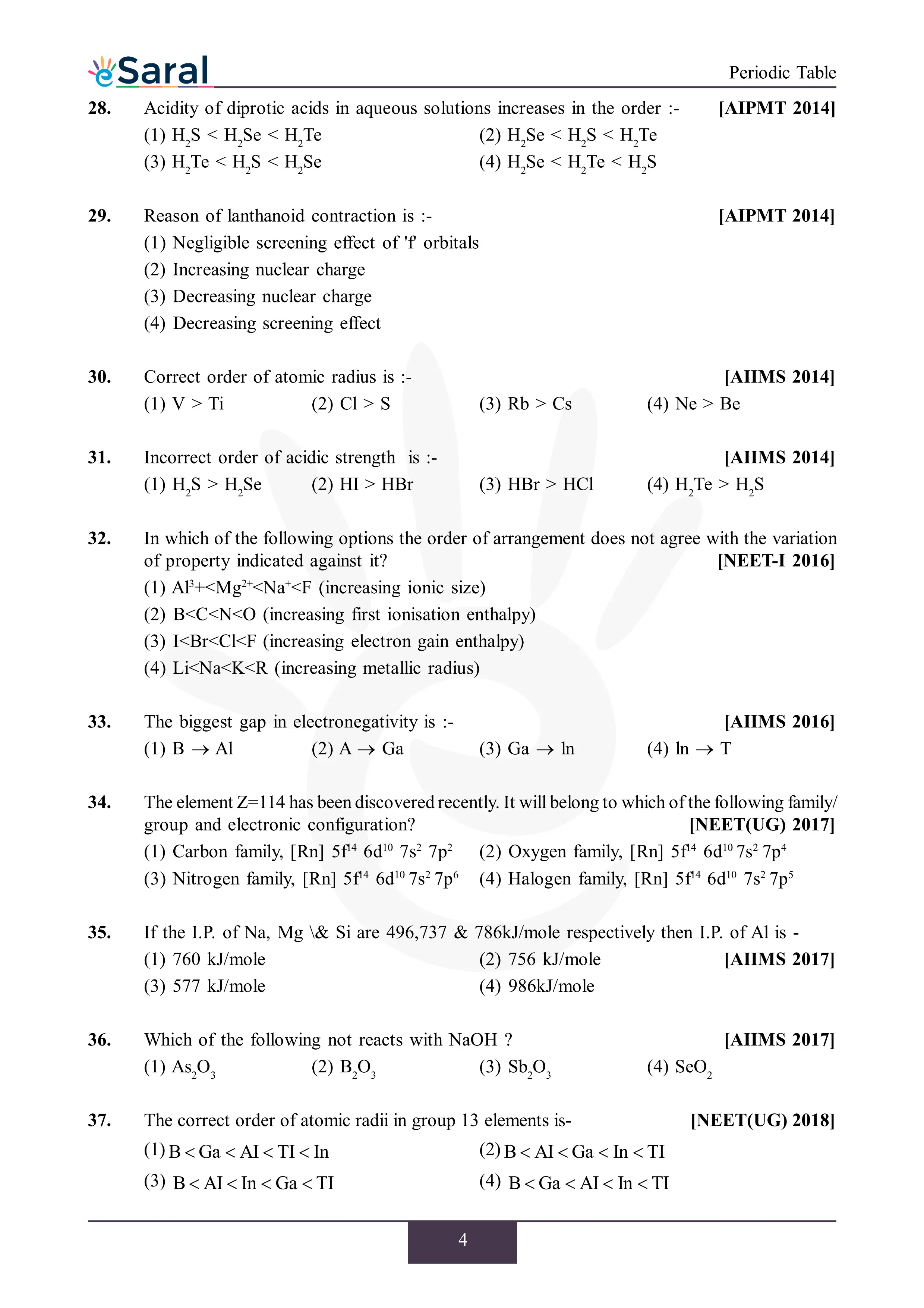


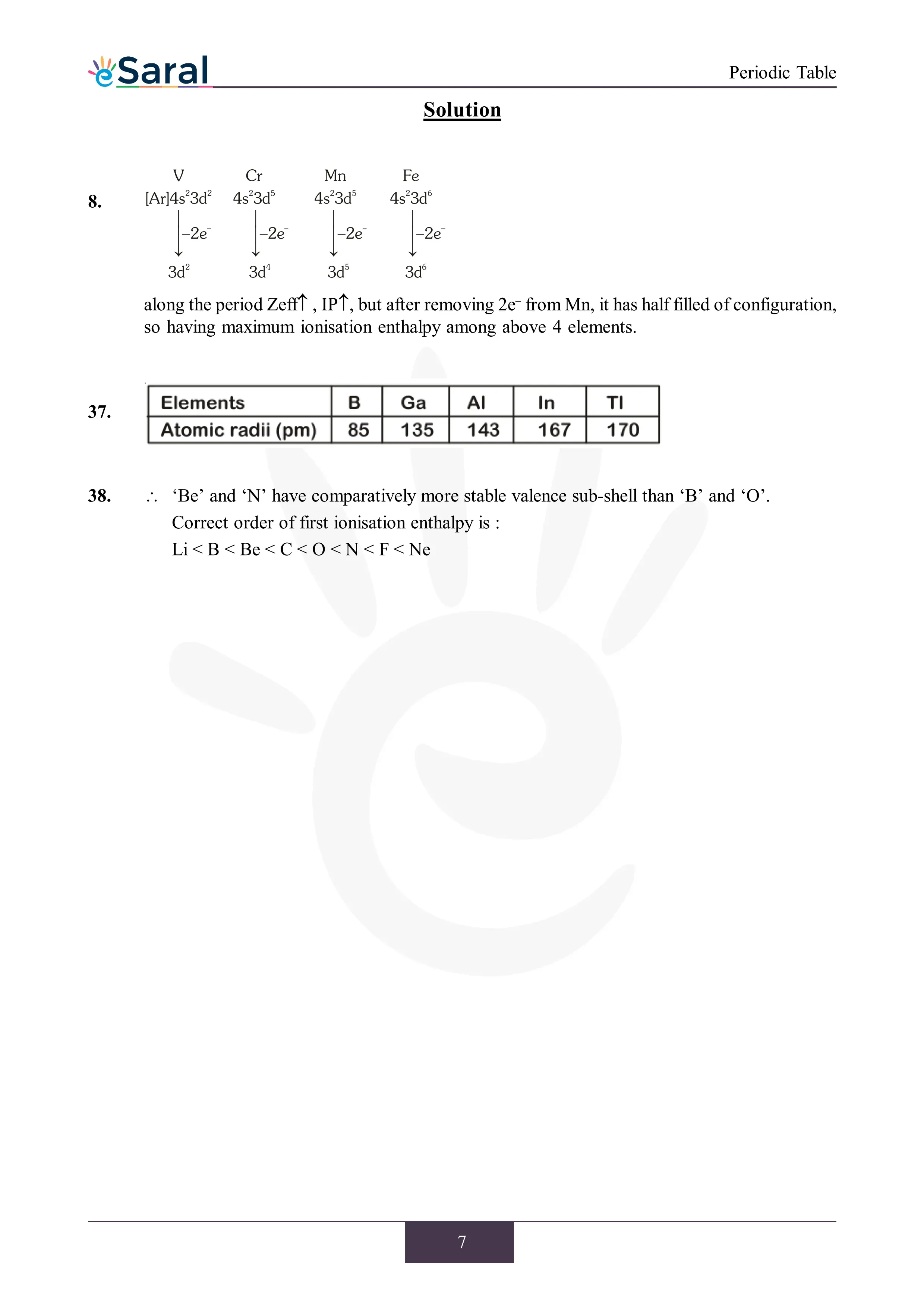
Chapter Overview: Topics and Subtopics
What This Chapter Covers
Topic | Subtopics | NEET Frequency |
|---|---|---|
History and Development | Dobereiner's Triads, Newlands' Octaves, Mendeleev's Periodic Law, Modern Periodic Law | Low |
Structure of the Modern Periodic Table | Periods, Groups, s/p/d/f blocks, position of elements | Medium |
Electronic Configuration and Periodicity | Relationship between electronic configuration and position in table | Medium |
Atomic and Ionic Radius | Trends across period and down group, covalent radius, ionic radius | Very High |
Ionisation Enthalpy | First, second IE trends; anomalies (Be > B, N > O, Mg > Al) | Very High |
Electron Gain Enthalpy | Trends, anomalies (O < S, F < Cl for EGA) | High |
Electronegativity | Pauling scale, trends, applications | High |
Valence and Oxidation States | Variation across period and group | Medium |
Metallic and Non-Metallic Character | Trends across period and group | Medium |
Diagonal Relationship | Li–Mg, Be–Al, B–Si similarities | Medium |
Anomalous Behaviour | First element of each group, small size effects | High |
NEET Weightage Analysis: Year-Wise Question Count
How Many Questions Come From Periodic Table in NEET?
NEET Year | Questions | Key Topics Tested |
|---|---|---|
NEET 2024 | 2 | Ionisation enthalpy anomaly, atomic radius trend |
NEET 2023 | 3 | Electron gain enthalpy, block classification, electronegativity |
NEET 2022 | 2 | IE anomaly (N > O), periodic trends across period |
NEET 2021 | 3 | Ionic radius, diagonal relationship, s/p/d/f blocks |
NEET 2020 | 2 | Electronegativity, IE trend down the group |
NEET 2019 | 3 | Atomic radius anomaly, EGA trend, valence electrons |
NEET 2018 | 2 | Modern periodic law, block identification |
NEET 2017 | 3 | IE trend, electron gain enthalpy, metallic character |
Average: 2.5 questions per year. At 4 marks each, this chapter reliably delivers 8–12 marks per NEET paper — with very high predictability in question type.
💡 Expert Tip by eSaral Chemistry Faculty: "Notice how ionisation enthalpy anomalies and atomic radius trends appear almost every year in some form. NTA is not testing whether you memorised the table — it is testing whether you understand why the anomaly exists. Learn the reasoning, not just the order."
Key Concepts You Must Know Before Solving PYQs
The 6 Non-Negotiable Facts for NEET
These six concept areas account for the vast majority of Periodic Table questions in NEET. Know every one cold.
1. Atomic Radius Trends
- Across a period (left → right): decreases — increasing nuclear charge pulls electrons closer
- Down a group (top → bottom): increases — new shells added
- Exception to note: Noble gases have the largest atomic radius in their period (van der Waals radius, which is not directly comparable)
2. Ionisation Enthalpy (IE) Trends and Anomalies
- Across a period: generally increases (left → right)
- Down a group: decreases
- Critical anomalies tested in NEET every year:
- Be > B: Be has a fully filled 2s² (extra stability); B has a lone 2p¹ electron which is easier to remove
- N > O: N has a half-filled 2p³ (extra stability from exchange energy); O has a paired electron in 2p⁴ which repels and is easier to remove
- Mg > Al: Same logic as Be > B — fully filled 3s² vs lone 3p¹
3. Electron Gain Enthalpy (EGA) Anomalies
- Fluorine has lower EGA than Chlorine: F is so small that the added electron faces high electron-electron repulsion in its compact 2p orbital
- Oxygen has lower EGA than Sulfur: same reasoning — O is smaller, more repulsion
- Noble gases have positive EGA — they do not accept electrons
4. Electronegativity
- Increases across a period, decreases down a group
- Fluorine is the most electronegative element (Pauling scale: 4.0)
- Electronegativity cannot be measured directly — it is a relative, comparative concept
5. Block Classification
- s-block: Groups 1 and 2 (alkali and alkaline earth metals) — last electron in s orbital
- p-block: Groups 13–18 — last electron in p orbital
- d-block: Groups 3–12 (transition elements) — last electron in d orbital
- f-block: Lanthanoids and Actinoids — last electron in f orbital
- Exception: He is in Group 18 (noble gases) but is an s-block element (configuration: 1s²)
6. Diagonal Relationship Elements diagonally placed in the periodic table sometimes show similar properties due to a balance of opposing trends (size increases down, but decreases across). Key pairs tested in NEET:
- Li and Mg
- Be and Al
- B and Si
Quick Reference: Trend Summary Table
Property | Across Period (→) | Down Group (↓) | Key Anomaly |
|---|---|---|---|
Atomic Radius | Decreases | Increases | — |
Ionisation Enthalpy | Increases | Decreases | Be > B, N > O, Mg > Al |
Electron Gain Enthalpy | Increases (more –ve) | Decreases | F < Cl; O < S |
Electronegativity | Increases | Decreases | F is highest (4.0) |
Metallic Character | Decreases | Increases | — |
Non-Metallic Character | Increases | Decreases | — |
Frequently Asked Questions
How many questions come from Periodic Table in NEET?
The Periodic Table chapter contributes 2–3 questions in most NEET UG papers. Over the last 8 years, the average is approximately 2.5 questions per year — roughly 8–12 marks. The chapter is highly predictable in its question types, making it one of the safest scoring chapters in NEET Chemistry.
What are the most important topics of Periodic Table for NEET?
The highest-frequency topics are: ionisation enthalpy trends and anomalies (Be > B, N > O, Mg > Al), electron gain enthalpy anomalies (F < Cl, O < S), atomic and ionic radius trends, electronegativity trends, and s/p/d/f block classification. These five areas account for roughly 80% of all Periodic Table questions in NEET over the last decade.
Which periodic trends are most tested in NEET?
Ionisation enthalpy — especially its anomalies — is the single most tested trend. It appears in some form in almost every NEET paper. Electron gain enthalpy anomalies (particularly why Cl > F) and atomic radius anomalies (particularly Ga < Al due to d-block contraction) are also tested very frequently.
Why does nitrogen have higher ionisation enthalpy than oxygen in NEET questions?
Nitrogen has a half-filled 2p³ configuration, which has extra stability due to exchange energy (all three 2p electrons are unpaired, maximising parallel spins). Oxygen has a 2p⁴ configuration where one orbital has a paired electron — this paired electron experiences extra repulsion and is easier to remove. So N requires more energy to ionise than O, despite O having a higher nuclear charge.
Where can I get all NEET chapter-wise PYQs for Chemistry with solutions?
eSaral provides a free, complete collection of NEET chapter-wise previous year questions with solutions for Physics, Chemistry, and Biology — organised by chapter and year, all in one place.
Team eSaral
eSaral Academic and Editorial Team
Team eSaral is the collective author profile for educational content created by eSaral’s teachers and academic contributors. The team draws on expertise from IIT graduates, doctors, experienced educators and subject specialists to develop resources for JEE, NEET and school students. Our articles aim to explain concepts clearly and help students study with confidence.
Related Posts
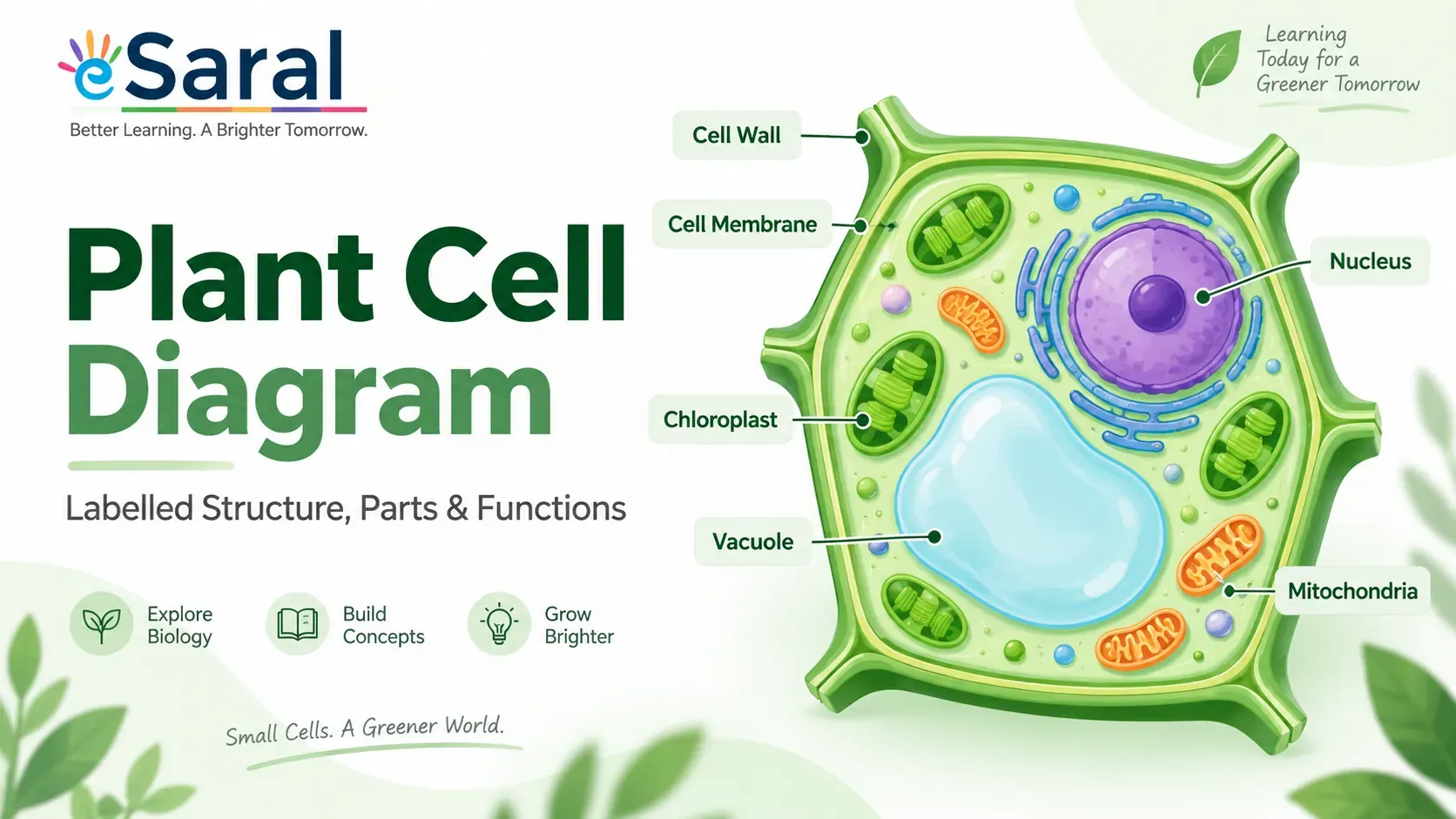
Plant Cell Diagram: Labelled Structure, Parts and Functions
Simple, labelled plant cell diagram with parts and functions. Covers plant cell structure for Class 6, 7, 8, 9, 10 and 11 students, CBSE-aligned.

Saransh Gupta Sir's Visit to IIT Patna: Hostel Life, Placements & Lessons for JEE Aspirants
Inside Saransh Gupta Sir's IIT Patna visit — hostel life, the library, placements, internships, and real advice for JEE aspirants from students living the IIT dream.
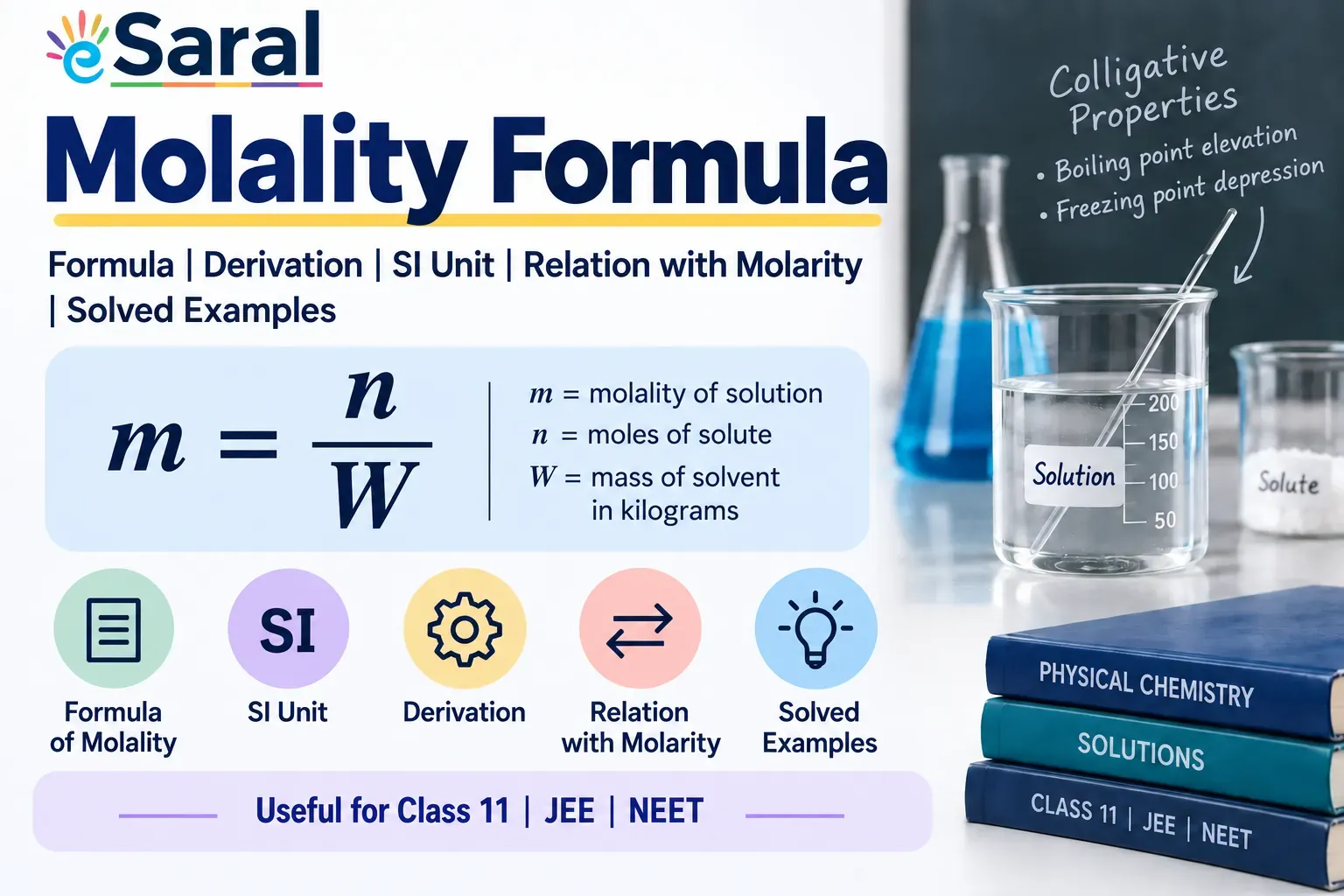
Molality Formula: Formula for Molality, Derivation & Solved Examples
Molality formula is $m = \dfrac{n}{W}$. Learn the formula of molality, its SI unit, derivation, relation with molarity, and solved examples for Class 11, JEE and NEET.
BITSAT Previous Year Question Paper PDF
Download BITSAT previous year question papers PDF. Get year-wise BITSAT PYQs, memory-based papers, exam pattern, and preparation tips to improve your BITSAT preparation.

Teachers’ Day 2026 at eSaral Gurukul: Celebrating the Bond Between Students, Teachers & Mentors
See how Teachers’ Day 2026 was celebrated at eSaral Gurukul, reflecting the bond among students, teachers, and mentors, and the role of guidance beyond academics.
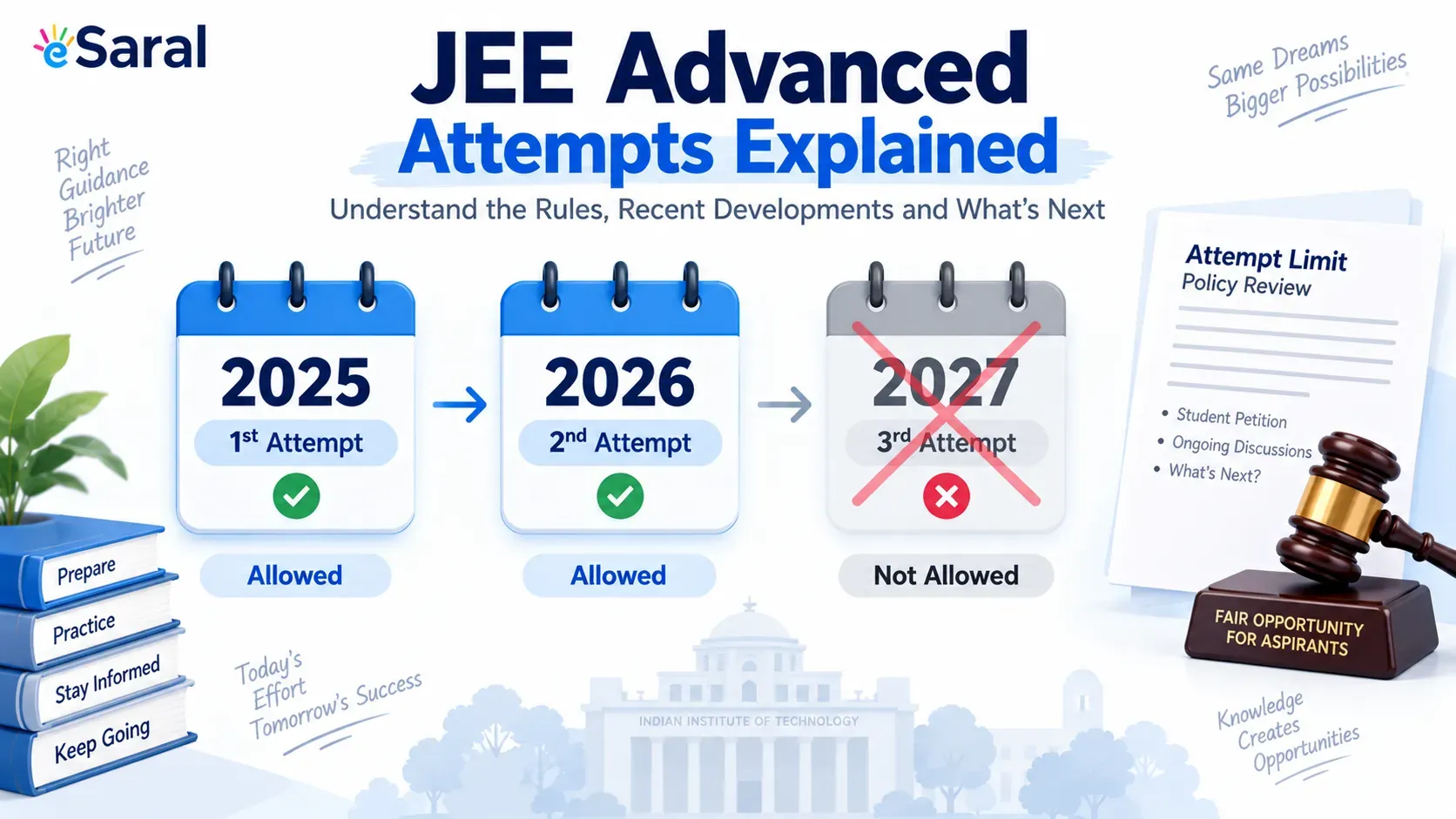
JEE Advanced Attempts: Can You Give It a Third Time? Rules Explained
JEE Advanced attempts: current rule is 2 consecutive years only: full eligibility criteria, the 2025 third-attempt controversy, and the latest 2026 petition news.

Best JEE Preparation App
Best JEE preparation app for Main & Advanced: AI mock tests, live doubt-solving, thousands of practice questions. JEE preparation app for droppers & Class 11-12.
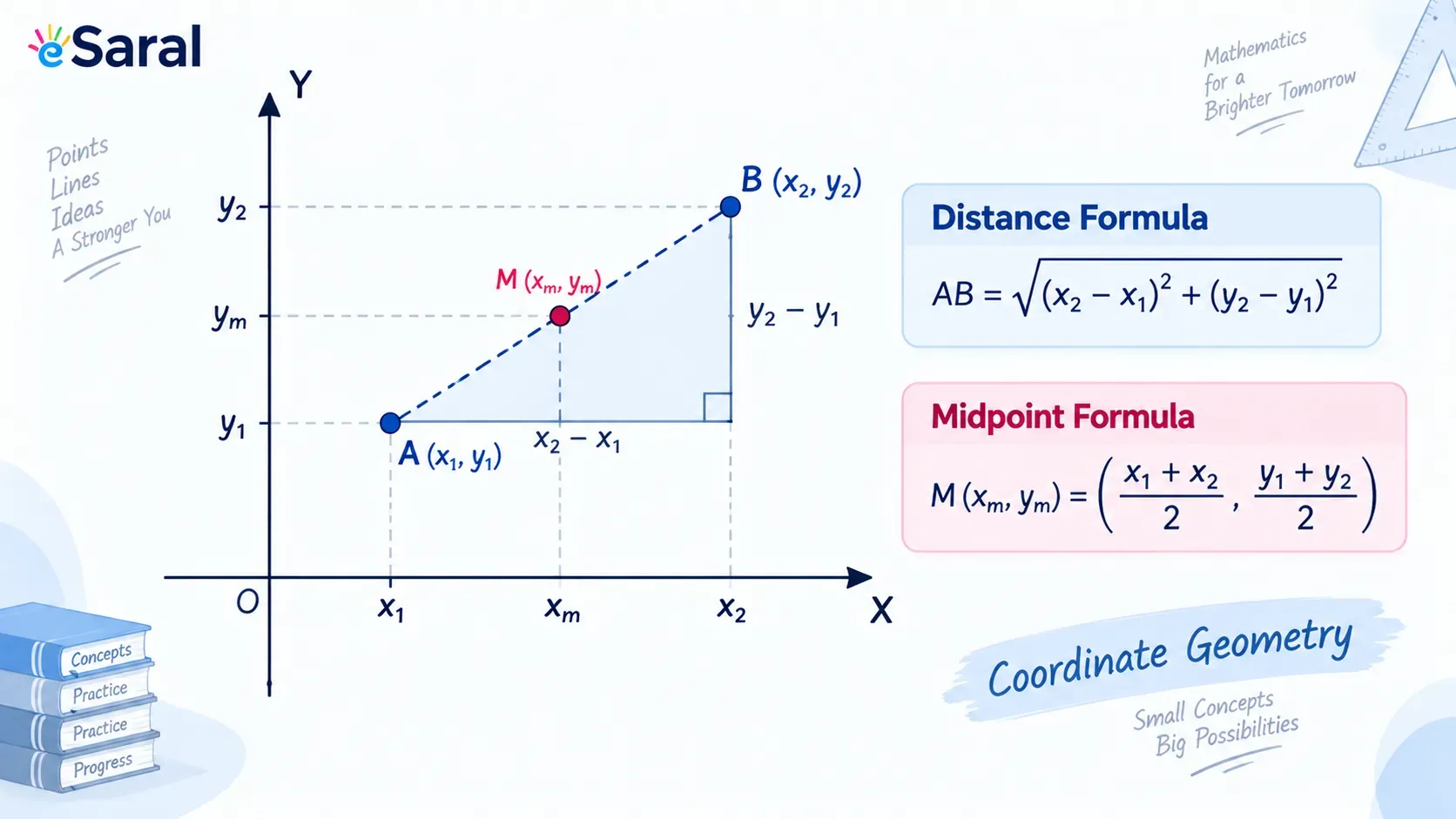
Coordinate Geometry Class 10: Formulas, Notes & Solved Examples
Coordinate geometry class 10: complete CBSE formulas — distance, section, midpoint and area of triangle — with derivation, notes and solved examples.
How to make Notes For JEE Smart Notes Strategy of an AIR 41
Learn how to make notes for JEE the way toppers do — indexing, shorthand, and smart short notes for JEE that cut revision time to just 5–7 days.
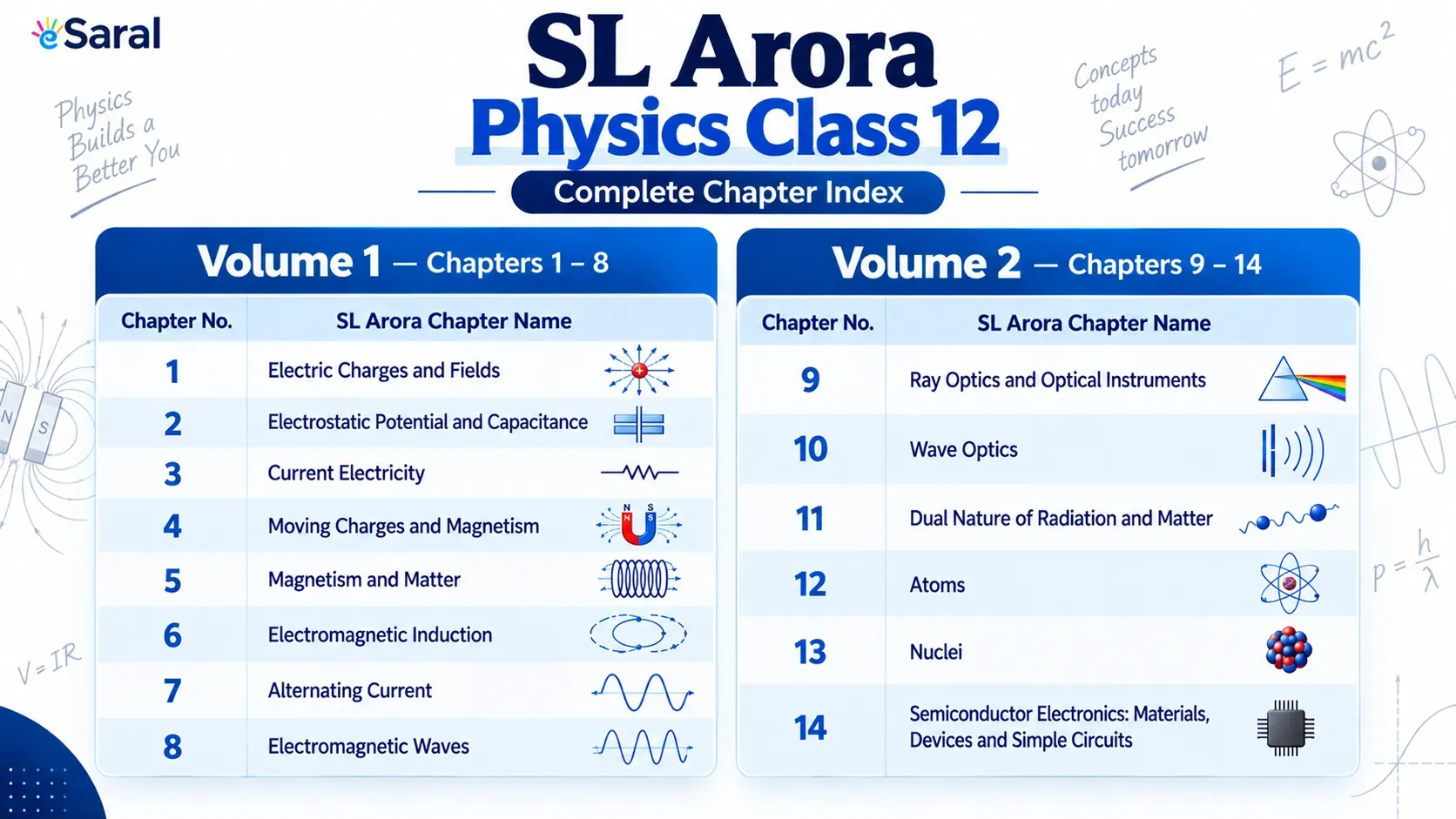
SL Arora Physics Class 12 Index – Chapter List for Volume 1 & 2
SL Arora Physics Class 12 index — complete chapter list for Volume 1 & 2, mapped to NCERT solutions for board, JEE Main, and NEET preparation.