
Potentiometer Working Principle, Uses, Advantages & Disadvantages || Class 12, JEE & NEET

eSaral Academic and Editorial Team
Summary
<p><strong>Potentiometer</strong> is a highly accurate device used to measure and compare potential differences, EMFs, and internal resistance by balancing voltages without drawing current from the source, making it an important topic in Class 12 Physics, JEE, and NEET.</p>
eSaral › Class 12 ›Potentiometer Working Principle, Uses, Advantages & Disadvantages

🚀 Checkout eSaral Courses
A potentiometer is a device used to measure the potential difference in a circuit. As we know that potential difference is the amount of work done in bringing a charge from one point to another. When there is potential difference in a circuit, the current flows through the circuit. The Unit of Potential Difference is measured in Volts. The potential difference of a circuit can be measure by a voltmeter. Now we will see Potentiometer Working Principle with the uses of Potentiometer.
Potentiometer Working Principle
The potential drop across any section of wire of uniform cross-section and composition is proportional to length of that section if a constant current flows through it. If $\mathbf{I}$ is the current in potentiometer wire AB of uniform cross-sectional area A, length L and specific resistance $\rho$ then unknown potential difference across AC is $V =\frac{ I \rho \ell}{ A }$ and known potential difference across AB is $E_{p}=\frac{I \rho L}{A}$
India's Best Exam Preparation for Class 12th - Download Now
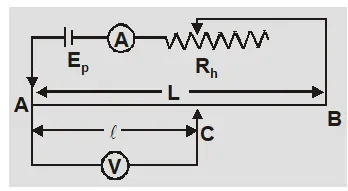
At balance point unknown potential difference = known potential difference or $\frac{V}{\ell}=\frac{E_{p}}{L}$ or $V=\left(\frac{E_{p}}{L}\right) \ell$ or $V=x l$ $$ \text { so } \quad V \propto \ell $$ where x = $E_{p} / L$= potential gradient i.e. fall of potential per unit length of potentiometer. Important Points
India's Best Exam Preparation for Class 12th - Download Now
- Potentiometer was devised by Poggendorf.
- The positive terminals of driving cell and unknown cell must be connected to the same end of potentiometer wire to obtain a balance point.
- A balance point is obtained on potentiometer wire if the fall of potential along potentiometer wire due to driving cell $E_{p}$ is greater than emf of cell to be balanced.
- The diameter of potentiometer wire must be uniform, specific resistance $P$ must be large and temperature coefficient of material of wire must be small.
- It is based of deflection method i.e. while measuring emf it does not draw any current from source of driving emf.
- While measuring unknown potential difference the resistance of potentiometer wire becomes infinite.
India's Best Exam Preparation for Class 12th - Download Now
Browse More Topics Related to Potentiometer:
- Potentiometer Working Principle
- Difference Between Potentiometer and Voltmeter
- Sensitivity of Potentiometer
- Uses of Potentiometer
- Advantages of Potentiometer
- Potentiometer Important Questions
India's Best Exam Preparation for Class 12th - Download Now
Potential Gradient
The fall of potential per unit length of potentiometer wire is called potential gradient. r = internal resistance of driving cell; $R_{h}$ = resistance of rheostat, $R_{e}$ = external series resistance, R is resistance of potentiometer wire, L is length of potentiometer wire. The current through primary circuit $I=\frac{E_{p}}{r+R_{h}+R_{e}+R}$
India's Best Exam Preparation for Class 12th - Download Now
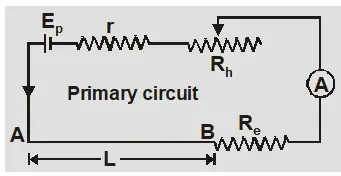
The potential gradient $x=\frac{I R}{L}=\frac{E_{p}}{r+R_{h}+R_{e}+R}\left(\frac{R}{L}\right)$
- If $R_{h}$ = 0 and $R_{e}$ = 0 x = $X_{\max }$ = $\frac{E_{p} R}{(r+R) L}0024
- x = $\mathrm{X}_{\mathrm{min}}$ = $\frac{E_{p}}{R+R_{h}+R_{e}+R}\left(\frac{R}{L}\right)$
- $x =\frac{ V }{ L }=\frac{\text { current } \times \text { resistance of potentiometer wire }}{\text { length of potentiometer wire }}= I \left(\frac{ R }{ L }\right)$
- where R/L is resistance per unit length of potentiometer wire.
- $R=\frac{\rho L}{A}$ or $\frac{ R }{ L }=\frac{\rho}{ A }$ so $x =\frac{ I \rho}{ A }=\frac{ I \times \text { specific resistance of material }}{\text { area of cross - sec tion }}$
- Unit of potential gradient is volt/meter and dimensions are $M^{1} L^{1} T^{-3} A^{-1}$.
- The potential gradient depends only on primary circuit and is independent of secondary circuit.
- On increasing the temperature of potentiometer wire there is no change in potential gradient if a constant current is maintained. If current is altered due to change in resistance of wire then potential gradient will change.
- Keeping the thickness of potentiometer wire constant if the length is changed from $L_{1}$ to $L_{2}$ then ratio of potential gradient will be $\frac{x_{1}}{x_{2}}=\frac{L_{2}}{L_{1}}$
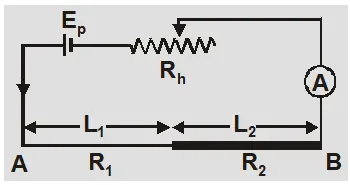
- If two wires of length $\mathrm{L}_{1}$ and $\mathrm{L}_{2},$ resistances $\mathrm{R}_{1}$ and $\mathrm{R}_{2}$ are joined in series with a battery of emf $E_{p}$ and a rheostat than the ratio of potential gradients can be calculated as $x_{1}=\left(\frac{E_{p}}{R_{1}+R_{2}}\right) \frac{R_{1}}{L_{1}} \quad$ and $\quad x_{2}=\left(\frac{E_{p}}{R_{1}+R_{2}}\right) \frac{R_{2}}{L_{2}} \quad$ or $\quad \frac{x_{1}}{x_{2}}=\frac{R_{1}}{R_{2}} \cdot \frac{L_{2}}{L_{1}}$
The potential gradient depends on:
- emf of battery in primary circuit $\left(E_{p}\right)$ and its internal resistance (r).
- Length of Potentiometer wire (L), its radius and its resistance (R).
- Specific resistance of material of wire $(\rho)$.
- Current flowing through the wire.
- Additional resistance like resistance of rheostat $\left(R_{h}\right)$ and series external resistance $\left(\mathrm{R}_{\mathrm{e}}\right)$.
India's Best Exam Preparation for Class 12th - Download Now
Watch out the Video: Applications of Potentiometer & its Construction by Saransh Sir.
Also Read:
- Types and Effects of Electric Current
- Ohm’s Law and Resistance
- Combination of Resistances
- EMF and Internal Resistances of a Cell
- Cells Connected in Series, parallel and Mixed
- Kirchhoff’s Circuit Law
- Electric Currents in Conductors
- Wheatstone Bridge
- Post office Box
- Wheatstone Meter Bridge
- Moving Coil galvanometer
- Ammeter and Voltmeter
- Potentiometer Working Principle
Frequently Asked Questions
What is the working principle of a potentiometer in simple words?
A potentiometer works on the principle that potential drop across a uniform wire is proportional to its length when a constant current flows through it. At the balance point, the unknown EMF equals the potential drop across the corresponding wire length, so no current flows through the galvanometer — this null condition gives the measurement.
What is potential gradient and what are its units?
Potential gradient is the fall of potential per unit length of the potentiometer wire. It is expressed as x = V/L or equivalently x = Iρ/A. Its SI unit is volt per metre (V/m) and its dimensions are M¹L¹T⁻³A⁻¹. It depends only on the primary circuit, not the secondary circuit.
What happens if the EMF of the driving cell is less than the EMF of the unknown cell?
If the driving cell's EMF (E_p) is less than or equal to the unknown cell's EMF, no balance point exists anywhere on the potentiometer wire. The galvanometer deflects in the same direction throughout the entire wire length, and you cannot complete the measurement. You must increase E_p or use a shorter/different wire.
How does temperature affect the potentiometer reading?
If temperature increases but current is held constant (by a rheostat), the potential gradient does not change. However, if no compensation is made, the wire's resistance increases with temperature, the current drops, and the potential gradient decreases. This shifts the balance point toward the battery end (longer balance length for same EMF).
What is the formula for finding the internal resistance of a cell using a potentiometer?
Internal resistance is given by r = ((ℓ₁ − ℓ₂) / ℓ₂) × R, where ℓ₁ is the balance length with no external resistance (open circuit), ℓ₂ is the balance length with external resistance R connected across the cell. This formula directly follows from the ratio E/V = ℓ₁/ℓ₂ and the expression E = I(R + r).
Team eSaral
eSaral Academic and Editorial Team
Team eSaral is the collective author profile for educational content created by eSaral’s teachers and academic contributors. The team draws on expertise from IIT graduates, doctors, experienced educators and subject specialists to develop resources for JEE, NEET and school students. Our articles aim to explain concepts clearly and help students study with confidence.
Related Posts

Plant Cell Diagram: Labelled Structure, Parts and Functions
Simple, labelled plant cell diagram with parts and functions. Covers plant cell structure for Class 6, 7, 8, 9, 10 and 11 students, CBSE-aligned.

Saransh Gupta Sir's Visit to IIT Patna: Hostel Life, Placements & Lessons for JEE Aspirants
Inside Saransh Gupta Sir's IIT Patna visit — hostel life, the library, placements, internships, and real advice for JEE aspirants from students living the IIT dream.
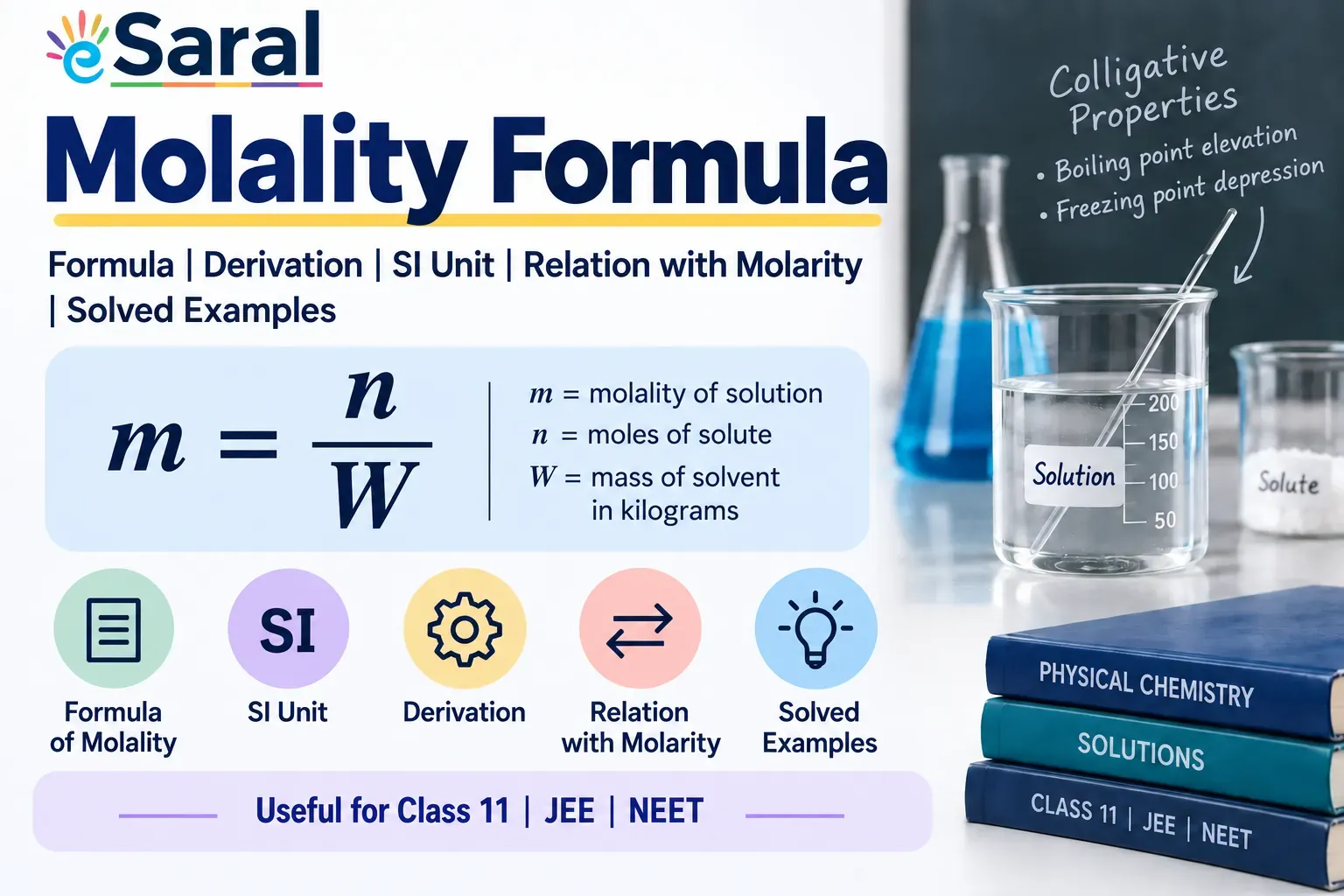
Molality Formula: Formula for Molality, Derivation & Solved Examples
Molality formula is $m = \dfrac{n}{W}$. Learn the formula of molality, its SI unit, derivation, relation with molarity, and solved examples for Class 11, JEE and NEET.

BITSAT Previous Year Question Paper PDF
Download BITSAT previous year question papers PDF. Get year-wise BITSAT PYQs, memory-based papers, exam pattern, and preparation tips to improve your BITSAT preparation.

Teachers’ Day 2026 at eSaral Gurukul: Celebrating the Bond Between Students, Teachers & Mentors
See how Teachers’ Day 2026 was celebrated at eSaral Gurukul, reflecting the bond among students, teachers, and mentors, and the role of guidance beyond academics.
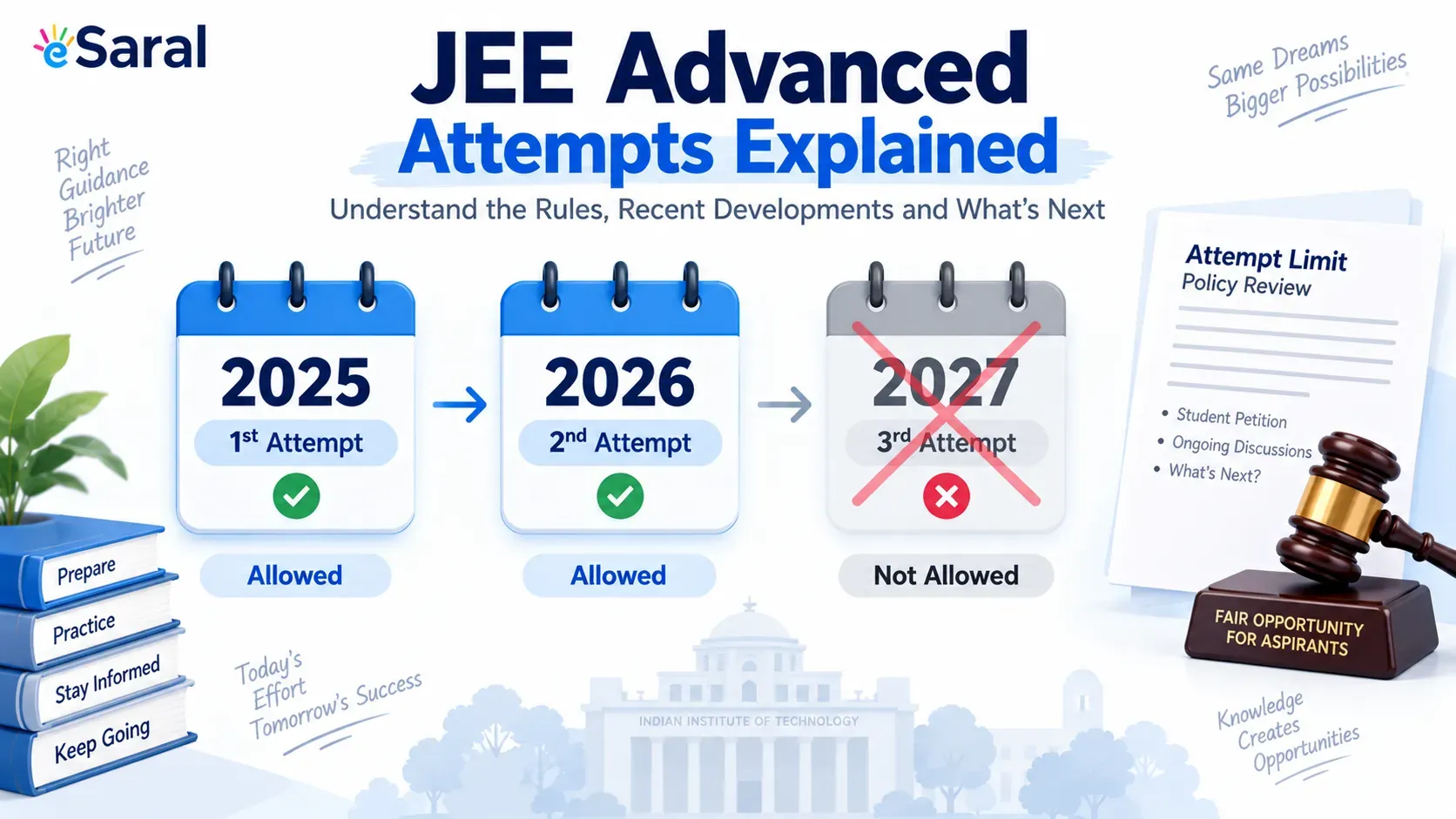
JEE Advanced Attempts: Can You Give It a Third Time? Rules Explained
JEE Advanced attempts: current rule is 2 consecutive years only: full eligibility criteria, the 2025 third-attempt controversy, and the latest 2026 petition news.

Best JEE Preparation App
Best JEE preparation app for Main & Advanced: AI mock tests, live doubt-solving, thousands of practice questions. JEE preparation app for droppers & Class 11-12.
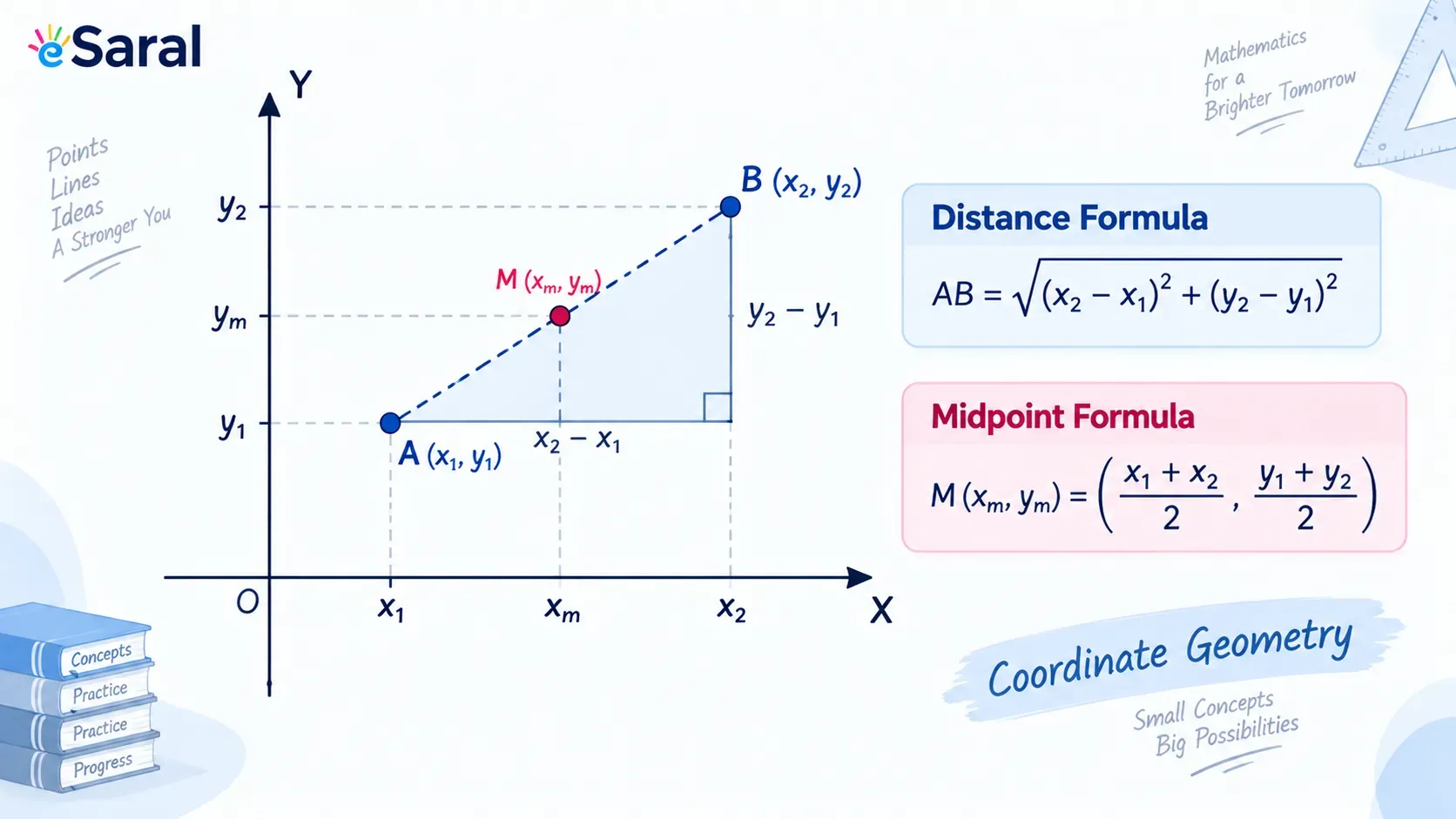
Coordinate Geometry Class 10: Formulas, Notes & Solved Examples
Coordinate geometry class 10: complete CBSE formulas — distance, section, midpoint and area of triangle — with derivation, notes and solved examples.
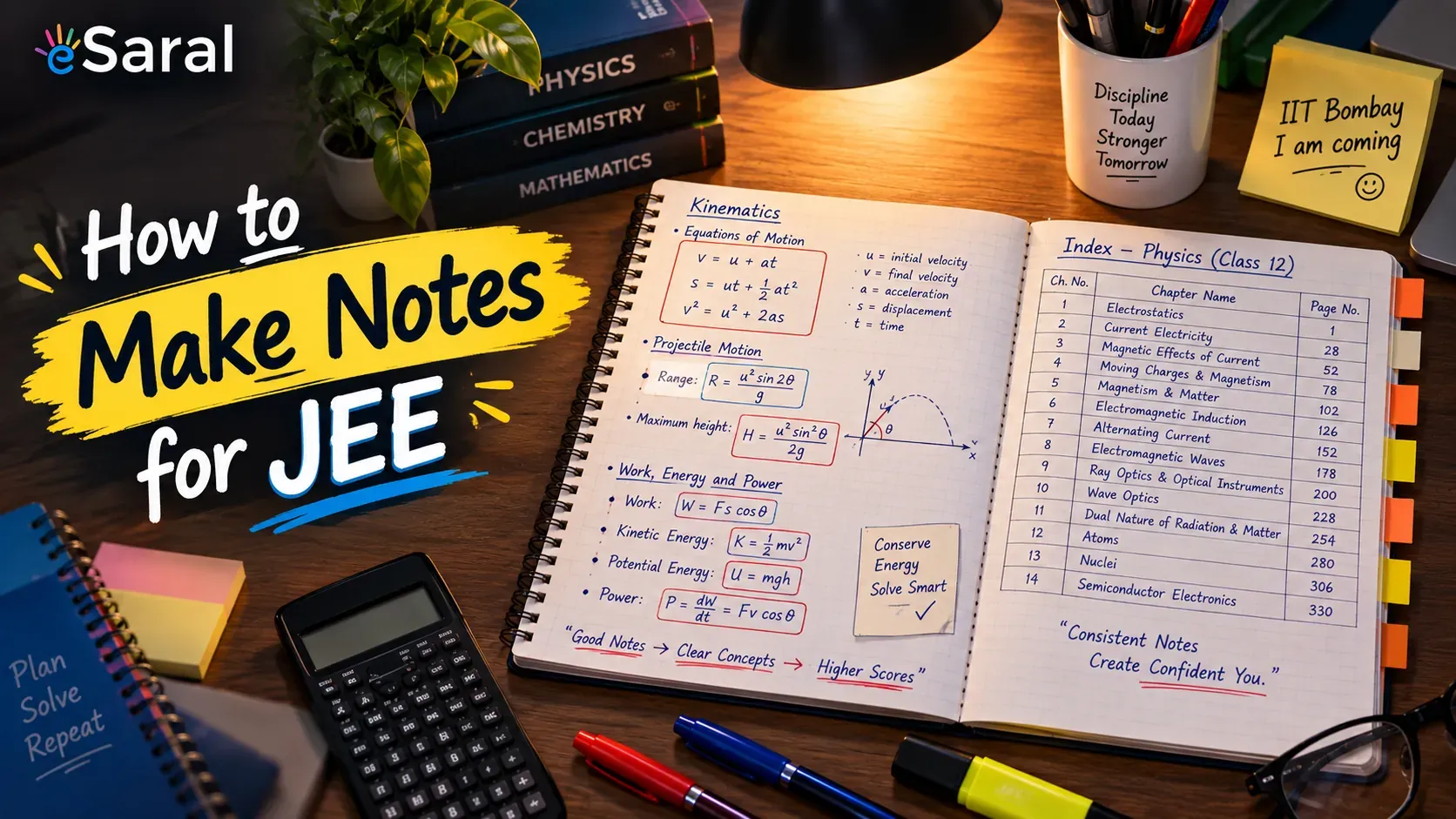
How to make Notes For JEE Smart Notes Strategy of an AIR 41
Learn how to make notes for JEE the way toppers do — indexing, shorthand, and smart short notes for JEE that cut revision time to just 5–7 days.
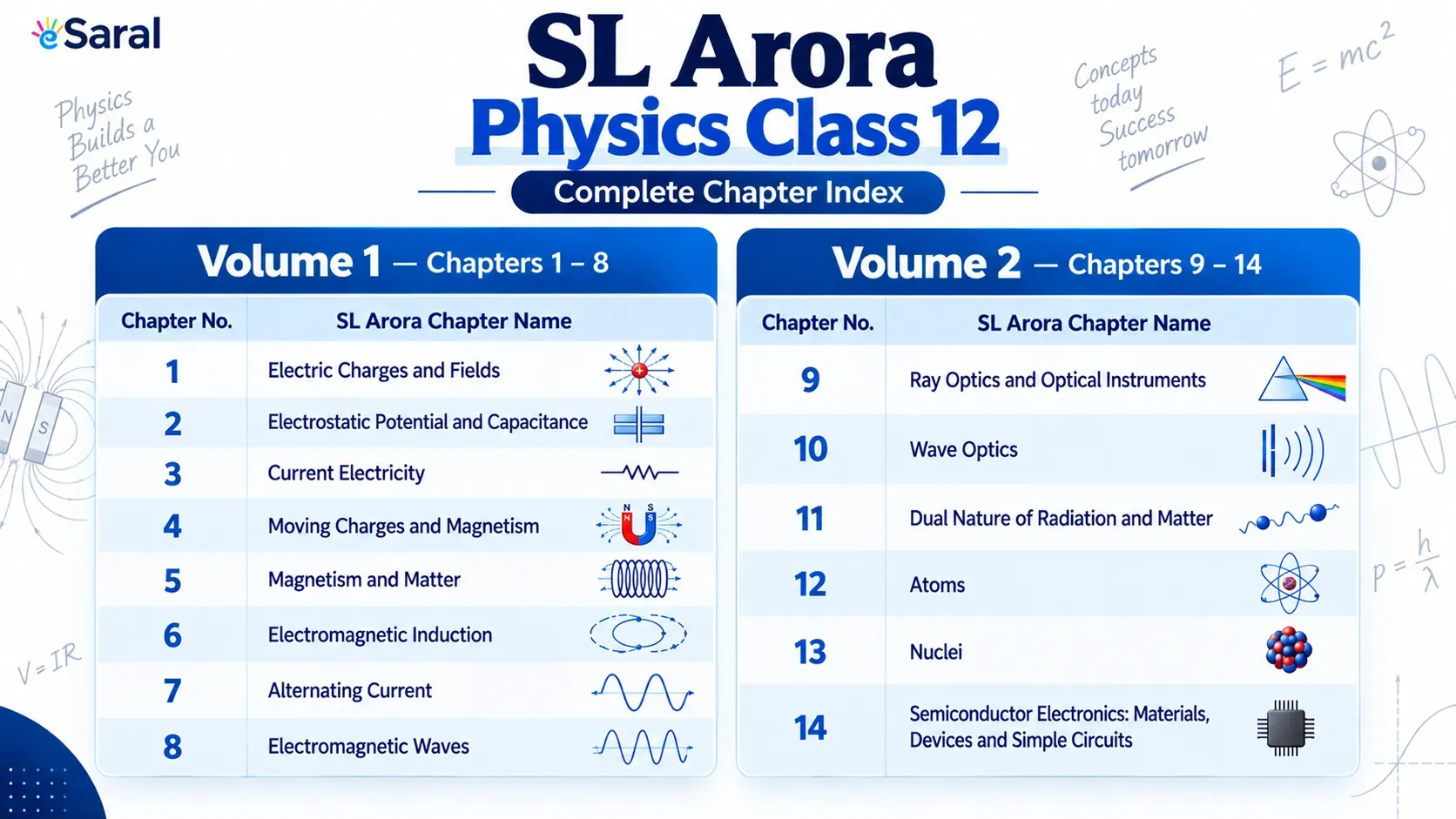
SL Arora Physics Class 12 Index – Chapter List for Volume 1 & 2
SL Arora Physics Class 12 index — complete chapter list for Volume 1 & 2, mapped to NCERT solutions for board, JEE Main, and NEET preparation.