
Real Numbers Class 10 Notes & Mind Maps | Chapter 1 Maths (CBSE)

eSaral Academic and Editorial Team
Summary
Real Numbers (Class 10 Chapter 1) covers Euclid's Division Lemma, the Fundamental Theorem of Arithmetic, methods to find HCF and LCM, and the nature of rational and irrational numbers. These notes and mind maps summarise every key formula, theorem, and definition you need for CBSE board exam revision in one place.
eSaral > Class 10 Maths Mind Maps > Real Numbers

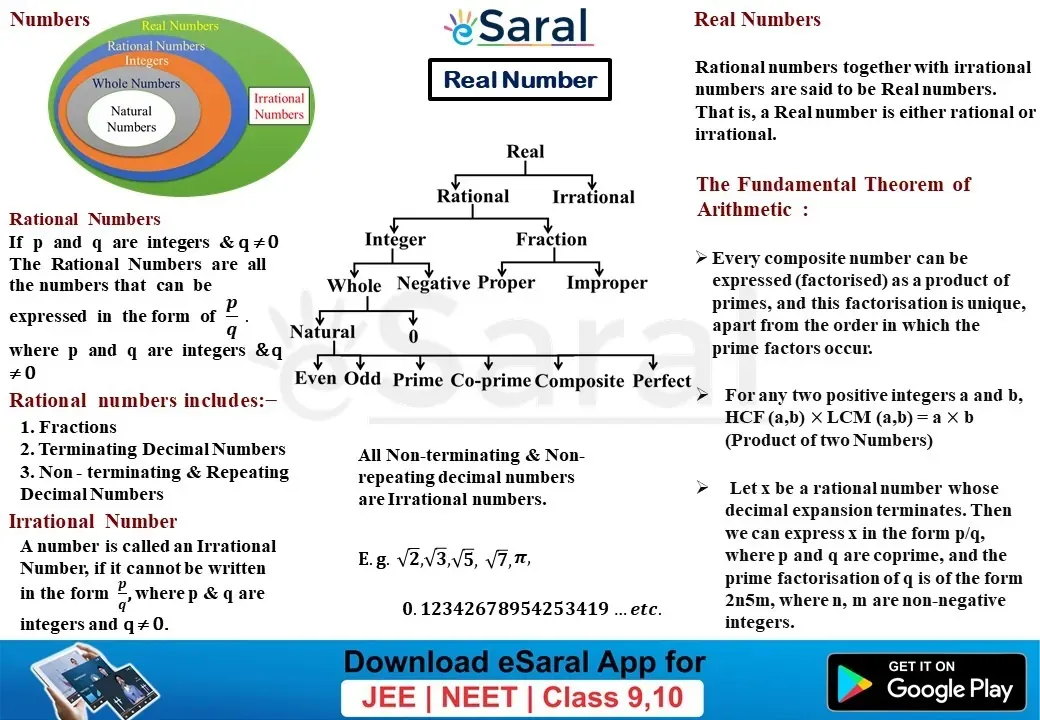
Get to learn all the formulae and important points of Real Numbers through this Mind Map. Download and share with your friends also.
India's Best Exam Preparation for Class 10th - Download Now
What Is Class 10 Chapter 1 Real Numbers About?
Real Numbers is the first chapter of Class 10 CBSE Mathematics and one of the highest-scoring topics in the board exam. It builds directly on your Class 9 number system knowledge and introduces two powerful tools — Euclid's Division Algorithm and the Fundamental Theorem of Arithmetic — that you will use throughout secondary and senior secondary maths.
The chapter carries approximately 6 marks in the CBSE Class 10 board paper (Unit 1: Number Systems). Questions typically appear as 1-mark MCQs, 2-mark short answers, and occasionally a 3-mark problem on HCF/LCM. Students who understand the why behind each theorem — not just the formula — consistently score full marks here.
These short notes and mind maps cover every definition, theorem, and result from the NCERT textbook. Work through each section, download the mind map PDF, and use the solved examples to test yourself before your exam.
For detailed step-by-step solutions to every NCERT exercise question, visit the NCERT Solutions for Class 10 Maths page.
Key Topics at a Glance — Chapter 1 Weightage Table
Topic | Core Concept | Exam Application | Typical Marks |
|---|---|---|---|
Euclid's Division Lemma | a = bq + r | Finding the HCF of two integers | 2–3 marks |
Fundamental Theorem of Arithmetic | Unique prime factorisation | Proving irrationality, HCF, LCM | 2–3 marks |
HCF and LCM | Product of all common/all prime factors | Word problems, number problems | 2–3 marks |
Rational Numbers | p/q form, q ≠ 0 | Identifying number type | 1 mark |
Irrational Numbers | Non-terminating, non-recurring | Proof-based questions | 2 marks |
Decimal Expansions | Terminating vs non-terminating | Identifying rational form | 1–2 marks |
Euclid's Division Lemma and Algorithm — How Does It Work?
Euclid's Division Lemma states: For any two positive integers a and b, there exist unique integers q (quotient) and r (remainder) such that:
a = bq + r, where 0 ≤ r < b
This single statement is the foundation for Euclid's Division Algorithm, which gives you a systematic method to find the HCF of any two positive integers without listing all factors.
Steps of Euclid's Division Algorithm
- Given two positive integers a and b (where a > b), write: a = bq₁ + r₁
- If r₁ = 0, then HCF(a, b) = b. Stop.
- If r₁ ≠ 0, apply the lemma again: b = r₁q₂ + r₂
- Continue until the remainder becomes 0. The last non-zero remainder is the HCF.
Worked Example
Find HCF(270, 192):
- 270 = 192 × 1 + 78
- 192 = 78 × 2 + 36
- 78 = 36 × 2 + 6
- 36 = 6 × 6 + 0
∴ HCF(270, 192) = 6
Important Points to Remember
- Euclid's algorithm works only for positive integers.
- The algorithm always terminates because the remainder decreases at every step.
- This method is especially efficient for large numbers where listing all factors is impractical.
Board Exam Tip: CBSE frequently asks questions involving numbers of the form 6q, 6q+1, etc. Always begin with Euclid's Division Lemma and list all possible remainders to earn full step marks.
Fundamental Theorem of Arithmetic
The Fundamental Theorem of Arithmetic (FTA) is one of the most important results in number theory and forms the foundation of several Class 10 board exam questions.
It states:
Every composite number can be expressed as a product of prime numbers, and this factorisation is unique apart from the order in which the prime factors occur.
Two Important Parts of the Theorem
Existence
Every composite number can be written as a product of prime numbers.
Uniqueness
The prime factorisation of a number is unique except for the order of factors.
Why Is This Theorem Important for CBSE Exams?
The Fundamental Theorem of Arithmetic is used directly in several high-frequency board exam questions.
Question Type | How the Theorem Is Used |
|---|---|
Proving √2, √3, √5 are irrational | Uses unique prime factorisation to reach a contradiction. |
Finding HCF | Product of common prime factors with lowest powers. |
Finding LCM | Product of all prime factors with highest powers. |
Key Formula Linking HCF and LCM
HCF(a, b) × LCM(a, b) = a × b
This formula applies only to two positive integers. Many students mistakenly apply it directly to three numbers, which is not valid.
Board Exam Alert: Whenever you calculate HCF and LCM in a question, verify your answer using this formula. This verification step often earns an additional mark.
HCF and LCM Using Prime Factorisation
Prime factorisation is one of the easiest and most reliable methods to calculate HCF and LCM. It is directly based on the Fundamental Theorem of Arithmetic.
How to Find HCF by Prime Factorisation
Steps:
- Write the prime factorisation of each number.
- Identify the common prime factors.
- Select the lowest power of each common prime factor.
- Multiply them to obtain the HCF.
Worked Example: HCF(12, 18)
- 12 = 2² × 3
- 18 = 2 × 3²
Common prime factors: 2 and 3
HCF = 2¹ × 3¹ = 6
How to Find LCM by Prime Factorisation
Steps:
- Write the prime factorisation of each number.
- Select all prime factors appearing in any factorisation.
- Choose the highest power of each prime factor.
- Multiply them to obtain the LCM.
Worked Example: LCM(12, 18)
- 12 = 2² × 3
- 18 = 2 × 3²
Highest powers:
LCM = 2² × 3² = 36
Verification Using the Formula
HCF × LCM = 6 × 36
= 216
= 12 × 18 ✓
Quick Comparison: HCF vs LCM
Feature | HCF | LCM |
|---|---|---|
Meaning | Highest Common Factor | Least Common Multiple |
Prime Factors Used | Common prime factors only | All prime factors |
Power Chosen | Lowest power | Highest power |
Value | Smaller | Larger |
Exam Tip: Students often lose marks by forgetting the verification step:
HCF × LCM = Product of the Numbers
Always write this line after solving HCF and LCM questions.
Rational and Irrational Numbers — What Is the Key Difference?
One of the most important concepts in Chapter 1 is understanding the difference between rational and irrational numbers. Questions based on number classification frequently appear in CBSE board exams and MCQs.
What Is a Rational Number?
A rational number is any number that can be written in the form:
p/q, where p and q are integers and q ≠ 0
Examples
- 3/4
- −7/2
- 0 = 0/1
- 5 = 5/1
- 0.75 = 3/4
What Is an Irrational Number?
An irrational number cannot be expressed in the form p/q.
Decimal expansion is non-terminating and non-repeating.
Examples
- √2
- √3
- √5
- π
- 0.1011011101111...
Quick Comparison: Rational vs Irrational Numbers
Property | Rational Number | Irrational Number |
|---|---|---|
Form | p/q | Cannot be expressed as p/q |
Decimal Expansion | Terminating or repeating | Non-terminating and non-repeating |
Examples | 1/2, 5, 0.25 | √2, π, √5 |
How to Prove a Number Is Irrational?
Proofs involving irrational numbers are among the most frequently asked long-answer questions in CBSE Class 10 board examinations.
The standard method uses contradiction and the Fundamental Theorem of Arithmetic.
Proof That √2 Is Irrational
- Assume √2 = p/q, where p and q are co-prime integers and q ≠ 0.
- Squaring both sides:
2 = p²/q² - Therefore:
p² = 2q² - Since p² is divisible by 2, p must also be divisible by 2.
- Let p = 2m.
- Substituting:
(2m)² = 2q²
4m² = 2q²
q² = 2m² - Therefore, q is also divisible by 2.
- Both p and q are divisible by 2, contradicting the assumption that they are co-prime.
- Therefore, our assumption is false.
∴ √2 is irrational.
Board Exam Tip: The same proof structure can be used for √3, √5, √7 and other non-perfect square roots. Practise this proof until you can reproduce it without looking at notes.
Decimal Expansions of Rational Numbers
The decimal expansion of a rational number depends entirely on the prime factorisation of its denominator when written in lowest form.
When Is a Decimal Expansion Terminating?
A rational number p/q (in simplest form) has a terminating decimal expansion if and only if:
q = 2ⁿ × 5ᵐ
where n and m are non-negative integers.
Examples
Rational Number | Denominator Factorisation | Decimal Type |
|---|---|---|
7/8 | 8 = 2³ | Terminating (0.875) |
3/25 | 25 = 5² | Terminating (0.12) |
1/6 | 6 = 2 × 3 | Non-terminating, repeating |
2/7 | 7 | Non-terminating, repeating |
Key Rule to Memorise
If the denominator (in lowest terms) contains any prime factor other than 2 or 5, the decimal expansion is non-terminating and repeating.
This rule allows you to answer most decimal expansion MCQs within seconds.
Chapter 1 Quick Revision Sheet
- Euclid's Division Lemma: a = bq + r
- HCF is obtained using Euclid's Division Algorithm.
- Every composite number has a unique prime factorisation.
- HCF = Product of common prime factors with the lowest powers.
- LCM = Product of all prime factors with the highest powers.
- HCF × LCM = Product of the two numbers.
- Rational numbers can be written as p/q.
- Irrational numbers cannot be expressed as p/q.
- √2, √3, √5 and π are irrational.
- Terminating decimal ⇒ denominator contains only 2 and/or 5.
- Any other prime factor ⇒ non-terminating repeating decimal.
For step-by-step worked solutions on this exact chapter, the NCERT solutions for class 10 Maths page is the natural next stop after this revision.
Frequently Asked Questions
What is the Fundamental Theorem of Arithmetic in simple terms?
Every whole number greater than 1 is either a prime or can be written as a product of prime numbers in exactly one way (ignoring the order). For example, 60 = 2² × 3 × 5 — no other combination of primes multiplies to give 60. This uniqueness is what makes the theorem so powerful for proofs
How do you find HCF using Euclid's Division Algorithm?
Divide the larger number by the smaller to get a remainder. Then divide the previous divisor by that remainder. Keep repeating until the remainder is zero. The last non-zero remainder is the HCF. For example, HCF(56, 98): 98 = 56×1+42 → 56 = 42×1+14 → 42 = 14×3+0. HCF = 14
What are the most important topics in Real Numbers Class 10 for the board exam?
The most important topics are Euclid's Division Algorithm (for HCF), the Fundamental Theorem of Arithmetic (for HCF, LCM, and irrational number proofs), and the rule for identifying whether a rational number has a terminating or non-terminating decimal. These three areas account for nearly all marks allotted to Chapter 1 in CBSE board papers.
What is the formula connecting HCF and LCM of two numbers?
For any two positive integers a and b: HCF(a, b) × LCM(a, b) = a × b. This formula is valid only for two numbers. If a question gives you HCF and the product of two numbers, you can directly find LCM by dividing the product by the HCF — and vice versa.
When does a rational number have a terminating decimal expansion?
A rational number p/q in its simplest form has a terminating decimal if and only if the denominator q has no prime factors other than 2 and 5. Check: if q = 2ⁿ × 5ᵐ, the decimal terminates. If q contains 3, 7, 11, or any other prime, the decimal is non-terminating and repeating.
How do you prove that √2 is irrational?
Assume √2 = p/q where p, q are co-prime integers. Squaring gives p² = 2q², so 2 divides p, meaning p = 2m. Substituting gives q² = 2m², so 2 divides q. Both p and q share factor 2, contradicting the co-prime assumption. Therefore √2 cannot be rational — it is irrational.
Are Real Numbers important for Class 11 and 12 Maths as well?
Yes. The concepts of rational and irrational numbers, prime factorisation, and number properties appear in Class 11 topics such as Sets, Relations, and later in Sequences and Series. Building a strong foundation in Class 10 Chapter 1 makes these senior secondary topics significantly easier to understand.
Team eSaral
eSaral Academic and Editorial Team
Team eSaral is the collective author profile for educational content created by eSaral’s teachers and academic contributors. The team draws on expertise from IIT graduates, doctors, experienced educators and subject specialists to develop resources for JEE, NEET and school students. Our articles aim to explain concepts clearly and help students study with confidence.
Related Posts

Plant Cell Diagram: Labelled Structure, Parts and Functions
Simple, labelled plant cell diagram with parts and functions. Covers plant cell structure for Class 6, 7, 8, 9, 10 and 11 students, CBSE-aligned.

Saransh Gupta Sir's Visit to IIT Patna: Hostel Life, Placements & Lessons for JEE Aspirants
Inside Saransh Gupta Sir's IIT Patna visit — hostel life, the library, placements, internships, and real advice for JEE aspirants from students living the IIT dream.
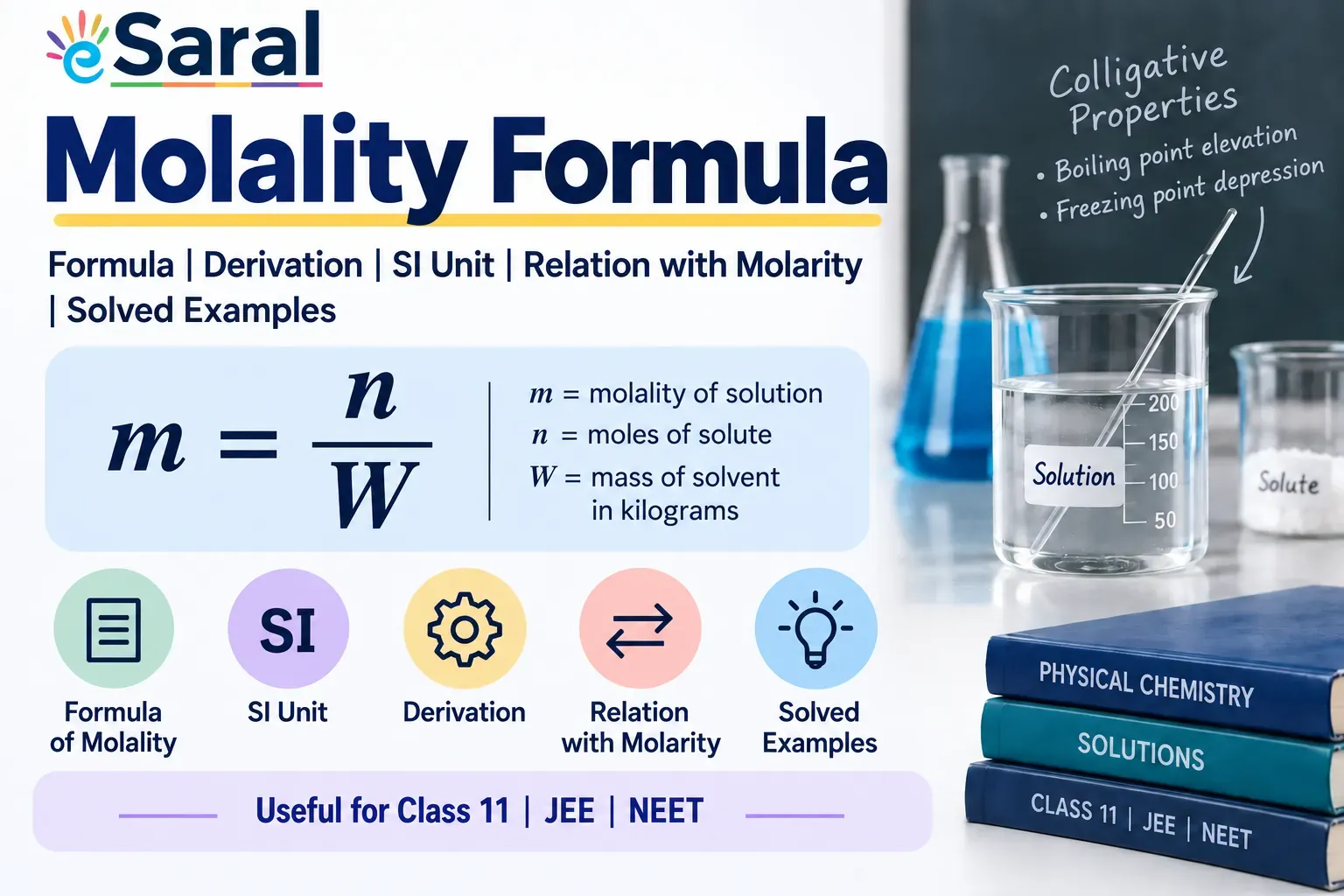
Molality Formula: Formula for Molality, Derivation & Solved Examples
Molality formula is $m = \dfrac{n}{W}$. Learn the formula of molality, its SI unit, derivation, relation with molarity, and solved examples for Class 11, JEE and NEET.

BITSAT Previous Year Question Paper PDF
Download BITSAT previous year question papers PDF. Get year-wise BITSAT PYQs, memory-based papers, exam pattern, and preparation tips to improve your BITSAT preparation.

Teachers’ Day 2026 at eSaral Gurukul: Celebrating the Bond Between Students, Teachers & Mentors
See how Teachers’ Day 2026 was celebrated at eSaral Gurukul, reflecting the bond among students, teachers, and mentors, and the role of guidance beyond academics.
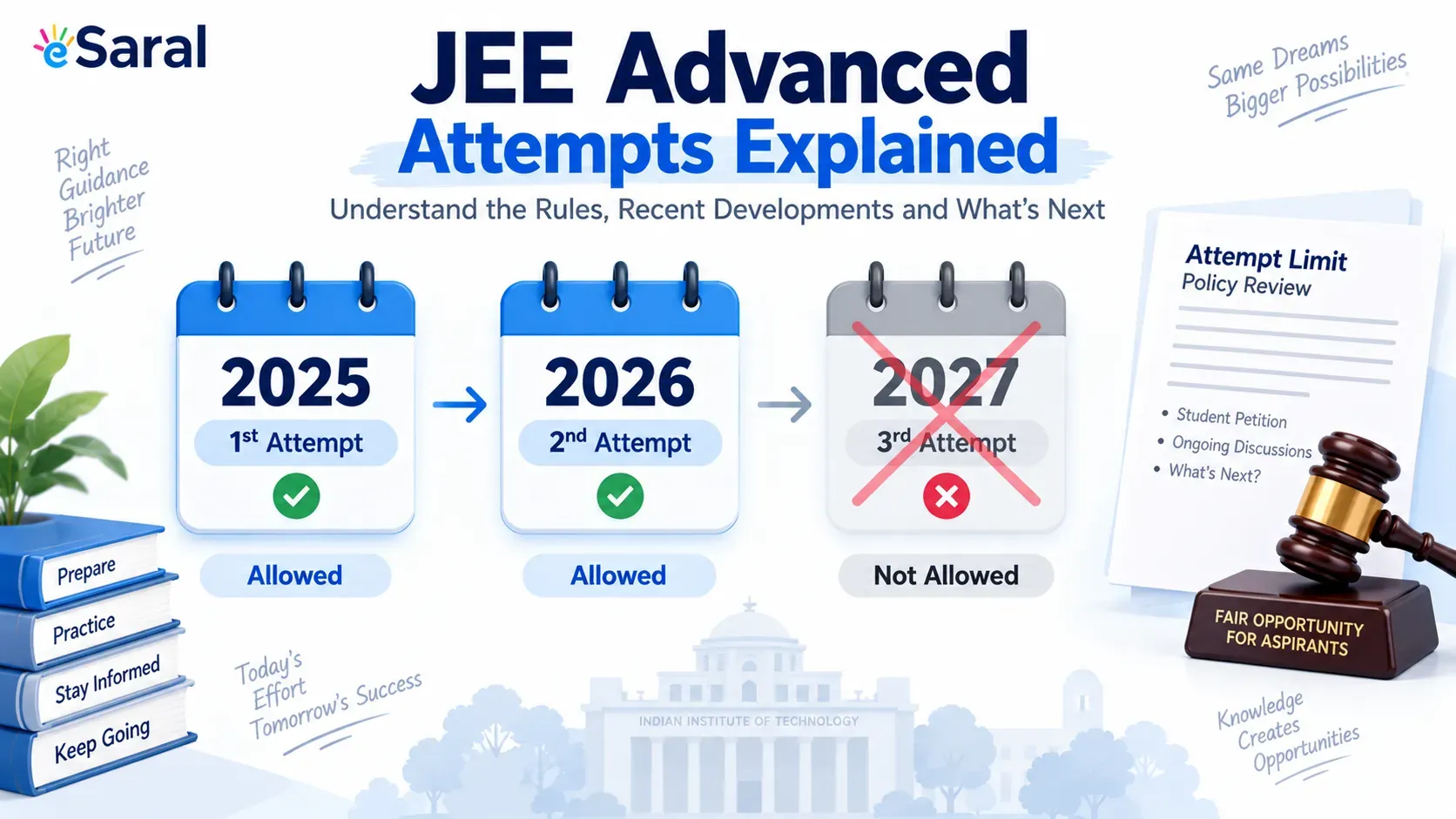
JEE Advanced Attempts: Can You Give It a Third Time? Rules Explained
JEE Advanced attempts: current rule is 2 consecutive years only: full eligibility criteria, the 2025 third-attempt controversy, and the latest 2026 petition news.

Best JEE Preparation App
Best JEE preparation app for Main & Advanced: AI mock tests, live doubt-solving, thousands of practice questions. JEE preparation app for droppers & Class 11-12.
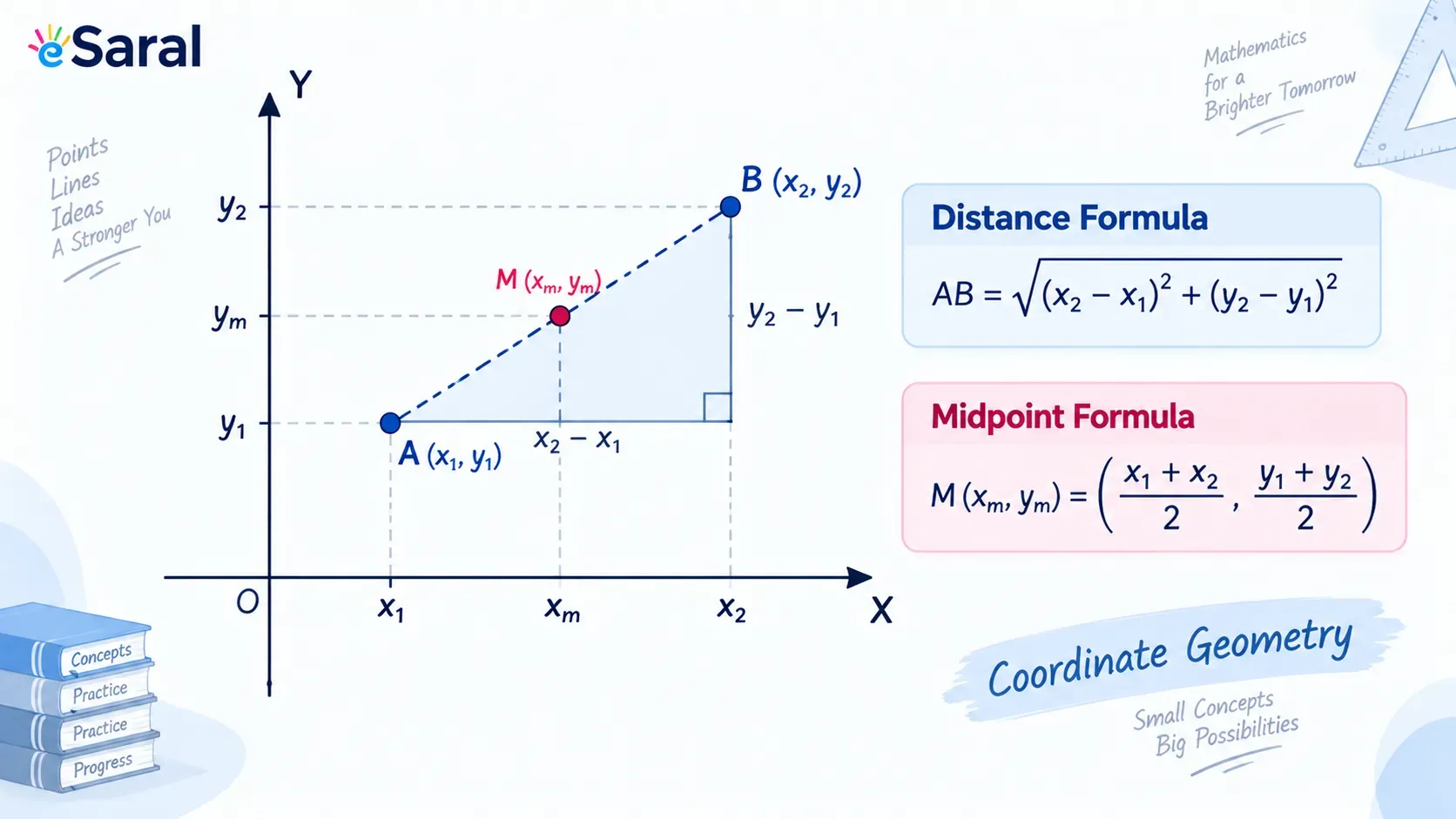
Coordinate Geometry Class 10: Formulas, Notes & Solved Examples
Coordinate geometry class 10: complete CBSE formulas — distance, section, midpoint and area of triangle — with derivation, notes and solved examples.
How to make Notes For JEE Smart Notes Strategy of an AIR 41
Learn how to make notes for JEE the way toppers do — indexing, shorthand, and smart short notes for JEE that cut revision time to just 5–7 days.
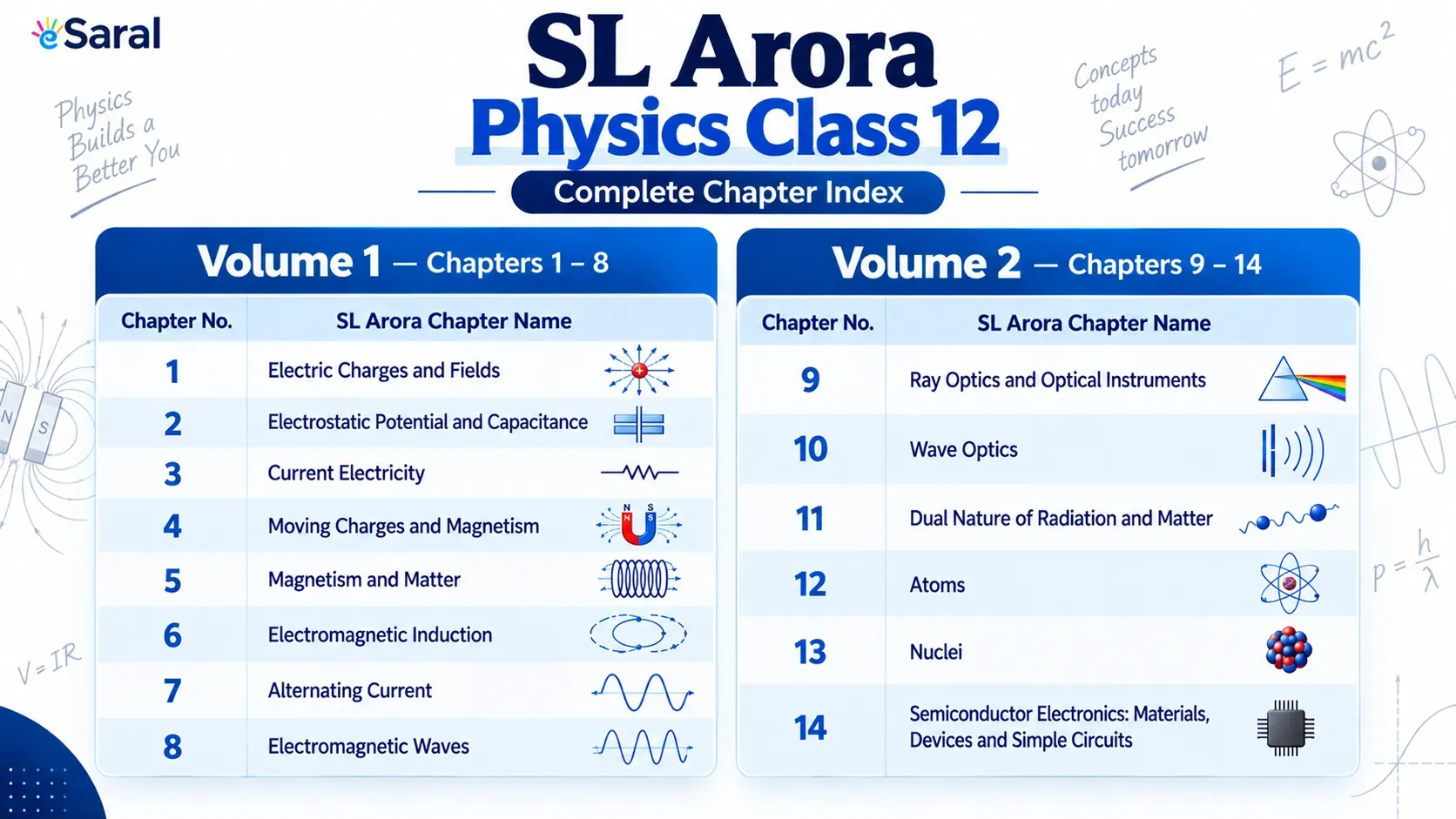
SL Arora Physics Class 12 Index – Chapter List for Volume 1 & 2
SL Arora Physics Class 12 index — complete chapter list for Volume 1 & 2, mapped to NCERT solutions for board, JEE Main, and NEET preparation.