
Sequence-series - JEE Advanced Previous Year Questions with Solutions

eSaral Academic and Editorial Team
Summary
Sequence and Series JEE Advanced previous year questions cover Arithmetic Progression (AP), Geometric Progression (GP), Harmonic Progression (HP), and AM–GM inequalities. Questions are typically 3–4 marks, single or multiple correct, and test conceptual depth over formula recall. Detailed solutions for all 10 questions are provided below.

eSaral > JEE Advanced Maths PYQs > Sequence and Series

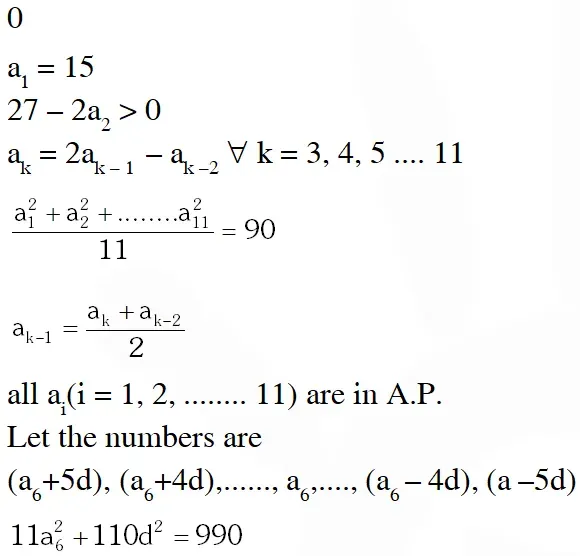
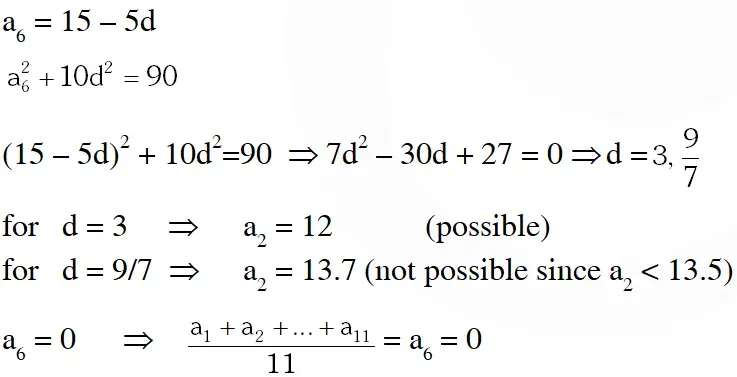
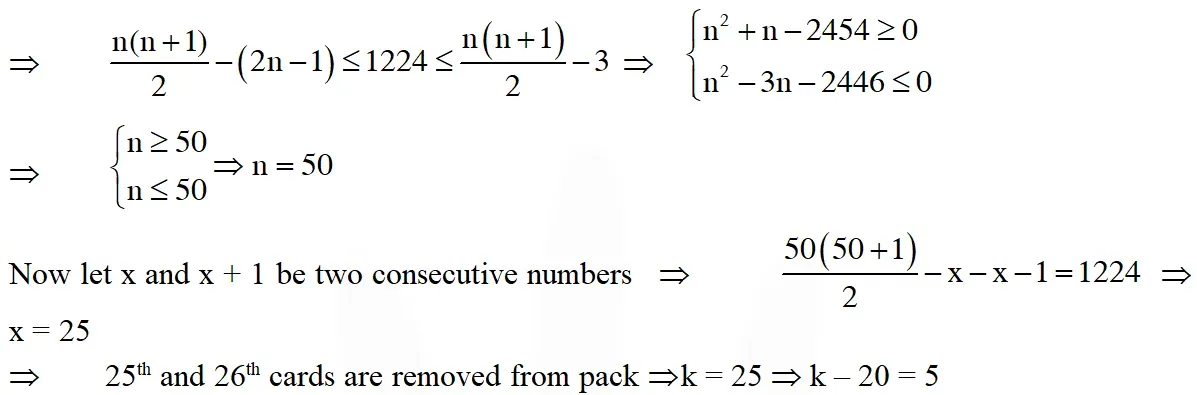
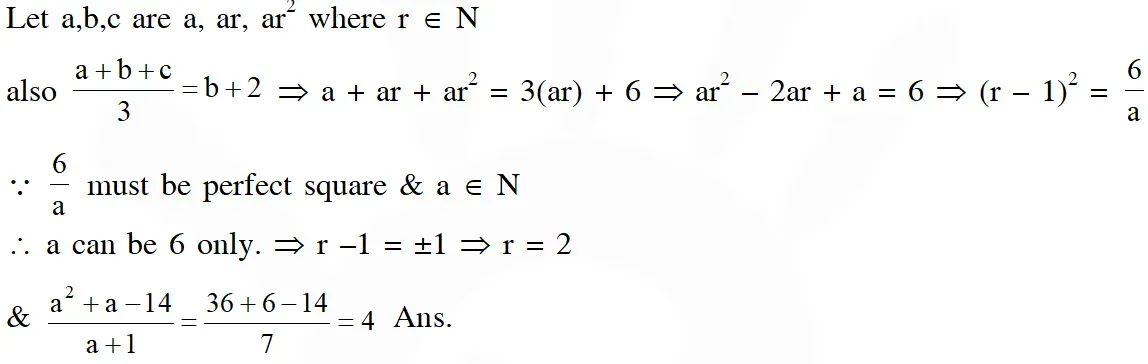
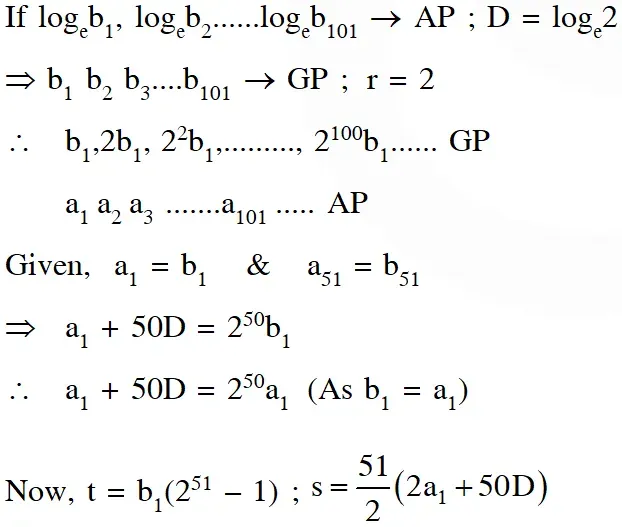
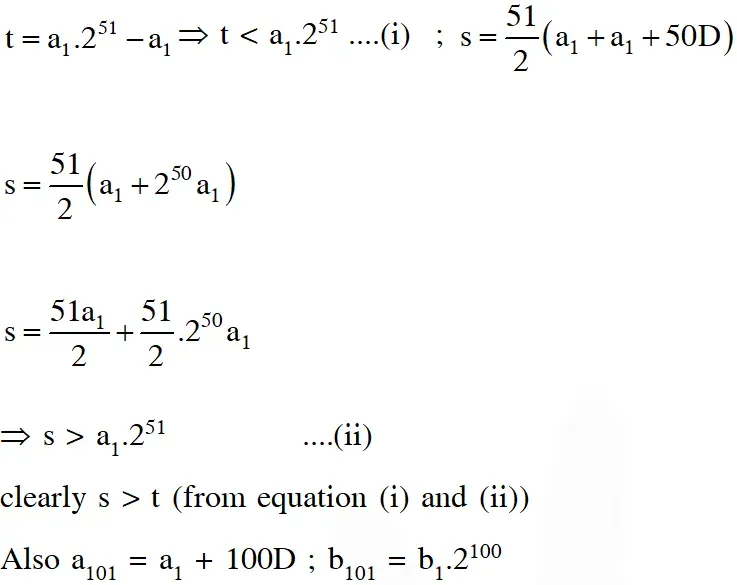
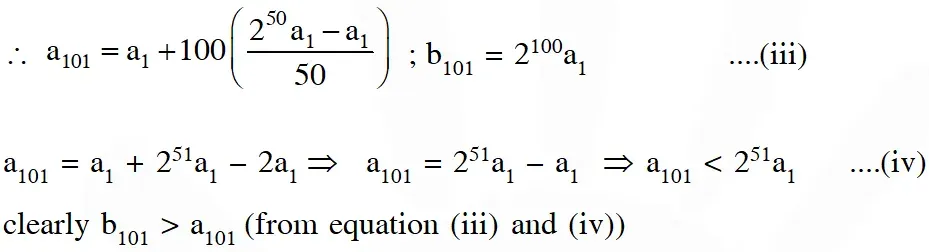
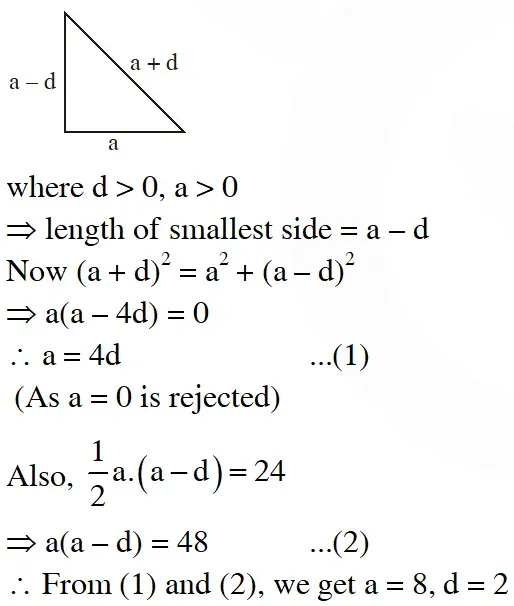
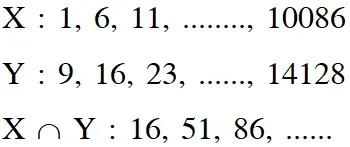
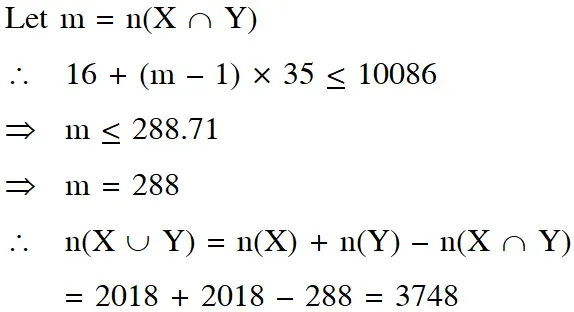
JEE Advanced Previous Year Questions of Math with Solutions are available at eSaral. Practicing JEE Advanced Previous Year Papers Questions of mathematics will help the JEE aspirants in realizing the question pattern as well as help in analyzing weak & strong areas. eSaral helps the students in clearing and understanding each topic in a better way. eSaral also provides complete chapter-wise notes of Class 11th and 12th both for all subjects. Besides this, eSaral also offers NCERT Solutions, Previous year questions for JEE Main and Advance, Practice questions, Test Series for JEE Main, JEE Advanced and NEET, Important questions of Physics, Chemistry, Math, and Biology and many more. Download eSaral app for free study material and video tutorials. [esquestion] If the sum of first $n$ terms of an A.P. is $\mathrm{c} n^{2},$ then the sum of squares of these $n$ terms is (A) $\frac{\mathrm{n}\left(4 \mathrm{n}^{2}-1\right) \mathrm{c}^{2}}{6}$ (B) $\frac{\mathrm{n}\left(4 \mathrm{n}^{2}+1\right) \mathrm{c}^{2}}{3}$ (C) $\frac{\mathrm{n}\left(4 \mathrm{n}^{2}-1\right) \mathrm{c}^{2}}{3}$ (D) $\frac{n\left(4 n^{2}+1\right) c^{2}}{6}$ #tag# [JEE 2009, 3 (–1)] #sol# (C) $\mathrm{C}$ $\mathrm{S}_{\mathrm{n}}=\mathrm{cn}^{2}$ $\mathrm{S}_{\mathrm{n}-1}=\mathrm{c}(\mathrm{n}-1)^{2}$ $\mathrm{T}_{\mathrm{n}}=\mathrm{S}_{\mathrm{n}}-\mathrm{S}_{\mathrm{n}-1}=\mathrm{c}(2 \mathrm{n}-1)$ $\mathrm{T}_{\mathrm{n}}^{\prime}=\mathrm{T}_{\mathrm{n}}^{2}=\mathrm{c}^{2}\left(4 \mathrm{n}^{2}-4 \mathrm{n}+1\right)$ $\sum \mathrm{T}_{\mathrm{n}}^{\prime}=\mathrm{nc}^{2}\left(\frac{4 \mathrm{n}^{2}-1}{3}\right)$ [/esquestion] [esquestion] Let $a_{1}, a_{2}, a_{3}, \ldots \ldots \ldots a_{11}$ be real numbers satisfying $\mathrm{a}_{1}=15,27-2 \mathrm{a}_{2}>0$ and $\mathrm{a}_{\mathrm{k}}=2 \mathrm{a}_{\mathrm{k}-1}-\mathrm{a}_{\mathrm{k}-2}$ for $\mathrm{k}=3,4 \ldots \ldots \ldots 11$ If $\frac{a_{1}^{2}+a_{2}^{2}+\ldots \ldots+a_{11}^{2}}{11}=90,$ then the value of $\frac{a_{1}+a_{2}+\ldots \ldots+a_{11}}{11}$ is equal to #tag# [JEE 2010,3+3] #sol# 0 [/esquestion] [esquestion] The minimum value of the sum of real numbers $a^{-5}, a^{-4}, 3 a^{-3}, 1, a^{8}$ and $a^{10}$ with $a>0$ is #tag# [JEE 2011, 4] #sol# 8 As $a>0$ and all the given terms are positive hence considering A.M. $\geq$ G.M. for given numbers : $\frac{\mathrm{a}^{-5}+\mathrm{a}^{-4}+\mathrm{a}^{-3}+\mathrm{a}^{-3}+\mathrm{a}^{-3}+\mathrm{a}^{8}+\mathrm{a}^{10}}{7} \geq\left(\mathrm{a}^{-5} \cdot \mathrm{a}^{-4} \cdot \mathrm{a}^{-3} \cdot \mathrm{a}^{-3} \cdot \mathrm{a}^{-3} \cdot \mathrm{a}^{10}\right)^{\frac{1}{7}}$ $\Rightarrow \frac{\mathrm{a}^{-5}+\mathrm{a}^{-4}+\mathrm{a}^{-3}+\mathrm{a}^{-3}+\mathrm{a}^{-3}+\mathrm{a}^{8}+\mathrm{a}^{10}}{7} \geq 1 \quad \Rightarrow\left(\mathrm{a}^{-5}+\mathrm{a}^{-4}+3 \mathrm{a}^{-3}+\mathrm{a}^{-3}+\mathrm{a}^{10}\right)_{\min }=7$ where $\mathrm{a}^{-5}=\mathrm{a}^{-4}=\mathrm{a}^{-3}=\mathrm{a}^{8}=\mathrm{a}^{10}$ i.e. $\mathrm{a}=1$ $\Rightarrow\left(\mathrm{a}^{-5}+\mathrm{a}^{-4}+3 \mathrm{a}^{-3}+\mathrm{a}^{8}+\mathrm{a}^{10}+1\right)_{\min }=8 \quad$ when $\mathrm{a}=1$ [/esquestion] [esquestion] Let $a_{1}, a_{2}, a_{3}, \ldots \ldots \ldots, a_{100}$ be an arithmetic progression with $a_{1}=3$ and $S_{p}=\sum_{i=1}^{p} a_{i}, 1 \leq p \leq 100 .$ For any integer $n$ with $1 \leq n \leq 20,$ let $m=5 n .$ If $\frac{S_{m}}{S_{n}}$ does not depend on n, then $a_{2}$ is #tag# [JEE 2011, 4] #sol# 9 or 3 9 or 3 (Comment : The information about the common difference i.e. zero or non-zero is not given in the question. Hence there are two possible answers) Consider $\mathrm{d} \neq 0$ the solution is $\mathrm{a}_{1}, \mathrm{a}_{2}, \mathrm{a}_{3}, \ldots \ldots \ldots \ldots ., \mathrm{a}_{100} \rightarrow \mathrm{AP}$ $\mathrm{a}_{1}=3 ; \quad \mathrm{S}_{\mathrm{p}}=\sum_{\mathrm{i}=1}^{\mathrm{p}} \mathrm{a}_{\mathrm{i}} \quad 1 \leq \mathrm{n} \leq 20$ $\mathrm{m}=5 \mathrm{n}$ $\frac{\mathrm{S}_{\mathrm{m}}}{\mathrm{S}_{\mathrm{n}}}=\frac{\frac{\mathrm{m}}{2}\left[2 \mathrm{a}_{1}+(\mathrm{m}-1) \mathrm{d}\right]}{\frac{\mathrm{n}}{2}\left[2 \mathrm{a}_{1}+(\mathrm{n}-1) \mathrm{d}\right]}$ $\frac{\mathrm{S}_{\mathrm{m}}}{\mathrm{S}_{\mathrm{n}}}=\frac{5\left[\left(2 \mathrm{a}_{1}-\mathrm{d}\right)+5 \mathrm{nd}\right]}{\left[\left(2 \mathrm{a}_{1}-\mathrm{d}\right)+\mathrm{nd}\right]}$ for $\frac{\mathrm{S}_{\mathrm{m}}}{\mathrm{S}_{\mathrm{n}}}$ to be independent of $\mathrm{n}$ $\begin{array}{ll}{\therefore 2 \mathrm{a}_{1}-\mathrm{d}=0} & {\Rightarrow \mathrm{d}=2 \mathrm{a}_{1} \Rightarrow \mathrm{d}=6 \Rightarrow \mathrm{a}_{2}=9} \\ {\text { If } \mathrm{d}=0 \quad \Rightarrow} & {\mathrm{a}_{2}=\mathrm{a}_{1}=3}\end{array}$ [/esquestion] [esquestion] Let $a_{1}, a_{2}, a_{3}, \ldots .$ be in harmonic progression with $a_{1}=5$ and $a_{20}=25 .$ The least positive integer n for which $a_{n}<0$ is (A) 22 (B) 23 (C) 24 (D) 25 #tag# [JEE 2012, 3 (–1)] #sol# (D) $a_{1}, a_{2}, a_{3} \dots \ldots . .$ be in $\mathrm{H.P} \Rightarrow \frac{1}{\mathrm{a}_{1}}, \frac{1}{\mathrm{a}_{2}}, \frac{1}{\mathrm{a}_{3}} \ldots$ be in A.P. in A.P. $\mathrm{T}_{1}=\frac{1}{\mathrm{a}_{1}}=\frac{1}{5}$ and $\mathrm{T}_{20}=\frac{1}{\mathrm{a}_{20}}=\frac{1}{25}$ $\therefore \mathrm{T}_{20}=\mathrm{T}_{1}+19 \mathrm{d}$ $\frac{1}{25}=\frac{1}{5}+19 \mathrm{d} \Rightarrow \mathrm{d}=-\frac{4}{19 \times 25}$ $\mathrm{T}_{\mathrm{n}}=\mathrm{T}_{1}+(\mathrm{n}-1) \mathrm{d}<0 \Rightarrow \frac{1}{5}-\frac{(\mathrm{n}-1) \cdot 4}{19 \times 25}<0 \quad \Rightarrow \frac{1}{5}<\frac{4(\mathrm{n}-1)}{25 \times 19} \Rightarrow \frac{5 \times 19}{4}+1<\mathrm{n} \Rightarrow \frac{99}{4}<\mathrm{n}$ $\Rightarrow$ least positive integer $n$ is 25 [/esquestion] [esquestion] Let $\mathrm{S}_{\mathrm{n}}=\sum_{\mathrm{k}=1}^{4 \mathrm{n}}(-1)^{\frac{\mathrm{k}(\mathrm{k}+1)}{2}} \mathrm{k}^{2} .$ Then $\mathrm{S}_{\mathrm{n}}$ can take value(s) (A) 1056 (B) 1088 (C) 1120 (D) 1332 #tag# [JEE-Advanced 2013, 4, (–1)] #sol# (A,D) $\mathrm{S}_{\mathrm{n}}=-1^{2}-2^{2}+3^{2}+4^{2}-5^{2}-6^{2}+7^{2}+8^{2} \ldots \ldots \ldots$ $\mathrm{S}_{\mathrm{n}}^{\mathrm{n}}=\left(3^{2}-1^{2}\right)+\left(4^{2}-2^{2}\right)+\ldots \ldots \ldots \ldots$ $\mathrm{S}_{\mathrm{n}}=2(1+2+3+\ldots \ldots+4 \mathrm{n})=\frac{2(4 n)(4 \mathrm{n}+1)}{2}$ $\mathrm{S}_{\mathrm{n}}=4 \mathrm{n}(4 \mathrm{n}+1)$ $\mathrm{S}_{\mathrm{n}}=4 \mathrm{n}(4 \mathrm{n}+1)=1056$ is possible when $\mathrm{n}=8$ $4 n(4 n+1)=1088$ not possible $4 n(4 n+1)=1120$ not possible $4 n(4 n+1)=1332$ possible when $n=9$ [/esquestion] [esquestion] A pack contains n cards numbered from 1 to n. Two consecutive numbered cards are removed from the pack and the sum of the numbers on the remaining cards is 1224. If the smaller to the numbers on the removed cards is k, then k – 20 = #tag# [JEE-Advanced 2013, 4, (–1)] #sol# 5 When 1 and 2 are removed from numbers 1 to n then we get maximum possible sum of remaining numbers and when n –1,n are removed then get minimum possible sum of remaining numbers. [/esquestion] [esquestion] Let a, b, c be positive integers such that $\frac{b}{a}$ is an integer. If $a, b, c$ are in geometric progression and the arithmetic mean of $a, b, c$ is $b+2,$ then the value of $\frac{a^{2}+a-14}{a+1}$ is #tag# [JEE(Advanced)-2014, 3] #sol# 4 [/esquestion] [esquestion] Let $b_{i}>1$ for $i=1,2, \ldots \ldots, 101 .$ Suppose $\log _{e} b_{1}, \log _{e} b_{2}, \ldots \ldots, \log b_{10}$ are in Arithmetic Progression (A.P.) with the common difference log $2 .$ Suppose $a_{1}, a_{2}, \ldots . ., a_{101}$ are in A.P. such that $a_{1}=$ $b_{1}$ and $a_{51}=b_{51}$. If $t=b_{1}+b_{2}+\ldots . .+b_{51}$ and $s=a_{1}+a_{2}+\ldots . .+a_{51}$ then (A) $\mathrm{s}>\mathrm{t}$ and $\mathrm{a}_{101}>\mathrm{b}_{101}$ (B) $\mathrm{s}>\mathrm{t}$ and $\mathrm{a}_{101}<\mathrm{b}_{101}$ (C) $\mathrm{s}<\mathrm{t}$ and $\mathrm{a}_{101}>\mathrm{b}_{101}$ (D) $\mathrm{s}<\mathrm{t}$ and $\mathrm{a}_{101}<\mathrm{b}_{101}$ #tag# [JEE(Advanced)-2016] #sol# B [/esquestion] [esquestion] The sides of the right angled triangle are in arithmetic progression. If the triangle has area 24, then what is the length of its smallest side ? #tag# [JEE(Advanced)-2017] #sol# 6 [/esquestion] [esquestion] Let $X$ be the set consisting of the first 2018 terms of the arithmetic progression $1,6,11, \ldots .$ , and $Y$ be the set consisting of the first 2018 terms of the arithmetic progression $9,16,23,$ $\ldots \ldots$ Then, the number of elements in the set $X \cup Y$ is #tag# [JEE(Advanced)-2018] #sol# 3748 [/esquestion]

Once Sequence & Series - JEE Advanced PYQs (Maths) is strong, test your preparation with complete papers from the JEE Advanced exam paper.
Frequently Asked Questions
What is the fastest way to identify whether a sequence is AP, GP, or HP?
Check differences first: if $a_{k} - a_{k-1}$ is constant, it is an AP. If $a_k / a_{k-1}$ is constant, it is a GP. If the reciprocals $1/a_k$ form an AP, it is an HP. In JEE Advanced, the recurrence relation form (like $a_k = 2a_{k-1} - a_{k-2}$) always signals an AP — rearrange it as $a_k - a_{k-1} = a_{k-1} - a_{k-2}$.
Is Sequence and Series more important for JEE Main or JEE Advanced?
Both exams test this topic, but differently. JEE Main tests direct formula application — sum formulas, nth term, inserting means. JEE Advanced tests conceptual depth, pattern recognition, and multi-step reasoning, often combining AP/GP/HP with inequalities or number theory. You need a stronger conceptual grip for JEE Advanced
How many questions from Sequence and Series appear in JEE Advanced each year?
Typically, 1–2 questions appear from Sequence and Series in JEE Advanced each year. The topic carries around 4–8 marks per paper. Between 2009 and 2023, there has been at least one question from this chapter in every paper. It is considered a medium-difficulty but high-reward topic because the concepts are well-defined.
Where can I find more Sequence and Series practice material for JEE Advanced?
After completing these PYQs, practise from the NCERT Solutions for Class 11 Maths Chapter 9 for foundational problems, then move to eSaral's topic-wise test series. eSaral's JEE Advanced course, taught by IIT Bombay faculty including AIR-41 rankers, includes chapter-wise video lectures, solved examples, and a 5-layer doubt-solving system to clear every conceptual block.
What is the standard method to solve HP problems in JEE Advanced?
Always convert the HP to its corresponding AP by taking reciprocals. Find the common difference of the AP using the given terms, then work entirely within the AP. Convert back to HP only for the final answer. There is no direct sum formula for HP, so every HP JEE Advanced question is really an AP problem in disguise.
How do I apply AM–GM in sequence problems where coefficients are greater than 1?
Split the term with a coefficient into that many equal separate terms before applying AM–GM. For example, $3a^{-3}$ becomes three separate $a^{-3}$ terms. This ensures the product of all terms simplifies cleanly (usually to 1), allowing you to find the exact minimum. This technique appeared directly in the JEE Advanced 2011 paper.
Team eSaral
eSaral Academic and Editorial Team
Team eSaral is the collective author profile for educational content created by eSaral’s teachers and academic contributors. The team draws on expertise from IIT graduates, doctors, experienced educators and subject specialists to develop resources for JEE, NEET and school students. Our articles aim to explain concepts clearly and help students study with confidence.
Related Posts
Plant Cell Diagram: Labelled Structure, Parts and Functions
Simple, labelled plant cell diagram with parts and functions. Covers plant cell structure for Class 6, 7, 8, 9, 10 and 11 students, CBSE-aligned.
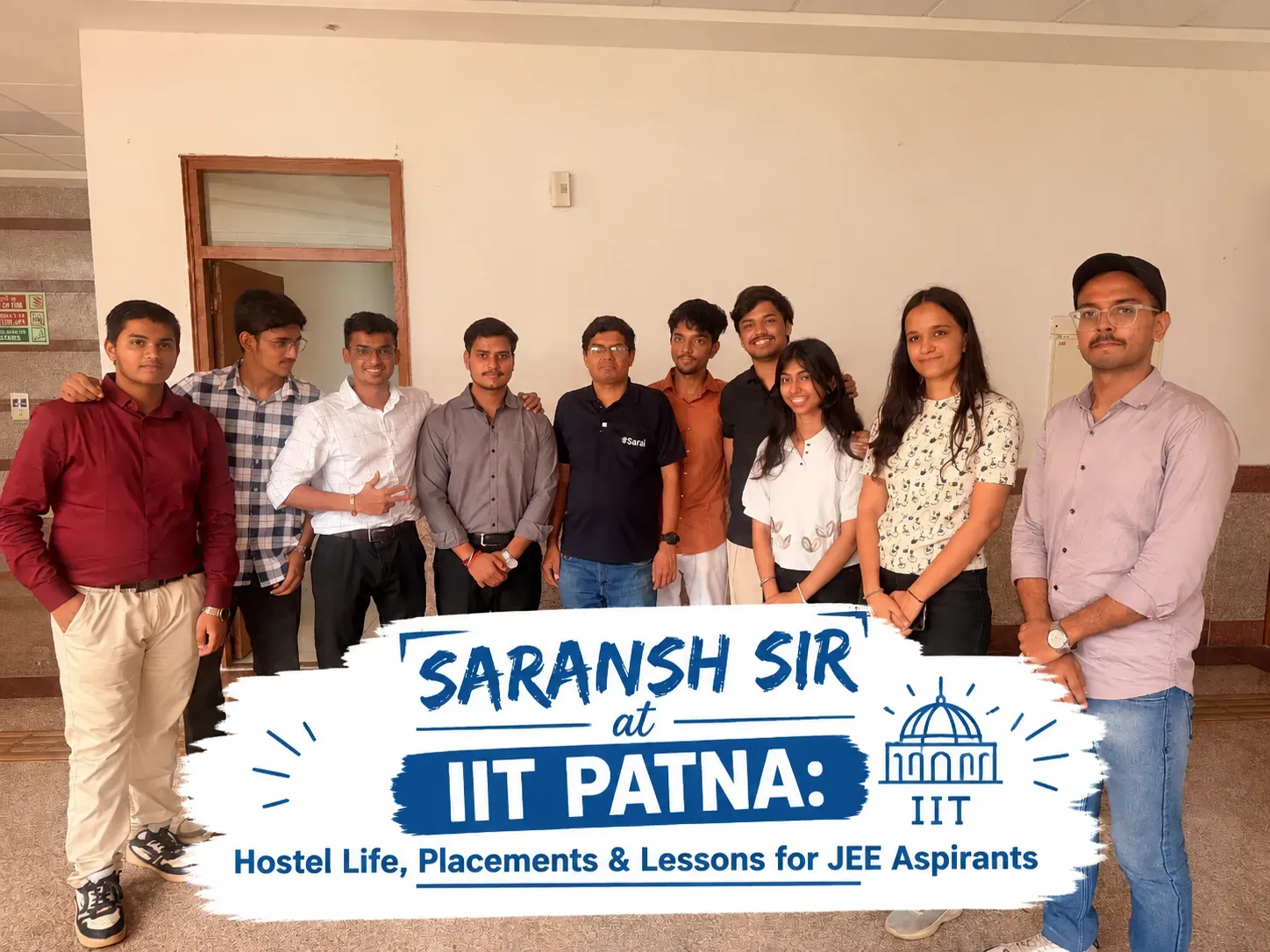
Saransh Gupta Sir's Visit to IIT Patna: Hostel Life, Placements & Lessons for JEE Aspirants
Inside Saransh Gupta Sir's IIT Patna visit — hostel life, the library, placements, internships, and real advice for JEE aspirants from students living the IIT dream.
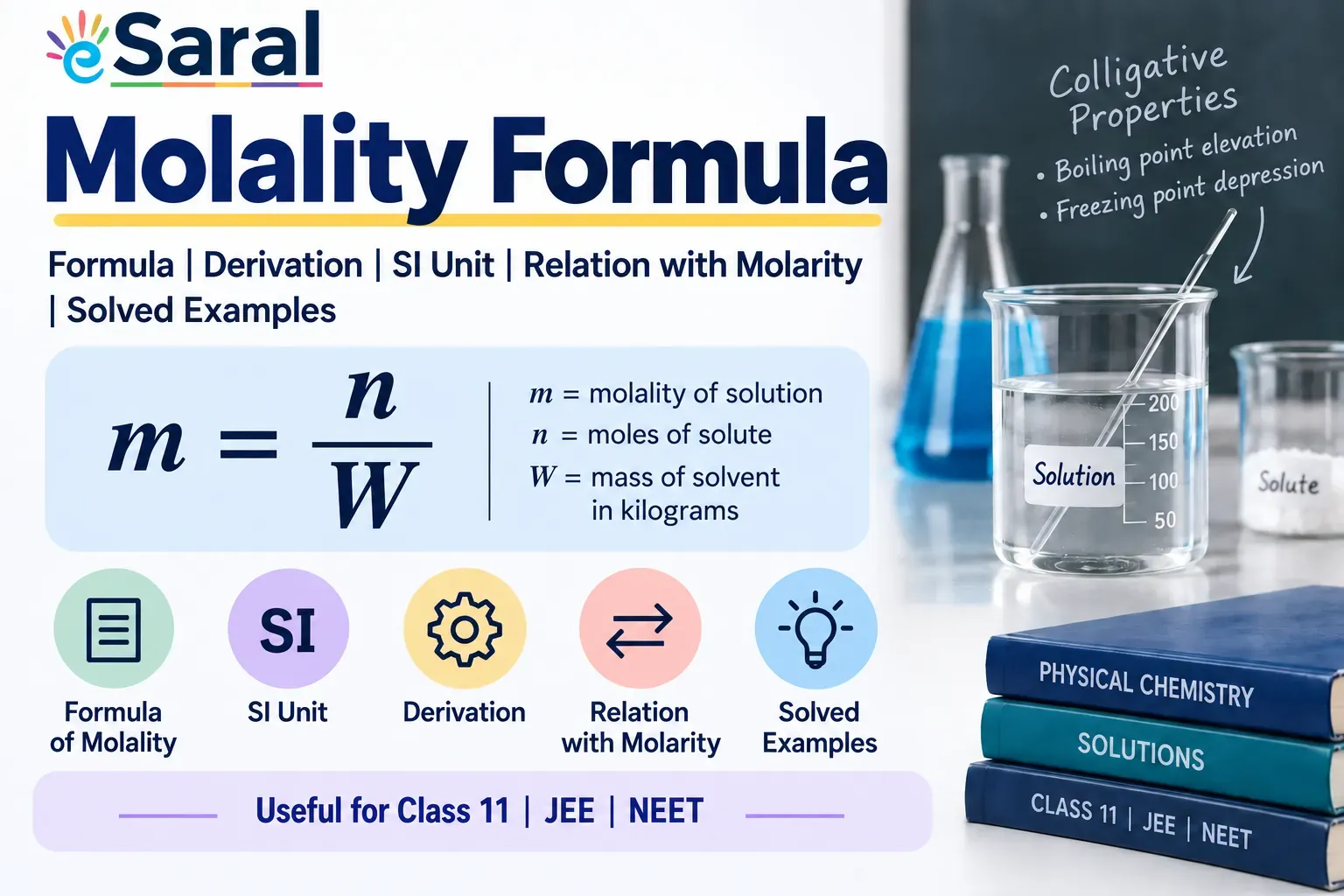
Molality Formula: Formula for Molality, Derivation & Solved Examples
Molality formula is $m = \dfrac{n}{W}$. Learn the formula of molality, its SI unit, derivation, relation with molarity, and solved examples for Class 11, JEE and NEET.
BITSAT Previous Year Question Paper PDF
Download BITSAT previous year question papers PDF. Get year-wise BITSAT PYQs, memory-based papers, exam pattern, and preparation tips to improve your BITSAT preparation.

Teachers’ Day 2026 at eSaral Gurukul: Celebrating the Bond Between Students, Teachers & Mentors
See how Teachers’ Day 2026 was celebrated at eSaral Gurukul, reflecting the bond among students, teachers, and mentors, and the role of guidance beyond academics.
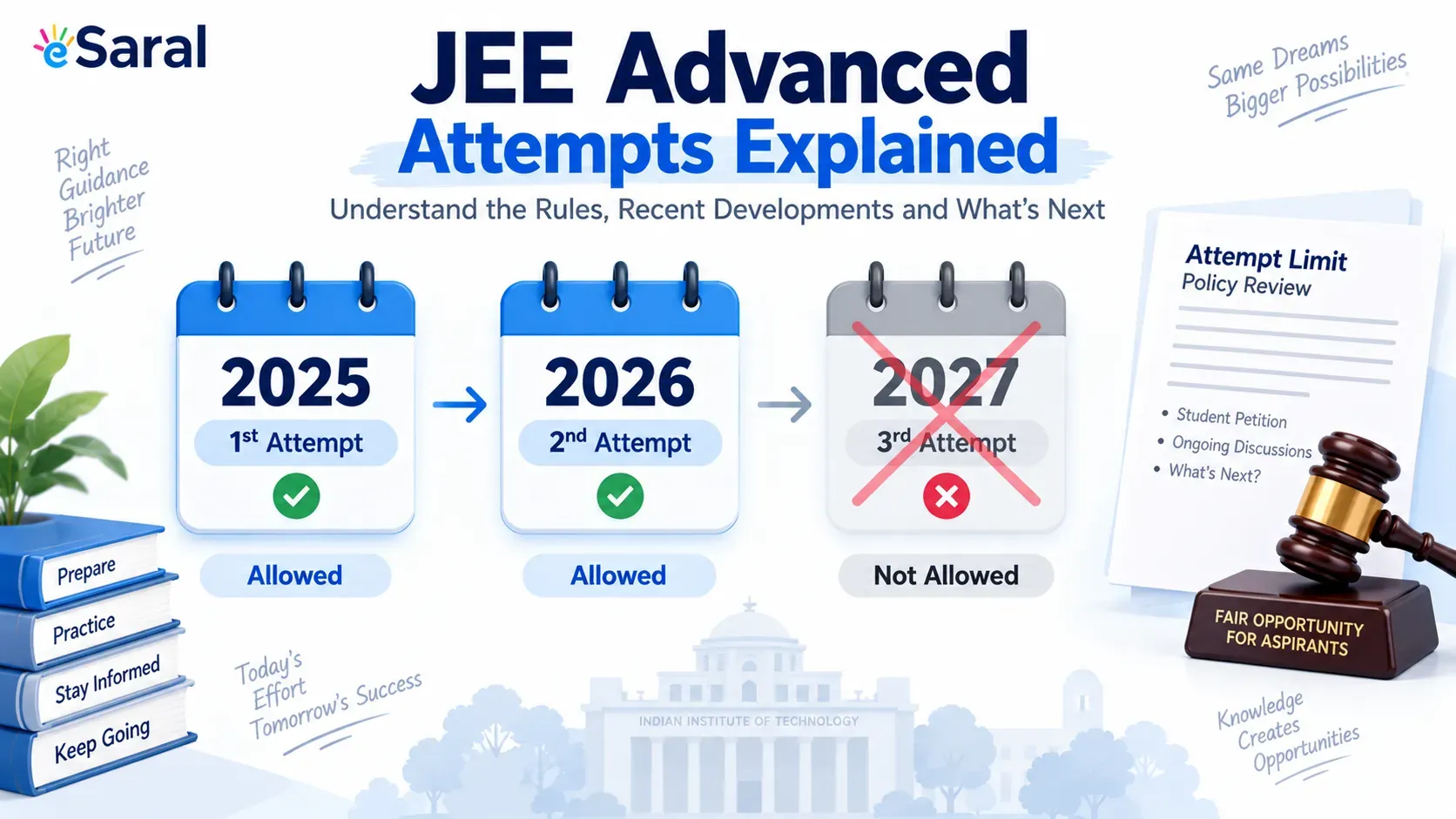
JEE Advanced Attempts: Can You Give It a Third Time? Rules Explained
JEE Advanced attempts: current rule is 2 consecutive years only: full eligibility criteria, the 2025 third-attempt controversy, and the latest 2026 petition news.

Best JEE Preparation App
Best JEE preparation app for Main & Advanced: AI mock tests, live doubt-solving, thousands of practice questions. JEE preparation app for droppers & Class 11-12.
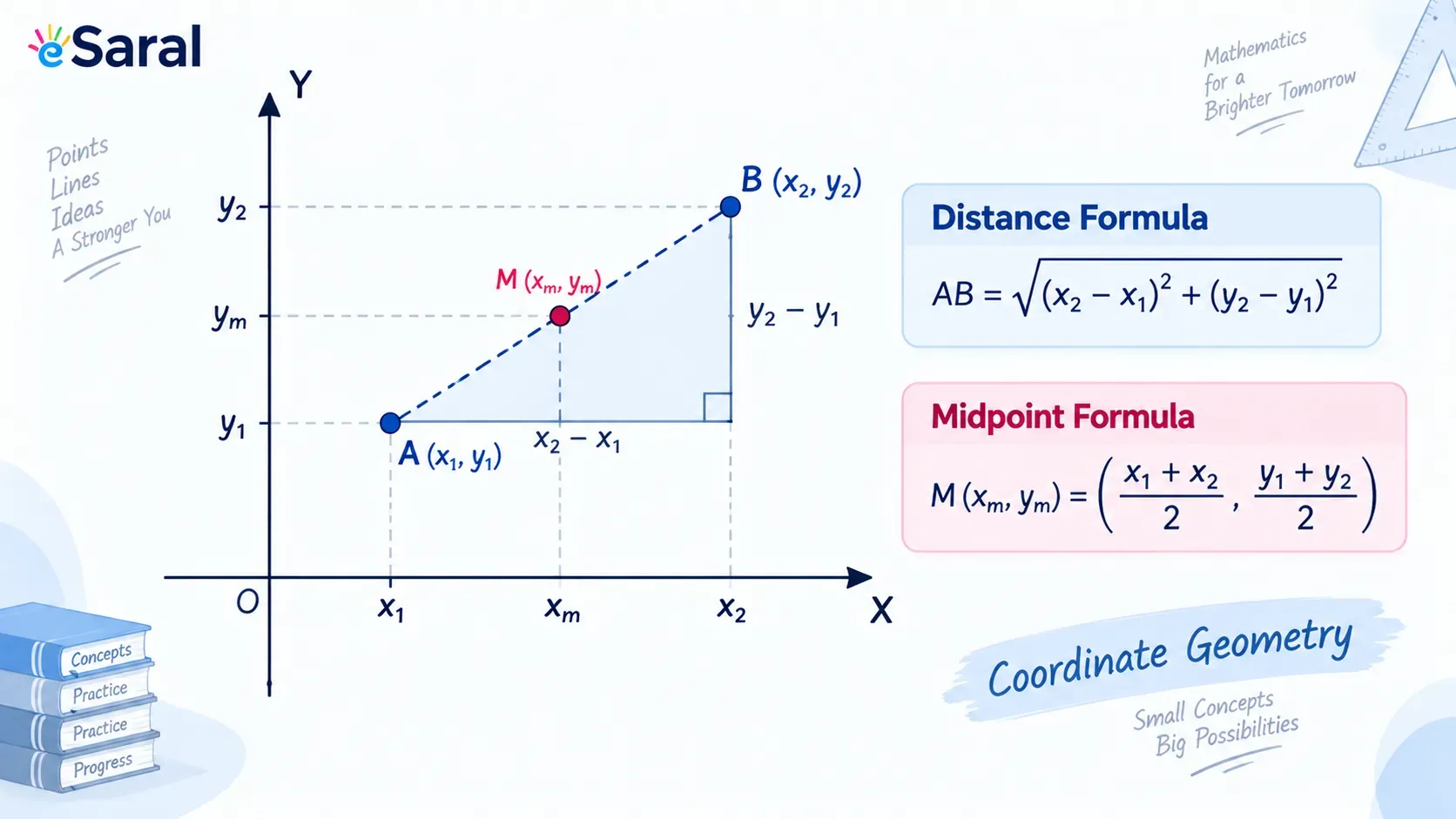
Coordinate Geometry Class 10: Formulas, Notes & Solved Examples
Coordinate geometry class 10: complete CBSE formulas — distance, section, midpoint and area of triangle — with derivation, notes and solved examples.
How to make Notes For JEE Smart Notes Strategy of an AIR 41
Learn how to make notes for JEE the way toppers do — indexing, shorthand, and smart short notes for JEE that cut revision time to just 5–7 days.
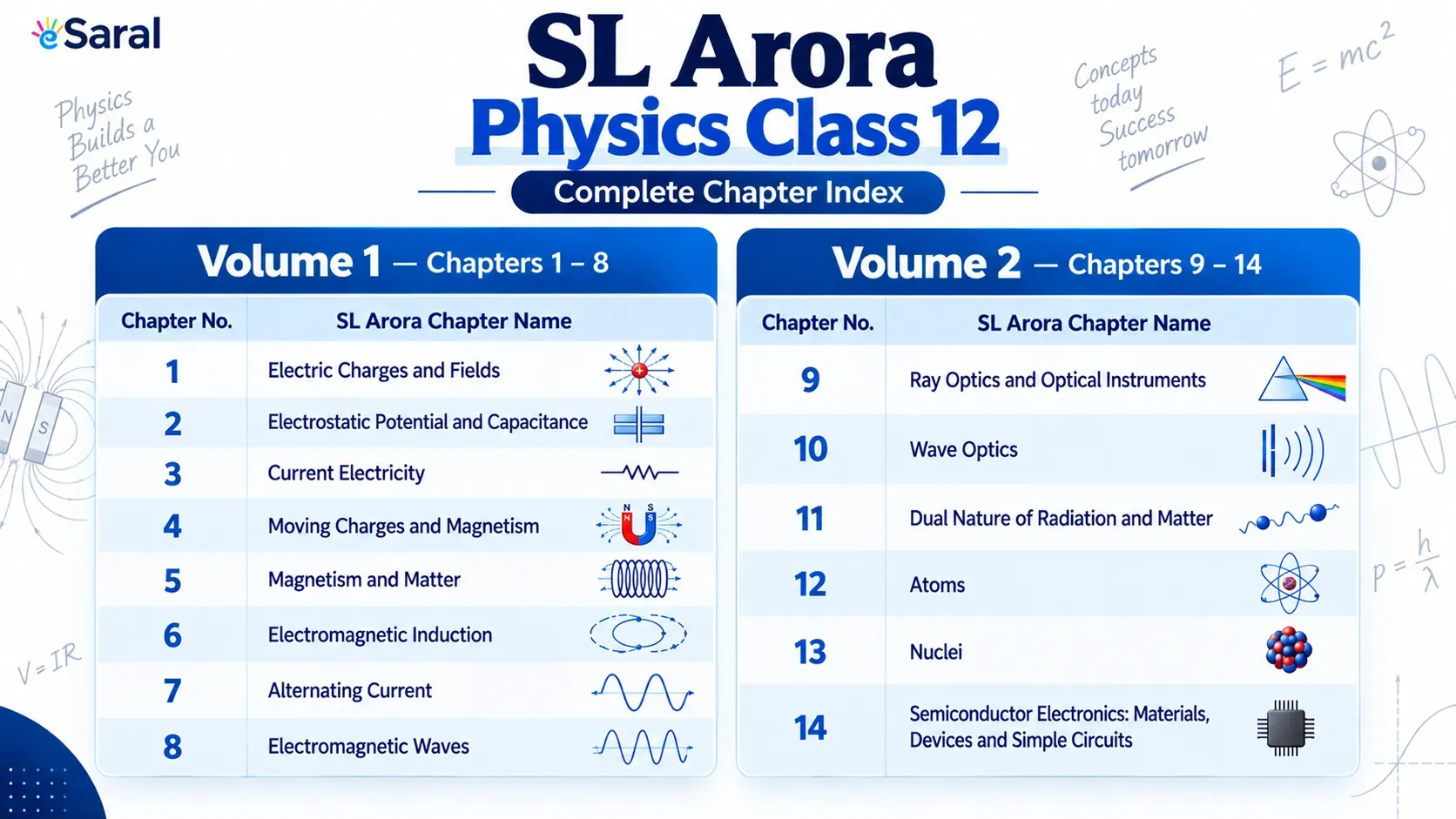
SL Arora Physics Class 12 Index – Chapter List for Volume 1 & 2
SL Arora Physics Class 12 index — complete chapter list for Volume 1 & 2, mapped to NCERT solutions for board, JEE Main, and NEET preparation.