
States of Matter - JEE Main Previous Year Questions with Solutions

eSaral Academic and Editorial Team
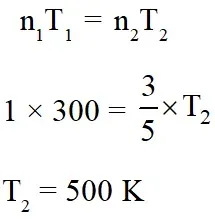
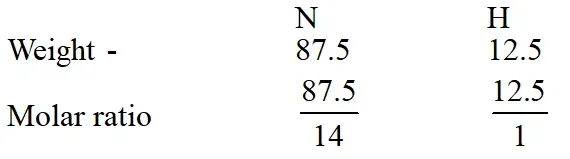
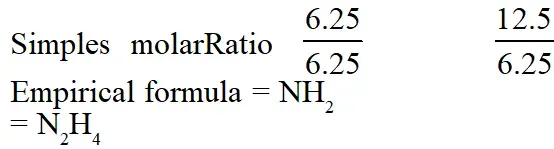
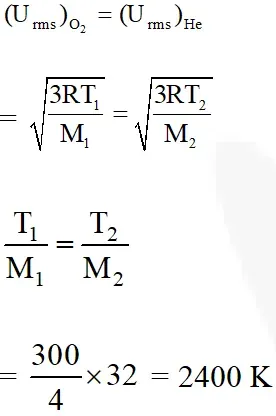
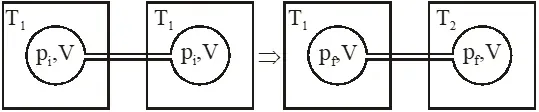
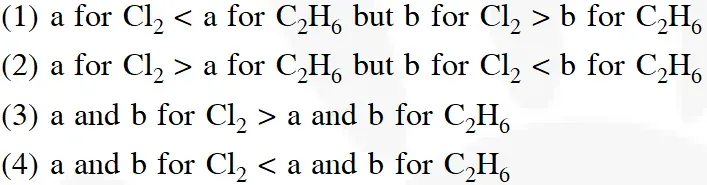
JEE Main Previous Year Papers Questions of Chemistry With Solutions are available at eSaral. Simulator Previous Years AIEEE/JEE Mains Questions [esquestion] The molecular velocity of any gas is :- (1) inversely proportional to the square root of temperature (2) inversely proportional to absolute temperature (3) directly proportional to square of temperature (4) directly proportional to square root of temperature #tag# [AIEEE-2011] #sol# (4) [/esquestion] [esquestion] , v and u represent most probable velocity, average velocity and root mean square velocity respectively of a gas at a particular temperature. The correct order among the following is - (1) > u > v (2) v > u > (3) u > v > (4) u > > v #tag# [JEE(Main)-2012] #sol# (3) [/esquestion] [esquestion] An open vessel at 300 K is heated till $\frac{2}{5}$th of the air in it is expelled. Assuming that the volume of the vessel remains constant, the temperature to which the vessel is heated is :- (1) 750 K (2) 400 K (3) 500 K (4) 1500K #tag# [JEE(Main-online)-2012] #sol# (3) [/esquestion] [esquestion] For 1 mol of an ideal gas at constant temperature T, the plot of (log P) against(logV) is a (P : Pressure, V : Volume) :- (1) Straight line parallel to x-axis (2) Curve starting at origin] (3) Straight line with a negative slope (4) Straight line passing through origin #tag# [JEE(Main-online)-2012] #sol# (3) PV = nRT log (PV) = log (nRT) log P + log V = log (nRT) log P = –log V + log (nRT) y = – mx + C slope $=\tan \theta=-1$ [/esquestion] [esquestion] The relationship among most probable velocity, average velocity and root mean square velocity is respectively :- (1) $\sqrt{2}: \sqrt{8 / \pi}: \sqrt{3}$ (2) $\sqrt{2}: \sqrt{3}: \sqrt{8 / \pi}$ (3) $\sqrt{3}: \sqrt{8 / \pi}: \sqrt{2}$ (4) $\sqrt{8 / \pi}: \sqrt{3}: \sqrt{2}$ #tag# [JEE(Main-online)-2012] #sol# (1) [/esquestion] [esquestion] Which one of the following is the wrong assumption of kinetic theory of gases ? (1) All the molecules move in straight line between collision and with same velocity. (2) Molecules are separated by great distances compared to their sizes. (3) Pressure is the result of elastic collision of molecules with the container's wall. (4) Momentum and energy always remain conserved. #tag# [JEE(Main-online)-2013] #sol# (1) [/esquestion] [esquestion] By how many folds the temperature of a gas would increase when the root mean square velocity of the gas molecules in a container of fixed volume is increased from $5 \times 10^{4} \mathrm{cm} /$ s to $10 \times 10^{4} \mathrm{cm} / \mathrm{s} ?$ (1) Four (2) three (3) Two (4) Six #tag# [JEE(Main-online)-2013] #sol# (1) $\mathrm{u}_{\mathrm{rms}} \propto \sqrt{\mathrm{T}}$ $\left(\frac{5 \times 10^{4}}{10 \times 10^{4}}\right)=\frac{\mathrm{T}_{1}}{\mathrm{T}_{2}}$ $\frac{1}{4}=\frac{T_{1}}{T_{2}}$ $\mathrm{T}_{2}=4 \mathrm{T}_{1}$ [/esquestion] [esquestion] For gaseous state, if most probable speed is denoted by C, average speed by $\overline{\mathrm{c}}$ and mean square speed by C, then for a large number of molecules the ratios of these speeds are :- (1) $\mathrm{C}: \overline{\mathrm{C}}: \mathrm{C}=1.225: 1.128: 1$ (2) $\mathrm{C}: \overline{\mathrm{C}}: \mathrm{C}=1.128: 1.225: 1$ (3) $\mathrm{C}: \overline{\mathrm{C}}: \mathrm{C}=1: 1.128: 1.225$ (4) $\mathrm{C}: \overline{\mathrm{C}}: \mathrm{C}=1: 1.225: 1.128$ #tag# [JEE(Main-offline)-2013] #sol# (3) $\mathrm{u}_{\mathrm{avg}}=\sqrt{\frac{8 \mathrm{RT}}{\pi \mathrm{M}}}$ $\mathrm{u}_{\mathrm{rms}}=\sqrt{\frac{3 \mathrm{RT}}{\mathrm{M}}}$ $\mathrm{u}_{\mathrm{mp}}=\sqrt{\frac{2 \mathrm{RT}}{\mathrm{M}}}$ [/esquestion] [esquestion] A gaseous compound of nitrogen and hydrogen contains 12.5%(by mass) of hydrogen. The density of the compound relative to hydrogen is 16. The molecular formula of the compound is : (1) $\mathrm{NH}_{2}$ (2) $\mathrm{NH}_{3}$ (3) $\mathrm{N}_{3} \mathrm{H}$ (4) $\mathrm{N}_{2} \mathrm{H}_{4}$ #tag# [JEE(Main-online)-2014] #sol# (4) [/esquestion] [esquestion] The initial volume of a gas cylinder is 750.0 mL. If the pressure of gas inside the cylinder changes from 840.0 mm Hg to 360.0 mm Hg, the final volume the gas will be (1)1.750 L (2) 7.50 L (3) 3.60 L (4) 4.032 L #tag# [JEE(Main-online)-2014] #sol# (1) $\mathrm{P}_{1} \mathrm{V}_{1}=\mathrm{P}_{2} \mathrm{V}_{2}$ $840 \times 750=360 \times \mathrm{V}_{2}$ $\mathrm{V}_{2}=\frac{840 \times 750}{360}$ [/esquestion] [esquestion] The temperature at which oxygen molecules have the same root mean square speed as helium atoms have at 300 K is : (Atomic masses : He = 4 u, O = 16 u) (1) 1200 K (2) 600 K (3) 300 K (4) 2400 K #tag# [JEE(Main-online)-2014] #sol# (4) [/esquestion] [esquestion] Two closed bulbs of equal volume(V) containing an ideal gas initially at pressure pi and temperature $\mathrm{T}_{1}$ are connected through a narrow tube of negligible volume as shown in the figure below. The temperature of one of the bulbs is then raised to $\mathrm{T}_{2}$. The final pressure $\mathrm{P}_{\mathrm{f}}$ is :- #tag# [JEE(Main)-2016] #sol# (4) Initial moles and final moles are equal $\left(\mathrm{n}_{\mathrm{T}}\right)_{\mathrm{i}}=\left(\mathrm{n}_{\mathrm{T}}\right)_{\mathrm{f}}$ $\frac{\mathrm{P}_{\mathrm{i}} \mathrm{V}}{\mathrm{RT}_{1}}+\frac{\mathrm{P}_{\mathrm{i}} \mathrm{V}}{\mathrm{RT}_{1}}=\frac{\mathrm{P}_{\mathrm{f}} \mathrm{V}}{\mathrm{RT}_{1}}+\frac{\mathrm{P}_{\mathrm{f}} \mathrm{V}}{\mathrm{RT}_{2}}$ $2 \frac{\mathrm{P}_{\mathrm{i}}}{\mathrm{T}_{\mathrm{i}}}=\frac{\mathrm{P}_{\mathrm{i}}}{\mathrm{T}_{\mathrm{i}}}+\frac{\mathrm{P}_{\mathrm{i}}}{\mathrm{T}_{2}}$ $\mathrm{P}_{\mathrm{f}}=\frac{2 \mathrm{P}_{\mathrm{i}} \mathrm{T}_{2}}{\mathrm{T}_{1}+\mathrm{T}_{2}}$ [/esquestion] [esquestion] 'a' and 'b' are Vander Waal's constants for gases. Chlorine is more easily liquefied than ethane because :- #tag# [Aieee-2012] #sol# (2) Higher the 'a' value, more easily the gas is liquified, lower the 'b' value, more easily the gas is liquified [/esquestion] [esquestion] The compressibility factor for a real gas at high pressure is :- (1) $1-\frac{\text { Pb }}{\mathrm{RT}}$ (2) $1+\frac{\mathrm{RT}}{\mathrm{Pb}}$ (3) 1 (4) $1+\frac{\mathrm{Pb}}{\mathrm{RT}}$ #tag# [Aieee-2012] #sol# (4) At high pressure, repulsion dominate. $\left(\mathrm{P}+\frac{\mathrm{a}}{\mathrm{Vm}^{2}}\right)(\mathrm{Vm}-\mathrm{b})=\mathrm{RT}$ P(Vm – b) = RT $\mathrm{So}, \mathrm{Z}=1+\frac{\mathrm{Pb}}{\mathrm{RT}}$ [/esquestion] [esquestion] If Z is the compressibility factor, van der Waals' equation at low pressure can be written as : $(1) Z=1-\frac{\mathrm{Pb}}{\mathrm{RT}}$ $(2) Z=1+\frac{\mathrm{Pb}}{\mathrm{RT}}$ (3) $\mathrm{Z}=1+\frac{\mathrm{RT}}{\mathrm{Pb}}$ (4) $\mathrm{Z}=1-\frac{\mathrm{a}}{\mathrm{V}_{\mathrm{m}} \mathrm{RT}}$ #tag# [JEE-MAINS-2014] #sol# (4) At low pressure, attractions dominate. $\left(\mathrm{P}+\frac{\mathrm{a}}{\mathrm{Vm}^{2}}\right)(\mathrm{Vm}-\mathrm{b})=\mathrm{RT}$ $\left(\mathrm{P}+\frac{\mathrm{a}}{\mathrm{Vm}^{2}}\right)(\mathrm{Vm})=\mathrm{RT}$ $\mathrm{So}, \mathrm{Z}=1-\frac{\mathrm{a}}{\mathrm{VmRT}}$ [/esquestion] [esquestion] When does a gas deviate the most from it's ideal behaviour ? (1) At high pressure and low temperature (2) At high pressure and high temperature (3) At low pressure and low temperature (4) At low pressure and high temperature #tag# [JEEMAINS(online)-2015] #sol# (1) Gas behaves most ideally at high T and low P while deviates most from ideal behaviour at high P and low T. [/esquestion]

If you're revising States of Matter today, use the JEE Mains PYQ chapter-wise PDF download archive to keep the next chapters within easy reach.
Solved a few States of Matter problems here? The complete JEE Main previous year paper has full, year-wise papers so you can see how States of Matter questions actually show up in the real exam.
Team eSaral
eSaral Academic and Editorial Team
Team eSaral is the collective author profile for educational content created by eSaral’s teachers and academic contributors. The team draws on expertise from IIT graduates, doctors, experienced educators and subject specialists to develop resources for JEE, NEET and school students. Our articles aim to explain concepts clearly and help students study with confidence.
Related Posts
Plant Cell Diagram: Labelled Structure, Parts and Functions
Simple, labelled plant cell diagram with parts and functions. Covers plant cell structure for Class 6, 7, 8, 9, 10 and 11 students, CBSE-aligned.

Saransh Gupta Sir's Visit to IIT Patna: Hostel Life, Placements & Lessons for JEE Aspirants
Inside Saransh Gupta Sir's IIT Patna visit — hostel life, the library, placements, internships, and real advice for JEE aspirants from students living the IIT dream.
Molality Formula: Formula for Molality, Derivation & Solved Examples
Molality formula is $m = \dfrac{n}{W}$. Learn the formula of molality, its SI unit, derivation, relation with molarity, and solved examples for Class 11, JEE and NEET.
BITSAT Previous Year Question Paper PDF
Download BITSAT previous year question papers PDF. Get year-wise BITSAT PYQs, memory-based papers, exam pattern, and preparation tips to improve your BITSAT preparation.

Teachers’ Day 2026 at eSaral Gurukul: Celebrating the Bond Between Students, Teachers & Mentors
See how Teachers’ Day 2026 was celebrated at eSaral Gurukul, reflecting the bond among students, teachers, and mentors, and the role of guidance beyond academics.

JEE Advanced Attempts: Can You Give It a Third Time? Rules Explained
JEE Advanced attempts: current rule is 2 consecutive years only: full eligibility criteria, the 2025 third-attempt controversy, and the latest 2026 petition news.

Best JEE Preparation App
Best JEE preparation app for Main & Advanced: AI mock tests, live doubt-solving, thousands of practice questions. JEE preparation app for droppers & Class 11-12.
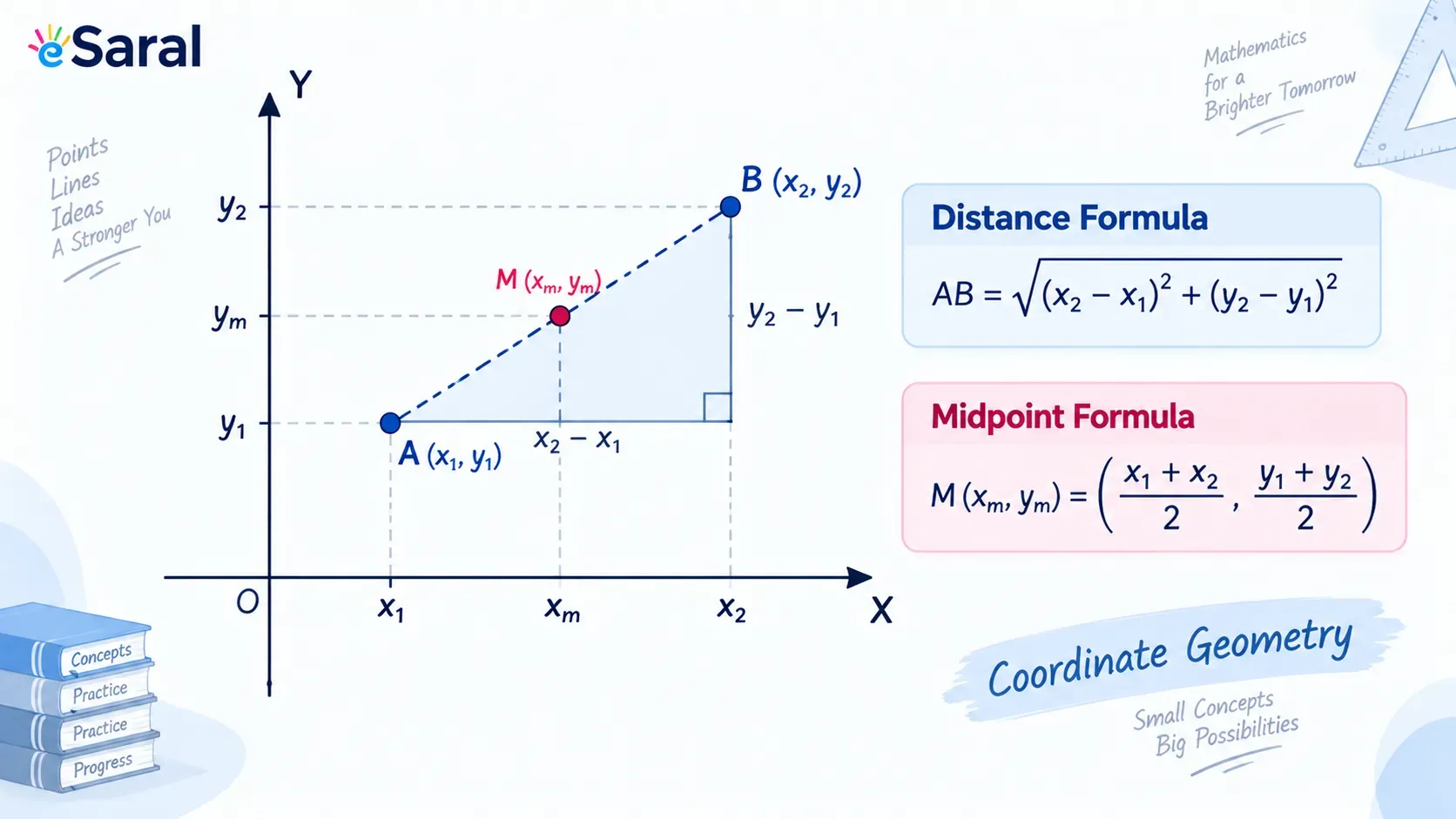
Coordinate Geometry Class 10: Formulas, Notes & Solved Examples
Coordinate geometry class 10: complete CBSE formulas — distance, section, midpoint and area of triangle — with derivation, notes and solved examples.
How to make Notes For JEE Smart Notes Strategy of an AIR 41
Learn how to make notes for JEE the way toppers do — indexing, shorthand, and smart short notes for JEE that cut revision time to just 5–7 days.
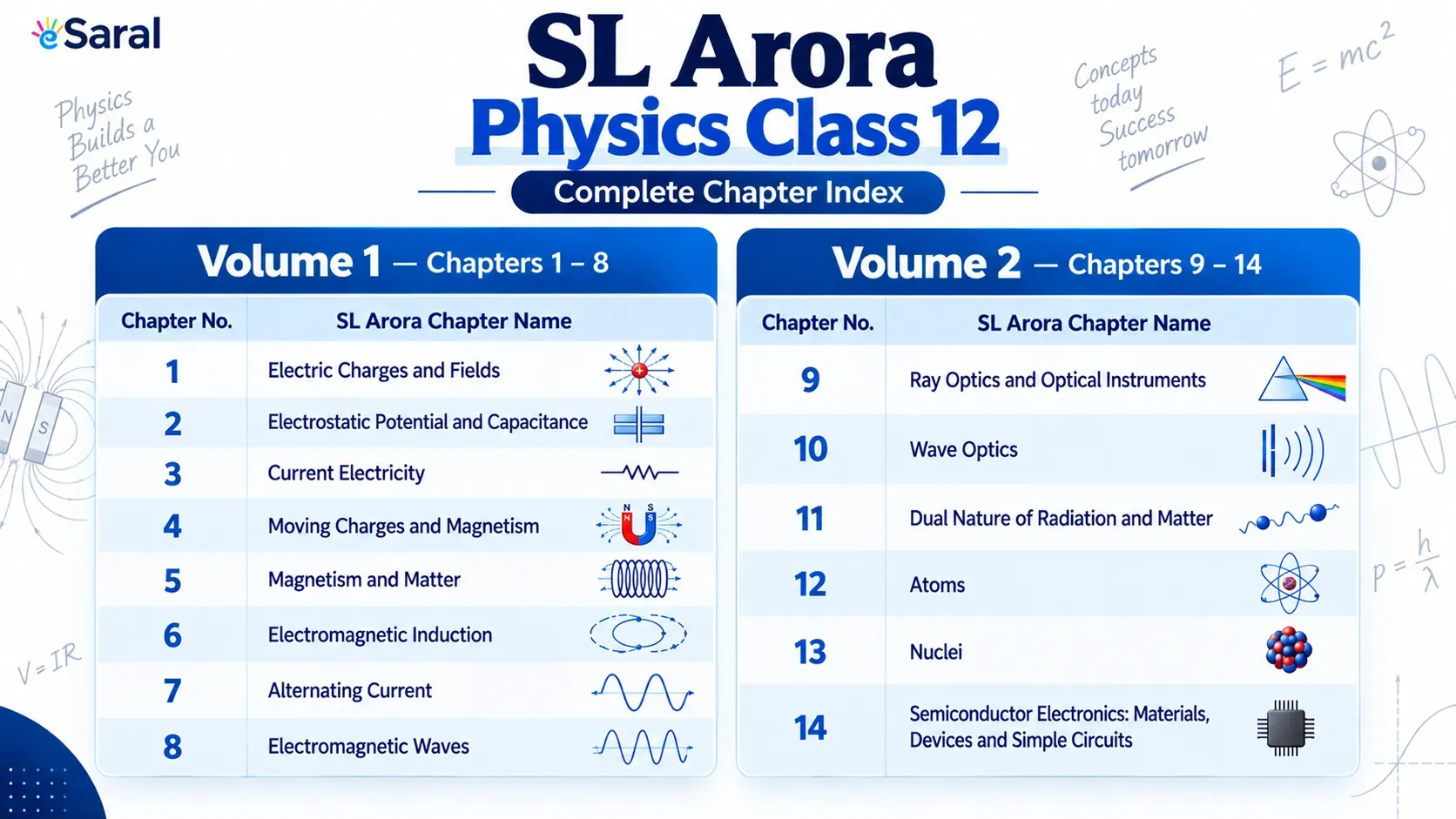
SL Arora Physics Class 12 Index – Chapter List for Volume 1 & 2
SL Arora Physics Class 12 index — complete chapter list for Volume 1 & 2, mapped to NCERT solutions for board, JEE Main, and NEET preparation.