
Straight Line - JEE Advanced Previous Year Questions with Solutions

eSaral Academic and Editorial Team
Summary
Straight Line JEE Advanced previous year questions test coordinate geometry at a conceptual depth far beyond JEE Main. From 2010 to 2024, JEE Advanced has asked questions on angle between lines, distance conditions, parallelogram/rhombus identification, and area of regions — usually in single-correct, multi-correct, and integer formats.

Home >JEE Advanced > Straight Line – JEE Advanced Previous Year Questions with Solutions

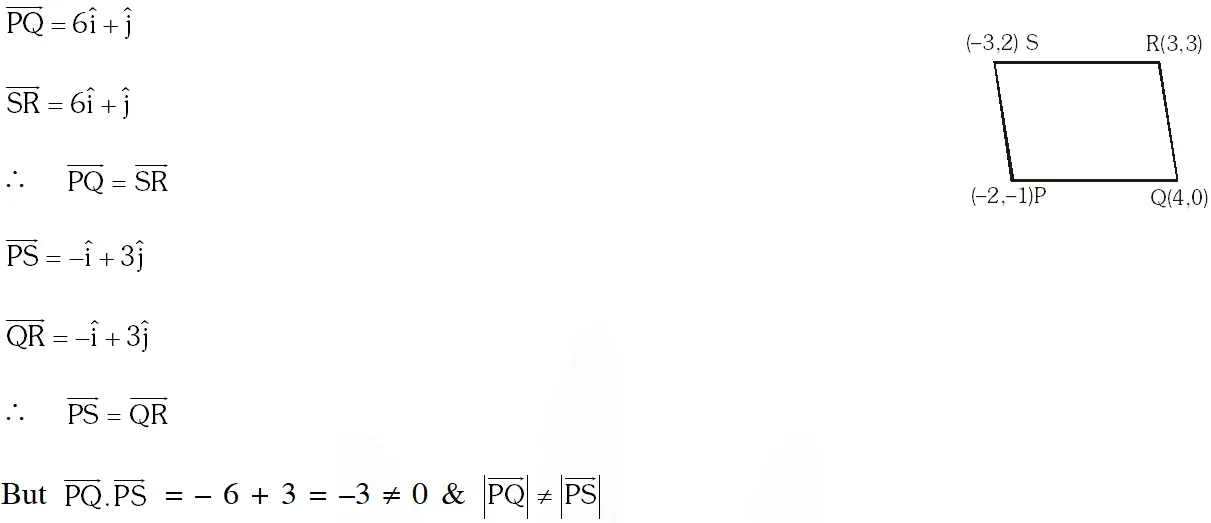
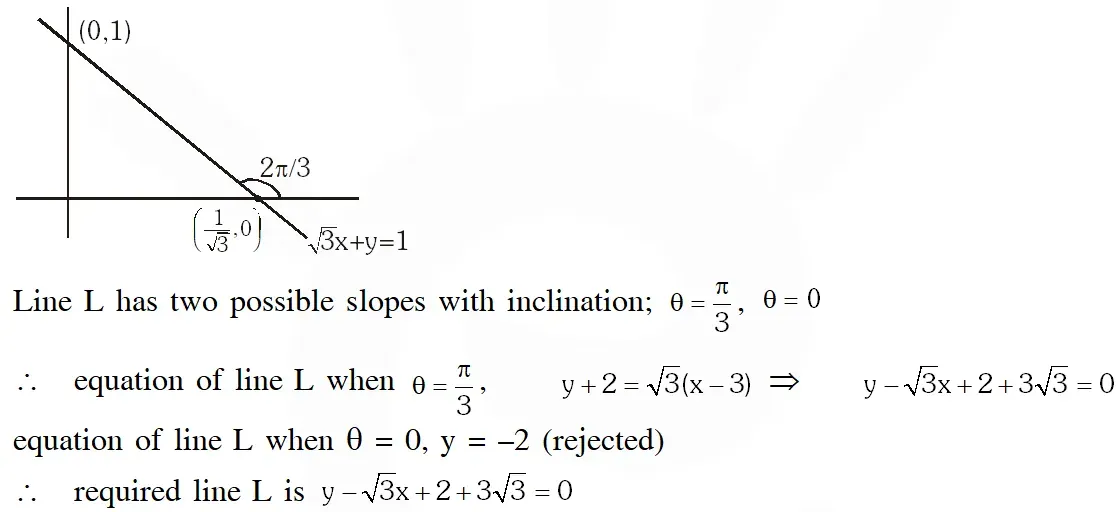
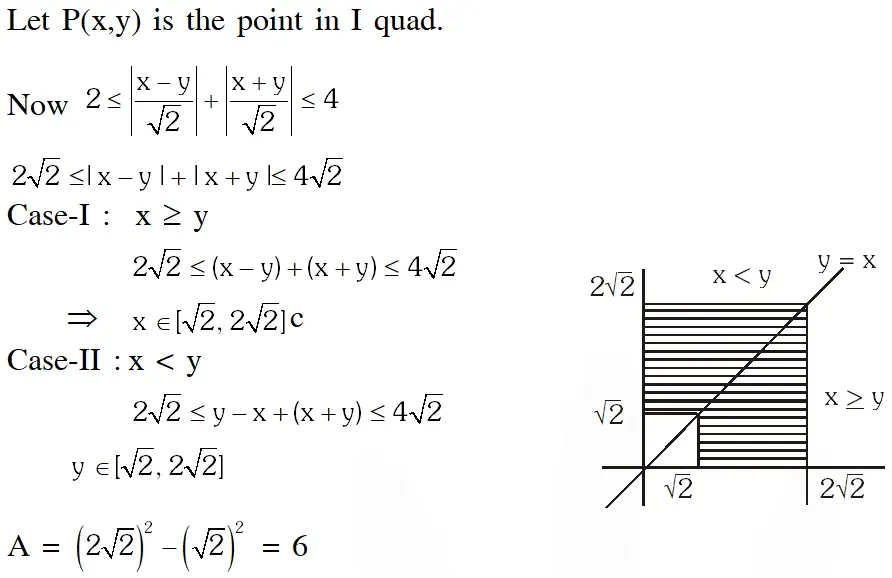
JEE Advanced Previous Year Questions of Math with Solutions are available at eSaral. Practicing JEE Advanced Previous Year Papers Questions of mathematics will help the JEE aspirants in realizing the question pattern as well as help in analyzing weak & strong areas. eSaral helps the students in clearing and understanding each topic in a better way. eSaral also provides complete chapter-wise notes of Class 11th and 12th both for all subjects. Besides this, eSaral also offers NCERT Solutions, Previous year questions for JEE Main and Advance, Practice questions, Test Series for JEE Main, JEE Advanced and NEET, Important questions of Physics, Chemistry, Math, and Biology and many more. Download eSaral app for free study material and video tutorials. [esquestion] Let $\mathrm{P}, \mathrm{Q}, \mathrm{R}$ and $\mathrm{S}$ be the points on the plane with position vectors $-2 \hat{\mathrm{i}}-\hat{\mathrm{j}}, 4 \hat{\mathrm{i}}, 3 \hat{\mathrm{i}}+3 \hat{\mathrm{j}}$ and $-3 \hat{\mathrm{j}}$ and $-3 \hat{\mathrm{i}}+2 \hat{\mathrm{j}}$ respectively. The quadrilateral PQRS must be a (A) parallelogram, which is neither a rhombus nor a rectangle (B) square (C) rectangle, but not a square (D) rhombus, but not a square #tag# [JEE 2010, 3] #sol# (A) $\Rightarrow$ PQRS is a parallelogram but neither a rhombus nor a rectangle. [/esquestion] [esquestion] A straight line L through the point $(3,-2)$ is inclined at an angle $60^{\circ}$ to the line $\sqrt{3} x+y=1$. If $L$ also intersect the x-axis, then the equation of $L$ is (A) $y+\sqrt{3} x+2-3 \sqrt{3}=0$ (B) $\mathrm{y}-\sqrt{3} \mathrm{x}+2+3 \sqrt{3}=0$ (C) $\sqrt{3} y-x+3+2 \sqrt{3}=0$ (D) $\sqrt{3} y+x-3+2 \sqrt{3}=0$ #tag# [JEE 2011, 3 (–1)] #sol# (B) [/esquestion] [esquestion] For a > b > c > 0, the distance between (1, 1) and the point of intersection of the lines $a x+b y+c=0$ and $b x+a y+c=0$ is less than $2 \sqrt{2} .$ Then (A) a + b – c > 0 (B) a – b + c < 0 (C) a – b + c > 0 (D) a + b – c < 0 #tag# [JEE-Advanced 2013, 2] #sol# (A or C or A,C) Point of intersection of both lines is $\left(-\frac{c}{(a+b)},-\frac{c}{(a+b)}\right)$ Distance between $\left(-\frac{c}{(a+b)},-\frac{c}{(a+b)}\right) \&(1,1)$ is Distance $=\sqrt{\frac{(a+b+c)^{2}}{(a+b)^{2}} \times 2}<2 \sqrt{2}$ $a+b+c<2(a+b)$ $a+b-c>0$ According to given condition option (C) also correct. [/esquestion] [esquestion] For a point $P$ in the plane, let $d_{1}(P)$ and $d_{2}(P)$ be the distances of the point $P$ from the lines $x-y=0$ and $x+y=0$ respectively. The area of the region $R$ consisting of all points $P$ lying in the first quadrant of the plane and satisfying $2 \leq d_{1}(P)+d_{2}(P) \leq 4,$ is #tag# [JEE(Advanced)-2014, 3] #sol# 6 [/esquestion]
Straight Lines - JEE Advanced PYQs (Maths) can be supplemented with full JEE Advanced papers available in the JEE Advanced exam paper archive.
Expert Tips for Straight Line in JEE Advanced
JEE Advanced rarely asks direct formula-based problems from Straight Lines. Most questions involve 2–3 concepts layered together — for example, the angle between lines combined with a constraint on intersection. Always read the question for hidden conditions like "intersects the x-axis" or "a > b > c > 0" — these constraints eliminate cases and are the actual test of your understanding.
How Should You Approach Straight Line Problems in JEE Advanced?
1. Identify the Given Constraints First
Before writing any equation, carefully identify all conditions given in the problem. Hidden constraints often determine the correct approach and eliminate unnecessary cases.
2. Draw a Rough Sketch
For every distance, region-based, or intersection problem, make a rough diagram. A simple sketch can save 3–4 minutes of unnecessary algebra and help visualise the geometry.
3. Verify Every Option in Multi-Choice Questions
Do not stop after finding one correct option. Evaluate each option independently because JEE Advanced frequently includes multiple correct answers.
4. Double-Check Sign Conventions
For integer-type and distance-based questions, carefully verify sign conventions in distance and coordinate formulas to avoid calculation errors.
5. Manage Your Time Strategically
If a Straight Line question appears alongside Circles or other Coordinate Geometry topics in Paper 2, consider attempting the Straight Line problem first as a confidence-building question.
Important Exam Insight
The 2014 region-area question is a classic example of how JEE Advanced creatively uses coordinate geometry. The key idea is to divide the first quadrant into separate regions based on whether x or y dominates. Practising at least five similar region-area problems is recommended, as such questions tend to appear approximately once every three years in JEE Advanced.
Frequently Asked Questions
What is the best way to practise Straight Line for JEE Advanced?
Start with NCERT Class 11 Maths Chapter 10 for conceptual clarity, then solve all PYQs from 2010 onwards in timed conditions. Identify your error pattern — most students lose marks on sign errors in distance formulas and missing cases in angle problems. Revise the family of lines concept separately.
Is Straight Line in JEE Advanced harder than JEE Main?
Yes, considerably. JEE Main tests direct formula application — slope, intercept, distance. JEE Advanced combines these with inequalities, regions, vectors, and multi-condition problems. A question that looks like a "simple angle between lines" problem in JEE Main becomes a multi-case elimination exercise in JEE Advanced.
How many questions from Straight Lines come in JEE Advanced each year?
Typically 1 question per year, occasionally 2, contributing 3–4 marks. While the number seems small, Straight Line concepts also appear embedded in Circle and Conic Section problems, making the effective weightage significantly higher. Consistent preparation in this chapter improves your overall coordinate geometry score.
Where can I find complete NCERT solutions to strengthen my Straight Line base?
eSaral provides detailed NCERT Solutions for Class 11 Maths covering Chapter 10 (Straight Lines) with step-by-step solutions. You can also access NCERT Books for Class 11 for free. These form the essential base before tackling JEE Advanced level problems.
Can I skip Straight Lines and still score well in JEE Advanced Maths?
Skipping is not advisable. Beyond the direct 3–4 marks, Straight Line is foundational for Circles (tangent conditions, chord of contact), Parabola/Ellipse/Hyperbola (normals, tangents), and 3D Geometry. Weak coordinate geometry creates a cascading effect across 20–25 marks in the paper.
Which topics within Straight Lines are most important for JEE Advanced?
Distance between parallel lines, angle between two lines, area of triangles/regions using coordinate methods, conditions for special quadrilaterals (parallelogram, rhombus, rectangle), and the family of lines passing through intersection of two given lines. Integer-type questions often involve area calculations.
Team eSaral
eSaral Academic and Editorial Team
Team eSaral is the collective author profile for educational content created by eSaral’s teachers and academic contributors. The team draws on expertise from IIT graduates, doctors, experienced educators and subject specialists to develop resources for JEE, NEET and school students. Our articles aim to explain concepts clearly and help students study with confidence.
Related Posts
Plant Cell Diagram: Labelled Structure, Parts and Functions
Simple, labelled plant cell diagram with parts and functions. Covers plant cell structure for Class 6, 7, 8, 9, 10 and 11 students, CBSE-aligned.
Saransh Gupta Sir's Visit to IIT Patna: Hostel Life, Placements & Lessons for JEE Aspirants
Inside Saransh Gupta Sir's IIT Patna visit — hostel life, the library, placements, internships, and real advice for JEE aspirants from students living the IIT dream.
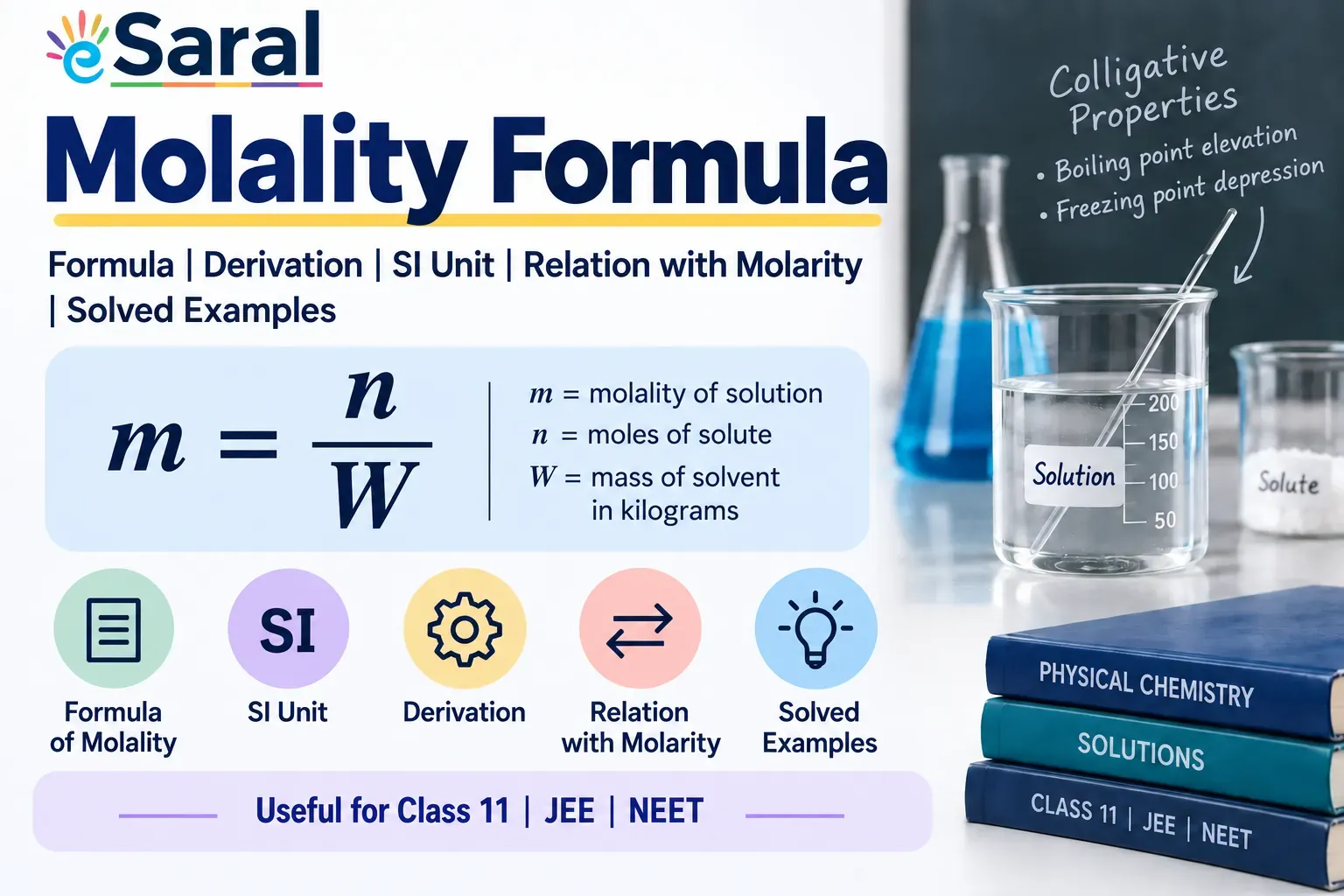
Molality Formula: Formula for Molality, Derivation & Solved Examples
Molality formula is $m = \dfrac{n}{W}$. Learn the formula of molality, its SI unit, derivation, relation with molarity, and solved examples for Class 11, JEE and NEET.
BITSAT Previous Year Question Paper PDF
Download BITSAT previous year question papers PDF. Get year-wise BITSAT PYQs, memory-based papers, exam pattern, and preparation tips to improve your BITSAT preparation.

Teachers’ Day 2026 at eSaral Gurukul: Celebrating the Bond Between Students, Teachers & Mentors
See how Teachers’ Day 2026 was celebrated at eSaral Gurukul, reflecting the bond among students, teachers, and mentors, and the role of guidance beyond academics.
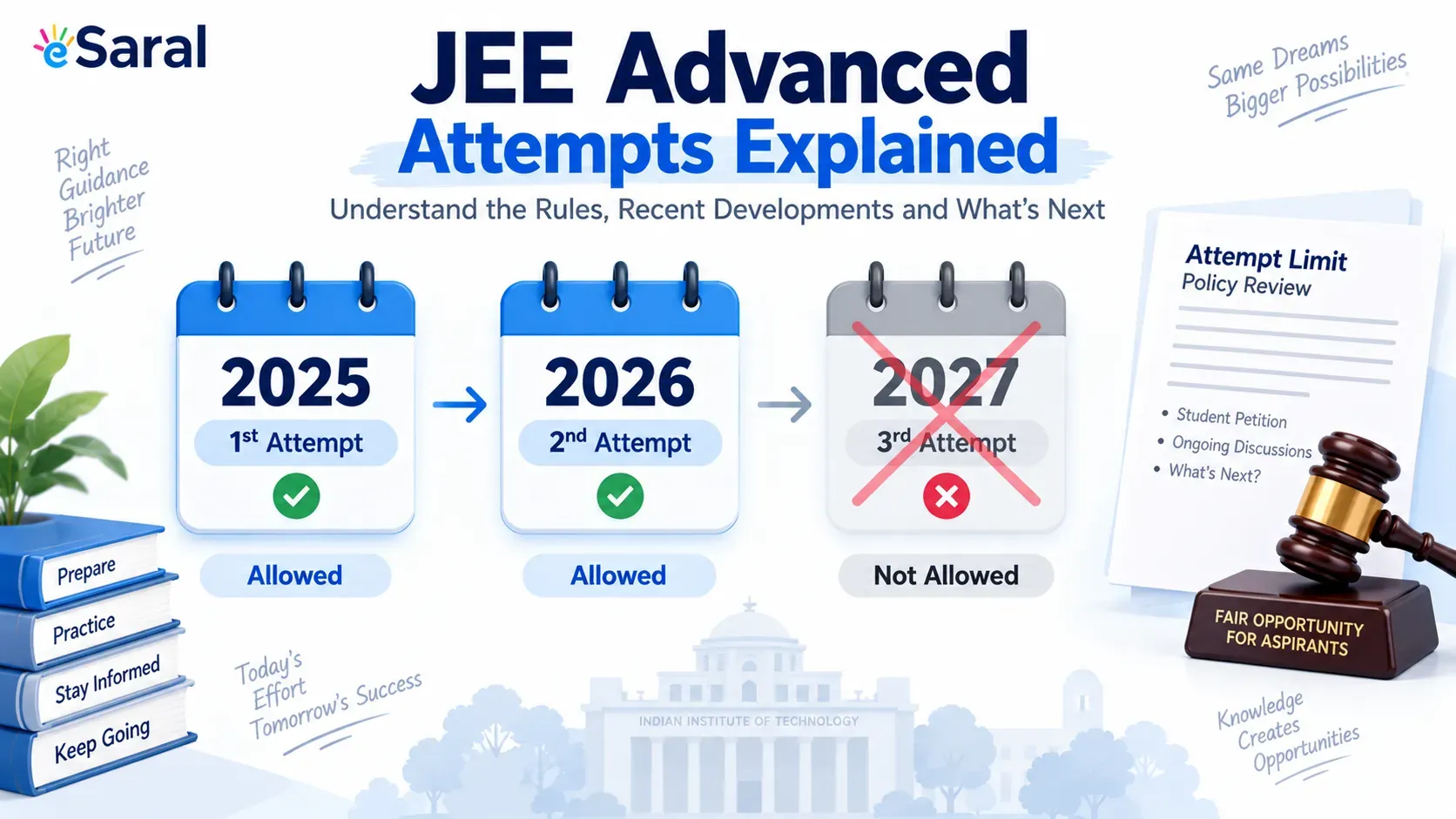
JEE Advanced Attempts: Can You Give It a Third Time? Rules Explained
JEE Advanced attempts: current rule is 2 consecutive years only: full eligibility criteria, the 2025 third-attempt controversy, and the latest 2026 petition news.

Best JEE Preparation App
Best JEE preparation app for Main & Advanced: AI mock tests, live doubt-solving, thousands of practice questions. JEE preparation app for droppers & Class 11-12.
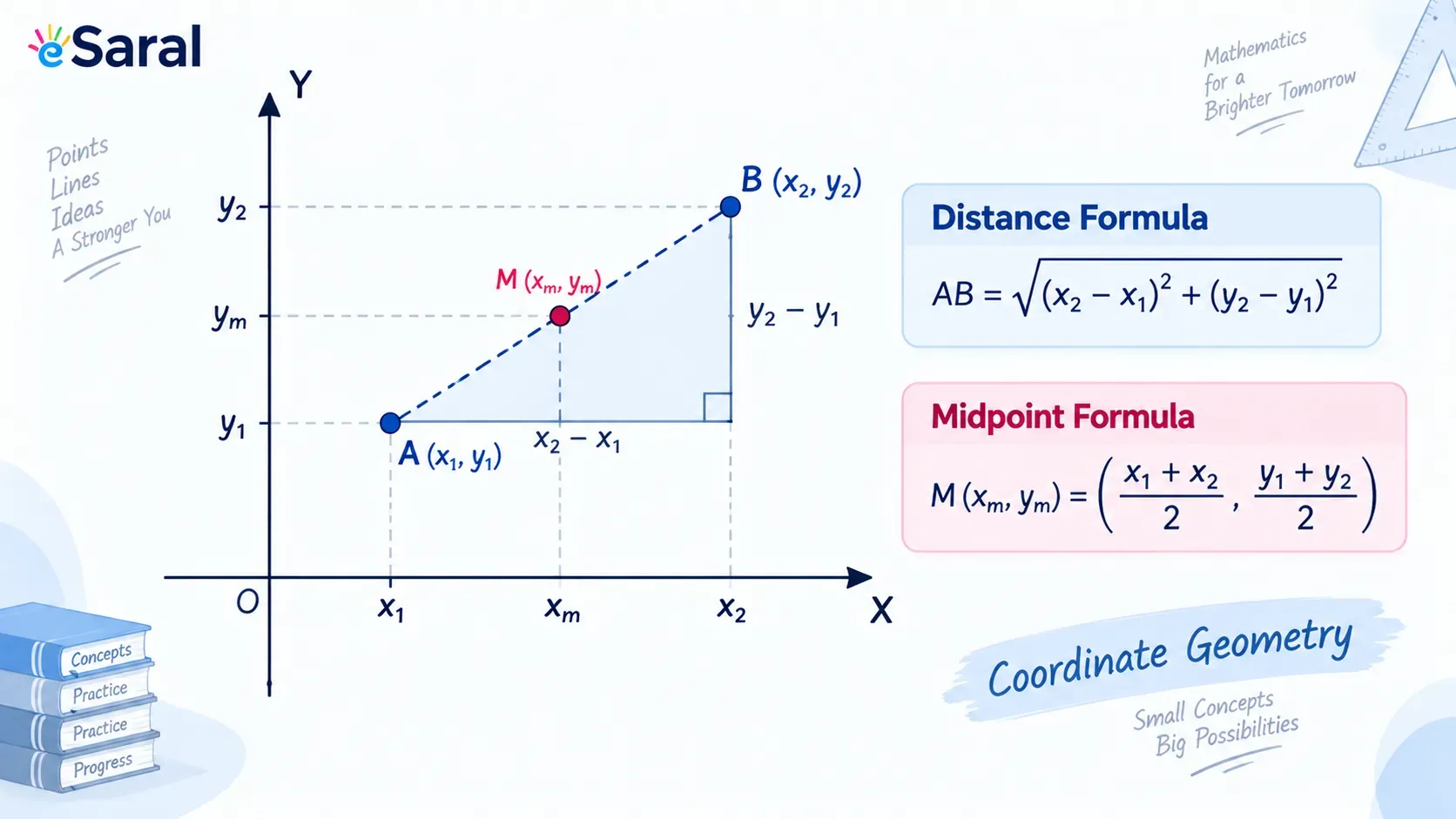
Coordinate Geometry Class 10: Formulas, Notes & Solved Examples
Coordinate geometry class 10: complete CBSE formulas — distance, section, midpoint and area of triangle — with derivation, notes and solved examples.
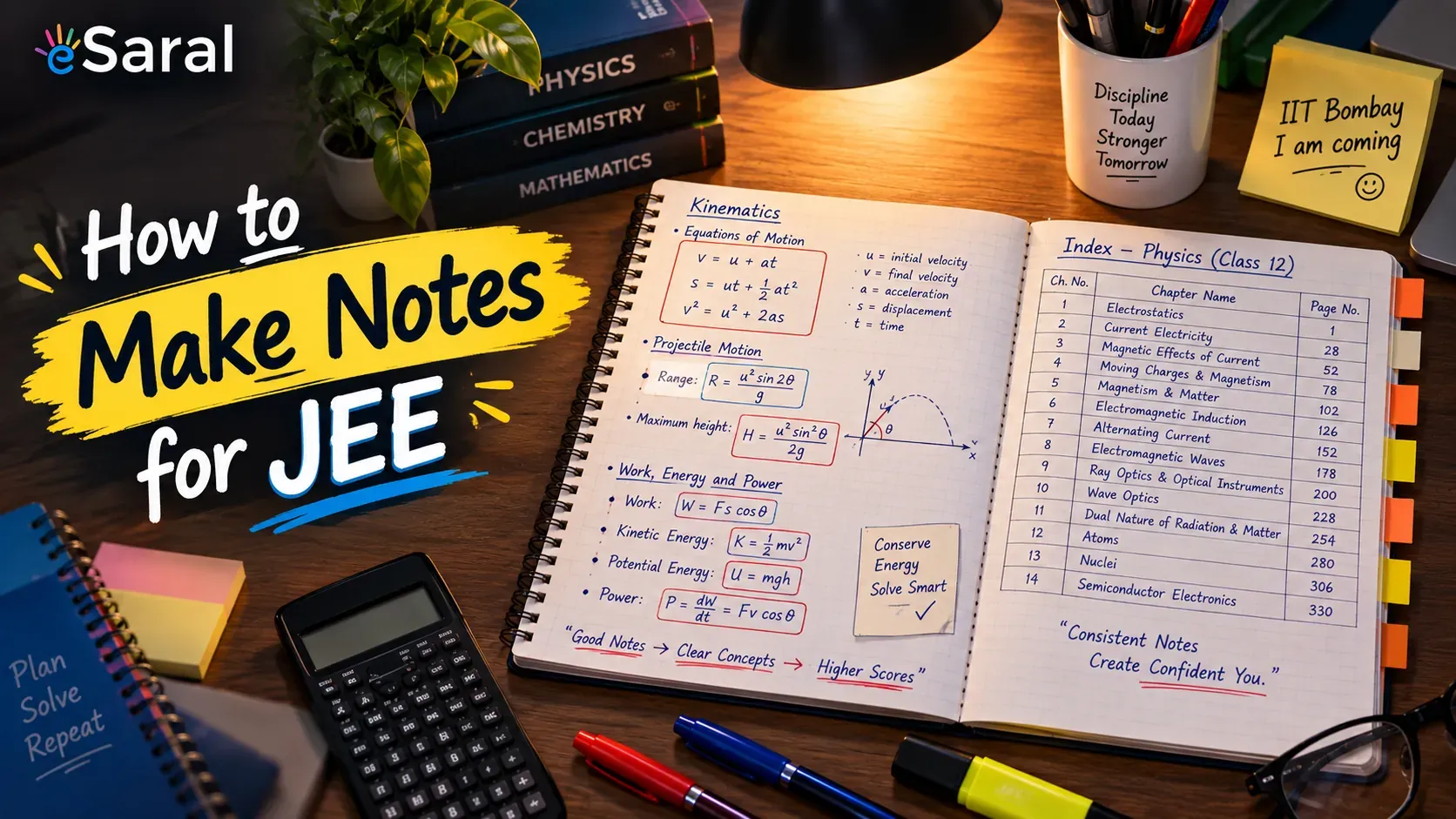
How to make Notes For JEE Smart Notes Strategy of an AIR 41
Learn how to make notes for JEE the way toppers do — indexing, shorthand, and smart short notes for JEE that cut revision time to just 5–7 days.
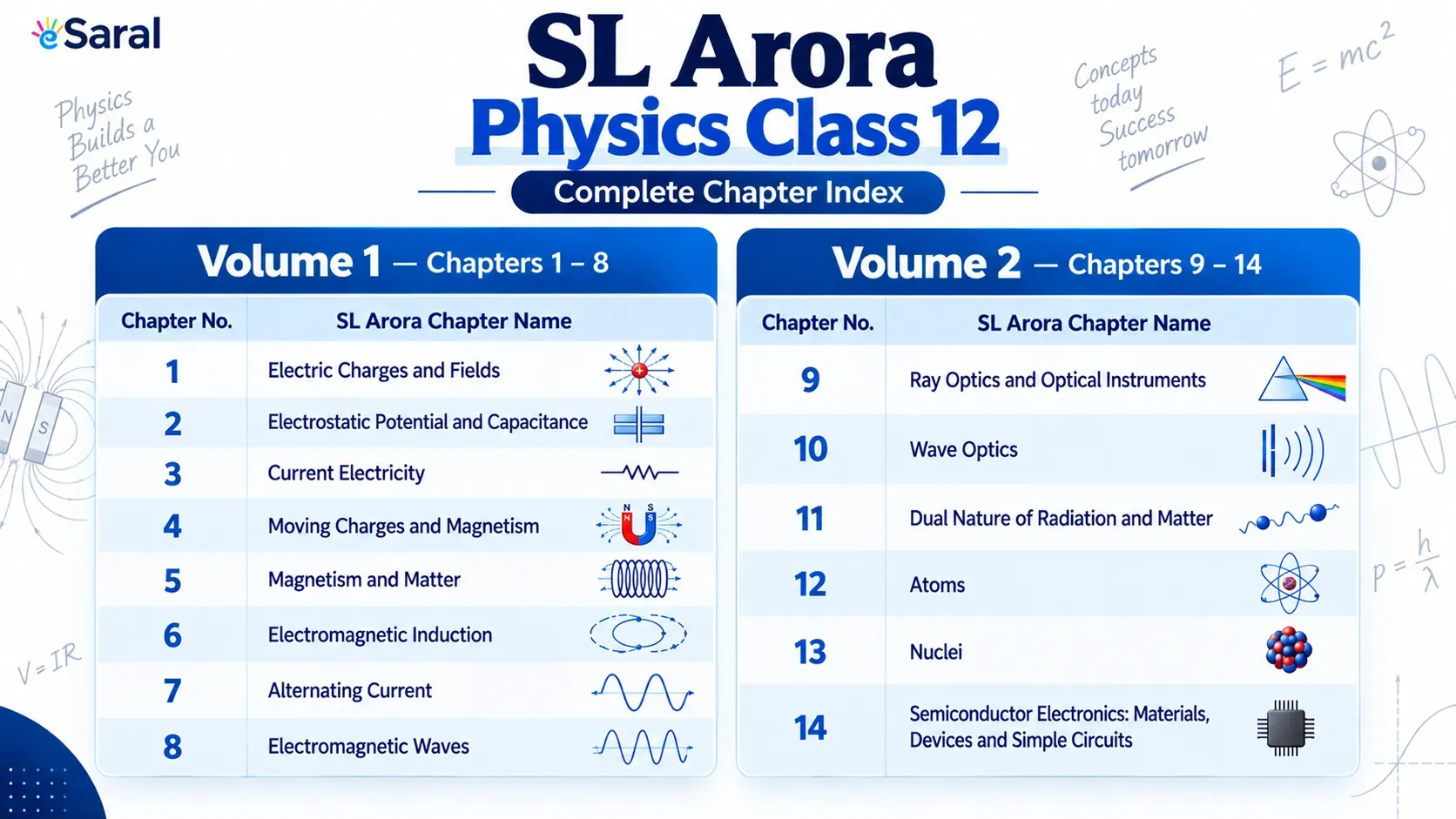
SL Arora Physics Class 12 Index – Chapter List for Volume 1 & 2
SL Arora Physics Class 12 index — complete chapter list for Volume 1 & 2, mapped to NCERT solutions for board, JEE Main, and NEET preparation.