
Themochemistry - JEE Main Previous Year Questions with Solutions

eSaral Academic and Editorial Team
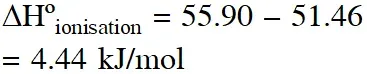
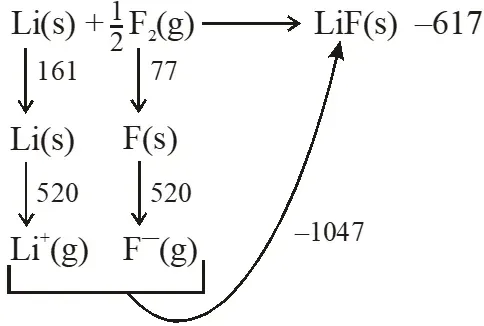
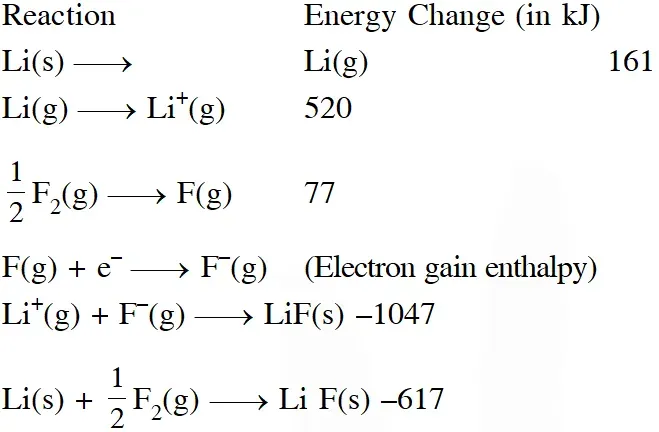
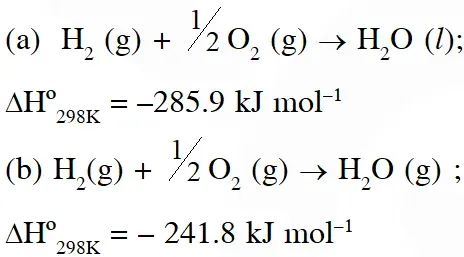
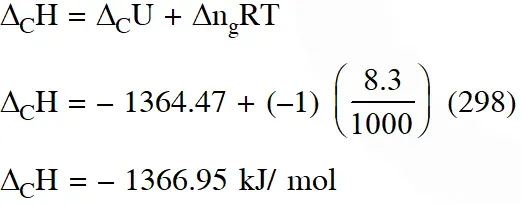
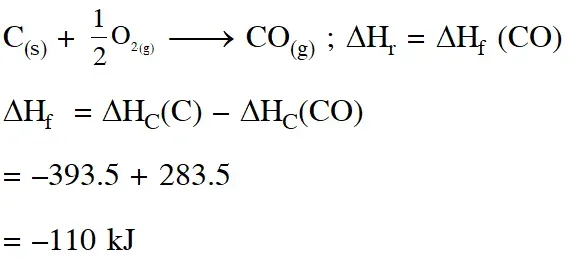
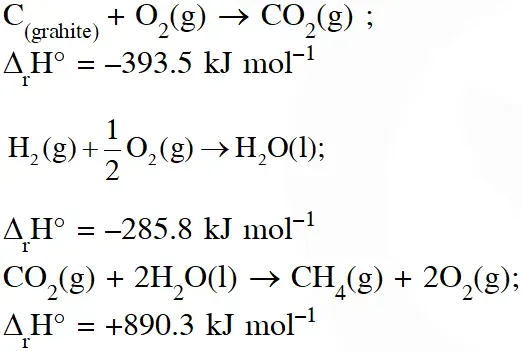
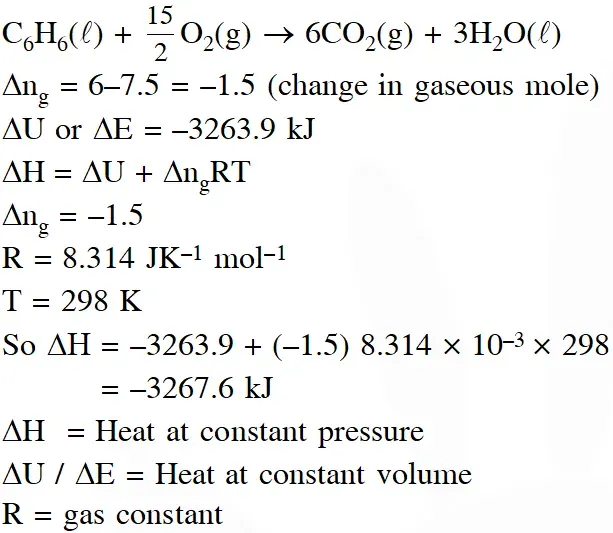
JEE Main Previous Year Papers Questions of Chemistry With Solutions are available at eSaral. Simulator Previous Years AIEEE/JEE Mains Questions [esquestion] In a fuel cell methanol is used as fuel and oxygen gas is used as an oxidizer. The reaction is $\mathrm{CH}_{3} \mathrm{OH}(\ell)+\frac{3}{2} \mathrm{O}_{2}(\mathrm{g}) \longrightarrow \mathrm{CO}_{2}(\mathrm{g})+2 \mathrm{H}_{2} \mathrm{O}(\ell)$ At 298 K standard Gibb's energies of formation for $\mathrm{CH}_{3} \mathrm{OH}(\ell), \mathrm{H}_{2} \mathrm{O}(\ell)$ and $\mathrm{CO}_{2}(\mathrm{g})$ are –166.2, –237.2 and –394.4 kJ $\mathrm{mol}^{-1}$ respectively. If standard enthalpy of combustion of methanol is –726 kJ $\mathrm{mol}^{-1}$, efficiency of the fuel cell will be (1) 90% (2) 97% (3) 80% (4) 87% #tag# [AIEEE-2009] #sol# (2) $\mathrm{CH}_{3} \mathrm{OH}(l)+\frac{3}{2} \mathrm{O}_{2}(\mathrm{g}) \rightarrow \mathrm{CO}_{2}+2 \mathrm{D}_{2} \mathrm{O}(l)$ $\Delta \mathrm{G}^{\circ}=\left(2 \Delta \mathrm{G}_{\mathrm{f}}^{\circ}\left[\mathrm{H}_{2} \mathrm{O}(l)+\Delta \mathrm{G}_{\mathrm{f}}^{\circ}\left[\mathrm{CO}_{2}(g)\right]\right)-\left(\Delta \mathrm{G}_{\mathrm{f}}^{\circ}\left[\mathrm{CH}_{3} \mathrm{OH}(l)+\frac{3}{2} \Delta \mathrm{G}_{\mathrm{F}}^{\circ}\left[\mathrm{O}_{2}(g)\right]\right)\right.\right.$ $\Delta \mathrm{G}^{\circ}=(2(-237.2)+(-394.4)-(-166.2+0)$ $\Delta \mathrm{G}^{\mathrm{o}}=-868.8+166.2$ $=-702.6 \mathrm{kJ} / \mathrm{mol}$ Cell efficiency $=\left|\frac{\Delta \mathrm{G}^{\circ}}{\Delta \mathrm{H}^{\circ}}\right| \times 100$ $=\frac{702.6}{726} \times 100=96.77 \approx 97 \%$ [/esquestion] [esquestion] On the basis of the following thermochemical data : $\left(\Delta \mathrm{G}_{\mathrm{f}}^{0} \mathrm{H}_{(\mathrm{a}) \mathrm{y}}^{+}=0\right)$ $\mathrm{H}_{2} \mathrm{O}(\ell) \rightarrow \mathrm{H}^{+}(\mathrm{aq})+\mathrm{OH}^{-}(\mathrm{aq}) ; \Delta \mathrm{H}=57.32 \mathrm{kJ}$ $\mathrm{H}_{2}(\mathrm{g})+\frac{1}{2} \mathrm{O}_{2}(\mathrm{g}) \rightarrow \mathrm{H}_{2} \mathrm{O}(\ell) ; \Delta \mathrm{H}=-286.20 \mathrm{kJ}$ The value of enthalpy of formation of $\mathrm{OH}^{-}$ ion at $25^{\circ} \mathrm{C}$ is :- (1) +228.88 kJ (2) –343.52 kJ (3) –22.88 kJ (4) –228.88 kJ #tag# [AIEEE-2009] #sol# (4) $\mathrm{H}_{2} \mathrm{O}(l) \longrightarrow \mathrm{H}^{+}(\mathrm{aq} .)+\mathrm{OH}^{-}(\mathrm{aq} .)$ $57.32=\Delta \mathrm{H}_{\mathrm{f}}^{\mathrm{o}}\left[\mathrm{OH}^{-}(\mathrm{aq})\right]-\Delta \mathrm{H}_{\mathrm{f}}^{\mathrm{o}}\left[\mathrm{H}_{2} \mathrm{O}_{(l)}\right]$ $57.32=\Delta \mathrm{H}_{\mathrm{F}}^{\circ}\left[\mathrm{OH}_{(\mathrm{aq})}^{-}\right]+286.20$ $\Delta \mathrm{H}_{\mathrm{F}}^{\circ}\left[\mathrm{OH}^{-}_{(\mathrm{aq})}\right]=-228.88 \mathrm{kJ}$ [/esquestion] [esquestion] The standard enthalphy of formation of $\mathrm{NH}_{3}$ is $-46.0 \mathrm{kJ} \mathrm{mol}^{-1}$ If the enthalpy of formation of H2 from its atoms is –436 kJ $\mathrm{mol}^{-1}$ and that of $\mathrm{N}_{2}$ is $-712 \mathrm{kJ} \mathrm{mol}^{-1}$, the average bond enthalpy of N–H bond in NH3 is (1) $-1102 \mathrm{kJ} \mathrm{mol}^{-1}$ (2) $-964 \mathrm{kJ} \mathrm{mol}^{-1}$ (3) $+352$ kJ mol $^{-1}$ (4) $+1056 \mathrm{kJ} \mathrm{mol}^{-1}$ #tag# [AIEEE-2010] #sol# (3) $\frac{1}{2} \mathrm{N}_{2}(\mathrm{g})+\frac{3}{2} \mathrm{H}_{2}(\mathrm{g}) \longrightarrow \mathrm{NH}_{3}(\mathrm{g})$ $-46=\frac{1}{2}(712)+\frac{3}{2}(436)-3(\mathrm{N}-\mathrm{H})$ – 46 = 356 + 654 – 3(N – H) N – H = 352 kJ / mol [/esquestion] [esquestion] Consider the reaction : $4 \mathrm{NO}_{2}(\mathrm{g})+\mathrm{O}_{2}(\mathrm{g}) \rightarrow 2 \mathrm{N}_{2} \mathrm{O}_{5}(\mathrm{g}), \Delta_{\mathrm{r}} \mathrm{H}=-111 \mathrm{kJ}$ If $\mathrm{N}_{2} \mathrm{O}_{5}(\mathrm{s})$ is formed instead of $\mathrm{N}_{2} \mathrm{O}_{5}(\mathrm{g})$ in the above reaction, the rH value will be :- (given, of sublimation for $\mathrm{N}_{2} \mathrm{O}_{5}$ is 54 kJ \mathrm{mol}^{-1}) (1) –165 kJ (2) +54 kJ (3) +219 kJ (4) –219 kJ #tag# [AIEEE-2011] #sol# (4) If $\mathrm{N}_{2} \mathrm{O}_{5}(\mathrm{s})$ is formed instead of $\mathrm{N}_{2} \mathrm{O}_{5}(\mathrm{g})$ then $\Delta_{1} \mathrm{H}=-111-2(54)$ $\Delta_{\mathrm{r}} \mathrm{H}=-111-108$ $\Delta_{1} \mathrm{H}=-219 \mathrm{kJ} / \mathrm{mol}$ [/esquestion] [esquestion] The enthalpy of neutralisation of \mathrm{NH}_{4} \mathrm{OH}with HCl is –51.46 kJ \mathrm{mol}^{-1} and the enthalpy of neutralisation of NaOH with HCl is –55.90 kJ $\mathrm{mol}^{-1}$ The enthalpy of ionisation of $\mathrm{NH}_{4} \mathrm{OH}$ is: (1) $+107.36 \mathrm{kJ} \mathrm{mol}^{-1}$ (2) $-4.44 \mathrm{kJ} \mathrm{mol}^{-1}$ (3) $-107.36 \mathrm{kJ} \mathrm{mol}^{-1}$ (4) $+4.44 \mathrm{kJ} \mathrm{mo}$ #tag# [JEE-mains (online) 2012] #sol# (4) [/esquestion] [esquestion] The reaction $\mathrm{X} \rightarrow \mathrm{Y}$ is an exothermic reaction. Activation energy of the reaction for X into Y is 150 kJ $\operatorname{mol}^{-1}$. Enthalpy of reaction is 135 kJ $\mathrm{mol}^{-1}$ . The activation energy for the reverse reaction, $\mathrm{Y} \rightarrow \mathrm{X}$ will be : (1) 15 kJ $\mathrm{mol}^{-1}$ (2) 285 kJ $\mathrm{mol}^{-1}$ (3) 270 kJ $\mathrm{mol}^{-1}$ (4) 280 kJ $\mathrm{mol}^{-1}$#tag# #sol# (3) $\Delta \mathrm{H}=\mathrm{E}_{\mathrm{a}(\mathrm{f})}-\mathrm{E}_{\mathrm{a}(\mathrm{b})}$ $-135=150-\mathrm{E}_{\mathrm{a}(\mathrm{b})}$ – 617 = 161 + 520 + 77 + x – 1047 x = –328 kJ/mol [/esquestion] [esquestion] Given Based on data provided, the value of electron gain enthalpy of fluorine would be : (1) –300 kJ $\mathrm{mol}^{-1}$ (2) –328 kJ $\mathrm{mol}^{-1}$ (3) –350 kJ $\mathrm{mol}^{-1}$ (4) –228 kJ $\mathrm{mol}^{-1}$ #tag# [JEE-mains (online) 2013] #sol# (2) [/esquestion] [esquestion] Given : The molar enthalpy of vapourisation of water will be :- (1) 241. 8 kJ $\mathrm{mol}^{-1}$ (2) 527.7 kJ $\mathrm{mol}^{-1}$ (3) 44.1 kJ $\mathrm{mol}^{-1}$ (4) 22.0 kJ $\mathrm{mol}^{-1}$ #tag# [JEE-mains (online) 2013] #sol# (3) [/esquestion] [esquestion] The standard enthalpy of formation $\left(\Delta_{\mathrm{f}} \mathrm{H}_{298}^{\circ}\right)$ for methane, $\mathrm{CH}_{4}$ is– 74.9 kJ $\mathrm{mol}^{-1}$. In order to calculate the average energy given out in the formation of a C–H bond from this it is necessary to know which one of the following? (1) the dissociation energy of the hydrogen molecule, $\mathrm{H}_{2}$. (2) the dissociation energy of $\mathrm{H}_{2}$ and enthalpy of sublimation of carbon (graphite). (3) the first four ionisation energies of carbon and electron affinity of hydrogen. (4) the first four ionisation energies of carbon. #tag# [JEE-mains(online) 2014] #sol# (2) From formation enthalpy of methane C-H bond enthalpy can be calculated as – $\mathrm{C}(\mathrm{s})+2 \mathrm{H}_{2}(\mathrm{g}) \longrightarrow \mathrm{CH}_{4}(\mathrm{g})$ $\Delta \mathrm{H}_{\mathrm{f}}^{\circ}\left(\mathrm{CH}_{4}(\mathrm{g})\right)=\Delta \mathrm{H}_{\mathrm{a}}^{\circ}[\mathrm{C}(\mathrm{s})]+2(\mathrm{H}-\mathrm{H})-4(\mathrm{C}-\mathrm{H})$ $(\mathrm{C}-\mathrm{H})=\frac{\Delta \mathrm{H}_{\mathrm{f}}^{\circ}\left(\mathrm{CH}_{4}(\mathrm{g})\right)-\Delta \mathrm{H}_{\mathrm{f}}^{\circ}(\mathrm{C}(\mathrm{s}))-2[\mathrm{H}-\mathrm{H}]}{4}$ So for calculating (C-H) bond we will required data of H- H bond enthalpy and sublimation enthalpy of carbon solid. [/esquestion] [esquestion] For an ideal Solution of two components A and B, which of the following is true ? (1) $\Delta \mathrm{H}_{\text {mixing }}<0$ (zero) (2) A – A, B – B and A – B interactions are identical (3) A – B interaction is stronger than A – A and B – B interactions (4) $\Delta \mathrm{H}_{\text {mixing }}>0$ (zero) #tag# [JEE-mains (online) 2014] #sol# (1) [/esquestion] [esquestion] For complete combustion of ethanol, $\mathrm{C}_{2} \mathrm{H}_{5} \mathrm{OH}(\ell)+3 \mathrm{O}_{2}(\mathrm{g}) \rightarrow 2 \mathrm{CO}_{2}(\mathrm{g})+3 \mathrm{H}_{2} \mathrm{O}(\ell)$the amount of heat produced as measured in bomb calorimeter, is 1364.47 kJ $\mathrm{mol}^{-1}$ at $25^{\circ} \mathrm{C}$. Assuming ideality the Enthalpy of combustion, $\Delta_{\mathrm{C}} \mathrm{H}$, for the raction will be :- $\left(\mathrm{R}=8.314 \mathrm{kJ} \mathrm{mol}^{-1}\right)$ (1) $-1460.50 \mathrm{kj} \mathrm{mol}^{-1}$ (2) $-1350.50 \mathrm{kJ} \mathrm{mol}^{-1}$ (3) $-1366.95 \mathrm{kJ} \mathrm{mol}^{-1}$ $(4)-1361.95 \mathrm{kJ} \mathrm{mol}^{-1}$ #tag# [JEE-mains(offline)2014] #sol# (3) [/esquestion] [esquestion] The heats of combustion of carbon and carbon monoxide are – 393.5 and – 285.5 kJ $\operatorname{mol}^{-1}$, respectively. The heat of formation (in kJ) of carbon monoxide per mole is : (1)– 110 (2) 110.5 (3) 676.5 (4) – 676.5 #tag# [JEE-Mains 2016] #sol# (1) [/esquestion] [esquestion] Given #tag# [JEE - Main - 2017] #sol# (3) $\mathrm{CO}_{2}(\mathrm{g})+2 \mathrm{H}_{2} \mathrm{O}(\ell) \rightarrow \mathrm{CH}_{4}(\mathrm{g})+2 \mathrm{O}_{2}(\mathrm{g}) ; \Delta \mathrm{H}^{\circ}=890.3$ $\Delta_{\mathrm{f}} \mathrm{H}^{\circ}-393.5-285.8$ $\Delta_{\mathrm{r}} \mathrm{H}^{\circ}=\sum\left(\Delta_{\mathrm{f}} \mathrm{H}^{\circ}\right)_{\text {protucts }}-\sum\left(\Delta_{\mathrm{f}} \mathrm{H}^{\circ}\right)_{\text {Restatatis }}$ $890.3=\left[1 \times\left(\Delta_{\mathrm{f}} \mathrm{H}^{\circ}\right)_{\mathrm{CH}_{4}}+2 \times 0\right]-[1 \times(-393.5)+2(-285.8)]$ $\left(\Delta_{\mathrm{f}} \mathrm{H}^{\circ}\right)_{\mathrm{CH}_{4}}=890.3-965.1=-74.8 \mathrm{kJ} / \mathrm{mol}$ [/esquestion] [esquestion] The combustion of benzene (l) gives $\mathrm{CO}_{2}(\mathrm{g})$ and $\mathrm{H}_{2} \mathrm{O}(\mathrm{l})$. Given that heat of combustion of benzene at constant volume is –3263.9 kJ $\operatorname{mol}^{-1}$ at $25^{\circ} \mathrm{C}$; heat of combustion (in kJ $\mathrm{mol}^{-1}$) of benzene at constant pressure will be - (R = 8.314 $\mathrm{JK}^{-1}$ $\mathrm{mol}^{-1}$) (1)–452.46 (2) 3260 (3) –3267.6 (4) 4152.6 #tag# [JEE - Main - 2018] #sol# (3) [/esquestion]



This chapter is only one part of the complete collection; use the JEE PYQ chapter wise index to continue your preparation.
Want the exam-format version, unsolved? Head to our JEE Main last year question paper for full papers rather than isolated Thermochemistry extracts.
Team eSaral
eSaral Academic and Editorial Team
Team eSaral is the collective author profile for educational content created by eSaral’s teachers and academic contributors. The team draws on expertise from IIT graduates, doctors, experienced educators and subject specialists to develop resources for JEE, NEET and school students. Our articles aim to explain concepts clearly and help students study with confidence.
Related Posts
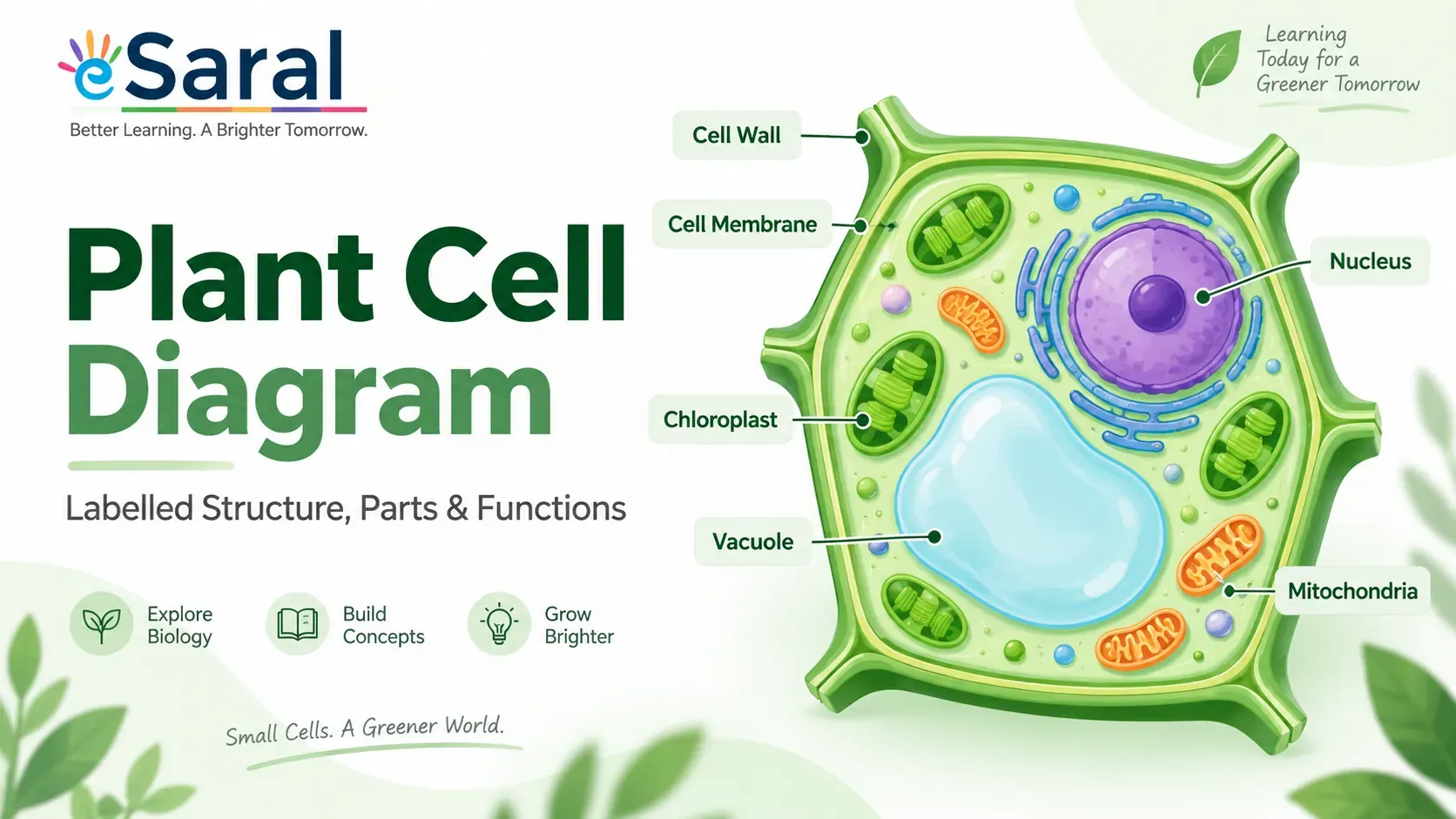
Plant Cell Diagram: Labelled Structure, Parts and Functions
Simple, labelled plant cell diagram with parts and functions. Covers plant cell structure for Class 6, 7, 8, 9, 10 and 11 students, CBSE-aligned.

Saransh Gupta Sir's Visit to IIT Patna: Hostel Life, Placements & Lessons for JEE Aspirants
Inside Saransh Gupta Sir's IIT Patna visit — hostel life, the library, placements, internships, and real advice for JEE aspirants from students living the IIT dream.
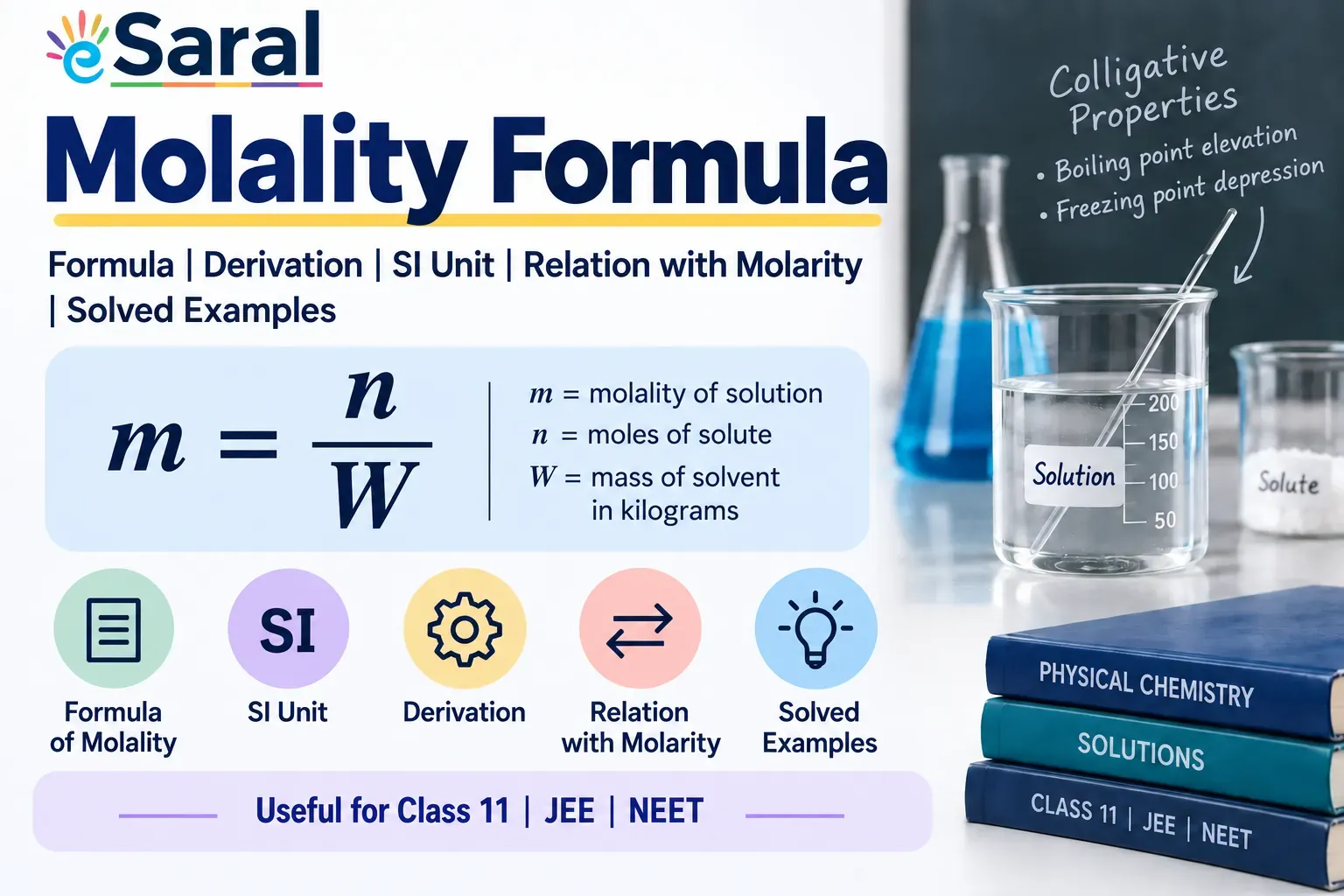
Molality Formula: Formula for Molality, Derivation & Solved Examples
Molality formula is $m = \dfrac{n}{W}$. Learn the formula of molality, its SI unit, derivation, relation with molarity, and solved examples for Class 11, JEE and NEET.
BITSAT Previous Year Question Paper PDF
Download BITSAT previous year question papers PDF. Get year-wise BITSAT PYQs, memory-based papers, exam pattern, and preparation tips to improve your BITSAT preparation.

Teachers’ Day 2026 at eSaral Gurukul: Celebrating the Bond Between Students, Teachers & Mentors
See how Teachers’ Day 2026 was celebrated at eSaral Gurukul, reflecting the bond among students, teachers, and mentors, and the role of guidance beyond academics.

JEE Advanced Attempts: Can You Give It a Third Time? Rules Explained
JEE Advanced attempts: current rule is 2 consecutive years only: full eligibility criteria, the 2025 third-attempt controversy, and the latest 2026 petition news.

Best JEE Preparation App
Best JEE preparation app for Main & Advanced: AI mock tests, live doubt-solving, thousands of practice questions. JEE preparation app for droppers & Class 11-12.
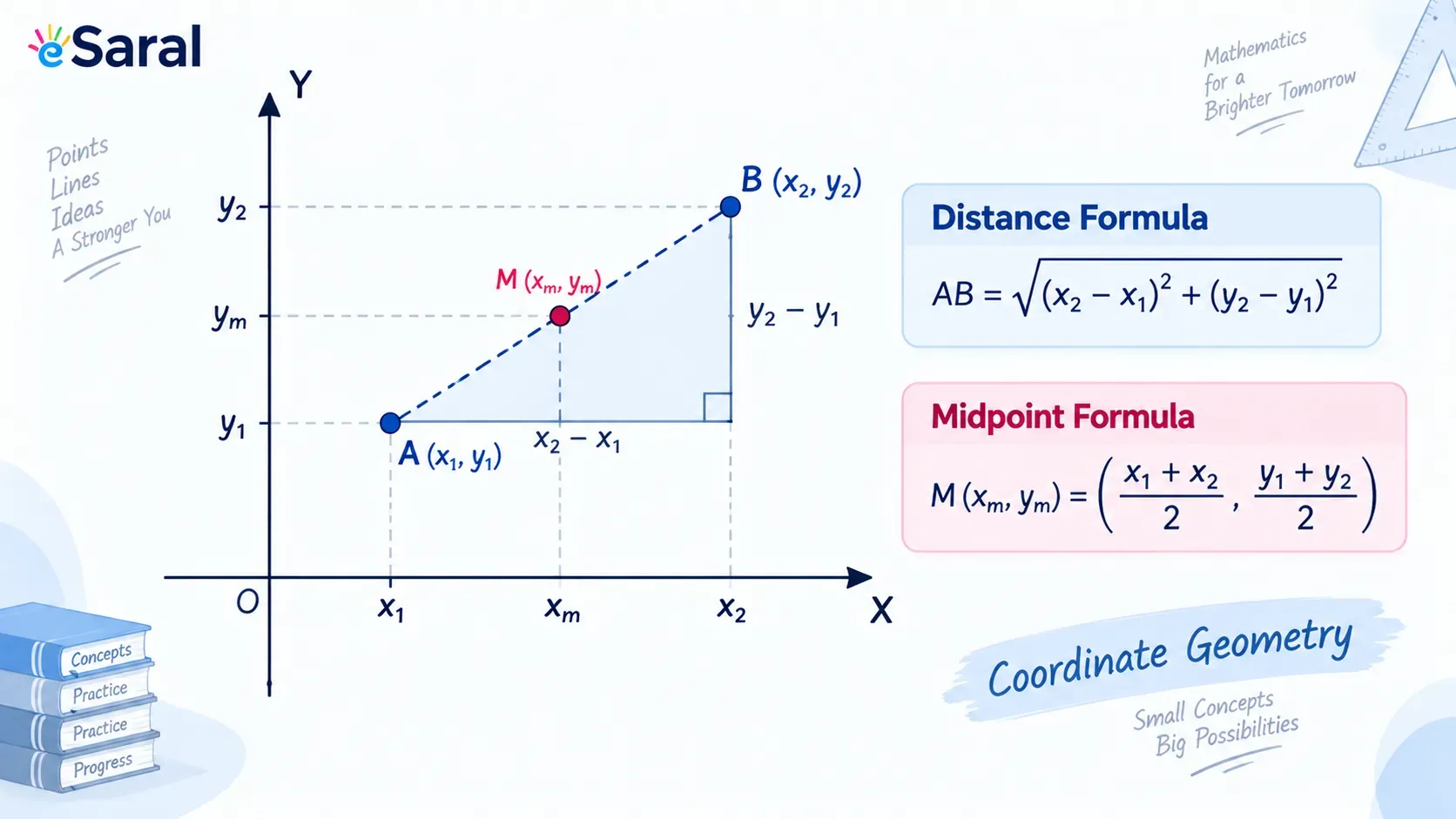
Coordinate Geometry Class 10: Formulas, Notes & Solved Examples
Coordinate geometry class 10: complete CBSE formulas — distance, section, midpoint and area of triangle — with derivation, notes and solved examples.
How to make Notes For JEE Smart Notes Strategy of an AIR 41
Learn how to make notes for JEE the way toppers do — indexing, shorthand, and smart short notes for JEE that cut revision time to just 5–7 days.
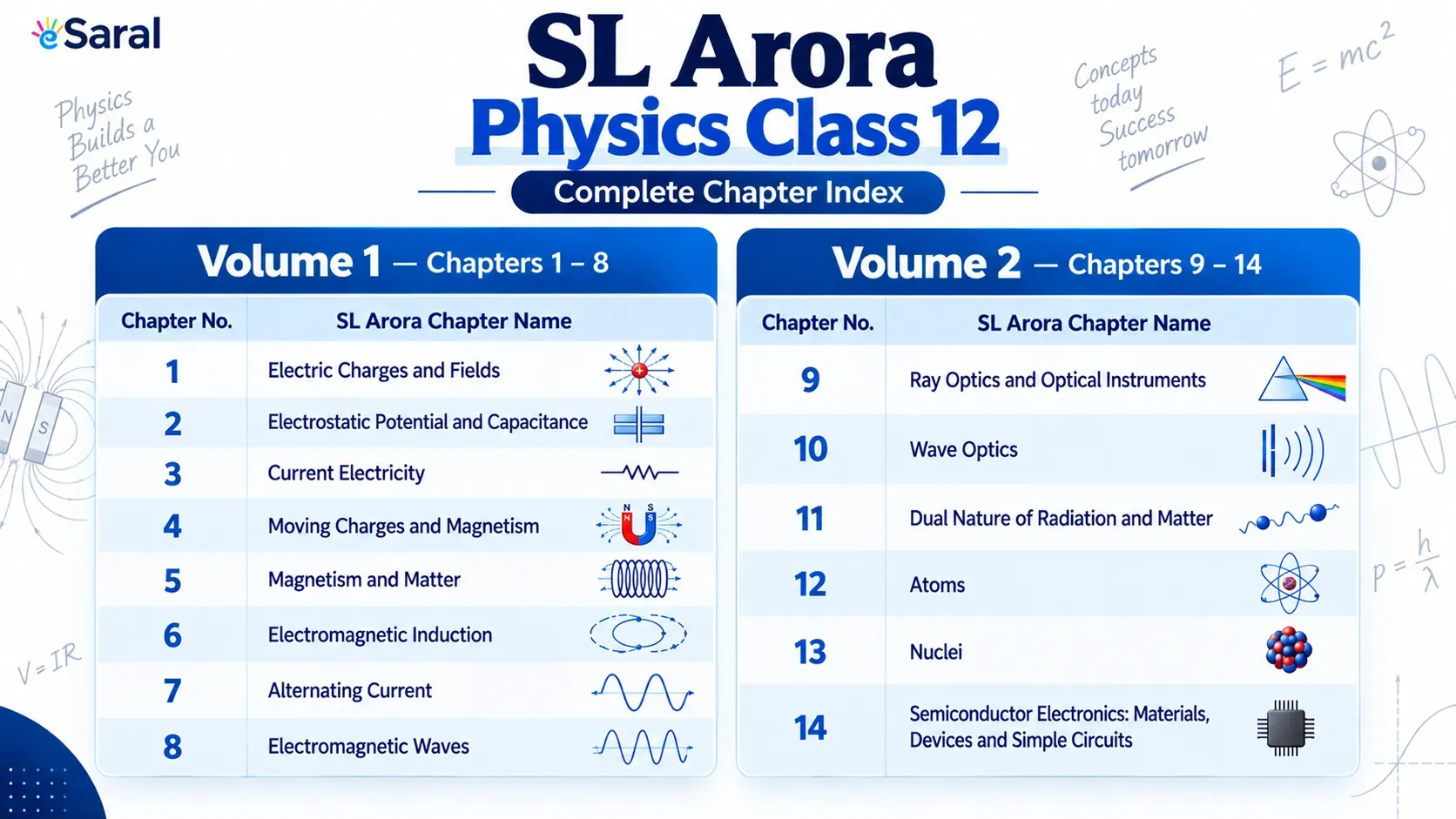
SL Arora Physics Class 12 Index – Chapter List for Volume 1 & 2
SL Arora Physics Class 12 index — complete chapter list for Volume 1 & 2, mapped to NCERT solutions for board, JEE Main, and NEET preparation.