
Thermodynamics - JEE Advanced Previous Year Questions with Solutions

eSaral Academic and Editorial Team
Summary
Thermodynamics JEE Advanced previous year questions cover state functions, entropy, Gibbs energy, adiabatic and isothermal processes, and cyclic processes. These 13+ questions — with verified answers and solutions — are essential practice for any JEE Advanced Chemistry preparation, as thermodynamics appears in almost every paper.

Home > JEE Advanced Previous Year Questions > Thermodynamics – JEE Advanced Questions with Solutions

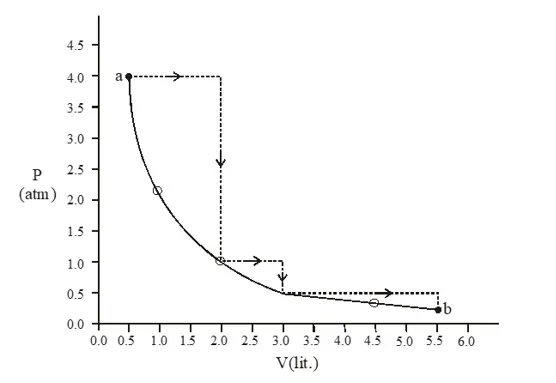
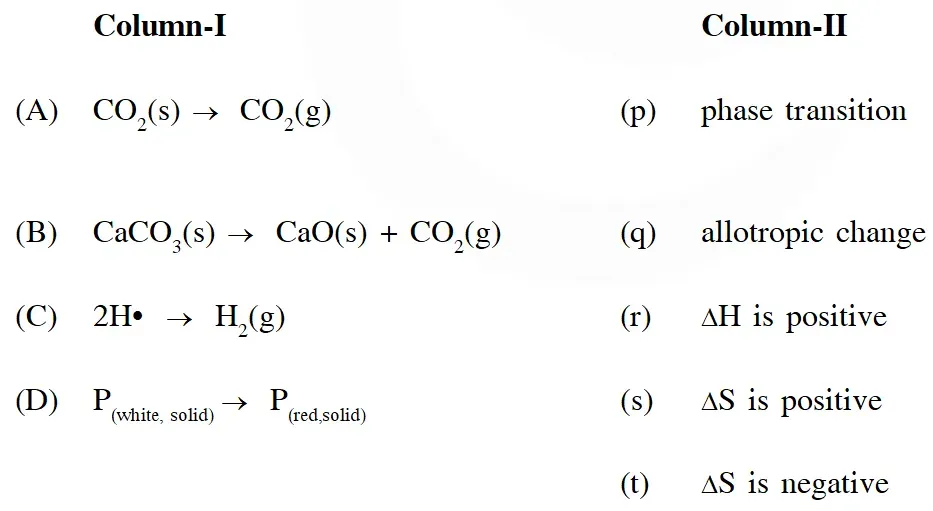
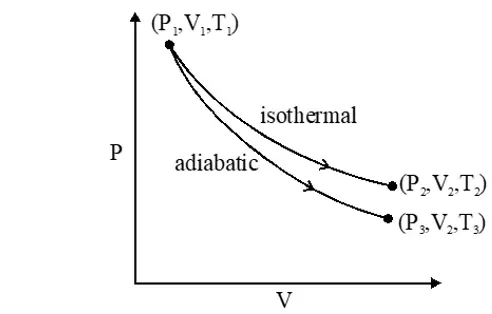
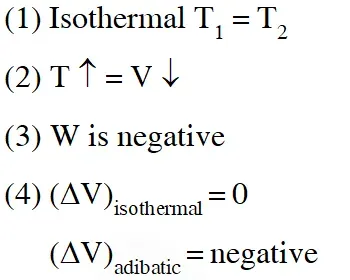
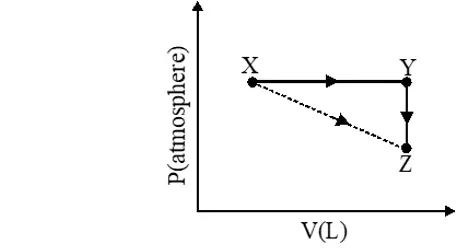
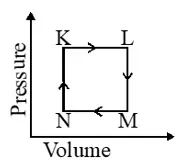
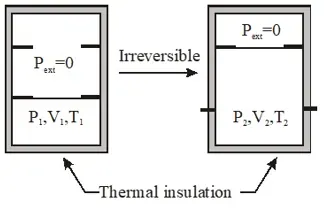
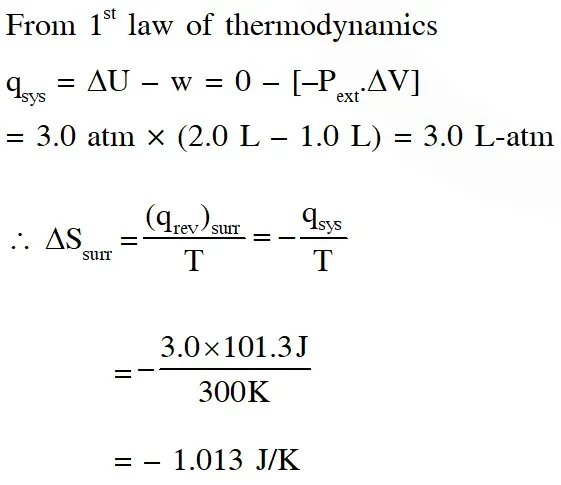
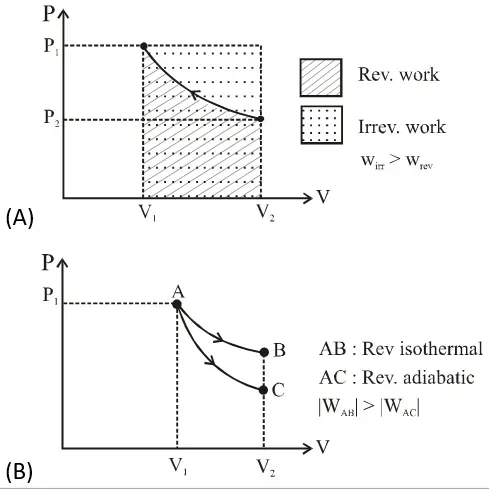
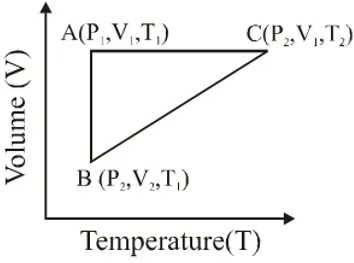
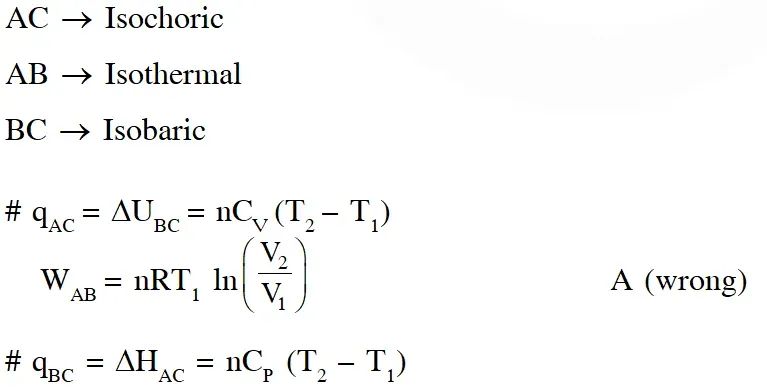
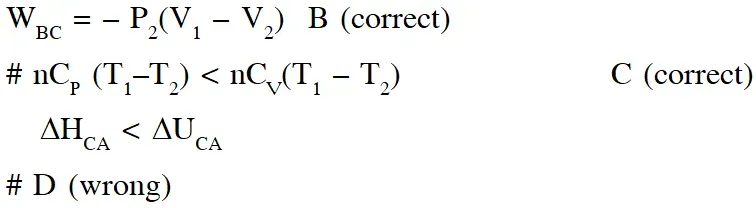
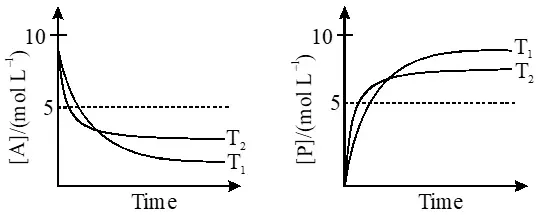
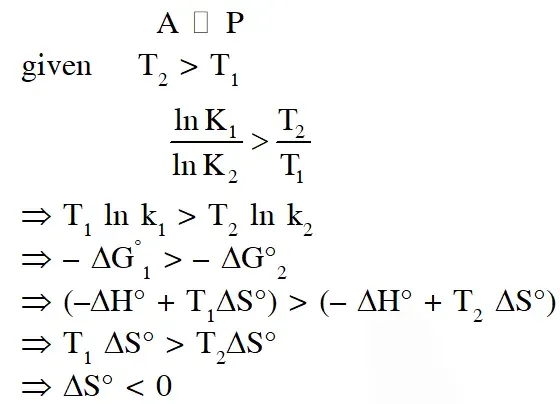
JEE Advanced Previous Year Questions of Physics with Solutions are available at eSaral. Practicing JEE Advanced Previous Year Papers Questions of Physics will help the JEE aspirants in realizing the question pattern as well as help in analyzing weak & strong areas. Get detailed Class 11th & 12th Physics Notes to prepare for Boards as well as competitive exams like IIT JEE, NEET etc. eSaral helps the students in clearing and understanding each topic in a better way. eSaral is providing complete chapter-wise notes of Class 11th and 12th both for all subjects. Click Here for JEE main Previous Year Topic Wise Questions of Physics with Solutions Download eSaral app for free study material and video tutorials. Simulator Previous Years JEE Advance Questions [esquestion] Among the following, the state function(s) is (are) (A) Internal energy (B) Irreversible expansion work (C) Reversible expansion work (D) Molar enthalpy #tag# [JEE 2009] #sol# (A,D) [/esquestion] [esquestion] One mole of an ideal gas is taken from a to b along two paths denoted by the solid and the dashed lines as shown in the graph below. If the work done along the solid line path is ws and that along the dotted line path is $\mathrm{w}_{\mathrm{d}},$ then the integer close to the ratio $\mathrm{w}_{\mathrm{d}} / \mathrm{w}_{\mathrm{s}}$ is- #tag# [JEE 2010] #sol# 2 $\mathrm{W}_{\mathrm{d}}=-(4 \times 1.5)+(0)-(1 \times 1)-\left(\frac{2}{3} \times 2.5\right)$ $\mathrm{W}_{\mathrm{S}}=-\mathrm{P}_{1} \mathrm{V}_{1} \ln \frac{\mathrm{V}_{2}}{\mathrm{V}_{1}}$ $=-4 \times 05 \times \ln \frac{5.5}{0.5}$ [/esquestion] [esquestion] Match the transformations in Column-I with appropriate option in Column-II #tag# [JEE 2011] #sol# $A \rightarrow(P, R, S) B \rightarrow(R, S) C \rightarrow T, D \rightarrow(P, Q, T)$ [/esquestion] [esquestion] The reversible expansion of an ideal gas under adiabatic and isothermal conditions is shown in the figure. Which of the following statement(s) is (are) correct ? (A) $\mathrm{T}_{1}=\mathrm{T}_{2}$ (B) $\mathrm{T}_{3}>\mathrm{T}_{1}$ (C) $\mathrm{W}_{\text {isothermal }}>\mathrm{W}_{\text {adiabatic }}$ (D) $\Delta \mathrm{U}_{\text {isothemal }}>\Delta \mathrm{U}_{\text {adibaic }}$ #tag# [JEE 2012] #sol# (A,D) [/esquestion] [esquestion] For an ideal gas, consider only P-V work in going from an initial state X to the final state Z. The final state Z can be reached by either of the two paths shown in the figure. Which of the following choice(s) is (are) correct ? [take S as change in entropy and w as work done] (A) $\Delta \mathrm{S}_{\mathrm{x} \rightarrow \mathrm{z}}=\Delta \mathrm{S}_{\mathrm{x} \rightarrow \mathrm{y}}+\Delta \mathrm{S}_{\mathrm{y} \rightarrow \mathrm{z}}$ (B) $\mathrm{W}_{\mathrm{x} \rightarrow \mathrm{z}}=\mathrm{W}_{\mathrm{x} \rightarrow \mathrm{y}}+\mathrm{W}_{\mathrm{y} \rightarrow \mathrm{z}}$ (C) $\mathrm{W}_{\mathrm{x} \rightarrow \mathrm{y} \rightarrow \mathrm{z}}=\mathrm{W}_{\mathrm{x} \rightarrow \mathrm{y}}$ (D) $\Delta \mathrm{S}_{\mathrm{x} \rightarrow \mathrm{y} \rightarrow \mathrm{z}}=\Delta \mathrm{S}_{\mathrm{x} \rightarrow \mathrm{y}}$ #tag# [JEE 2012] #sol# (A,C) [/esquestion] Paragraph for Question 6 and 7 A fixed mass 'm' of a gas is subjected to transformation of states from K to L to M to N and back to K as shown in the figure. [esquestion] The pair of isochoric processes among the transformation of states is (A) K to L and L to M (B) L to M and N to K (C) L to M and M to N (D) M to N nd N to K #tag# [JEE 2013] #sol# (B) Isochoric $\Rightarrow \mathrm{V}-$ constant [/esquestion] [esquestion] The succeeding operations that enable this transformation of states are (A) Heating, cooling, heating, cooling (B) cooling, heating, cooling, heating (C) Heating, cooling, cooling, heating (D) Cooling, heating, heating, cooling #tag# [JEE 2013] #sol# (C) Isochoric $\Rightarrow \mathrm{V}-$ constant [/esquestion] [esquestion] An ideal gas in thermally insulated vessel at internal pressure = $\mathrm{P}_{1}$, volume = $V_{1}$ and absolute temperature = $\mathrm{T}_{1}$ expands irrversibly against zero external pressure, as shown in the diagram. The final internal pressure, volume and absolute temperature of the gas are $P_{2}$, $\mathrm{V}_{2}$ and $\mathrm{T}_{2}$, respectively. For this expansion, (A) q = 0 (B) $\mathrm{T}_{2}=\mathrm{T}_{1}$ (C) $\mathrm{P}_{2} \mathrm{V}_{2}=\mathrm{P}_{1} \mathrm{V}_{1}$ $(\mathrm{D}) \mathrm{P}_{2} \mathrm{V}_{2}^{\gamma}=\mathrm{P}_{1} \mathrm{V}_{1}^{\gamma}$ #tag# [JEE 2014] #sol# 1,2,3 $\mathrm{q}=0 ; \mathrm{w}=0 ; \Delta \mathrm{U}=0 ; \mathrm{T}_{1}=\mathrm{T}_{2} ; \mathrm{PV}=\mathrm{constant}$ [/esquestion] [esquestion] One mole of an ideal gas at 300 K in thermal contact with surroundings expands isothermally from 1.0 L to 2.0 L against a constant pressure of 3.0 atm. In this process, the change in entropy of surroundings $\left(\Delta \mathrm{S}_{\text {surr }}\right)$ in $\mathrm{J} \mathrm{K}^{-1}$ is – (1 L atm = 101.3 J) (A) 5.763 (B) 1.013 (C) –1.013 (D) –5.763 #tag# [JEE - Advanced - 2016] #sol# (C) [/esquestion] [esquestion] For a reaction taking place in a container in equilibrium with its surroundings, the effect of temperature on its equilibrium constant K in terms of change in entropy is described by (A) With increase in temperature, the value of K for exothermic reaction decreases because the entropy change of the system is positive (B) With increase in temperature, the value of K for endothermic reaction increases because unfavourable change in entropy of the surroundings decreases (C) With increase in temperature, the value of K for exothermic reaction decreases because favourable change in entropy of the surroundings decreases (D) With increase in temperature, the value of K for endothermic reaction increases because the entropy change of the system negative #tag# [JEE - Adv. 2017] #sol# (B,C) [/esquestion] [esquestion] An ideal gas is expanded from $\left(p_{1}, V_{1}, T_{1}\right)$ to $\left(p_{2}, V_{2}, T_{2}\right)$ under different conditions. The correct statement(s) among the following is(are) (A) The work done on the gas is maximum when it is compressed irreversibly from ($\mathrm{p}_{2}$ , $\mathrm{V}_{2}$) to ($\mathrm{p}_{1}, \mathrm{V}_{1}$) against constant pressure $\mathrm{p}_{1}$ (B) The work done on the gas is less when it is expanded reversibly from $\mathrm{V}_{1}$ to $\mathrm{V}_{2}$ under adiabatic conditions as compared to that when expanded reversibly from $\mathrm{V}_{1}$ to $\mathrm{V}_{2}$ under isothermal conditions. (C) The change in internal energy of the gas (i) zero, if it is expanded reversibly with $\mathrm{T}_{1} \mathrm{T}_{2}$, and (ii) positive, if it is expanded reversibly under adiabatic conditions with $\mathrm{T}_{1} \neq \mathrm{T}_{2}$ (D) If the expansion is carried out freely, it is simultaneously both isothermal as well as adiabatic #tag# [JEE - Adv. 2017] #sol# 1,2,4 (3) (i) $\left.\Delta \mathrm{U}=\mathrm{nC}_{\mathrm{v}} \Delta \mathrm{T}=0 \text { (isothermal hence } \Delta \mathrm{T}=0\right)$ (ii) $\Delta \mathrm{U}=\mathrm{q}+\mathrm{w}=-\mathrm{ve}(\mathrm{q}=0, \mathrm{w}<0)$ $\Delta \mathrm{U}=\mathrm{nC}_{\mathrm{v}} \Delta \mathrm{T} \Rightarrow \Delta \mathrm{T}<0$ $\begin{aligned}(\mathbf{4}) \mathrm{q} &=0(\text { adiabatic }), \mathrm{w}=0(\text { free expansion }) \\ \Delta \mathrm{U} &=0 \Rightarrow \Delta \mathrm{T}=0 \text { (isothermal) } \end{aligned}$ [/esquestion] [esquestion] A reversible cyclic process for an ideal gas is shown below. Here, P , V and T are pressure , volume and temperature , respectively. The thermodynamic parameters q, w, H and U are heat, work, enthalpy and internal energy, respectively. The correct option(s) is (are) (A) $\mathrm{q}_{\mathrm{AC}}=\Delta \mathrm{U}_{\mathrm{BC}}$ and $\mathrm{w}_{\mathrm{AB}}=\mathrm{P}_{2}\left(\mathrm{V}_{2}-\mathrm{V}_{1}\right)$ (B) $\mathrm{w}_{\mathrm{BC}}=\mathrm{P}_{2}\left(\mathrm{V}_{2}-\mathrm{V}_{1}\right)$ and $\mathrm{q}_{\mathrm{BC}}=\Delta \mathrm{H}_{\mathrm{AC}}$ (C) $\Delta \mathrm{H}_{\mathrm{CA}}<\Delta \mathrm{U}_{\mathrm{CA}}$ and $\mathrm{q}_{\mathrm{AC}}=\Delta \mathrm{U}_{\mathrm{BC}}$ (D) $\mathrm{q}_{\mathrm{BC}}=\Delta \mathrm{H}_{\mathrm{AC}}$ and $\Delta \mathrm{H}_{\mathrm{CA}}>\Delta \mathrm{U}_{\mathrm{CA}}$ #tag# [JEE - Adv. 2018 #sol# (B,C) [/esquestion] [esquestion] For a reaction, $\mathbf{A} \square \mathbf{P}$, the plots of [A] and [P] with time at temperatures $\mathrm{T}_{1}$ and $\mathrm{T}_{2}$ are given below. If $\mathrm{T}_{2}>\mathrm{T}_{1},$ the correct statement(s) is (are) (Assume $\Delta \mathrm{H}^{\theta}$ and $\Delta \mathrm{S}^{\theta}$ are independent of temperature and ratio of $\ln \mathrm{K}$ at $\mathrm{T}_{1}$ to $\ln \mathrm{K}$ at $\mathrm{T}_{2}$ is greater than $\mathrm{T}_{2 / \mathrm{T}_{\mathrm{T}}}$. Here H, S, G and K are enthalpy, entropy, Gibbs energy and equilibrium constant, respectively.) (A) $\Delta \mathrm{H}^{\theta}<0, \Delta \mathrm{S}^{\theta}<0$ (B) $\Delta \mathrm{G}^{\theta}<0, \Delta \mathrm{H}^{\theta}>0$ (C) $\Delta \mathrm{G}^{\theta}<0, \Delta \mathrm{S}^{\theta}<0$ (D) $\Delta \mathrm{G}^{\theta}<0, \Delta \mathrm{S}^{\theta}>0$ #tag# [JEE - Adv. 2018] #sol# (A,C) [/esquestion]
To build the deeper conceptual clarity JEE Advanced numericals demand, follow up this Thermodynamics PYQ set with our Irodov questions for JEE.
After mastering Thermodynamics - JEE Advanced PYQs (Physics), test your understanding under real paper conditions with the JEE Advanced exam paper.
Frequently Asked Questions
What is the difference between state functions and path functions in JEE Advanced context?
State functions (internal energy U, enthalpy H, entropy S, Gibbs energy G) depend only on the current state — not how the system got there. Path functions (heat q, work w) depend on the specific process. JEE Advanced 2009 tested this directly. Any time a question asks "which is always the same regardless of path," the answer involves state functions only.
Is Class 11 or Class 12 thermodynamics more important for JEE Advanced?
Both are tested together. Class 11 covers the laws of thermodynamics, internal energy, enthalpy, and work (Chapter 6 of NCERT Chemistry Part 1). Class 12 builds on this with Gibbs energy, equilibrium constant, and spontaneity. JEE Advanced questions frequently combine both — for example, using ΔG° = −RT ln K alongside first-law calculations.
How many questions come from Thermodynamics in JEE Advanced each year?
Thermodynamics typically contributes 2–4 questions per year in JEE Advanced Chemistry. Between 2009 and 2018, it appeared every year without exception. The questions are usually multi-correct or paragraph-based, carrying 3–8 marks each, making it one of the highest-value single chapters in Physical Chemistry.
What is free expansion and why is it both isothermal and adiabatic for an ideal gas?
Free expansion occurs when a gas expands against zero external pressure (P_ext = 0). Since w = −P_ext × ΔV = 0, and if the vessel is thermally insulated q = 0, then ΔU = 0. For an ideal gas, internal energy depends only on temperature, so ΔT = 0 — the process is isothermal. It is simultaneously adiabatic (q = 0) and isothermal (ΔT = 0). JEE Advanced 2014 and 2017 both tested this concept.
Why does K decrease with temperature for exothermic reactions?
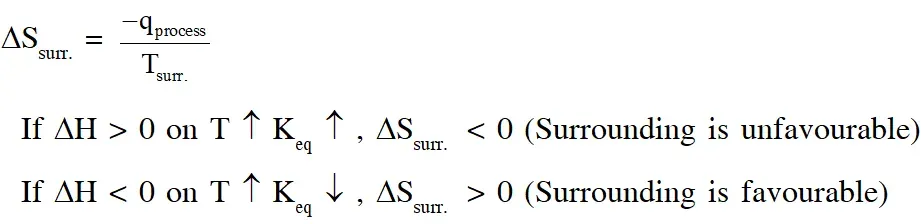
For an exothermic reaction, ΔH° < 0. The entropy gain of surroundings equals −ΔH°/T. As temperature increases, this term decreases in magnitude, making the overall ΔS_total less positive — shifting equilibrium back toward reactants and reducing K. This is the entropy-based explanation tested in JEE Advanced 2017, option (C).
How do I calculate entropy change of surroundings in JEE Advanced problems?
Use ΔS_surr = −q_sys / T. First calculate q_sys using q = ΔU − w or directly from the process conditions. For an isothermal expansion against constant external pressure: w = −P_ext × ΔV, and for an ideal gas ΔU = 0, so q_sys = −w = P_ext × ΔV. Then divide by temperature in Kelvin and apply the negative sign. This was exactly the method needed for the 2016 question.
Team eSaral
eSaral Academic and Editorial Team
Team eSaral is the collective author profile for educational content created by eSaral’s teachers and academic contributors. The team draws on expertise from IIT graduates, doctors, experienced educators and subject specialists to develop resources for JEE, NEET and school students. Our articles aim to explain concepts clearly and help students study with confidence.
Related Posts
Plant Cell Diagram: Labelled Structure, Parts and Functions
Simple, labelled plant cell diagram with parts and functions. Covers plant cell structure for Class 6, 7, 8, 9, 10 and 11 students, CBSE-aligned.
Saransh Gupta Sir's Visit to IIT Patna: Hostel Life, Placements & Lessons for JEE Aspirants
Inside Saransh Gupta Sir's IIT Patna visit — hostel life, the library, placements, internships, and real advice for JEE aspirants from students living the IIT dream.
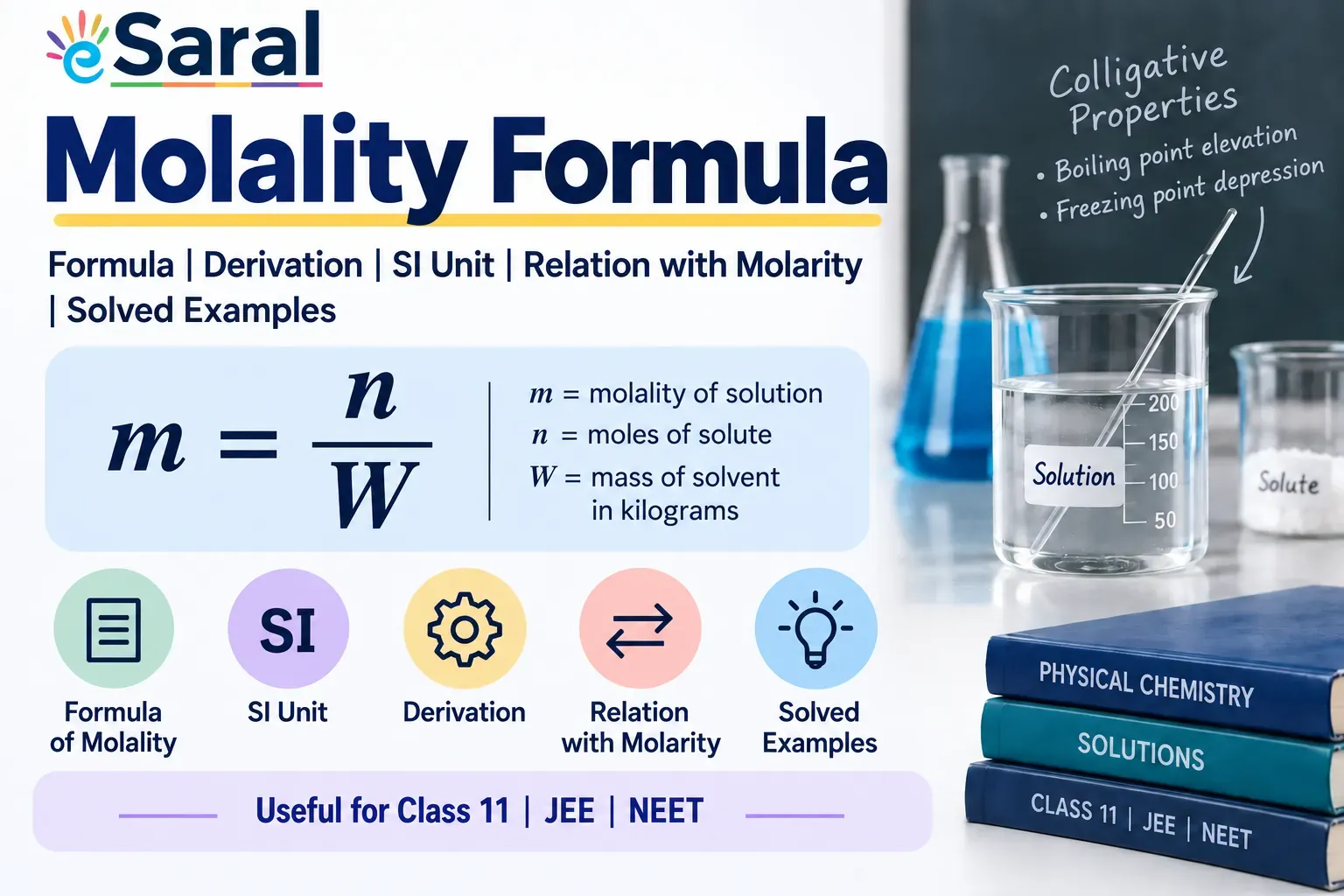
Molality Formula: Formula for Molality, Derivation & Solved Examples
Molality formula is $m = \dfrac{n}{W}$. Learn the formula of molality, its SI unit, derivation, relation with molarity, and solved examples for Class 11, JEE and NEET.
BITSAT Previous Year Question Paper PDF
Download BITSAT previous year question papers PDF. Get year-wise BITSAT PYQs, memory-based papers, exam pattern, and preparation tips to improve your BITSAT preparation.

Teachers’ Day 2026 at eSaral Gurukul: Celebrating the Bond Between Students, Teachers & Mentors
See how Teachers’ Day 2026 was celebrated at eSaral Gurukul, reflecting the bond among students, teachers, and mentors, and the role of guidance beyond academics.
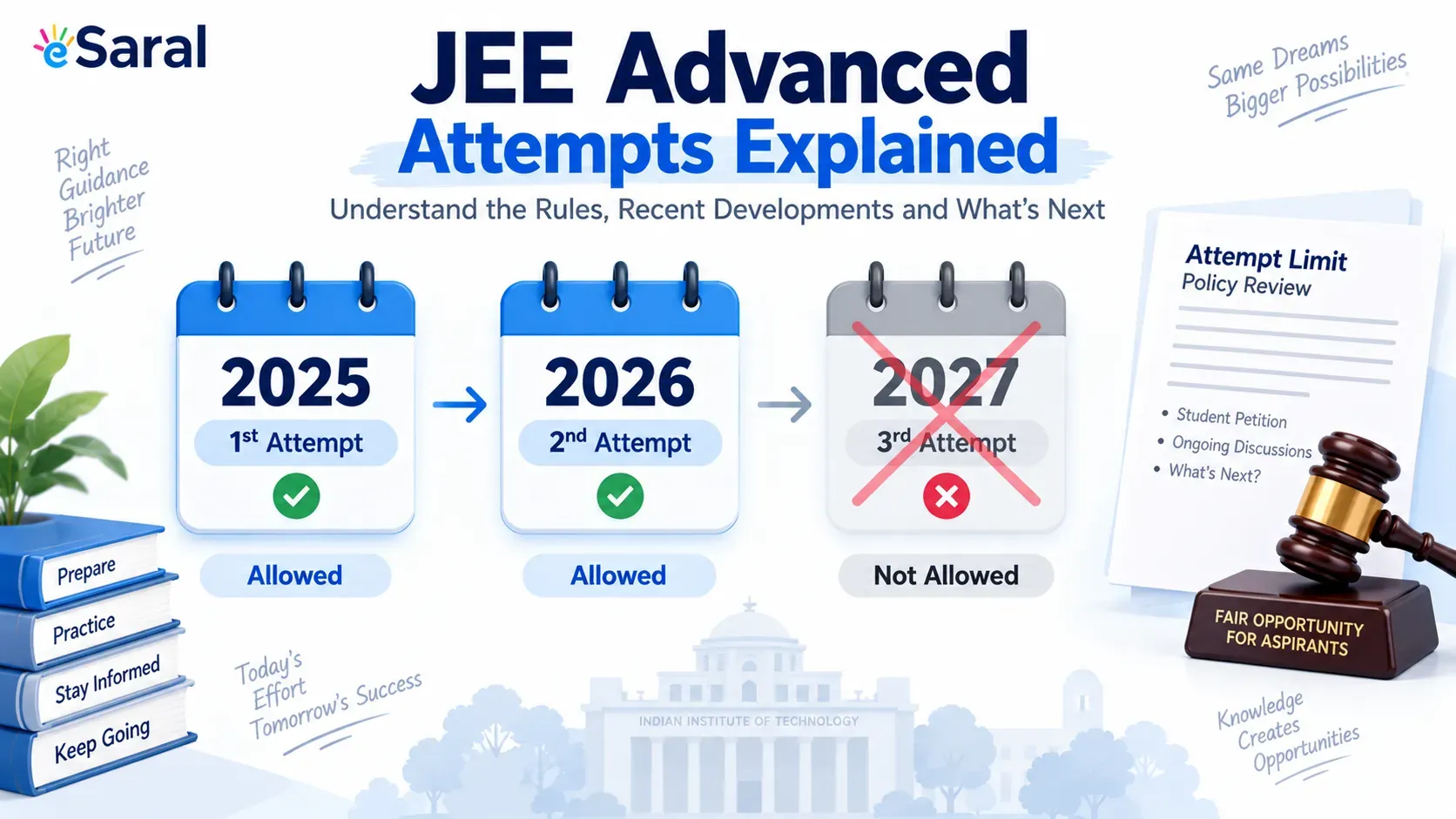
JEE Advanced Attempts: Can You Give It a Third Time? Rules Explained
JEE Advanced attempts: current rule is 2 consecutive years only: full eligibility criteria, the 2025 third-attempt controversy, and the latest 2026 petition news.

Best JEE Preparation App
Best JEE preparation app for Main & Advanced: AI mock tests, live doubt-solving, thousands of practice questions. JEE preparation app for droppers & Class 11-12.
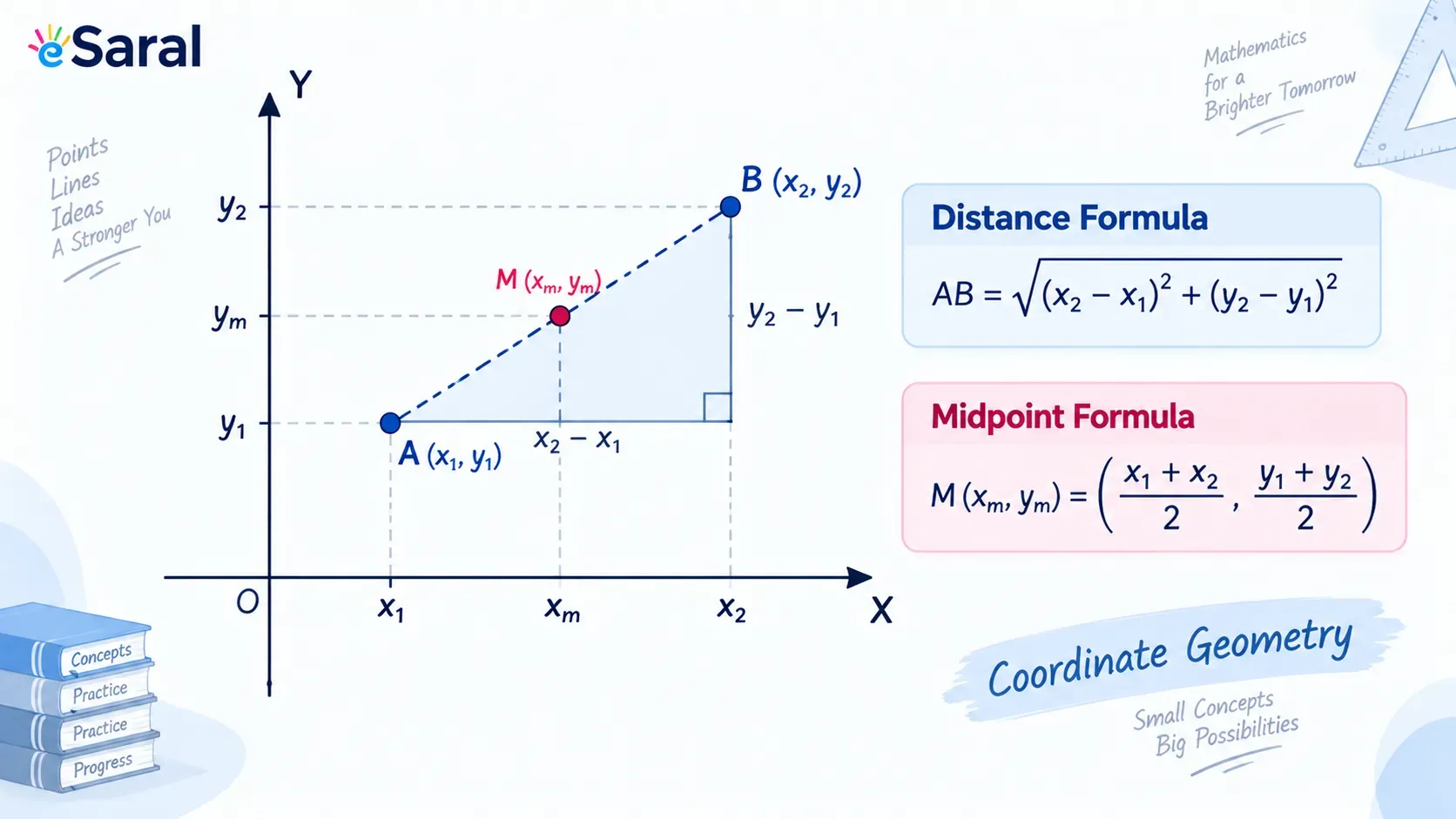
Coordinate Geometry Class 10: Formulas, Notes & Solved Examples
Coordinate geometry class 10: complete CBSE formulas — distance, section, midpoint and area of triangle — with derivation, notes and solved examples.
How to make Notes For JEE Smart Notes Strategy of an AIR 41
Learn how to make notes for JEE the way toppers do — indexing, shorthand, and smart short notes for JEE that cut revision time to just 5–7 days.
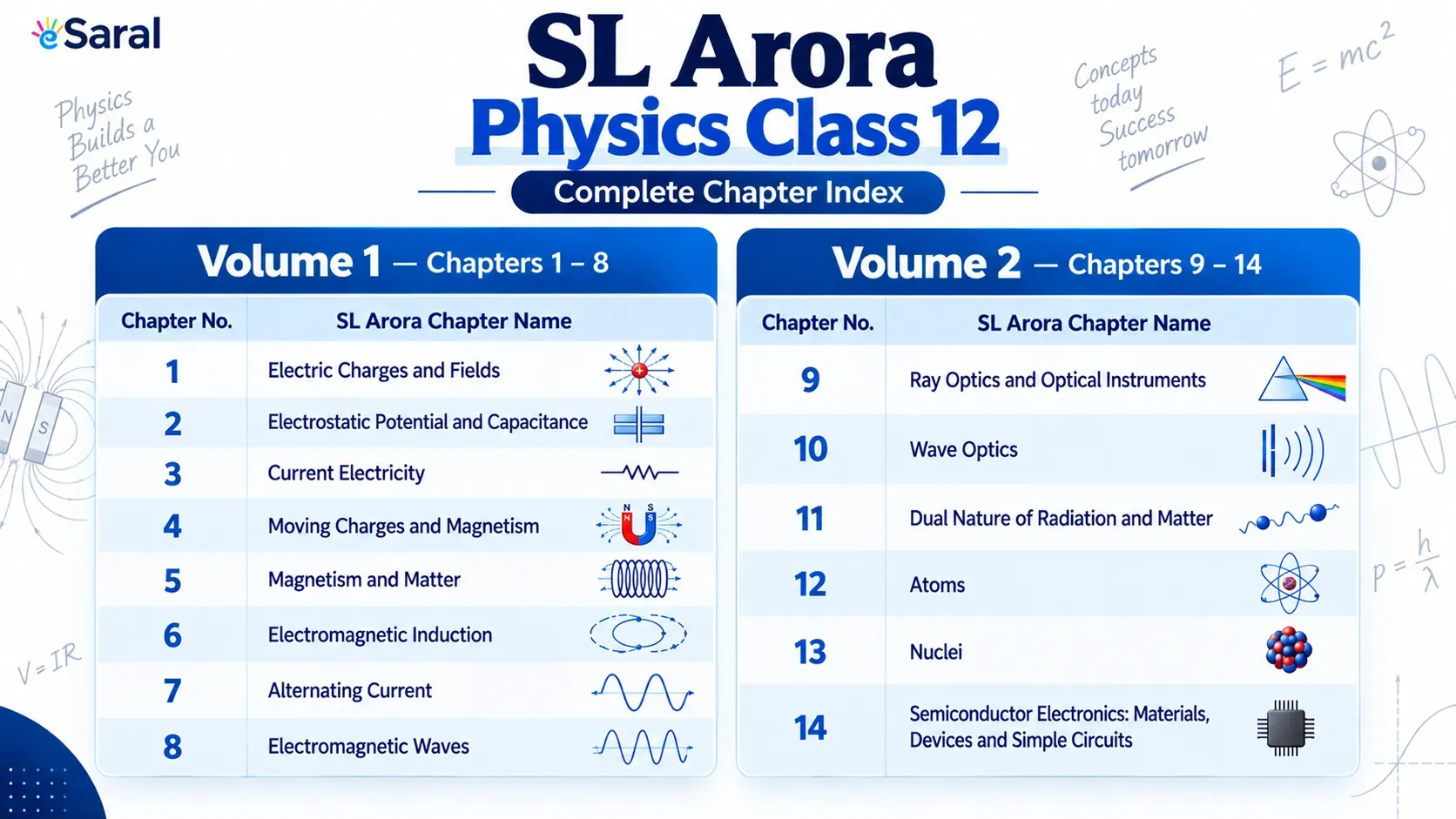
SL Arora Physics Class 12 Index – Chapter List for Volume 1 & 2
SL Arora Physics Class 12 index — complete chapter list for Volume 1 & 2, mapped to NCERT solutions for board, JEE Main, and NEET preparation.