
3D Geometry- JEE Advanced Previous Year Questions with Solutions

eSaral Academic and Editorial Team
Summary
<p>JEE Advanced 3D Geometry Previous Year Questions cover planes, lines, vectors, distances, angles, and spatial reasoning concepts essential for mastering high-weightage coordinate geometry problems in the exam.</p>
eSaral › JEE › JEE Main ›3D Geometry- JEE Advanced Previous Year Questions with Solutions

🚀 Checkout eSaral Courses
Why 3D Geometry Matters in JEE Advanced
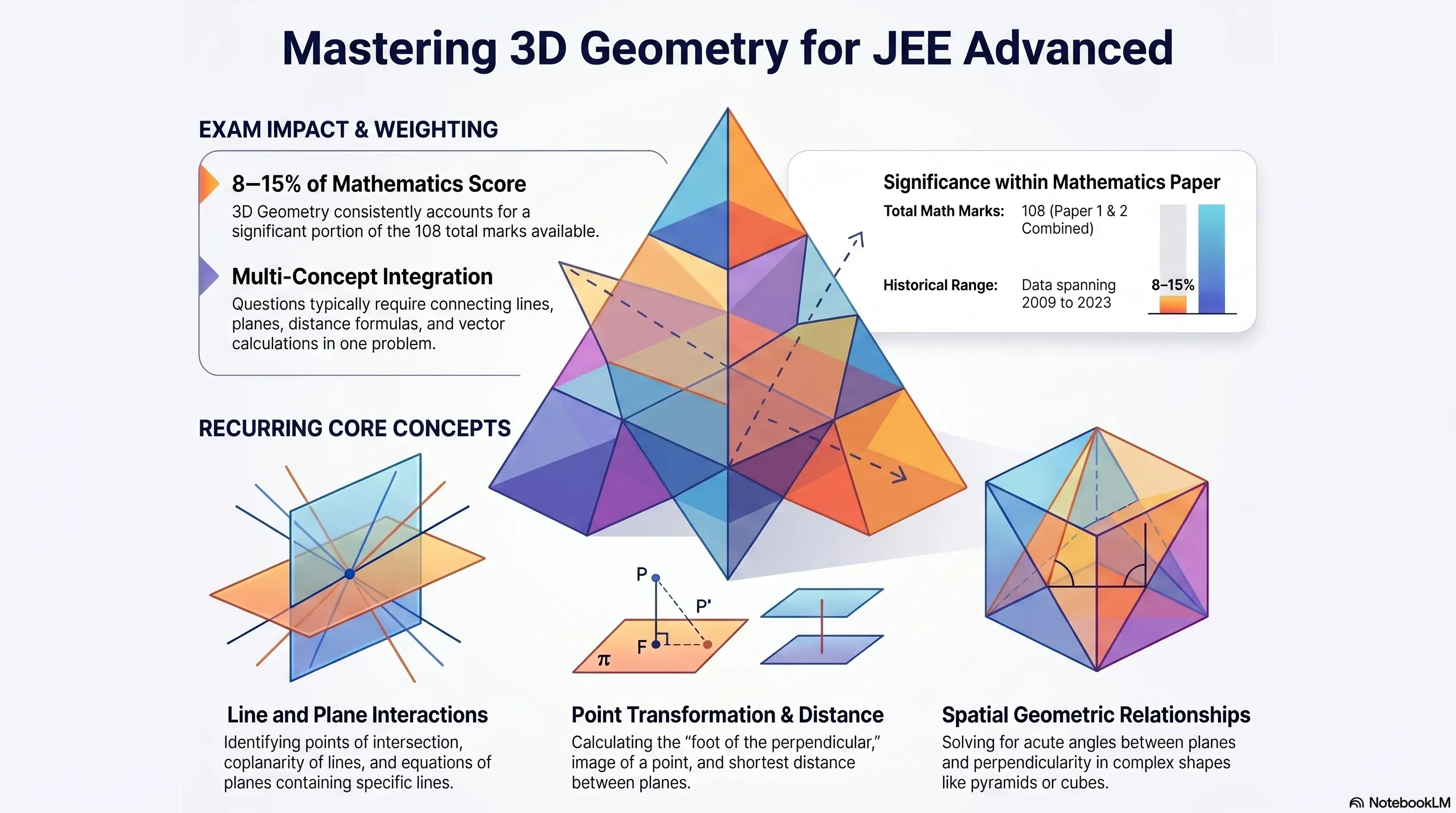
Three-dimensional geometry is one of the most consistently tested topics in JEE Advanced Mathematics. Questions from this chapter test spatial reasoning, vector fluency, and the ability to connect multiple concepts — lines, planes, distance formulas, and angle calculations — within a single problem.
According to the official JEE Advanced information brochure published by IIT (the organising institute rotates annually), Mathematics carries 108 marks in Paper 1 and Paper 2 combined. 3D Geometry alone has accounted for roughly 8–15% of the Mathematics score in most years between 2009 and 2023.
JEE Advanced Previous Year Questions
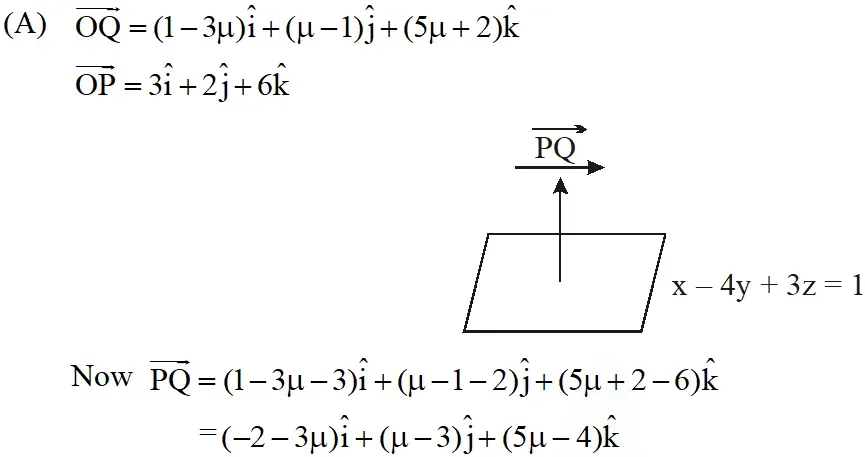
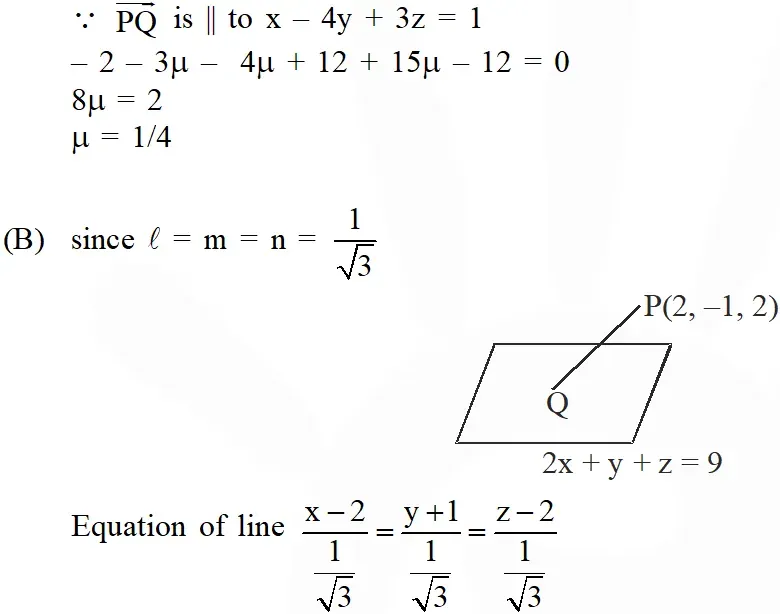
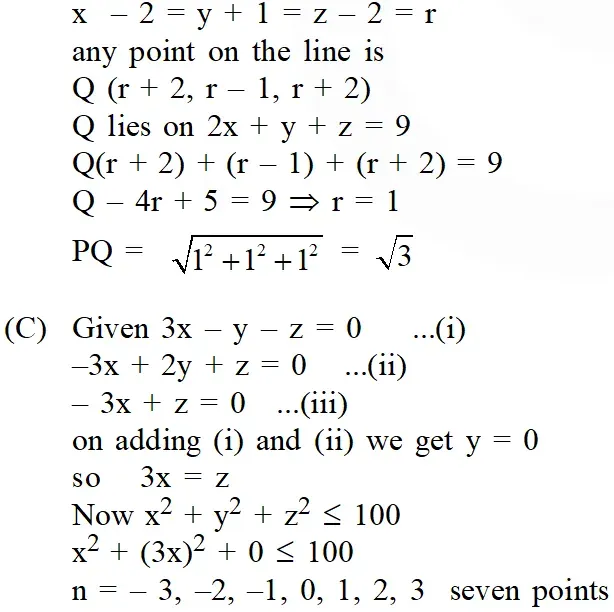
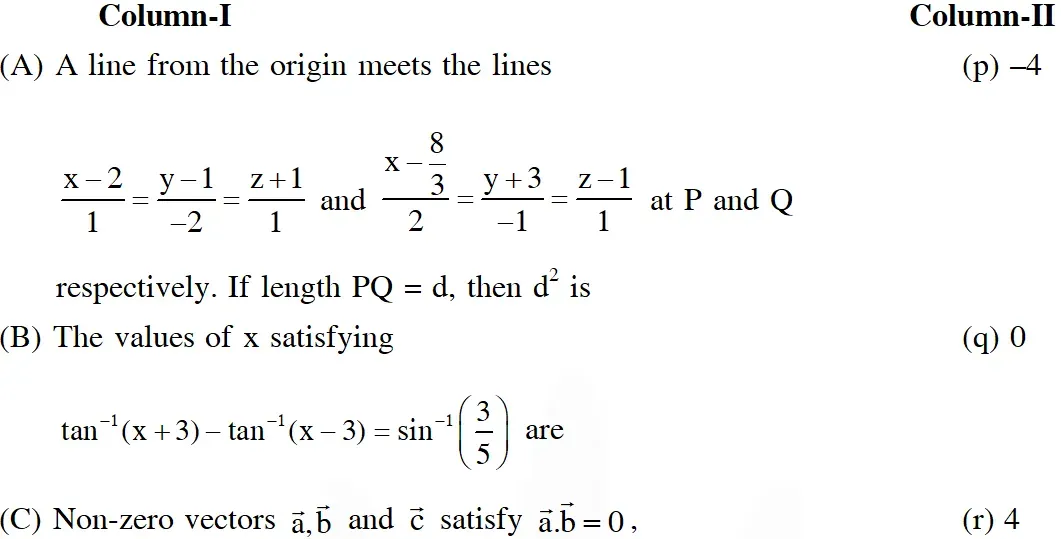
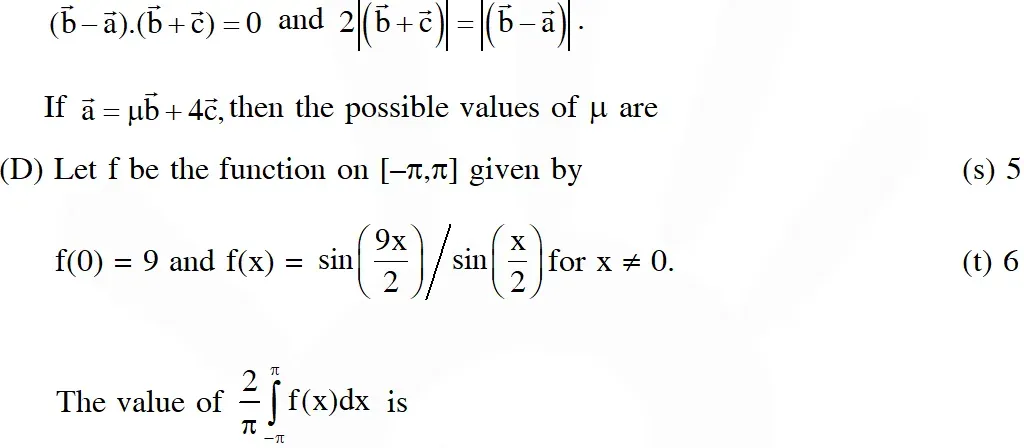
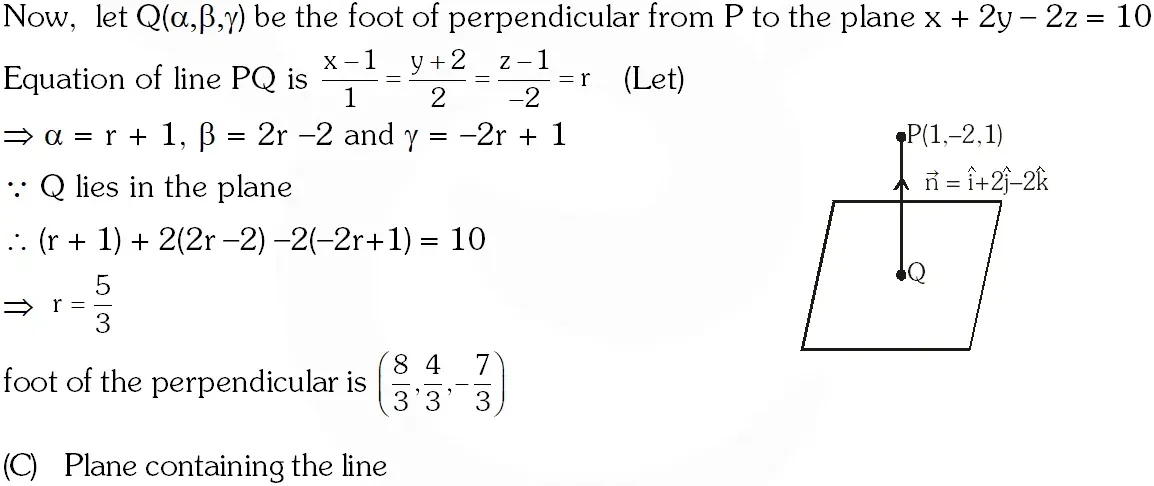
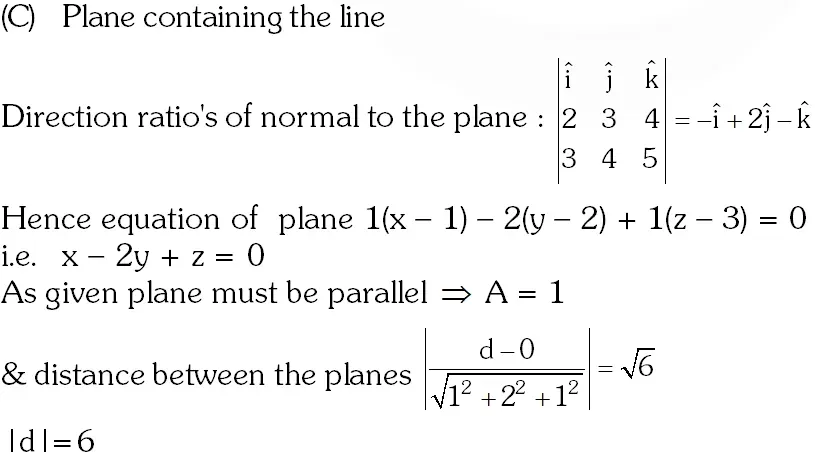
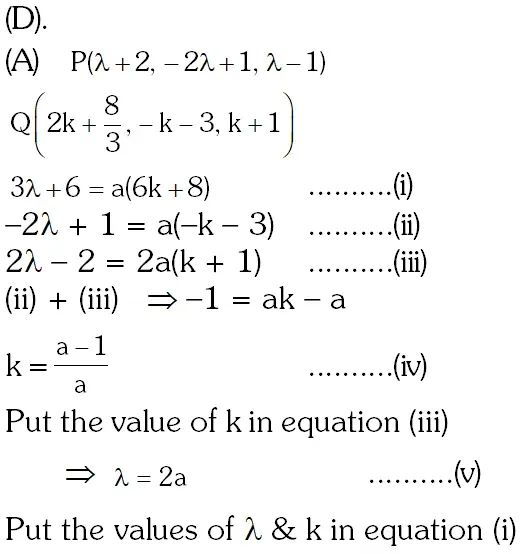
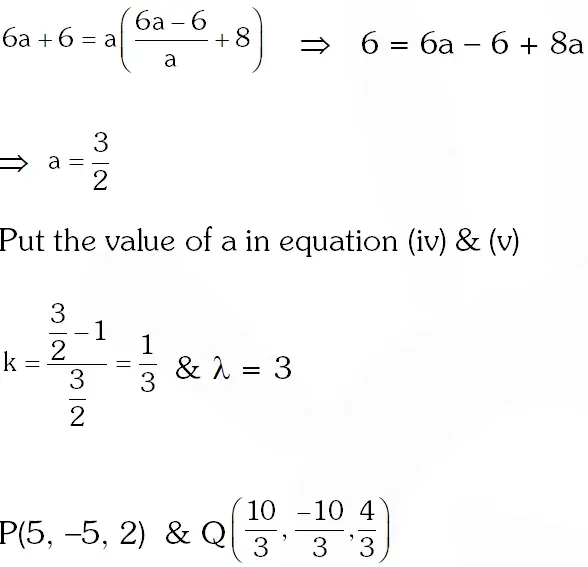
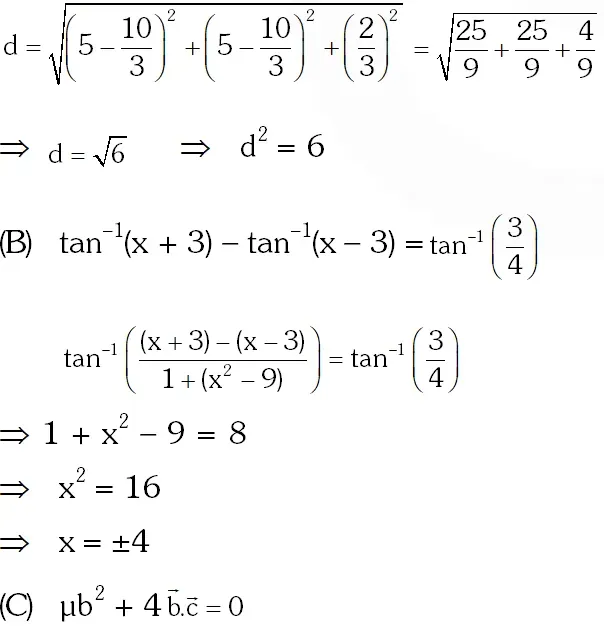
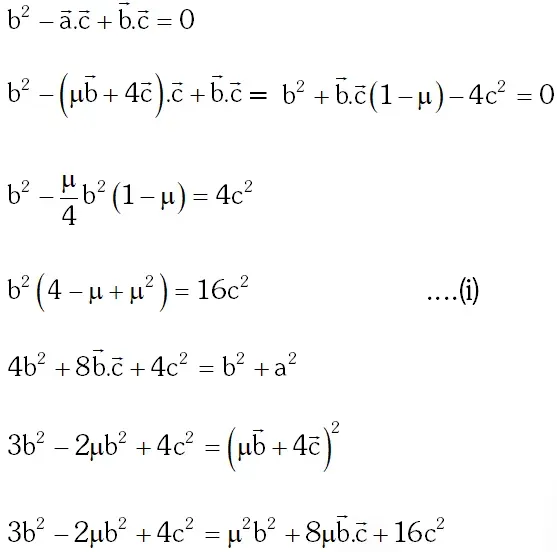
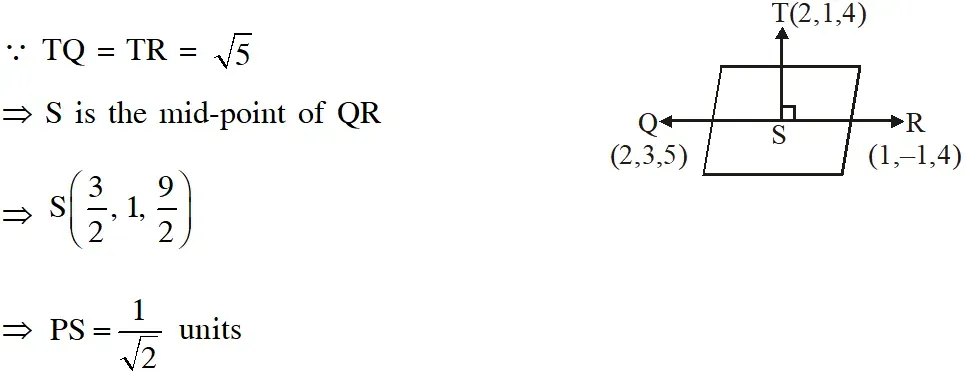
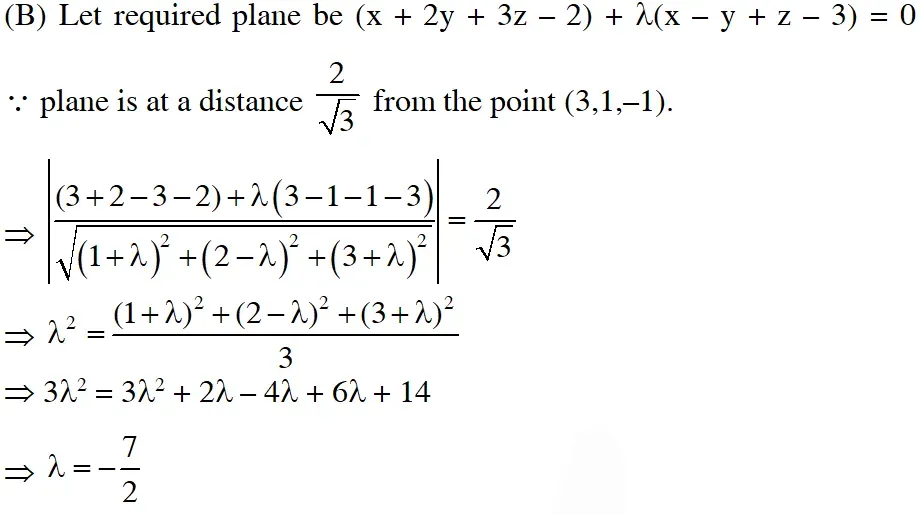
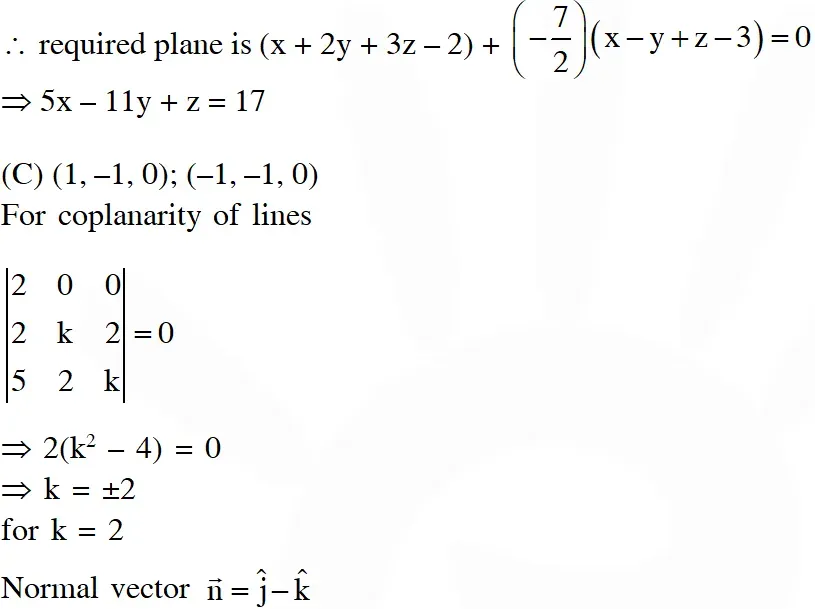
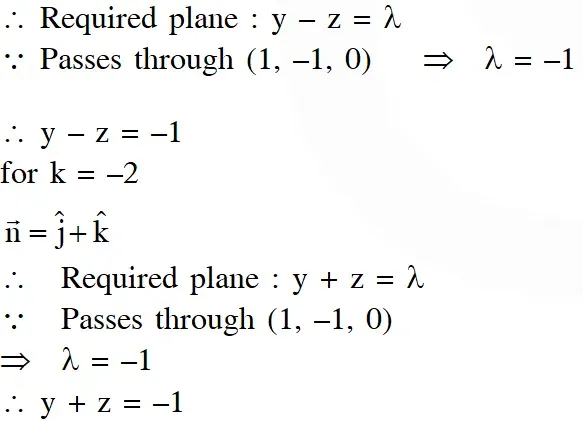
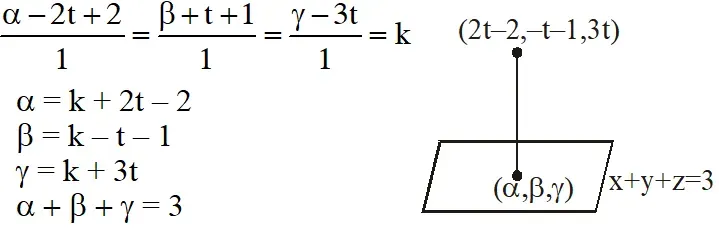
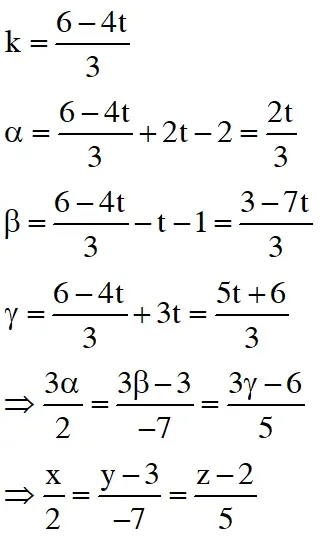
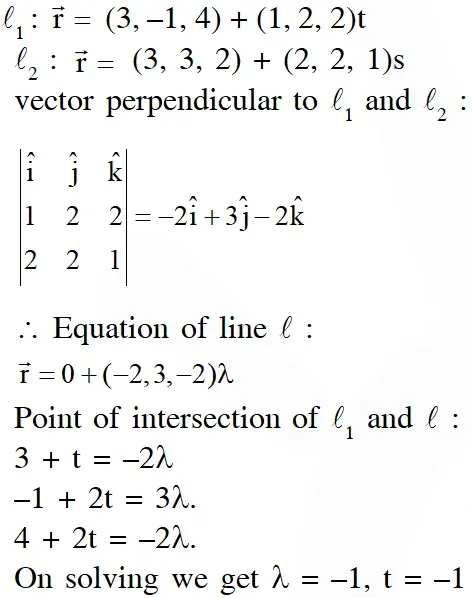
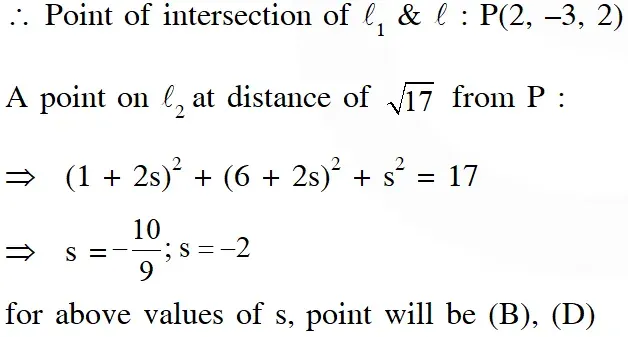
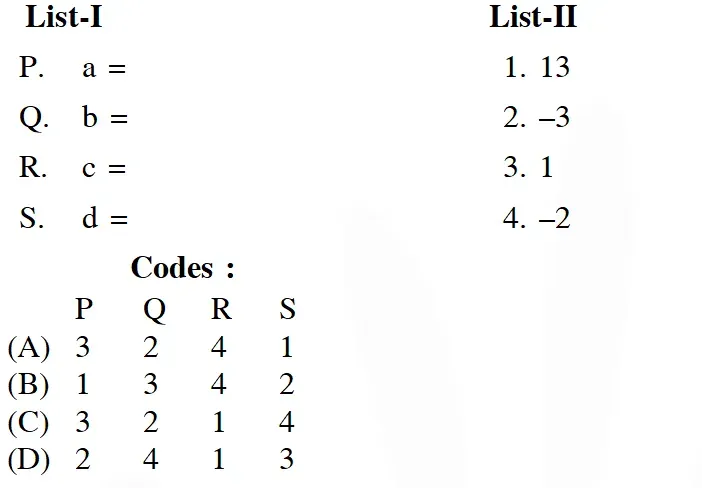
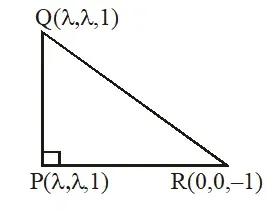
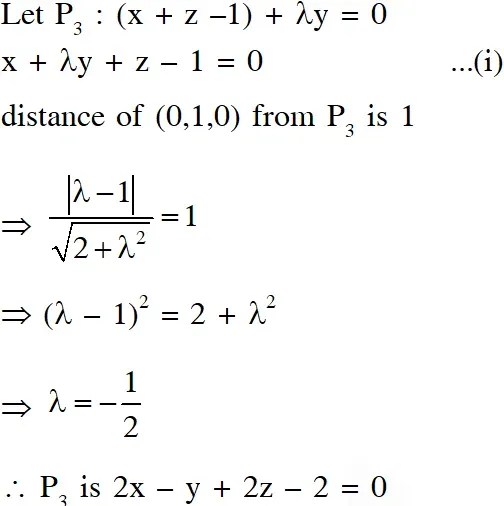
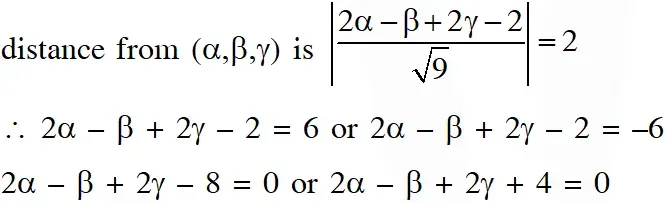
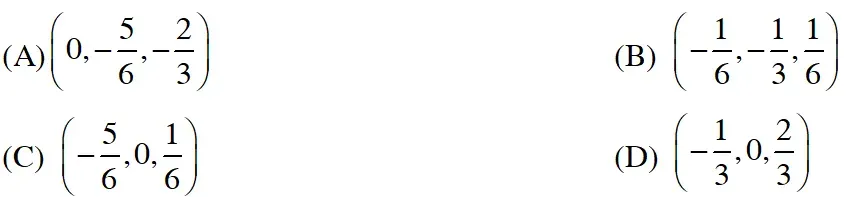
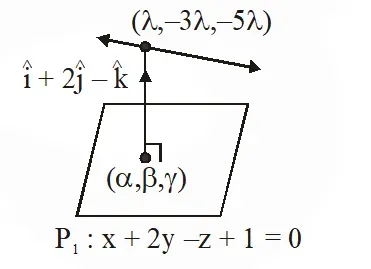
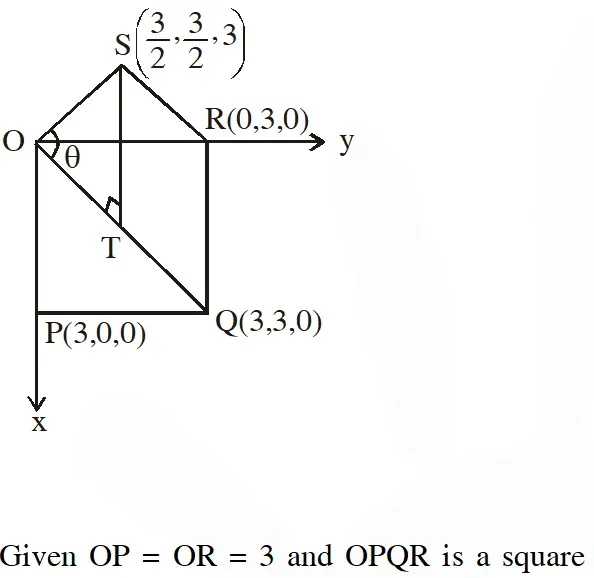
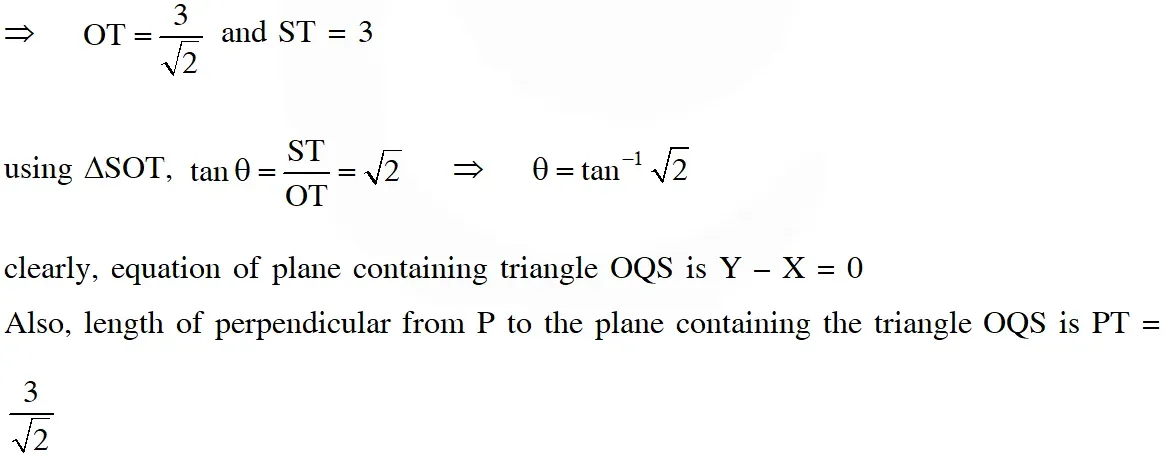
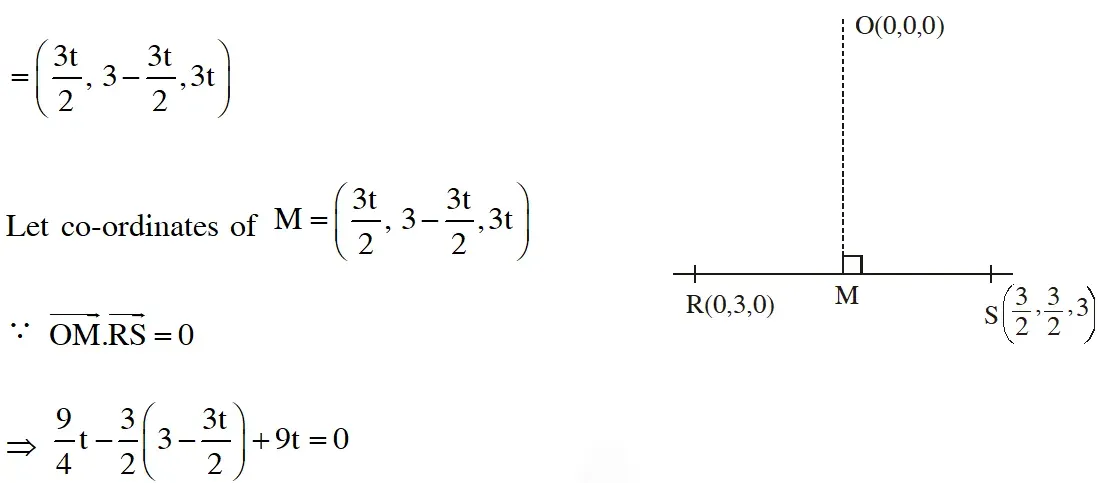
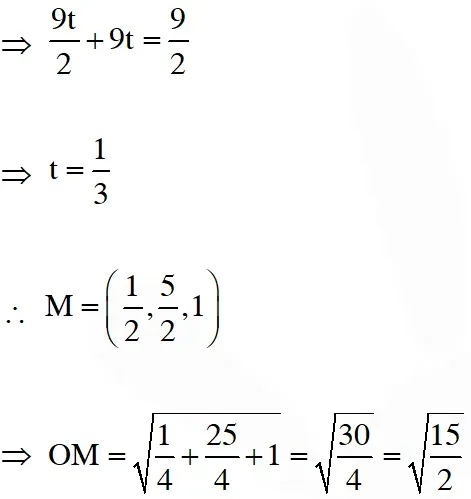
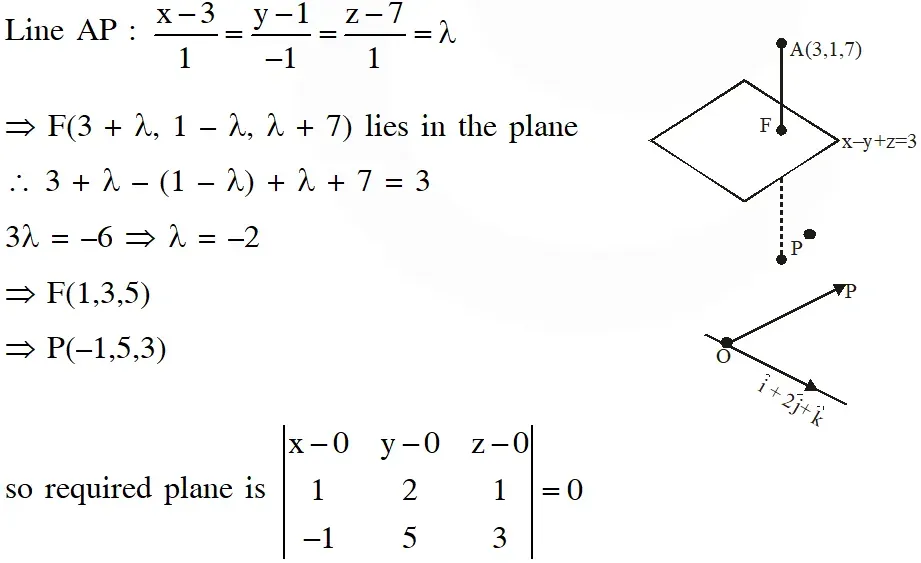
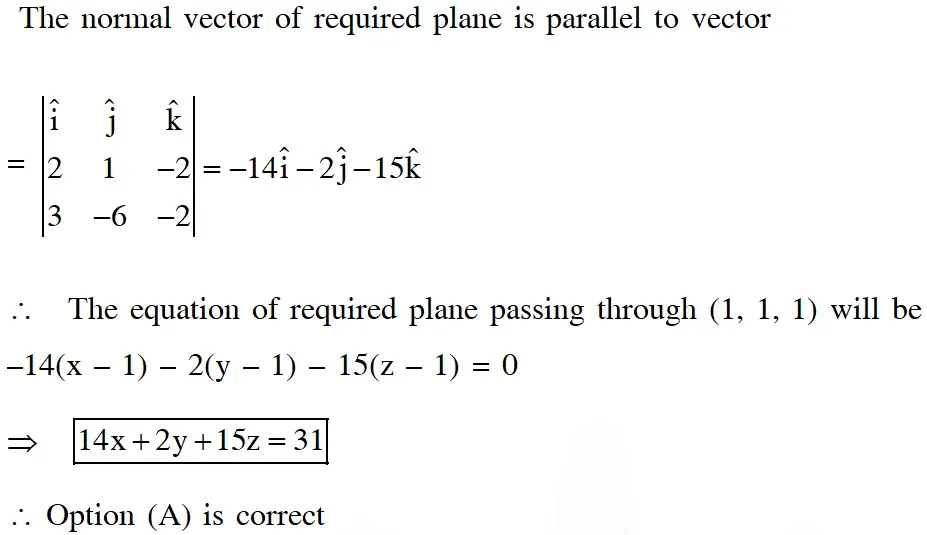
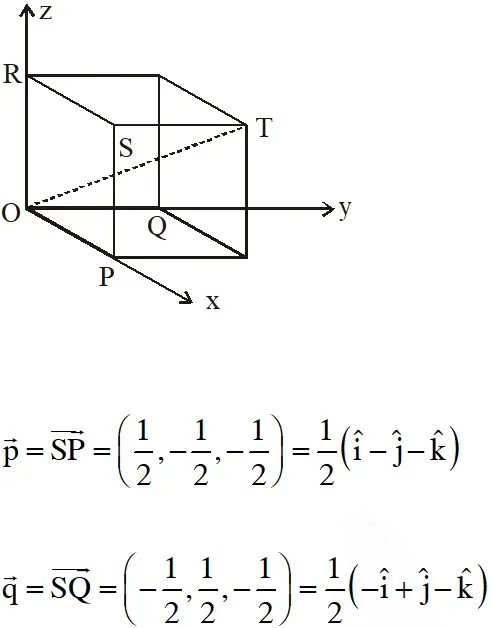
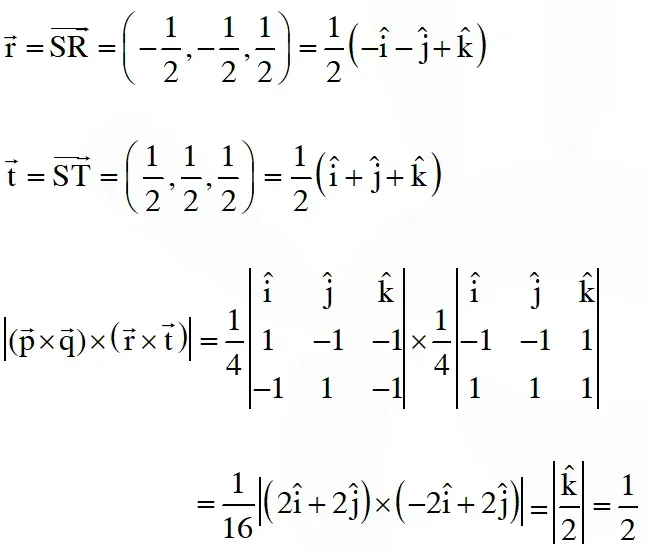
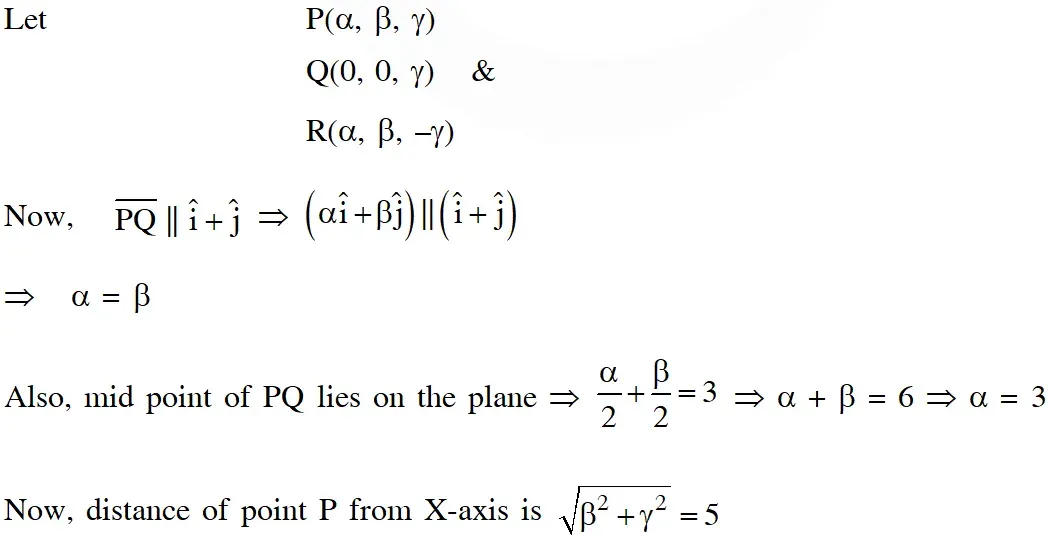
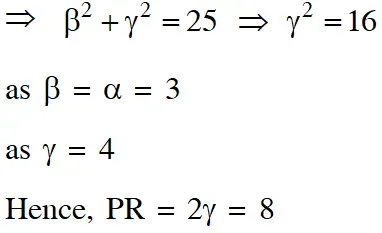
Download eSaral app for free study material and video tutorials. [esquestion] (A) Let $\mathrm{P}(3,2,6)$ be a point in space and $\mathrm{Q}$ be a point on the line $\overrightarrow{\mathrm{r}}=(\hat{\mathrm{i}}-\hat{\mathrm{j}}+2 \hat{\mathrm{k}})+\mu(-3 \hat{\mathrm{i}}+\hat{\mathrm{j}}+5 \hat{\mathrm{k}}) .$ Then the value of $\mu$ for which the vector $\overline{\mathrm{PQ}}$ is parallel to the plane $x-4 y+3 z=1$ is - (A) $\frac{1}{4}$ (B) $-\frac{1}{4}$ (C) $\frac{1}{8}$ (D) $-\frac{1}{8}$ (B) A line with positive direction cosines passes through the point P (2, –1, 2) and makes equal angles with the coordinate axes. The line meets the plane 2x + y + z = 9 at point Q. The length of the line segment PQ equals – (A) 1 (B) $\sqrt{2}$ (C) $\sqrt{3}$ (D) 2 (C) Let $(\mathrm{x}, \mathrm{y}, \mathrm{z})$ be points with integer coordinates satisfying the system of homogeneous equations $: 3 x-y-z=0 ;-3 x+z=0 ;-3 x+2 y+z=0 .$ Then the number of such points for which $\mathrm{x}^{2}+\mathrm{y}^{2}+\mathrm{z}^{2} \leq 100$ is #tag# [JEE 2009, 3+3+4] #sol# ( (a) $A ;(b) C ;(c) 7$ ) [/esquestion] [esquestion] (A) Equation of the plane containing the straight line $\frac{\mathrm{x}}{2}=\frac{\mathrm{y}}{3}=\frac{\mathrm{z}}{4}$ and perpendicular to the plane containing the straight lines $\frac{x}{3}=\frac{y}{4}=\frac{z}{2}$ and $\frac{x}{4}=\frac{y}{2}=\frac{z}{3}$ (A) x + 2y – 2z = 0 (B) 3x + 2y – 2z = 0 (C) x – 2y + z = 0 (D) 5x + 2y – 4z = 0 (B) If the distance of the point $\mathrm{P}(1,-2,1)$ from the plane $\mathrm{x}+2 \mathrm{y}-2 \mathrm{z}=\alpha$ where $\alpha>0,$ is $5,$ then the foot of the perpendicular from $P$ to the plane is- (A) $\left(\frac{8}{3}, \frac{4}{3},-\frac{7}{3}\right)$ (B) $\left(\frac{4}{3},-\frac{4}{3}, \frac{1}{3}\right)$ (C) $\left(\frac{1}{3}, \frac{2}{3}, \frac{10}{3}\right)$ (D) $\left(\frac{2}{3},-\frac{1}{3}, \frac{5}{2}\right)$ (C) If the distance between the plane Ax – 2y + z = d and the plane containing the lines $\frac{x-1}{2}=\frac{y-2}{3}=\frac{z-3}{4}$ and $\frac{x-2}{3}=\frac{y-3}{4}=\frac{z-4}{5}$ is $\sqrt{6},$ then $|d|$ is (D) Match the statements in Column-I with the values in Column-II. #tag# [JEE 2010, 3+5+3+(2+2+2+2)] #sol# ((A) $\mathrm{C} ;(\mathrm{B}) \mathrm{A} ;(\mathrm{C}) 6 ;(\mathrm{D})(\mathrm{A}) \mathrm{t}(\mathrm{B}) \mathrm{p}, \mathrm{r}(\mathrm{C}) \mathrm{q}(\mathrm{D}) \mathrm{r}$ ) (a) Normal vector to the plane containing the lines $\frac{x}{3}=\frac{y}{4}=\frac{z}{2}$ and $\frac{x}{4}=\frac{y}{2}=\frac{z}{3}$ is $\hat{n}=\left|\begin{array}{lll}{\hat{i}} & {\hat{j}} & {\hat{k}} \\ {3} & {4} & {2} \\ {4} & {2} & {3}\end{array}\right|=8 \hat{i}-\hat{j}-10 \hat{k}$ Let direction ratios of required plane be a, b, c. Now 8a – b – 10c = 0 and $2 \mathrm{a}+3 \mathrm{b}+4 \mathrm{c}=0\left(\because \text { plane contains the line } \frac{\mathrm{x}}{2}=\frac{\mathrm{y}}{3}=\frac{\mathrm{z}}{4}\right)$ $\Rightarrow \frac{a}{1}=\frac{b}{-2}=\frac{c}{1}$ $\cdot$ plane contains the line, which passes through origin, hence origin lies on a plane. $\Rightarrow$ equation of required plane is $x-2 y+z=0$ (b) $\quad \because \quad\left|\frac{1-4-2-\alpha}{3}\right|=5$ $\Rightarrow \alpha=10,-20$ $\Rightarrow \alpha=10 \because \alpha>0$ [/esquestion] [esquestion] (A) The point P is the intersection of the straight line joining the points Q(2,3,5) and R(1,–1,4) with the plane 5x – 4y – z = 1. If S is the foot of the perpendicular drawn from the point T(2,1,4) to QR, then the length of the line segment PS is – (A) $\frac{1}{\sqrt{2}}$ (B) $\sqrt{2}$ (C) 2 (D) $2 \sqrt{2}$ (B) The equation of a plane passing through the line of intersection of the planes x + 2y $+3 \mathrm{z}=2$ and $\mathrm{x}-\mathrm{y}+\mathrm{z}=3$ and at a distance $\frac{2}{\sqrt{3}}$ from the point $(3,1,-1)$ is (A) $5 x-11 y+z=17$ (B) $\sqrt{2} x+y=3 \sqrt{2}-1$ (C) $x+y+z=\sqrt{3}$ (D) $x-\sqrt{2} y=1-\sqrt{2}$ (C) If the straight lines $\frac{x-1}{2}=\frac{y+1}{k}=\frac{z}{2}$ and $\frac{x+1}{5}=\frac{y+1}{2}=\frac{z}{k}$ are coplanar, then the plane(s) containing these two lines is(are) (A) y + 2z = –1 (B) y + z = –1 (C) y – z = –1 (D) y – 2z = –1 #tag# [JEE 2012, 3+3+4] #sol# ((a) $A ;(b) A ;(c) B, C$) (a) Line QR : $\frac{x-2}{1}=\frac{y-3}{4}=\frac{z-5}{1}=\lambda$ Any point on line QR : $(\lambda+2,4 \lambda+3, \lambda+5)$ $\therefore$ Point of intersection with plane : $5 \lambda+10-16 \lambda-12-\lambda-5=1$ $\Rightarrow \lambda=-\frac{2}{3}$ $\therefore \mathrm{P}\left(\frac{4}{3}, \frac{1}{3}, \frac{13}{3}\right)$ [/esquestion] [esquestion] Perpendiculars are drawn from points on the line $\frac{x+2}{2}=\frac{y+1}{-1}=\frac{z}{3}$ to the plane $x$ $+\mathrm{y}+\mathrm{z}=3 .$ The feet of perpendiculars lie on the line (A) $\frac{x}{5}=\frac{y-1}{8}=\frac{z-2}{-13}$ (B) $\frac{x}{2}=\frac{y-1}{3}=\frac{z-2}{-5}$ (C) $\frac{x}{4}=\frac{y-1}{3}=\frac{z-2}{-7}$ (D) $\frac{x}{2}=\frac{y-1}{-7}=\frac{z-2}{5}$ #tag# [JEE-Advanced 2013, 2] #sol# (D) [/esquestion] [esquestion] A line $\ell$ passing through the origin is perpendicular to the lines $\ell_{1}:(3+\mathrm{t}) \hat{\mathrm{i}}+(-1+2 \mathrm{t}) \hat{\mathrm{j}}+(4+2 \mathrm{t}) \hat{\mathrm{k}},-\infty<\mathrm{t}<\infty$ $\ell_{2}:(3+2 s) \hat{\mathrm{i}}+(3+2 \mathrm{s}) \hat{\mathrm{j}}+(2+\mathrm{s}) \hat{\mathrm{k}},-\infty<\mathrm{s}<\infty$ Then, the coordinate(s) of the point(s) on $\ell_{2}$ at a distance of $\sqrt{17}$ from the point of intersection of $\ell$ and $\ell_{1}$ is (are) – (A) $\left(\frac{7}{3}, \frac{7}{3}, \frac{5}{3}\right)$ (B) (–1,–1,0) (C) (1,1,1) (D) $\left(\frac{7}{9}, \frac{7}{9}, \frac{8}{9}\right)$ #tag# [JEE-Advanced 2013, 4, (–1)] #sol# (B,D) [/esquestion] [esquestion] Two lines $L_{1}: x=5, \frac{y}{3-\alpha}=\frac{z}{-2}$ and $L_{2}: x=\alpha, \frac{y}{-1}=\frac{z}{2-\alpha}$ are coplanar. Then $\alpha$ can take value(s) (A) 1 (B) 2 (C) 3 (D) 4 #tag# [JEE-Advanced 2013, 3, (–1)] #sol# (A,D) $\mathrm{L}_{1}: \frac{\mathrm{x}-5}{0}=\frac{\mathrm{y}}{3-\alpha}=\frac{\mathrm{z}}{-2}$ $\mathrm{L}_{2}: \frac{\mathrm{x}-\alpha}{0}=\frac{\mathrm{y}}{-1}=\frac{\mathrm{z}}{2-\alpha}$ for lines to be coplanar $\left|\begin{array}{ccc}{5-\alpha} & {0} & {0} \\ {0} & {3-\alpha} & {-2} \\ {0} & {-1} & {2-\alpha}\end{array}\right|=0$ $\Rightarrow \quad(5-\alpha)((3-\alpha)(2-\alpha)-2)=0$ $\Rightarrow \quad(5-\alpha)\left(\alpha^{2}-5 \alpha+4\right)=0$ $\Rightarrow \quad \alpha=1,4,5$ [/esquestion] [esquestion] Consider the lines $\mathrm{L}_{1}: \frac{\mathrm{x}-1}{2}=\frac{\mathrm{y}}{-1}=\frac{\mathrm{z}+3}{1}, \mathrm{L}_{2}: \frac{\mathrm{x}-4}{1}=\frac{\mathrm{y}+3}{1}=\frac{\mathrm{z}+3}{2}$ and the planes $\mathrm{P}_{1}: 7 \mathrm{x}+\mathrm{y}+2 \mathrm{z}=3, \mathrm{P}_{2}: 3 \mathrm{x}+5 \mathrm{y}-6 \mathrm{z}=4 .$ Let $\mathrm{ax}+\mathrm{by}+\mathrm{cz}=\mathrm{d}$ be the equation of the plane passing through the point of intersection of lines $L_{1}$ and $\mathrm{L}_{2}$ and perpendicular to planes $\mathrm{P}_{1}$ and $\mathrm{P}_{2} .$ Match List-I with List-II and select the correct answer using the code given below the lists. #tag# [JEE-Advanced 2013, 3, (–1)] #sol# (A) For point of intersection of $L_{1}$ and $L_{2}$ $\left\{\begin{array}{l}{2 \lambda+1=\mu+4} \\ {-\lambda=\mu-3} \\ {\lambda-3=2 \mu-3}\end{array}\right.$ $\Rightarrow \mu=1$ $\Rightarrow$ point of intersction is $(5,-2,-1)$ Now, vector normal to the plane is $\overrightarrow{\mathrm{n}}_{1} \times \overrightarrow{\mathrm{n}}_{2}=\left|\begin{array}{ccc}{\hat{\mathrm{i}}} & {\hat{\mathrm{j}}} & {\hat{\mathrm{k}}} \\ {7} & {1} & {2} \\ {3} & {5} & {-6}\end{array}\right|$ $=-16(\hat{i}-3 \hat{j}-2 \hat{k})$ Let equation of required plane be $x-3 y-2 z=\alpha$ $\because$ it passes through $(5,-2,-1)$ $\therefore \alpha=13$ $\Rightarrow$ equation of plane is $x-3 y-2 z=13$ [/esquestion] [esquestion] From a point $\mathrm{P}(\lambda, \lambda, \lambda),$ perpendiculars $\mathrm{PQ}$ and $\mathrm{PR}$ are drawn respectively on the lines $\mathrm{y}=$ $\mathrm{x}, \mathrm{z}=1$ and $\mathrm{y}=-\mathrm{x}, \mathrm{z}=-1 .$ If $\mathrm{P}$ is such that $\angle \mathrm{QPR}$ is a right angle, then the possible value(s) of $\lambda$ is (are) (A) $\sqrt{2}$ (B) 1 (C) –1 (D) $-\sqrt{2}$ #tag# [JEE(Advanced)-2014, 3] #sol# (C) Line $\mathrm{L}_{1}$ given by $\mathrm{y}=\mathrm{x} ; \mathrm{z}=1$ can be expressed as $\mathrm{L}_{1}: \frac{\mathrm{x}}{1}=\frac{\mathrm{y}}{1}=\frac{\mathrm{z}-1}{0}$ Similarly $\mathrm{L}_{2}(\mathrm{y}=-\mathrm{x} ; \mathrm{z}=-1)$ can be expressed as $\mathrm{L}_{2}: \frac{\mathrm{x}}{1}=\frac{\mathrm{y}}{-1}=\frac{\mathrm{z}+1}{0}$ Let any point $\mathrm{Q}(\alpha, \alpha, 1)$ on $\mathrm{L}_{1}$ and $\mathrm{R}(\beta,-\beta,-1)$ on $\mathrm{L}_{2}$ Given that $\mathrm{PQ}$ is perpendicular to $\mathrm{L}_{1}$ $\Rightarrow(\lambda-\alpha) .1+(\lambda-\alpha) \cdot 1+(\lambda-1) \cdot 0=0 \Rightarrow \lambda=\alpha$ $\therefore \mathrm{Q}(\lambda, \lambda, 1)$ Similarly PR is perpendicular to L $_{2}$ $(\lambda-\beta) \cdot 1+(\lambda+\beta)(-1)+(\lambda+1) \cdot 0=0 \Rightarrow \beta=0$ $\therefore \mathrm{R}(0,0,-1)$ Now as given $\Rightarrow \overrightarrow{\mathrm{PR}} \cdot \overrightarrow{\mathrm{PQ}}=0$ $0 . \lambda+0 . \lambda+(\lambda-1)(\lambda+1)=0$ $\lambda \neq 1$ as $\mathrm{P} \& \mathrm{Q}$ are different points $\Rightarrow \lambda=-1$ [/esquestion] [esquestion] In $\mathbb{D}^{3},$ consider the planes $P_{1}: y=0$ and $P_{2}: x+z=1 .$ Let $P_{3}$ be a plane, different from $\mathrm{P}_{1}$ and $\mathrm{P}_{2},$ which passes through the intersection of $\mathrm{P}_{1}$ and $\mathrm{P}_{2} .$ If the distance of the point $(0,1,0)$ from $P_{3}$ is 1 and the distance of a point $(\alpha, \beta, \gamma)$ from $P_{3}$ is $2,$ then which of the following relations is (are) true? (A) $2 \alpha+\beta+2 \gamma+2=0$ (B) $2 \alpha-\beta+2 \gamma+4=0$ (C) $2 \alpha+\beta-2 \gamma-10=0$ (D) $2 \alpha-\beta+2 \gamma-8=0$ #tag# [JEE 2015, 4M, –2M] #sol# (B,D) [/esquestion] [esquestion] In $\square^{3},$ let $L$ be a straight line passing through the origin. Suppose that all the points on $L$ are at a constant distance from the two planes $P_{1}: x+2 y-z+1=0$ and $P_{2}: 2 x-y+$ $\mathrm{z}-1=0 .$ Let $\mathrm{M}$ be the locus of the feet of the perpendiculars drawn from the points on L to the plane $P_{1} .$ Which of the following points lie(s) on M? #tag# [JEE 2015, 4M, –2M] #sol# (A,B) Straight line 'L' is parallel to line of intersection of plane $\mathrm{P}_{1} \&$ plane $\mathrm{P}_{2}$ $\therefore$ Equation of line $^{\prime} \mathbf{L}^{\prime}$ is $\frac{x}{1}=\frac{y}{-3}=\frac{z}{-5}=\lambda$ $\frac{\alpha-\lambda}{1}=\frac{\beta+3 \lambda}{2}=\frac{\gamma+5 \lambda}{-1}=\mathrm{k}$ $\left.\begin{array}{l}{\alpha=\mathrm{k}+\lambda} \\ {\beta=2 \mathrm{k}-3 \lambda} \\ {\mathrm{y}=-\mathrm{k}-5 \lambda}\end{array}\right\}$ ...(1) satisfying in plane $\mathrm{P}_{1}$ $\mathrm{k}+\lambda+4 \mathrm{k}-6 \lambda+\mathrm{k}+5 \lambda+1=0$ $6 k=-1$ putting in ( 1) required locus is $\mathrm{x}=-\frac{1}{6}+\lambda$ $y=-\frac{1}{3}-3 \lambda$ $z=\frac{1}{6}-5 \lambda$ Now check the options. [/esquestion] [esquestion] Consider a pyramid OPQRS located in the first octant $(\mathrm{x} \geq 0, \mathrm{y} \geq 0, \mathrm{z} \geq 0)$ with $\mathrm{O}$ as origin, and OP and OR along the x-axis and the y-axis, respectively. The base OPQR of the pyramid is a square with $\mathrm{OP}=3 .$ The point $\mathrm{S}$ is directly above the mid-point $\mathrm{T}$ of diagonal OQ such that TS $=3 .$ Then- (A) the acute angle between $\mathrm{OQ}$ and $\mathrm{OS}$ is $\frac{\mathrm{K}}{3}$ (B) the equaiton of the plane containing the triangle $\mathrm{OQS}$ is $\mathrm{x}-\mathrm{y}=0$ (C) the length of the perpendicular from $P$ to the plane containing the triangle OQS is $\frac{3}{\sqrt{2}}$ (D) the perpendicular distance from $\mathrm{O}$ to the straight line containing RS is $\sqrt{\frac{15}{2}}$ #tag# [JEE(Advanced) 2016] #sol# (B,C,D) [/esquestion] [esquestion] Let $P$ be the image of the point $(3,1,7)$ with respect to the plane $x-y+z=3 .$ Then the equation of the plane passing through $\mathrm{P}$ and containing the straight line $\frac{\mathrm{x}}{1}=\frac{\mathrm{y}}{2}=\frac{\mathrm{z}}{1}$ is (A) x + y – 3z = 0 (B) 3x + z = 0 (C) x – 4y + 7z = 0 (D) 2x – y = 0 #tag# [JEE(Advanced) 2016] #sol# (C) $\therefore x-4 y+7 z=0$ [/esquestion] [esquestion] The equation of the plane passing through the point (1,1,1) and perpendicular to the planes 2x + y – 2z = 5 and 3x – 6y – 2z = 7, is- (A) 14x + 2y + 15z = 31 (B) 14x + 2y – 15z = 1 (C) –14x + 2y + 15z = 3 (D) 14x – 2y + 15z = 27 #tag# [JEE(Advanced) 2017] #sol# (A) [/esquestion] [esquestion] Let $P_{1}: 2 x+y-z=3$ and $P_{2}: x+2 y+z=2$ be two planes. Then, which of the following statement(s) is (are) TRUE ? (A) The line of intersection of $\mathrm{P}_{1}$ and $\mathrm{P}_{2}$ has direction ratios $1,2,-1$ (B) The line $\frac{3 x-4}{9}=\frac{1-3 y}{9}=\frac{z}{3}$ is perpendicular to the line of intersection of $P_{1}$ and $P_{2}$ (C) The acute angle between $\mathrm{P}_{1}$ and $\mathrm{P}_{2}$ is $60^{\circ}$ (D) If $P_{3}$ is the plane passing through the point $(4,2,-2)$ and perpendicular to the line of intersection of $\mathrm{P}_{1}$ and $\mathrm{P}_{2},$ then the distance of the point $(2,1,1)$ from the plane $\mathrm{P}_{2}$ is $\frac{2}{\sqrt{3}}$ #tag# [JEE(Advanced) 2018] #sol# (C,D) D.C. of line of intersection $(a, b, c)$ $\begin{aligned} \Rightarrow \quad & 2 \mathrm{a}+\mathrm{b}-\mathrm{c}=0 \\ & \mathrm{a}+2 \mathrm{b}+\mathrm{c}=0 \end{aligned}$ $\frac{a}{1+2}=\frac{b}{-1-2}=\frac{c}{4-1}$ $\therefore \quad \mathrm{D} . \mathrm{C} .$ is $(1,-1,1)$ B) $\frac{3 x-4}{9}=\frac{1-3 y}{9}=\frac{z}{3}$ $\Rightarrow \quad \frac{x-4 / 3}{3}=\frac{y-1 / 3}{-3}=\frac{z}{3}$ $\Rightarrow \quad$ lines are parallel. (C) Acute angle between $\mathrm{P}_{1}$ and $\mathrm{P}_{2}=\cos ^{-1}\left(\frac{2 \times 1+1 \times 2-1 \times 1}{\sqrt{6} \sqrt{6}}\right)$ \[ =\cos ^{-1}\left(\frac{3}{6}\right)=\cos ^{-1}\left(\frac{1}{2}\right)=60^{\circ} \] (D) Plane is given by $(x-4)-(y-2)+(z+2)=0$ \[ \Rightarrow \quad x-y+z=0 \] Distance of $(2,1,1)$ from plane $=\frac{2-1+1}{\sqrt{3}}=\frac{2}{\sqrt{3}}$ [/esquestion] [esquestion] Consider the cube in the first octant with sides $\mathrm{OP}, \mathrm{OQ}$ and $\mathrm{OR}$ of length $1,$ along the x-axis, y-axis and z-axis, respectively, where $\mathrm{O}(0,0,0)$ is the origin. Let $\mathrm{S}\left(\frac{1}{2}, \frac{1}{2}, \frac{1}{2}\right)$ be the centre of the cube and $T$ be the vertex of the cube opposite to the origin $O$ such that $S$ lies on the diagonal OT.If $\overrightarrow{\mathrm{p}}=\overrightarrow{\mathrm{SP}}, \overrightarrow{\mathrm{q}}=\overrightarrow{\mathrm{SQ}}, \overrightarrow{\mathrm{r}}=\overrightarrow{\mathrm{SR}}$ and $\overrightarrow{\mathrm{t}}=\overrightarrow{\mathrm{ST}},$ then the value of $|(\overrightarrow{\mathrm{p}} \times \overrightarrow{\mathrm{q}}) \times(\overrightarrow{\mathrm{r}} \times \overrightarrow{\mathrm{t}})|$ is #tag# [JEE(Advanced) 2018] #sol# 8 [/esquestion] [esquestion] Let P be a point in the first octant, whose image Q in the plane x + y = 3 (that is, the line segment PQ is perpendicular to the plane x + y = 3 and the mid-point of PQ lies in the plane x + y = 3) lies on the z-axis. Let the distance of P from the x-axis be 5. If R is the image of P in the xy-plane, then the length of PR is #tag# #sol# 8 [/esquestion]


After solving 3D Geometry - JEE Advanced PYQs (Maths), practise the concepts within complete timed papers from the JEE Advanced exam paper archive.
Frequently Asked Questions
How many questions from 3D Geometry appear in JEE Advanced each year?
JEE Advanced typically includes 1–5 questions from 3D Geometry per year, contributing roughly 3–14 marks depending on the question type. Single correct, multiple correct, integer type, and match-the-column formats have all been used. Based on papers from 2009–2023, at least one 3D Geometry question appears every single year without exception.
Which topics in 3D Geometry are most important for JEE Advanced?
The highest-priority topics are: (1) equations of lines and planes in vector and Cartesian form, (2) foot of perpendicular, (3) coplanarity of two lines using the determinant condition, and (4) distance of a point from a plane. These four subtopics account for approximately 80% of all 3D Geometry marks in JEE Advanced papers from 2009–2023.
Is 3D Geometry difficult in JEE Advanced compared to JEE Main?
3D Geometry in JEE Advanced is significantly harder than in JEE Main. JEE Main questions are largely formula-based and single-step. JEE Advanced questions require connecting two or three sub-concepts in a single problem — for example, finding the intersection of two lines and then computing the angle that the joining segment makes with a plane.
How do I prepare 3D Geometry for JEE Advanced from scratch?
Start with NCERT Class 12 Maths Chapter 11 to build conceptual clarity. Then solve NCERT examples and exercises fully, using NCERT Solutions for Class 12 Maths to verify each step. Once you score 90%+ on NCERT-level problems, move directly to JEE Advanced previous year questions sorted by topic — not by year — to build pattern recognition.
How much time should I spend on a 3D Geometry question in JEE Advanced?
Target 5–7 minutes per question for standard 3D Geometry problems. Questions involving match-the-column or multiple correct answers (common in JEE Advanced) may justify up to 9 minutes. If a question involves more than three distinct steps and you are not making progress after 4 minutes, mark it and return — time management is critical in JEE Advanced where the penalty for wrong answers in multiple correct questions can be −2 marks.
Team eSaral
eSaral Academic and Editorial Team
Team eSaral is the collective author profile for educational content created by eSaral’s teachers and academic contributors. The team draws on expertise from IIT graduates, doctors, experienced educators and subject specialists to develop resources for JEE, NEET and school students. Our articles aim to explain concepts clearly and help students study with confidence.
Related Posts

Plant Cell Diagram: Labelled Structure, Parts and Functions
Simple, labelled plant cell diagram with parts and functions. Covers plant cell structure for Class 6, 7, 8, 9, 10 and 11 students, CBSE-aligned.

Saransh Gupta Sir's Visit to IIT Patna: Hostel Life, Placements & Lessons for JEE Aspirants
Inside Saransh Gupta Sir's IIT Patna visit — hostel life, the library, placements, internships, and real advice for JEE aspirants from students living the IIT dream.
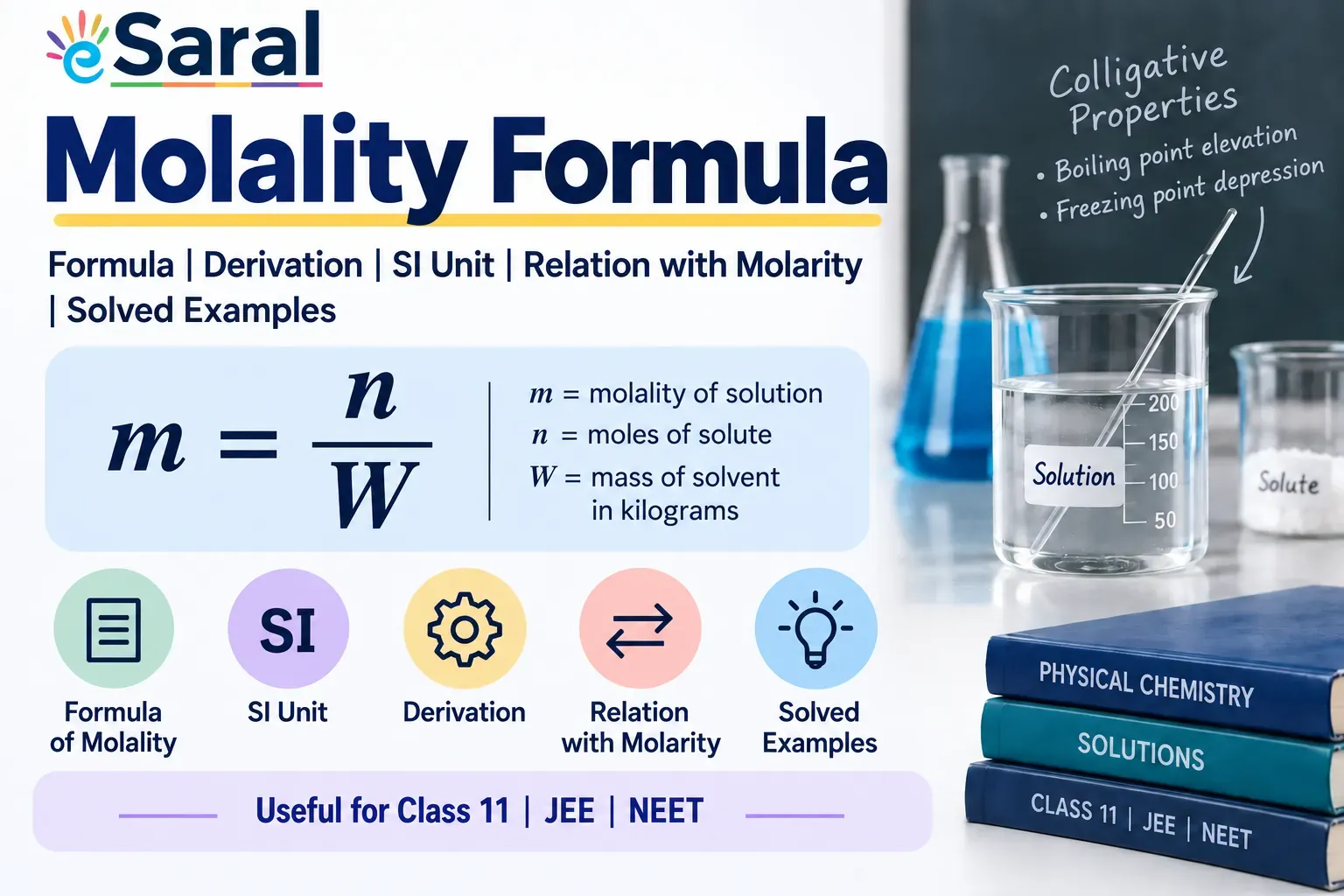
Molality Formula: Formula for Molality, Derivation & Solved Examples
Molality formula is $m = \dfrac{n}{W}$. Learn the formula of molality, its SI unit, derivation, relation with molarity, and solved examples for Class 11, JEE and NEET.

BITSAT Previous Year Question Paper PDF
Download BITSAT previous year question papers PDF. Get year-wise BITSAT PYQs, memory-based papers, exam pattern, and preparation tips to improve your BITSAT preparation.

Teachers’ Day 2026 at eSaral Gurukul: Celebrating the Bond Between Students, Teachers & Mentors
See how Teachers’ Day 2026 was celebrated at eSaral Gurukul, reflecting the bond among students, teachers, and mentors, and the role of guidance beyond academics.

JEE Advanced Attempts: Can You Give It a Third Time? Rules Explained
JEE Advanced attempts: current rule is 2 consecutive years only: full eligibility criteria, the 2025 third-attempt controversy, and the latest 2026 petition news.

Best JEE Preparation App
Best JEE preparation app for Main & Advanced: AI mock tests, live doubt-solving, thousands of practice questions. JEE preparation app for droppers & Class 11-12.
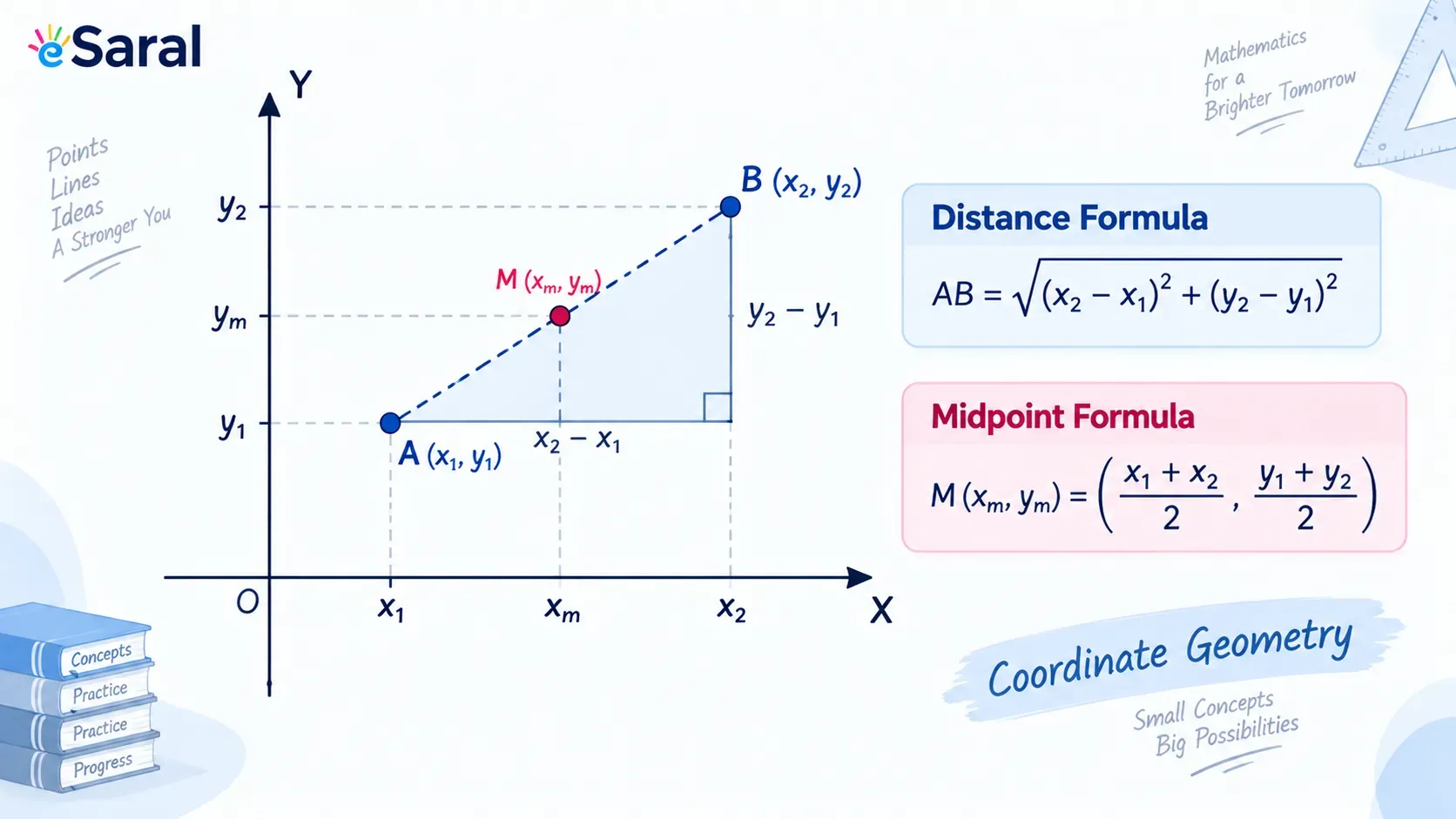
Coordinate Geometry Class 10: Formulas, Notes & Solved Examples
Coordinate geometry class 10: complete CBSE formulas — distance, section, midpoint and area of triangle — with derivation, notes and solved examples.
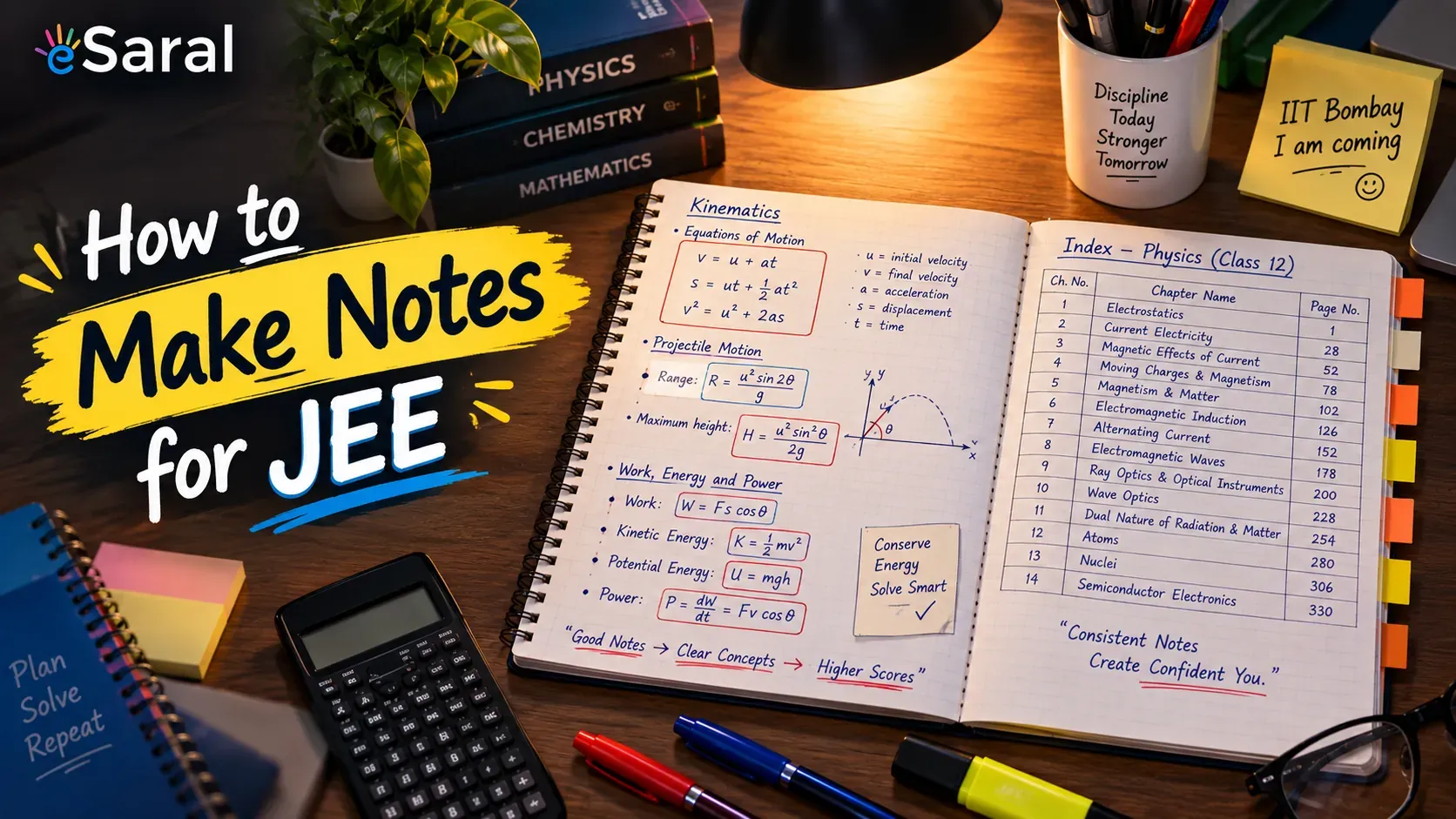
How to make Notes For JEE Smart Notes Strategy of an AIR 41
Learn how to make notes for JEE the way toppers do — indexing, shorthand, and smart short notes for JEE that cut revision time to just 5–7 days.
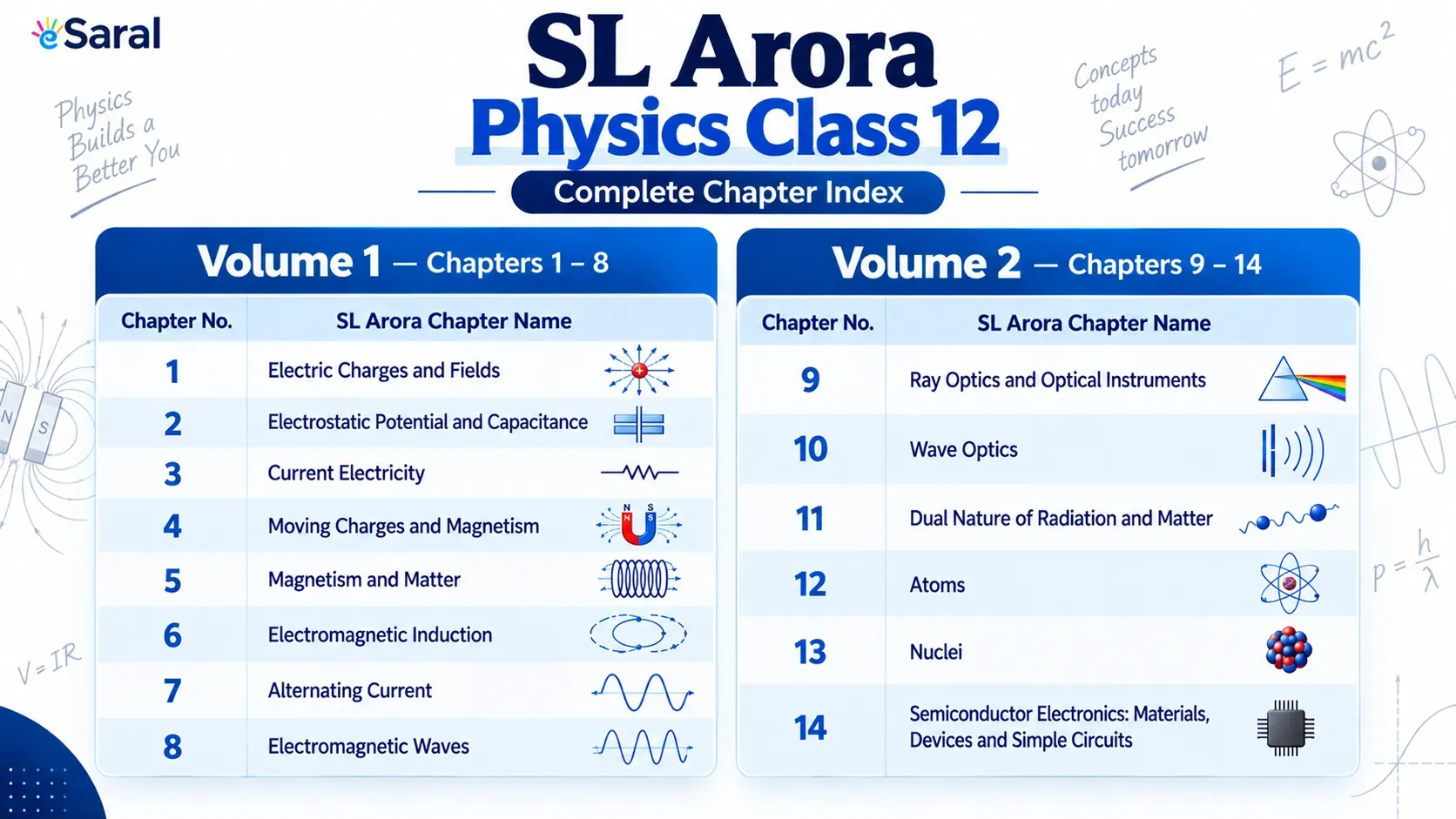
SL Arora Physics Class 12 Index – Chapter List for Volume 1 & 2
SL Arora Physics Class 12 index — complete chapter list for Volume 1 & 2, mapped to NCERT solutions for board, JEE Main, and NEET preparation.