
Chemical Equilibrium - JEE Mains Previous Year Questions

eSaral Academic and Editorial Team
Summary
<p>Practice JEE Main Chemical Equilibrium previous year questions covering equilibrium constants (Kc, Kp), degree of dissociation, reaction quotients, gaseous equilibria, and numerical problem-solving with detailed solutions for effective exam preparation.</p>
eSaral › JEE › JEE Main ›Chemical Equilibrium

🚀 Checkout eSaral Courses
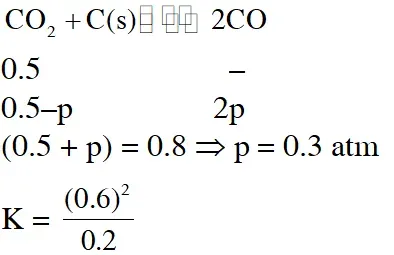
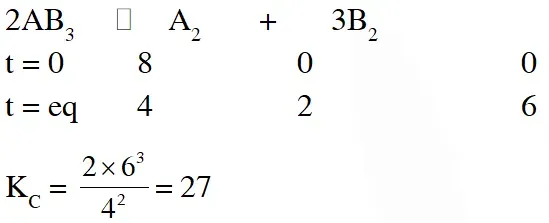
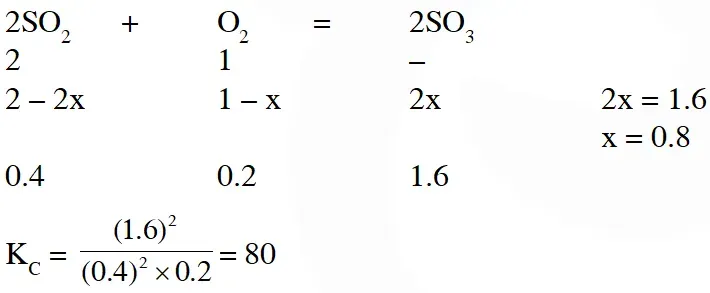
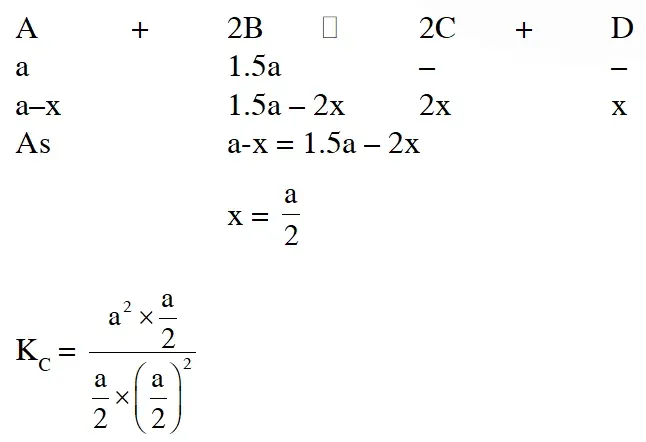
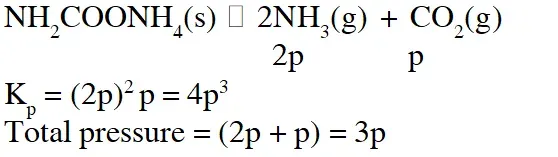
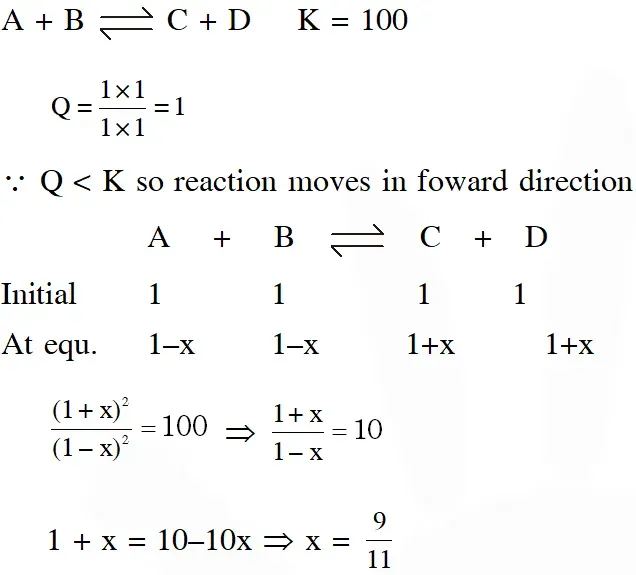
JEE Main Previous Year Papers Questions of Chemistry With Solutions are available at eSaral. Simulator Previous Years AIEEE/JEE Mains Questions [esquestion] A vessel at 1000 K contains $\mathrm{CO}_{2}$ with a pressure of 0.5 atm. Some of the $\mathrm{CO}_{2}$ is converted into CO on the addition of graphite. If the total pressure at equilibrium is 0.8 atm, the value of K is :- (1) 0.3 atm (2) 0.18 atm (3) 1.8 atm (4) 3 atm #tag# [AIEEE-2011] #sol# (3) [/esquestion] [esquestion] The equilibrium constant $\left(\mathrm{K}_{\mathrm{C}}\right)$ for the reaction $\mathrm{N}_{2}(\mathrm{g})+\mathrm{O}_{2}(\mathrm{g}) \longrightarrow 2 \mathrm{NO}(\mathrm{g})$ at temperature T is $4 \times 10^{-4}$ The value of $\mathrm{K}_{\mathrm{c}}$ for the reaction. $\mathrm{NO}(\mathrm{g}) \longrightarrow 1 / 2 \mathrm{N}_{2}(\mathrm{g})+1 / 2 \mathrm{O}_{2}(\mathrm{g})$ at the same temperature is :- (1) 50.0 (2) 0.02 (3) $2.5 \times 10^{2}$ (4) $4 \times 10^{-4}$ #tag# [AIEEE-2012] #sol# (1) $\mathrm{K}_{\mathrm{c}}=\frac{1}{\sqrt{\mathrm{K}_{\mathrm{c}}}}$ [/esquestion] [esquestion] 8 mol of $\mathrm{AB}_{3}(\mathrm{g})$ are introduced into a 1.0 $\mathrm{d} \mathrm{m}^{3}$ vessel. If it dissociates as $2 \mathrm{AB}_{3}(\mathrm{g}) \square \quad \mathrm{A}_{2}(\mathrm{g})+3 \mathrm{B}_{2}(\mathrm{g})$ At equilibrium, 2mol of $\mathrm{A}_{2}$ are found to be present. The equilibrium constant of this reaction is :- (1) 36 (2) 3 (3) 27 (4) 2 #tag# [JEE-MAINS(online)-2012] #sol# (3) [/esquestion] [esquestion] The value of Kp for the equilibrium reaction $\mathrm{N}_{2} \mathrm{O}_{4}(\mathrm{g}) \square 2 \mathrm{NO}_{2}(\mathrm{g})$ is 2 The percentage dissociation of $\mathrm{N}_{2} \mathrm{O}_{4}(\mathrm{g})$ at a pressure of 0.5 atm is (1) 71 (2) 50 (3) 88 (4) 25 #tag# [JEE-MAINS(online)-2012] #sol# (1) $\mathrm{K}_{\mathrm{p}}=\frac{(2 \alpha)^{2}}{(1-\alpha)} \times \frac{0.5}{(1+\alpha)}$ [/esquestion] [esquestion] $\mathrm{K}_{1}, \mathrm{K}_{2}$ and $\mathrm{K}_{3}$ are the equilibrium constants of the following reactions (I), (II) and (III), respectively (I) $\mathrm{N}_{2}+2 \mathrm{O}_{2} \square 2 \mathrm{NO}_{2}$ (II) $2 \mathrm{NO}_{2} \square \mathrm{N}_{2}+2 \mathrm{O}_{2}$ (III) $\mathrm{NO}_{2} \square \frac{1}{2} \mathrm{N}_{2}+\mathrm{O}_{2}$ The correct relation from the following is : (1) $\mathrm{K}_{1}=\sqrt{\mathrm{K}_{2}}=\mathrm{K}_{3}$ (2) $\mathrm{K}_{1}=\frac{1}{\mathrm{K}_{2}}=\frac{1}{\mathrm{K}_{3}}$ $(3) \mathrm{K}_{1}=\frac{1}{\mathrm{K}_{2}}=\mathrm{K}_{3}$ (4)$\mathrm{K}_{1}=\frac{1}{\mathrm{K}_{2}}=\frac{1}{\left(\mathrm{K}_{3}\right)^{2}}$ #tag# [JEE-MAINS(online)-2012] #sol# (4) Fact [/esquestion] [esquestion] One mole of $\mathrm{O}_{2}(\mathrm{g})$ and two moles of SO2(g) were heated in a closed vessel of one litre capacity at 1098 K. At equilibrium 1.6 moles of $\mathrm{SO}_{3}$ (g) were found. The equilibrium constant $\mathbf{K}_{C}$ of the reaction would be :- (1) 60 (2) 80 (3) 30 (4) 40 #tag# [JEE-MAINS(online)-2012] #sol# (2) [/esquestion] [esquestion] $\mathrm{N}_{2}(\mathrm{g})+3 \mathrm{H}_{2}(\mathrm{g}) \square 2 \mathrm{NH}_{3}(\mathrm{g}), \mathrm{K}_{1}$ $\mathrm{N}_{2}(\mathrm{g})+\mathrm{O}_{2}(\mathrm{g}) \square 2 \mathrm{NO}(\mathrm{g}), \mathrm{K}_{2} \quad(\mathrm{B})$ $\mathrm{H}_{2}(\mathrm{g})+\frac{1}{2} \mathrm{O}_{2}(\mathrm{g}) \square \mathrm{H}_{2} \mathrm{O}(\mathrm{g}), \mathrm{K}_{3} \quad(\mathrm{C})$ The equation for the equilibrium constant of the reaction $2 \mathrm{NH}_{3}(\mathrm{g})+\frac{5}{2} \mathrm{O}_{2}(\mathrm{g}) \square 2 \mathrm{NO}(\mathrm{g})+3 \mathrm{H}_{2} \mathrm{O}(\mathrm{g}),\left(\mathrm{K}_{4}\right)$ in terms of $\mathrm{K}_{1}, \mathrm{K}_{2}$ and $\mathrm{K}_{3}$ is : (1) $\frac{\mathrm{K}_{1} \mathrm{K}_{3}^{2}}{\mathrm{K}_{2}}$ (2) $\frac{\mathrm{K}_{2} \mathrm{K}_{3}^{3}}{\mathrm{K}_{1}}$ (3) $\frac{\mathrm{K}_{1} \mathrm{K}_{2}}{\mathrm{K}_{3}}$ (4) $\mathrm{K}_{1} \mathrm{K}_{2} \mathrm{K}_{3}$ #tag# [JEE-MAINS(online)-2013] #sol# (2) Fact [/esquestion] [esquestion] In reaction $\mathrm{A}+2 \mathrm{B} \square 2 \mathrm{C}+\mathrm{D}$, initial concentration of B was 1.5 times of |A|, but at equilibrium the concentrations of A and B became equal. The equilibrium constant for the reaction is (1)4 (2) 6 (3) 12 (4) 8 #tag# [JEE-MAINS(online)-2013] #sol# (1) $\mathrm{K}_{\mathrm{c}}=4$ [/esquestion] [esquestion] For the decomposition of the compound, represented as If the reaction is started with 1 mol of the compound, the total pressure at equilibrium would be (1) $38.8 \times 10^{-2}$ atm (2) $1.94 \times 10^{-2}$ atm (3) $5.82 \times 10^{-2}$ atm (4) $7.66 \times 10^{-2}$ atm #tag# [JEE-MAINS(online)-2014] #sol# (3) [/esquestion] [esquestion] For the reaction $\mathrm{SO}_{2(\mathrm{g})}+\frac{1}{2} \mathrm{O}_{2(\mathrm{g})} \square \mathrm{SO}_{3(\mathrm{g})},$ if $\mathrm{K}_{\mathrm{p}}=\mathrm{K}_{\mathrm{C}}(\mathrm{RT})^{\mathrm{x}}$ where the symbols have usual meaning then the value of x is : (assuming ideality) ( 1)$\frac{1}{2}$ ( 2) 1 (3) –1 $(4)-\frac{1}{2}$ #tag# [JEE-MAINS 2014] #sol# (4) $\mathrm{K}_{\mathrm{p}}=\mathrm{K}_{\mathrm{C}}(\mathrm{RT})^{-\frac{1}{2}}$ [/esquestion] [esquestion] The equilibrium constants at 298 K for a reaction $\mathrm{A}+\mathrm{B} \rightleftharpoons \mathrm{C}+\mathrm{D}$ is 100 If the initial concentration of all the four species were 1 M each, then equilibrium concentration of D (in mol $\mathrm{L}^{-1}$) will be : (1) 1.182 (2) 0.182 (3) 0.818 (4) 1.818 #tag# [JEE-Mains 2016] #sol# (4) [/esquestion]


Students studying Chemical Equilibrium can keep their revision organised with the JEE Mains PYQ chapter wise index.
This Chemical Equilibrium set covers one chapter only — for entire papers exactly as they appeared on exam day, check our JEE Main exam papers.
Frequently Asked Questions
How many questions come from Chemical Equilibrium in JEE Main?
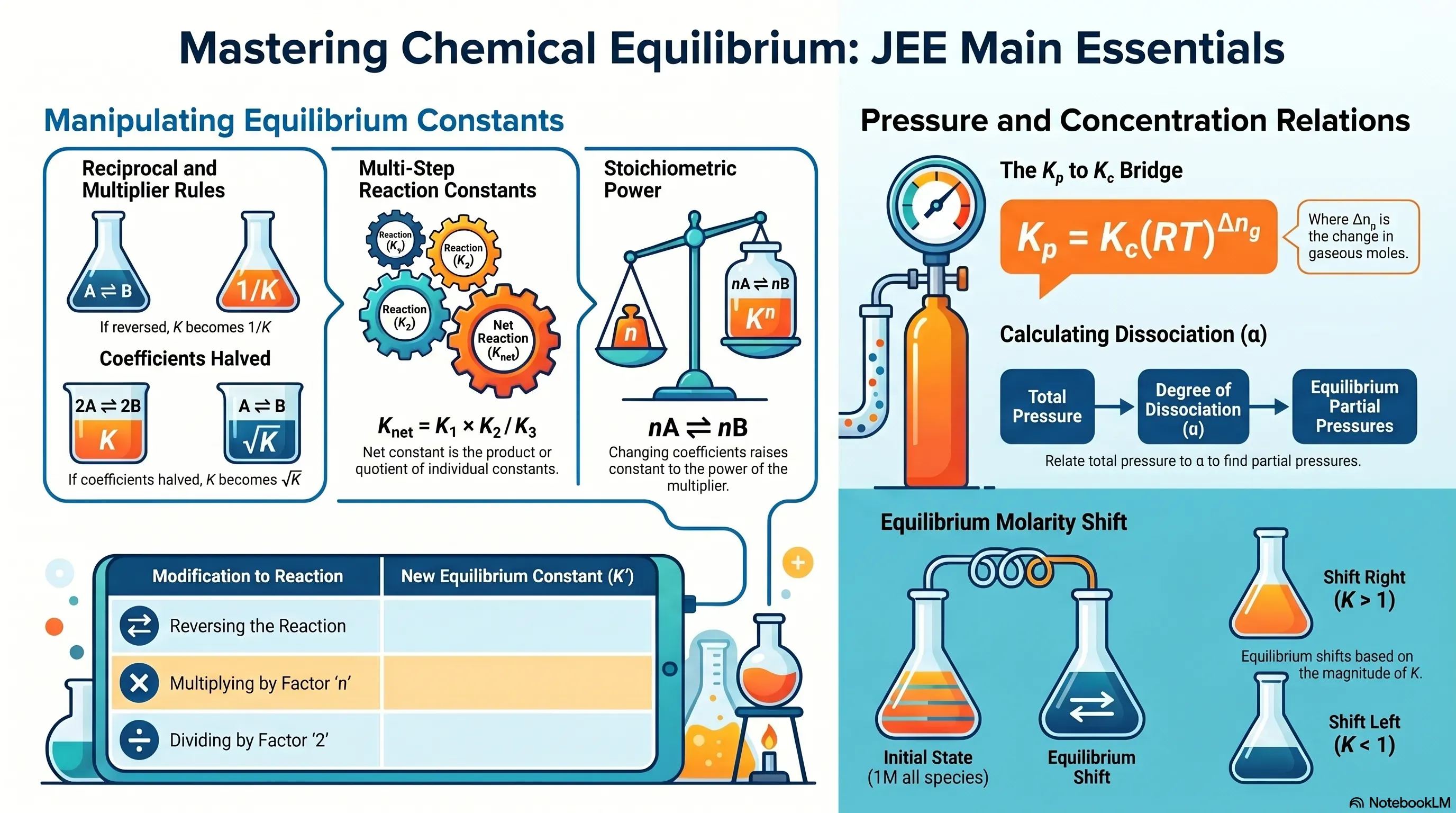
JEE Main typically includes 1 to 2 questions from Chemical Equilibrium per session, based on NTA's official question paper archives from 2011 to 2026. The chapter appears in both the January and April sessions. It is one of the more predictable scoring chapters in Physical Chemistry because question patterns repeat across years.
What is the relationship between Kp and Kc?
Kp = Kc × (RT)^Δn, where Δn is the difference between moles of gaseous products and moles of gaseous reactants in the balanced equation, R is 0.0821 L·atm·mol⁻¹·K⁻¹, and T is temperature in Kelvin. When Δn = 0, Kp equals Kc. This formula appears directly or indirectly in nearly every JEE Main Kp question.
How do I find Kc when the equilibrium is reversed or scaled?
If the forward reaction has equilibrium constant K, the reverse reaction has constant 1/K. If all coefficients in the equation are multiplied by a factor n, the new equilibrium constant is K^n. These two rules, applied together, solve the majority of "K₁, K₂, K₃ relationship" questions in JEE Main without any calculation.
What is the degree of dissociation and how is it tested in JEE Main?
Degree of dissociation (α) is the fraction of the original substance that has dissociated at equilibrium. JEE Main questions typically give you Kp and the total pressure, then ask for the percentage dissociation. Set up the equilibrium mole table in terms of α, write the Kp expression, and solve — the equation usually simplifies to a clean quadratic or, when α << 1, a simple approximation.
Is Chemical Equilibrium important for JEE Advanced as well?
Yes. JEE Advanced tests the same concepts but at greater depth — multi-step equilibria, buffer solutions (linked to ionic equilibrium), and simultaneous equilibria. The previous year questions on this page cover the JEE Main level fully. For JEE Advanced, extend your study to ionic equilibrium and common-ion effect. The NCERT Books Class 12 are the correct starting point for both levels.
Team eSaral
eSaral Academic and Editorial Team
Team eSaral is the collective author profile for educational content created by eSaral’s teachers and academic contributors. The team draws on expertise from IIT graduates, doctors, experienced educators and subject specialists to develop resources for JEE, NEET and school students. Our articles aim to explain concepts clearly and help students study with confidence.
Related Posts
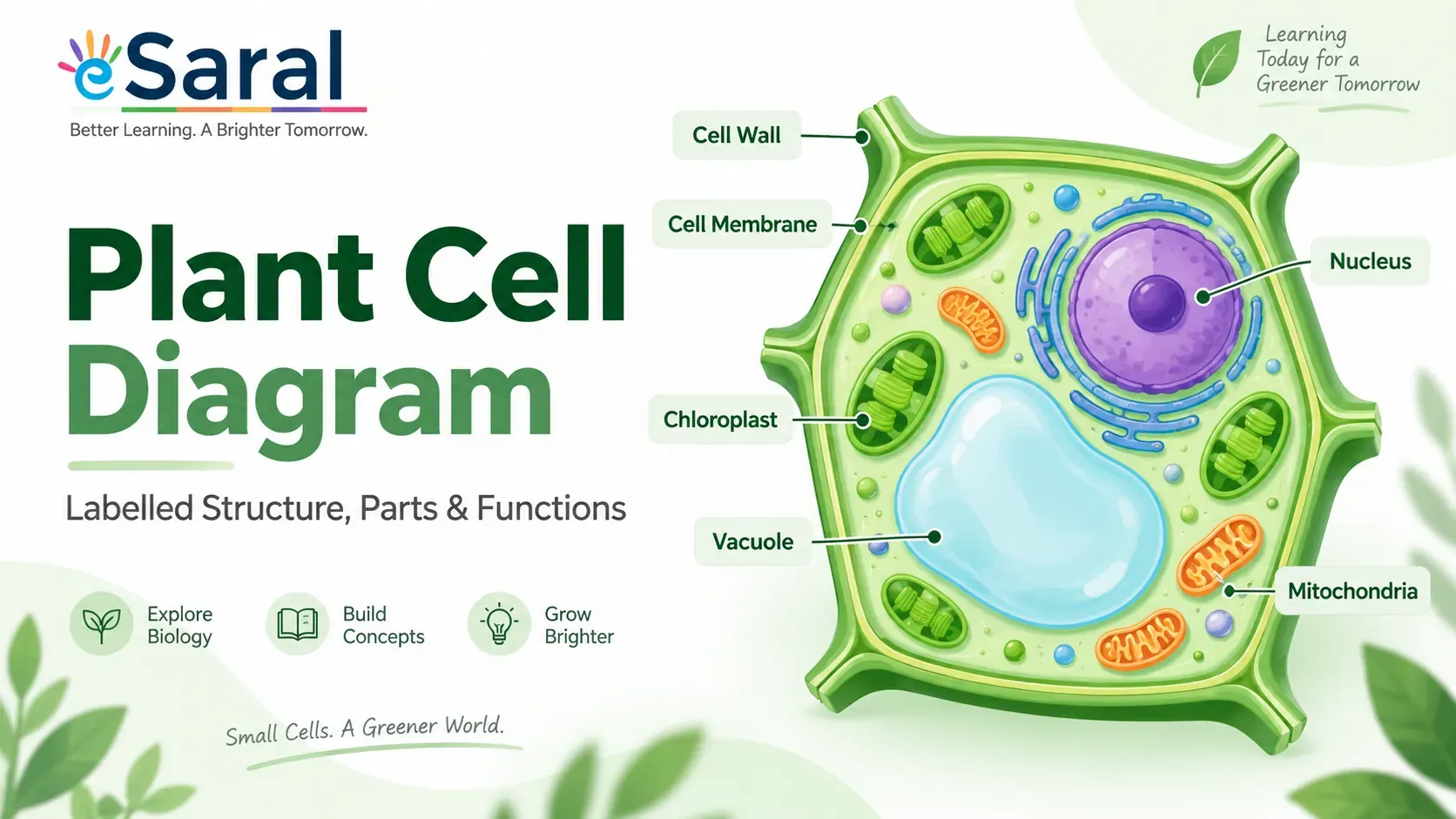
Plant Cell Diagram: Labelled Structure, Parts and Functions
Simple, labelled plant cell diagram with parts and functions. Covers plant cell structure for Class 6, 7, 8, 9, 10 and 11 students, CBSE-aligned.

Saransh Gupta Sir's Visit to IIT Patna: Hostel Life, Placements & Lessons for JEE Aspirants
Inside Saransh Gupta Sir's IIT Patna visit — hostel life, the library, placements, internships, and real advice for JEE aspirants from students living the IIT dream.
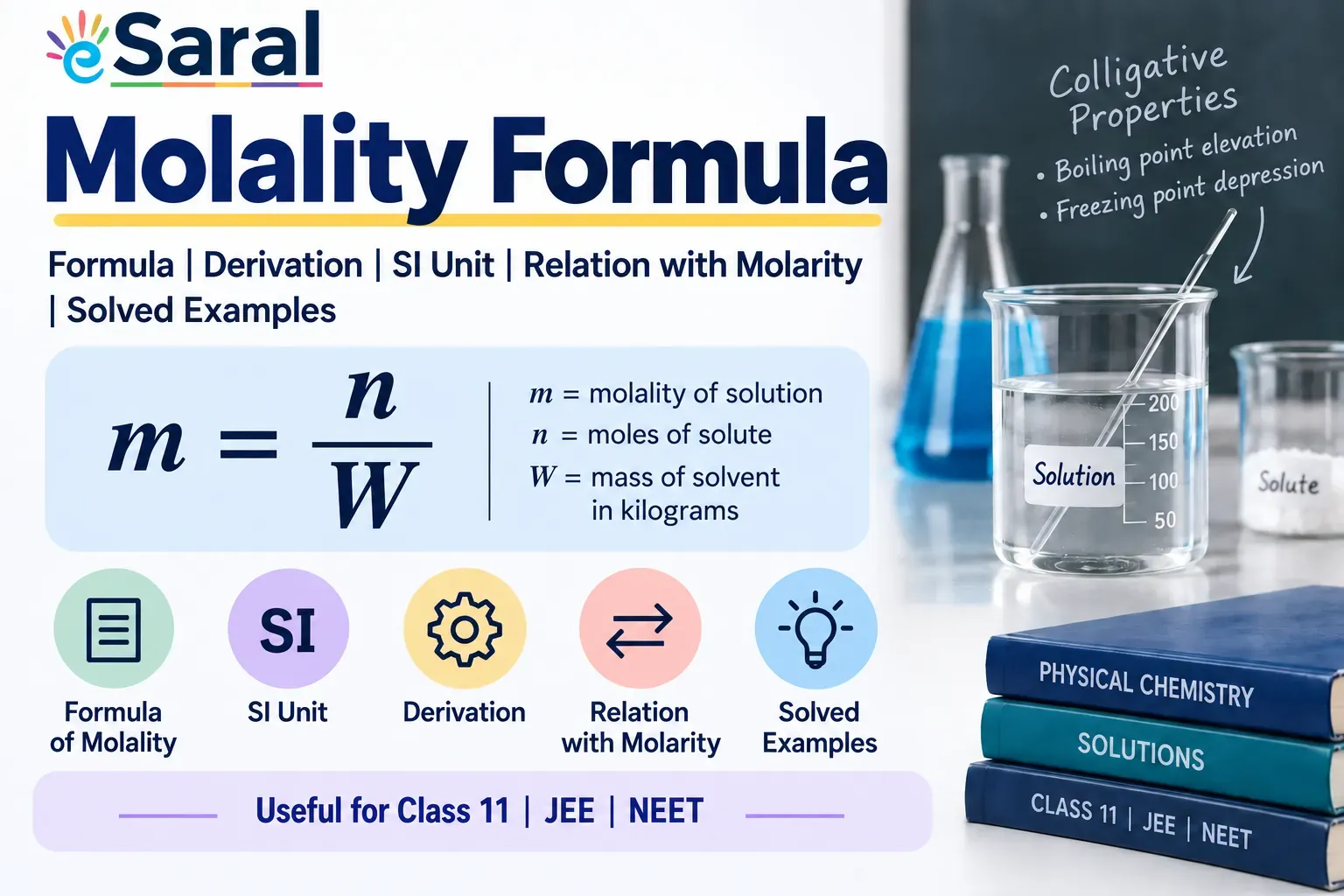
Molality Formula: Formula for Molality, Derivation & Solved Examples
Molality formula is $m = \dfrac{n}{W}$. Learn the formula of molality, its SI unit, derivation, relation with molarity, and solved examples for Class 11, JEE and NEET.
BITSAT Previous Year Question Paper PDF
Download BITSAT previous year question papers PDF. Get year-wise BITSAT PYQs, memory-based papers, exam pattern, and preparation tips to improve your BITSAT preparation.

Teachers’ Day 2026 at eSaral Gurukul: Celebrating the Bond Between Students, Teachers & Mentors
See how Teachers’ Day 2026 was celebrated at eSaral Gurukul, reflecting the bond among students, teachers, and mentors, and the role of guidance beyond academics.
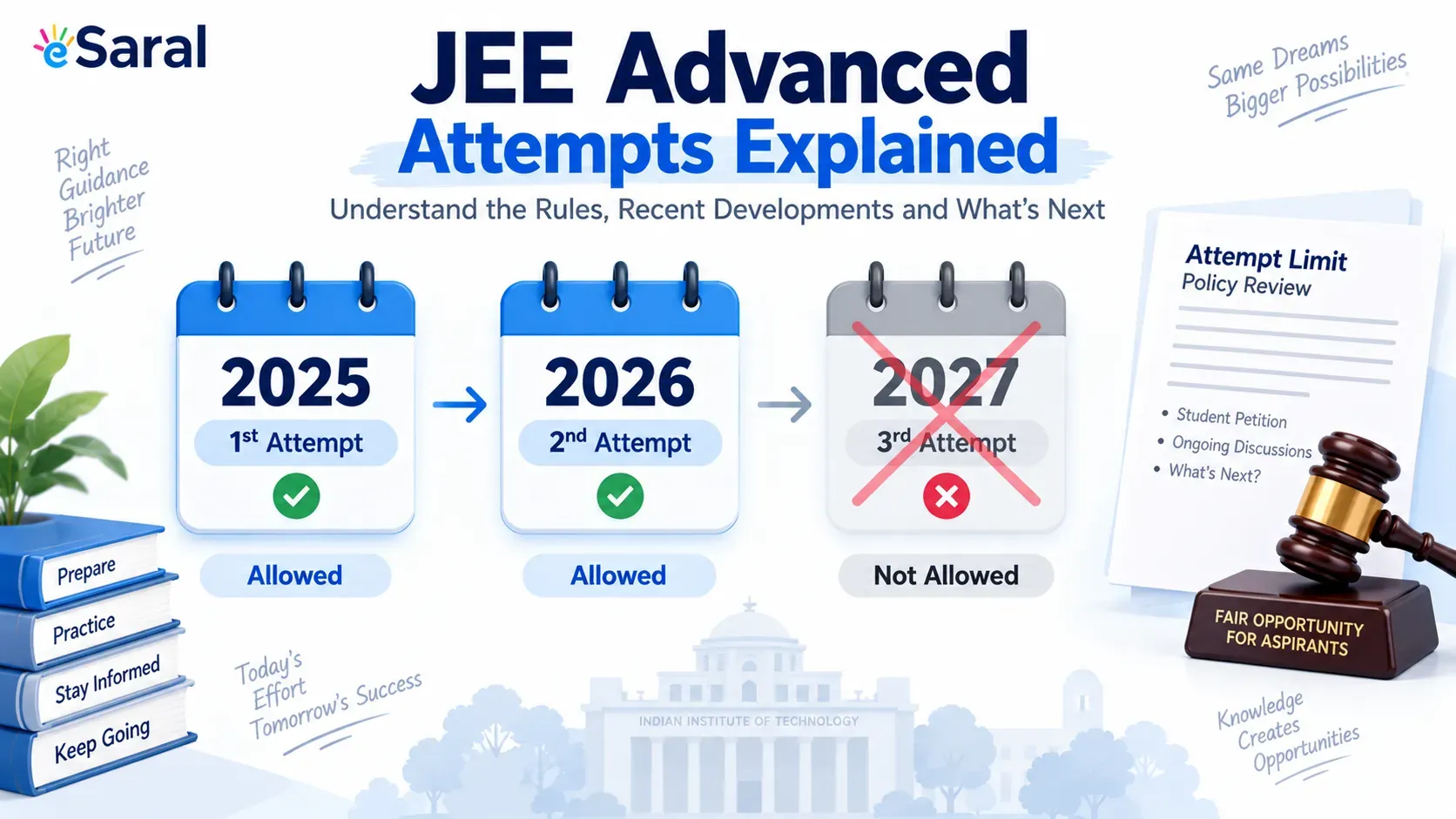
JEE Advanced Attempts: Can You Give It a Third Time? Rules Explained
JEE Advanced attempts: current rule is 2 consecutive years only: full eligibility criteria, the 2025 third-attempt controversy, and the latest 2026 petition news.

Best JEE Preparation App
Best JEE preparation app for Main & Advanced: AI mock tests, live doubt-solving, thousands of practice questions. JEE preparation app for droppers & Class 11-12.
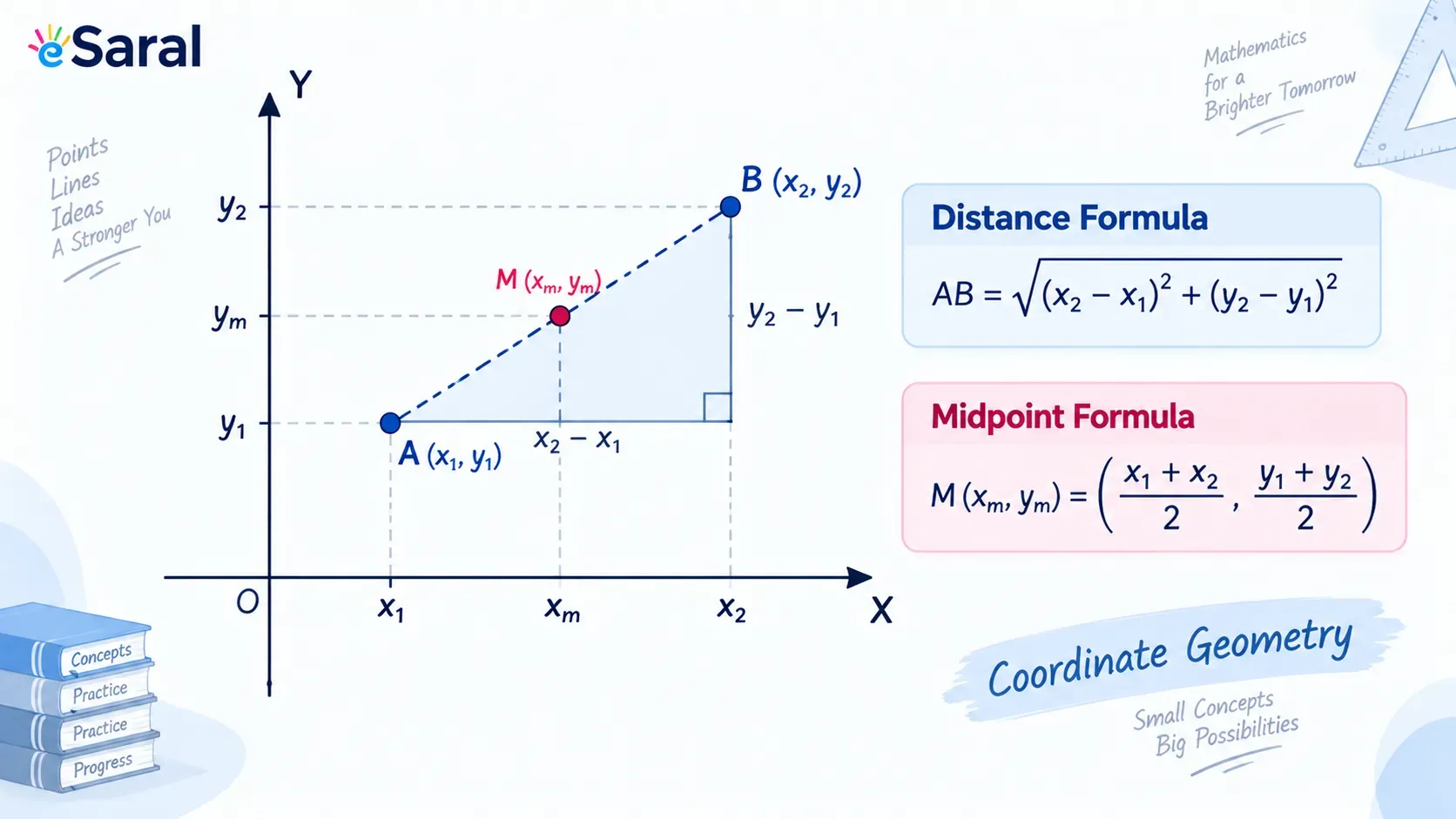
Coordinate Geometry Class 10: Formulas, Notes & Solved Examples
Coordinate geometry class 10: complete CBSE formulas — distance, section, midpoint and area of triangle — with derivation, notes and solved examples.
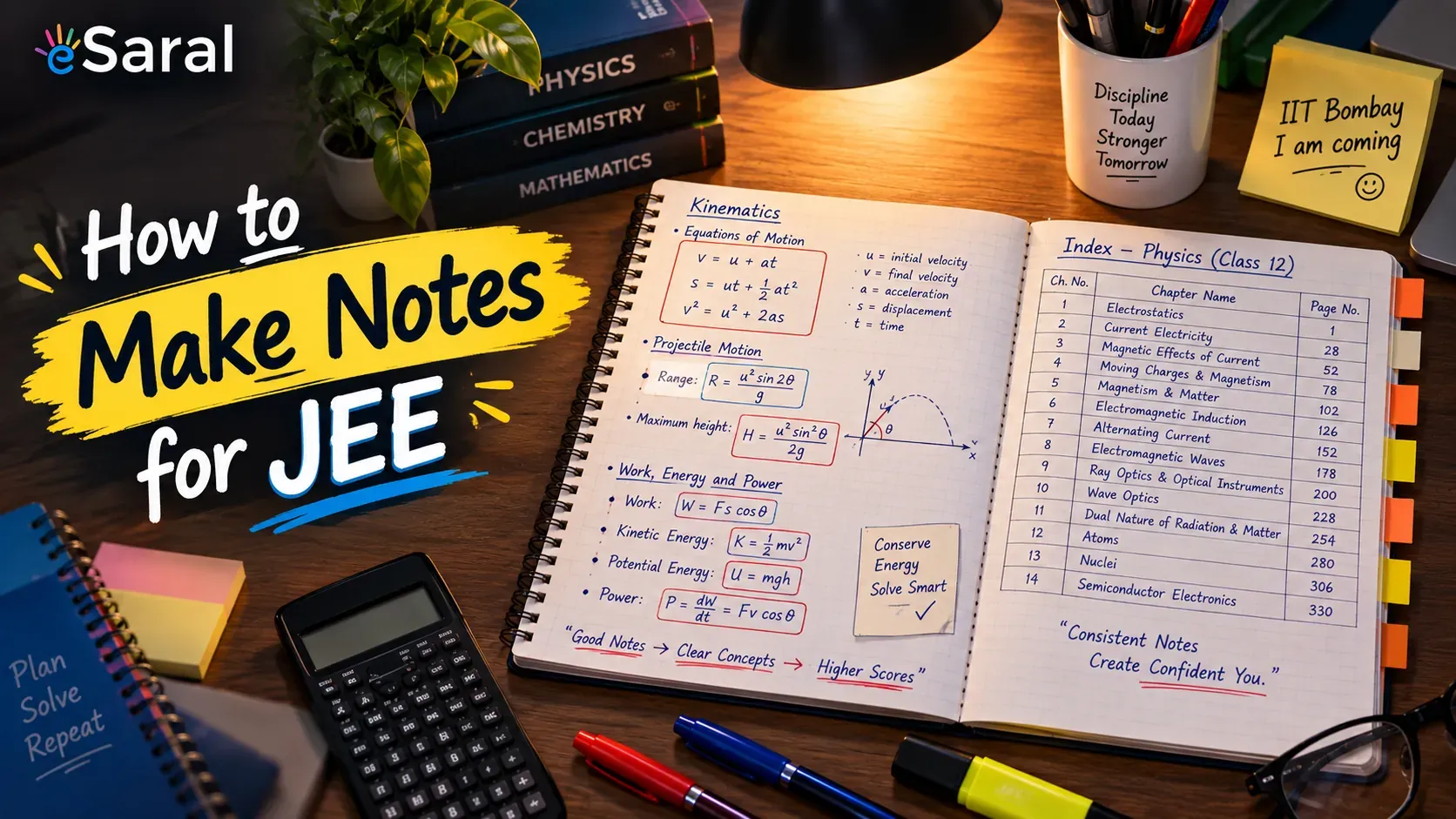
How to make Notes For JEE Smart Notes Strategy of an AIR 41
Learn how to make notes for JEE the way toppers do — indexing, shorthand, and smart short notes for JEE that cut revision time to just 5–7 days.
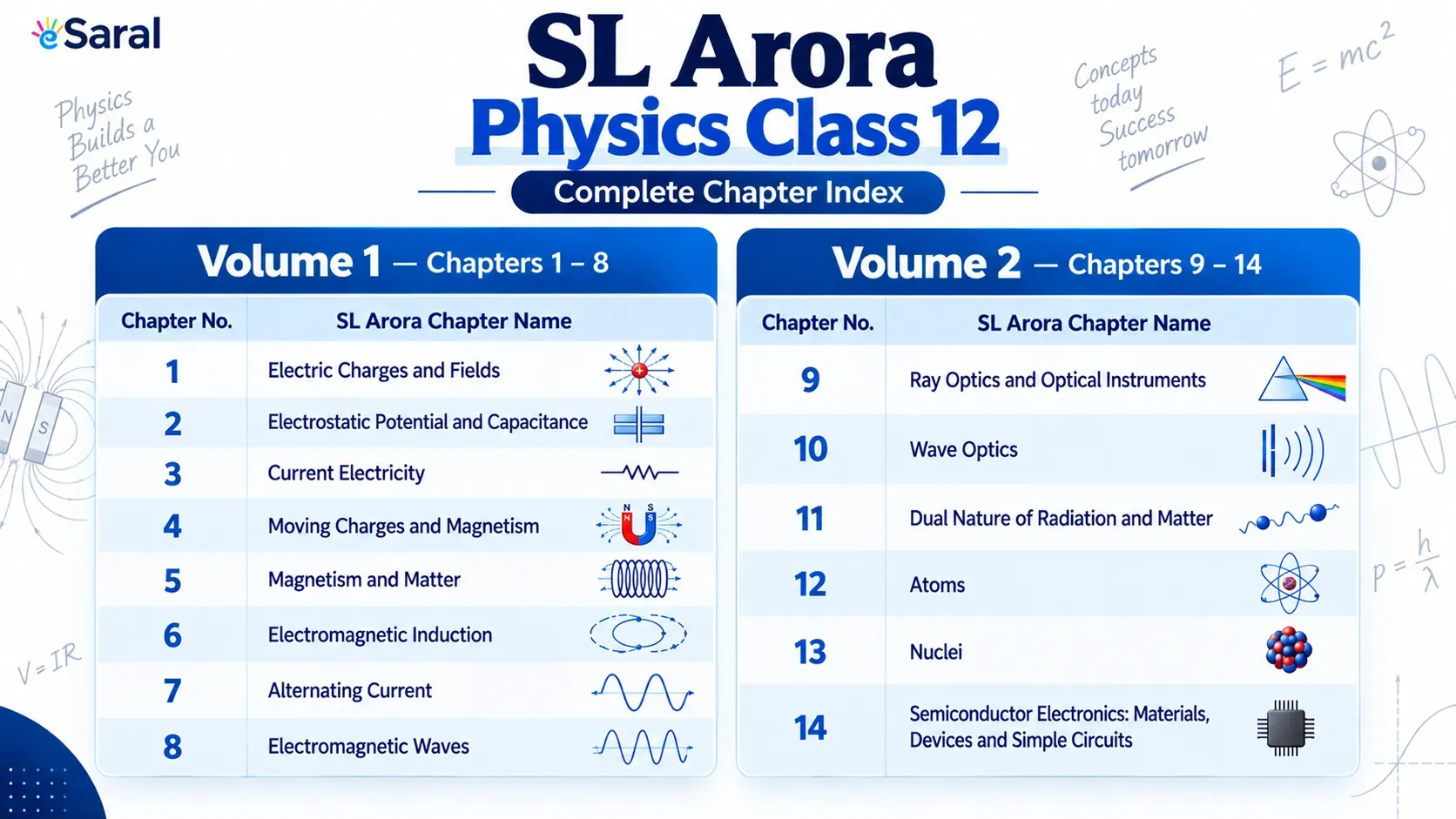
SL Arora Physics Class 12 Index – Chapter List for Volume 1 & 2
SL Arora Physics Class 12 index — complete chapter list for Volume 1 & 2, mapped to NCERT solutions for board, JEE Main, and NEET preparation.