
Electrochemistry - JEE Main Previous Year Questions with Solutions

eSaral Academic and Editorial Team
Summary
Electrochemistry JEE Main previous year questions (AIEEE 2009 to JEE Main 2018) cover standard electrode potential calculations, Kohlrausch's law, Faraday's laws of electrolysis, and galvanic cell EMF. This page compiles all official questions with step-by-step solutions so you can identify your weak areas and practise exam-pattern problems efficiently.

Home > JEE Main Previous Year Questions > Electrochemistry JEE Main Previous Year Questions

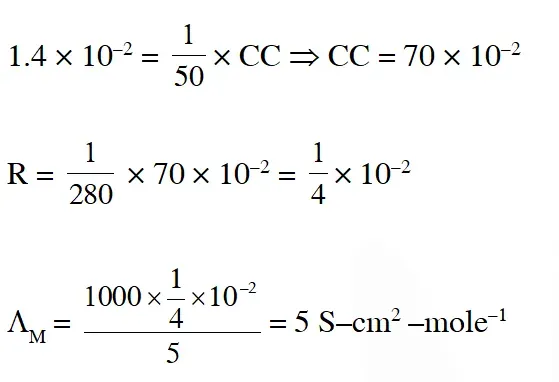
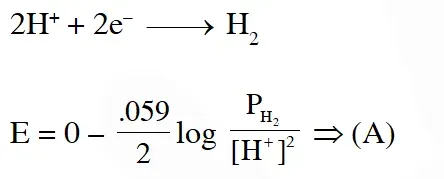
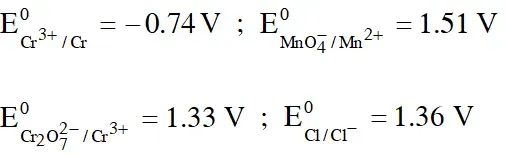
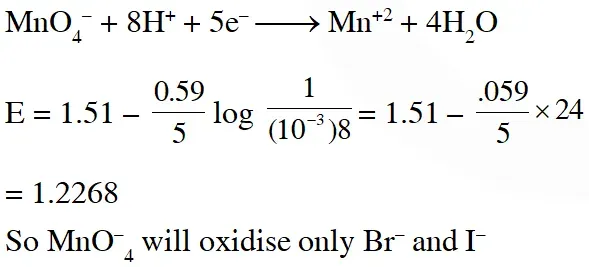
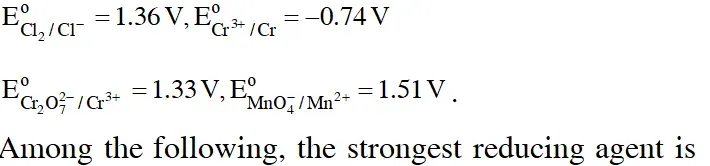
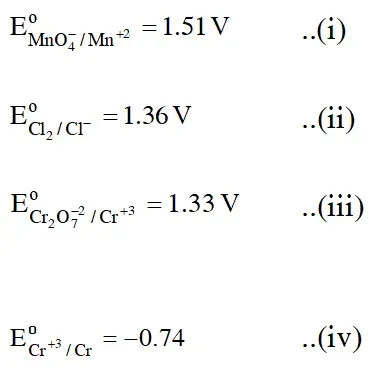
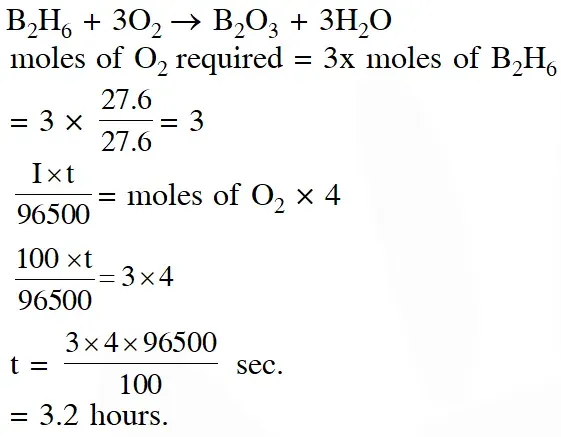
JEE Main Previous Year Papers Questions of Chemistry with Solutions are available at eSaral. Practicing JEE Main chapter wise questions of Chemistry will help the JEE aspirants in realizing the question pattern as well as help in analyzing weak & strong areas. Simulator Previous Years AIEEE/JEE Mains Questions [esquestion] Given : $\mathrm{E}_{\mathrm{Fe}^{-3} / \mathrm{Fe}}^{\circ}=-0.036 \mathrm{V}, \quad \mathrm{E}_{\mathrm{Fe}^{-2} / \mathrm{Fe}}^{\circ}=-0.439 \mathrm{V}$. The value of standard electrode potential for the change. $\mathrm{Fe}^{+3}_{(\mathrm{aq})}+\mathrm{e}^{-} \longrightarrow \mathrm{Fe}^{+2}_{(\mathrm{aq})}$ will be :- (1) 0.770 V (2) –0.27 V (3) –0.072 V (4) 0.385 V #tag# AIEEE 2009 #sol# (1) $\mathrm{E}^{\circ}=\frac{3 \times-0.036+2 \times 0.439}{1}=0.77 \Rightarrow \mathrm{A}$ [/esquestion] [esquestion] The Gibbs energy for the decomposition of $\mathrm{Al}_{2} \mathrm{O}_{3}$ at $500^{\circ} \mathrm{C}$ is as follows : $\frac{2}{3} \mathrm{Al}_{2} \mathrm{O}_{3} \longrightarrow \frac{4}{3} \mathrm{Al}+\mathrm{O}_{2}, \mathrm{AG}=+966 \mathrm{KJ} \mathrm{mol}^{-1}$ The potential difference needed for electrolytic reduction of $\mathrm{Al}_{2} \mathrm{O}_{3}$ at $500^{\circ} \mathrm{C}$ is at least :- (1) 5.0 V (2) 4.5 V (3) 3.0 V (4) 2.5 V #tag# AIEEE 2010 #sol# (4) $966 \times 10^{3}=4 \times 96500 \times \mathrm{E} \Rightarrow \mathrm{E}=2.5 \mathrm{V}$ [/esquestion] [esquestion] Resistance of 0.2 M solution of an electrolyte is $50 \Omega$. The specific conductance of the solution is 1.3 S $\mathrm{m}^{-1}$. If resistance of the 0.4M solution of the same electrolyte is $260 \Omega$, its molar conductivity is :- (1) $6250 \mathrm{Sm}^{2} \mathrm{mol}^{-1}$ (2) $6.25 \times 10^{-4} \mathrm{S} \mathrm{m}^{2} \mathrm{mol}^{-1}$ (3) $625 \times 10^{-4} \mathrm{S} \mathrm{m}^{2} \mathrm{mol}^{-1}$ (4) $62.5 \mathrm{S} \mathrm{m}^{2} \mathrm{mol}^{-1}$ #tag# AIEEE 2011/JEE-MAIN 2014 #sol# (2) [/esquestion] [esquestion] The reduction potential of hydrogen half-cell will be negative if :- (1) $\mathrm{p}\left(\mathrm{H}_{2}\right)=2 \operatorname{atm}\left[\mathrm{H}^{+}\right]=1.0 \mathrm{M}$ (2) $\mathrm{p}\left(\mathrm{H}_{2}\right)=2$ atm and $\left[\mathrm{H}^{+}\right]=2.0 \mathrm{M}$ (3) $\mathrm{p}\left(\mathrm{H}_{2}\right)=1$ atm and $\left[\mathrm{H}^{+}\right]=2.0 \mathrm{M}$ (4) $\mathrm{p}\left(\mathrm{H}_{2}\right)=1$ atm and $\left[\mathrm{H}^{+}\right]=1.0 \mathrm{M}$ #tag# AIEEE 2011 #sol# (1) [/esquestion] [esquestion] The standard reduction potentials for $\mathrm{Zn}^{2+} / \mathrm{Zn}, \mathrm{Ni}^{2+} / \mathrm{Ni}$ and $\mathrm{Fe}^{2+} / \mathrm{Fe}$ are $-0.76,-0.23$ and – 0.44 V respectively. The reaction $\mathrm{X}+\mathrm{Y}^{+2} \rightarrow \mathrm{X}^{2+}+\mathrm{Y}$ will be spontaneous when (1) X = Zn, Y = Ni (2) X = Ni, Y = Fe (3) X = Ni, Y = Zn (4) X = Fe, Y = Zn#tag# #sol# (1) For spontaneous reaction $\mathrm{E}^{\circ}>0 \mathrm{so}(\mathrm{A})$ [/esquestion] [esquestion] Given : Based on the data given above, strongest oxidising agent will be : (1) Cl– (2) $\mathrm{Cr}^{3+}$ (3) $\mathrm{Mn}^{2+}$ (4) $\mathrm{MnO}_{4}^{-}$ #tag# JEE-Mains 2013 #sol# (4) Higher the SRP, stronger will be oxidising agent Hence, $\mathrm{MnO}_{4}^{-}$ is stronger oxidising agent. [/esquestion] [esquestion] The equivalent conductance of NaCl at concentration C and at infinite dilution are $\lambda_{\mathrm{C}}$ and $\lambda_{\infty}$ , respectively. The correct relationship between $\lambda_{\mathrm{C}}$ and $\lambda_{\infty}$ is given as: (1) $\lambda_{\mathrm{C}}=\lambda_{\infty}-(\mathrm{B}) \sqrt{\mathrm{C}}$ (2) $\lambda_{\mathrm{C}}=\lambda_{\infty}+(\mathrm{B}) \sqrt{\mathrm{C}}$ (3) $\lambda_{\mathrm{C}}=\lambda_{\infty}+(\mathrm{B}) \mathrm{C}$ (4) $\lambda_{\mathrm{C}}=\lambda_{\infty}-(\mathrm{B}) \mathrm{C}$ #tag# JEE-Mains 2014 #sol# (1) Fact [/esquestion] [esquestion] At 298 K, the standard reduction potentials are 1.51 V for $\mathrm{MnO}_{4}-| \mathrm{Mn}^{2+}$ , 1.36 V for $\mathrm{Cl}_{2} | \mathrm{Cl}^{-}$, 1.07 V for $\mathrm{Br}_{2} | \mathrm{Br}^{-},$ and $0.54 \mathrm{V}$ for $\mathrm{I}_{2} | \mathrm{I}^{-} .$ At $\mathrm{pH}=3$, permanganate is expected to oxidize $\left(\frac{\mathrm{RT}}{\mathrm{F}}=0.059 \mathrm{V}\right):-$ (1) $\mathrm{Cl}^{-}$ and $\mathrm{Br}^{-}$ (2) $\mathrm{Cl}^{-}, \mathrm{Br}^{-}$ and $\mathrm{I}^{-}$ (3) $\mathrm{Br}^{-}$ and $\mathrm{I}^{-}$ (4) I- only #tag# JEE-Mains (online) 2015 #sol# (3) [/esquestion] [esquestion] A variable, opposite external potential $\left(\mathrm{E}_{\mathrm{ext}}\right)$ is applied to the cell $\mathrm{Zn}\left|\mathrm{Zn}^{2+}(1 \mathrm{M}) \| \mathrm{Cu}^{2+}(1 \mathrm{M})\right| \mathrm{Cu}$, of potential 1.1 V. When $\mathrm{E}_{\mathrm{ext}}<1.1 \mathrm{V}$ and $\mathrm{E}_{\mathrm{ext}}>1.1 \mathrm{V}$ , respectively electrons flow from : (1) anode to cathode in both cases (2) anode to cathode and cathode to anode (3) cathode to anode in both cases (4) cathode to anode and anode to cathode #tag# JEE-Mains (online) 2015 #sol# (2) Fact [/esquestion] [esquestion] Two Faraday of electricity is passed through a solution of $\mathrm{CuSO}_{4}$. The mass of copper deposited at the cathode is : (at. mass of Cu = 63.5 amu) (1) 2g (2) 127 g (3) 0 g (4) 63.5 g #tag# JEE-Mains 2015 #sol# (4) $2 \mathrm{F}=2 \mathrm{eq}=1$ mole $=63.5 \mathrm{gm}$ [/esquestion] [esquestion] Galvanization is applying a coating of :- (1)Zn (2) Pb (3) Cr (4) Cu #tag# JEE-Mains 2016 #sol# (1) Galvanization is the process of applying a protective zinc coating of steel or iron, to prevent rusting. [/esquestion] [esquestion] Given (1)Cr (2) $\mathrm{Mn}^{2+}$ (3) $\mathrm{Cr}^{3+}$ (4) $\mathrm{Cl}^{-}$ #tag# JEE-Mains 2017 #sol# (1) Since $\mathrm{Cr}^{+3}$ is having least reducing potential, so Cr is the best Reducing agent. [/esquestion] [esquestion] How long (approximate) should water be electrolysed by passing through 100 amperes current so that the oxygen released can completely burn 27.66 g of diborane ? (Atomic weight of B = 10.8 u) (1)0.8 hours (2) 3.2 hours (3) 1.6 hours (4) 6.4 hours #tag# JEE-Mains 2018 #sol# (2) [/esquestion]
The Electrochemistry questions can be followed by more chapter-specific practice through the JEE Mains PYQ chapter wise index.
Curious how often Electrochemistry gets tested? Browse our JEE Main last year paper archive and count the questions yourself, session by session.
Frequently Asked Questions
Is the Nernst equation directly asked in JEE Main?
Yes. The Nernst equation appears both directly — asking you to calculate E at non-standard conditions — and indirectly, such as determining when a hydrogen half-cell has negative reduction potential. Knowing E = E° – (0.0592/n) log Q at 298 K is sufficient for most JEE Main problems.
Which topic within Electrochemistry has the highest weightage in JEE Main?
Standard electrode potential and related Gibbs energy calculations account for roughly 40% of all Electrochemistry questions in JEE Main history. Questions on Faraday's laws of electrolysis and molar conductivity each contribute around 20–25%. Galvanic cell operation, Kohlrausch's law, and corrosion make up the remainder.
How many questions from Electrochemistry appear in JEE Main each year?
EE Main typically features 1 to 2 questions from Electrochemistry per session. With two sessions per year, you can expect 2–4 questions annually, worth 8–16 marks. The chapter has appeared in every JEE Main / AIEEE paper since 2009 without exception, making it one of the most reliable scoring topics in Physical Chemistry
What is the difference between molar conductivity and specific conductance?
Specific conductance (κ, units S m⁻¹) measures the conductance of a 1 m³ cube of solution. Molar conductivity (λ_m, units S m² mol⁻¹) is defined as λ_m = κ/C, where C is concentration in mol m⁻³. Molar conductivity increases as the solution is diluted because more ions become mobile. Specific conductance decreases on dilution because fewer ions are present per unit volume.
How do I identify the strongest oxidising agent from a table of SRP values?
The strongest oxidising agent is the species with the highest (most positive) standard reduction potential. It has the greatest tendency to accept electrons. In JEE Main 2013, MnO₄⁻ (E° = +1.51 V) was the correct answer for this exact reason. Conversely, the best reducing agent is the metal with the most negative SRP.
What is the formula to find the minimum voltage needed for electrolysis?
Use ΔG = nFE, where ΔG is the Gibbs energy of the reaction (in joules), n is the number of electrons transferred per formula unit, and F = 96,500 C mol⁻¹. Rearranging: E (minimum) = ΔG / (nF). This was directly tested in AIEEE 2010 for the electrolytic reduction of Al₂O₃.
Team eSaral
eSaral Academic and Editorial Team
Team eSaral is the collective author profile for educational content created by eSaral’s teachers and academic contributors. The team draws on expertise from IIT graduates, doctors, experienced educators and subject specialists to develop resources for JEE, NEET and school students. Our articles aim to explain concepts clearly and help students study with confidence.
Related Posts
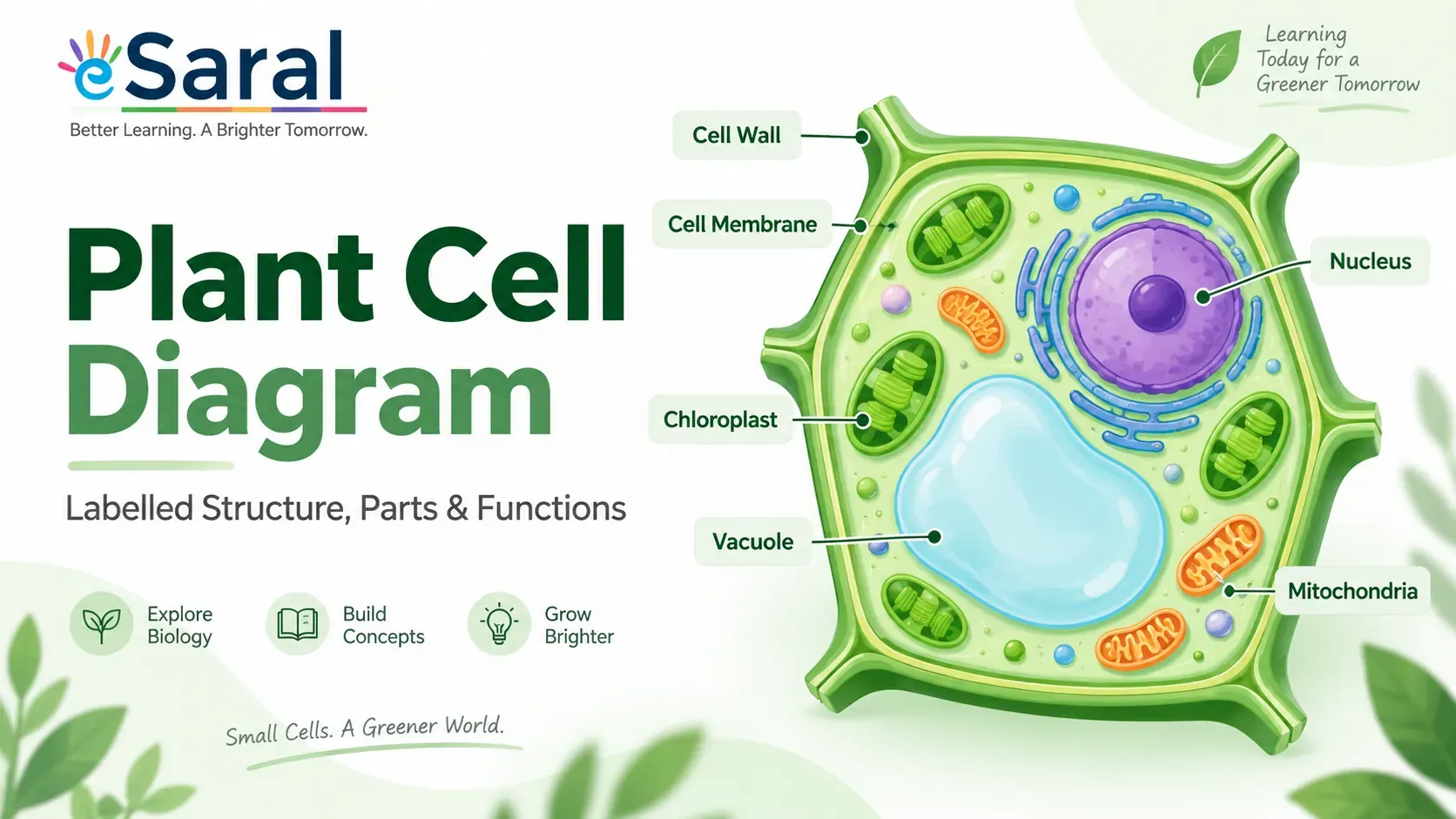
Plant Cell Diagram: Labelled Structure, Parts and Functions
Simple, labelled plant cell diagram with parts and functions. Covers plant cell structure for Class 6, 7, 8, 9, 10 and 11 students, CBSE-aligned.

Saransh Gupta Sir's Visit to IIT Patna: Hostel Life, Placements & Lessons for JEE Aspirants
Inside Saransh Gupta Sir's IIT Patna visit — hostel life, the library, placements, internships, and real advice for JEE aspirants from students living the IIT dream.
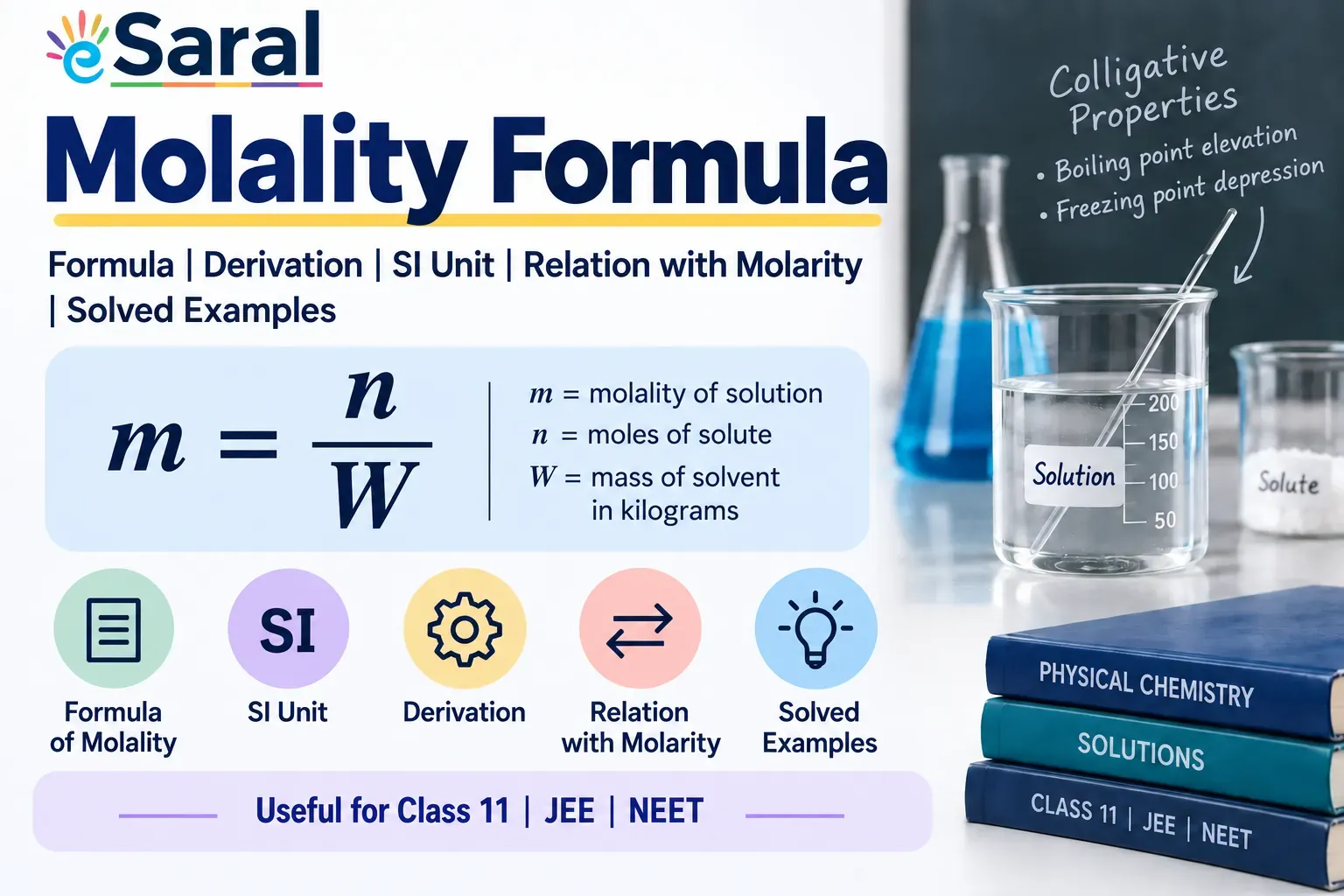
Molality Formula: Formula for Molality, Derivation & Solved Examples
Molality formula is $m = \dfrac{n}{W}$. Learn the formula of molality, its SI unit, derivation, relation with molarity, and solved examples for Class 11, JEE and NEET.
BITSAT Previous Year Question Paper PDF
Download BITSAT previous year question papers PDF. Get year-wise BITSAT PYQs, memory-based papers, exam pattern, and preparation tips to improve your BITSAT preparation.

Teachers’ Day 2026 at eSaral Gurukul: Celebrating the Bond Between Students, Teachers & Mentors
See how Teachers’ Day 2026 was celebrated at eSaral Gurukul, reflecting the bond among students, teachers, and mentors, and the role of guidance beyond academics.
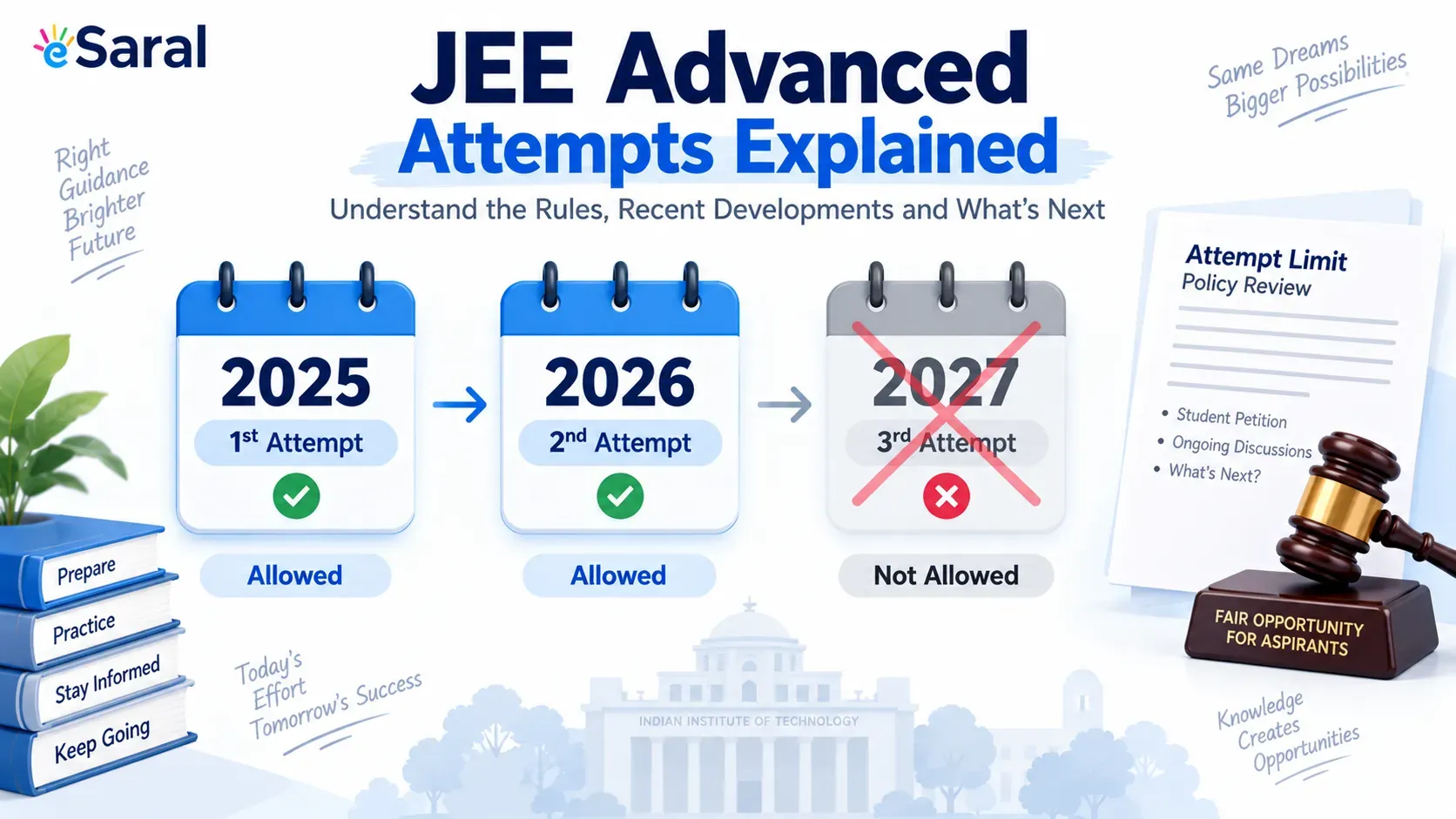
JEE Advanced Attempts: Can You Give It a Third Time? Rules Explained
JEE Advanced attempts: current rule is 2 consecutive years only: full eligibility criteria, the 2025 third-attempt controversy, and the latest 2026 petition news.

Best JEE Preparation App
Best JEE preparation app for Main & Advanced: AI mock tests, live doubt-solving, thousands of practice questions. JEE preparation app for droppers & Class 11-12.
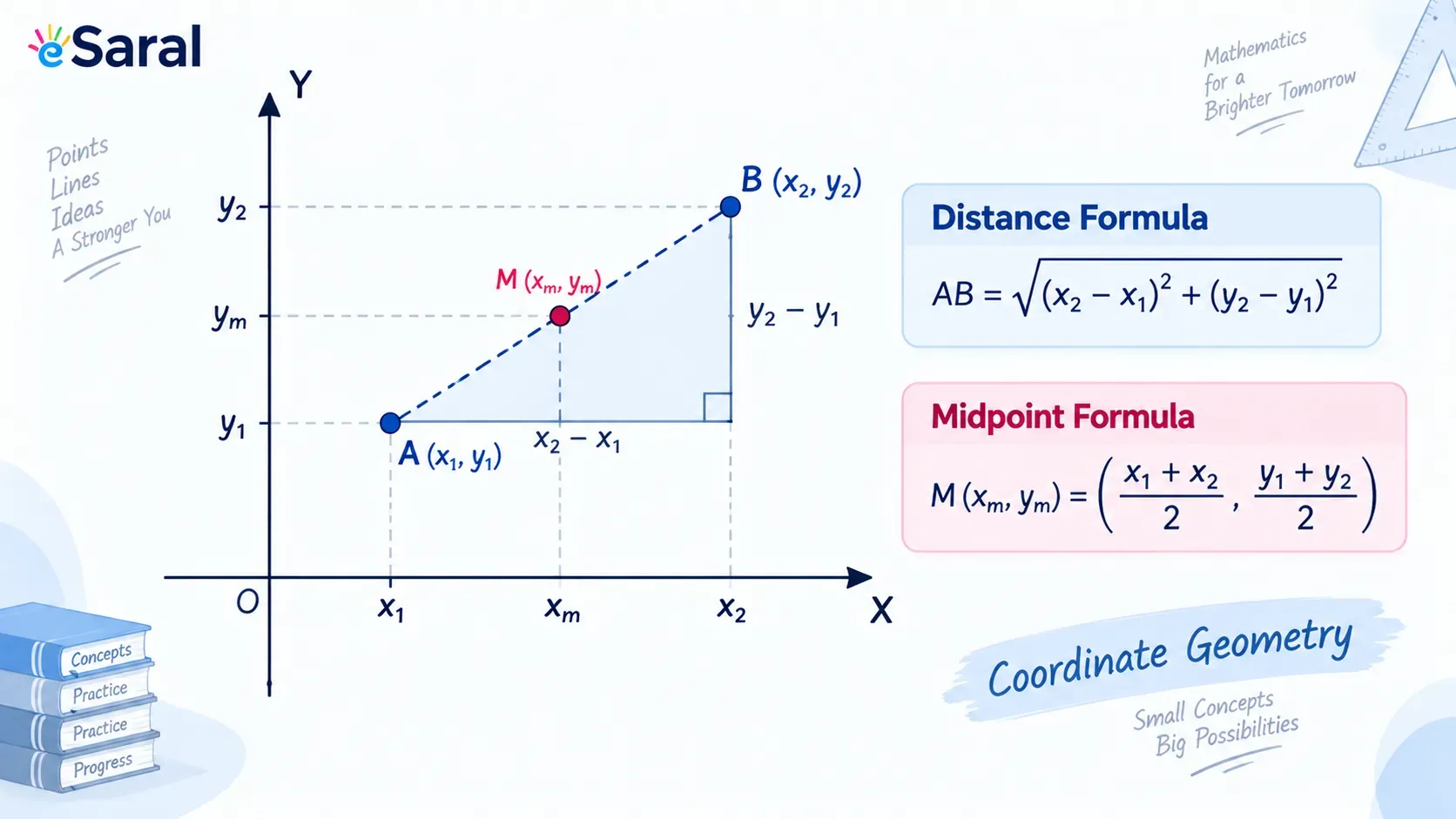
Coordinate Geometry Class 10: Formulas, Notes & Solved Examples
Coordinate geometry class 10: complete CBSE formulas — distance, section, midpoint and area of triangle — with derivation, notes and solved examples.
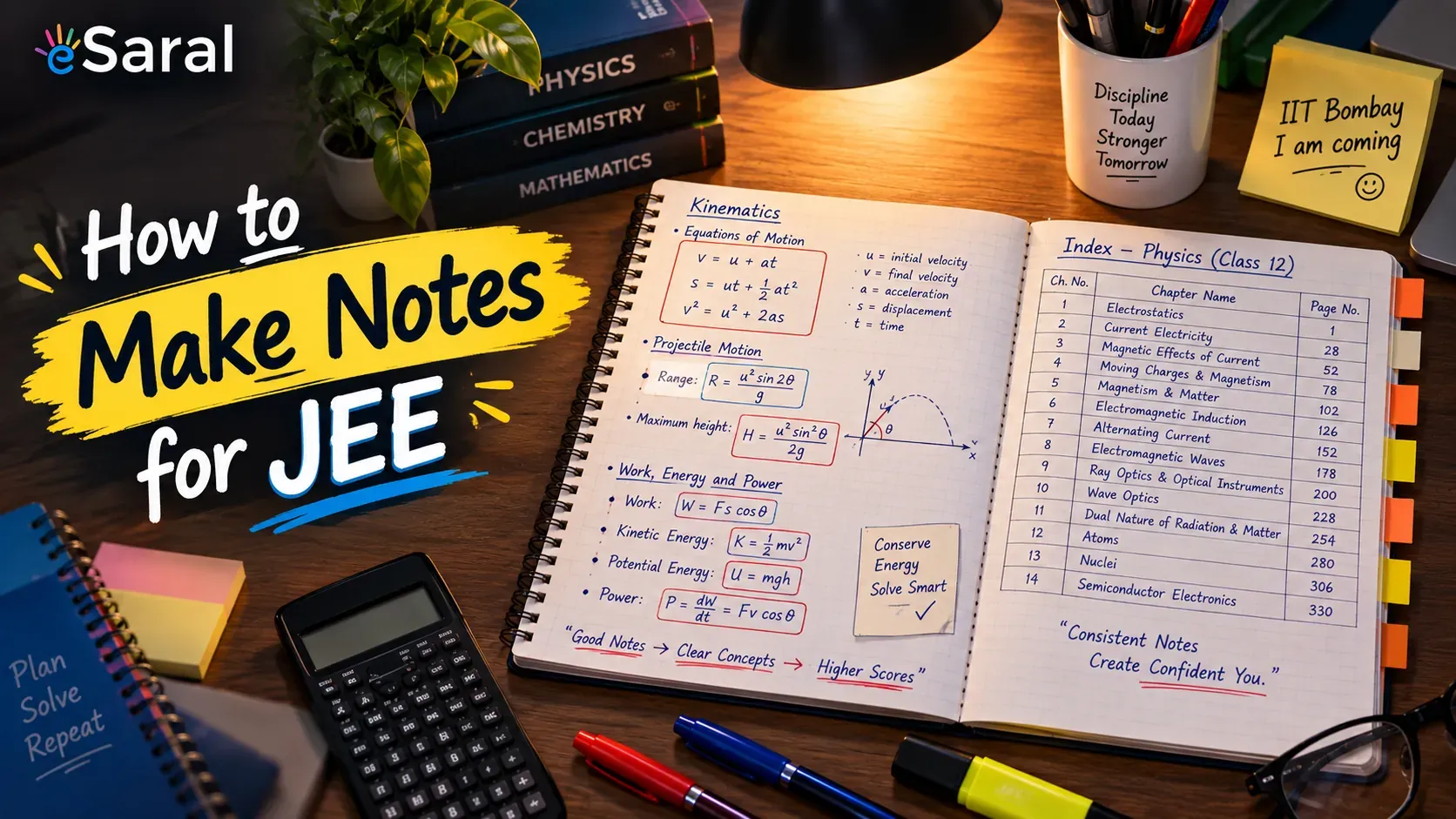
How to make Notes For JEE Smart Notes Strategy of an AIR 41
Learn how to make notes for JEE the way toppers do — indexing, shorthand, and smart short notes for JEE that cut revision time to just 5–7 days.
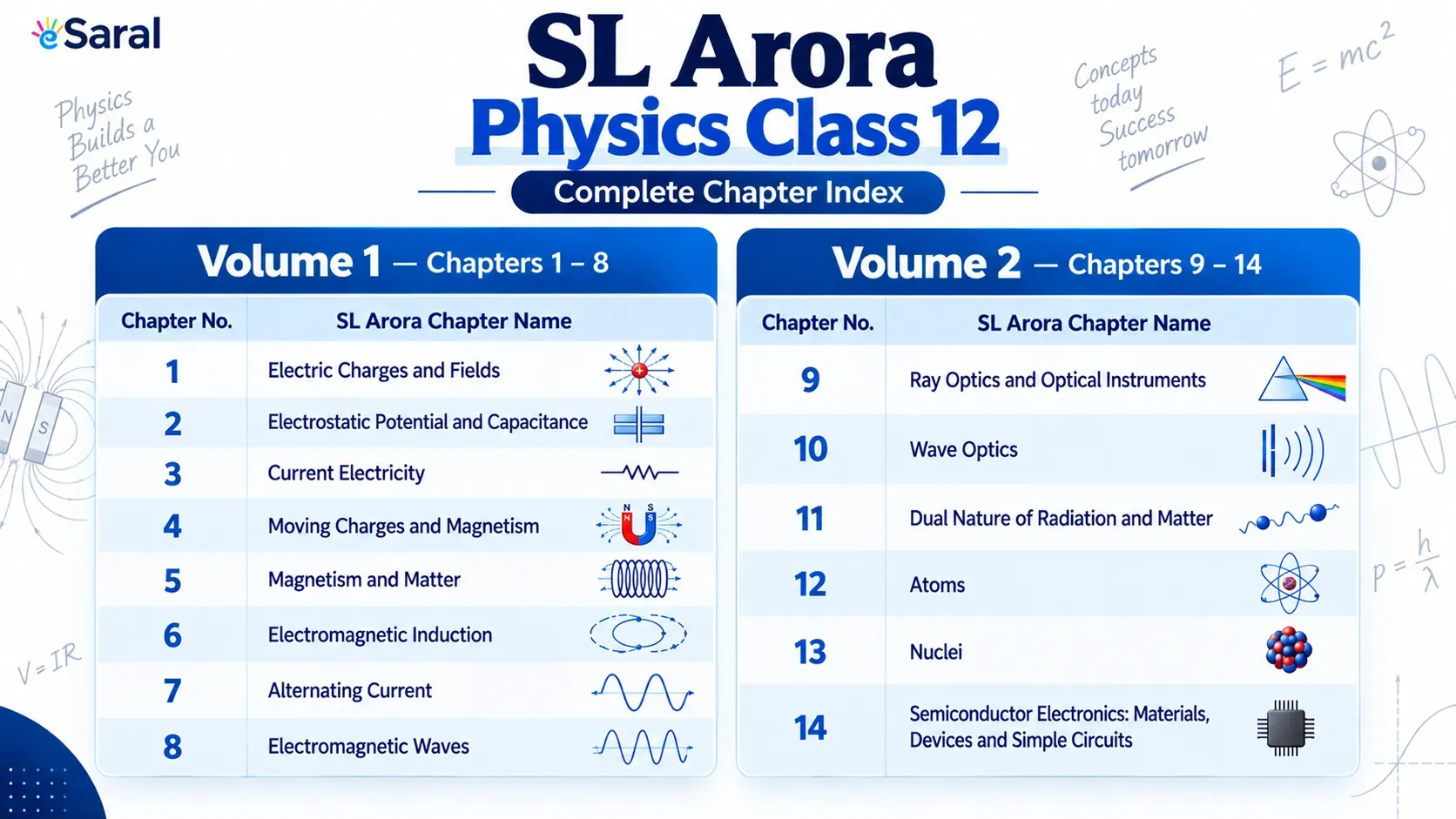
SL Arora Physics Class 12 Index – Chapter List for Volume 1 & 2
SL Arora Physics Class 12 index — complete chapter list for Volume 1 & 2, mapped to NCERT solutions for board, JEE Main, and NEET preparation.