
Error in Measurement & Instruments - JEE Main Previous Year Questions with Solutions

eSaral Academic and Editorial Team
Summary
JEE Main Error in Measurement & Instruments PYQs cover vernier calipers, screw gauge, significant figures, least count, error analysis, percentage error propagation, and measurement-based numerical problems frequently asked in AIEEE/JEE Main exams.

eSaral › JEE › JEE Main › Error in Measurement & Instruments

🚀 Checkout eSaral Courses
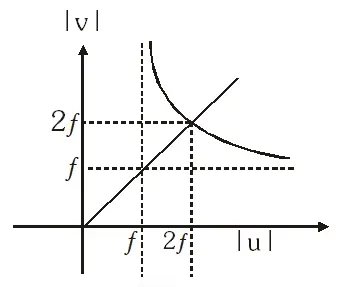
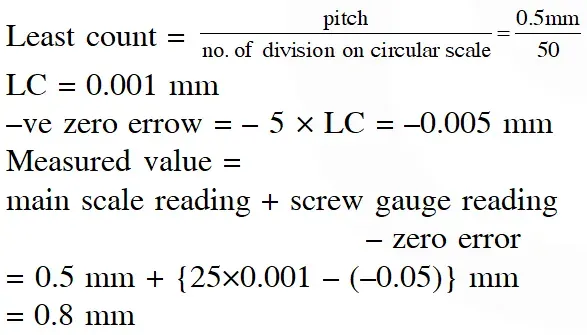
Previous Years AIEEE/JEE Mains Questions [esquestion] In an experiment the angles are required to be measured using an instrument 29 divisions of the main scale exactly coincide with the 30 divisions of the vernier scale. If the smallest division of the main scale is half-a-degree $\left(=0.5^{\circ}\right)$, then the least count of the instrument is :- (1) One degree (2) Half degree (3) One minute (4) Half minute #tag# [AIEEE - 2009] #sol# (3) Least count of vernier callipers L.C. = 1MSD – 1VSD But here $29 \mathrm{MSD}=30 \mathrm{VSD} \Rightarrow 1 \mathrm{VSD}=\frac{29}{30} \mathrm{MSD}$ $\Rightarrow \mathrm{L.C.}=1 \mathrm{MSD}-\frac{29}{30} \mathrm{MSD}=$ $\frac{1}{30} \mathrm{MSD}=\frac{1}{30} \times 0.5^{\circ}=\left(\frac{1}{60}\right)^{\circ}=1$ minute. [/esquestion] [esquestion] In an optics experiment, with the position of the object fixed, a student varies the position of a convex lens and for each position, the screen is adjusted to get a clear image of the object. A graph between the object distance u and the image distance v, from the lens, is plotted using the same scale for the two axes. A straight line passing through the origin and making an angle of $45^{\circ}$ with the x-axis meets the experimental curve at P. The coordinates of P will be :- (1) (ƒ, ƒ) (2) (4ƒ, 4ƒ) (3) (2ƒ, 2ƒ) (4) $\left(\frac{f}{2}, \frac{f}{2}\right)$ #tag# [AIEEE - 2009] #sol# (3) [/esquestion] [esquestion] The respective number of significant figures for the numbers $23.023,0.0003$ and $2.1 \times 10^{-3}$ are :- (1) 4, 4, 2 (2) 5, 1, 2 (3) 5, 1, 5 (4) 5, 5, 2 #tag# [AIEEE - 2010] #sol# (2) 5, 1, 2 resp. [/esquestion] [esquestion] A screw gauge gives the following reading when used to measure the diameter of a wire. Main scale reading : 0 mm. Circular scale reading : 52 divisions Given that 1 mm on main scale corresponds to 100 divisions of the circular scale. The diameter of wire from the above date is :- (1) 0.026 cm (2) 0.005 cm (3) 0.52 cm (4) 0.052 cm #tag# [AIEEE - 2011] #sol# (4) Least count $=\frac{1 \mathrm{mm}}{100}=0.01 \mathrm{mm}$ Diameter of the wire = 0 + 52 × 0.01 mm = 0.52 mm = 0.052 cm [/esquestion] [esquestion] A spectrometer gives the following reading when used to measure the angle of a prism. Main scale reading : 58.5 degree Vernier scale reading : 09 divisions Given that 1 division on main scale corresponds to 0.5 degree. Total divisions on the vernier scale is 30 and match with 29 divisions of the main scale. The angle of the prism from the above data : (1) 59 degree (2) 58.59 degree (3) 58.77 degree (4) 58.65 degree #tag# [AIEEE - 2012] #sol# (4) Least count = MSD – VSD where $\mathrm{MSD}=0.5^{\circ} \& 30 \mathrm{VSD}=29 \mathrm{MSD}$ so least count $=0.5^{\circ}-\left(\frac{29}{30}\right) \times 0.5^{\circ}=\left(\frac{0.5}{30}\right)^{\circ}$ Reading $=58.5^{\circ}+(09) \times\left(\frac{0.5}{30}\right)^{\circ}=58.65^{\circ}$ [/esquestion] [esquestion] Resistance of a given wire is obtained by measuring the current flowing in it and the voltage difference applied across it. If the percentage errors in the measurement of the current and the voltage difference are 3% each, then error in the value of resistance of the wire is :- (1) 3% (2) 6% (3) zero (4) 1% #tag# [AIEEE - 2012] #sol# (2) $\mathrm{R}=\frac{\mathrm{V}}{\mathrm{I}} \Rightarrow \frac{\Delta \mathrm{R}}{\mathrm{R}}=\pm\left(\frac{\Delta \mathrm{V}}{\mathrm{V}}+\frac{\Delta \mathrm{I}}{\mathrm{I}}\right)$ $=\pm(3+3) \%=\pm 6 \%$ [/esquestion] [esquestion] The current voltage relation of diode is given by $\mathrm{I}=\left(\mathrm{e}^{1000 \mathrm{V} / \mathrm{T}}-1\right) \mathrm{mA}$, where the applied voltage V is in volts and the temperature T is in degree Kelvin. If a student makes an error measuring $\pm 0.01 \mathrm{V}$ while measuring the current of 5 mA at 300 K, what will be error in the value of current in mA ? (1) 0.5 mA (2) 0.05 mA (3) 0.2 mA (4) 0.02 mA #tag# [JEE-Mains 2014] #sol# (3) Given current $\mathrm{I}=\left(e^{1000 \mathrm{V} / \mathrm{T}}-1\right) \mathrm{mA}$ $\Rightarrow \mathrm{I}+1=e^{1000 \mathrm{V} / \mathrm{T}}$ $\mathrm{d} \mathrm{l}=\frac{1000}{\mathrm{T}}\left[e^{\frac{1000 \mathrm{v}}{\mathrm{T}}}\right] \mathrm{d} \mathrm{V}$ $\mathrm{d} \mathrm{l}=\frac{1000}{\mathrm{T}}[1+1] \mathrm{dV}=\frac{1000}{300}[6] \times(0.01)$ dI = 0.2 mA [/esquestion] [esquestion] A student measured the length of a rod and wrote it as 3.50 cm. Which instrument did he use to measure it ? (1) A screw gauge having 100 divisions in the circular scale and pitch as 1 mm. (2) A screw gauge having 50 divisions in the circular scale and pitch as 1 mm. (3) A meter scale (4) A vernier calliper where the 10 divisions in vernier scale matches with 9 division in main scale and main scale has 10 divisions in 1 cm. #tag# [JEE-Mains 2014] #sol# (4) Least count of varnier calliper is 0.01 cm Hence it matches with the reading. [/esquestion] [esquestion] The period of oscillation of a simple pendulum is T = $2 \pi \sqrt{\frac{\mathrm{L}}{\mathrm{g}}}$. Measured value of L is 20.0 cm known to 1 mm accuracy and time for 100 oscillations of the pendulum is found to be 90s using a wrist watch of 1s resolution. The accuracy in the determination of g is : (1)1% (2) 5% (3) 2% (4) 3% #tag# [JEE-Mains 2015] #sol# (4) $\mathrm{T}=2 \pi \sqrt{\frac{\ell}{\mathrm{g}}}$ $\mathrm{g}=\frac{4 \pi^{2} \ell}{\mathrm{T}^{2}}$ $\frac{\Delta \mathrm{g}}{\mathrm{g}}=\frac{\Delta \ell}{\ell}+2 \frac{\Delta \mathrm{T}}{\mathrm{T}}$ $\frac{\Delta \mathrm{g}}{\mathrm{g}}=\frac{1 \times 10^{-3}}{20 \times 10^{-2}}+2 \times \frac{1}{100 \times \frac{90}{100}}$ $\therefore \frac{\Delta \mathrm{g}}{\mathrm{g}} \times 100=2.722 \% \approx 3 \%$ [/esquestion] [esquestion] A screw gauge with a pitch of 0.5 mm and a circular scale with 50 divisions is used to measure the thickness of a thin sheet of Aluminium. Before starting the measurement , it is found that when the two jaws of the screw gauge are brought in contact, the 45th division coincides with the main scale line and that the zero of the main scale is barely visible. What is the thickness of the sheet if the main scale reading is 0.5 mm and the 25th division coincides with the main scale line ? (1) 0.50 mm (2) 0.75 mm (3) 0.80 mm (4) 0.70 mm #tag# [JEE-Mains 2016] #sol# (3) [/esquestion] [esquestion] A student measures the time period of 100 oscillations of a simple pendulum four times. The data set is 90 s, 91 s, 95 s and 92 s. If the minimum division in the measuring clock is 1 s, then the reported mean time should be :- (1) $92 \pm 3 \mathrm{s}$ (2) $92 \pm 2 \mathrm{s}$ (3) $92 \pm 5.0 \mathrm{s}$ (4) $92 \pm 1.8 \mathrm{s}$ #tag# [JEE-Mains 2016] #sol# (2) $\mathrm{T}_{\mathrm{AV}}=92 \mathrm{s}$ $(|\Delta \mathrm{T}|)_{\text {mean }}=1.5 \mathrm{s}$ Least conunt of clock is 1sec. So value that clock can measure should be 1, 2, 3......so on so reported mean time should be $92 \pm 2$ Ref : NCERT (XIth) Ex. 2.7, Page. 25 [/esquestion] [esquestion] The following observations were taken for determining surface tensiton T of water by capillary method : Diameter of capilary, $\mathrm{D}=1.25 \times 10^{-2} \mathrm{m}$ rise of water, $h=1.45 \times 10^{-2} \mathrm{m}$ Using $\mathrm{g}=9.80 \mathrm{m} / \mathrm{s}^{2}$ and the simplified relation $\mathrm{T}=\frac{\mathrm{rhg}}{2} \times 10^{3} \mathrm{N} / \mathrm{m},$ the possible error in surface tension is closest to : (1) 2.4% (2) 10% (3) 0.15% (4) 1.5% #tag# [JEE-Mains 2017] #sol# (4) $\mathrm{T}=\frac{\mathrm{rhg}}{2} \times 10^{3}$ $\frac{\Delta \mathrm{T}}{\mathrm{T}}=\frac{\Delta \mathrm{r}}{\mathrm{r}}+\frac{\Delta \mathrm{h}}{\mathrm{h}}+0$ $100 \times \frac{\Delta \mathrm{T}}{\mathrm{T}}=\left(\frac{10^{-2} \times .01}{1.25 \times 10^{-2}}+\frac{10^{-2} \times .01}{1.45 \times 10^{-2}}\right) 100$ $=(0.8+0.689)$ $=(1.489)$ $100 \times \frac{\Delta \mathrm{T}}{\mathrm{T}}=1.489 \%$ = 1.5% [/esquestion] [esquestion] The density of a material in the shape of a cube is determined by measuring three sides of the cube and its mass. If the relative errors in measuring the mass and length are respectively 1.5% and 1%, the maximum error in determining the density is :- (1) 3.5 % (2) 4.5 % (3) 6 % (4) 2.5 % #tag# [JEE-Mains 2018] #sol# (2) Density $=\frac{\text { Mass }}{\text { Volume }}$ $\frac{1 \Delta \mathrm{d}}{\mathrm{d}}=\frac{1 \Delta \mathrm{M}}{\mathrm{M}}+\frac{3 \Delta \mathrm{L}}{\mathrm{L}}$ = 1.5 + 3(1) = 4.5 % [/esquestion]
After revising Errors in Measurement, use the JEE Mains chapter wise PYQ index to move through the remaining Physics chapters from a single organised resource.
These Errors in Measurement questions are pulled from real exams — see them in their original paper format on our JEE Main exam papers page.
Frequently Asked Questions
What is the least count of an instrument?
The least count is the smallest measurement that an instrument can accurately measure. It determines the precision of the instrument.
How is the least count of a Vernier Caliper calculated?
The least count of a Vernier Caliper is calculated using:
Least Count=1MSD−1VSD
where MSD is the Main Scale Division and VSD is the Vernier Scale Division.
What are significant figures?
Significant figures are the meaningful digits in a measured quantity that indicate its precision. They include all certain digits and the first uncertain digit.
Why are significant figures important in measurements?
Significant figures help represent the accuracy of experimental data and prevent reporting results with unrealistic precision.
What is zero error in a Screw Gauge? .
Zero error occurs when the screw gauge does not show zero reading when its jaws are fully closed. This error must be corrected to obtain accurate measurements.
Team eSaral
eSaral Academic and Editorial Team
Team eSaral is the collective author profile for educational content created by eSaral’s teachers and academic contributors. The team draws on expertise from IIT graduates, doctors, experienced educators and subject specialists to develop resources for JEE, NEET and school students. Our articles aim to explain concepts clearly and help students study with confidence.
Related Posts

Plant Cell Diagram: Labelled Structure, Parts and Functions
Simple, labelled plant cell diagram with parts and functions. Covers plant cell structure for Class 6, 7, 8, 9, 10 and 11 students, CBSE-aligned.

Saransh Gupta Sir's Visit to IIT Patna: Hostel Life, Placements & Lessons for JEE Aspirants
Inside Saransh Gupta Sir's IIT Patna visit — hostel life, the library, placements, internships, and real advice for JEE aspirants from students living the IIT dream.
Molality Formula: Formula for Molality, Derivation & Solved Examples
Molality formula is $m = \dfrac{n}{W}$. Learn the formula of molality, its SI unit, derivation, relation with molarity, and solved examples for Class 11, JEE and NEET.

BITSAT Previous Year Question Paper PDF
Download BITSAT previous year question papers PDF. Get year-wise BITSAT PYQs, memory-based papers, exam pattern, and preparation tips to improve your BITSAT preparation.

Teachers’ Day 2026 at eSaral Gurukul: Celebrating the Bond Between Students, Teachers & Mentors
See how Teachers’ Day 2026 was celebrated at eSaral Gurukul, reflecting the bond among students, teachers, and mentors, and the role of guidance beyond academics.
JEE Advanced Attempts: Can You Give It a Third Time? Rules Explained
JEE Advanced attempts: current rule is 2 consecutive years only: full eligibility criteria, the 2025 third-attempt controversy, and the latest 2026 petition news.

Best JEE Preparation App
Best JEE preparation app for Main & Advanced: AI mock tests, live doubt-solving, thousands of practice questions. JEE preparation app for droppers & Class 11-12.
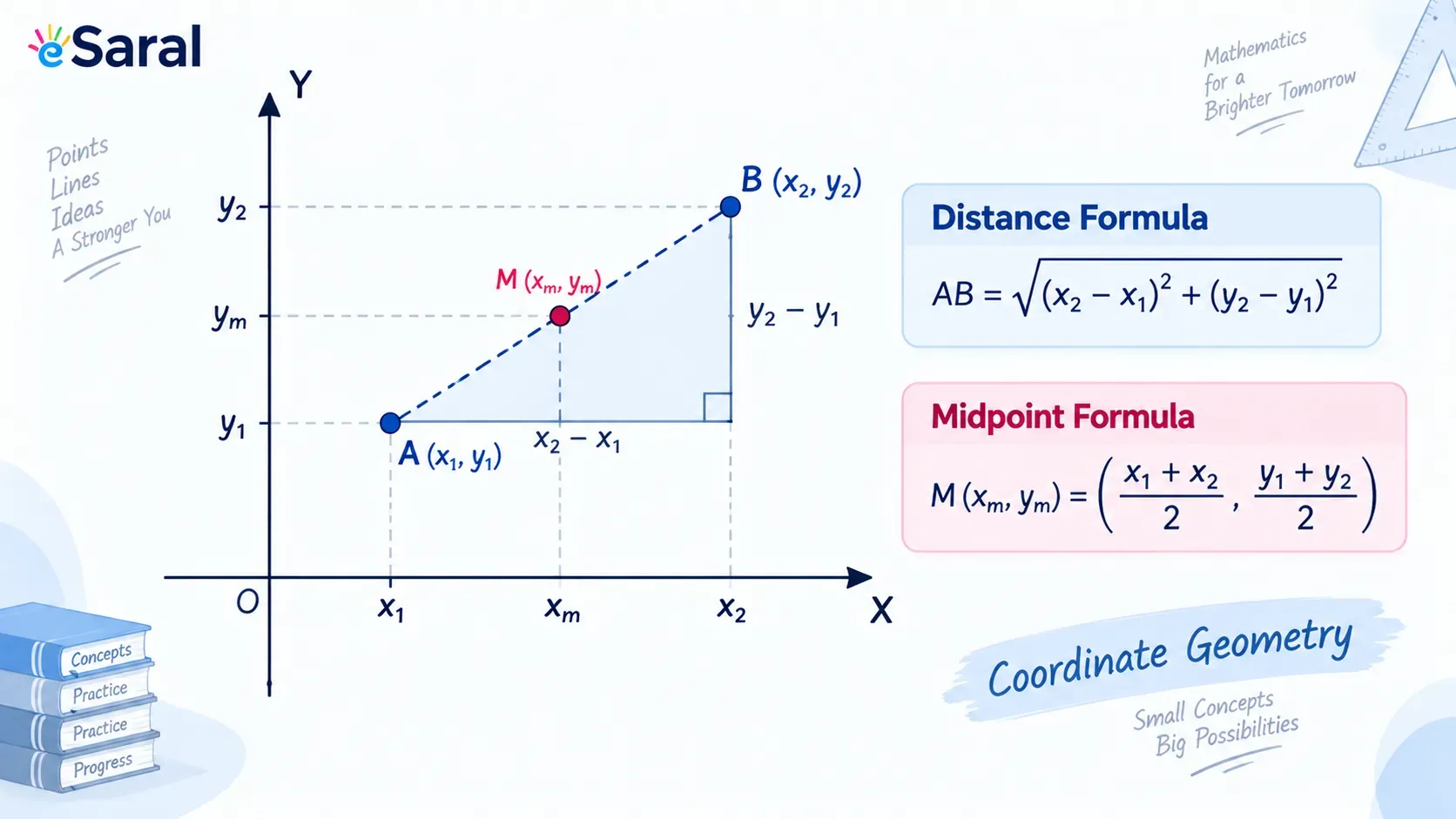
Coordinate Geometry Class 10: Formulas, Notes & Solved Examples
Coordinate geometry class 10: complete CBSE formulas — distance, section, midpoint and area of triangle — with derivation, notes and solved examples.
How to make Notes For JEE Smart Notes Strategy of an AIR 41
Learn how to make notes for JEE the way toppers do — indexing, shorthand, and smart short notes for JEE that cut revision time to just 5–7 days.
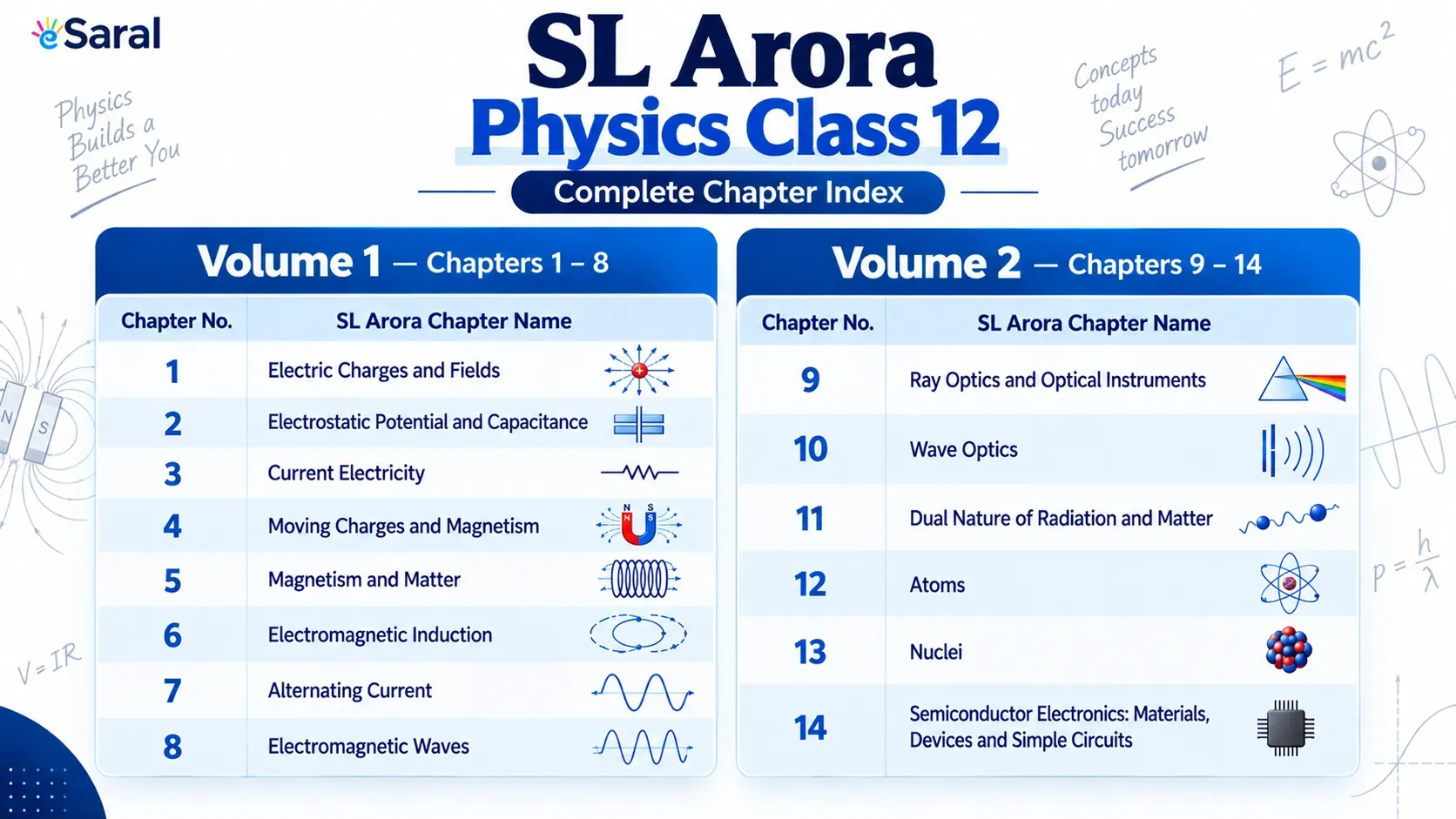
SL Arora Physics Class 12 Index – Chapter List for Volume 1 & 2
SL Arora Physics Class 12 index — complete chapter list for Volume 1 & 2, mapped to NCERT solutions for board, JEE Main, and NEET preparation.