
General Organic Chemistry - JEE Advanced Previous Year Questions with Solutions

eSaral Academic and Editorial Team
Summary
<p><strong>General Organic Chemistry JEE Advanced PYQ:</strong> Practice previous year JEE Advanced questions on resonance, inductive effect, hyperconjugation, acidity, aromaticity, and reaction mechanisms to build a strong Organic Chemistry foundation.</p>
eSaral › JEE › JEE Main ›General Organic Chemistry

🚀 Checkout eSaral Courses
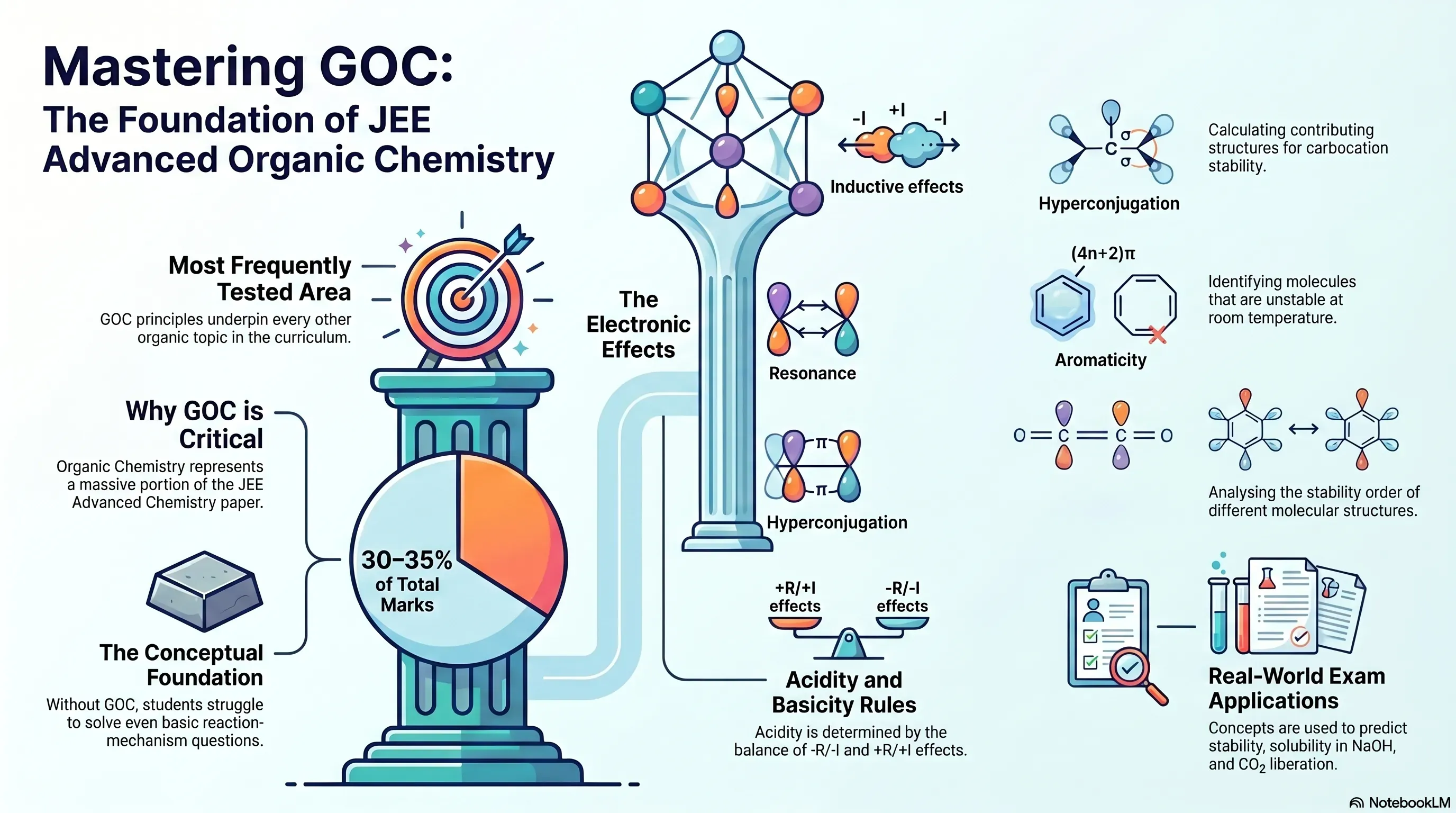
Why GOC Is Critical for JEE Advanced
General Organic Chemistry is the foundation of the entire Organic Chemistry section in JEE Advanced. Without a solid grasp of concepts like inductive effects, resonance, hyperconjugation, and aromaticity, students struggle to solve even straightforward reaction-mechanism questions in later chapters.
According to the official NTA/IIT JEE paper analysis, Organic Chemistry as a whole contributes roughly 30–35% of Chemistry marks in JEE Advanced. Within that, GOC — though a single chapter — is the most frequently tested conceptual area because its principles underpin every other organic topic.
JEE Advanced PYQs with Solutions
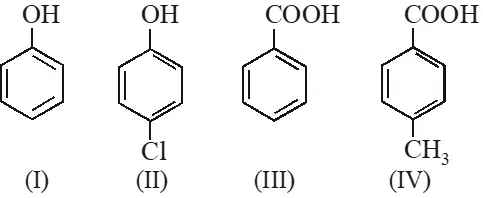
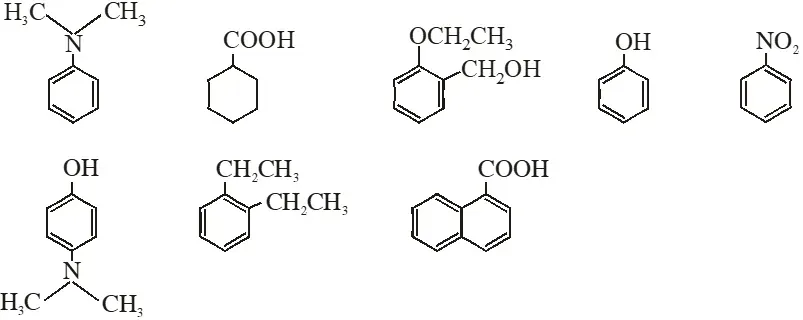
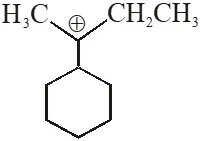
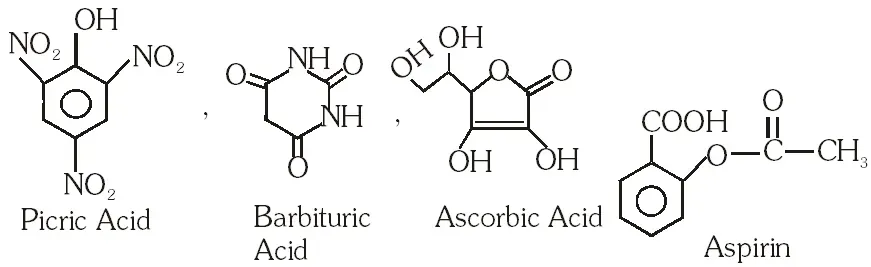
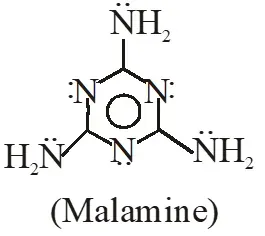
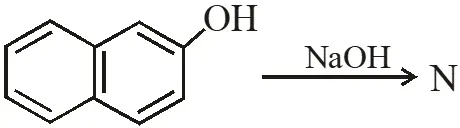
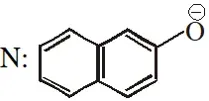
JEE Advanced Previous Year Questions of Chemistry with Solutions are available at eSaral. Practicing JEE Advanced Previous Year Papers Questions of Chemistry will help the JEE aspirants in realizing the question pattern as well as help in analyzing weak & strong areas. Simulator Previous Years JEE Advance Questions [esquestion] The correct acidity order of the following is : (A) (III) > (IV) > (II) > (I) (B) (IV) > (III) > (I) > (II) (C) (III) > (II) > (I) > (IV) (D) (II) > (III) > (IV) > (I) #tag# [IIT-JEE-2009] #sol# (A) (A) Acidity $\propto-R /-I \propto \frac{1}{+R /+I}$ [/esquestion] [esquestion] The correct stability order of the following resonance structures is #tag# [IIT-2009] #sol# (B) [/esquestion] [esquestion] Amongst the following, the total number of compounds soluble in aquesous NaOH is: #tag# [IIT-JEE-2010] #sol# 4 (4) Compound which is more acidic than water is soluble in NaOH [/esquestion] [esquestion] The total number of contributing structures showing hyperconjugation (involving C–H bonds) for the following carbocation is. #tag# [IIT-2011] #sol# 6 $6 \propto \mathrm{H}$ ore present. [/esquestion] [esquestion] Among the following compounds, the most acidic is – (A) p-nitrophenol (B) p-hydroxybenzoic acid (C) o-hydroxybenzoic acid (D) p-toluic acid #tag# [IIT-JEE-2011] #sol# (C) [/esquestion] [esquestion] Which of the following molecules, in pure from , is (are) unstable at room temperature ? #tag# [IIT-2012] #sol# (B,C) Anti - Aromatic : B,C [/esquestion] [esquestion] The carboxyl functional group (–COOH) is present in – (A) picric acid (B) barbituric acid (C) ascorbic acid (D) aspirin #tag# [IIT-JEE-2012] #sol# (D) [/esquestion] [esquestion] Identify the binary mixtures (s) that can be separated into the individual compounds, by differential extraction, as shown in the given scheme - (A) $\mathrm{C}_{6} \mathrm{H}_{5} \mathrm{OH}$ and $\mathrm{C}_{6} \mathrm{H}_{5} \mathrm{COOH}$ (B) $\mathrm{C}_{6} \mathrm{H}_{5} \mathrm{COOH}$ and $\mathrm{C}_{6} \mathrm{H}_{5} \mathrm{CH}_{2} \mathrm{OH}$ (C) $\mathrm{C}_{6} \mathrm{H}_{5} \mathrm{CH}_{2} \mathrm{OH}$ and $\mathrm{C}_{6} \mathrm{H}_{5} \mathrm{OH}$ (D) $\mathrm{C}_{6} \mathrm{H}_{5} \mathrm{CH}_{2} \mathrm{OH}$ and $\mathrm{C}_{6} \mathrm{H}_{5} \mathrm{CH}_{2} \mathrm{COOH}$ #tag# [IIT-JEE-2012] #sol# (B,D) [/esquestion] [esquestion] The hyperconjugative stbilities of tert-butyl cation and 2-butene, respectively, are due to – (A) $\sigma \rightarrow \mathrm{p}$ (empty) and $\sigma \rightarrow \pi$ electron delocalisations (B) $\sigma \rightarrow \sigma$ and $\sigma \rightarrow \pi$ electron delocalisations (C) $\sigma \rightarrow \mathrm{p}(\text { filled })$ and $\sigma \rightarrow \pi$ electron delocalisations (D) $\mathrm{p}$ (filled) $\rightarrow \sigma$ and $\sigma \rightarrow \pi$ electron delocalisations #tag# [IIT-2013] #sol# (A) [/esquestion] [esquestion] The total number of lone-pairs of electrons in melamine is - #tag# [IIT-2013] #sol# 6 [/esquestion] [esquestion] The compound that does NOT liberate $\mathrm{CO}_{2}$, on treatment with aqueous sodium bicarbonate solution, is – (A) Benzoic acid (B) Benzenesulphonic acid (C) Salicylic acid (D) Carbolic acid (phenol) #tag# [JEE-ADVANCED-2013] #sol# (D) (D) Compound which is more acidic than $\mathrm{H}_{2} \mathrm{CO}_{3}$ liberate $\mathrm{CO}_{2}$ gas. [/esquestion] [esquestion] Hydrogen bonding plays a central role in the following phenomena (A) Ice floats in water (B) Higher Lewis basicity of primary amines than tertiary amines in aqueous solutions (C) Formic acid is more acidic than acetic acid (D) Dimerisation of acetic acid in benzene #tag# [JEE-ADVANCED-2014] #sol# (A,B,D) [/esquestion] [esquestion] The number of resonance structures for N is : #tag# [IIT-2015] #sol# 9 [/esquestion]



After working through General Organic Chemistry - JEE Advanced PYQs (Chemistry), test your concepts in complete timed papers from the JEE Advanced exam paper.
Frequently Asked Questions
How many questions from General Organic Chemistry appear in JEE Advanced each year?
GOC typically contributes 2–4 questions per JEE Advanced paper. The exact number varies by year, but the chapter has appeared consistently since 2009. Because each GOC question is often high in marks (3–4 marks), even one well-prepared concept can shift your rank significantly.
Is GOC asked in JEE Main as well as JEE Advanced?
Yes. GOC appears in both JEE Main and JEE Advanced, but JEE Advanced questions are more application-heavy and often test two or three concepts in a single question — for example, combining resonance with acidity order in one MCQ.
What is the fastest way to learn acidity order for JEE Advanced?
Start by memorising the four effect types (inductive, resonance, ortho, field), then practise ranking acids by asking: which effect dominates, and does it stabilise or destabilise the conjugate base? Solving 20–30 ranked acidity problems from previous year papers builds the required intuition quickly.
How do you count hyperconjugative structures for a carbocation?
Count the total number of α-hydrogen atoms — that is, every C–H bond on a carbon directly bonded to the carbocation centre. Each α-hydrogen contributes exactly one hyperconjugative (no-bond resonance) structure. For the tert-butyl cation, there are 9 α-hydrogens and thus 9 hyperconjugative structures
Why is phenol not soluble in NaHCO₃ solution?
Phenol (pKa ≈ 10) is a weaker acid than carbonic acid (pKa₁ ≈ 6.35). A compound can displace CO₂ from NaHCO₃ only if it is a stronger acid than H₂CO₃. Since phenol cannot donate a proton to HCO₃⁻ in a thermodynamically favourable reaction, it does not dissolve in NaHCO₃.
Team eSaral
eSaral Academic and Editorial Team
Team eSaral is the collective author profile for educational content created by eSaral’s teachers and academic contributors. The team draws on expertise from IIT graduates, doctors, experienced educators and subject specialists to develop resources for JEE, NEET and school students. Our articles aim to explain concepts clearly and help students study with confidence.
Related Posts
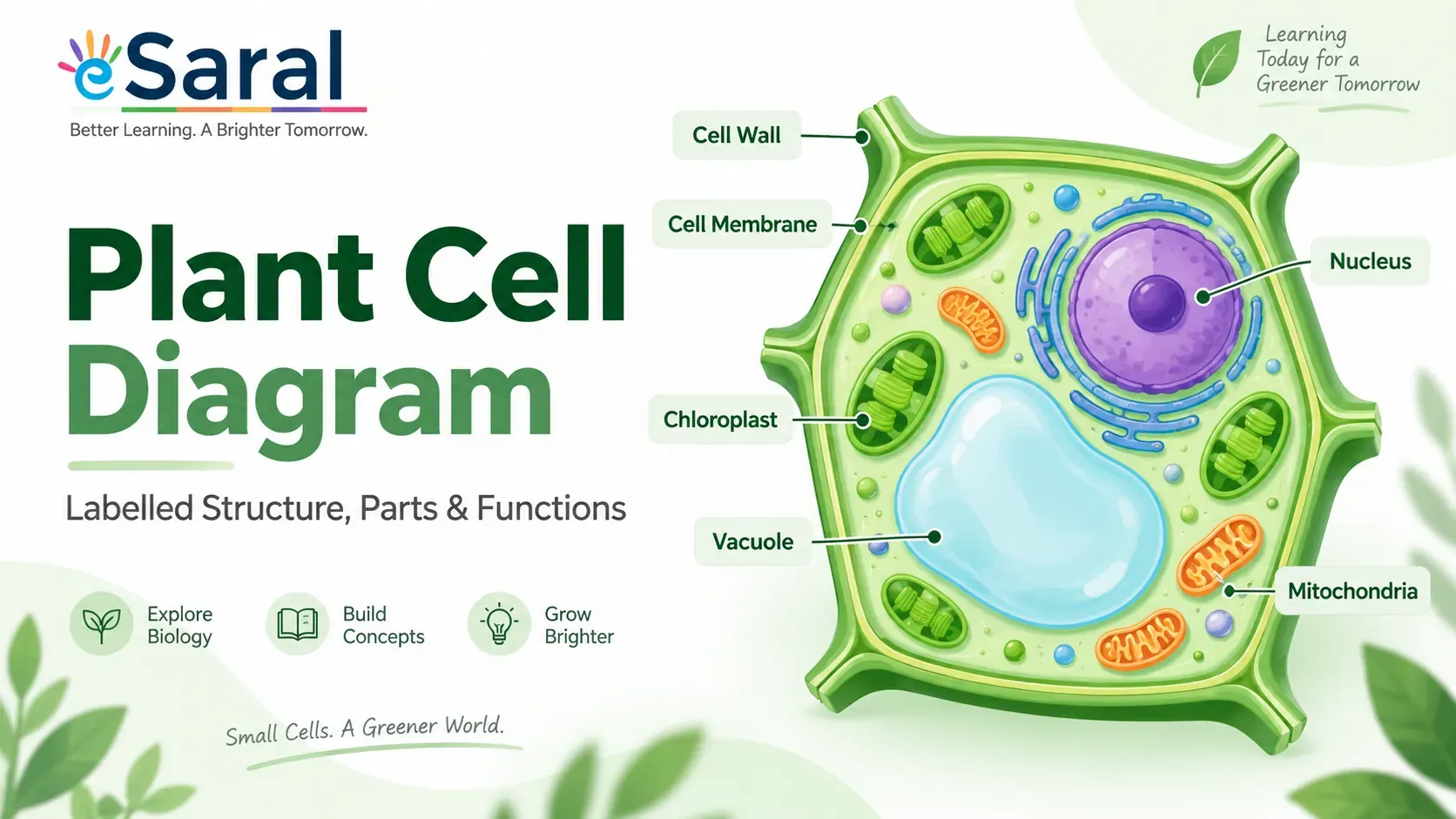
Plant Cell Diagram: Labelled Structure, Parts and Functions
Simple, labelled plant cell diagram with parts and functions. Covers plant cell structure for Class 6, 7, 8, 9, 10 and 11 students, CBSE-aligned.
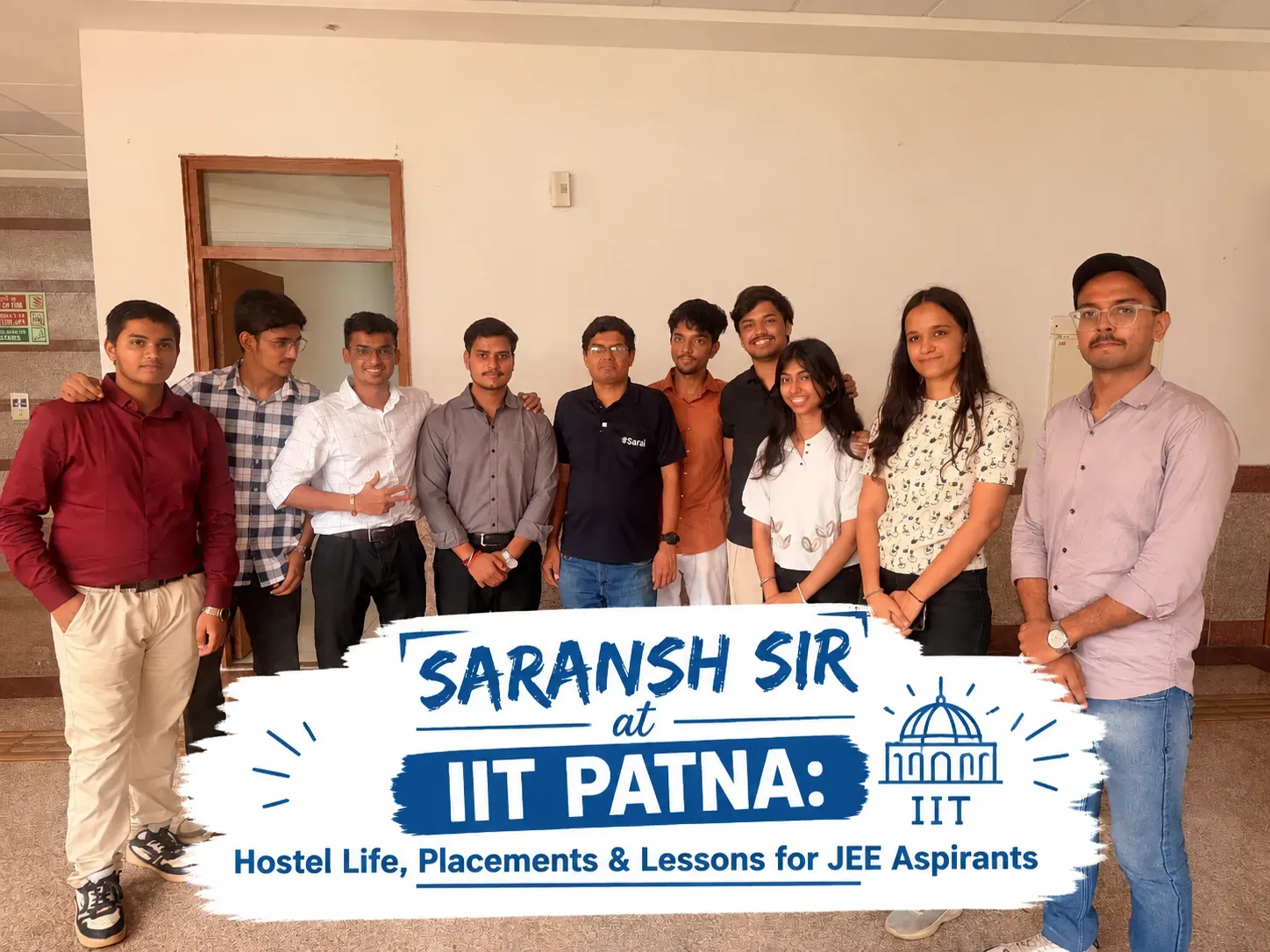
Saransh Gupta Sir's Visit to IIT Patna: Hostel Life, Placements & Lessons for JEE Aspirants
Inside Saransh Gupta Sir's IIT Patna visit — hostel life, the library, placements, internships, and real advice for JEE aspirants from students living the IIT dream.
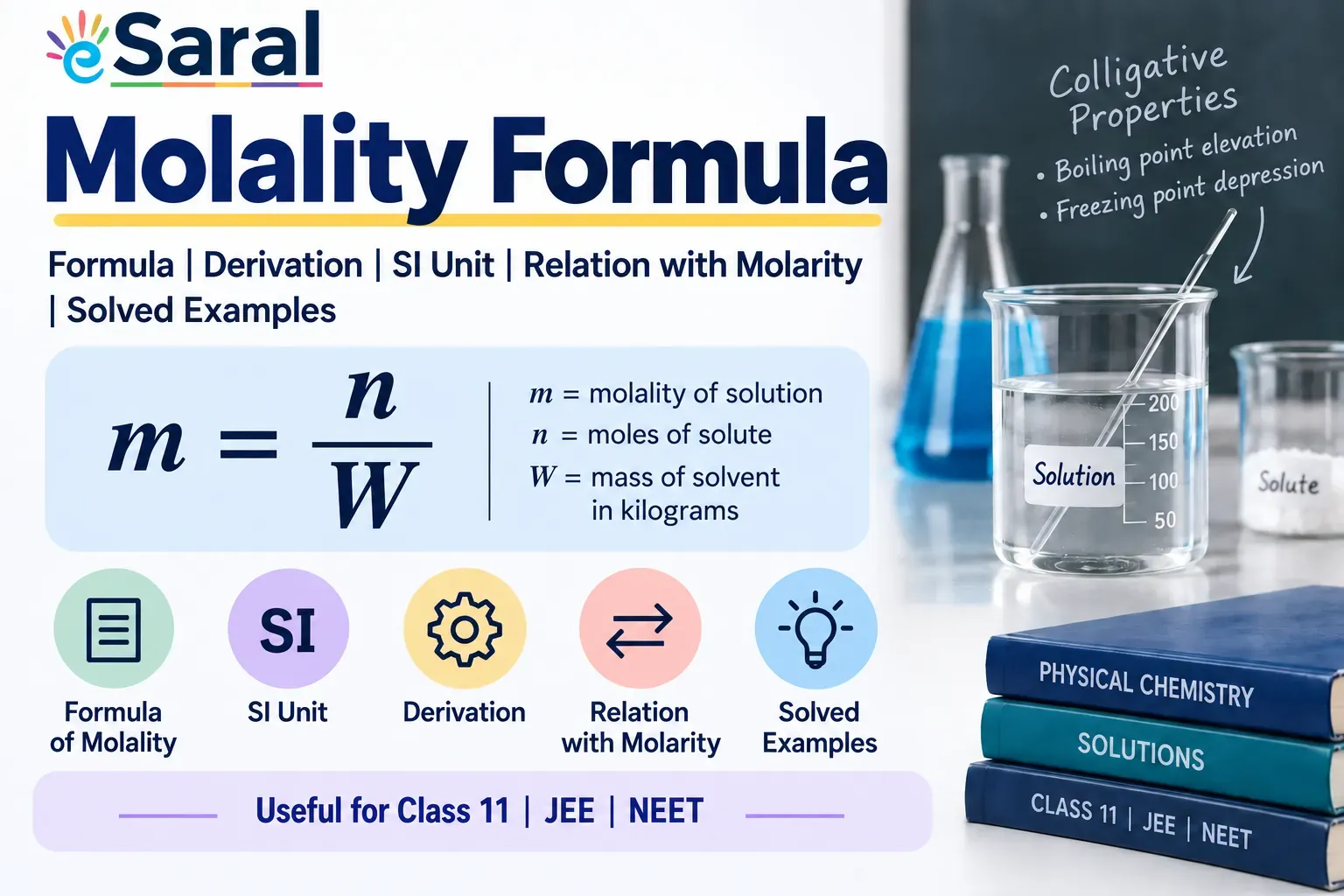
Molality Formula: Formula for Molality, Derivation & Solved Examples
Molality formula is $m = \dfrac{n}{W}$. Learn the formula of molality, its SI unit, derivation, relation with molarity, and solved examples for Class 11, JEE and NEET.
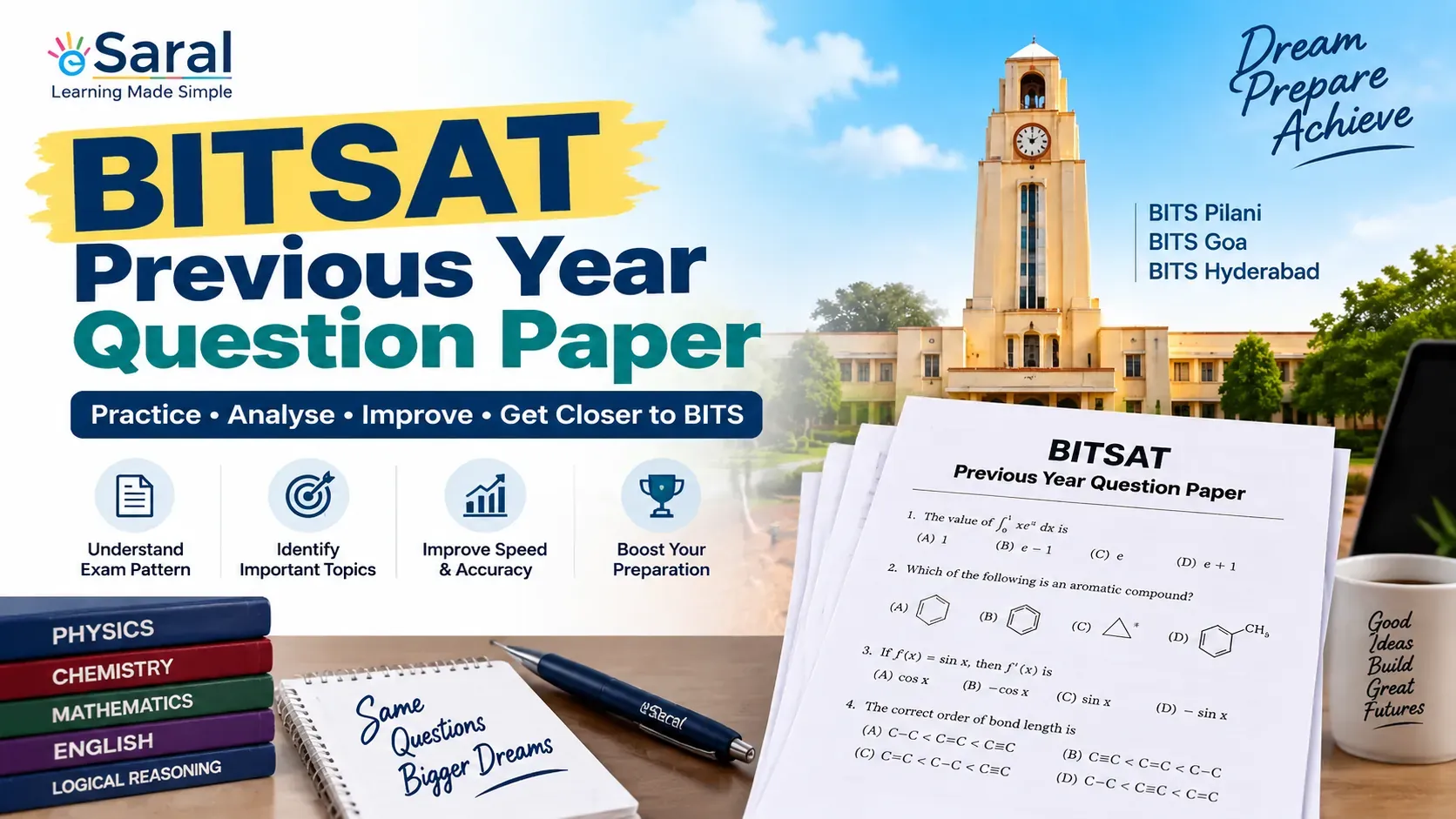
BITSAT Previous Year Question Paper PDF
Download BITSAT previous year question papers PDF. Get year-wise BITSAT PYQs, memory-based papers, exam pattern, and preparation tips to improve your BITSAT preparation.

Teachers’ Day 2026 at eSaral Gurukul: Celebrating the Bond Between Students, Teachers & Mentors
See how Teachers’ Day 2026 was celebrated at eSaral Gurukul, reflecting the bond among students, teachers, and mentors, and the role of guidance beyond academics.
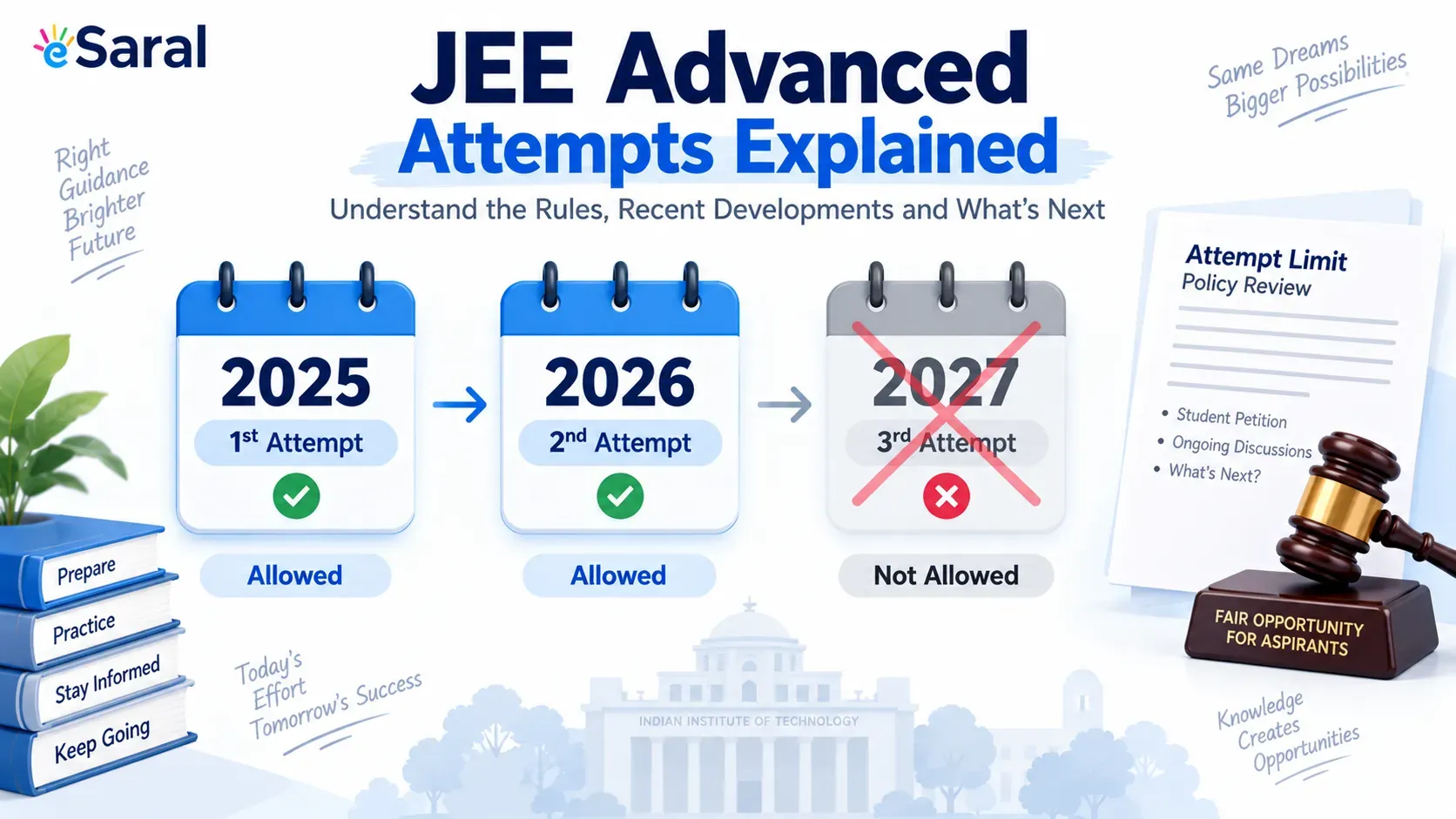
JEE Advanced Attempts: Can You Give It a Third Time? Rules Explained
JEE Advanced attempts: current rule is 2 consecutive years only: full eligibility criteria, the 2025 third-attempt controversy, and the latest 2026 petition news.
Best JEE Preparation App
Best JEE preparation app for Main & Advanced: AI mock tests, live doubt-solving, thousands of practice questions. JEE preparation app for droppers & Class 11-12.
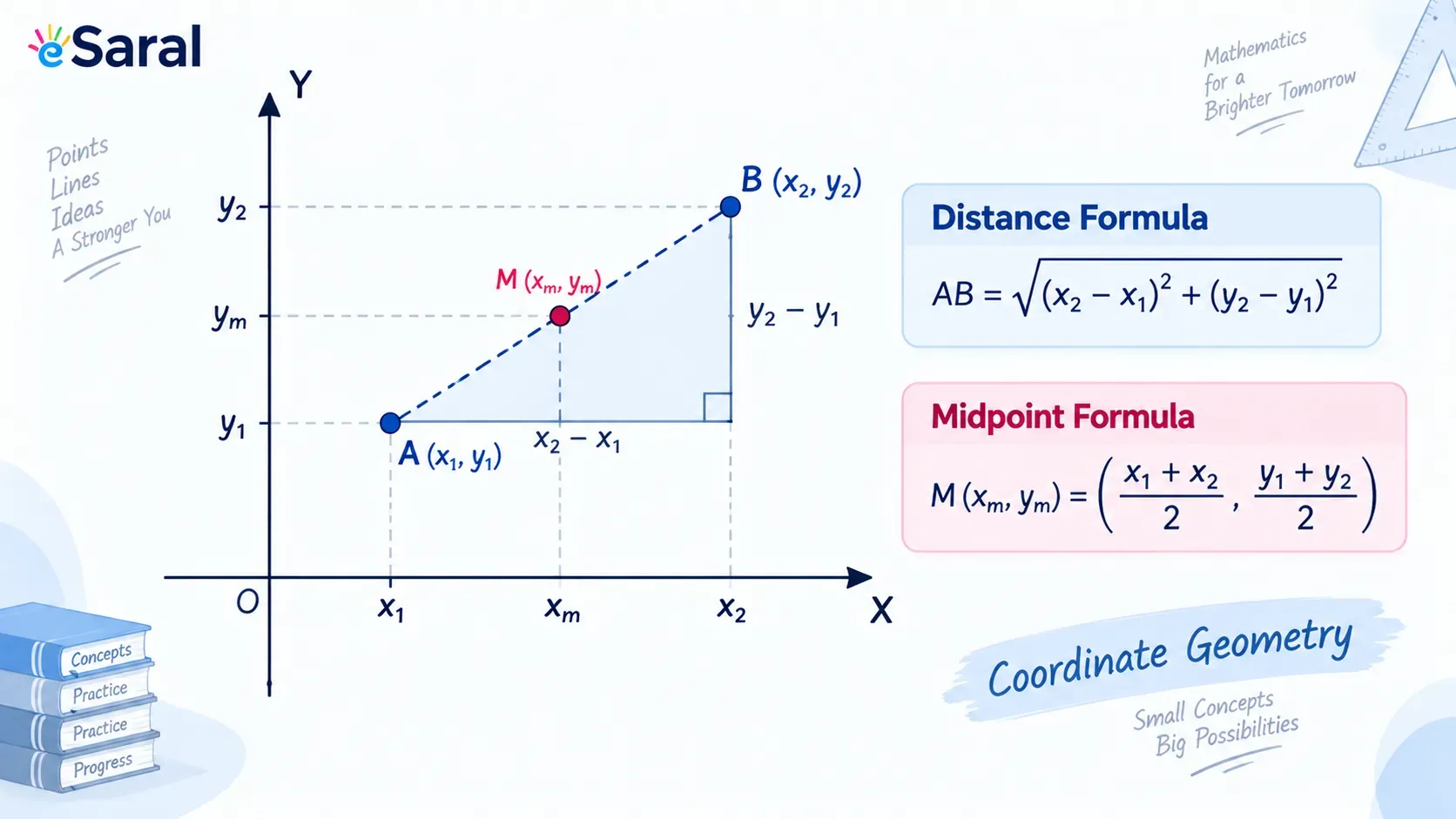
Coordinate Geometry Class 10: Formulas, Notes & Solved Examples
Coordinate geometry class 10: complete CBSE formulas — distance, section, midpoint and area of triangle — with derivation, notes and solved examples.
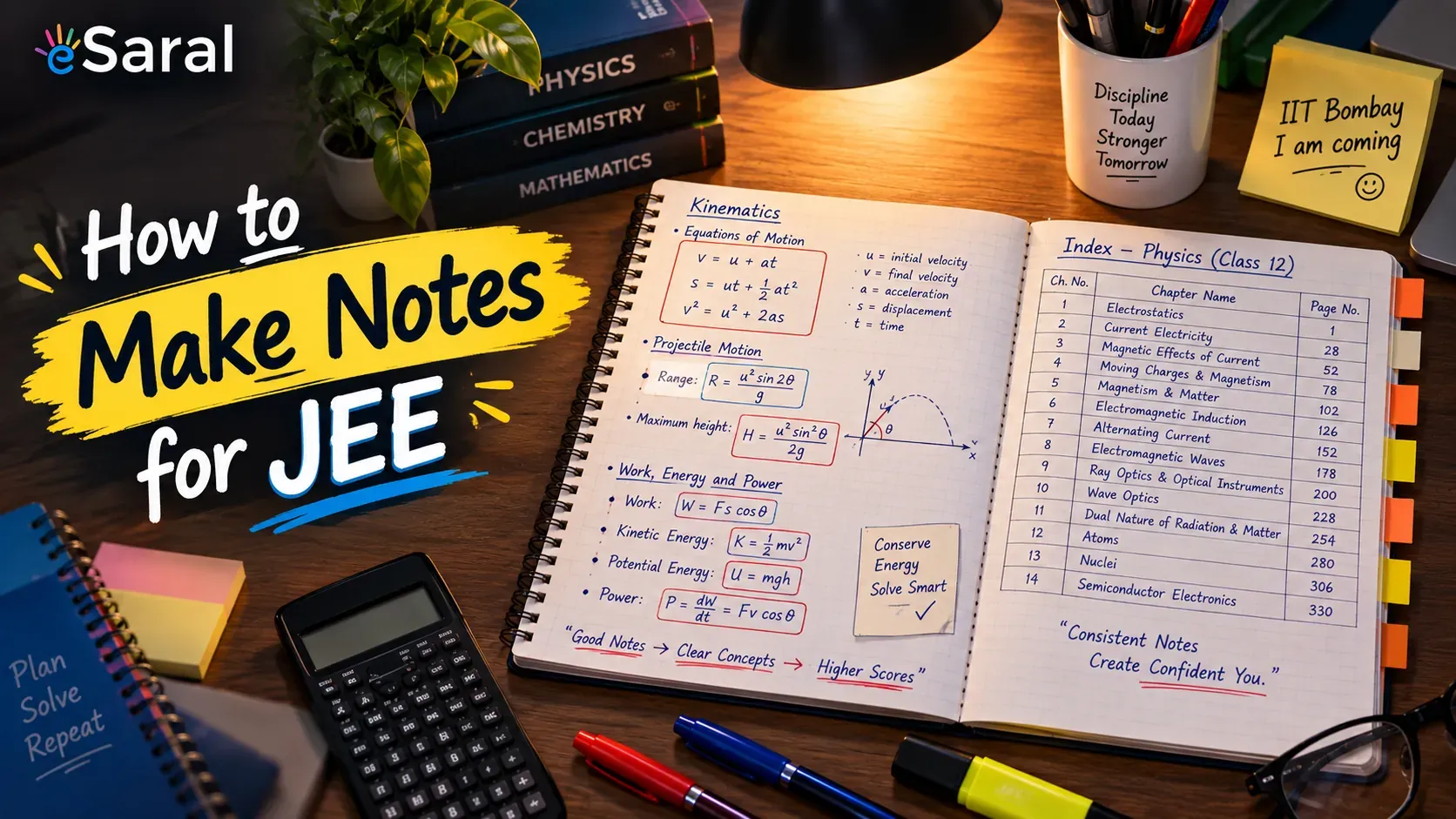
How to make Notes For JEE Smart Notes Strategy of an AIR 41
Learn how to make notes for JEE the way toppers do — indexing, shorthand, and smart short notes for JEE that cut revision time to just 5–7 days.
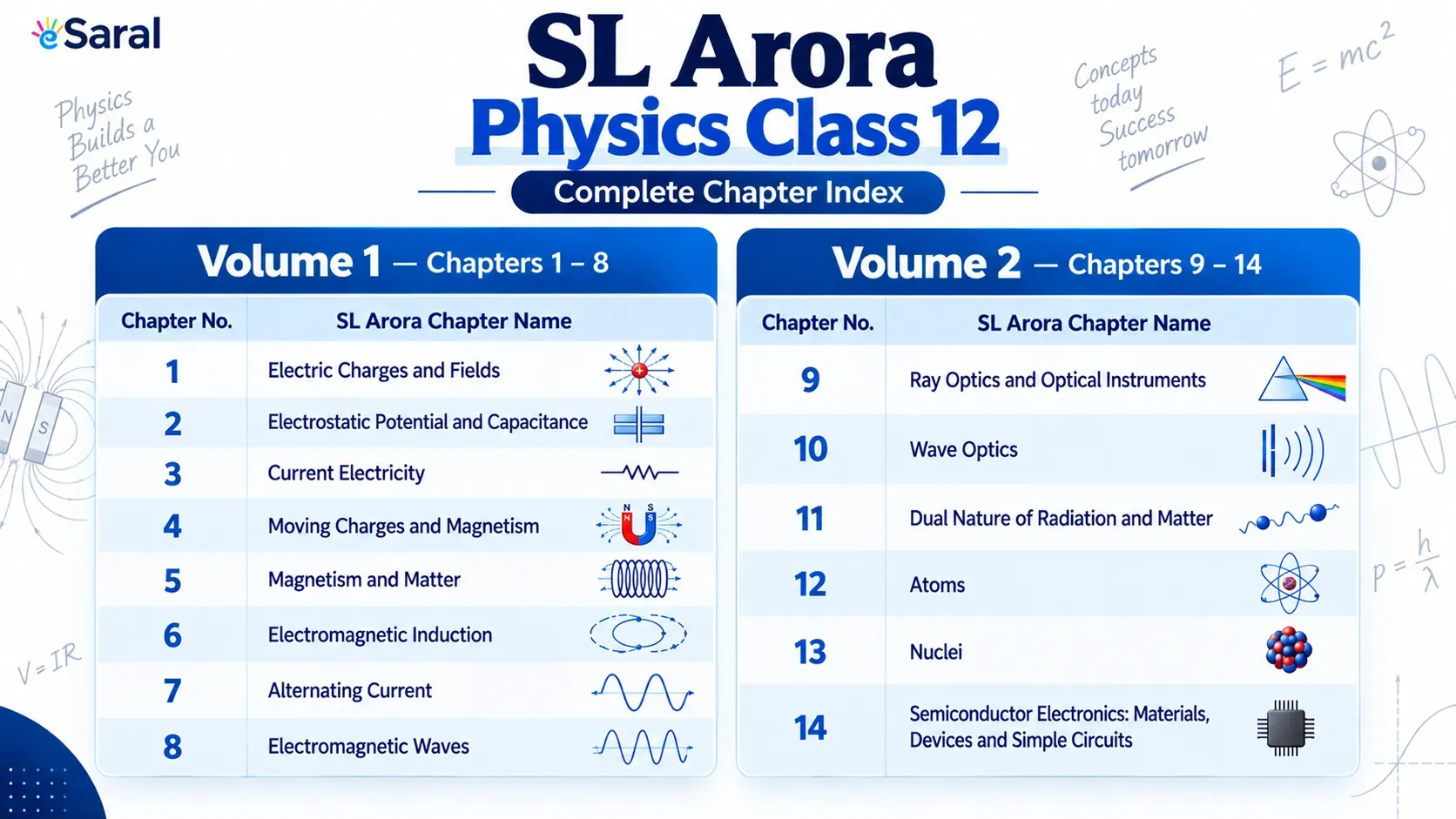
SL Arora Physics Class 12 Index – Chapter List for Volume 1 & 2
SL Arora Physics Class 12 index — complete chapter list for Volume 1 & 2, mapped to NCERT solutions for board, JEE Main, and NEET preparation.