
Heat Transfer - JEE Main Previous Year Questions with Solutions

eSaral Academic and Editorial Team
Summary
<p><strong>Heat Transfer – JEE Main Previous Year Questions</strong> features exam-focused problems on conduction, radiation, Newton’s law of cooling, temperature variation, and heat flow in composite systems, helping students master the most frequently tested concepts in JEE Main Thermal Physics.</p>
eSaral › JEE › JEE Main ›Heat Transfer - JEE Main Previous Year Questions with Solutions

🚀 Checkout eSaral Courses
What Is Heat Transfer and Why Does It Matter for JEE Main?
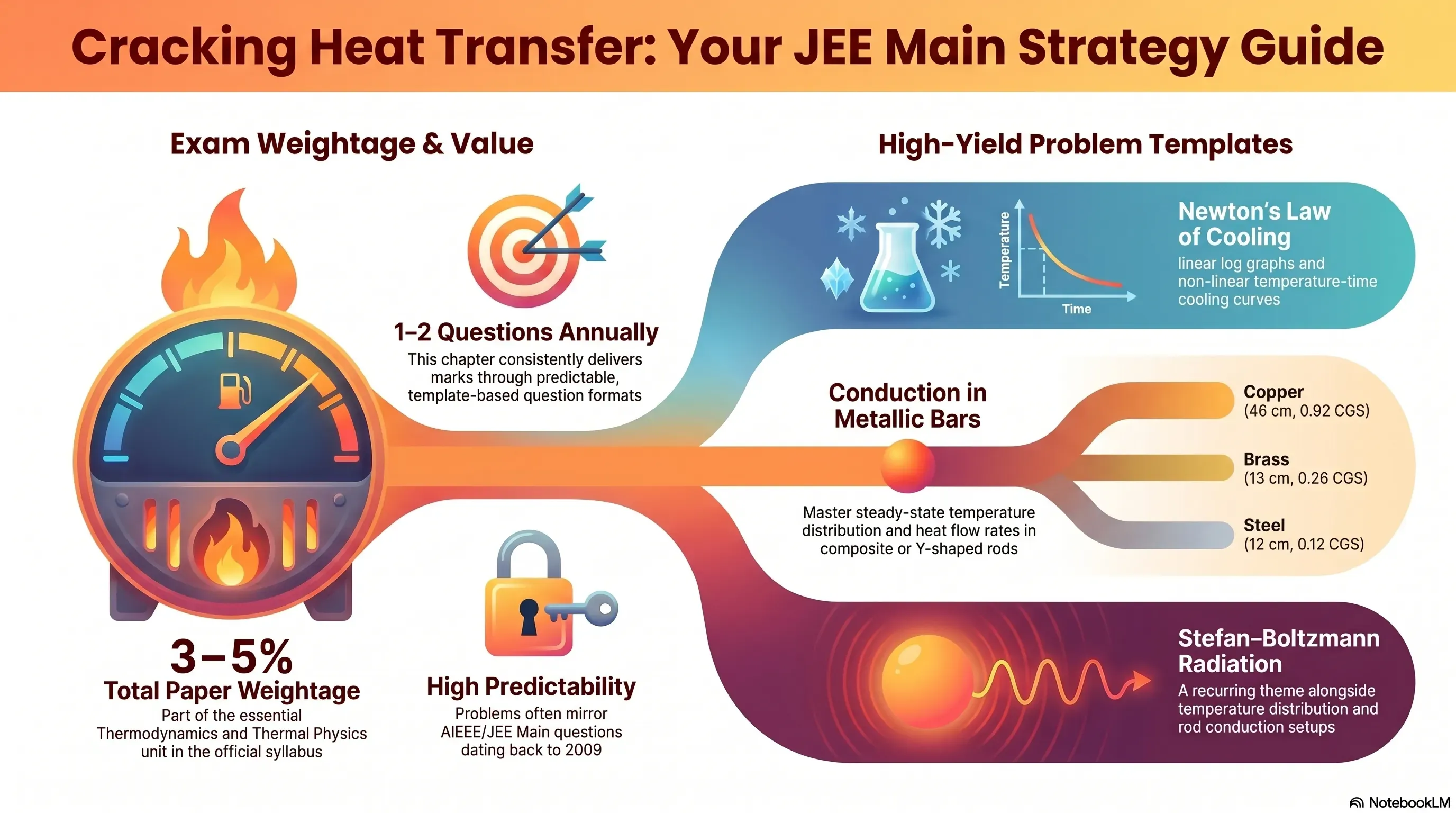
Heat Transfer is a chapter from Class 11 Physics (Chapter 11 — Thermal Properties of Matter) that consistently delivers 1–2 questions in JEE Main every year. According to NTA's official syllabus, the chapter is part of the Thermodynamics and Thermal Physics unit, which carries roughly 3–5% of the total paper weightage.
What makes this chapter valuable for JEE Main preparation is the predictability of its questions. NTA has returned repeatedly to four themes: temperature distribution along conducting rods, Newton's law of cooling graphs, Stefan–Boltzmann radiation problems, and composite-rod (series/parallel) conduction setups. A student who has worked through every previous year question from AIEEE 2009 onwards will recognise the template of almost every new question that appears.
Heat Transfer JEE Main Previous Year Questions & Solutions
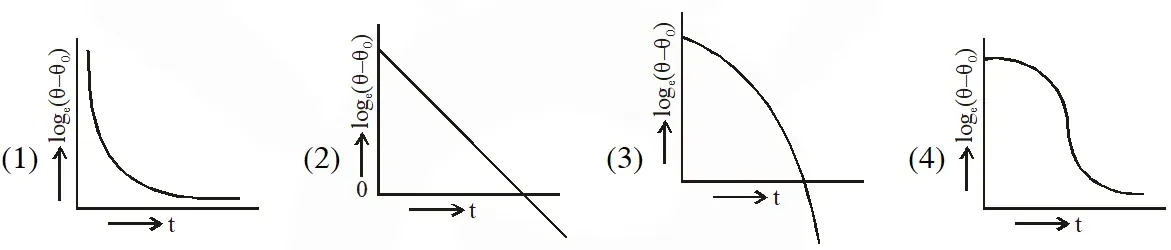
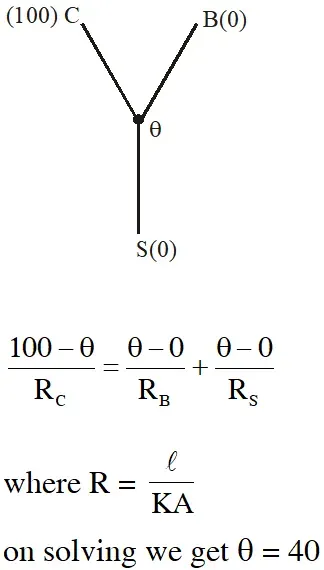
Download eSaral app for free study material and video tutorials. Simulator Previous Years AIEEE/JEE Mains Questions [esquestion] A long metallic bar is carrying heat from one of its ends to the other end under steady-state. The variation of temperature $\theta$ along the length x of the bar from its hot end is best described by which of the following figures ? #tag# [AIEEE - 2009] #sol# (4) The heat flow rate is given by $\frac{d Q}{d t}=\frac{k A\left(\theta_{1}-\theta\right)}{x}$ $\Rightarrow \theta=\theta_{1}-\frac{x}{k A} \frac{d Q}{d t}$ where $\theta_{1}$ is the temp of hot end and $\theta$ is temp at a distance x from hot end. [/esquestion] [esquestion] A liquid in a beaker has temperature $\theta(\mathrm{t})$ at time t and $\theta_{0}$ is temperature of surroundings, then according to Newton's law of cooling the correct graph between $\log _{\mathrm{e}}\left(\theta-\theta_{0}\right)$ and t is :- #tag# [AIEEE 2012] #sol# (2) Newtons law of cooling $\frac{d \theta}{d t}=-k\left(\theta-\theta_{0}\right)$ $\Rightarrow \frac{d \theta}{\left(\theta-\theta_{0}\right)}=-k d t$ Integrating $\ln \left(\theta-\theta_{0}\right)=-k t+C$ [/esquestion] [esquestion] If a piece of metal is heated to temperature $\theta$ and then allowed to cool in a room which is at temperature $\theta_{0}$ the graph between the temperature T of the metal and time t will be closed to: #tag# [JEE-Main- 2013] #sol# (3) According to Newtons law of cooling, The temp goes on decreasing with time non-linearly. [/esquestion] [esquestion] Three rods of Copper, Brass and Steel are welded together to form a Y-shaped structure. Area of cross-section of each rod = $4 \mathrm{cm}^{2}$. End of copper rod is maintained at $100^{\circ} \mathrm{C}$ where as ends of brass and steel are kept at $0^{\circ} \mathrm{C}$. Lengths of the copper, brass and steel rods are 46, 13 and 12 cms respectively. The rods are thermally insulated from surroundings except at ends. Thermal conductivities of copper, brass and steel are 0.92, 0.26 and 0.12 CGS units respectively. Rate of heat flow through copper rod is : (1) 4.8 cal/s (2) 6.0 cal/s (3) 1.2 cal/s (4) 2.4 cal/s #tag# [JEE-Main-2014] #sol# (1) Heat flow per unit time through copper rod $=\frac{(100-40)}{\ell_{\mathrm{c}}}\left(\mathrm{K}_{\mathrm{c}} \mathrm{A}_{\mathrm{c}}\right)$ $=\frac{60}{46} \times 0.92 \times 4$ $=4.8 \mathrm{cal} / \mathrm{s}$ [/esquestion]


For Heat Transfer and other Physics topics, the JEE Mains PYQ chapter wise page provides chapter-wise questions for focused practice.
For a true exam simulation, pair this Heat Transfer practice with our JEE Main previous year question paper, which has complete papers from past sessions.
Frequently Asked Questions
How many questions come from Heat Transfer in JEE Main each year?
NTA typically sets 1–2 questions from Heat Transfer in JEE Main. The chapter is part of the broader Thermal Physics unit, which contributes 3–5 questions in total. Based on the pattern from 2009 to 2024, at least one question every year involves either a Newton's law of cooling graph or a conduction rod calculation.
Is Heat Transfer important for JEE Advanced as well?
Yes. JEE Advanced tests Heat Transfer at a deeper level, often combining it with thermodynamic processes. Problems may involve Wien's law, emissivity comparisons, or multi-mode heat transfer. Students aiming for IIT ranks should understand the Stefan–Boltzmann derivation and be able to apply it under time pressure.
What is the formula for Newton's law of cooling and how is it derived?
Newton's law of cooling states dθ/dt = −k(θ − θ₀), where θ is the body's temperature, θ₀ is the surroundings' temperature, and k is a positive constant. It is derived as a limiting case of Stefan's radiation law when the temperature difference is small. Integrating gives ln(θ − θ₀) = −kt + C, so temperature falls exponentially toward θ₀.
How do I solve composite rod problems (series and parallel) quickly?
For rods in series, the total thermal resistance is R_total = R₁ + R₂ + … and heat current (dQ/dt) is the same through all rods. For rods in parallel, the total conductance is the sum of individual conductances (kA/L), and the temperature difference is the same across all rods. Always draw the thermal circuit before writing equations.
Which graph appears most often in JEE Main Heat Transfer questions?
The ln(θ − θ₀) versus time graph from Newton's law of cooling appears most frequently — it has appeared in AIEEE 2012 and in multiple JEE Main sessions since. The second most common is the temperature versus distance graph for a conducting rod under steady state. Both have appeared at least five times between 2009 and 2026.
Team eSaral
eSaral Academic and Editorial Team
Team eSaral is the collective author profile for educational content created by eSaral’s teachers and academic contributors. The team draws on expertise from IIT graduates, doctors, experienced educators and subject specialists to develop resources for JEE, NEET and school students. Our articles aim to explain concepts clearly and help students study with confidence.
Related Posts
Plant Cell Diagram: Labelled Structure, Parts and Functions
Simple, labelled plant cell diagram with parts and functions. Covers plant cell structure for Class 6, 7, 8, 9, 10 and 11 students, CBSE-aligned.
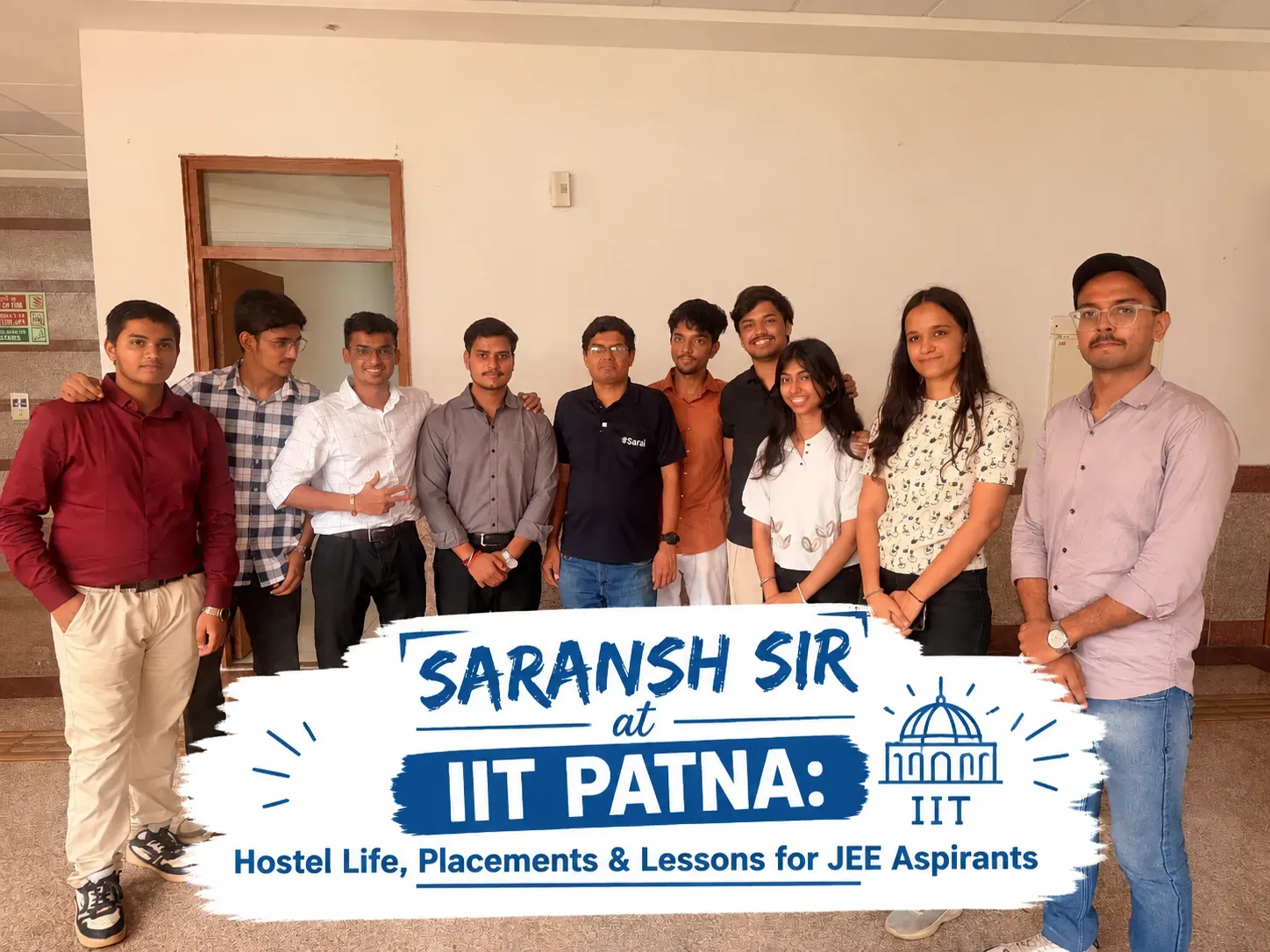
Saransh Gupta Sir's Visit to IIT Patna: Hostel Life, Placements & Lessons for JEE Aspirants
Inside Saransh Gupta Sir's IIT Patna visit — hostel life, the library, placements, internships, and real advice for JEE aspirants from students living the IIT dream.
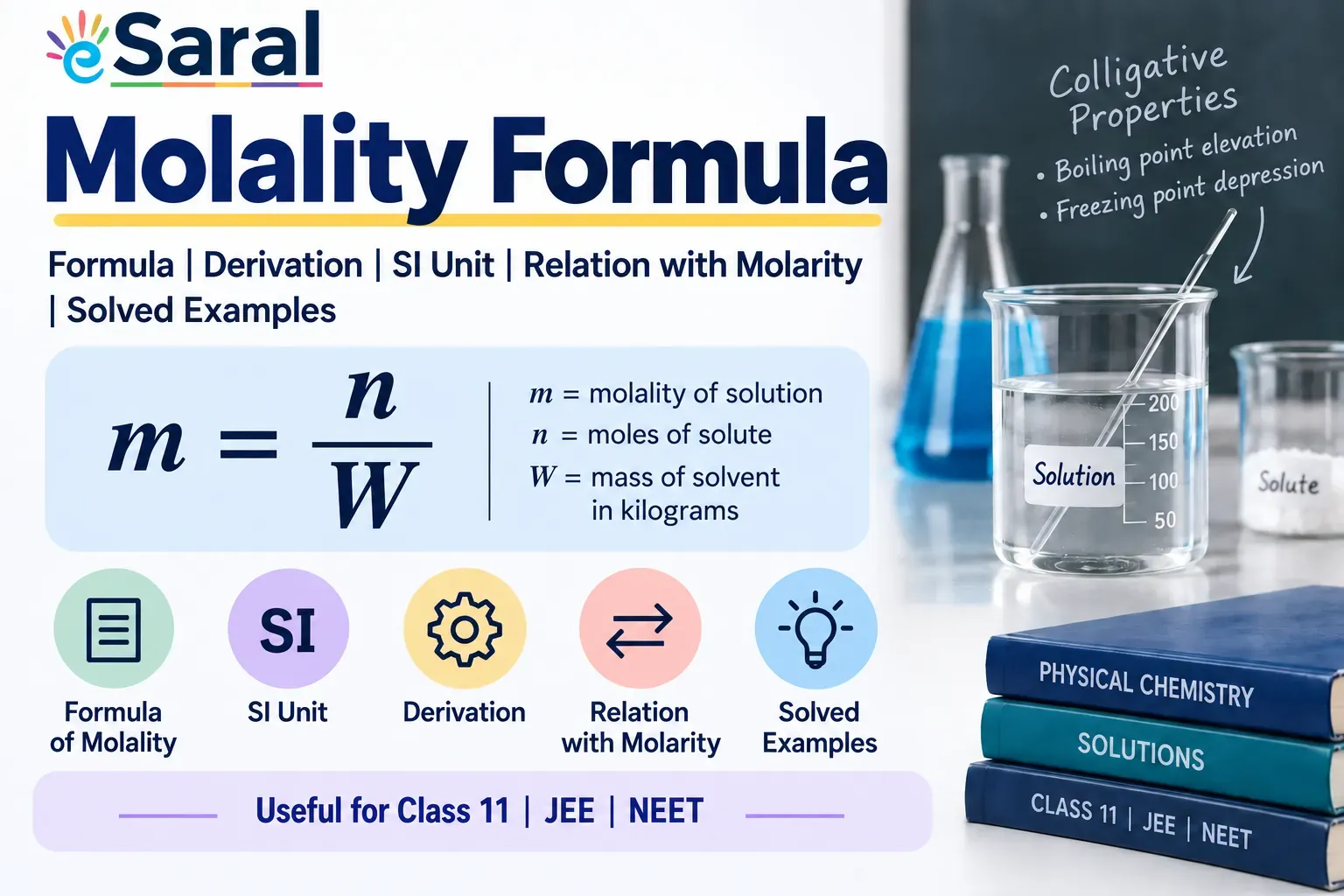
Molality Formula: Formula for Molality, Derivation & Solved Examples
Molality formula is $m = \dfrac{n}{W}$. Learn the formula of molality, its SI unit, derivation, relation with molarity, and solved examples for Class 11, JEE and NEET.
BITSAT Previous Year Question Paper PDF
Download BITSAT previous year question papers PDF. Get year-wise BITSAT PYQs, memory-based papers, exam pattern, and preparation tips to improve your BITSAT preparation.

Teachers’ Day 2026 at eSaral Gurukul: Celebrating the Bond Between Students, Teachers & Mentors
See how Teachers’ Day 2026 was celebrated at eSaral Gurukul, reflecting the bond among students, teachers, and mentors, and the role of guidance beyond academics.
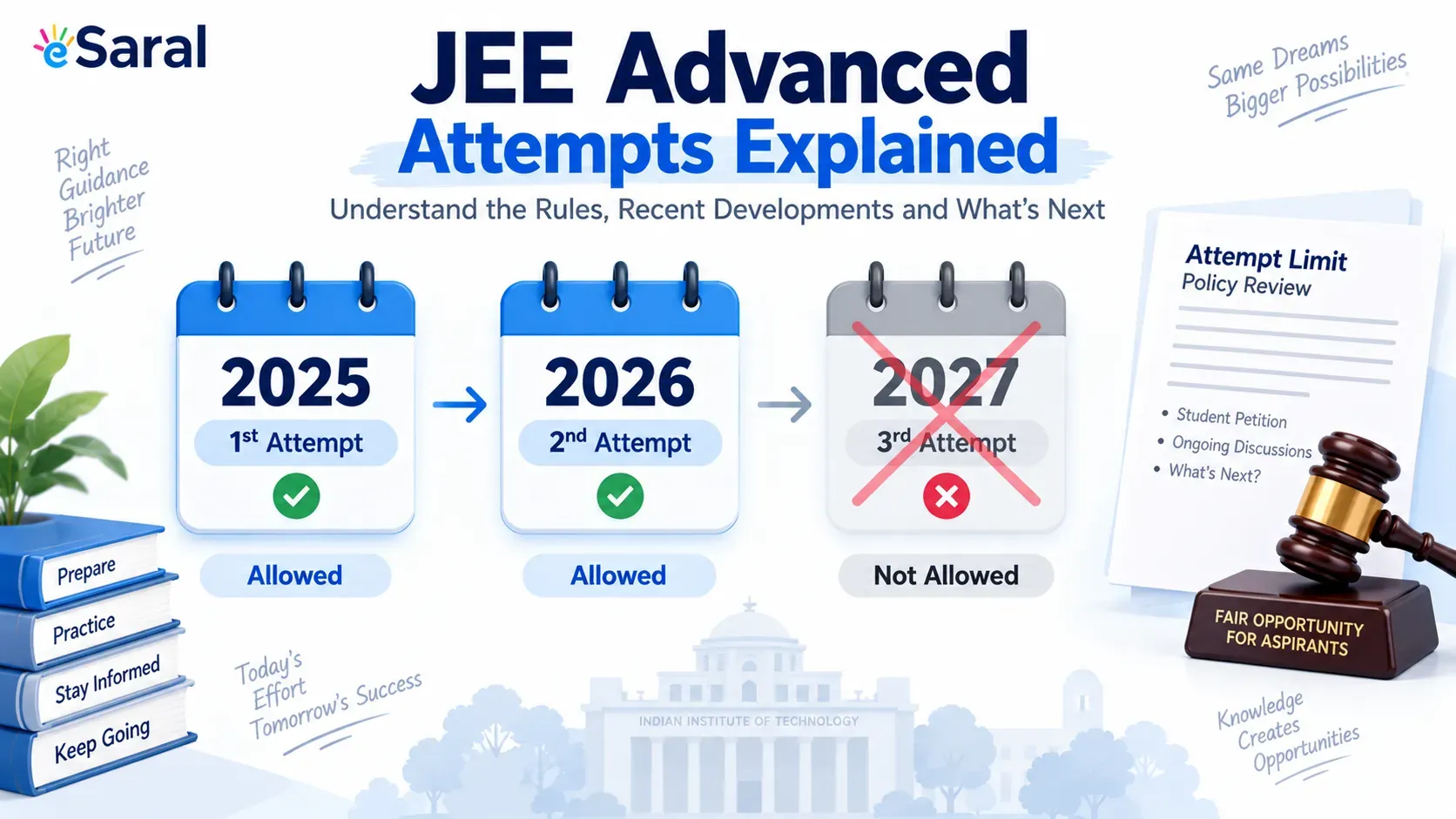
JEE Advanced Attempts: Can You Give It a Third Time? Rules Explained
JEE Advanced attempts: current rule is 2 consecutive years only: full eligibility criteria, the 2025 third-attempt controversy, and the latest 2026 petition news.

Best JEE Preparation App
Best JEE preparation app for Main & Advanced: AI mock tests, live doubt-solving, thousands of practice questions. JEE preparation app for droppers & Class 11-12.
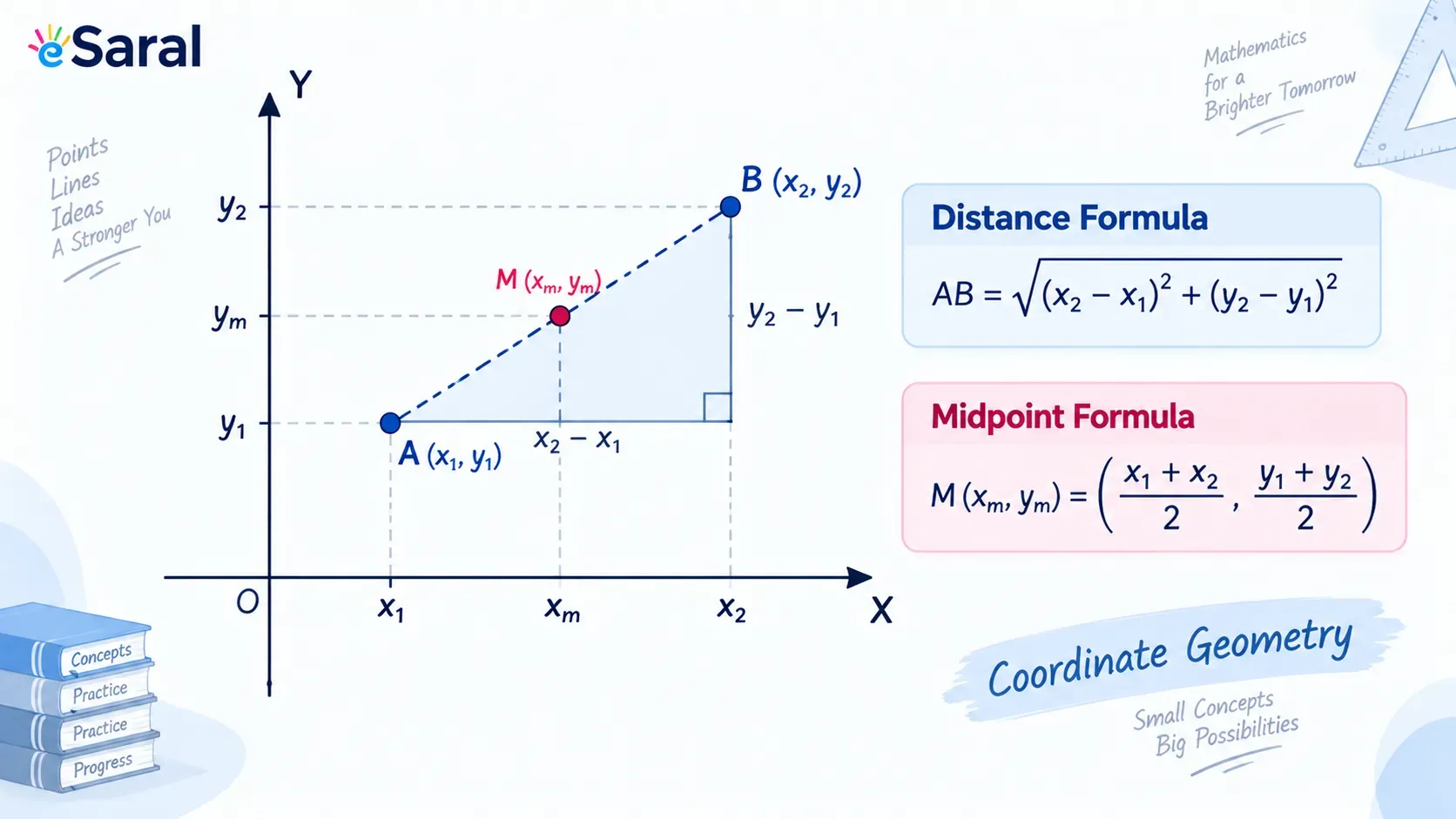
Coordinate Geometry Class 10: Formulas, Notes & Solved Examples
Coordinate geometry class 10: complete CBSE formulas — distance, section, midpoint and area of triangle — with derivation, notes and solved examples.
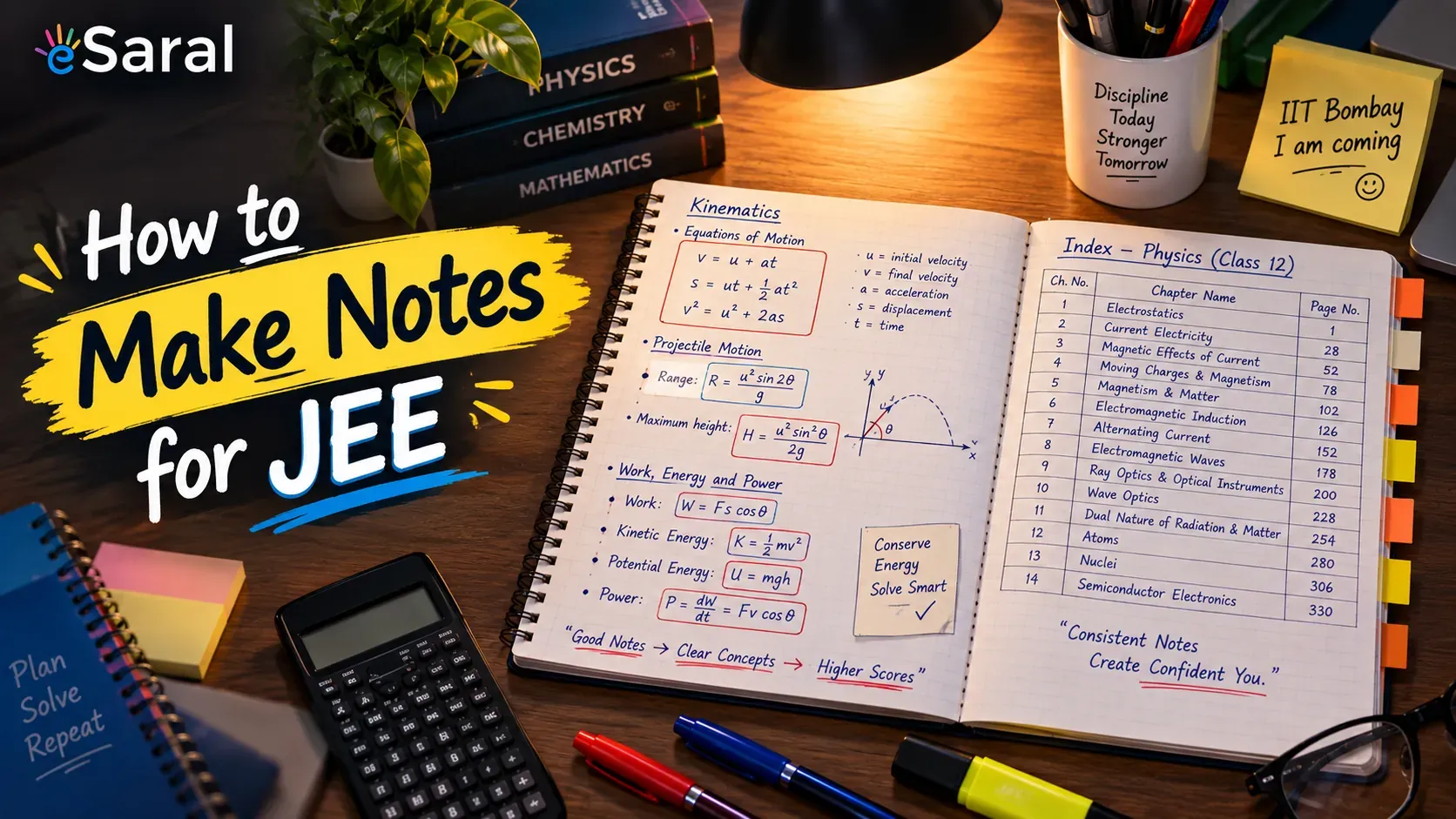
How to make Notes For JEE Smart Notes Strategy of an AIR 41
Learn how to make notes for JEE the way toppers do — indexing, shorthand, and smart short notes for JEE that cut revision time to just 5–7 days.
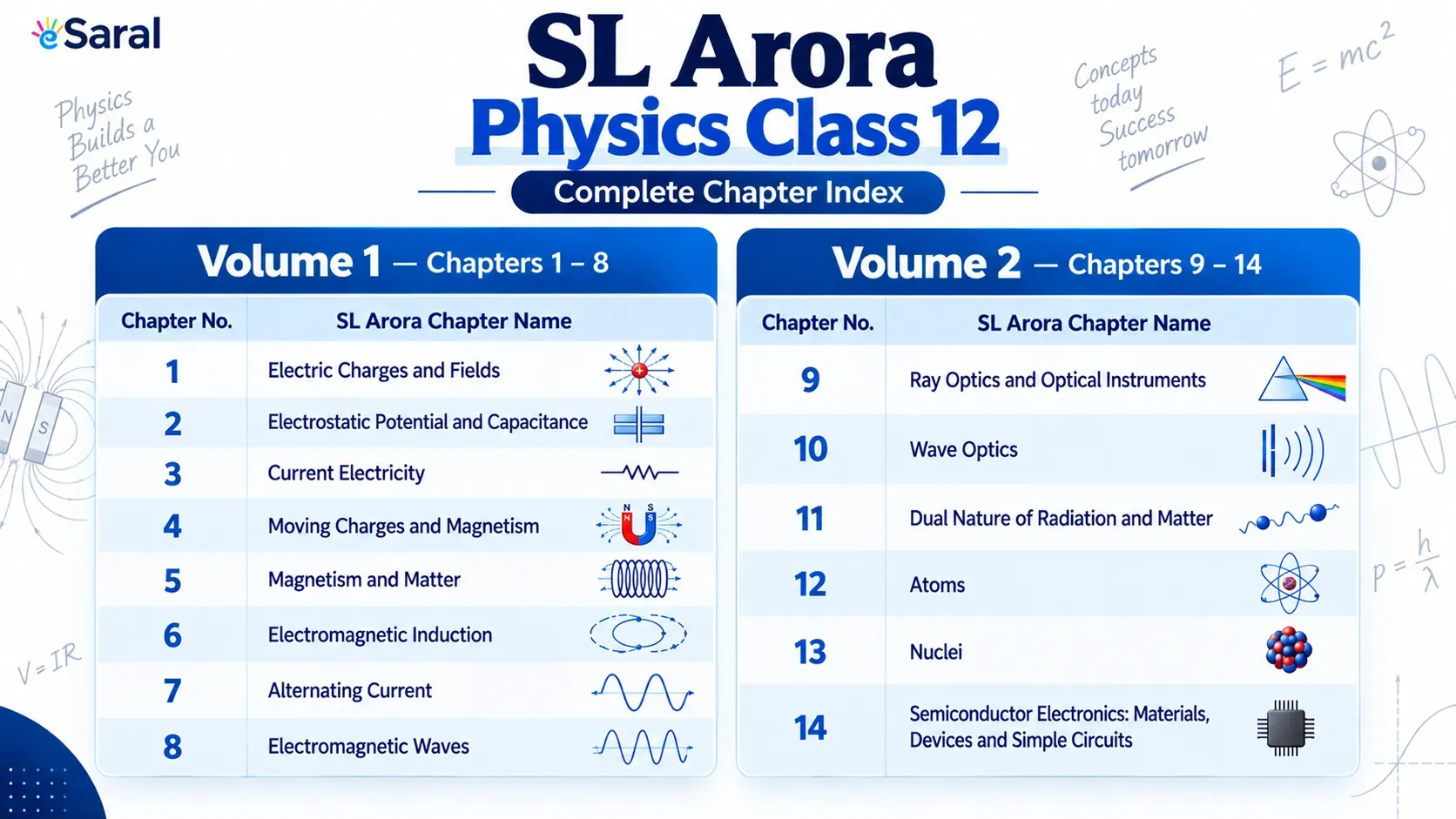
SL Arora Physics Class 12 Index – Chapter List for Volume 1 & 2
SL Arora Physics Class 12 index — complete chapter list for Volume 1 & 2, mapped to NCERT solutions for board, JEE Main, and NEET preparation.