
Hydrocarbons - JEE Main Previous Year Questions with Solutions

eSaral Academic and Editorial Team
Summary
This Hydrocarbons chapter summary covers key JEE Main reactions and concepts including ozonolysis, hydroboration-oxidation, alkyne reductions, polymerization, bromination, Markovnikov/anti-Markovnikov additions, and important previous-year questions with solutions.
eSaral › JEE › JEE Main ›Hydrocarbons

🚀 Checkout eSaral Courses
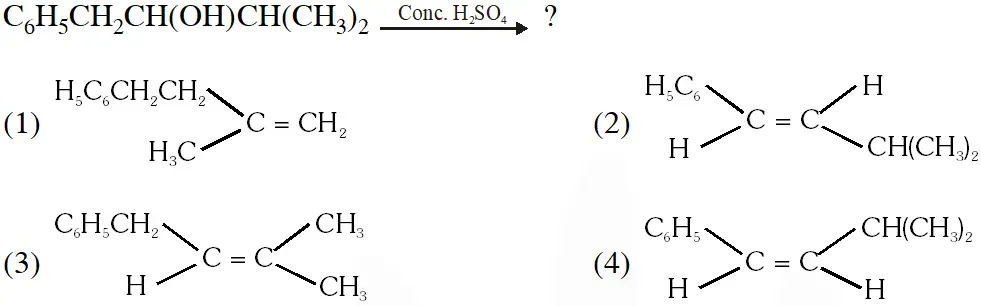
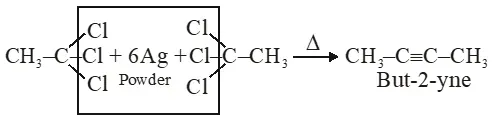
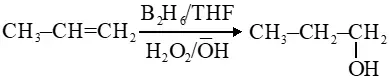
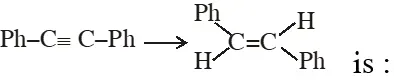
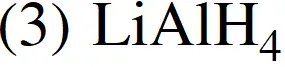
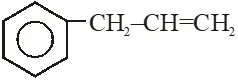
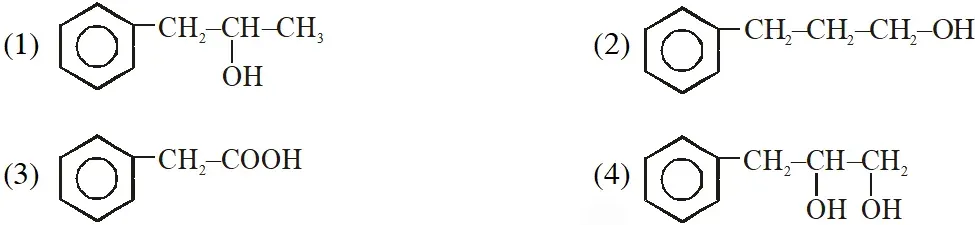
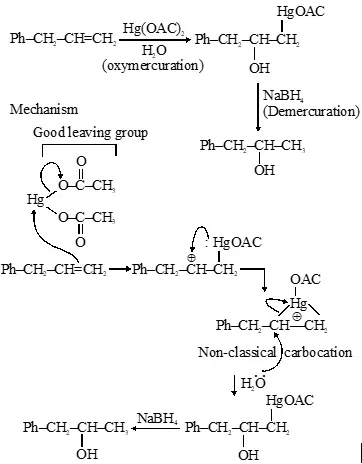
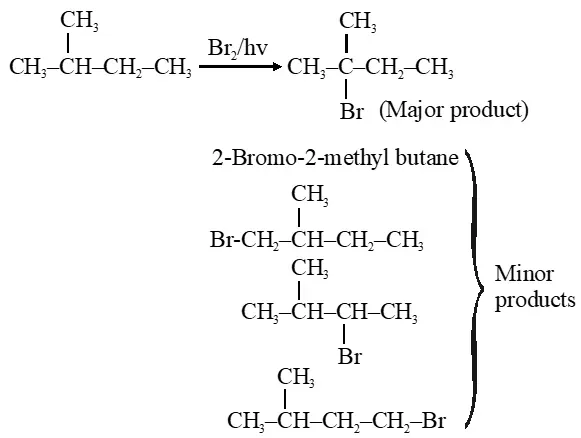
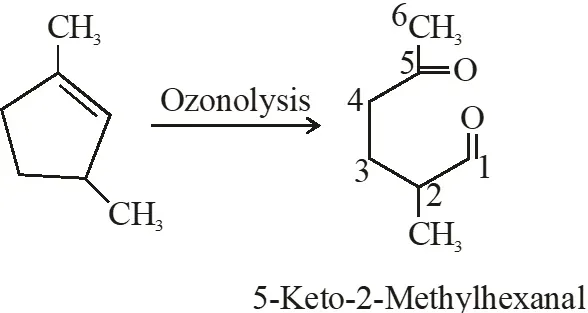
JEE Main Previous Year Papers Questions of Chemistry With Solutions are available at eSaral. Simulator Previous Years AIEEE/JEE Mains Questions [esquestion] The main product of the following reaction is #tag# [AIEEE-2010] #sol# (2) [/esquestion] [esquestion] One mole of a symmetrical alkene on ozonolysis gives two moles of an aldehyde having a molecular mass of 44 u. The alkene is :- (1) Ethene (2) Propene (3) 1-Butene (4) 2-Butene #tag# [AIEEE-2010] #sol# (4) [/esquestion] [esquestion] Ozonolysis of an organic compound gives formaldehyde as one of the products. This confirms the presence of :- (1) an isopropyl group (2) an acetylenic triple bond (3) two ethylenic double bonds (4) a vinyl group #tag# [AIEEE-2011] #sol# (4) [/esquestion] [esquestion] Ozonolysis of an organic compound 'A' produces acetone and propionaldehyde in equimolar mixture. Identify 'A' from the following compounds :- (1) 2-Methyl-1-pentene (2) 1-Pentene (3) 2-Pentene (4) 2-Methyl-2-pentene #tag# [AIEEE-2011] #sol# (4) [/esquestion] [esquestion] 2–Hexyne gives trans–2–Hexene on treatment with :- #tag# [AIEEE-2012] #sol# (3) [/esquestion] [esquestion] In the given transformation, which of the following is the most appropriate reagent ? #tag# [AIEEE-2012] #sol# (2) [/esquestion] [esquestion] The major organic compound formed by the reaction of 1, 1, 1–trichloroethane with silver powder is :- (1) 2-Butyne (2) 2-Butene (3) Acetylen (4) Ethene #tag# [Jee-Main offline 2013] #sol# (1) [/esquestion] [esquestion] The number and type of bonds in $\mathrm{C}_{2}^{2-}$ ion in $\mathrm{CaC}_{2}$ are: (1) Two $\sigma$ bonds and one $\pi$ - bond (2) Two $\sigma$ bonds and two $\pi$ - bonds (3) One $\sigma$ bond and two $\pi$ - bonds (4) One $\sigma$ bond and one $\pi-$ bond #tag# [Jee-Main offline 2014] #sol# (3) $\mathrm{Ca}^{+2}[\mathrm{C} \equiv \mathrm{C}]^{-2}$ [/esquestion] [esquestion] In the hydroboration - oxidation reaction of propene with diborane, $\mathrm{H}_{2} \mathrm{O}_{2}$ and NaOH, the organic compound formed is : (1) $\mathrm{CH}_{3} \mathrm{CH}_{2} \mathrm{CH}_{2} \mathrm{OH}$ ( 2)$\left(\mathrm{CH}_{3}\right)_{3} \mathrm{COH}$ (3) $\mathrm{CH}_{3} \mathrm{CHOHCH}_{3}$ (4) $\mathrm{CH}_{3} \mathrm{CH}_{2} \mathrm{OH}$ #tag# [Jee-Main offline 2014] #sol# (1) [/esquestion] [esquestion] Which one of the following class of compounds is obtained by polymerization of acetylene ? (1) Poly-ene (2) Poly-yne (3) Poly-amide (4) Poly-ester #tag# [Jee-Main offline 2014] #sol# (2) [/esquestion] [esquestion] The gas liberated by the electrolysis of Dipotassium succinate solution is : (1) Ethyne (2) Ethene (3) Propene (4) Ethane #tag# [Jee-Main offline 2014] #sol# (2) [/esquestion] [esquestion] The reagent needed for converting (1) $\mathrm{H}_{2} /$ lindlar Cat. (2) Cat. Hydrogenatio (4) LiNH $_{3}$ #tag# [Jee-Main offline 2014] #sol# (4) [/esquestion] [esquestion] on mercuration- demercuration produces the major product :- #tag# [Jee-Main offline 2014] #sol# (1) Rearrangement of carbocation formed is not possible due to formatiion of cyclic non-classical carbocation. [/esquestion] [esquestion] The major product obtained in the photo catalysed bromination of 2-methylbutane is :- (1) 2-bromo-2-methylbutane (2) 2-bromo-3-methylbutane (3) l-bromo-2-methylbutane (4) l-bromo-3-methylbutane #tag# [Jee-Main offline 2014] #sol# (1) [/esquestion] [esquestion] In the presence of peroxide, HC and HI do not give anti-Markownikoff s addition to alkenes because (1) All the steps are exothermic in HCl and HI (2) One of the steps is endothermic in HCl and HI (3) HCl is oxidizing and the HI is reducing (4) Both HCl and HI are strong acids #tag# [Jee-Main offline 2014] #sol# (2) relectivity ratio for bromination is $1^{\circ}: 2^{\circ}: 3^{\circ}: 1: 82: 1600$ Hence $3^{\circ}$ product will be major product. [/esquestion] [esquestion] Which compound would give 5-keto-2-methyl hexanal upon ozonlysis? #tag# [Jee-Main offline 2015] #sol# (4) [/esquestion] [esquestion] The trans-alkenes are formed by the reduction of alkynes with : (1) $\mathrm{NaBH}_{4}$ (2) Na/liq. NH $_{3}$ (3) Sn–HCl (4) $\mathrm{H}_{2}-\mathrm{Pd} / \mathrm{C}, \mathrm{BaSO}_{4}$ #tag# [Jee-Main offline 2018] #sol# (2) Birch reduction is anti addition. So trans alkene will be produced. [/esquestion]






Hydrocarbons is part of a broader PYQ set, so use the JEE Mains PYQs chapter wise archive to move between Chemistry chapters efficiently.
Chapter practice builds concepts, but timed papers build speed. Once you're done here, move to our JEE Main previous year question paper to attempt Hydrocarbons in a real, timed setting.
Frequently Asked Questions
How many questions from Hydrocarbons appear in JEE Main each year?
JEE Main typically includes 1–2 questions from Hydrocarbons per session (4–8 marks per year across sessions). Based on NTA's released papers from 2010 to 2024, ozonolysis and alkene addition reactions are the most frequently tested sub-topics. Expect at least one question on reaction mechanism or product identification.
Is the Hydrocarbons chapter important for JEE Main 2025 and 2026?
Yes. Hydrocarbons appears in the JEE Main Chemistry syllabus under Organic Chemistry – Part 1 (Class 11 topic) and has been tested without interruption since AIEEE 2010. The NTA has not removed it from the official syllabus. Prioritise ozonolysis, Markovnikov rule, and alkyne reduction reactions.
What is the difference between Lindlar's catalyst and Na/liq. NH₃ in alkyne reductions?
Lindlar's catalyst (Pd/CaCO₃ with quinoline) gives cis (Z)-alkene through syn addition of H₂. Na/liquid NH₃ (Birch reduction) gives trans (E)-alkene through anti addition via radical anion intermediates. JEE Main has asked this distinction directly at least three times between 2012 and 2018.
Why do HCl and HI not show the peroxide effect with alkenes?
HCl and HI do not give anti-Markovnikov addition with peroxides because one step in their radical chain mechanism is endothermic — making the overall chain non-propagating. Only HBr has all radical chain steps exothermic, enabling anti-Markovnikov (peroxide) addition. This was directly tested in JEE Main 2014.
How do I identify an unknown alkene from its ozonolysis products in JEE Main?
Replace each C=O group in the ozonolysis products with a C= carbon, then join those two carbons with a double bond. If one product is formaldehyde (HCHO), the original compound had a terminal =CH₂ (vinyl group). If both products are identical aldehydes or ketones, the alkene was symmetrical. This reverse-engineering approach solves most JEE ozonolysis problems in under a minute.
Team eSaral
eSaral Academic and Editorial Team
Team eSaral is the collective author profile for educational content created by eSaral’s teachers and academic contributors. The team draws on expertise from IIT graduates, doctors, experienced educators and subject specialists to develop resources for JEE, NEET and school students. Our articles aim to explain concepts clearly and help students study with confidence.
Related Posts
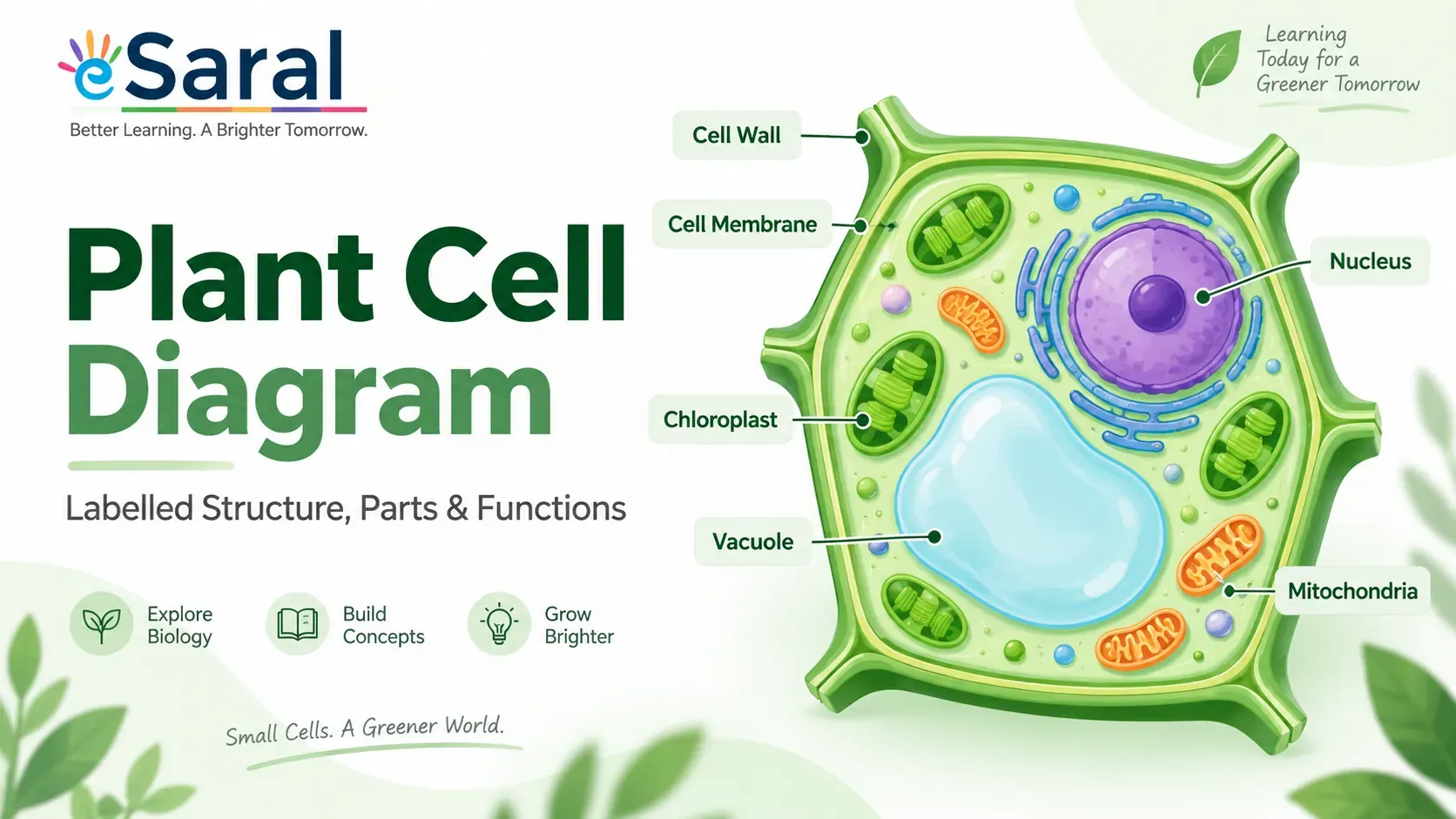
Plant Cell Diagram: Labelled Structure, Parts and Functions
Simple, labelled plant cell diagram with parts and functions. Covers plant cell structure for Class 6, 7, 8, 9, 10 and 11 students, CBSE-aligned.
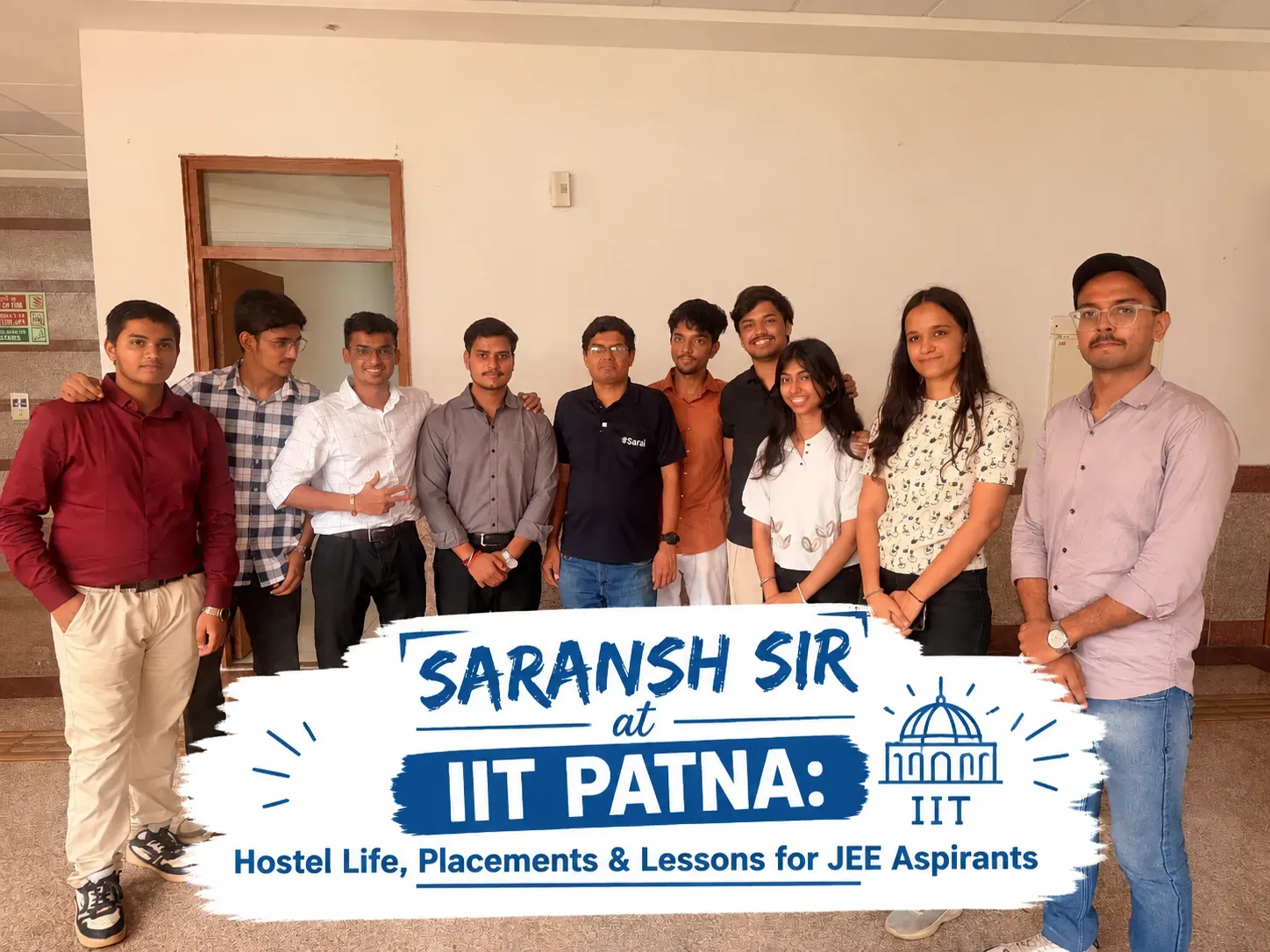
Saransh Gupta Sir's Visit to IIT Patna: Hostel Life, Placements & Lessons for JEE Aspirants
Inside Saransh Gupta Sir's IIT Patna visit — hostel life, the library, placements, internships, and real advice for JEE aspirants from students living the IIT dream.
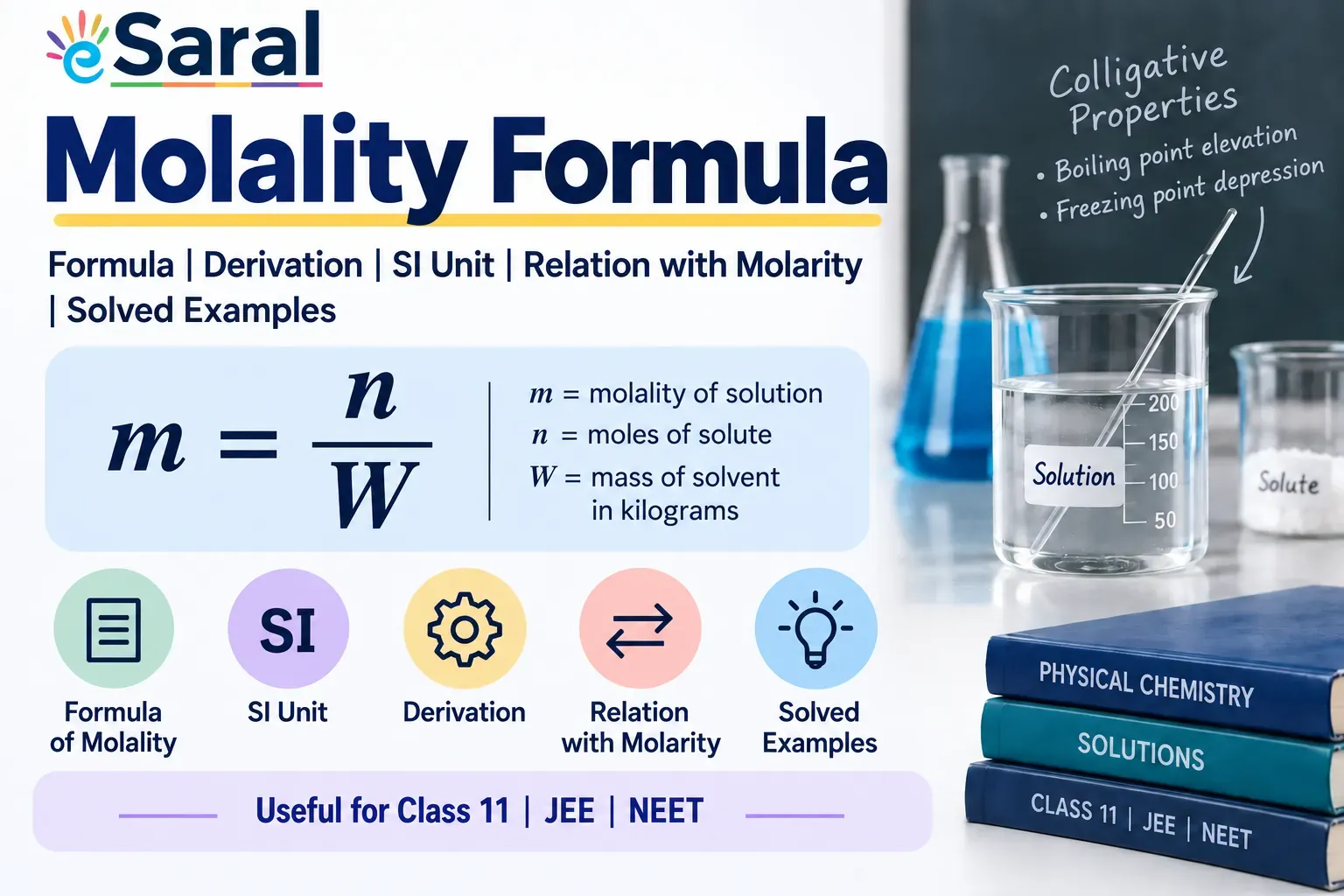
Molality Formula: Formula for Molality, Derivation & Solved Examples
Molality formula is $m = \dfrac{n}{W}$. Learn the formula of molality, its SI unit, derivation, relation with molarity, and solved examples for Class 11, JEE and NEET.
BITSAT Previous Year Question Paper PDF
Download BITSAT previous year question papers PDF. Get year-wise BITSAT PYQs, memory-based papers, exam pattern, and preparation tips to improve your BITSAT preparation.

Teachers’ Day 2026 at eSaral Gurukul: Celebrating the Bond Between Students, Teachers & Mentors
See how Teachers’ Day 2026 was celebrated at eSaral Gurukul, reflecting the bond among students, teachers, and mentors, and the role of guidance beyond academics.
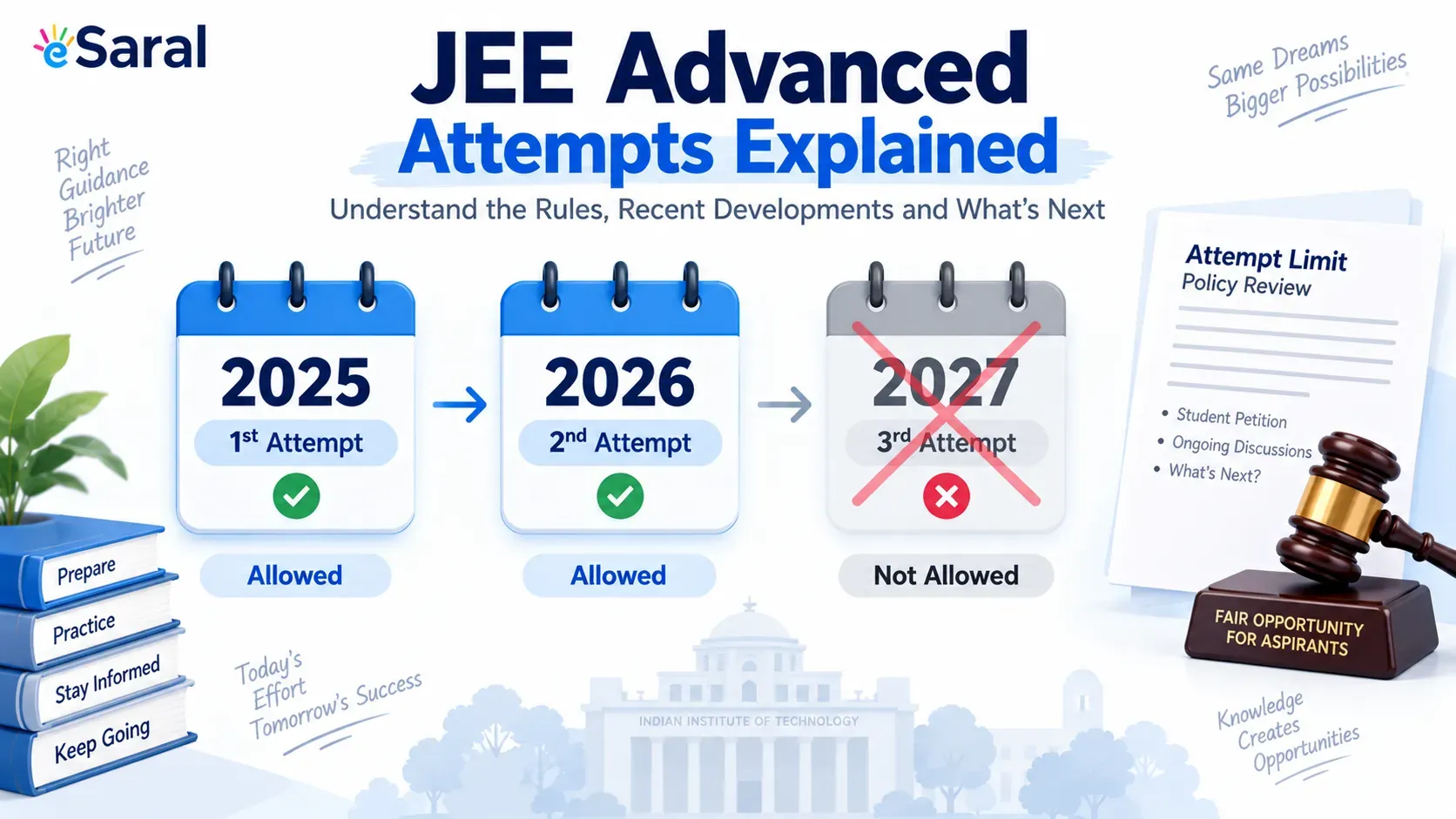
JEE Advanced Attempts: Can You Give It a Third Time? Rules Explained
JEE Advanced attempts: current rule is 2 consecutive years only: full eligibility criteria, the 2025 third-attempt controversy, and the latest 2026 petition news.
Best JEE Preparation App
Best JEE preparation app for Main & Advanced: AI mock tests, live doubt-solving, thousands of practice questions. JEE preparation app for droppers & Class 11-12.
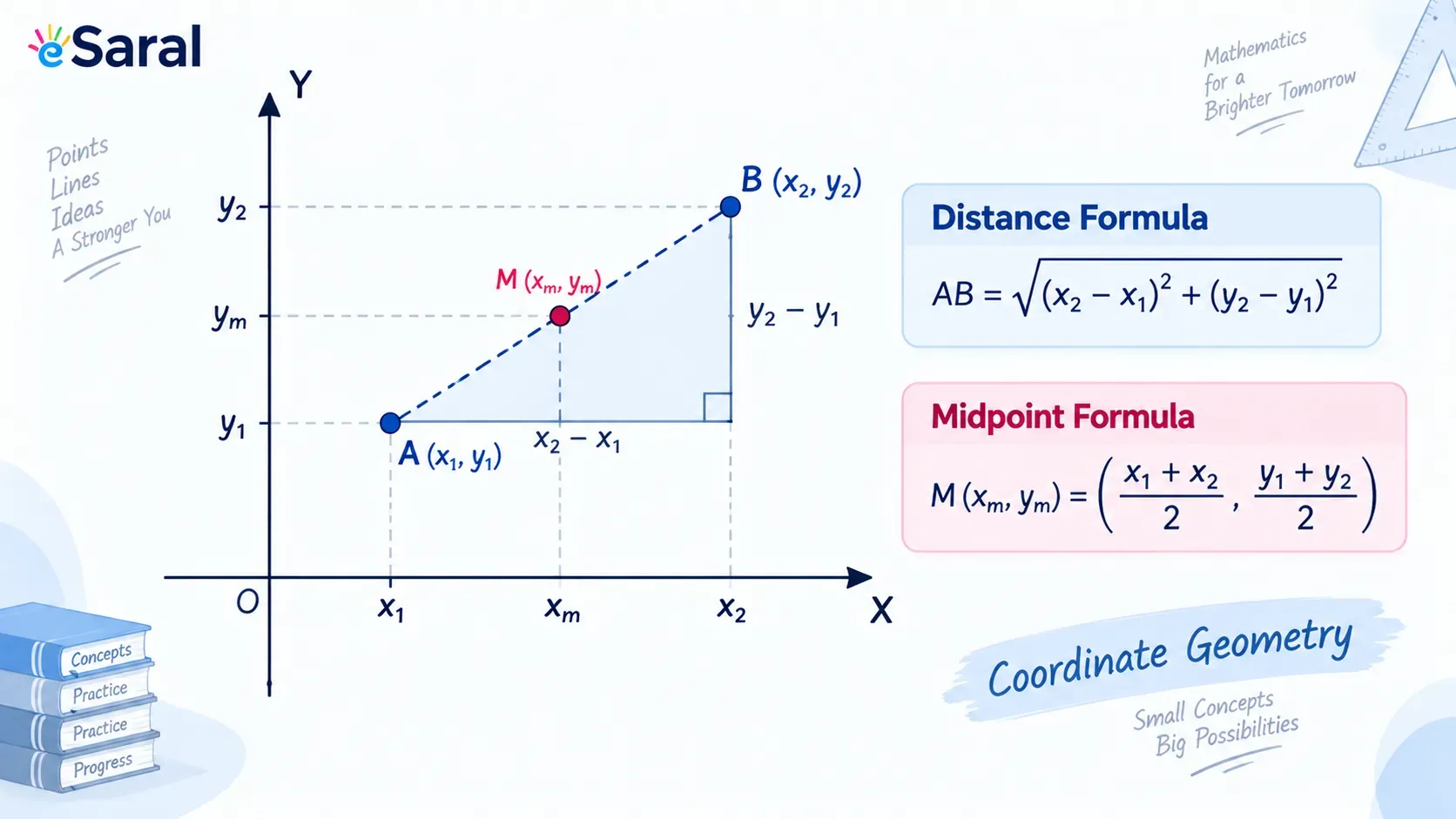
Coordinate Geometry Class 10: Formulas, Notes & Solved Examples
Coordinate geometry class 10: complete CBSE formulas — distance, section, midpoint and area of triangle — with derivation, notes and solved examples.
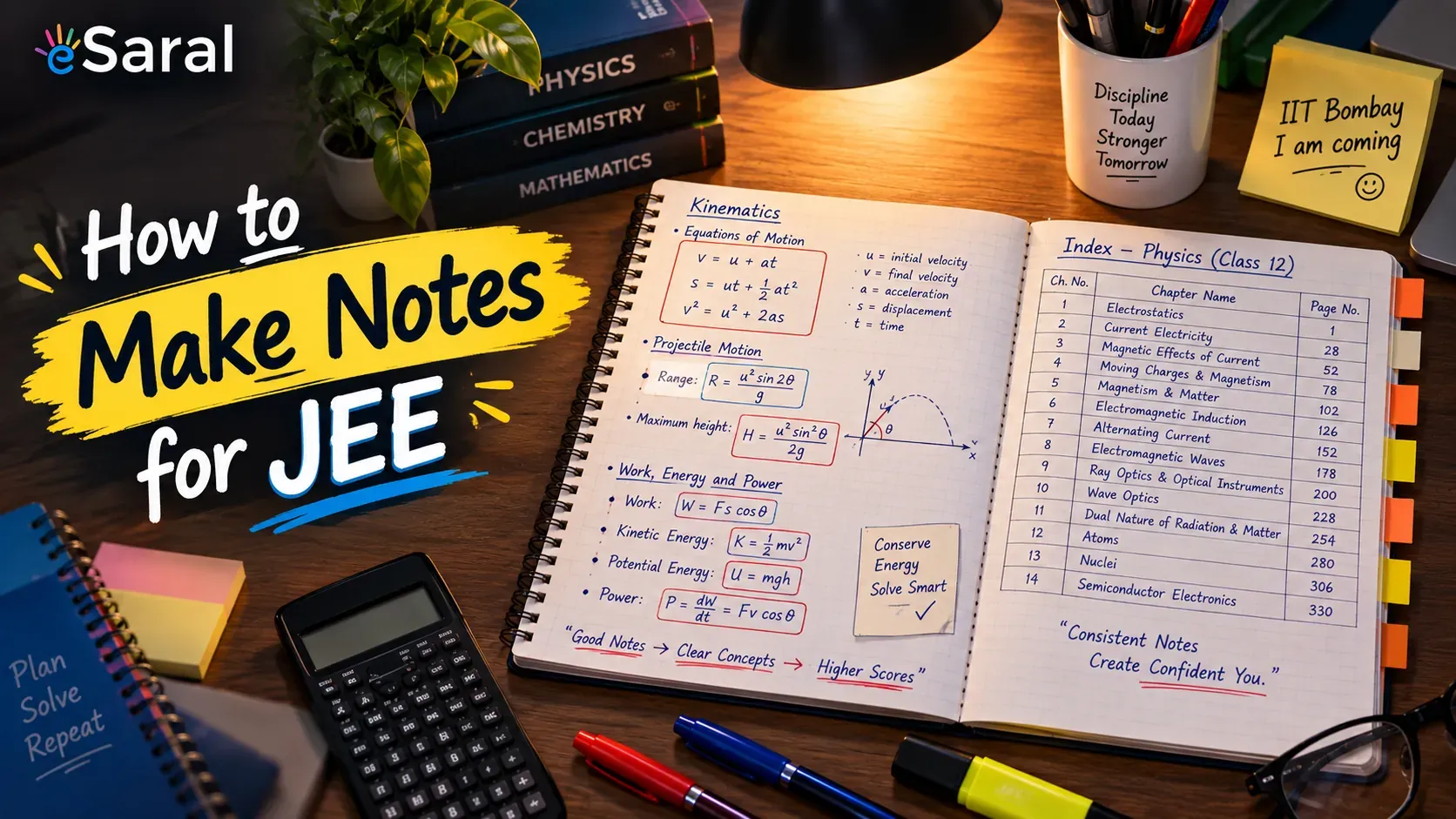
How to make Notes For JEE Smart Notes Strategy of an AIR 41
Learn how to make notes for JEE the way toppers do — indexing, shorthand, and smart short notes for JEE that cut revision time to just 5–7 days.
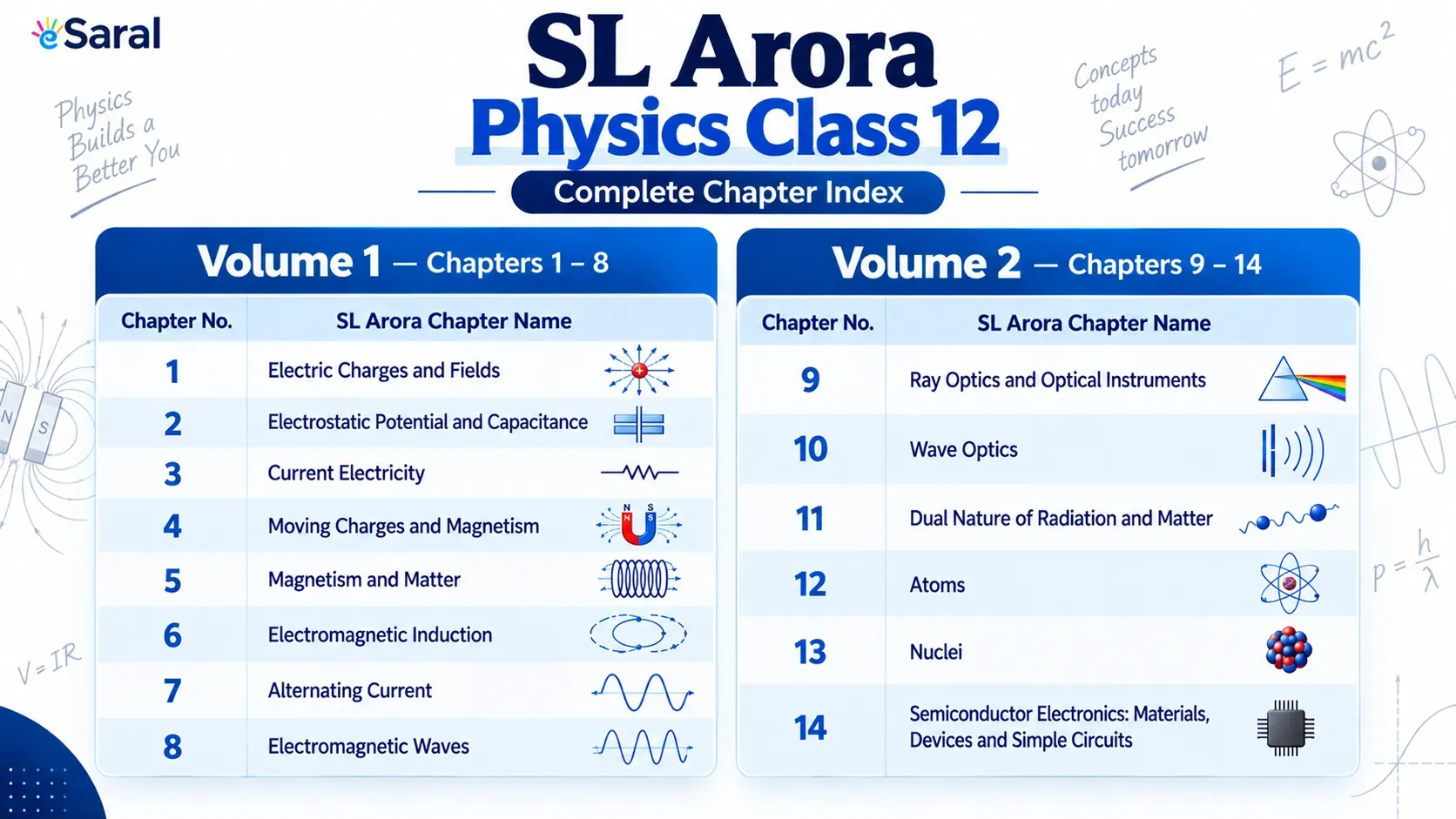
SL Arora Physics Class 12 Index – Chapter List for Volume 1 & 2
SL Arora Physics Class 12 index — complete chapter list for Volume 1 & 2, mapped to NCERT solutions for board, JEE Main, and NEET preparation.