
JEE Main Mathematics Syllabus 2026– All 16 Chapters, Topic Breakdown & Weightage

eSaral Academic and Editorial Team
Summary
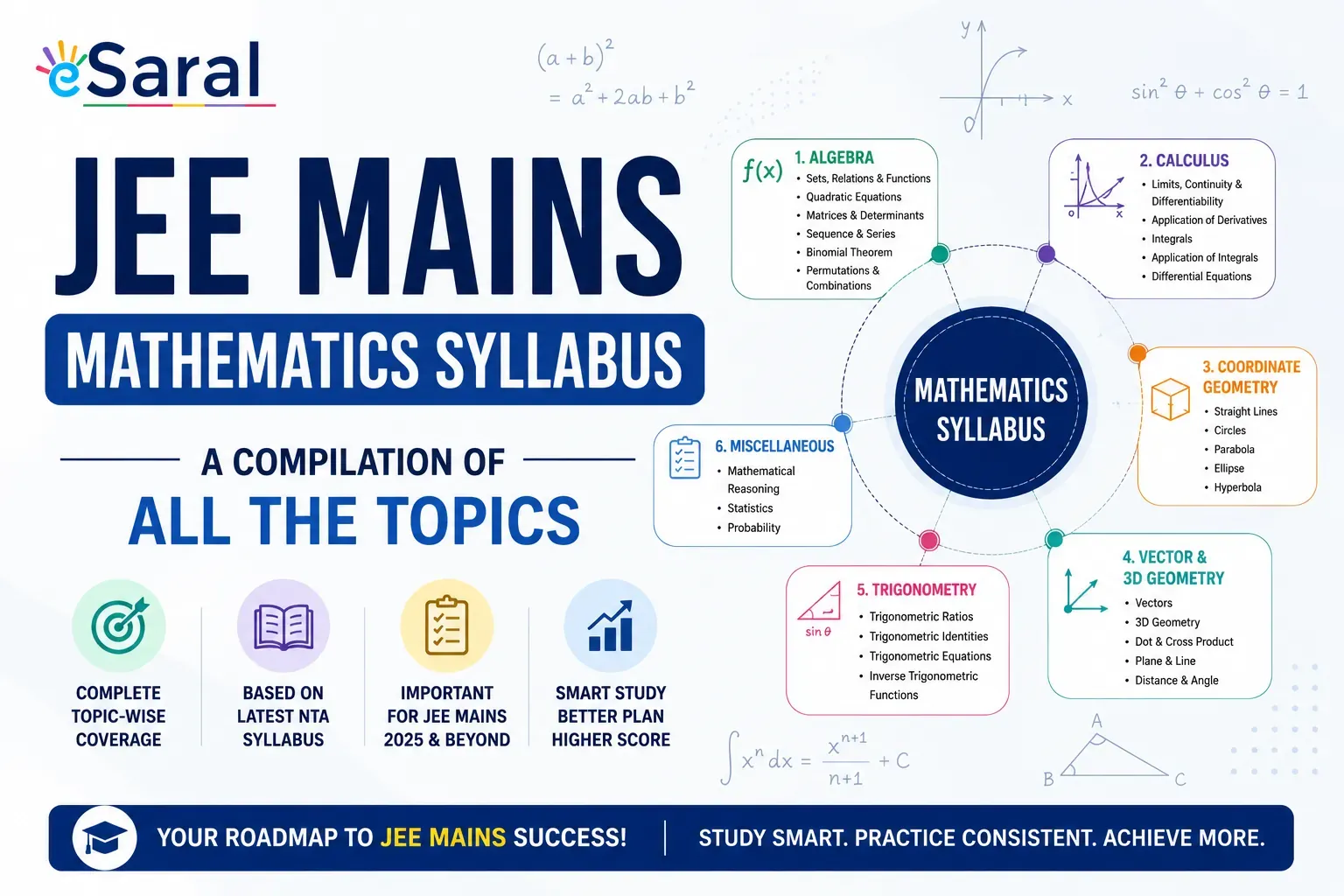
The JEE Main Mathematics syllabus, as prescribed by NTA, covers 16 chapters across 5 units — Algebra, Calculus, Coordinate Geometry, Trigonometry, and Statistics & Probability. Key topics include Calculus, Coordinate Geometry, Algebra, and Vectors. Knowing every chapter in advance lets you prioritise high-weightage areas and build a focused study plan.
Home » JEE Main Syllabus » JEE Main Mathematics Syllabus

What is the JEE Main Mathematics Syllabus?
JEE Main is conducted by the National Testing Agency (NTA) as the gateway to NITs, IIITs, and other centrally funded technical institutes. Mathematics is one of three papers, carrying 100 marks (20 MCQs + 10 numerical-answer questions), and it is often the subject that separates close ranks in the final merit list.
The syllabus is built on Class 11 and Class 12 NCERT Mathematics. This means your board preparation and your JEE preparation overlap heavily; a fact that experienced teachers use to their advantage. If you have not already worked through your NCERT textbooks chapter by chapter, that is the single best place to start. You can find solved examples and exercises in the NCERT Solutions for Class 11 Maths and NCERT Solutions for Class 12 Maths to build your foundation before moving to JEE-level problems.
The 16 chapters are grouped under 5 broad units:
- Algebra (Chapters 1–7 and 13, 14, 16)
- Calculus (Chapters 8–10)
- Coordinate Geometry (Chapter 11)
- 3D Geometry & Vectors (Chapters 12–13)
- Trigonometry (Chapter 15)
Which Chapters Are Most Important in JEE Main Maths?
Not all chapters carry equal weight in the actual exam. Based on previous years' NTA question papers, here is a chapter-wise weightage and difficulty breakdown to help you plan your time:
Chapter | Unit | Approx. Questions (out of 30) | Difficulty |
|---|---|---|---|
Calculus (LCD + Integral) | Calculus | 5–7 | Medium–High |
Coordinate Geometry | Coord. Geometry | 4–5 | Medium |
Algebra (Matrices, Complex Nos., P&C) | Algebra | 5–6 | Medium |
Vectors & 3D Geometry | 3D/Vectors | 3–4 | Medium |
Probability & Statistics | Statistics | 2–3 | Low–Medium |
Trigonometry | Trigonometry | 2–3 | Low–Medium |
Sequence & Series | Algebra | 1–2 | Low |
Mathematical Reasoning | Algebra | 1 | Low |
Mathematical Induction | Algebra | 0–1 | Low |
Students who follow this priority-based approach consistently outperform those who study all chapters with equal effort. In eSaral's 2025 JEE batch, students who spent at least 60% of their Maths practice time on Calculus and Coordinate Geometry improved their Maths percentile by an average of 12 points in the final attempt compared to their first mock test scores.
Chapter-Wise Syllabus – All 16 Chapters in Detail
Unit 1: Algebra
Chapter 1 – Sets, Relations, and Functions
- Sets and their representation
- Union, intersection, and complement of sets and their algebraic properties
- Power set
- Types of relations: equivalence relations
- Functions: one-to-one, into and onto functions; composition of functions
Chapter 2 – Complex Numbers & Quadratic Equations
- Complex numbers as ordered pairs of reals; Argand diagram
- Algebra of complex numbers: modulus, argument, and square root
- Triangle inequality
- Quadratic equations in real and complex number systems
- Relation between roots and coefficients; nature of roots; formation of quadratic equations
Chapter 3 – Matrices & Determinants
- Algebra of matrices; types of matrices (order two and three)
- Properties of determinants; area of triangles using determinants
- Adjoint and inverse of a square matrix
- Consistency and solution of simultaneous linear equations using determinants and matrices
Chapter 4 – Permutations and Combinations
- Fundamental principle of counting
- Permutation as arrangement; combination as selection
- Meaning and applications of P(n,r) and C(n,r)
Chapter 5 – Mathematical Induction
- Principle of Mathematical Induction and its simple applications
Chapter 6 – Binomial Theorem
- Binomial theorem for a positive integral index
- General term, middle term, and properties of binomial coefficients
Chapter 7 – Sequence & Series
- Arithmetic and Geometric progressions; insertion of A.M. and G.M.
- Relation between A.M. and G.M.
- Sum of special series: Σn, Σn², Σn³
- Arithmetico-Geometric progression
Unit 2: Calculus
Chapter 8 – Limit, Continuity & Differentiability
- Real-valued functions: polynomials, rational, trigonometric, logarithmic, and exponential functions
- Limits, continuity, and differentiability
- Differentiation of the sum, difference, product, and quotient of two functions
- Differentiation of trigonometric, inverse trigonometric, logarithmic, exponential, composite, and implicit functions; derivatives up to order two
- Rolle's Theorem and Lagrange's Mean Value Theorem
- Applications: rate of change, monotonic functions, maxima and minima, tangents and normals
Chapter 9 – Integral Calculus
- Integral as an antiderivative; fundamental integrals
- Integration by substitution, by parts, and by partial fractions
- Integration using trigonometric identities
- Integral as limit of a sum; Fundamental Theorem of Calculus
- Properties and evaluation of definite integrals
- Area of regions bounded by simple curves
Chapter 10 – Differential Equations
- Ordinary differential equations: order and degree
- Formation of differential equations
- Solution by separation of variables
- Solution of homogeneous and linear differential equations
Unit 3: Coordinate Geometry
Chapter 11 – Coordinate Geometry
- Cartesian coordinates: distance formula, section formula, locus, translation of axes
- Straight lines: various forms of line equations, angles between lines, concurrence conditions, distance of a point from a line, bisectors, centroid, orthocentre, circumcentre
- Circles: standard and general forms, equation from diameter endpoints, tangent conditions
- Conic sections: parabola, ellipse, hyperbola in standard forms; tangent conditions
Unit 4: Vectors & 3D Geometry
Chapter 12 – 3-Dimensional Geometry
- Coordinates in space; distance between two points; section formula
- Direction ratios and direction cosines; angle between lines
- Skew lines and the shortest distance
- Equations of a line and a plane; intersection of line and plane; coplanar lines
Chapter 13 – Vector Algebra
- Vectors and scalars; addition of vectors
- Components in 2D and 3D space
- Scalar (dot) and vector (cross) products; scalar and vector triple products
Unit 5: Statistics, Probability & Trigonometry
Chapter 14 – Statistics & Probability
- Statistics: Mean, median, mode for grouped and ungrouped data; standard deviation, variance, and mean deviation
- Probability: Addition and multiplication theorems; Bayes' theorem; probability distribution of a random variable; Bernoulli trials; Binomial distribution
Chapter 15 – Trigonometry
- Trigonometric identities and equations
- Trigonometric functions and their properties
- Inverse trigonometric functions
- Heights and distances
Chapter 16 – Mathematical Reasoning
- Statements; logical operations (and, or, implies, implied by, if and only if)
- Tautology, contradiction, converse, and contrapositive
How Should You Prepare for JEE Main Mathematics?
Step 1 – Build Your Foundation with NCERT First
Every JEE Main question in Mathematics has its roots in NCERT concepts. Before picking up any advanced problem book, make sure every solved example and exercise in your Class 11 and Class 12 NCERT textbooks is done. Start with NCERT Solutions for Class 11 Maths for chapters like Sets, Trigonometry, and Sequences, then move to NCERT Solutions for Class 12 Maths for Calculus, Vectors, and Probability.
Step 2 – Follow a Chapter Priority Order
Use the weightage table above. Begin with Calculus (Chapters 8–10), then Coordinate Geometry (Chapter 11), then Algebra (Chapters 2–4, 7). Complete lower-weightage chapters like Mathematical Induction and Reasoning last.
Step 3 – Practice Daily and Track Accuracy, Not Just Speed
Speed without accuracy loses marks because of negative marking. Fix your accuracy above 80% on a chapter before increasing your solving speed. Daily 2-hour focused practice beats 6-hour unfocused sessions consistently.
Step 4 – Solve Previous Year Papers Chapter-Wise
NTA repeats question patterns. Solving 5 years of JEE Main Mathematics papers chapter-wise reveals exactly which subtopics get tested repeatedly. This is one of the most efficient revision strategies used by Kota's top faculty.
All Chapters
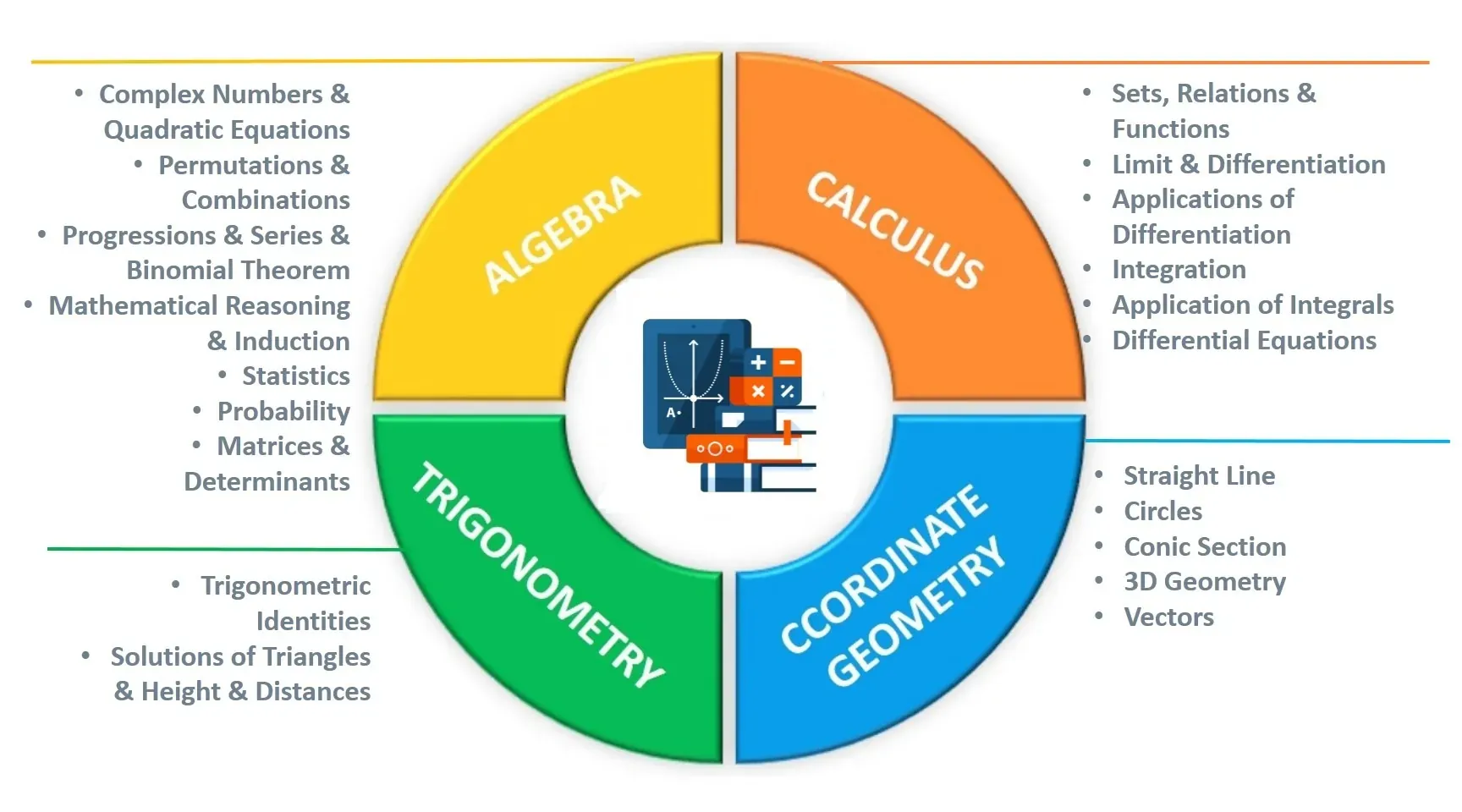
- Sets, Relations, and Functions
- Complex Numbers & Quadratic Equations
- Matrices & Determinants
- Permutations and Combinations
- Mathematical Induction
- Binomial Theorem
- Sequence & Series
- Limit, Continuity & Differentiability
- Integral Calculus
- Differential Equations
- Coordinate Geometry
- 3 Dimensional Geometry
- Vector Algebra
- Statistics & Probability
- Trigonometry
- Mathematical Reasoning
Click on the links below to get a detailed syllabus of Chemistry and Physics as well.
So, that’s all from this post. I hope you get the idea about the JEE Mains Mathematics Syllabus. If you enjoyed this post, then please share it with your friends. Stay tuned with eSaral.
To watch Free Learning Videos on physics by Saransh Gupta sir (AIR 41), install the eSaral App.
Frequently Asked Questions
Is the JEE Main Mathematics syllabus the same every year?
Yes, the core NTA-prescribed JEE Main Mathematics syllabus has remained stable for several years. NTA does occasionally release official notifications clarifying minor changes. Always verify against the official NTA JEE Main information bulletin for the current year before finalising your study plan.
Which is the most important chapter in JEE Main Maths?
Calculus — covering Limits & Derivatives, Integral Calculus, and Differential Equations — is the most important unit, contributing roughly 5–7 questions out of 30 in most JEE Main sessions. Coordinate Geometry follows closely. Together, these two units account for approximately 35–40% of the Mathematics paper.
How many chapters are in JEE Main Mathematics syllabus?
JEE Main Mathematics syllabus contains 16 chapters grouped under 5 units: Algebra, Calculus, Coordinate Geometry, 3D Geometry & Vectors, and Trigonometry. The full chapter list is prescribed by NTA and is largely aligned with Class 11 and Class 12 NCERT Mathematics textbooks.
Is there any change in JEE Main Maths syllabus for 2026?
NTA has not announced any major changes to the JEE Main Mathematics syllabus for 2025 from the standard pattern. The paper continues to have 30 questions (20 MCQs + 10 numerical). Always check the official NTA website (nta.ac.in) or the JEE Main 2026 information bulletin for the most current official version.
How much time should I give to Mathematics for JEE Main?
Most successful JEE Main qualifiers dedicate roughly 35–40% of their total study time to Mathematics, given the depth of Calculus and Coordinate Geometry. For a 6-hour daily schedule, that is approximately 2–2.5 hours on Maths, with dedicated daily practice and weekly full-length mock tests.
Can I clear JEE Main Maths with just NCERT?
NCERT is essential but not sufficient on its own for JEE Main. NCERT builds conceptual clarity, which is the foundation. JEE Main questions test application, speed, and multi-concept problem solving — skills that require practice beyond NCERT through chapter-wise JEE-level question banks and previous year papers.
Team eSaral
eSaral Academic and Editorial Team
Team eSaral is the collective author profile for educational content created by eSaral’s teachers and academic contributors. The team draws on expertise from IIT graduates, doctors, experienced educators and subject specialists to develop resources for JEE, NEET and school students. Our articles aim to explain concepts clearly and help students study with confidence.
Related Posts
Plant Cell Diagram: Labelled Structure, Parts and Functions
Simple, labelled plant cell diagram with parts and functions. Covers plant cell structure for Class 6, 7, 8, 9, 10 and 11 students, CBSE-aligned.

Saransh Gupta Sir's Visit to IIT Patna: Hostel Life, Placements & Lessons for JEE Aspirants
Inside Saransh Gupta Sir's IIT Patna visit — hostel life, the library, placements, internships, and real advice for JEE aspirants from students living the IIT dream.
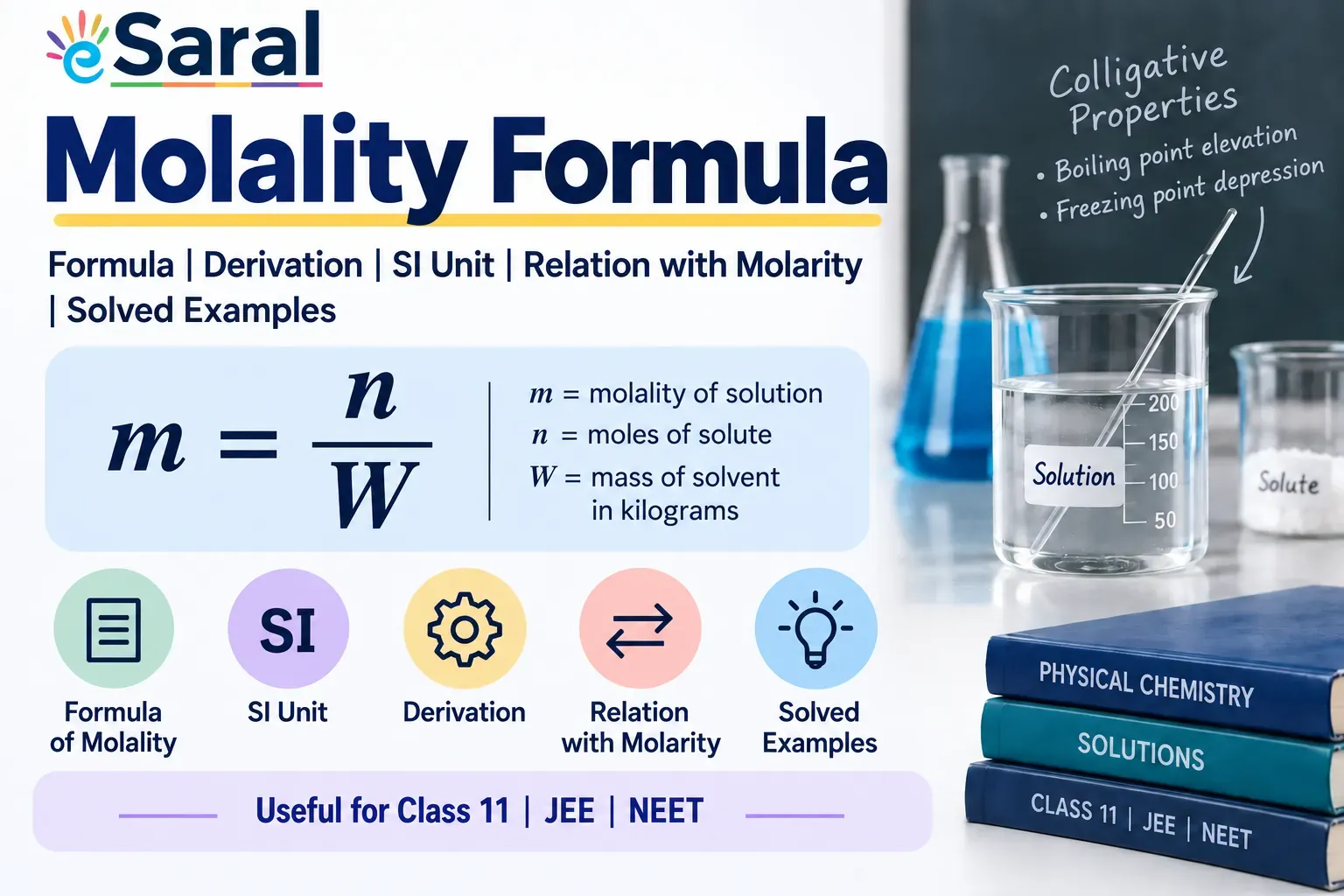
Molality Formula: Formula for Molality, Derivation & Solved Examples
Molality formula is $m = \dfrac{n}{W}$. Learn the formula of molality, its SI unit, derivation, relation with molarity, and solved examples for Class 11, JEE and NEET.
BITSAT Previous Year Question Paper PDF
Download BITSAT previous year question papers PDF. Get year-wise BITSAT PYQs, memory-based papers, exam pattern, and preparation tips to improve your BITSAT preparation.

Teachers’ Day 2026 at eSaral Gurukul: Celebrating the Bond Between Students, Teachers & Mentors
See how Teachers’ Day 2026 was celebrated at eSaral Gurukul, reflecting the bond among students, teachers, and mentors, and the role of guidance beyond academics.
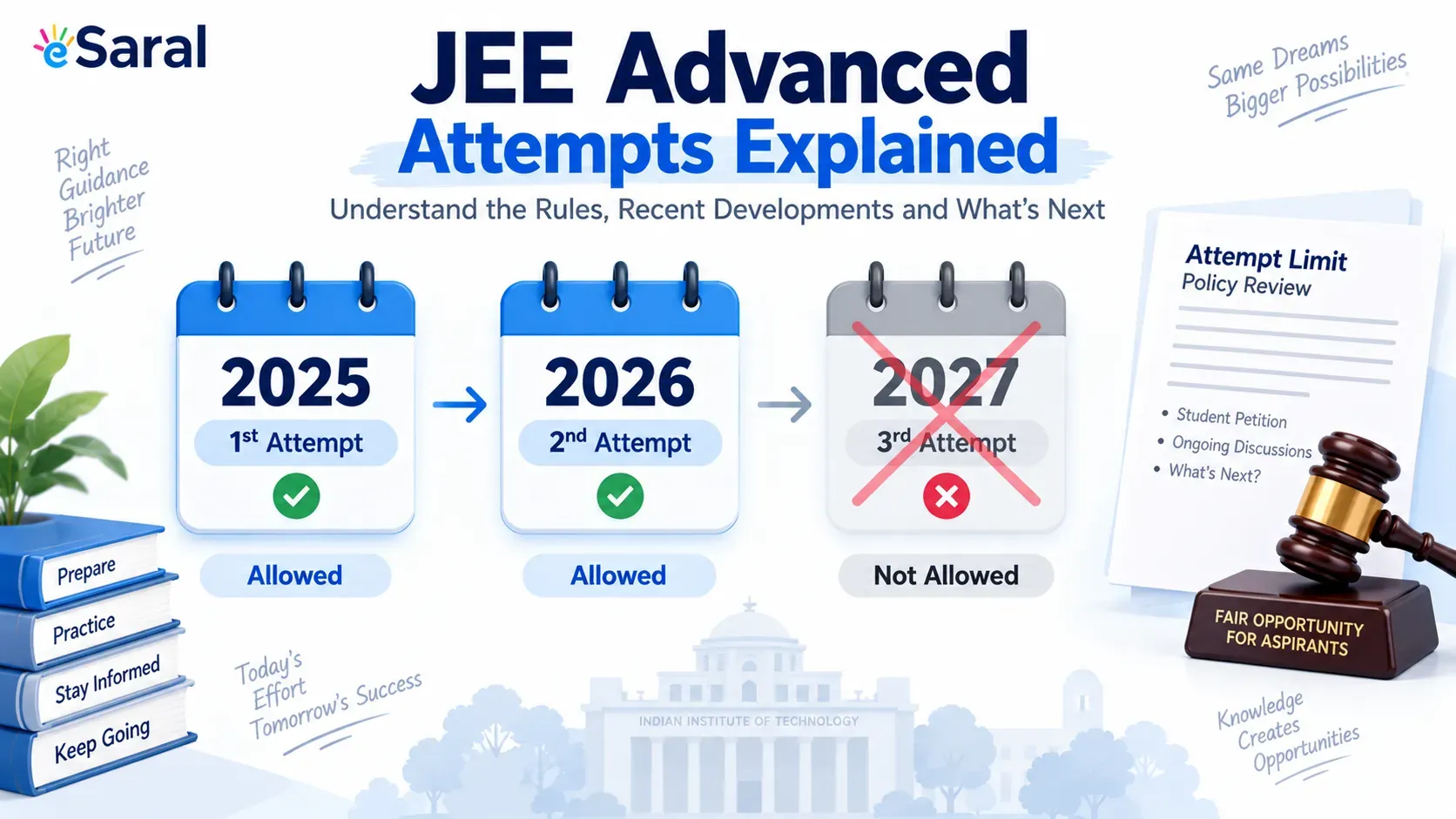
JEE Advanced Attempts: Can You Give It a Third Time? Rules Explained
JEE Advanced attempts: current rule is 2 consecutive years only: full eligibility criteria, the 2025 third-attempt controversy, and the latest 2026 petition news.

Best JEE Preparation App
Best JEE preparation app for Main & Advanced: AI mock tests, live doubt-solving, thousands of practice questions. JEE preparation app for droppers & Class 11-12.
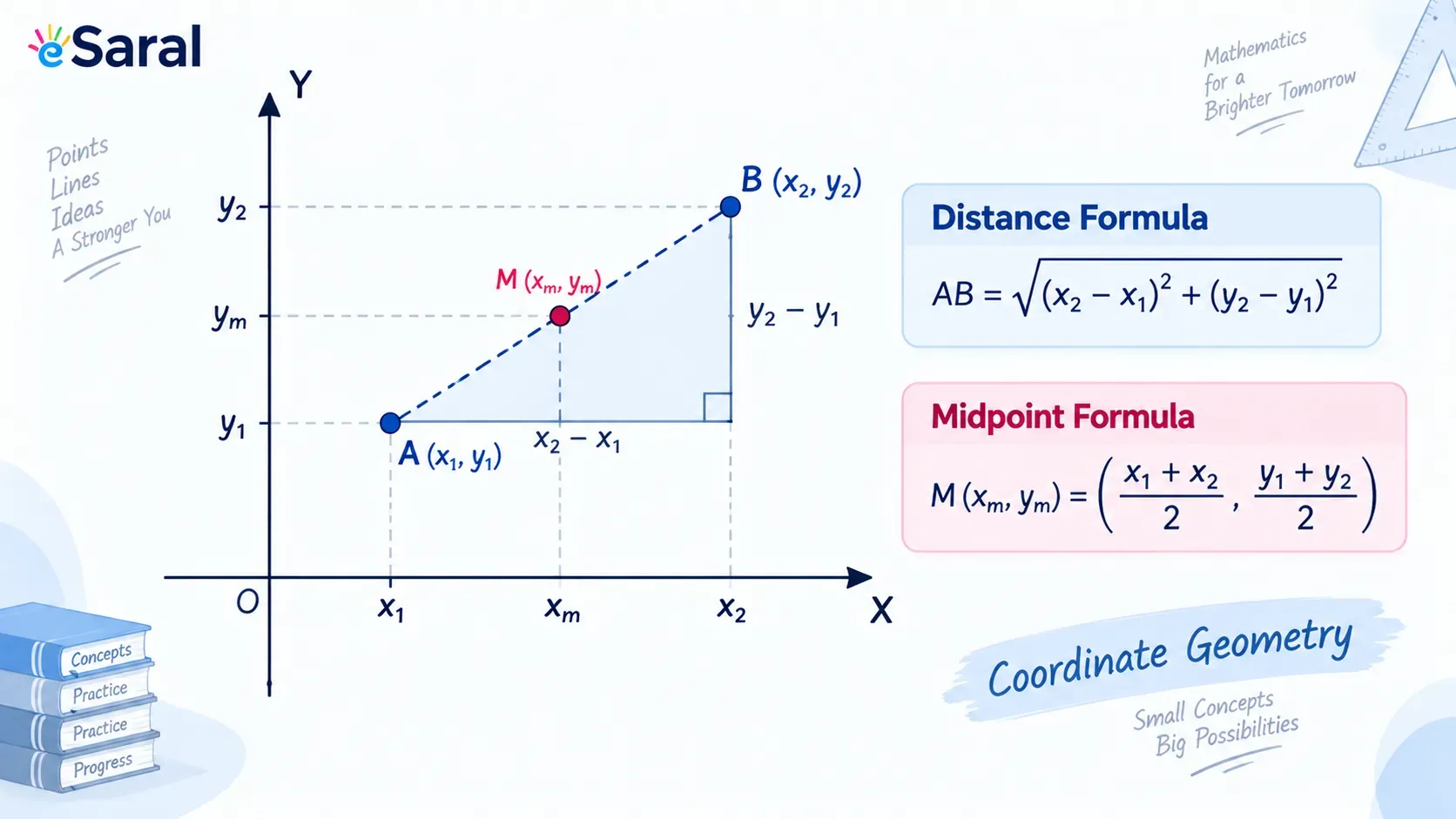
Coordinate Geometry Class 10: Formulas, Notes & Solved Examples
Coordinate geometry class 10: complete CBSE formulas — distance, section, midpoint and area of triangle — with derivation, notes and solved examples.
How to make Notes For JEE Smart Notes Strategy of an AIR 41
Learn how to make notes for JEE the way toppers do — indexing, shorthand, and smart short notes for JEE that cut revision time to just 5–7 days.
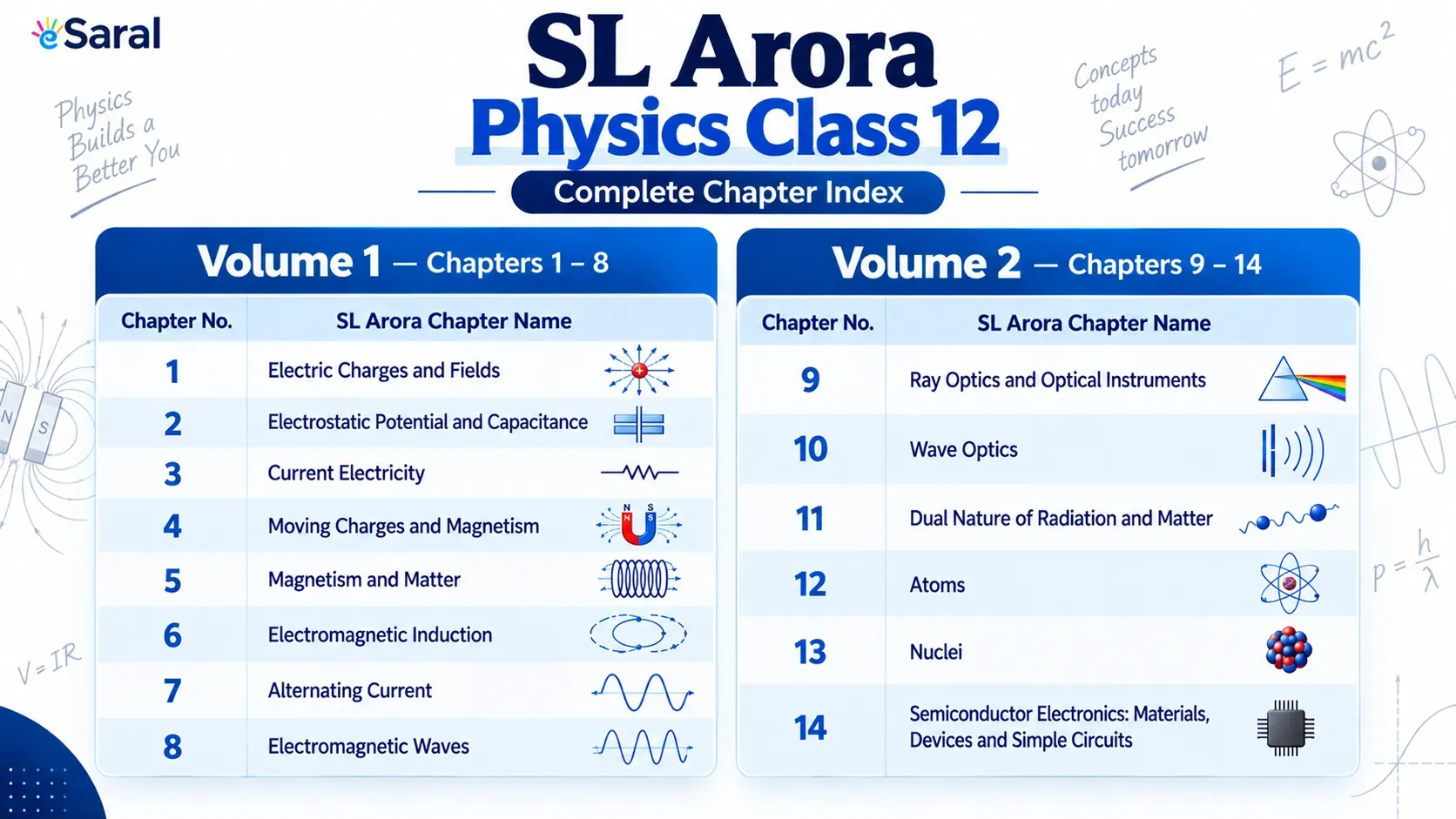
SL Arora Physics Class 12 Index – Chapter List for Volume 1 & 2
SL Arora Physics Class 12 index — complete chapter list for Volume 1 & 2, mapped to NCERT solutions for board, JEE Main, and NEET preparation.