
Kinematics 1D- JEE Main Previous Year Questions with Solutions

eSaral Academic and Editorial Team
Summary
Kinematics 1D JEE Main previous year questions cover motion in a straight line — including equations of motion, variable acceleration, projectile basics, and graph interpretation. From AIEEE 2009 to JEE Main 2018, roughly 1–2 questions appear from this chapter every year. All solved questions with step-by-step solutions are listed below.

eSaral > JEE Main Physics PYQs > Kinematics 1D
[jee-post-banner]
JEE Main Previous Year Question of Physics with Solutions is available here. Practicing JEE Main Previous Year Papers Questions of Physics will help all the JEE aspirants in realizing the question pattern, as well as help in analyzing their weak & strong areas.
Get detailed Class 11th &12th Physics Notes to prepare for Boards as well as competitive exams like IIT JEE, NEET, etc.
eSaral helps the students in clearing and understanding each topic in a better way. eSaral is providing complete chapter-wise notes of Class 11th and 12th for all subjects.
Besides this, eSaral also offers NCERT Solutions, Previous year questions for JEE Main and Advanced, Practice questions, Test Series for JEE Main, JEE Advanced and NEET, Important questions of Physics, Chemistry, Math, and Biology, and many more.
Download the eSaral app for free study material and video tutorials.
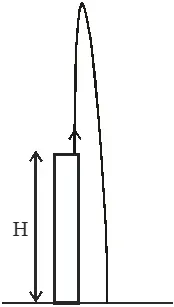
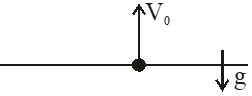
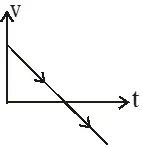
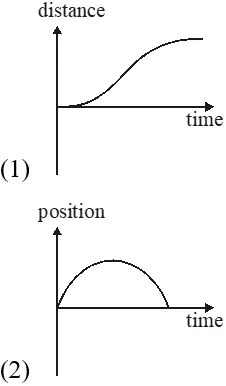
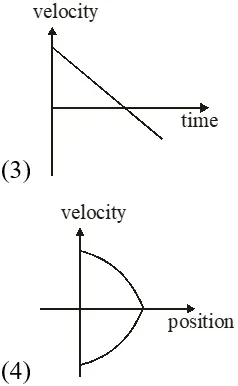
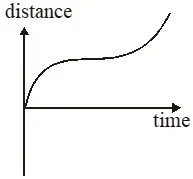
Simulator Previous Years AIEEE/JEE Mains Questions [esquestion] A particle has an initial velocity of $3 \hat{i}+4 \hat{j}$ and an acceleration of $0.4 \hat{\mathrm{i}}+0.3 \hat{\mathrm{j}}$. Its speed after 10s is:- (1) 7 units (2) 8.5 units (3) 10 units (4) $7 \sqrt{2}$ units #tag# [AIEEE-2009] #sol# (4) v = u + at u = 3i + 4j + (0.4 i + 0.3 j) × 10 = 3i + 4j + 4i + 3i u = 7i + 7j $|\overrightarrow{\mathrm{u}}|=\sqrt{7^{2}+7^{2}}$ $=7 \sqrt{2}$ [/esquestion] [esquestion] An object, moving with a speed of 6.25 m/s, is decelerated at a rate given by $\frac{\mathrm{dv}}{\mathrm{dt}}=-2.5 \sqrt{\mathrm{v}}$ where v is the instantaneous speed. The time taken by the object, to come to rest, would be :- (1) 4 s (2) 8 s (3) 1 s (4) 2 s #tag# [AIEEE-2011] #sol# (4) $\overrightarrow{\mathrm{a}}=\frac{\mathrm{d} \mathrm{v}}{\mathrm{dt}}$ $\frac{\mathrm{d} \mathrm{v}}{\mathrm{dt}}=-2.5 \sqrt{\mathrm{v}}$ $\int \mathrm{d} \mathrm{v} \times \mathrm{v}^{-1 / 2}=\int-2.5 \mathrm{dt}$ $\frac{\mathrm{v}^{\frac{1}{2}}}{\frac{1}{2}}=-2.5 \mathrm{t}$ $2 \sqrt{\mathrm{v}}=-2.5 \mathrm{t}+\mathrm{c}$ $2 \sqrt{6.25}=-2.5 \mathrm{t}+\mathrm{c}$ 2 × 0.25 = c 5 = c $2 \sqrt{\mathrm{v}}=-\mathrm{kt}+5$ 0 = –kt + 5 kt = 5 $\mathrm{t}=\frac{5 \mathrm{sec}}{2.5}=2 \mathrm{sec}$ [/esquestion] [esquestion] From a tower of height H, a particle is thrown vertically upwards with a speed u. The time taken by the particle, to hit the ground, is n times that taken by it to reach the highest point of its path. The relation between H, u and n is : (1) $2 \mathrm{g} \mathrm{H}=\mathrm{nu}^{2}(\mathrm{n}-2)$ (2) $\mathrm{g} \mathrm{H}=(\mathrm{n}-2) \mathrm{u}^{2}$ (3) $2 \mathrm{g} \mathrm{H}=\mathrm{n}^{2} \mathrm{u}^{2}$ (4) $\mathrm{g} \mathrm{H}=(\mathrm{n}-2)^{2} \mathrm{u}^{2}$ #tag# [JEE-MAIN-2014] #sol# (1) Time to reach highest point $=\mathrm{t}=\frac{\mathrm{u}}{\mathrm{g}}$ time to reach ground = nt $\mathrm{S}=\mathrm{ut}+\frac{1}{2} \mathrm{at}^{2}$ $-\mathrm{H}=\mathrm{u}(\mathrm{nt})-\frac{1}{2} \mathrm{g}(\mathrm{nt})^{2}$ $\Rightarrow 2 \mathrm{gH}=\mathrm{nu}^{2}(\mathrm{n}-2)$ [/esquestion] [esquestion] A body is thrown vertically upwards. Which one of the following graphs correctly represent the velocity vs time ? #tag# [JEE Mains - 2017] #sol# (1) Velocity at any time t is given by v = u + at v = v0 + (–g)t $\mathrm{v}=\mathrm{v}_{0}-\mathrm{gt}$ $\Rightarrow$ straight line with negative slope [/esquestion] [esquestion] All the graphs below are intended to represent the same motion. One of them does it incorrectly. Pick it up. #tag# [JEE Mains - 2018] #sol# (1) In this question option (2) and (4) are the corresponding position - time graph and velocity –position graph of option (3) and its distance – time graph is given as Hence incorrect graph is option (1) [/esquestion]
After finishing this chapter, browse the complete JEE Mains PYQ chapter-wise PDF download collection to choose the next topic for revision.
These Kinematics (1D) questions are pulled from real exams — see them in their original paper format on our previous years JEE Main question papers page.
Frequently Asked Questions
What is the best way to study Kinematics 1D for JEE Main?
Start with NCERT Chapter 3 (Class 11 Physics) to build concept clarity, then solve previous year questions chapter-wise. Focus on sign conventions, graph interpretation, and variable acceleration problems. Use eSaral's NCERT Solutions for Class 11 Physics for concept-aligned explanations, then progress to PYQs and test series.
Is Kinematics 1D important for JEE Advanced as well?
Yes. Kinematics 1D concepts directly underpin JEE Advanced questions on relative motion, projectile motion, and constraint-based problems. While standalone 1D questions are less common in Advanced, the chapter's calculus applications — particularly $a = v\, dv/ds$ — appear frequently in harder mechanics problems. Mastering it at JEE Main level is the right starting point.
How many questions from Kinematics 1D appear in JEE Main each year?
JEE Main typically includes 1 to 2 questions from Kinematics 1D (Motion in a Straight Line) per session. Given that JEE Main is now conducted in multiple sessions annually, you can expect this chapter to appear in most papers. Based on NTA's official question distribution, it carries 4–8 marks and has moderate difficulty.
Where can I find more JEE Main Physics PYQs chapter-wise?
eSaral provides chapter-wise JEE Main and JEE Advanced PYQs across all Physics chapters, with detailed solutions. You can also access NCERT Solutions for Class 12 Physics for higher-level concept revision. The eSaral app additionally offers full mock tests modelled on NTA's official exam pattern.
Can I skip Kinematics 1D if I am short on time?
Skipping it is not advisable. It is one of the shortest chapters in Class 11 Physics and requires less memorisation than most. With 4–6 hours of focused study, you can cover all the concepts needed to solve JEE Main questions from this chapter. The return on time invested is high relative to chapters like Thermodynamics or Modern Physics.
Which topics within Kinematics 1D are asked most often in JEE Main?
The highest-frequency topics are: (1) velocity-time and position-time graph questions, (2) bodies thrown vertically upward from heights (tower problems), and (3) variable acceleration using integration. Equations of motion with constant acceleration appear in easier questions, often as single-step calculations.
Team eSaral
eSaral Academic and Editorial Team
Team eSaral is the collective author profile for educational content created by eSaral’s teachers and academic contributors. The team draws on expertise from IIT graduates, doctors, experienced educators and subject specialists to develop resources for JEE, NEET and school students. Our articles aim to explain concepts clearly and help students study with confidence.
Related Posts
Plant Cell Diagram: Labelled Structure, Parts and Functions
Simple, labelled plant cell diagram with parts and functions. Covers plant cell structure for Class 6, 7, 8, 9, 10 and 11 students, CBSE-aligned.

Saransh Gupta Sir's Visit to IIT Patna: Hostel Life, Placements & Lessons for JEE Aspirants
Inside Saransh Gupta Sir's IIT Patna visit — hostel life, the library, placements, internships, and real advice for JEE aspirants from students living the IIT dream.
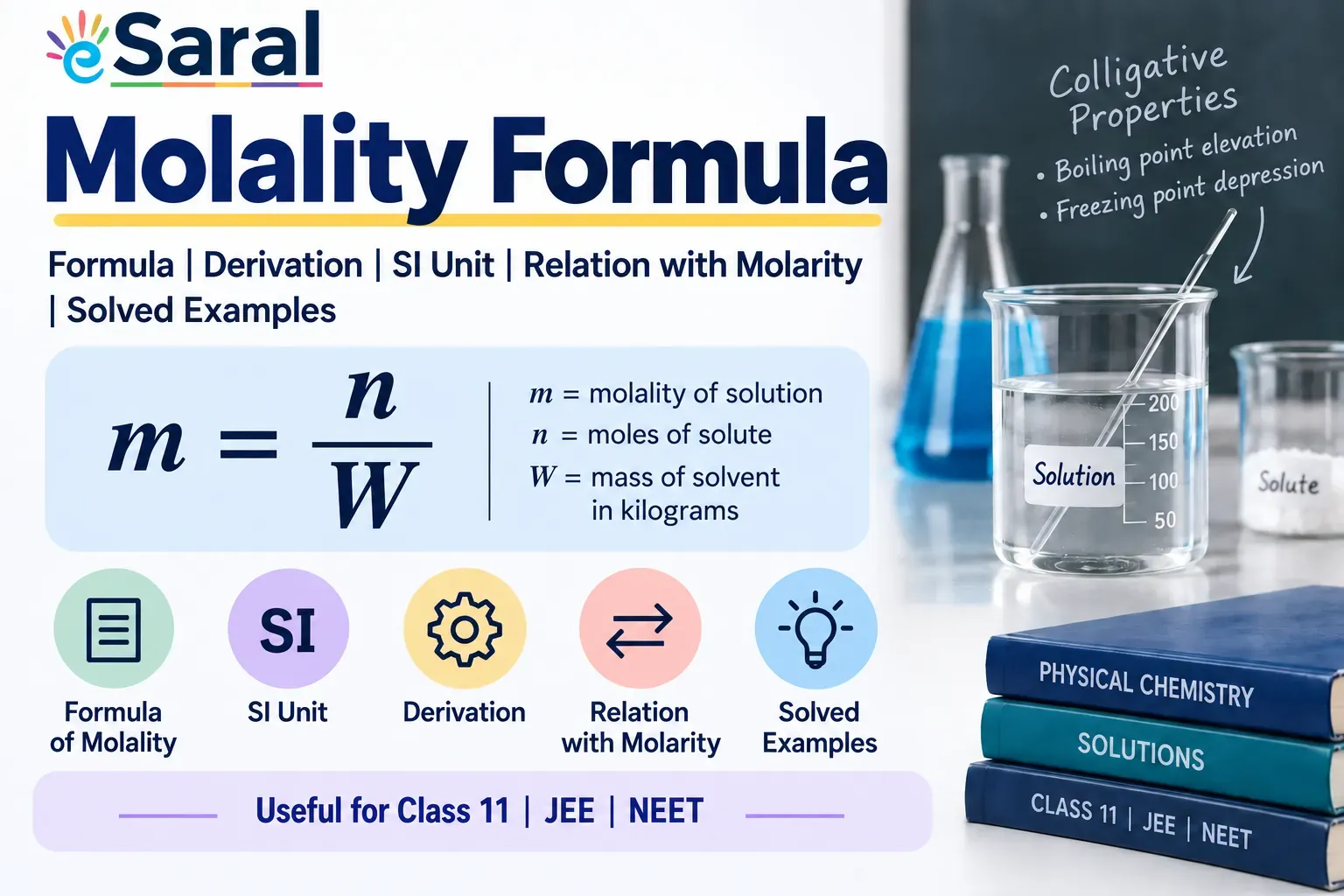
Molality Formula: Formula for Molality, Derivation & Solved Examples
Molality formula is $m = \dfrac{n}{W}$. Learn the formula of molality, its SI unit, derivation, relation with molarity, and solved examples for Class 11, JEE and NEET.
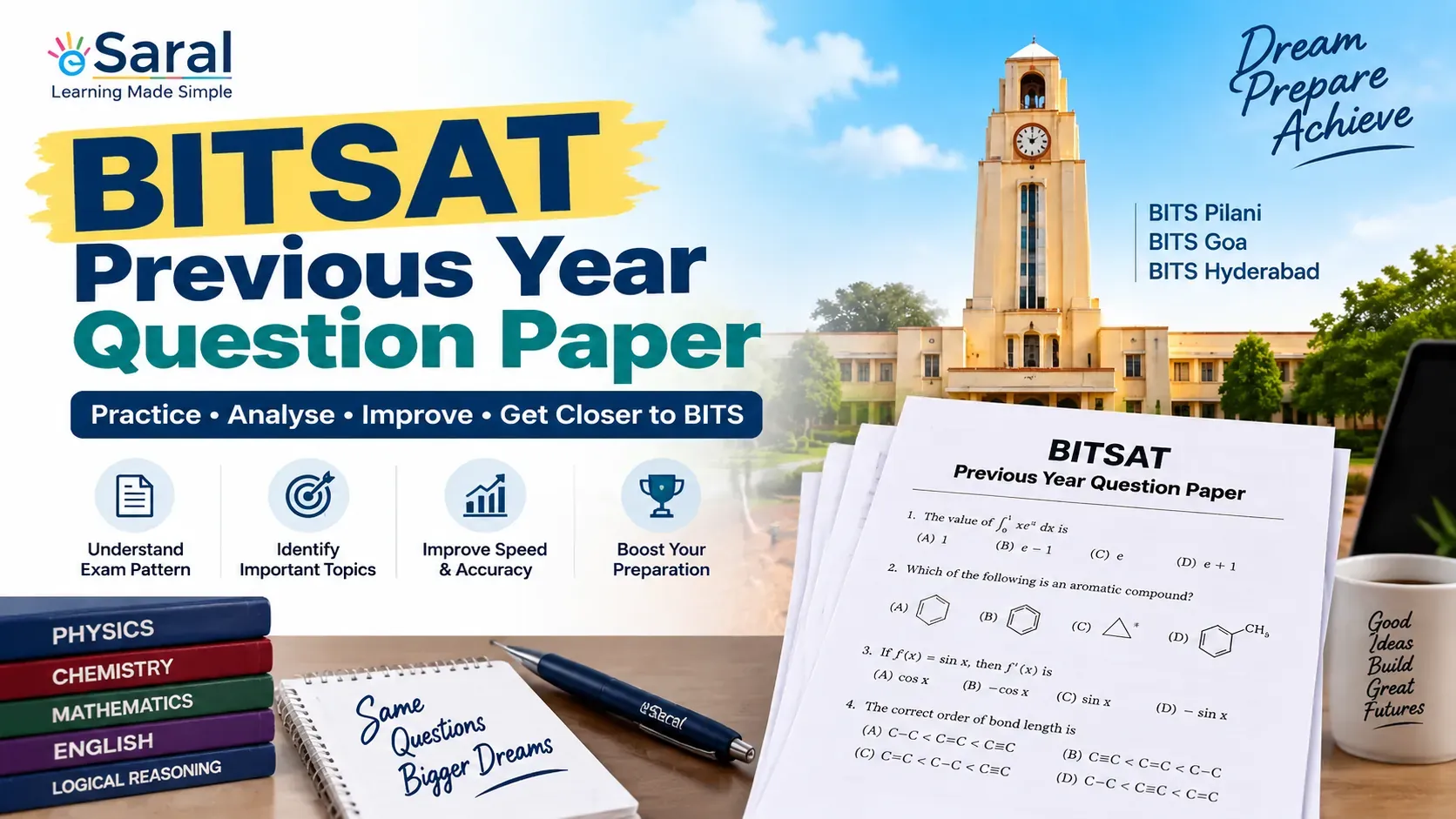
BITSAT Previous Year Question Paper PDF
Download BITSAT previous year question papers PDF. Get year-wise BITSAT PYQs, memory-based papers, exam pattern, and preparation tips to improve your BITSAT preparation.

Teachers’ Day 2026 at eSaral Gurukul: Celebrating the Bond Between Students, Teachers & Mentors
See how Teachers’ Day 2026 was celebrated at eSaral Gurukul, reflecting the bond among students, teachers, and mentors, and the role of guidance beyond academics.
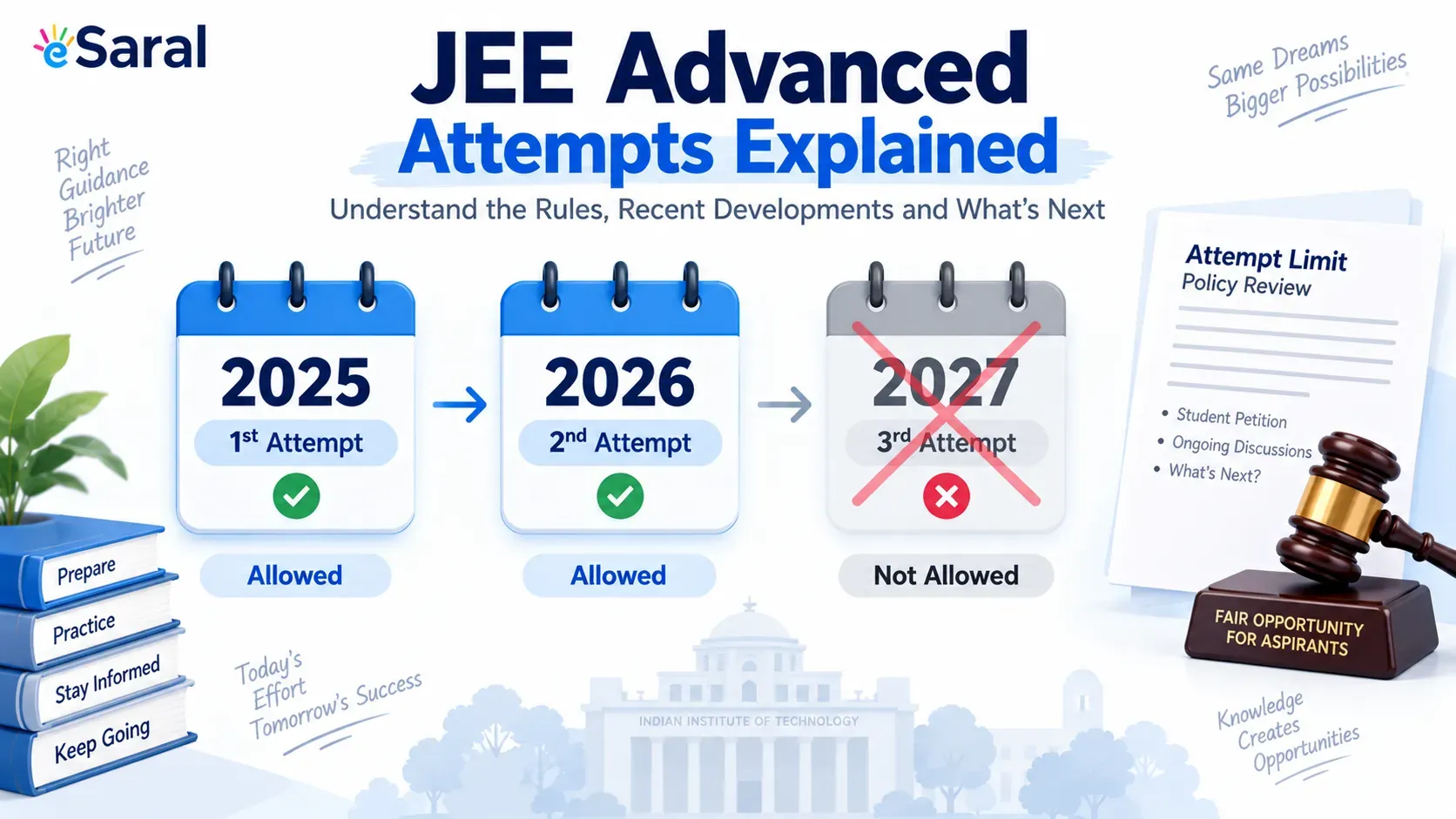
JEE Advanced Attempts: Can You Give It a Third Time? Rules Explained
JEE Advanced attempts: current rule is 2 consecutive years only: full eligibility criteria, the 2025 third-attempt controversy, and the latest 2026 petition news.

Best JEE Preparation App
Best JEE preparation app for Main & Advanced: AI mock tests, live doubt-solving, thousands of practice questions. JEE preparation app for droppers & Class 11-12.
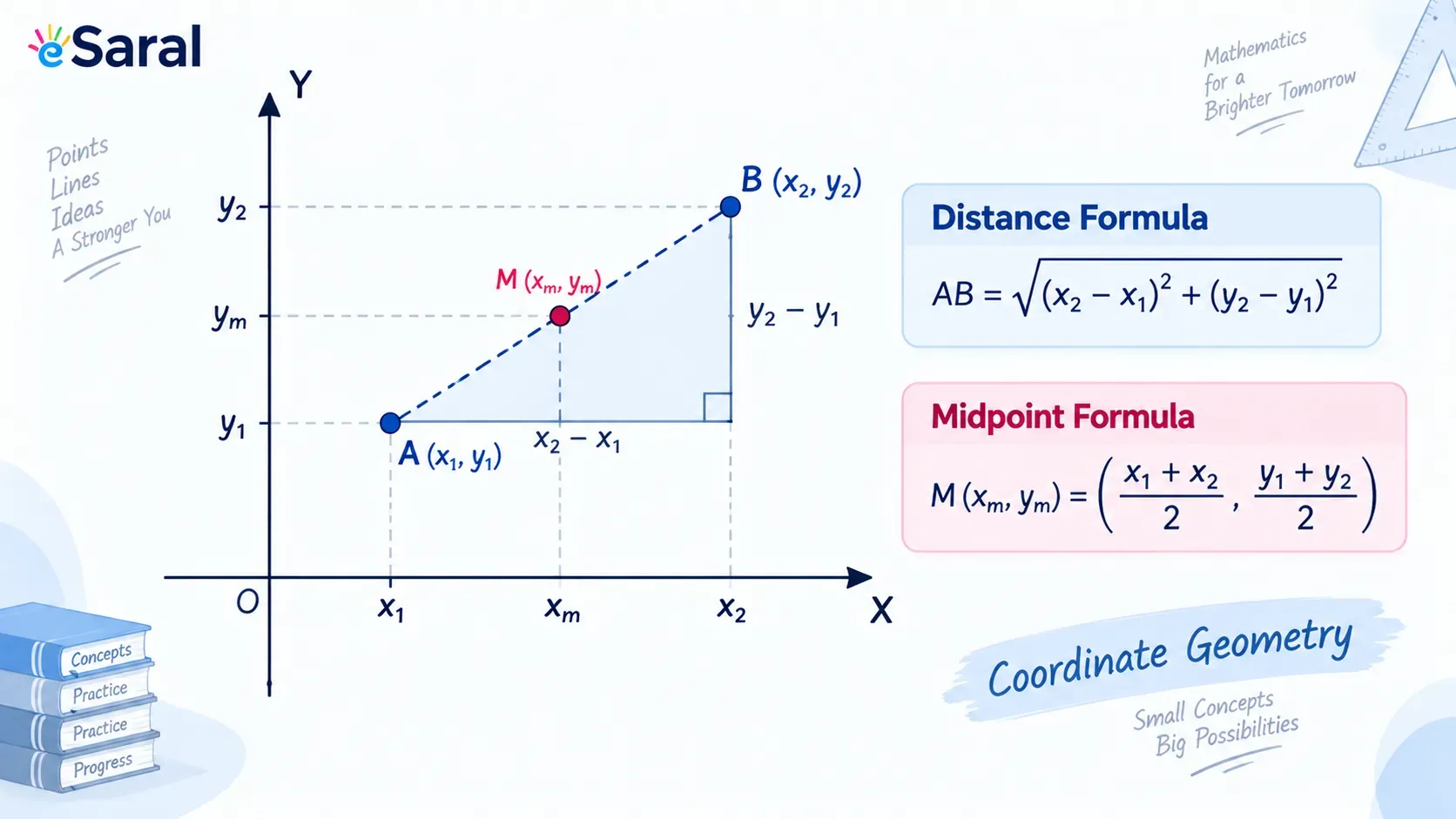
Coordinate Geometry Class 10: Formulas, Notes & Solved Examples
Coordinate geometry class 10: complete CBSE formulas — distance, section, midpoint and area of triangle — with derivation, notes and solved examples.
How to make Notes For JEE Smart Notes Strategy of an AIR 41
Learn how to make notes for JEE the way toppers do — indexing, shorthand, and smart short notes for JEE that cut revision time to just 5–7 days.
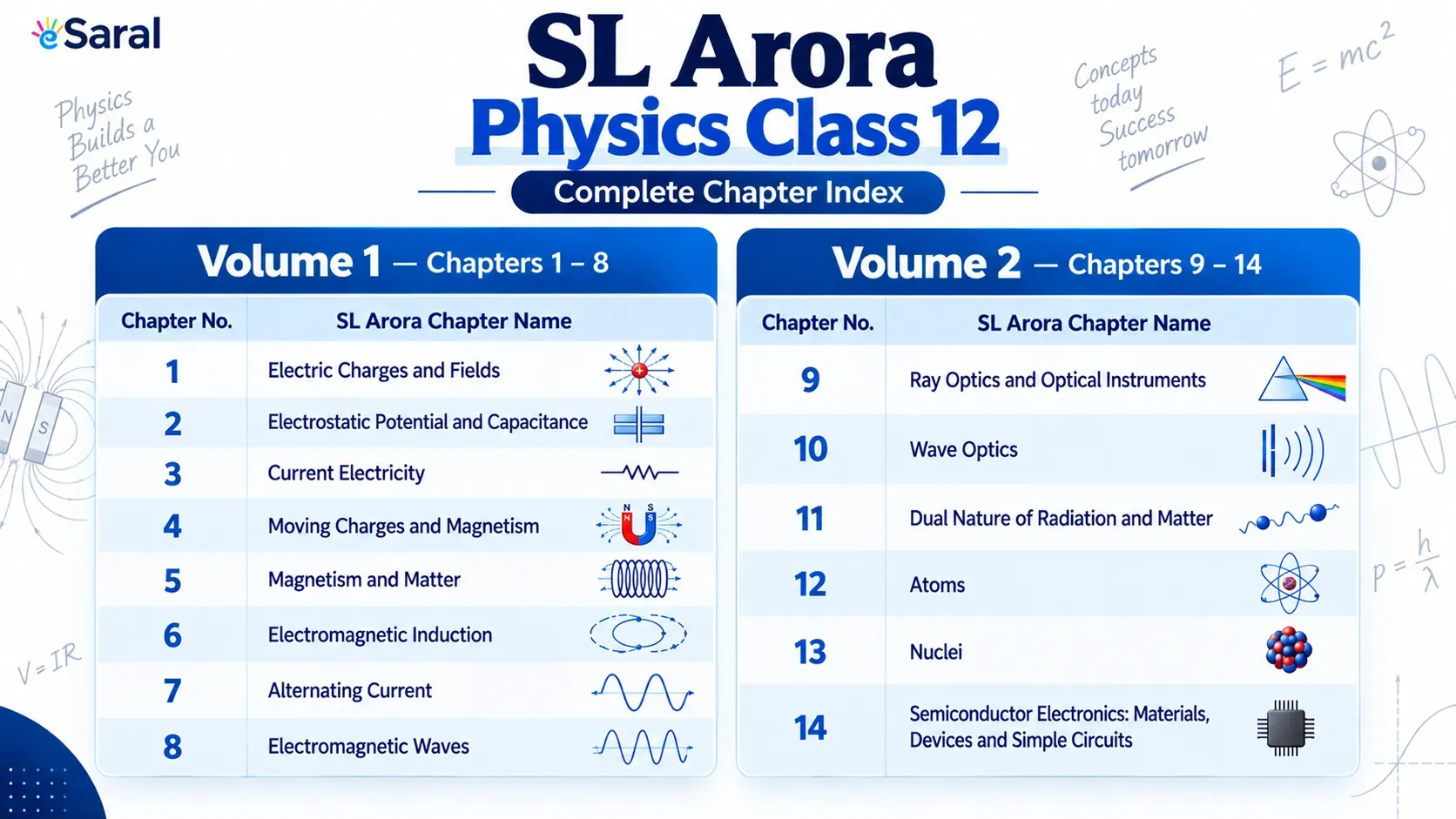
SL Arora Physics Class 12 Index – Chapter List for Volume 1 & 2
SL Arora Physics Class 12 index — complete chapter list for Volume 1 & 2, mapped to NCERT solutions for board, JEE Main, and NEET preparation.